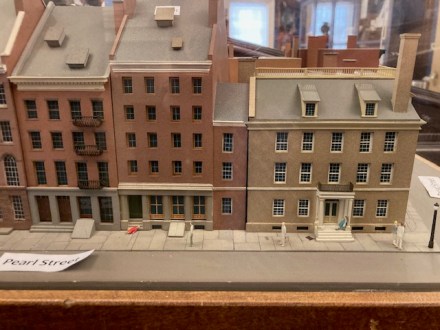
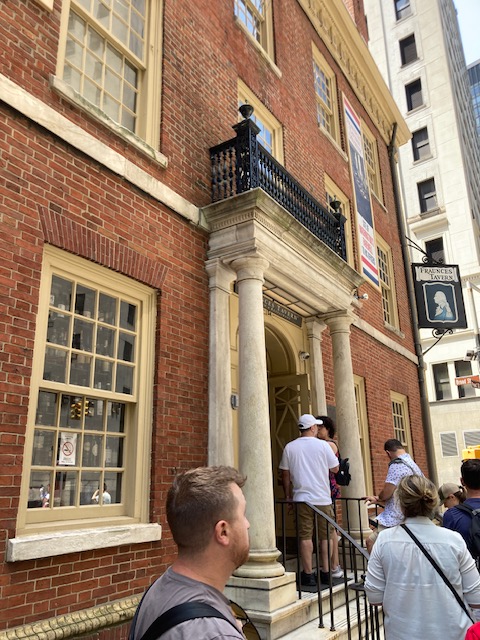
Pam’s Pictorama Post: Yesterday on a whim Kim and I spent the Independence Day holiday in a remarkably patriotic way with a trip to the Fraunces Tavern museum in lower Manhattan. This important Revolutionary War landmark, where George Washington said farewell to his troops, is tucked among towering modern edifices, near the water and Wall Street. Kim just finished Washington Irving’s biography of Washington and it occurred to me that neither of us had ever been before.
The Tavern remains a restaurant and pub (I don’t believe it has operated continuously as there was information about a renovation and restoration at one time in one of the exhibits) and, unsure if it would be the holiday destination for many, I made a lunch reservation in one of the several dining rooms just to be safe. We had a 12:45 reservation which turned out to be about right to see the museum first.
Luckily it was a glorious day and we hopped on a ferry running along the East River and took it all the way to Wall Street from 90th Street, convenient to our Yorkville neighborhood here. July 4 is one of those holidays when Manhattan generally empties out and aside from some tourists, there is a group of us left to our devices here and that was represented by folks who were lined up to take this local ferry to the beach, biking or like activities. The result was a fairly full but not crowded ferry ride. (I became enamored of the ferry system, running up and down the east side, to Queens, Brooklyn and even New Jersey during Covid and have written about my introduction to the longer on to Jersey here .)
It was fun to travel to the museum by water rather than subway, a period appropriate way as the water would have frequently been used for transport in the 18th century. It was also a fraction of travel time – although the wait was longer than for a train and this was exacerbated by the mercurial holiday schedule it seemed to be on.
The museum is just a few blocks from the ferry terminal although Google lead us on a bit of a roundabout merry chase in an attempt to use maps. I think in part the problem is with so many tall buildings that reception is iffy there and the map would not reload properly. Anyway, we arrived as a small parade of folks in period clothes seemed to be wrapping up. (I overhead that they were here from Virginia but I am not sure if I caught the broader reason for their costumed attendance there.)
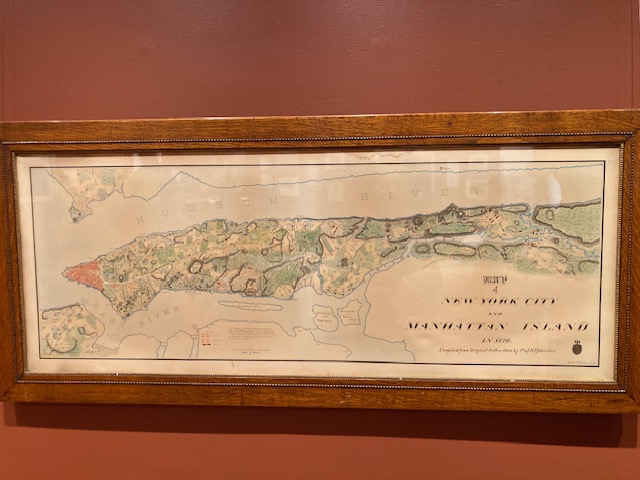
For those of you who don’t know the city, downtown Manhattan is entirely different than the rest of the island. As the area that was first built up, the streets are tiny and narrow. Because it is now the seat of commerce and business, enormous towers have risen and largely block the light from the clutches of tiny, historic buildings. I cannot imagine living or working in the area – it would be like living in an entirely different city. Unlike the rest of the city, lower Manhattan is not on a grid and hence the need for a map to find your way among unfamiliar and twisting streets.
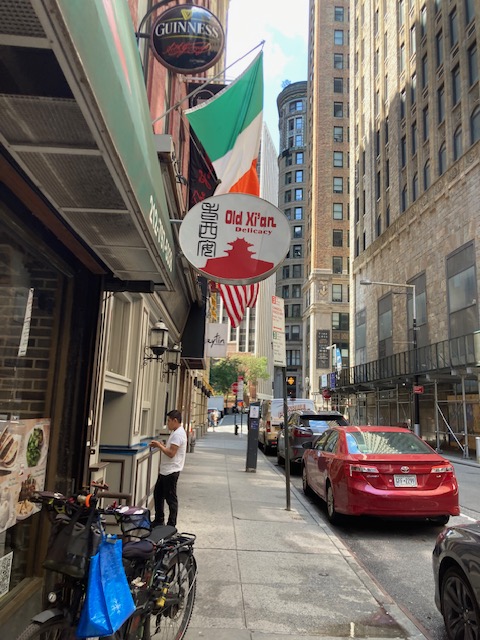
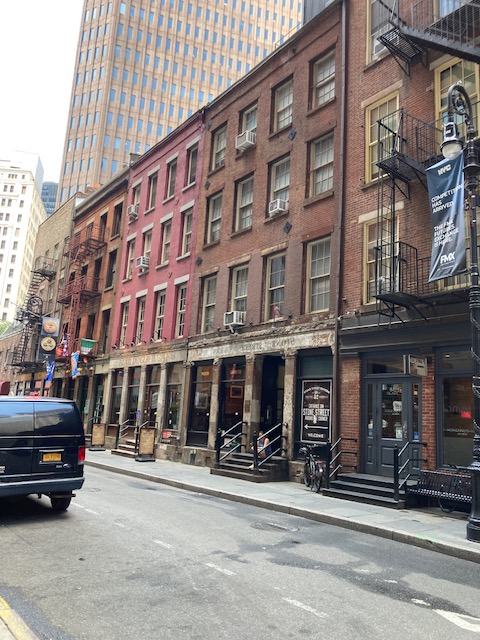
Even for all of that, we arrived early for the noon opening of the museum. There was a line outside but that was really just waiting for it to open – it did not have a persistent line throughout the day although they seemed largely booked for dining.
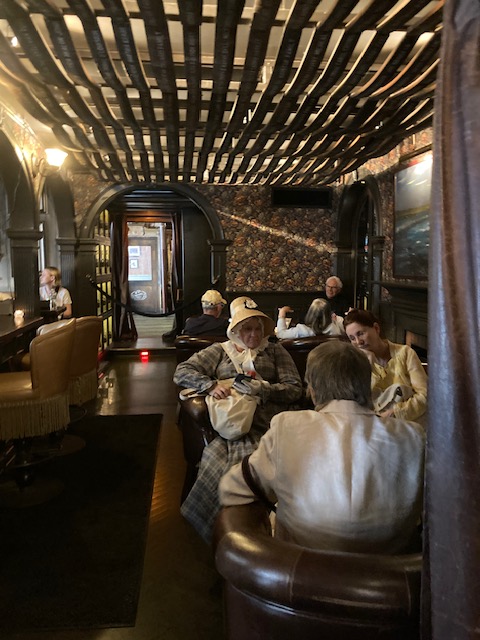
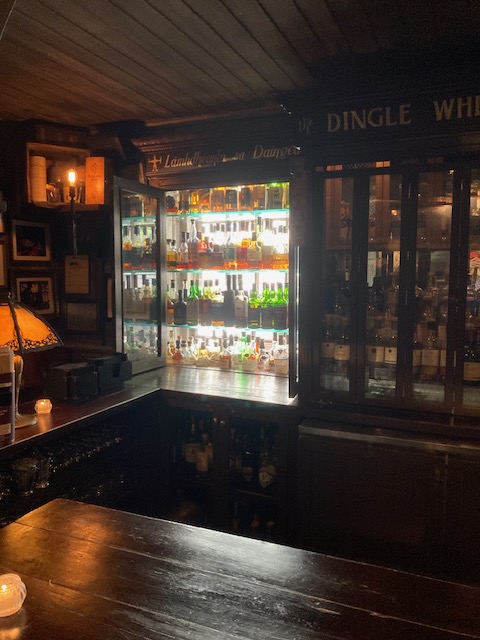
We were herded into one of the bar spaces to wait which gave us a chance to study that room a bit. There are, I believe, six different dining and drinking spaces (although there was a private dining area which may be a seventh – I lost count.) I was unable to figure out if the configuration was based on the original layout – many small rooms being typical of such an early building. There is evidently a piano bar occupying the fourth, top floor, but it was not open and we didn’t get to see it.
The museum commences on the second floor which, in its day, would have also been serving spaces. It is not clear to me that this edifice was anything other than an eatery so perhaps all the floors were dining areas. (It isn’t clear that Mr. Fraunces or subsequent others lived there. It seems that in Washington’s day it was open day and night so my guess is he did live on the premises.) A large room on the second floor is said to be where Washington addressed his troops – it seems too small for that leaving us wondering how that worked. A firsthand account of the event is on display but also written on wall text for easy reading.
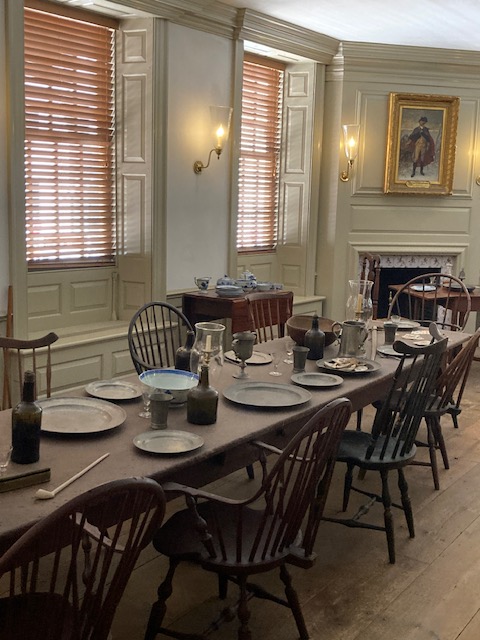
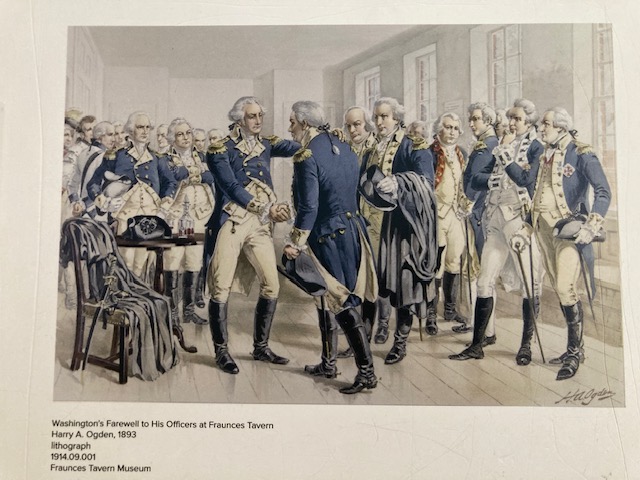
The tavern was also used to house some of the governmental staff during that first Presidential term which was served in New York and not Washington DC. I think it housed foreign relations and another arm of government I have forgotten. There is a small special exhibit about the discussion of the British evacuating New York and the trails that were held for traitors to the American cause.
In culinary history, the restaurant is known as being among the first to have a la carte table services while others still only offered family style meals at large tables. As mentioned above, it was also open 24 hours a day – all making it a bit ground breaking in that sense.
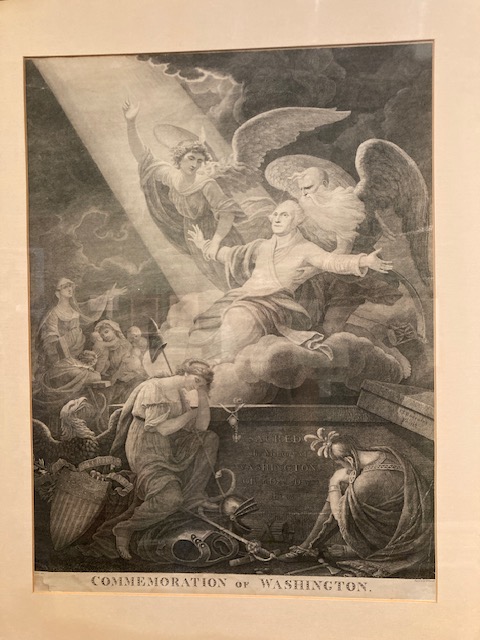
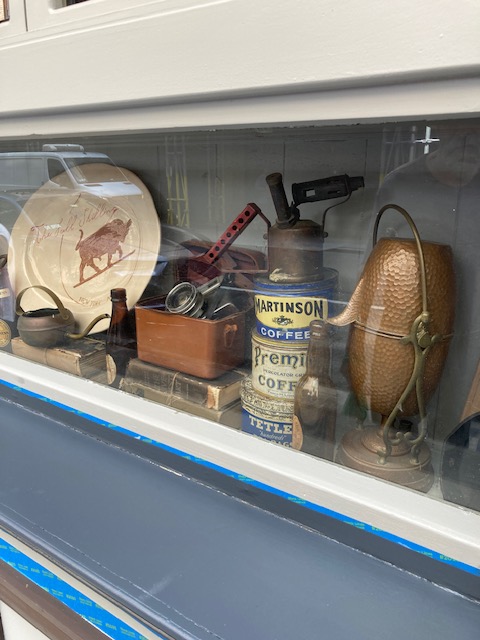
While the second floor has the one period room (also where you pay admission, usually $10 but only $1 yesterday for the holiday, a small shop there as well) and an exhibition space. The third floor are the larger galleries and a room set up auditorium style. (They were actually preparing for a lecture later that afternoon.) The exhibitions are largely reproductions of documents and a smattering of items. The old maps were of interest and some of the letters (the original of Hale’s last letter before he was captured and executed as a spy) are available to be read more easily online with a QR code.
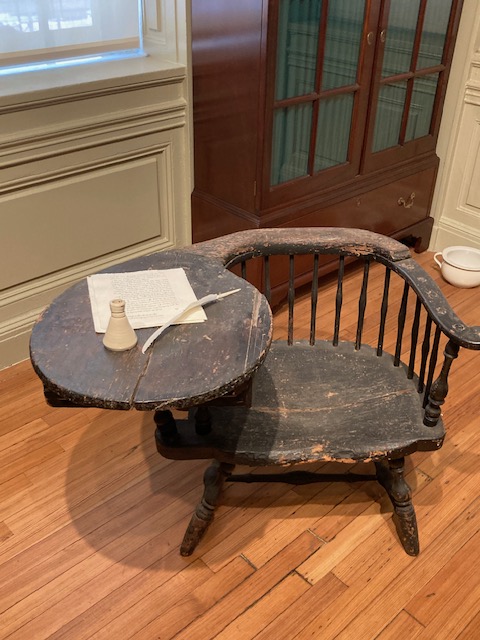
The physical space is a mishmash of period styles and bits. For example, the enormous original plank floors are only in the smallest area with a mix of wooden floors from different periods throughout. Early wallpaper is noted to be from an indeterminant early but later period. Ceilings are low and rooms are intimate – fireplaces in all the original rooms. However obviously the space has been renovated, constructed and reconstructed to make it (somewhat) accessible and work for modern displays.
The displays, as mentioned, are a bit ricky ticky, if you need sophistication you will be disappointed. However, the museum appears to have a robust program of lectures, symposium and especially family activities and while it certainly attracts tourists it is clearly also a part of its community for those who live in the area. (Events around period games, quilts and story time are scheduled for the remainder of July.) I got the feeling that for some folks it is a regular neighborhood hang for food and drink.
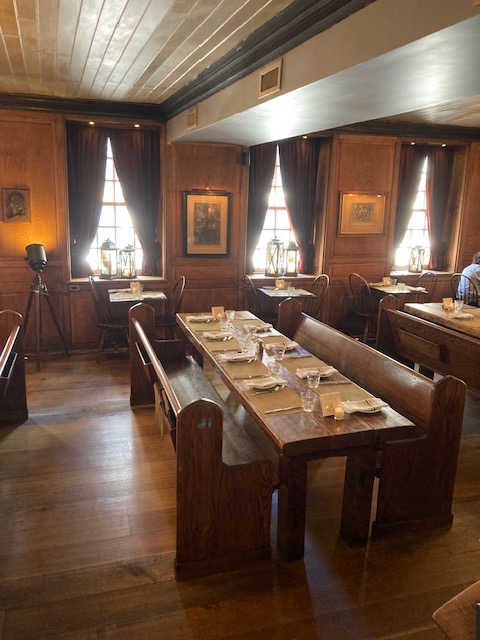
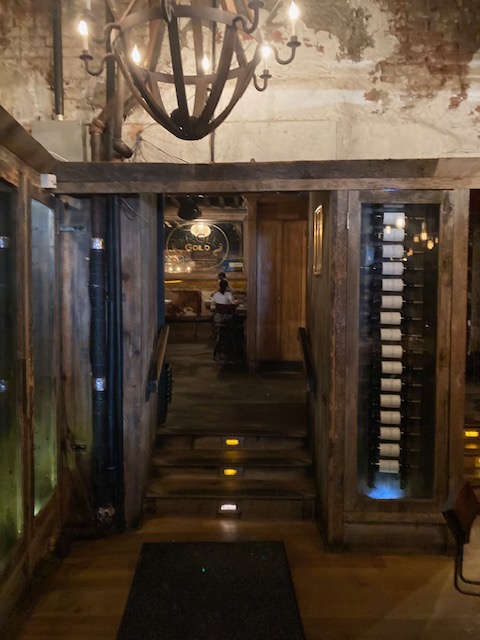
With that I would say the same about the food establishments. There are programs of live music most evenings and at least one of the bars is for walk ins only. I was pleasantly surprised to find that the prices are not touristy gouge-y, but actually quite average for New York City. I made a reservation through Open Table online and we were put in a long bar space in the front of the building. The other large dining room, running along the side of the building, is somewhat more formal.
Incongruously perhaps, soft rock music circa the 1990’s played (loud but not hideously so) in the bar space we occupied for lunch. Kim had a burger and fries and I had a blackened salmon sandwich with sweet potato fries. Kim had one of a number of non-alcohlic beers and I had a large (very good) extremely local Frances Tavern pale ale. While I was very tempted by the idea of a sticky toffee pudding (I generally cannot resist that description) I decided to be good and allow for the possibility of an ice cream later.
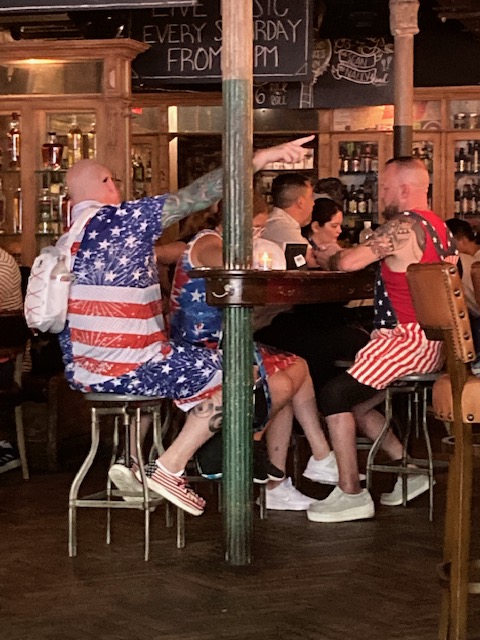
The ice cream never materialized. After leaving Fraunces Tavern we attempted a visit to the nearby Seaport Museum but they had (mysteriously) opted to be closed for the Fourth. Our day ended with ferry mishaps as they decided to run the last ferry earlier than published and police barricades (anticipating crowds along the waterfront for the fireworks which wouldn’t start for many hours) kept us from hopping on the final one. So the day ended on the 4 train speeding uptown and ultimately a happy collapse in air conditioning and with cats as the conclusion to our holiday adventure.
 Pam's Pictorama