Rosa Mulholland: Part One

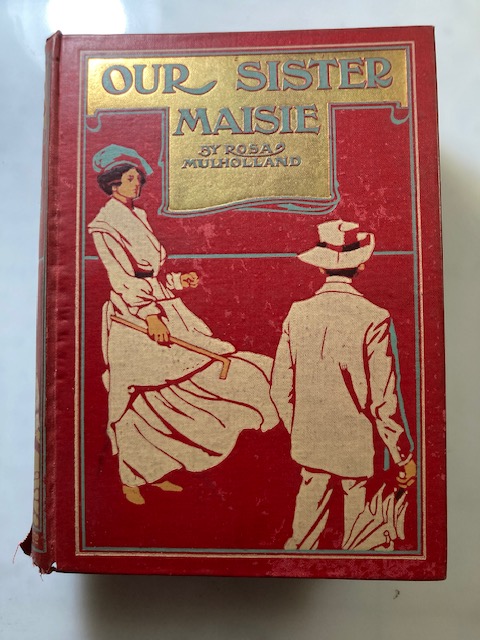
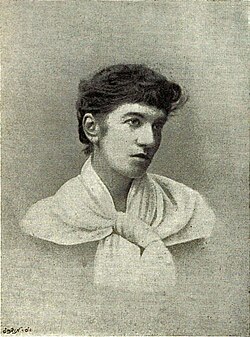
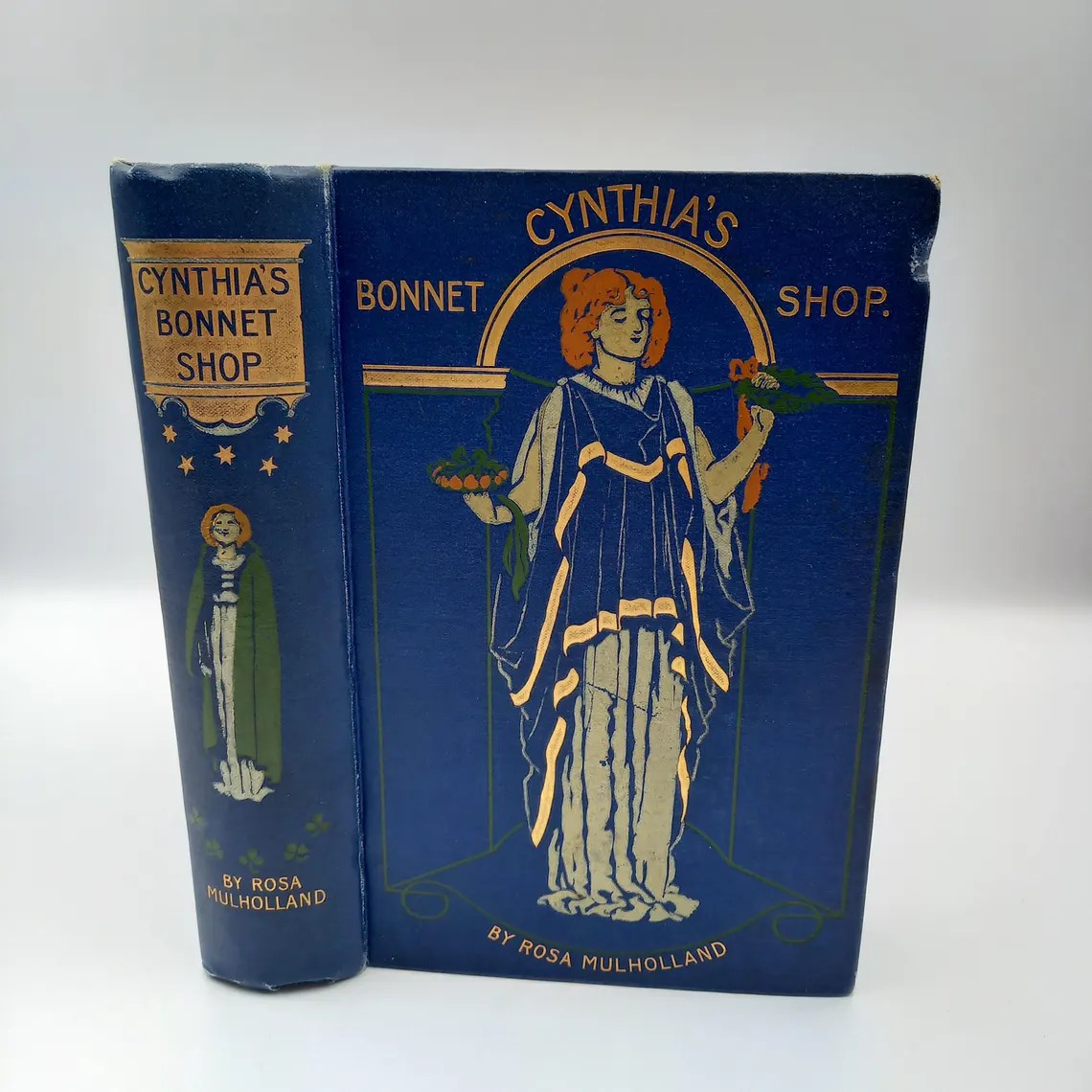
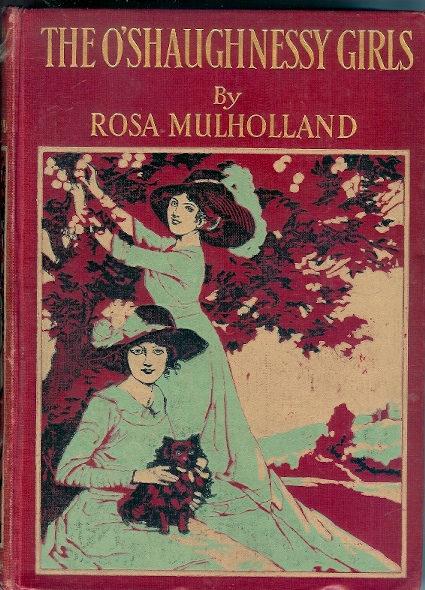
Pam’s Pictorama Post: If yesterday was devoted to a bit of what we’ve been watching here at Deitch Studio, today I will spend some time on what I have been reading. You may remember that as part of a much belated birthday celebration spent wandering around downtown with Kim, I purchased a rather beautifully bound volume by Rosa Mulholland with the intention of reading it. That volume, Our Sister Maisie, turned out to be an interesting sort of a point in her career to stumble onto and, written when she was 66 years old, it seems to have been one of her most popular books.

Volume I purchased as a belated birthday gift to myself in March at The Strand.

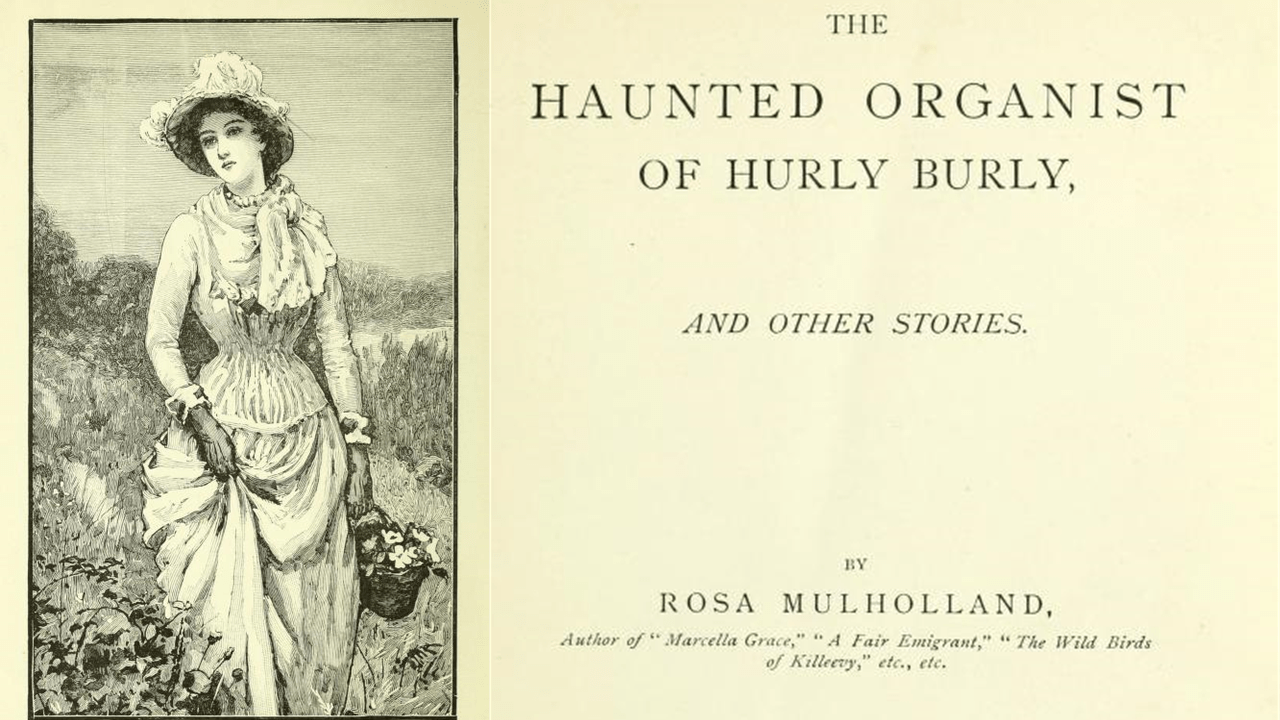
Her biography is interesting when considering her stories which deal a lot with the position of women in terms of money and livelihood at the time which she documents and considers. The daughter of a prominent doctor she came from a fairly well to do Irish family in Dublin. Other she first dabbled in painting (I have seen no evidence of it) she turned her hand to writing early and began trying to get published in her teens, including a novel at 15. One of the most interesting pieces of the tale is that early publication of her work caught the eye of an elderly Charles Dickens who not only encourage her but published her in one of his magazines and in a compilation with one of his own stories.

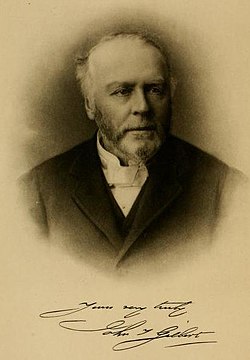
He bet on a good horse. She was very prolific with a list of upward of forty publications, mostly novels, to her credit. She wrote under at least three names I can find, Rosa Mulholland, Rosa Gilbert and very early on, Ruth Murray and seem to have published until a few years before her death and there was a healthy reprinting of her work which continues into the 1940’s. Gilbert is her married name – she married at the age of 50 to a well-known historian, Sir Thomas Gilbert, 12 years her senior. By marriage she therefore became Lady Gilbert.

If any of her writing was used for films I cannot find any evidence of it. I want to say that her books while very popular in Ireland and Great Britain they appear to have been less known here in the US. Really though the only evidence I have of that is that used contemporary copies of her books are mostly available in Britain.
Much like some of the other women authors I have written about previously (for starters, the adult novels of Francis Hodgson Burnett which can be found here, one about Mrs. George de Horne Vaizey here and an earlier one on Edna Ferber here) she is writing about the changing values and culture evolving around women’s emerging role in the late 19th and into the 20th century. Of the above mentioned authors, Francis Hodgson Burnett writes a bit about the other side of the Atlantic and especially the influence of the more forward Americans who visit there – generally very wealthy ones at that. Mrs. George de Horne Vaizey also writes about Britain but is poised a bit later.

A pretty if damaged volume for sale. I am waiting for a less expensive but equally beautiful volume.

Mulholland therefore is a bit unique in her entirely Irish perspective and generally a bit earlier than the women above. She recognizes that there is a problem where women’s only option for survival is the money their family could supply in the form of a life-long bit of capital to earn and be spent down and the marriage they make. Therefore nascent attempts to work among them are plot points – smart and ambitious women (much like herself we have to assume) are trying to break the mold either because they have been left with no money or are a simmering genius whose talent must find an outlet.

For all of that and knowing of her own life she can be a bit hard on these women – perhaps as society at the time was and it was the feeling of the day. I have read three of her books to date and in Our Sister Maisie there is a younger sister who yearns to be an architect – much like the young Mulholland she even has some of her designs used when she is teenager. Against all odds she makes it to architecture school and, although it is a bit unclear, drops out just before completion to marry her wealthy and wonderful heart’s desire.

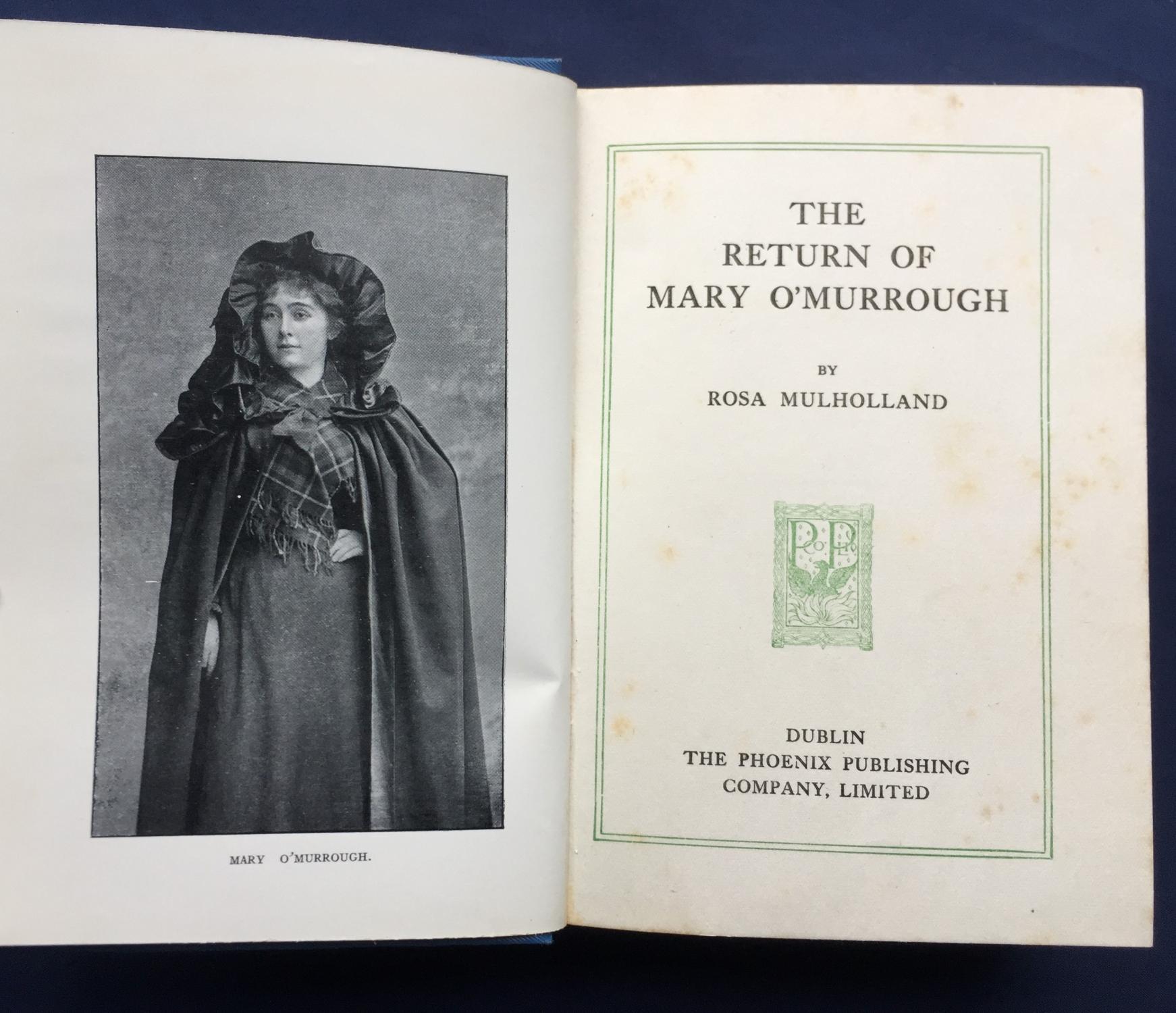
I don’t have this one yet either but great title and nice opening page.

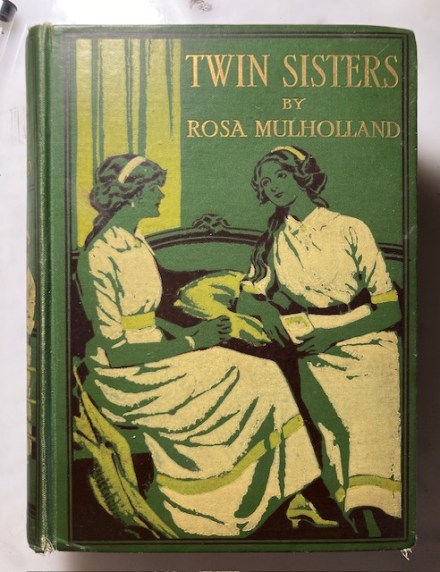
In a later volume, Twin Sisters, An Irish Tale published in 1913 she has a female character who, in charge of her late husband’s estate (it is thought of as her managing it for her son – as if she wasn’t also living off it in the meanwhile) invests aggressively in the stock market and makes but ultimately loses much of the fortune. She is criticized as having had no business trying to do the work of a man. But women like her are frequently left to their own devices and the heroine of the story arrives, along with her twin sister, in Britain from Spain as the wards of a family friend they never met. Penniless, the woman charitably agrees to help launch them into society and make agreeable marriages for them. Our girl Pipa isn’t having it though and takes work in an apple orchard in the country instead. Although she is roundly criticized for this, she is our heroine so needless to say she does the right thing – but of course she will end up with her best mate as well.

I’m also holding out for this illustrated version of this volume.

Mulholland’s books are a bit harder to track down than what I have enjoyed in recent years where there has been aplenty available online and in inexpensive used volumes. Rosa Muholland’s books tend to be beautifully bound, illustrated, volumes that are being sold at a premium because of that and despite the fact that there is not much demand to read them. Why more are not available electronically I cannot quite figure out. Perhaps she is just a bit early for for most people – or if the basis of those collections is based on American libraries and universities she may just not be in the right purview.

Clearly it would be a pity not to read this one in a beautiful illustrated volume like this one as well! Not in my collection – yet!

All this to say that while between the acquisition of physical volumes of her books, I grabbed one of her earlier works online and that was interesting and The Late Miss Hollingford was the story of hers, serialized in a magazine, that caught Dickens’s eye. Her descriptive powers were in greater force in her early writing, although her descriptions of the Irish country and seaside are also wonderful in Our Sister Maisie. The descriptions of the farm this young woman goes to live on are just cozy and great. (Yes, another orphaned girl-woman sent off to live with folks she hardly knows – this time her parents, who she barely knew, died of a fever in India leaving her a sufficient income although in reverse this time she is sent to live with people who don’t have money. The father was the perpetrator of a pyramid scheme and those seemed to be rampant at this time – I know the from the de Vaizey books among others!)

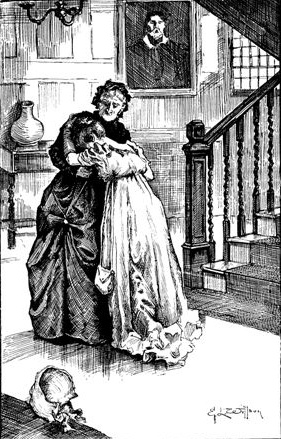
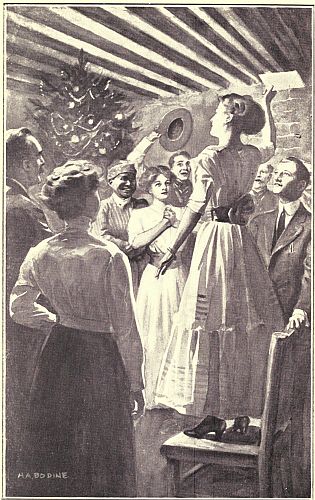
Illustration from the Late Miss Hollingford which I read electronically but with illustrations via Project Gutenberg.

I suspect there will be more to come on Ms. Mulholland and her writing as I am wading into the depths. I also suspect that Abe Books and others can expect to be seeing a whole lot of my pocket change in the near future. Stay tuned.

Reading: de Horne Vaizey Cont.

Pam’s Pictorama Post: I continue to work my way through the available books by Mrs. George (nee Jessie Mansergh) de Horne Vaizey, as chronicled in early parts here and here. I have had a tough time reading with a consistent timeline so I have hopped a bit through her ten year, prolific career and have been spending a lot of time around 1908 and 1909 recently, with a few jumps to near the end of her life in 1917.

There is not a lot of deep biographical information readily available and I sketched out most of it in my second post about her. She had a good for nothing drug addicted husband who had the good grace to die and she starts publishing shortly after. What I didn’t know until recently was that her young daughter, Gwenyth, took one of her stories from a drawer and sent it to a magazine contest without telling her mother. Jessie won and the prize was a cruise where she met George de Horne Vaizey and they marry and meanwhile her career was launched.

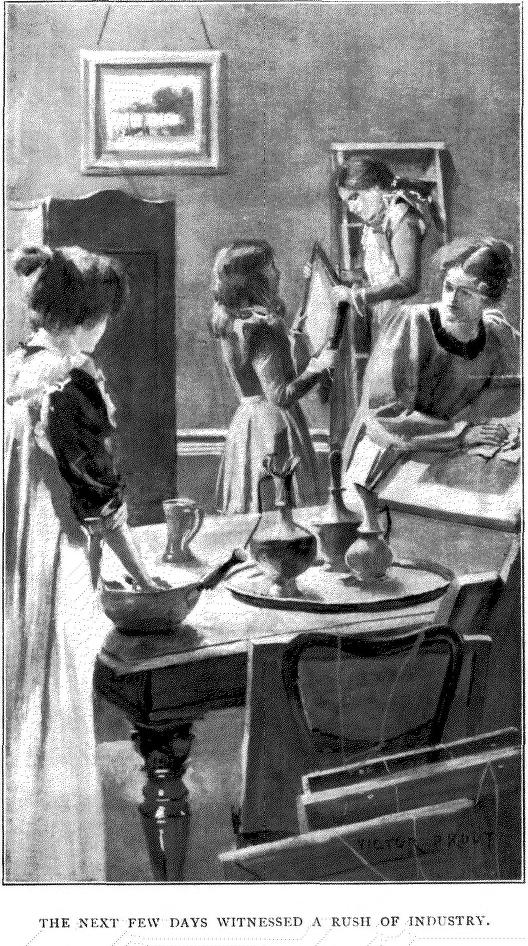
From A Houseful of Girls, 1902.

So the question of what was really lighting a fire under her about writing is an open one – she must have enjoyed it, but was it a financial need? I always thought she wrote for a longer time before remarrying and needed to support her family. Nonetheless, write she does with tremendous output. Wikipedia counts 31 books in the span of her brief career (another site says 33) and I think we have to assume there were magazine stories published as well. (There appears to be a collection of them published either right before or after her death.)

Her books are not especially brief. I would say they average around 300 pages. Reading them electronically it is a bit hard to tell. Sometimes two or even three were published in a given year.

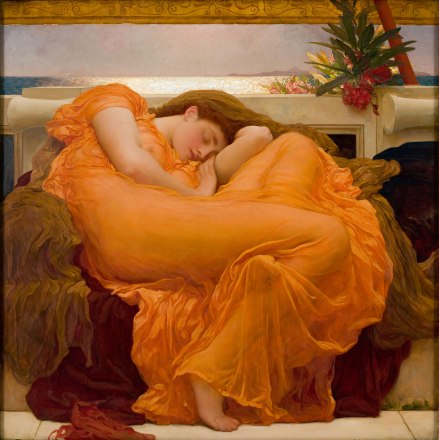
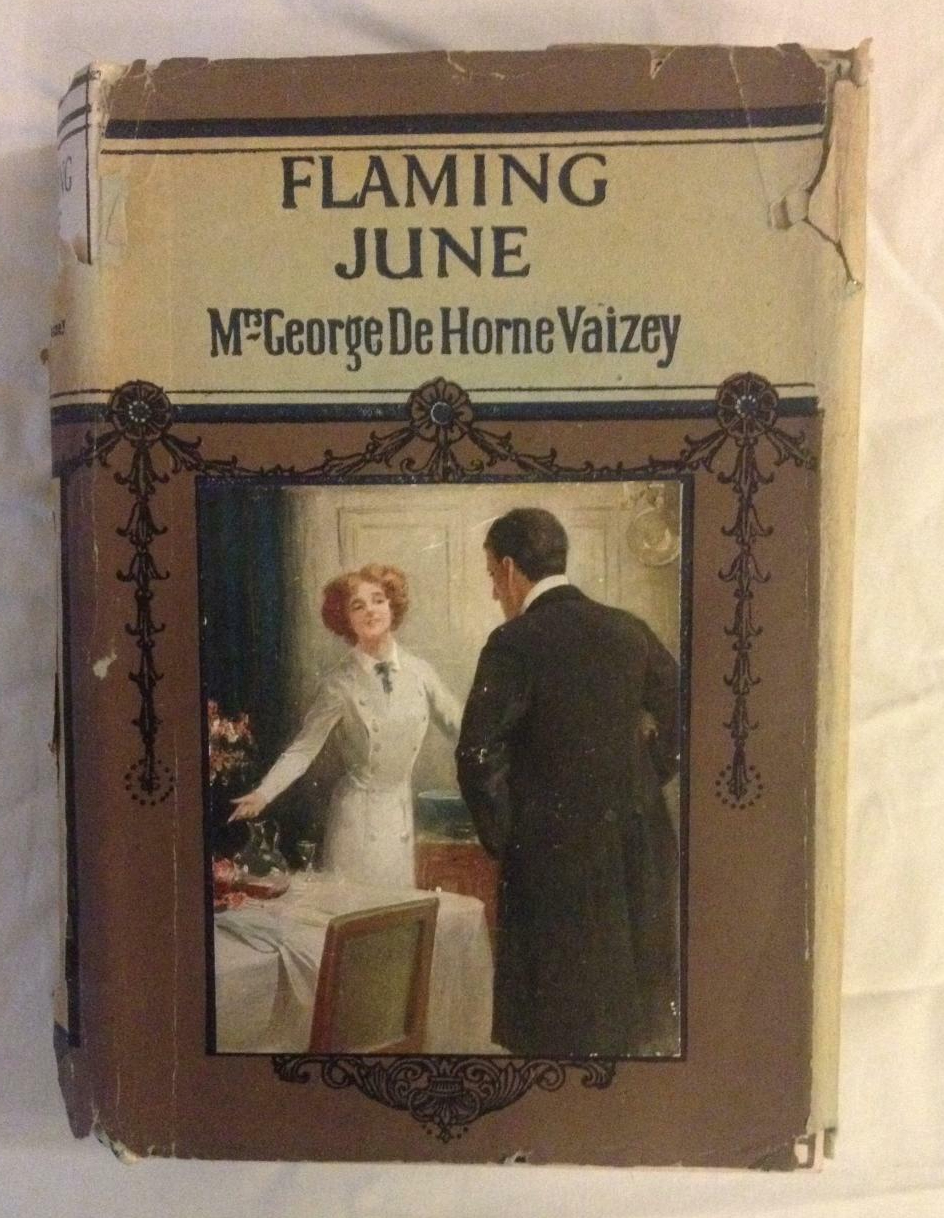
I have been thinking about her heroines as I read and as they grow in interest with her increased skill as a writer. They stop being simply likable (beautiful and loveable – gray eyes, long lashes) fairly early on and start to become more complicated. In Flaming June (note that the painting above is of the same name and was well known at the time – was she making reference to it? Frederic Leighton, 1895 – I say yes!) she has an American main character with a Western accent which, while effective, gets a bit tedious to read after awhile. (She also had a character with a lisp in one volume that started to drive me nuts. It seems to be a fashion for writers of the time to show all the accents they could write with.)

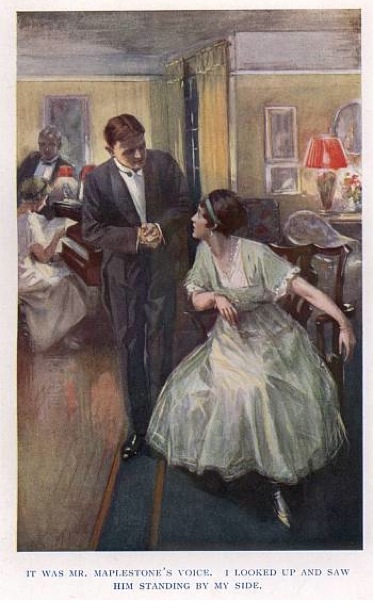
Also from A House Full of Girls.

However, over time her women grow into complex characters who are sometimes more interesting than likeable. For example, the woman in Flaming June is hot tempered and extremely independent. Much of the plot, and what happens to her both good and bad, centers on this quality as well as her stubbornness. It makes the story tick and, without being a spoiler I will say, gives it a somewhat quixotic ending.

In addition to greater character development her plots become more interesting and she leaves off the basic sort of worn tropes about school days and money acquired, lost and acquired again which were the bread and butter of her early writing and certainly for women authors of the day. A young woman of middling income decides to take a basement flat in the city and dress as a much older woman so that she will be free to help people in a way that an attractive young woman could not. (The eponymous volume is The Lady of the Basement Flat, 1917.) The story is worked however so that she also has a life at a country house where she is herself – of course the two weave together at some point. However, what a concept!

From Etheldreda the Ready, which I am currently reading, 1910. Definitely not one of her more likeable heroines! Etheldreda is utterly self-oriented and conceited, thus far anyway!

In What a Man Wills she takes a sort of well trod narrative path with a wealthy, ill, elderly man who invites four nieces and nephews for a long visit to decide who will be his heir. While, again without being a spoiler, I would say she doesn’t manage an entirely new take on it, she does well with expanding it and again, not afraid to make one of her main characters flawed.

Her women, even her heroines, can fall victim to vanity and greed, if not quite all the way to ambition. (She does poke fun at women authors occasionally with a sort of self-deprecation.) They are often a bit forward for the time and space they live in – especially those who reside in or come to find themselves in small rural towns. Financial ruin comes to people and families on a routine basis, but with a sort of detail that makes you think that for those who lived on investment income they way many people did at the time, that this was a very real event.

Her characters opine on the limited options for women – that they are not trained for anything to prepare them for life or possible ways to make a living. Therefore their fortunes hang largely on their ability to marry well – or remain dependent on a male relative or someone else to settle money on them. In the end this depends on how attractive they are and can make themselves and some of the more forward characters have a real struggle with this very real problem.

From The Lady of the Basement Flat – sadly I don’t have one of her dress as the elderly version of herself!

Frankly, the male characters tend to be a bit more one dimensional; she came from a large family and almost all of her characters do. Therefore, there are always a few brothers for color and plot development and of course there are suitors, and although we are privy to fewer of their thoughts and motivations, they are generally not fleshed out like the women are having they were often an end goal which offered security and a home in addition to whatever romantic interest was brought to the table.

The closest we come to the male prospective in the somewhat brilliant novel, An Unknown Lover. This is a complicated plot and while there is a woman at the center of it, we do get into the heads of both her epistolatory lover and brother and their motivations which help drive this story. Thus far I would say this is her best, published in ’13 so she is flexing her muscles, but not yet at the end of her life.

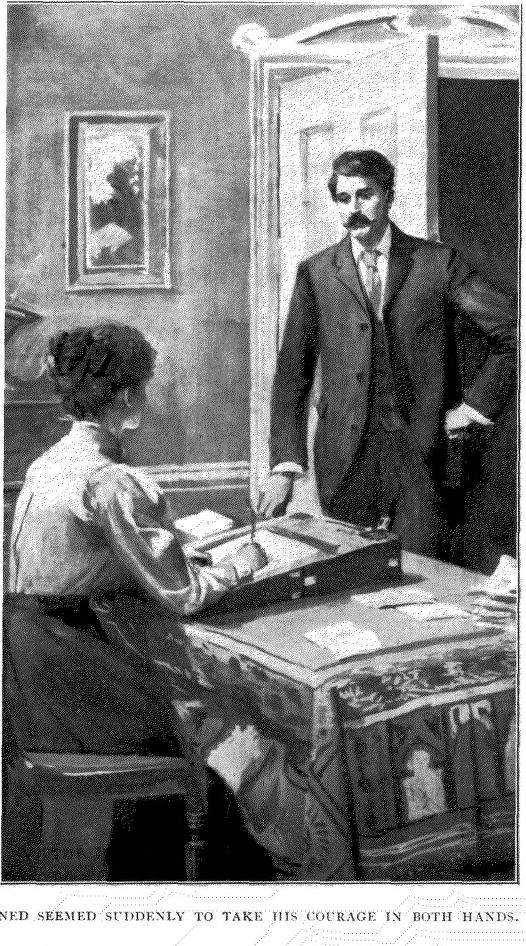
From Daugther of a Genius, 1903. A ner’do well father dies leaving his children to rely on their wits and creativity to make their way.

So my interest in women authors at the turn of the last century continues unabated. Watching them chafe at the conventions that defined their lives and dictated how they could live – sometimes these very conventions sentencing them to penury without a way to survive. It has been interesting to place her historically before some of my other beloved authors such as the adult novels of Frances Hodgson Burnett and Edna Ferber (a few of those posts are here and here, but there are others!) but interesting to add her to the timeline. Also, the play between the British authors and the American is interesting as women in the United States seem to have been freer to pursue a living more broadly than their British counterparts earlier on – and the conventions of our society a smidge less confining.

As stated in my earlier posts, Jessie de Horne Vaizey spends the last years of her life bedridden and dies in 1917. I learned recently however that it was first typhoid, then eventually arthritis which confined her to bed and she died unexpectedly during an operation for an appendicitis – so what made her an invalid is not what killed her. She does some of her characters painful rheumatic complaints, usually elderly men, but clearly she knew what she wrote of – and as someone who suffers from it myself, I can only imagine the kind of pain she must have had without the meds of today to help alleviate them. There are also many plot instances of long recoveries from illness, not unlike her typhoid I assume. She was my age when she died, but she made the most of her almost two decades as an author.

Part 2: Mrs. George de Horne Vaizey Cont.

Pam’s Pictorama Post: Apologies in advance for anyone who was peevish that yesterday was a book-ish post as I am going to wrap up (at least for now) my thoughts on Mrs. George de Horne Vaizey today as she continues to be my reading material of choice. (Yesterday’s post is here.)

I will confess I went for a long fallow period of not reading much and just one off books here and there when I was. Kim powers through all sorts of long and short term reading projects, both for his own edification and for things related to work, so I am jealous when I am without one too. However, I am there with the best when I find a rabbit hole to go down and therefore here we are today.

From Wikipedia and the only image of her I can find.

Mrs. G de HV as I like to call her, is fading from consciousness and seems to have barely been rescued for the digital age. If we are to look at the remaining availability of her published volumes, we have to assume that the Pixie books I wrote about yesterday were among her most popular, with a few other titles that seem to stand out. She wrote upwards of 32 books (I say upwards because Wikipedia does not always have every book published by an author although they do a good job of it) and clearly there were short stories. There is a collection of them mentioned as published in 1918. The list of her publications runs from 1897 to 1918, ending with that collection of stories. However, if I really want to read the widest swath of her work I will need to dig some. I would say about half is available online or for sale as antique volumes or occasional reprint.

From “Tom and Some Other Girls”, 1901.

Born Jessie Bell in 1857 as one in a melee of seven children (four brothers, two sisters) she was the daughter of a Scottish insurance broker. Her place of birth was Liverpool. She first married Henry Mansergh, a cotton broker, and published her first volumes under the name Jessie Mansergh. They had a daughter, Gwyneth Alice, in 1886. Mansergh was an addict which seems to have contributed to his early death. Reading between the lines so to speak, one wonders what part her early writing played in supporting them.

While I was certain that hers was a pen name of a type that was often adopted at the time, I learned that no, her second husband was indeed George de Horne Vaizey. She meets him while on a cruise which was a prize awarded for one of her short stories. They marry in ’98 and have a son, also named George, who goes on to be a writer. Sadly her own life ends as an invalid, confined to bed for many years. She dies in 1917 at about age 60 (her precise date of birth unknown) and therefore the final volume is posthumous.

From “A College Girl”, 1914.

Jessie uses her own life as whole cloth for her fiction. Large dynamic families, addiction, illness abound in her pages. Therefore, I have to assume that her evolving views on marriage and the relationships between men and women was also explored on her pages. If you’ve followed my previous musings on women writings of the early 20th century, you know that I found that even the juveniles such as The Radio Girls and Automobile Girls were gently ever pushing the line forward for what was permissible and acceptable for young women. (Some posts on those books here and here.)

Interesting to find Mrs. G de HV who is a bit earlier still than those authors and for me a logical forerunner of some. The line for women, the options they had in society for supporting themselves, is still more nascent although shifting all the time. An ongoing theme she explores is the unmarried middle class woman and her lack of options. I’ve already encountered several books where due to various circumstances the heroine is in some way prohibited or unable to marry and is faced with the issue of how to live their lives, preferably not just dependent on family. She seems to walk a narrow line – clearly a woman married to a man of means is the safest port in the storm.

She also confronts the daily reality of marriage – the idea that you are joining up with a mate who you will continue to make conversation with daily for decades. (I have often said that knowing that I would never be bored talking to Kim helped ensure a good union for us!) The sheer difficulty and exhaustion of running a house and caring for a family.

From “Lady of the Basement Flat”, 1917.

I am going to skip forward to An Unknown Lover, a novel published in 1913. (Some spoiler alerts ahead for those who care.) The author sets herself some unusual tasks. We have a heroine, Katrine, in her late twenties who has spent most of the last decade caring for her older brother who was widowed shortly after marrying. There are rarely effective parents in her books – adult children have either lost them or they are on the sidelines for some reason. I can’t even remember why they weren’t present to stop this hot mess of a situation – dead and forgotten in this case.

Anyway, both characters are beginning to chafe at the situation. The heroine opines on having all the responsibilities of housekeeping without the partnership of a true mate. She is also painfully aware that she is dependent on her brother for her keep, which comes to a hard point when he decides to remarry. She has no marketable skills and living in a small hamlet no prospects of marriage which is more or less what she is trained for. As a literary challenge, our author has placed an epistolary relationship through part of the book, which moves the storyline along. At first it seemed a bit awkward, but it grew on me. Despite some flaws and maybe questionable decisions, it is to date my favorite of her novels.

Love this title and looking forward to this one. Published in 1908.

De Horne Vaizey has beloved tropes – I’ve noted before a preponderance of gray eyed heroines, some have golden eyes as an alternative. An odd one seems to be a fondness for shipwrecks – I believe I may be up to three in her oeuvre to date. An interesting tidbit, while researching this post I came across the following in an Internet Archive version of An Unknown Lover which actually photographs the pages of a hard copy of the novel and included this forward below:

AUTHOR’S NOTE

Lest I should be credited with making literary material out of a disaster still painfully fresh in the minds of readers on both sides of the Atlantic, I should like to record the following rather striking coincidence.

On the fourteenth of April last, I was engaged in writing the description of the collision at sea in which the heroine of the present book plays a part; and after some deliberation as to the most forceful word to employ, wrote the sentence which originally ran as follows: —

”Mercifully it is not one person in many thousands who is called upon to endure so titanic an experience. …”

A few hours later my husband returned home and told me of the news which had that day thrilled the world — the foundering of the steamship Titanic on her maiden voyage.

Many weeks passed by before I could bring myself to continue the narrative.

Hampstead.

Jessie de Horne Vaizey.

Somehow she pulls out two parallel love stories and details the personal growth of Katrine as she makes some rather bold leaps forward to attain a measure of happiness and independence, gently breaking with at least some of society’s conventions.

Sadly Jessie de Horn Vaizey doesn’t live quite long enough to see the shift which occurs even in the early 20’s for women. At six or so volumes I have barely scratched the surface and if it is interesting enough I promise more to come.

Red Cross Girls!

Pam’s Pictorama Post: I think I will always look back on this year and a half (heading into two year) period as my plucky young woman literary fiesta. It probably isn’t a coincidence that this, difficult period of time has made these stories of achievement under great duress appealing. Working my way through the work of author Margaret Vandercook in particular has been wonderful and these books have contributed to a longer reading project which builds on the changing role of women during the first part of the 20th century. Nursing on the front lines during the war, even driving ambulances there, was an enormous departure for young American women and according to these books they also lead the way for young European women to do the same.

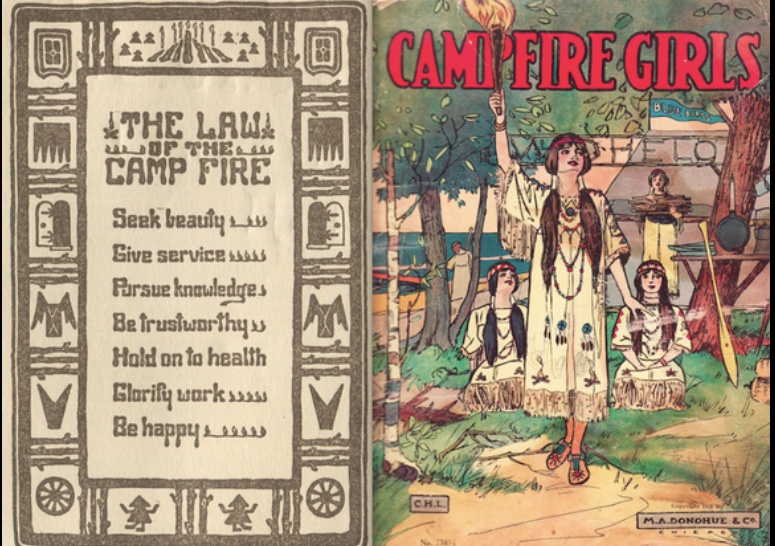
As long-standing readers know, I started my journey with Margaret Vandercook via her many volumes of Camp Fire Girls books, took on the somewhat more raucous Ranch Girls next and am now investigating and celebrating the ten volumes devoted to the Red Cross Girls. (Some of those prior posts can be found here, here and here.)

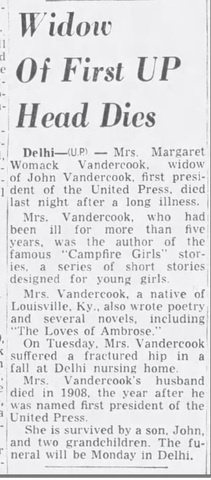
I came across an obit for Marjorie Vandercook clipped from an unknown, undated source – very little information seems to survive on her and this is the first obit I stumbled onto. It doesn’t supply much information, but I include it here for anyone else who might find it of interest. Of course they lead with her husband’s accomplishments and barely touch on her own contribution!

My first question was, did young women really do this? I mean did young women volunteer and head out to Europe to work with the Red Cross? Seems a bit crazy and it’s a bit hard to say. Obviously Red Cross nurses served in Europe during WWI, about 300 lost their lives working on the front lines. It isn’t clear what qualifications were expect however and if young women who had “a nursing course” or even less experience actually went over such as our heroines did, is hard to track down. Nurses, it seems for the most part, were from working class or rural backgrounds although some were indeed from affluent families, a mix like we have in volume one. So let’s assume that the role of our heroines is relatively realistic for starters.

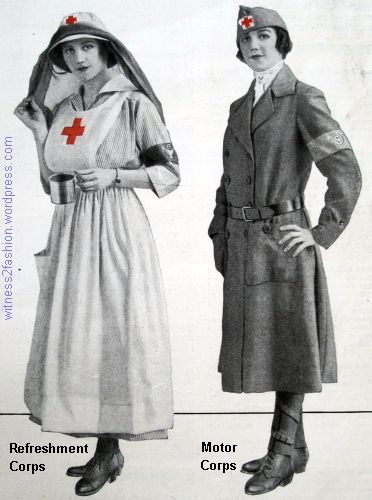
Via witness2fashion.com as noted above.

Certainly the war that was being described was more or less torn from the headlines of the day since these books were published starting in 1915. Four women start out from New York City on a ship heading to Europe. Their first adventures and a few plot points that will reach several volumes occur onboard ship before making landing in Britain which is their first stop before nursing wounded British soldiers in France. (Vandercook must have had several of these books outlined to some degree, dropping in opportunities to come back and layer on plot in future volumes.)

I wondered how Vandercook would handle the sheer horror of nursing on the front lines with the sort of story line she generally develops and I report that she does an admirable job of it. Admirably, somehow she neither downplays the dangers and horrors of war, nor does she dwell too much on the gore. Of course the tales of valor are overblown, but after all these are fictional volumes for younger readers.

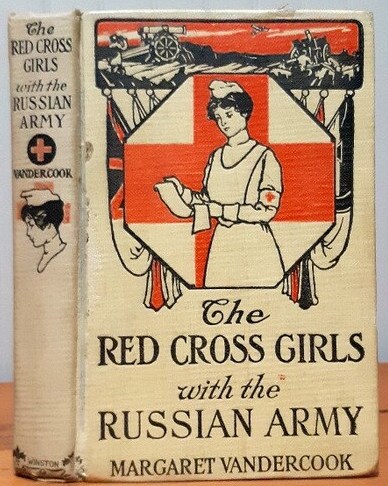
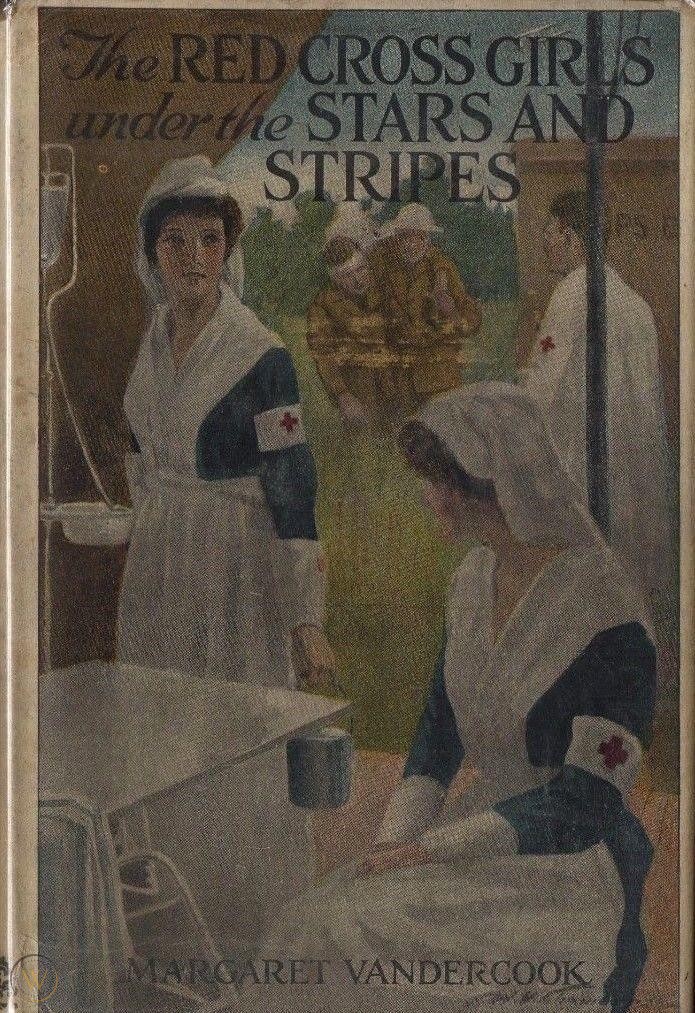
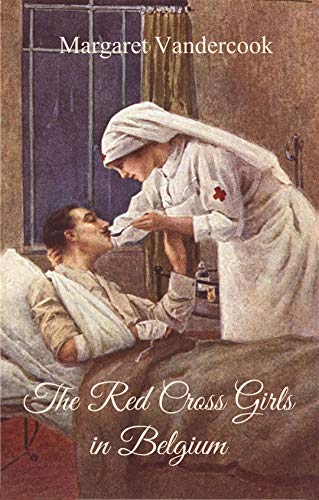
Dust jacket from volume 3.

Plucky indeed these young women are too. While the Campfire Girls had an interesting creed and much ceremony, the Ranch Girls just had a sense of the wild west where they had their origin. The Red Cross girls fall somewhere in the middle – there is a code for behavior and there are references to their need, like soldiers, to follow orders and fall in with the greater good for the whole. It would seem there is a creed – whether it had a basis in reality or not I cannot really say, but I would imagine that the spirit was there at a minimum although it isn’t as codified, nor as lore filled, as that of The Campfire Girls.

It is interesting to be reminded that the Red Cross nurses and doctors were of course technically neutral by definition. The United States would not enter the war until 1917 and the ethos of the Red Cross was (is) apolitical. However, these were stories going out to an American readership and the clear lines of sympathy for the British and French soldiers and a fear of the Germans is evident.

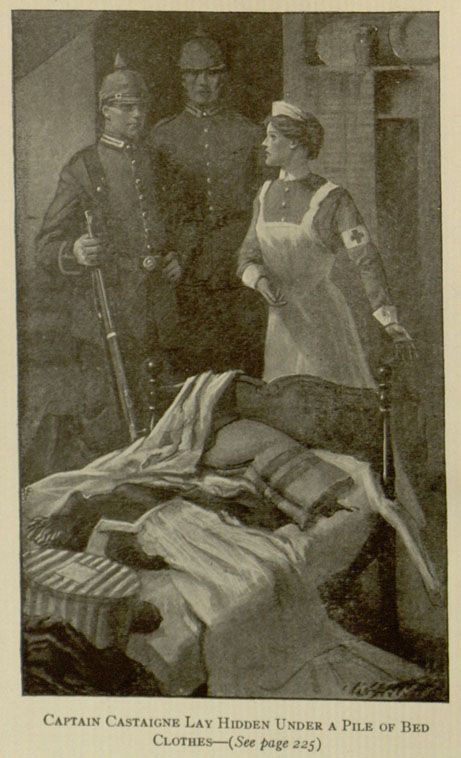
Illustration also from volume 3.

As of the volume I am currently finishing – The Red Cross Girls with the Italian Army – the fifth and published in May of 1918, there is no mention of the influenza epidemic which would certainly take headlines later that year although I assume will find its way into subsequent volumes. The first four volumes form a story arc and the fifth, harder to obtain as an e-book, seems to mostly to be tying up some loose ends and perhaps planting some new plots for the remaining second half of the series. The United States will be entering the war soon, presumably in the next volume.

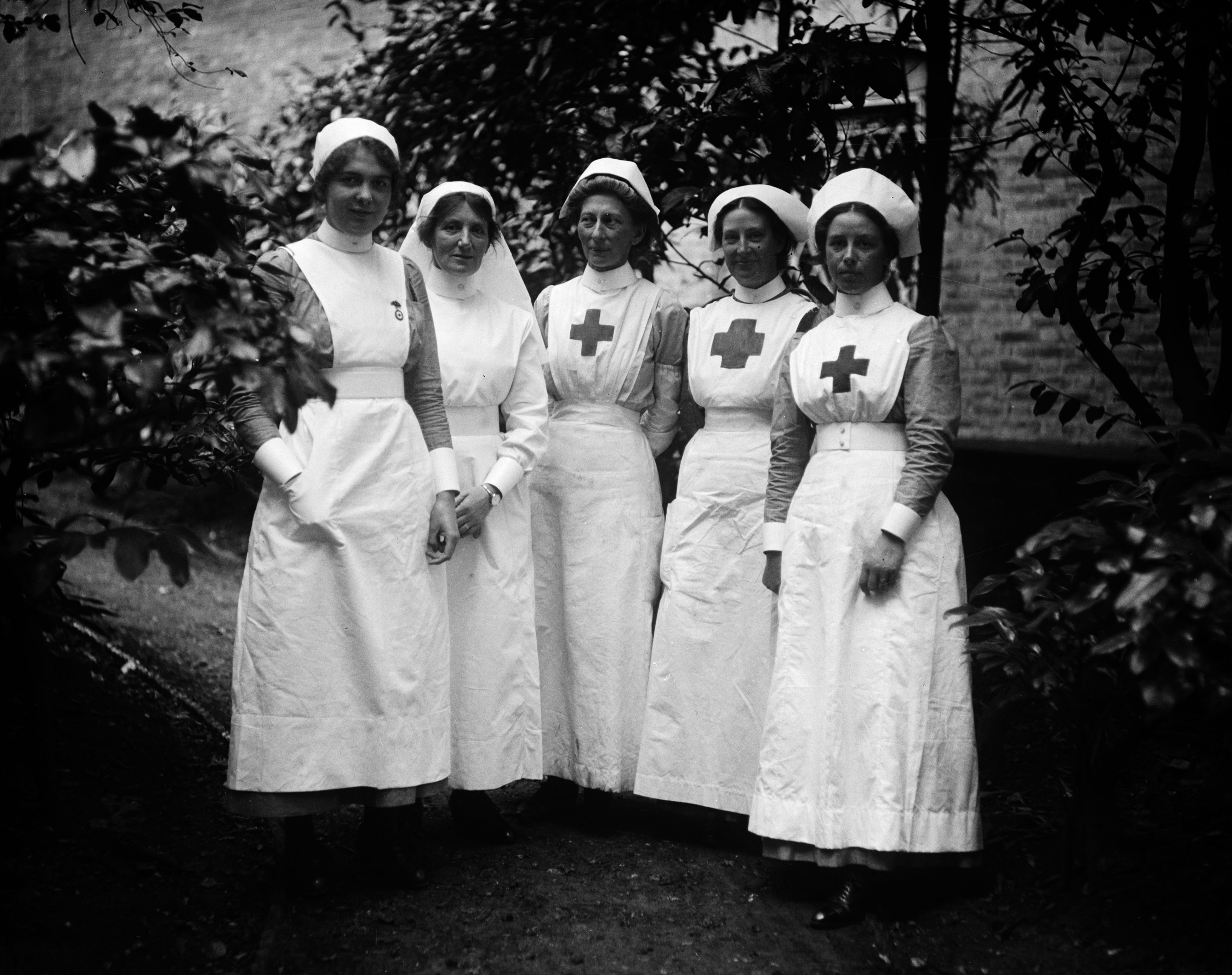
September 1915: A group of nurses at Hamworth Hall which is serving as a Red Cross Hospital during WW1. (Photo by Topical Press Agency/Getty Images) via Time magazine.

I am reminded that we are reading these books with the benefit of historical hindsight. Marjorie Vandercook had no way of knowing that it wouldn’t be be that many years before the world was back at war, barely a generation, and the fictional futures she thought she was securing for her heroines would perhaps be less than untroubled. It is hard not to read them knowing of the tumult of the political upheavals of Russia and that the sons of this generation would be the soldiers of that next enormous war.

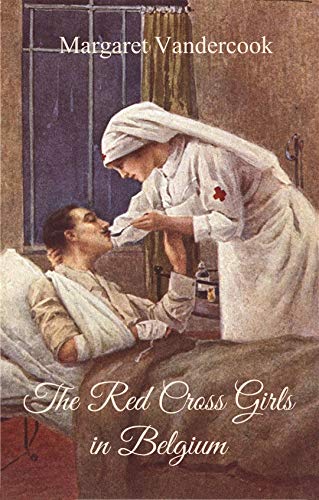
The first three volumes of the not quite five I have thus consumed, were the most compelling with The Red Cross Girls in Belgium being my favorite. I found the novel concerning their time in Russia, The Red Cross Girls with the Russian Army, a bit hair raising actually. What on earth were they thinking going to Russia? How did they even get there? Of course you should read it, but I am warning you, it puts you a bit on the edge of your seat.

This may be the only accessible volume from the second half of the series, but you know I will try to ferret them out!

As alluded to above, the first four volumes were easily available on Project Gutenberg as free e-books. After a bit of searching I located the current volume on the Internet Archive site. While they e-books don’t seem to be technically downloadable they are still easily read online and they have bailed me out on obscure volumes before. I think I will have some trouble acquiring the remaining volumes of the series which seem to follow the American army through other parts of Europe and then home. With any luck, I will be able to report on those in subsequent posts.

Margaret Vandercook and the Ranch Girls

Pam’s Pictorama Post: For fans of my writing on series books of the early 20th century, I am back at it today with something to say about the first few books of this grand and lesser known series. Like the majority of the books about The Camp Fire Girls I have most enjoyed (my posts devoted to these books can be found here, here, here and here), this series was written by Margaret Vandercook, or aka Margaret Love Sanderson.

The only photo I can find of Vandercook.

Now even in the age of the internet Ms. Vandercook is a bit of a cypher. Between 1912 and about 1924 she published several dozen books under her own name and the pen name above. (I can tell you she wrote the heck out of these books too.) The meagre biography that is available sites that she began writing professionally after the death of her husband, presumably to support herself and her son. Although there are some allusions to magazine work done after that time and a book of poetry published in the 1940’s, the internet provides no trail for what happened in the mid-1920’s that caused her to cease publication, at least under these names. I speculate that possibly she remarried and continued to publish work under that name is not attached to her. She lives until 1958 and given how prodigious her output was during the decade above it is hard to imagine that she ceased writing altogether. (I am unable to even find an obituary attached to her.)

For my money Vandercook is a very good writer and despite the fact that she was juggling a myriad of characters and storylines, every series and each book remains quite distinct. I have said in former blog posts (I have written about The Camp Fire Girls here, here and here) that it is a wonder she had time to eat or sleep when we consider how much she produced. I somehow imagine her spending mornings with the The Campfire Girls, lunch with The Ranch Girls, late afternoons with The Red Cross Girls and evenings with The Girl Scouts.

Merely because these are juveniles and series books they should not be dismissed lightly. I have come to realize that, at least for now, I am tracking her more as an author than I am following a series as such. And as beloved as my Judy Bolton books are, (I wrote about those here and here) these are in no way as formulaic. Working for a series of lesser publishers Vandercook may have had more freedom. There are indications that she plotted these way in advance and perhaps wrote them straight through, splicing them into volumes of the right length along the way, the storyline continuing with the turn of a page.

Margaret Vandercook has an odd habit of engaging you with a lead character for a few volumes and then utterly sidelining that character for one or more volumes. This allows her to explore and develop others more thoroughly. It is a bit jolting if you were really attached to that storyline though – you may not pick it back up for a volume or two.

As I turned my attention from The Camp Fire Girls to The Ranch Girls I expected to lose the sense of wonder and lore that had made The Camp Fire Girls novels so wonderful. They were filled with the ceremony, rites and values of the early days of that movement. To my happy surprise this series is infused instead with admiration for the women of the still young West – the frontier spirit and how it could be found in this subsequent generation.

Wyoming Dude Ranch of the same period.

This is best seen in volume two, The Ranch Girls’ Pot of Gold, when the main character, a young woman name Jack, is injured and lost. She struggles through a storm to find her way back to camp and there is a ringing passage about the plucky stuff today’s girls still have, much as the prior generation of westward bound women exemplified.

In the teens and early twenties the Western genre was of course a mainstay in literature and film. While much tamer then the days of its origin, it remained remote and the imagination seems like it was endlessly stoked by storytellers using it at this time. Tales of gold strikes, disputes over land and water rights and the hardship of the elements make up an almost endless backdrop of lives lived in a saddle and the “taming” of this part of the country. The myth of the west is endlessly embellished.

From The Ranch Girls at Rainbow Lodge.

The Ranch Girls embody these same themes and spirit with the addition of being three (and then four) young women left to fend for themselves on a ranch in Wyoming after the death of their father, their mother having been lost at a much earlier time – as evidenced by the fact that she is almost never mentioned. They live under the (somewhat) watchful eye of their guardian and ranch overseer, Jim, and ultimately a cousin who comes to live with them to the end of civilizing them. The adult supervision being benign enough to allow them to get into a fair amount of trouble and adventure.

It is interesting that only two are sisters, the third a cousin who has lived with them since since childhood, and then the adopted fourth. A wonky thing happens with their ages and somehow the youngest sister ages a few years and catches up to the others between volume one and two.

If The Camp Fire Girls allowed Vandercook to explore those rites and rituals, it also underscored a favorite theme of mine, the emergence of women during this period as they fought their way through the right to vote, but also the right to work, be educated and marry for something other than economic advantage. The Ranch Girls takes this theme and expands it even further. These somewhat untamed young women of the West are sort of noble examples of what girls growing up outside society can produce.

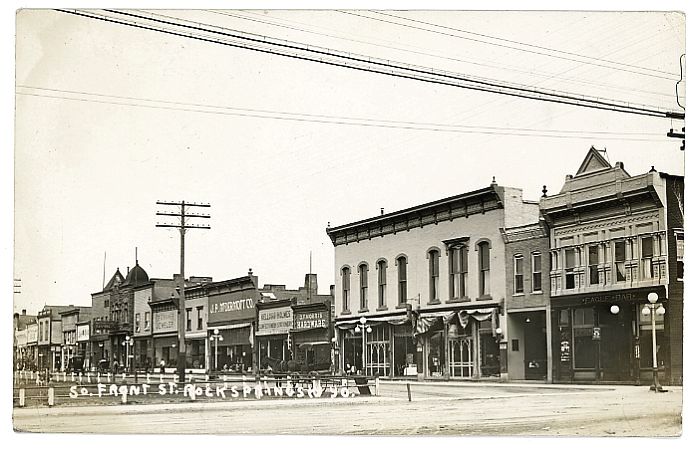
Rock Springs Wyoming, 1915. Wyomingtalesandtrails.com

Their broader and less hidebound perspective is shocking to many as they move through society in the East during a stint in boarding school. However when the series takes them to Europe, it is this easy going nature that almost makes them prey for bounders and fortune hunters. Their refreshing American West personas do make them great favorites among the more staid Europeans they meet along the way. (While many of these series books take girls from the East and first send them out West and then to Europe these obviously work in the reverse!)

Where from our 21st century perspective, a full hundred years later, this series is well meaning but misses the mark is the exploration of the relationship to Native Americans it undertakes. It is an underlying theme and storyline and I was frankly shocked by the racism that one main character, Olive, is the center of in the first few volumes. She is assumed to be half Native American and the prejudice that must have been very real for the day is portrayed as she is thought at best to be given a position as a maid.

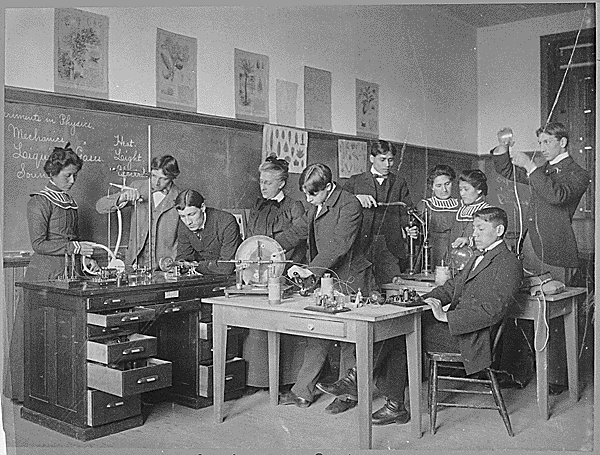
Physics class at Carlyle school which sought to eradicate Indian culture.

While the Ranch Girls adopt Olive as one of their family, there is still the undeniable relief when in subsequent volumes she is discovered to be half Spanish instead, born of a wealthy father and European mother, both dead. Evidently the character was not going to be allowed to flourish unless she was white. Later in the series Vandercook is still working through resolving attitudes toward Native Americans with another character in the story. I believe that in reality she was very interested in making people recognize the culture of these native tribes and to respect them. However, given both the pressures of her publishers, the readers and being of her own time, by today’s standards it is ham handed at times and can still be painful to read. For me it is valuable reminder of the prevalence of such attitudes and useful to understand the attempts to change it which did not just happen with the stroke of a pen.

For me these volumes are rollicking good stories with a nod to the highs and lows of dime novels mixed with the loftier ideals of instilling new values in young women of the time. These books are asking them to take a new look at the world around them and to consider how the modern young woman might make a difference and change the world. These books helped, one story at a time.

The Camp Fire Girls at Top ‘o the World

Pam’s Pictorama Post: Another pastime that will remind me of our long Covid year will be discovering and tearing my way through a large swath of Camp Fire Girls novels. While my past reading obsessions included all the adult fiction of Francis Hodgson Burnett (discussed in one of several posts here), the short works and then novels of Edna Ferber (found here), and Judy Bolton Girl Detective (first of two posts here) saw me through the sleepless nights during the early months of the pandemic, it will be The Camp Fire Girls that will bring back memories of recent months.

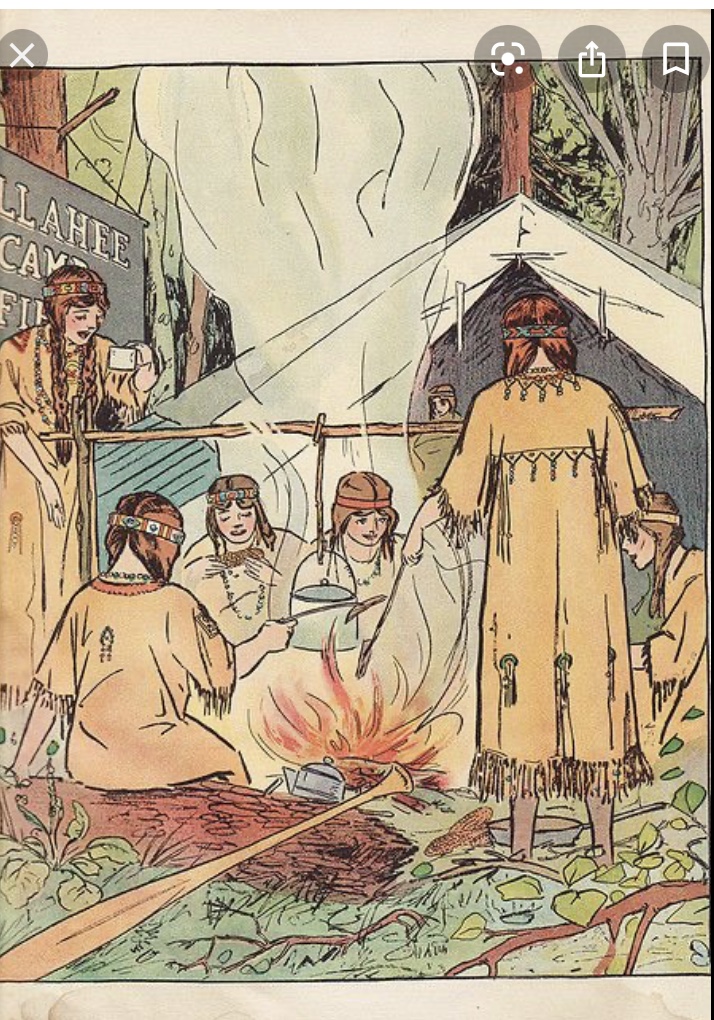
Illustration from The Camp Fire Girls at Driftwood Heights – none of the illustrations in this series is worthy of note!

I will never think of sitting in the ER at Lenox Hill Hospital waiting for a hand surgeon to work on my broken fingers on Memorial Day without also thinking about The Camp Fire Girls at Driftwood Heights, which I read on my phone throughout that long afternoon.

Reading about these plucky young heroines who are endlessly resourceful while constantly poking at the confines of what a respectable young woman could be at the dawn of the 20th century has provided the right stuff for managing through our own trying times.

I have been tackling this reading project in as organized a way as the acquisition of these aged books allows – most are at or just beyond the centennial of their having been penned, after all. I have been fortunate to find the lion’s share available for free on Project Gutenberg or other free, or virtually free, platforms. (Walmart e-books anyone? Internet Archive.com?) The book I am pulling out today is an exception and in an effort to lay down some tracks for a future reader with the same endeavor in mind I am making some notes here. It had to be purchased in its original form, busted spine, and a bit dear.

This series of books is nothing short of sprawling in scope. There seem to be maybe three main authors (and other lesser entries) over several decades. In an effort to follow story lines I have taken one author, Margaret Vandercook and read all under her name, and then all under her alternate nom de plume, Margaret Love Sanderson. When I have written previously about these novels (oh gosh, here, here and here) it was all the Vandercook novels – which I will label a superior group. I was very sorry to finish reading them and even after two generations of Camp Fire Girls, I could have happily stuck around for a third. They are her earliest efforts and I think she took what she learned about pacing and applied it to the latter series – these teens grow up much more slowly.

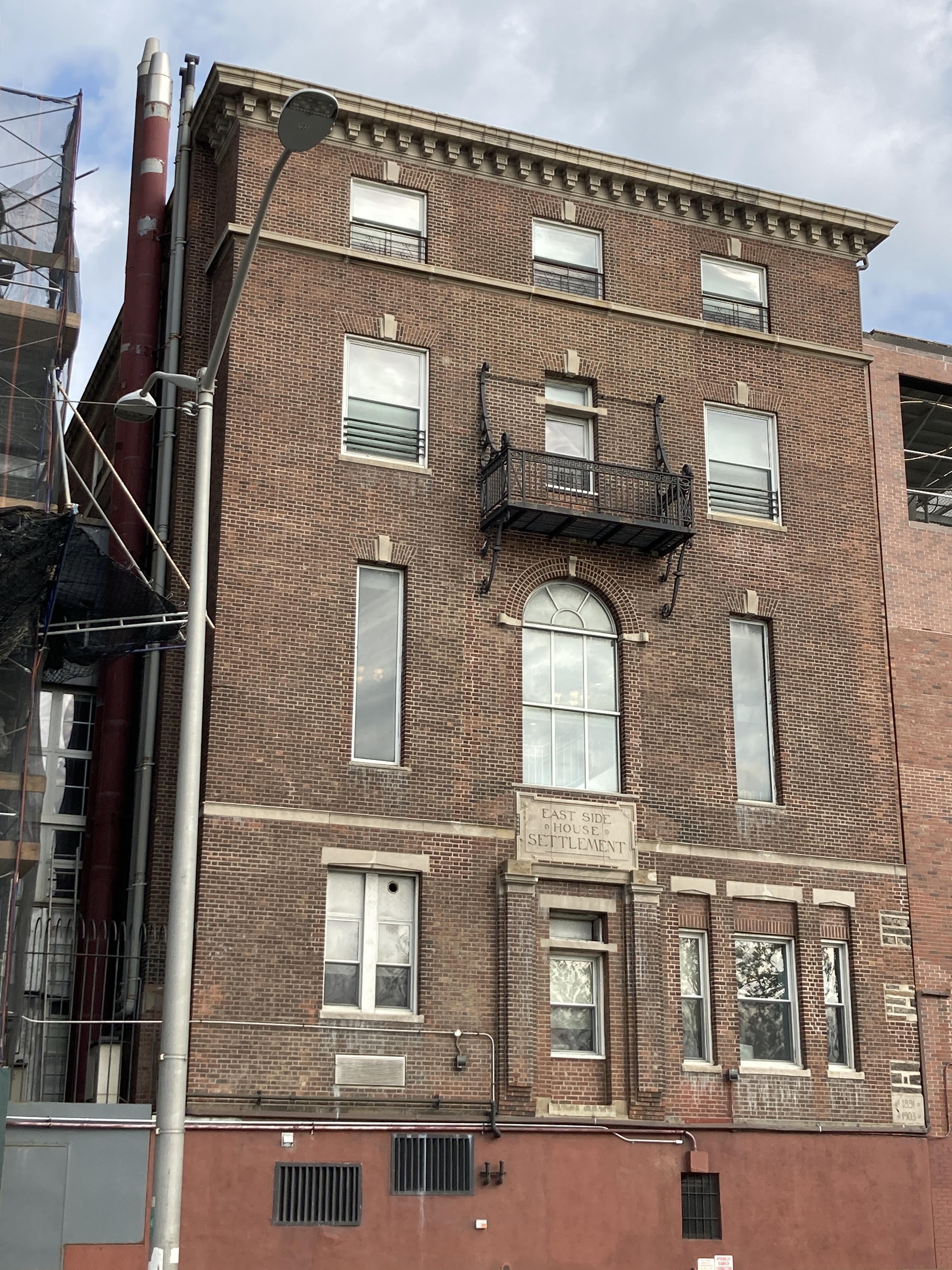
The series which I believe she intended to wrap up with one more volume, ends with the primary heroine, Bettina, leaving off the life of Washington debutante to follow settlement house work on Manhattan’s upper east side. These books play constantly with the shifting roles of women and forcefully promotes the interaction between the wealthy and the poor in associations and ways that were clearly still controversial at the time of writing. I would have liked to cap the series with a final book and the last two and my most beloved characters settled with their choice of mate and set on the path of their adult lives, but I guess it wasn’t meant to be. Alas! (Wikipedia sites her as the author of 21 books in the series – /i have found about two thirds – where are the others?)

I actually run (now walk0 past the East Side Settlement House most mornings! This was where Bettina was learning settlement work in the final volume of that series.

Margaret was so prolific I cannot imagine how she had time to eat or sleep between about 1915 and 1921, let alone raise her son alone after her husband died. While pounding out these volumes at an astounding rate, it appears she kept at least three other robust series underway The Red Cross Girls, The Ranch Girls, and contributed to The Girl Scout series as well. I would very much like to get to the roots of her story, but I don’t see anything beyond bare bones in my searches to date. After this frenzy of work in the teens and into the early twenties, she seems to have stopped writing novels, done some magazine work and disappeared, although living until 1958. Re-married? Other pen names?

To further confuse the reader, Margaret had certain character names which she used constantly. Bettys and Mollys (as well as Mollies and Pollys) proliferate. I include lists of the books by story lines I have followed below in the hope that it might prove helpful to someone in the future. I wonder how even she kept it all straight.

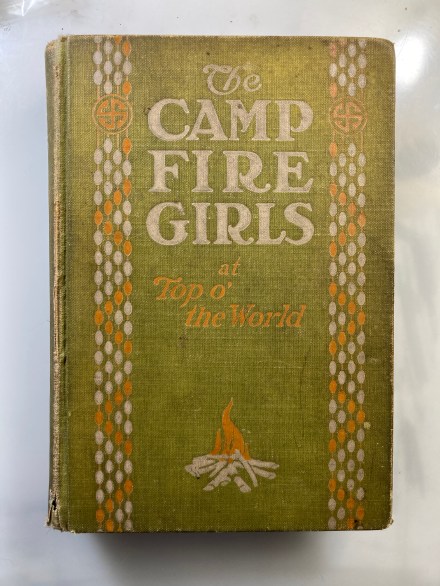
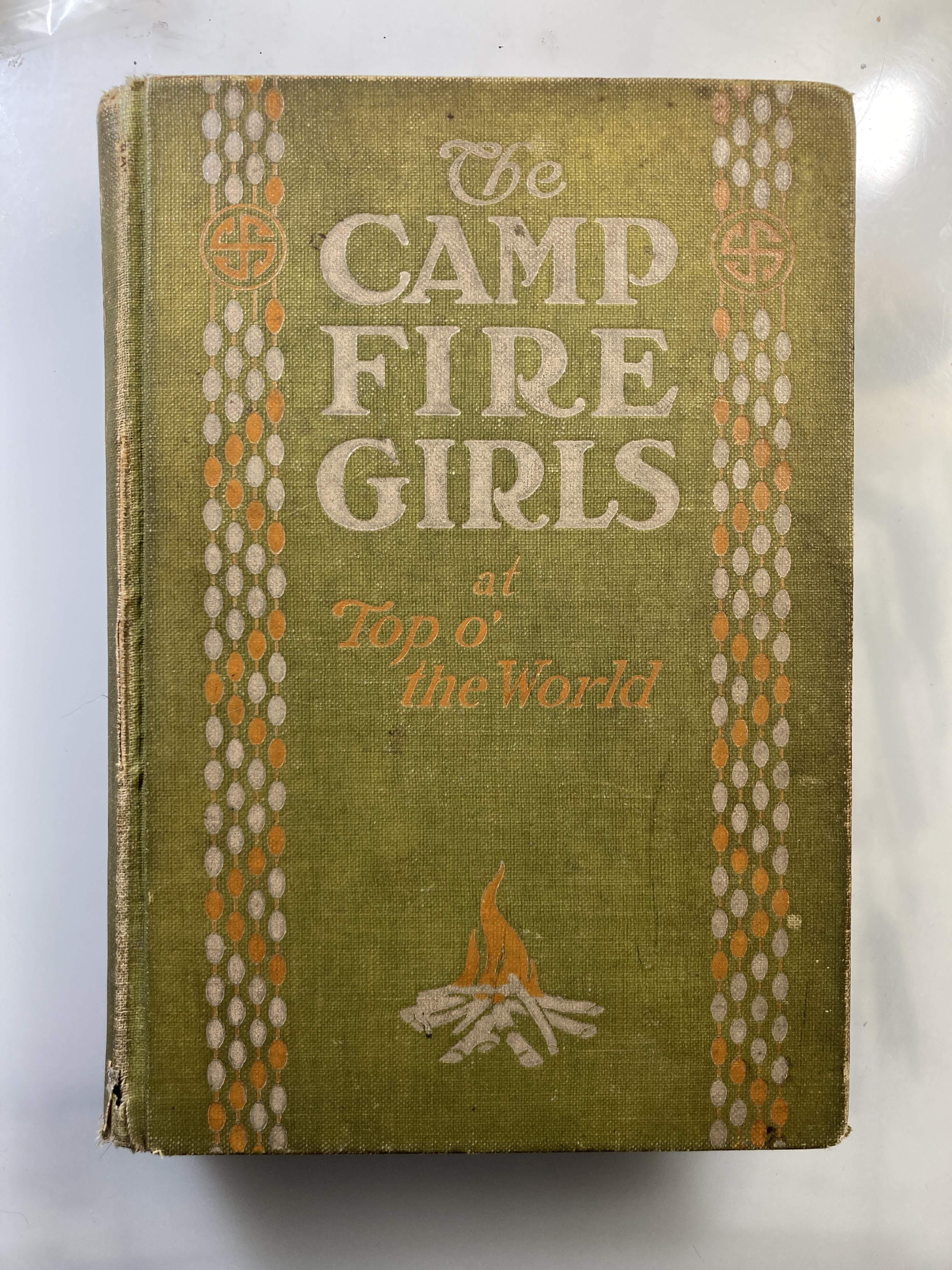
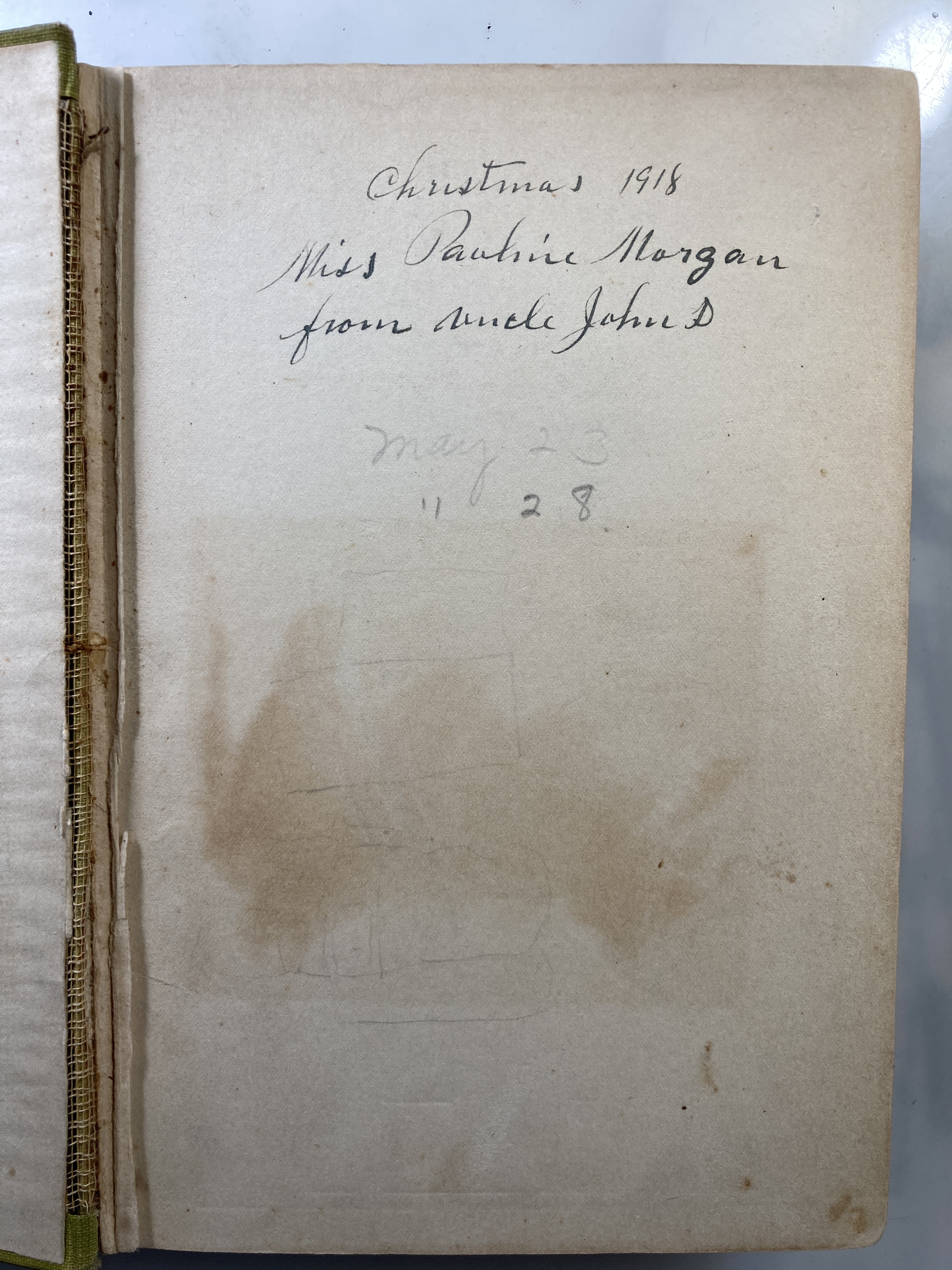
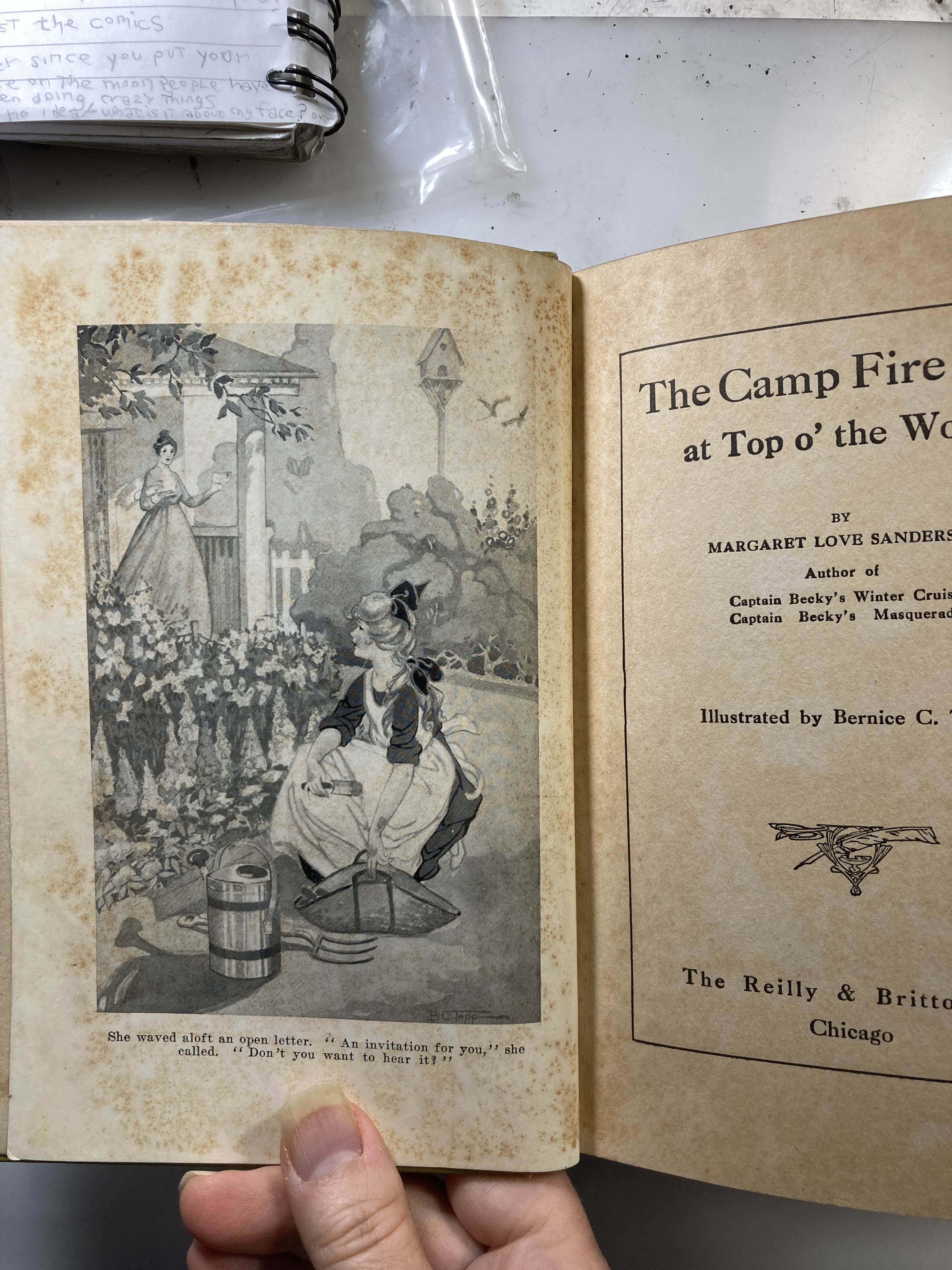
The Camp Fire Girls at Top ‘o the World (a great title, right?) is an outlier. Published in 1916 (my volume sweetly inscribed for Christmas of 1918) it introduces a new set of characters (Mollie Wren is our girl and she is of the from a poor, large family model, but with great Camp Fire Girl grit), who are gathered rather randomly from all over the country for a summer at the farm of authoress Julia Allen – not sure it is made clear where, but somewhere called Lakewood, most likely in Wisconsin.

It is a somewhat plot heavy volume – Margaret S. didn’t shy away from plot! A stray Russian girl from a New York factory is thrown into the mix (this isn’t her first Russian immigrant girl character, which makes me think it was part of the culture at the time – my own grandparents showing up on these shores as young adults in those years), a Southern belle and a wealthy New York niece who is a bit older and more sophisticated than the others. Dialect is rendered liberally and sometimes painfully around the Russian girl and Southerner. I won’t give more of the plot than this, but it is an enjoyable ride.

It would appear that this is the only volume produced for these characters and for whatever reason it seems to be an isolated volume. This probably explains its relative scarcity. I would love to find a way to donate this and another hard to find volume (The Camp Fire Girls in Merrie England) somewhere to have them scanned and made available for other completists like myself. Give a shout if you are acquainted with the process.

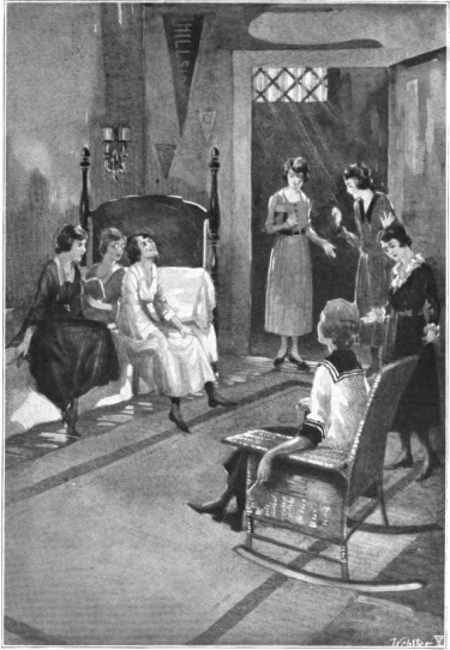
A sadly insipid frontispiece from The Campfire Girls at Top ‘o the World.

In closing a quick shout out to Jennifer White at whose wonderful eBay guide list to these books can be found at her blog Series Books for Girls and who kindly answered a burning question I had about a missing volume mentioned at the close of The Camp Fire Girls at Drift at Driftwood Heights The Camp Fire Girls at Sweetwater Ranch – which is a ghost volume that, never published. Her blog Series Books for Girls contains some all important lists including one that appears to be the complete list for the Margaret Love Sanderson books above. The list below is from Wikipedia and is for the Margaret Vandercook ones. (Please note that Wikipedia has the order wrong on the last two volumes – it is correct as below.)

‘The Camp Fire Girls Books by Margaret Vandercook

The Camp Fire Girls at Sunrise Hill (1913)
The Camp Fire Girls Amid the Snows (1913)
The Camp Fire Girls in the Outside World (1914)
The Camp Fire Girls Across the Seas (1914)
The Camp Fire Girls’ Careers (1915)
The Camp Fire Girls in After Years (1915)
The Camp Fire Girls on the Edge of the Desert (1917)
The Camp Fire Girls at the End of the Trail (1917)
The Camp Fire Girls Behind the Lines (1918)
The Camp Fire Girls on the Field of Honor (1918)
The Camp Fire Girls in Glorious France (1919)
The Camp Fire Girls in Merrie England (1920)
The Camp Fire Girls at Half Moon Lake (1921)
The Camp Fire Girls by the Blue Lagoon (1921)

Socialism, Pacifism and Then War: Politics in the Campfire Girls

Pam’s Pictorama Post: Preemptive apologies for those of you who don’t share my passion for early 20th Century young adult literature, because today I am posting about the Campfire Girls as they head into WWI. Also, a warning that I give away some key plot points so be forewarned if you are reading as a review and perhaps come back later after reading if that concerns you.

I have written about this series before (those posts can be found here and here), but this series is a bit hard to get your hands around because as I can best piece it together several authors were contributing books published at the same time so you think you are reading them in order, but you have picked up another story line. Also, many of the sources have listed the order of the books incorrectly further confounding my efforts to read them in some sort of order. The good news, and there is a lot of good news, is that they are widely available by free download, although I have been forced to read them on a variety of platforms – some decidedly less friendly than others, but after all, free is free. Most are available on the very user friendly Project Gutenberg website.

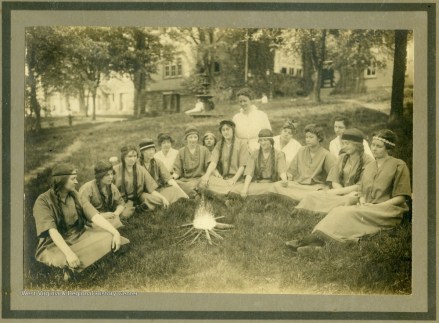
Camp Fire Girls, circa 1918.  Photo courtesy of Latah County Historical Society.

My best effort to rectify this was to find one author and follow her and I have been reading the books of Margaret Vandercook, aka Margaret Love Sanderson (warning however, that nom de plume was also used by a Emma Keats Speed Sampson), who was known as The Queen of the Camp Fire writers according to a brief Wikipedia entry, one which is especially useful in correctly listing her books. (Love you Goodreads, but you don’t have it straight and neither does the Wikipedia entry under The Campfire Girls overall.) There are 21 Camp Fire Girls books to her name (although oddly Wikipedia only lists 14) and she also wrote the Ranch Girls, Red Cross Girls and Girl Scout novels.

Her bio is brief, born in 1877 in Kentucky, she lived until 1958. Married for eight years to John Filkin Vandercook who eventually became the first President of the United Press Association, so we will assume he was a writer too. After his death in 1908 she started to write professionally and, man, she was prolific – churning out several of these novels a year. Strangely though, she appears to stop writing abruptly, at least in this genre and as far as I can tell, in the early 1920’s. I wonder if she remarried at that time and no longer needed to support herself and her son? A mention is made of magazine work, articles, poems and stories. Also, perhaps they run longer since as I pointed out the list I am working from appears to be incomplete.

From Campfire Girls at Camp Keewaydin

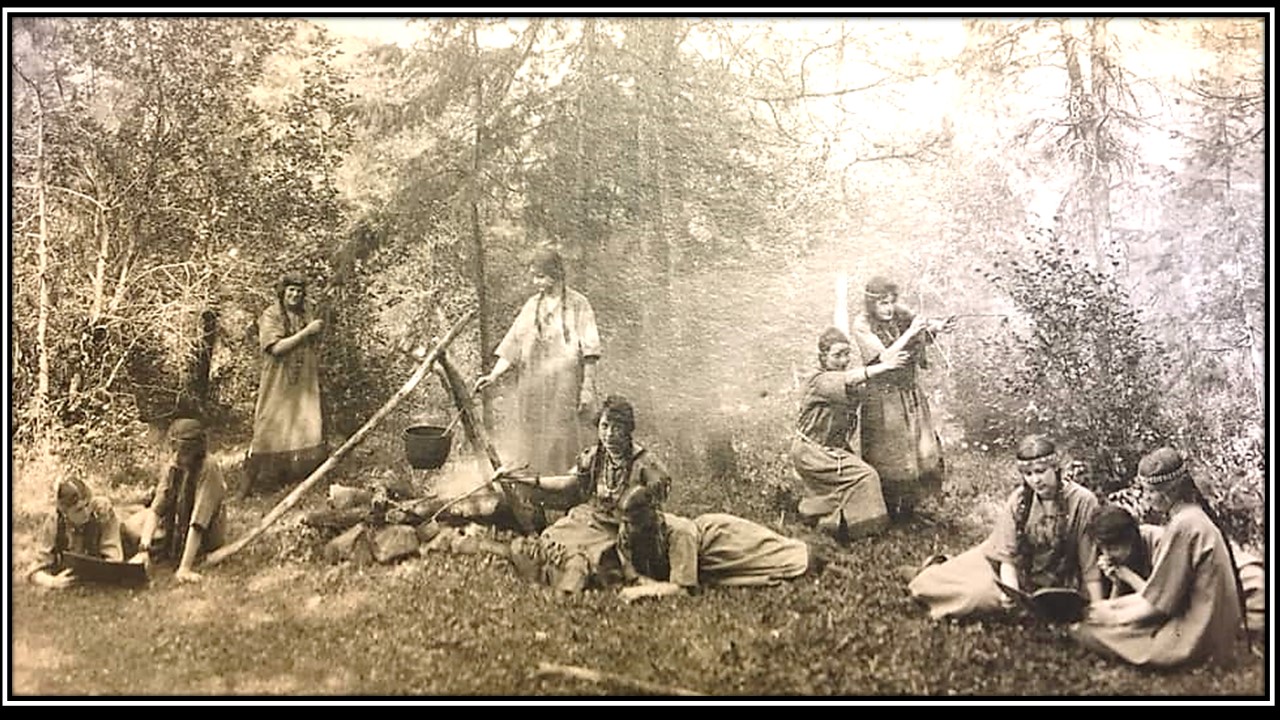
There’s a lot of charm in these books and I really took a bath in the lore and accoutrements of the Camp Fire Girls as outlined in the early books – rings, costumes, poems and all. While this remains a backdrop Vandercook stealthily moves us into other territory and as the century turns from the early and mid-teens to 1918 and beyond she is writing stories that are almost contemporaneous accounts of the country preparing for and entering in WWI. There is a strange sense in reading them one after the other, that perhaps they were written in larger chunks and then parsed into pieces that make up the novels. The story continuity from one to another is seamless and more like the next chapter in a book than a new book in many of these.

From Campfire Girls at Camp Keewaydin

Much to my surprise in The Camp Fire Girls at the End of the Trail (1917) Socialism pops up. The Camp Fire Girls have been out west for a volume already (also, we are on the second generation of girls here and Vandercook wised up and they age a bit more slowly in the second half of the series) and the younger brother of one is sent to stay with them to recover from the sort of mysterious wasting diseases that seemed to permeate the pre-antibiotic world. He is portrayed as an usual young man, only about 15 years old, and among his peculiarities it emerges that he is a Socialist.

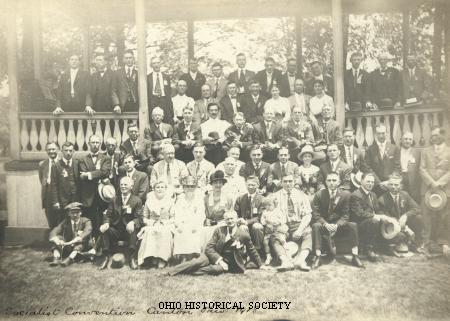
Group portrait of Socialist Party members gathered for the Socialist Convention and Eugen V. Debs picnic in Canton, Ohio 1918.

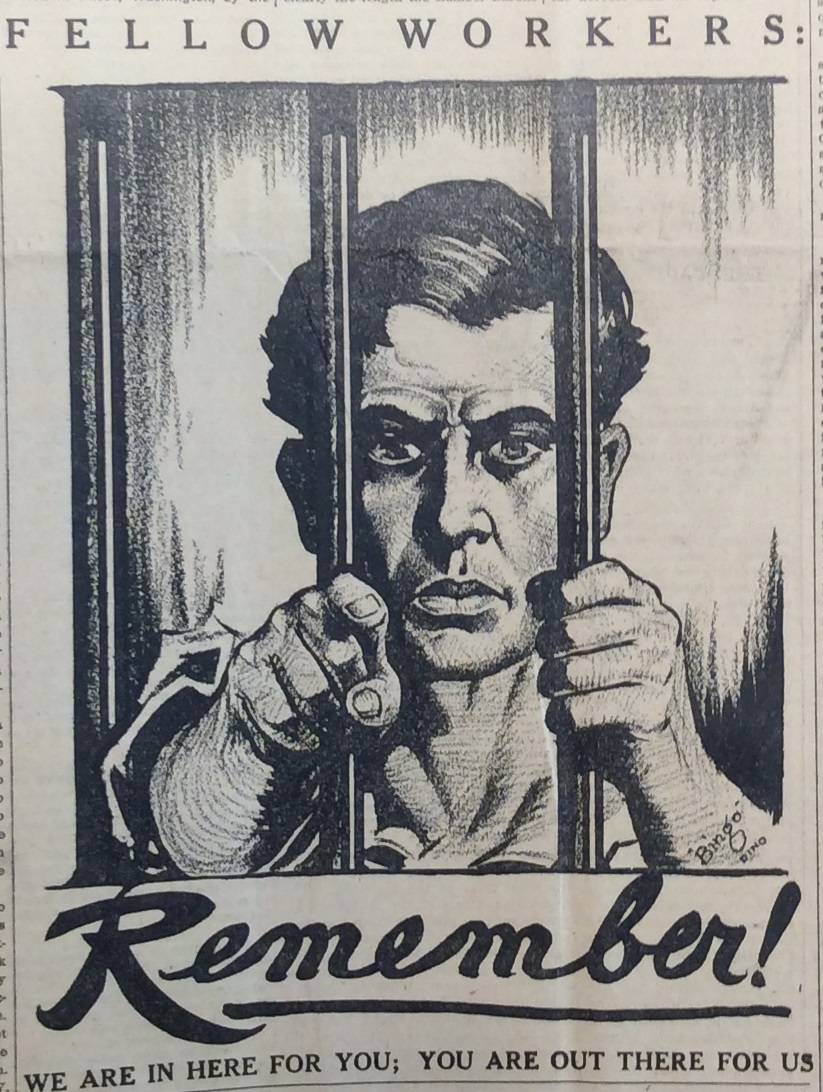
In the first volume of their time out west there is an effort to address the situation for Native Americans which I think was sincere, if ham-handed and wrong by today’s standards. Socialism, which is addressed in the form of young Billy getting involved with railroad union organizing. Seems Billy had gotten an earful of Socialist propaganda from a Russian immigrant working on his father’s farm in New Hampshire. He finds his way into an enclave of railroad workers and becomes a leader among them – but pushing a non-violent agenda among. It ends badly, with violence, for which he is ultimately blamed, but in a glossing over it is quickly remedied by his family’s wealth and connections. It manages to be both sympathetic and yet illustrate what was probably the more accepted feeling of the day about unions and Socialism. While it seemed a bit surprising, again, these were novels that were addressing the current events of the day in almost real time.

End paper for Camp Fire Girls at the End of the Trail via Project Gutenberg.

Without ruining the plot, I will just say that his pacifism is treated with some thoughtfulness considering how enthusiastically we are told Americans generally geared up for that war. It is fair to say it is presented as an untenable view, but not without sympathy for his position. Frankly, I was surprised and would have expected these books to be full only of endorsement for our entrance into the war.

Vandercook wasn’t done with this character yet and uses him to address pacifism in the next volume as the country tunes up for entry into the war. Published in 1918 The Camp Fire Girls Behind the Lines still has them in the West, but now near a newly established army training base in the country, somewhere in Southern California. Billy has been joined by his brother who is anxious to enlist. Billy, on the other hand, is a vocal pacifist and decries the military approach to solving the world’s problems. He wiles his way into working at the army base and makes friends with the fellows working there, becoming very popular with them. It would seem he intends to infiltrate them and then convert them to his way of thinking, but again, things take a very different turn in the end.

In case you are wondering, these are just sub-plots in these novels which still very much manage to be about this clutch of Campfire Girls and told from their perspective.

Finally, I found myself at the group of novels which deal directly with the war and takes a slightly smaller group of girls to France to help with the reclamation work which evidently began there even before the war ended. First I will volunteer that I thought this was likely where I would get off this trolley because this seemed like an absurd idea and this sort of girls in the Red Cross thing was profoundly uninteresting to me. (As I said to Kim, these kinds of books going to war is a bit like most series going out west, the beginning of the end.)

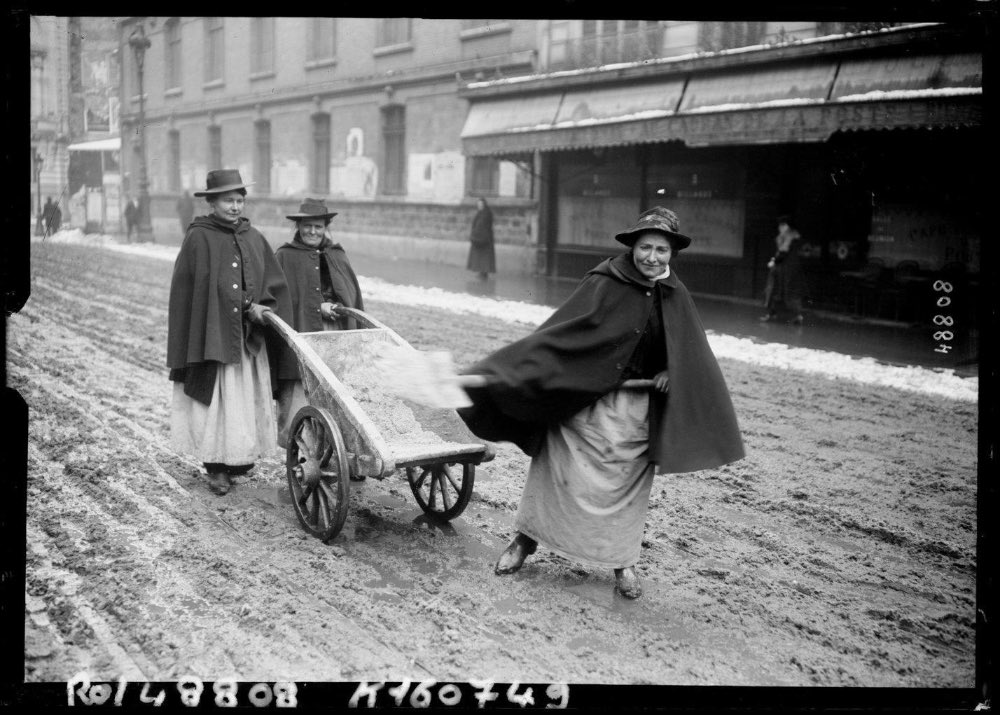
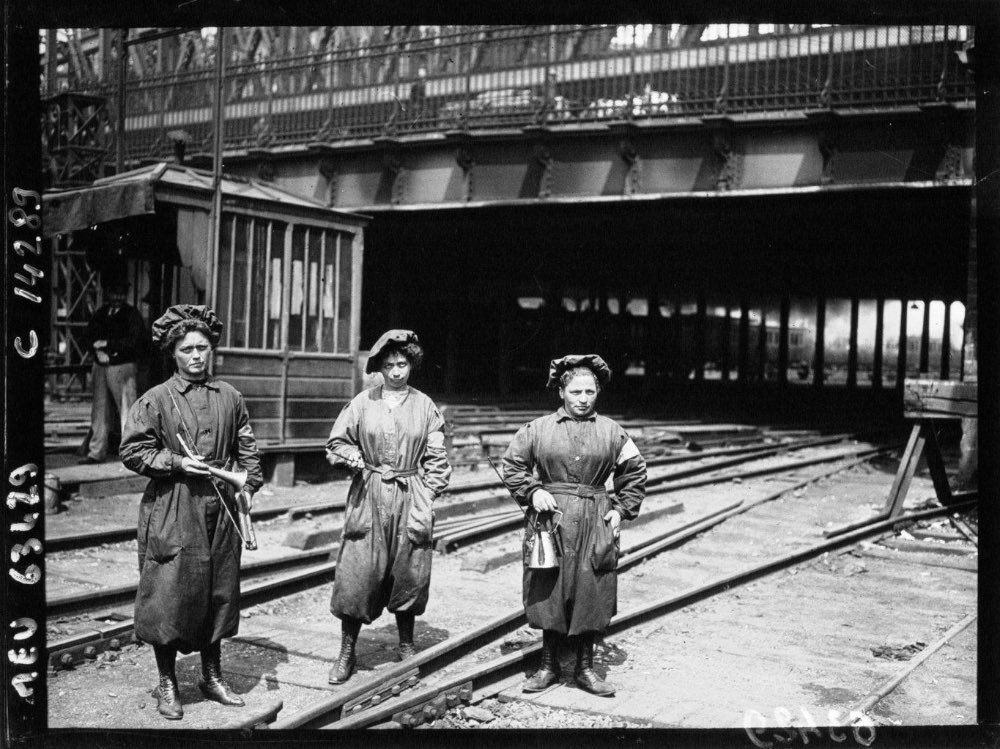
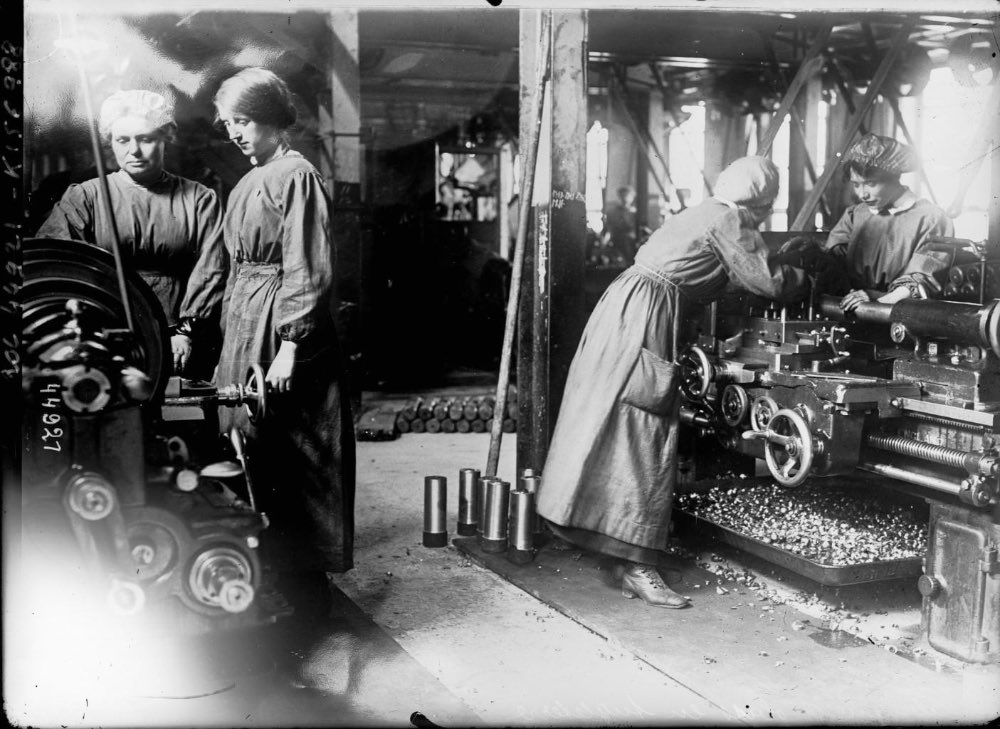
However, I learned that there is historical precedent for a small number of self-financed women who actually did this – driving cars (a skill which many of their French counterparts did not possess), bringing first aide, childhood education to a generation of orphans and semi-orphans, and all sorts of similar endeavors – a small but determined league of women did do this work taking on six month hitches at a go. (All of the photos snatched here can be found on Mashable, 1914-1918 Working Women of WWI here. A rather excellent entry about some of this history can be found here on the Morgan Library site from one of their exhibitions.)

Women shoveling snow from the road Paris France

Therefore the storyline was an acceptable one and doesn’t entirely stretch credulity as I originally thought. (Learning these somewhat forgotten bits of history along the way is one of the decided byproducts of reading these books.) Again, these books were written almost in real time so I would think she did know what would be believable and acceptable to her audience. If the idea that the Campfire Girls were establishing their first roots in France this way has any historical reality or not.

Women grease and inspect the signals Gare du Nord Paris France

Perhaps more to the point Vandercook makes these compelling stories and her descriptions of war torn France have the ring of truth and reality. Although well traveled there is no indication that she actually was in Europe during or immediately following the war and I assume it was newsreels and news accounts that informed her writing – and the tales of these women abroad must have captured her imagination.

Women making missiles in a munitions factory England

Not surprisingly, there is a strong underlying patriotism to these stories, as to be expected. Then again though, there are details which we get from this real time account – the feeling of Paris on the day the armistice was declared; the reaction to Wilson as part of the Peace Conference there which is fascinating and wonderful. She writes about a post-war ambivalence between American and French troops which must have been a real issue. of the day. Incidentally, my pandemic pals, the 1918 Influenza epidemic is entirely ignored.

It is a bit painful to read about as their hopes for a lasting world peace is detailed and never suspecting that we would be back at war a scant twenty plus years later. Sadly we know what the future held and that these hopes for a lasting world peace were not to be.

The Radio Girls and the Campfire Girls: Part One

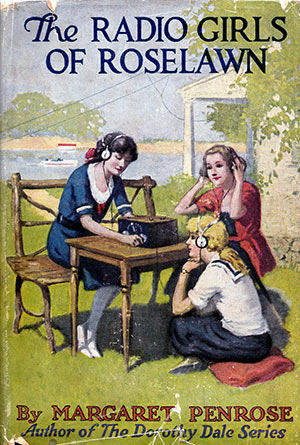
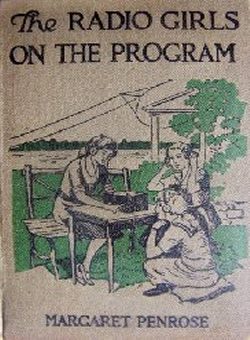
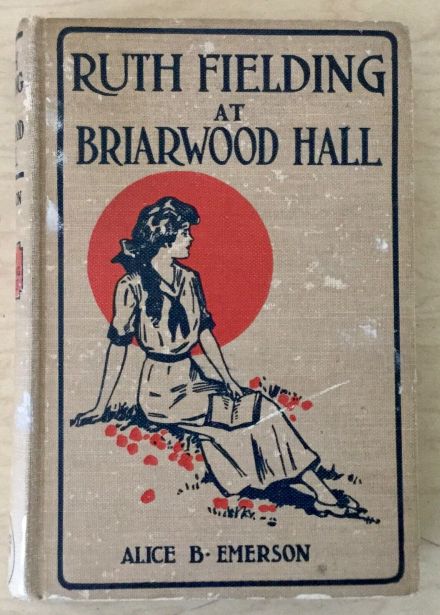
Pam’s Pictorama Post: I stumbled on the four Radio Girl novels advertised in the back of a Ruth Fielding novel which must have been a reprint as these were published in the 1920’s and that volume dated from 1915. (You will find my brief survey of Ruth Fielding in a post here.) Just a note that all four books are available on ebooks – I believe I read them all on Google Play rather than Project Gutenberg.

Although this clutch of novels was later repackaged with the Campfire Girls novels, they are more of the breed of The Automobile Girls or The Moving Picture Girls, (my prior post on those can be found here) than what turn out to be rather distinct novels devoted to the Campfire Girls and that real world movement which was picking up speed at the beginning of the twentieth century. (It should be noted that it is spelled both as one word Campfire and two, Camp Fire, at various times. Without really being able to lock it down I would hazard to say that the one word spelling is the earlier spelling. The contemporary organization uses two words.) While all belong to what I think of as the plucky young girl genre, the idea of exploiting the new inventions of the times – the new world opening up with the advent of the automobile, films and also radio – is the jumping off point for each of these.

As I have written about previously, the thrill of a changing (modernizing one if you will) world is at the center of each of these – and the evolving role of young women, emerging from their teen years pretty much at the same time as the century itself. It reminds us that society evolved slowly and these novels go to some pains to show that these are nice and average girls, in this series they are fairly affluent. (Unlike Ruth Fielding and some other plucky young dames who are of the poor and/or orphaned variety.)

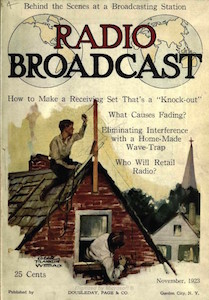
It is boys not girls climbing onto the roof on the cover of this magazine from the same period.

I deeply regret that the Radio Girls series is only the four volumes because I liked the characters and the writing, as well as finding the topic endearing. These novels were published in the early 1920’s although the dates when penned are hard to figure out since the first three volumes all have publication dates of 1922, the last volume 1924 – I deeply suspect that at least the first three volumes, or even all four – were produced all at once like a long book. These were written under the pen name of Margaret Penrose, a Stratemeyer Syndicate nom de plume for a number of authors writing under a single name. I cannot find further information about who actually wrote them although they do seem to have all been written by the same unidentified person.

While it may sound surprising to say, these are chocked full of the thrill and excitement of radio as it was dawning. It amazes me how much mileage the author gets out of it. Most charming for me is where Jessie and Amy (our protagonists) speculate on what the future might look like – a world with radios and telephones you carry around with you – television! (I could not help but wonder what they would have made of the iPad I was reading the book on in bed that evening.) They reflect on the radio’s place in a world that was still reeling from the establishment of the telegraph and telephone not all that long before. Telephones and radios were just being adopted by middle class American families and were still indeed novel.

At the heart of the plot of each is a mystery of sorts – kidnapped girls, raising needed funds for a worthy cause, or perhaps alternatively being stranded on the water, an island or on a sinking boat and the radio helps save the day! It is worth noting that the author goes to great pains to make Jessie and Amy, but especially Jessie, the master of all things radio, where she outshines both her college aged brother and his friends.

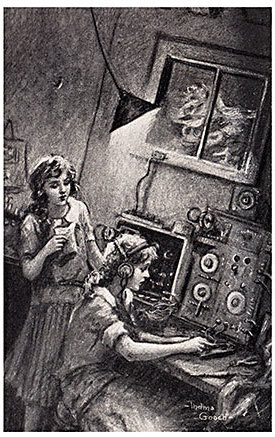
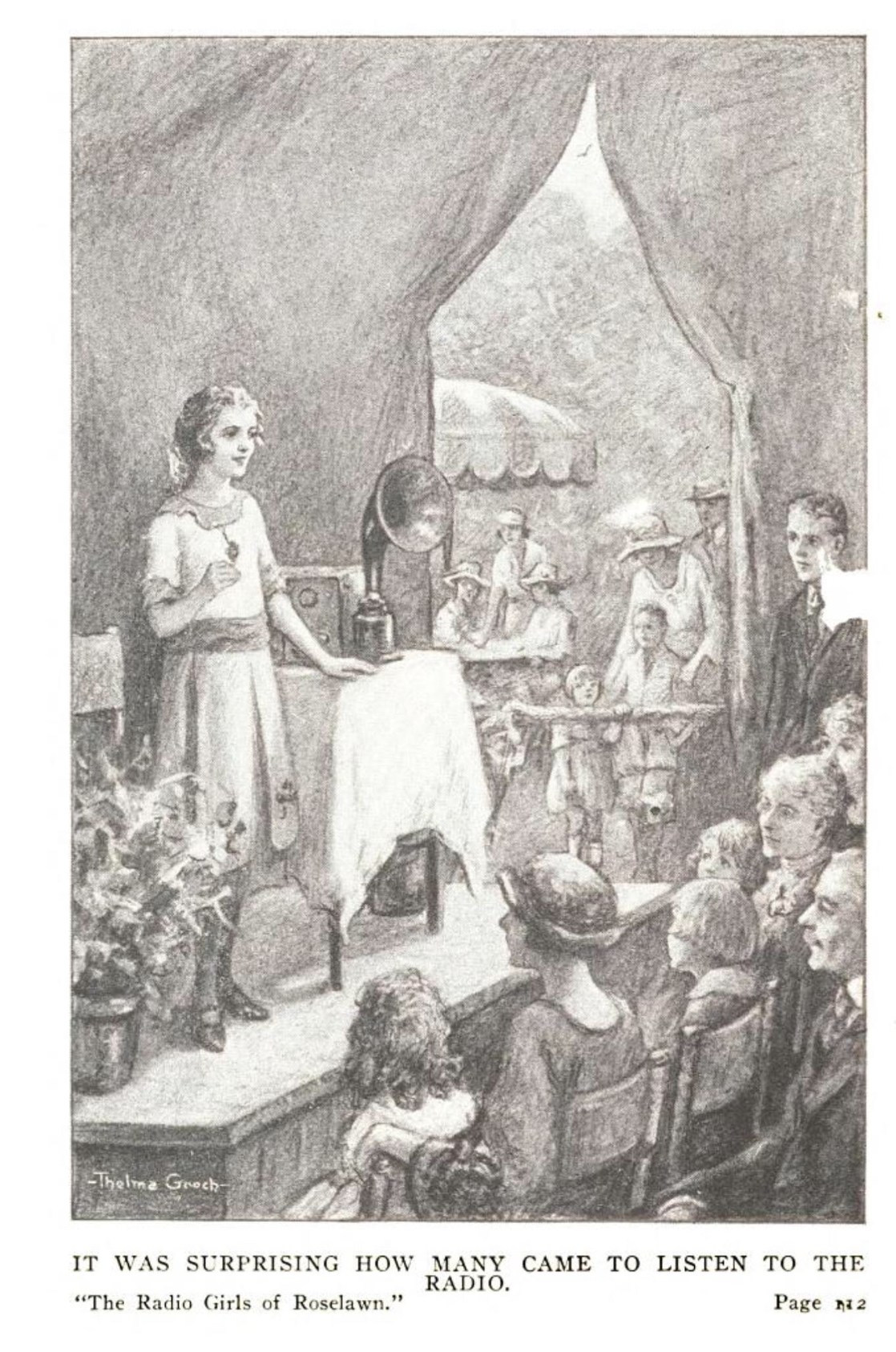
Jessie’s mother, Momsey, tends to fret a bit about the radio – however it does seems that there was the very real possibility of the set-ups attracting lightening strikes so she wasn’t exactly foolish in her fears. (It comes to pass in one of the volumes where a fire is started in a house via lightening strike and an open circuit on a radio set-up.) Meanwhile, Jessie eschews purchasing a kit for her radio and uses instructions (from a magazine I believe) to set up her rig – which includes climbing a tree and out a window in front of their large home, in order to string the wires. In the end, both mother and father are in full support of the endeavor. Once an acoustical horn is acquired for the radio (at first each person had to wear headphones) the whole family and their guests endeavor to listen ongoing – even a ticketed demonstration for the community to raise funds for a hospital project takes place in the first book.

In a later volume the young girls get to perform on the radio too and we get a glimpse of the mix of the behind-the-scenes performers, professional and amateur vying for radio time. Kim turned me onto some of the radio magazines that existed at the time, ones that seem to mix the upgrades in equipment and mechanics with the emerging star power of the day – sort of a film star magazine for radio. These are very appealing and I may pick up a few on eBay and wander through them.

How the Radio Girls are repackaged as Campfire Girls and the republication schedule of these is a bit of a mystery to me – the original copyright is on the volumes I read. I see some evidence that maybe the subsequent publication was issued in the 1930’s. Each was originally published with the double name title convention such as, The Radio Girls on Station Island or The Wireless from Steam Yacht. Campfire Girls replaces Radio Girls in the titles and they are repackaged and presumably sent out again to another generation of young readers by the new publisher. I can only imagine that they must have been somewhat confusing to girls who were expecting not just plucky heroines, but some actual reference to the Campfire Girls – those novels are chocked full of Campfire Girl lore.

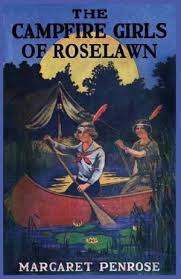
While a tad resentful at first that my Radio Girls were subsumed into another entity, I gathered a few early volumes of the Camp Fire Girls on my iPad. I hope to eventually see if the original characters and story lines of the Radio Girls were picked up – they do not appear to be. However, the very different charm of those lured me in and in a subsequent post I will write about the first volumes I have tackled in that very long and interesting series, the genesis of the series which predates the Radio Girls with the earliest volumes coming out around 1912. As I like to start at the beginning of things I am still in the early volumes published before 1920, so more to discover and come on that.

Ruth Fielding

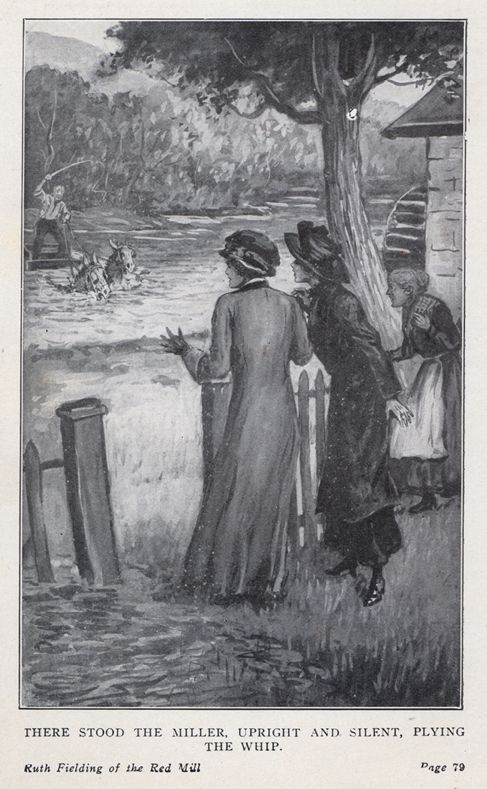
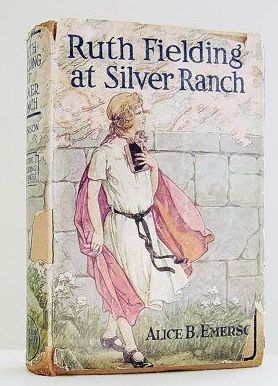
Pam’s Pictorama Post: I am sitting down to start this post with the first three books in the Ruth Fielding series under my belt, as well as having made a good start on Volume 4. Unlike some of the recent entries in my forays into juvenile fiction of the early 20th century, this series, part of the Stratemeyer Syndicate, is of the multiple author variety all under the nom de plume of Alice B. Emerson. Titles 1-19 are written by someone named W. Burt Foster and so those I write about today are all his. (I cannot find tracks of him other than these books, at least not with a casual search.) For anyone I manage to engage in reading these – the excellent news is that they are widely available online for free in a combination of Project Gutenberg and Google Play Books.

This series of 30 books starts in 1913, making it even earlier than the Miss Pat series and as extensive a series as Judy Bolton. (For new comers, a quick gander at Pictorama posts devoted to those series and you can find the Miss Pat ones here and here and two on Judy Bolton here and here.) Wikipedia makes note of the fact that Ruth ultimately marries and that this is unusual in the Stratemeyer universe. Although of course the aforementioned Judy Bolton, another Stratemeyer alum, marries as well.

The main character, Ruth, is of the plucky orphan variety and we meet her in Volume 1 as a young girl who has just lost her father, the second of her parents to die – no time is spent on any details around this. She is sent to live with a distant uncle on her mother’s side who is billed as a miser – a word we don’t hear that much any longer, but surely has it remains relevant today. He seems to get over that fairly early in the series, at least to some degree, although the moniker does stick. But the first volume shows her mettle and despite a certain modest reserve and even shyness, she manages to rescue people with quick thinking and initiative, more than once.

Ruth Fielding at Briarwood Hall, or Solving the Campus Mystery (Volume 2) is my favorite one so far. I am reminded of a book that came into my possession as a pre-teen that must have been written in the 30’s or 40’s. It was a novel about a girl going away to boarding school and who modeled her life there on these kinds of early stories – like this volume, midnight suppers and secret societies abound. It must have come to me in some box of books or something and for the life of me I cannot remember the name of it. However, as I read this book the scenes come back to me vividly and I remember my own fascination with these rites as a result. However, my life was a public school one, not boarding school so I never got to explore what I am sure was a much different contemporary reality. It was written harking back to the time of stories like this.

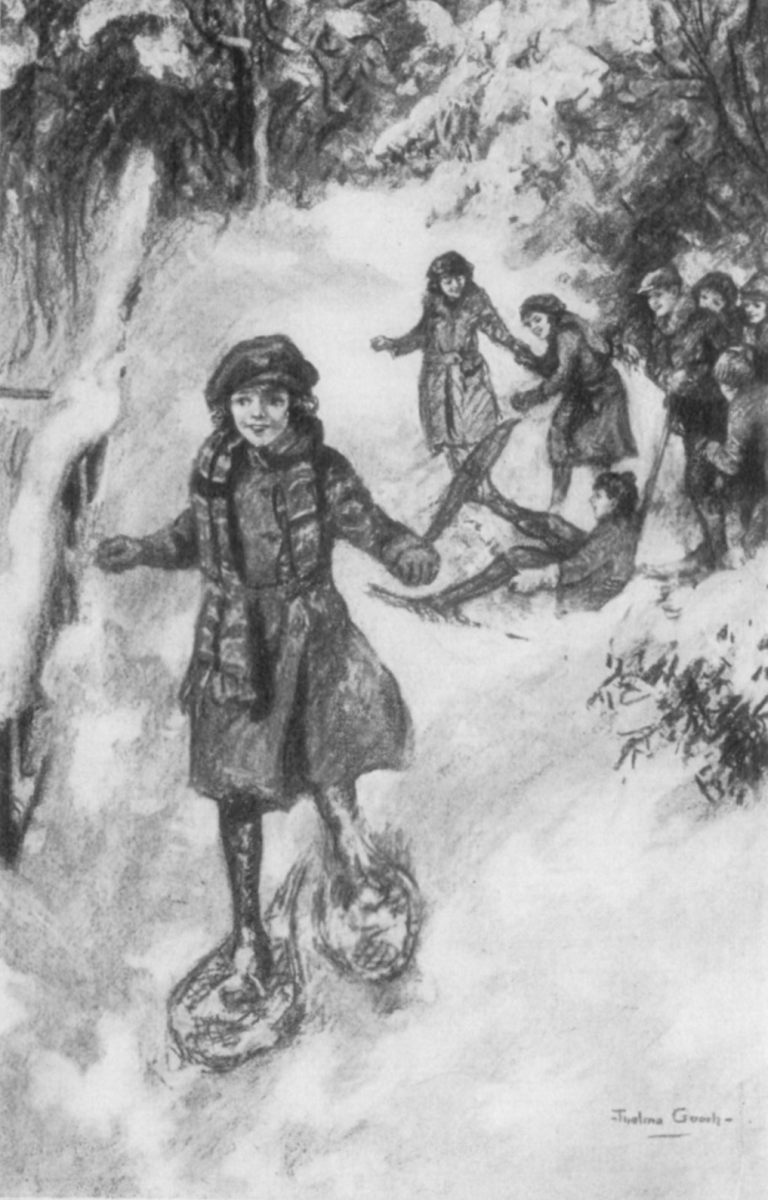
Snow shoeing is a frequent necessity or recreation in the snowier volumes.

The third volume (Ruth Fielding at Snow Camp, or Lost in the Backwoods) takes us to a Snow Camp (not a term I am familiar with but seems self-explanatory) somewhere near the Canadian border. (Ruth appears to reside somewhere in the northwest part of New York State in a town I cannot find if real called Cheslow, and near a town Kim thought he invented called Lumberton. It would appear that Burt Foster, aka Alice B. Emerson, lived in that region as well. See Kim’s illustrated novel The Amazing, Enlightening and Absolutely True Adventures of Katherine Whaley for his version of Lumberton.) Here we explore snow shoeing, much ice skating, toboggans and being lost in a blizzard. Ruth turns out to be an unusually resourceful young girl, especially in the outdoors. She proves to be a strong swimmer and there is a girl, generally known as The Fox, who is her nemesis despite that fact that Ruth has saved her from drowning in two out of the four volumes I have read thus far. Mary, The Fox, is utterly ungrateful. I’m sure somewhere in the next 26 volumes she will change her ways however and see the light however.

Volume 4, Ruth Fielding at Lighthouse Point or Nita, the Girl Castaway, takes the gang (a small gaggle of girls and a more or less complementary bunch of boys) to the seashore where they take a runaway under their wing. And in the fifth volume, a lesser favorite, Ruth and her friends take a trip out west. Kim has always warned that out west was usually the end of a series and while it doesn’t kill off Ruth or the series it does make for a lesser book in my opinion.

While these stories are less formulaic than some of the others I have read (not that I dislike those either – nothing wrong with a good formula really), you can count on Ruth to get in the path of at least one, usually more, wild animals in each story. As I round the bend now on Volume 6 I can vouch for her escaping encounters with various large cats in several volumes – puma, mountain lion and something called a catamount which appears to be a type of cougar – and in addition I remember a bear as well. Sometimes she kills the the animal, sometimes someone else does (at the last moment before she herself is killed), but she is indeed a resourceful and one brave little miss!

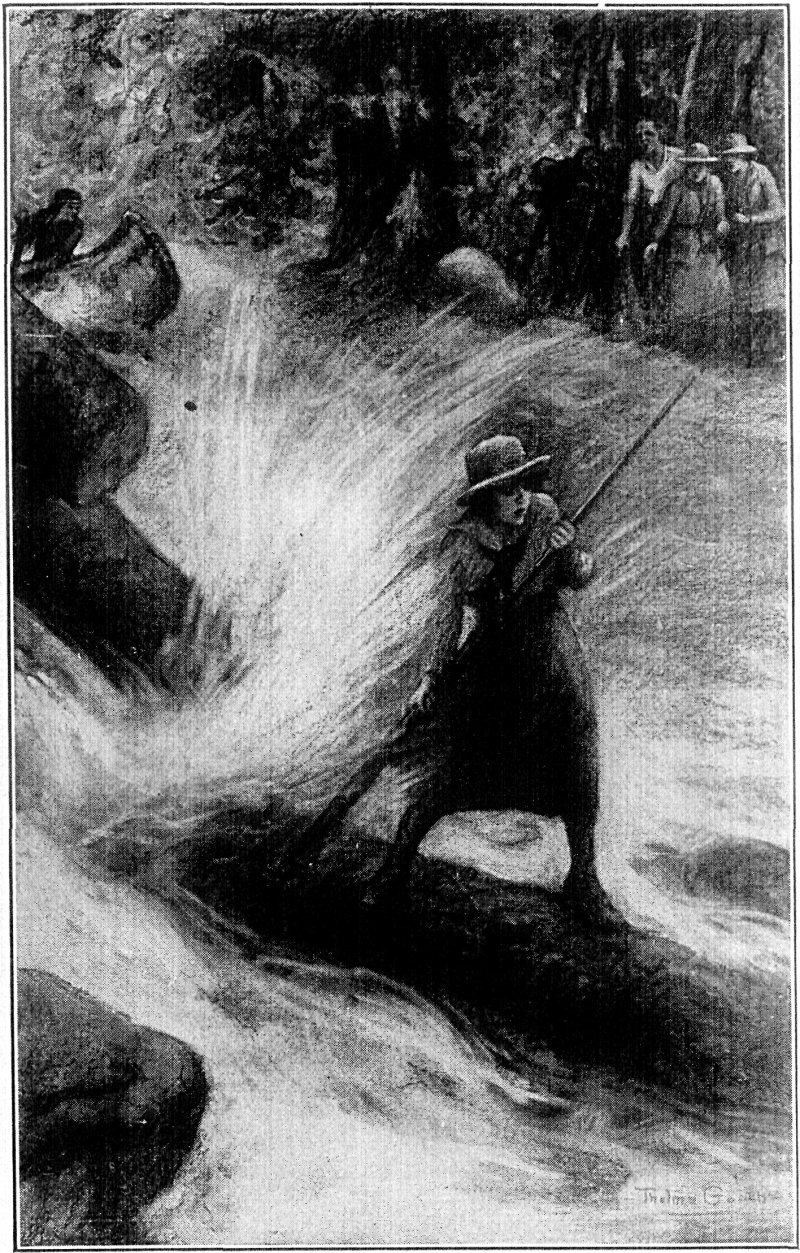
From a future volume, but a good illustration of Ruth doing her thing.

Ruth’s story lines also favor the finding of lost strong or money boxes – if you lost one or had one stolen, you’d want her on the case because, while these are not detective stories, she has a way of retrieving them again and again for their owners. Seems like banks still weren’t entirely in favor back at the turn of the century, and many of these plots mean that someone has lost their entire life savings in such a missing or stolen box. To date these have been stolen, swept away by floods and buried in an avalanche thus far in my reading.

I will warn that there is some dreadful racist descriptions in a few of these volumes. Unlike Judy Bolton trying, if awkwardly, to figure out her relationship to the Native Americans she encounters, Ruth lives in an extremely white world taking place several decades earlier. Poor, occasionally indigent, people are largely the greatest diversity in these books, but on the one or two occasions she encounters (at least thus far in my reading) anyone of color the descriptions are crude.

If the teens were an era of casual banking, it was equally a time of casual parenting. Stray children abound in these stories – orphans for the most part, but also children who seem to wander away from families, living with other relatives or even strangers; occasionally children stolen or spirited away as well. While in part this can be attributed to the page-turning novel genre which these hail from, I think it was also somewhat a reality of the time. There just seem to be stories from that generation about this uncle who went to live with neighbors or that child sent off that even Kim and I know between us. I remember a few years ago when my mom casually mentioned that my grandmother had a brother who was “stolen by gypsies from the backyard” and never seen again! First, how could I have reached middle age and never heard that family tale and second – gypsies?

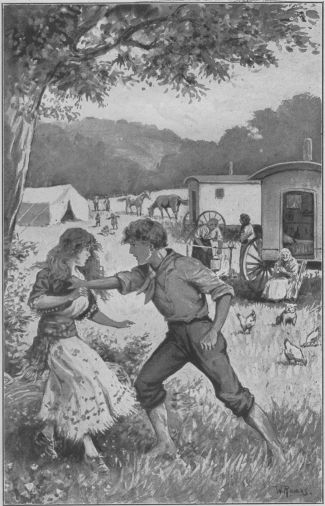
Ruth in the gypsy camp here.

Volume 8, Ruth Fielding and the Gypsies; or The Missing Pearl Necklace, is the book I am immersed in as I wrap this first part post up. You’ll have to wait to hear whether or not I think she gives the Romany a fair shake or not. (Spoiler alert – mixed bag really.) I have just been told that Jazz at Lincoln Center will take the coming two holiday weeks off and I intend to happily immerse myself in Miss Fielding’s further adventures from bed, in my pj’s, while listening to music and drinking smoking hot coffee!

Miss Pat: Pam’s Bedtime Reading

Pam’s Pictorama Post: It is hard to believe that it was only a week ago that I sat down to write about Miss Pat’s adventures in the juvenile series written in the first years of the 20th century, the first being published in 1915. After an announcement about the Presidential election was made I detoured and spent Sunday considering my deep affection for the voting process in our country. It’s been quite a week, but I don’t mind sinking back into thoughts of the early 20th century via fiction this morning. I hope you will grab another cup of coffee and join me.

The years between 1915 and 1918 in our country’s history have always interested me. The teens were years that seemed to hold great excitement in this country. Technological advancements abounded – photography change and improves rapidly and gives way to moving picture films – bicycles become early motorcycles and automobiles push horses out of the way. It was a wonderful, bright world and it just seemed to get better and better.

In these times, American women first rode bicycles, then drove automobiles and suffragettes fought for the vote. (I wrote about one series devoted just to women driving, The Automobile Girls and it can be found here.) It was all evolving quickly it seems and I always feel a sort of giddy excitement radiating from it. For me 1916 is the pinnacle of this sensibility, all the hope and enthusiasm peaks – then 1917 comes, the US enters WWI, the 1918 influenza epidemic follows and the second half of the teens is a much more somber time. (Of course we’ve spent much time recently considering the epidemic of ’18, an attempt to read the tea leaves about our own Covid situation.)

By Ginther via the Bucks County Artist Database. Is that a black cat on her lap?

The first three volumes of the series, Miss Pat and Her Sisters, Miss Pat at School and Miss Pat in the Old World were all published in 1915. They aren’t long, but I assume they were written in the years before and the contract received for three at once.

Because it is the most accessible, I was able to obtain Miss Pat at School first by downloading it on Project Gutenberg for free. It appears to be the most popular volume and original copies and reprints are available. It is worth noting that the site Goodreads has been useful in figuring out the order of the books and how to acquire them. As noted in the first post, there is not so much as a Wikipedia entry about Pemberton Ginther or the books.

Arguably this second voulme, Miss Pat at School, it is the best volume and a fair place to start if you aren’t a completist like I am – Ginther clearly drawing on her own experience at art school makes it more vivid. The Manhattan art school they attend is very reminiscent of The Arts Student’s League (which I attended briefly in the late 1980’s and in my life in the great before I walked past it on my way to and from my office daily), although I do not believe it is ever named as such. It is co-educational, unlike Moore College of Art which we know Pemberton Ginther attended, but she also took classes at the Philadelphia Academy which was probably a great deal like the Art Student’s League here.


Illustration for Miss Pat at School, by the author.

It is a classic book of its type – filled with dress up balls worthy of a Busby Berkley production by description; minor scholastic intrigue around a prize which the eldest sister, Elinor (whose nickname is Norn, never heard that name before and just love it), is hugely talented and who is a prime candidate to win.

These three young sisters living in New York alone and going to art school were clearly just on the edge of respectability for the times. They are orphaned and under the charge of Norn, who is probably about 18 or 19. For me these books are about that edge and the reality of the pressures of remaining respectable that women in particular at the time faced – as combined with the realities of making a living and being young and alone in the world.

Illustration by the author from a later volume, Miss Pat at Artemis Lodge

Many references are made to the specifics of the first novel and a great deal of plot that occurred in it and I was peeved I was reading them out of order. However Miss Pat and Her Sisters turned out to be harder to obtain. I was eventually rewarded for my diligence with a fairly inexpensive copy on eBay as I was unable to find it online.
Miss Pat and Her Sisters presents the three young women, recently orphaned at the death of their father, their mother longer deceased. We never get the backstory on either parent, nor their demise and find the three young women under the care of the eldest, but it is Miss Pat the middle sister, who engineers much of the plot and displaying the necessary pluck and drive to move the story.

The girls have inherited a lovely house, located in a small town which seems to be somewhere in northwestern New York state, from an aunt they didn’t know (is always good to kill off people no one will much miss), but sadly no money to maintain it. The book follows their endeavors to make money which include: candy making (hard work, but successful until someone steals the business out from under them, nefarious man!); giving music lessons; starting a library (also successful, but no one did the math to figure out that it wasn’t going to make enough to save their bacon); and taking in boarders – you can imagine how that might work out.

Drawing or illustration by Pemberton Ginther currently on sale on eBay.

Staying on the right side of being respectable is a large paradigm of this book. They feel they cannot let anyone know they need money which adds difficulty to earning it – being impoverished and without family evidently reflected poorly on young women at the time. Unlike ambitious young men their stories of self made fortune, women had fewer avenues.

Therefore, despite their enterprise their fortunes are ultimately largely turned by the appearance of a lost twin brother (yeah, we never really find out why or how they were separated so no spoiler alert there), and ultimately a marriage change their financial fortune. This of course is largely the only way women at the time really went from rags to riches. All in all, this volume only vaguely pays off on the promise of the delivery of the entire backstory. It disappoints in that sense.

The third volume, Miss Pat in the Old World, (this volume is available for free on Google Play books) takes them on a ship voyage to a Europe which turns out to be on the verge of war – sending them home abruptly. This volume has some marked racism so a heads up there. It is in part an interesting glimpse of the almost real time account of war beginning in Europe. I have to wonder if it reflects an actual experience of the author – it has that sense about it. In many ways I found it the thinnest of these. There are some passages of fairly wonky European history filling it out. I must say the ocean voyage was the most interesting part for me – the ship leaves Manhattan and makes a stop at Atlantic Highland, NJ near where I grew up and where I recently landed by ferry.

Miss Pat and Company Limited (also available for free on Google Play) returns us to the ancestral home, Greycroft. Miss Pat is back at her money making schemes and this time takes to raising chickens with mixed results. Norn has gone off to live in Manhattan with her husband to pursue a career as an artist, and this satisfying volume concentrates on Miss Pat and her younger sister, Judy (or Ju as she is known to family) residing in the aforementioned family home. Having removed the direness of her need for funds allows for a bit more fun in the enterprise. Miss Pat is able to glory in her pursuits and I feel well launched for the second half of the series.

Acquiring these books has been a bit difficult to map. I have a reprint of Miss Pat’s Holidays at Greycroft (book five, this in a reprint version I paid up for – they are available in a spotty way in reprinted paperbacks), Miss Pat at Artemis Lodge (book 6) safely tucked away on my iPad from Project Gutenberg, and Miss Pat’s Career (book 9) sitting on my desk. Original volumes can sometimes be found on eBay, or for significant amounts on other used book sites, but not consistently – in this sense Judy Bolton they are not. While waiting I began an entirely new series from the same period, centered around another orphaned but plucky young woman named Ruth Fielding, more to come on that.

Found this volume at a flea market a few weeks ago and started at the beginning of the series which is available on Google Play. I am excited for the period descriptions of film making.

However, even though they are quick reads I believe I have my bedtime reading more or less set until the beginning of the New Year – alleviating the daily concerns of 2020 before heading to the Land of Nod each night and setting me up for better dreams. I highly recommend it. Seems that Pemberton Ginther wrote a few other series and something called The Jade Necklace seems to have been very popular. I think between Ruth Fielding and these I will make it well into 2021, armed at bedtime no matter what the world decides to throw my way.