Reading: de Horne Vaizey Cont.

Pam’s Pictorama Post: I continue to work my way through the available books by Mrs. George (nee Jessie Mansergh) de Horne Vaizey, as chronicled in early parts here and here. I have had a tough time reading with a consistent timeline so I have hopped a bit through her ten year, prolific career and have been spending a lot of time around 1908 and 1909 recently, with a few jumps to near the end of her life in 1917.

There is not a lot of deep biographical information readily available and I sketched out most of it in my second post about her. She had a good for nothing drug addicted husband who had the good grace to die and she starts publishing shortly after. What I didn’t know until recently was that her young daughter, Gwenyth, took one of her stories from a drawer and sent it to a magazine contest without telling her mother. Jessie won and the prize was a cruise where she met George de Horne Vaizey and they marry and meanwhile her career was launched.
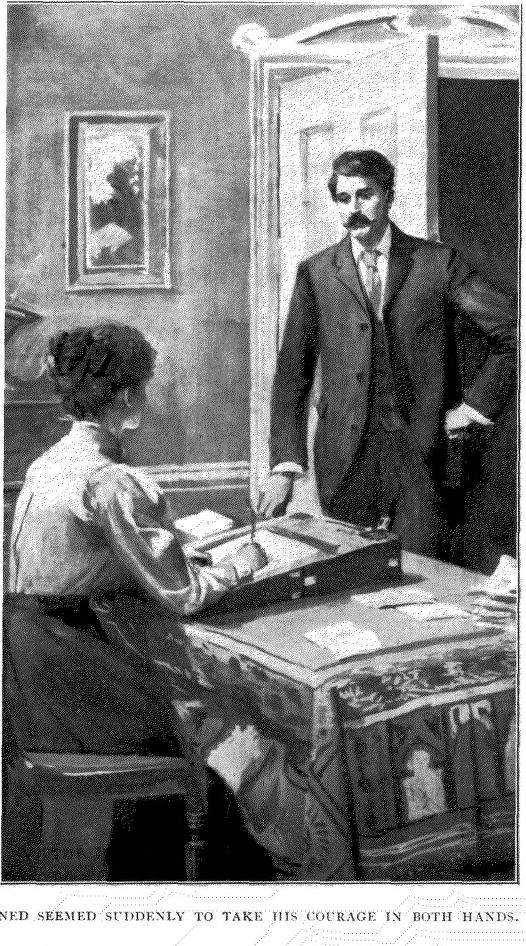
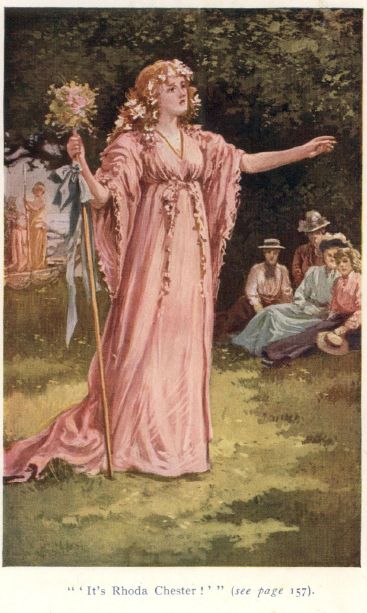
From A Houseful of Girls, 1902.

So the question of what was really lighting a fire under her about writing is an open one – she must have enjoyed it, but was it a financial need? I always thought she wrote for a longer time before remarrying and needed to support her family. Nonetheless, write she does with tremendous output. Wikipedia counts 31 books in the span of her brief career (another site says 33) and I think we have to assume there were magazine stories published as well. (There appears to be a collection of them published either right before or after her death.)

Her books are not especially brief. I would say they average around 300 pages. Reading them electronically it is a bit hard to tell. Sometimes two or even three were published in a given year.

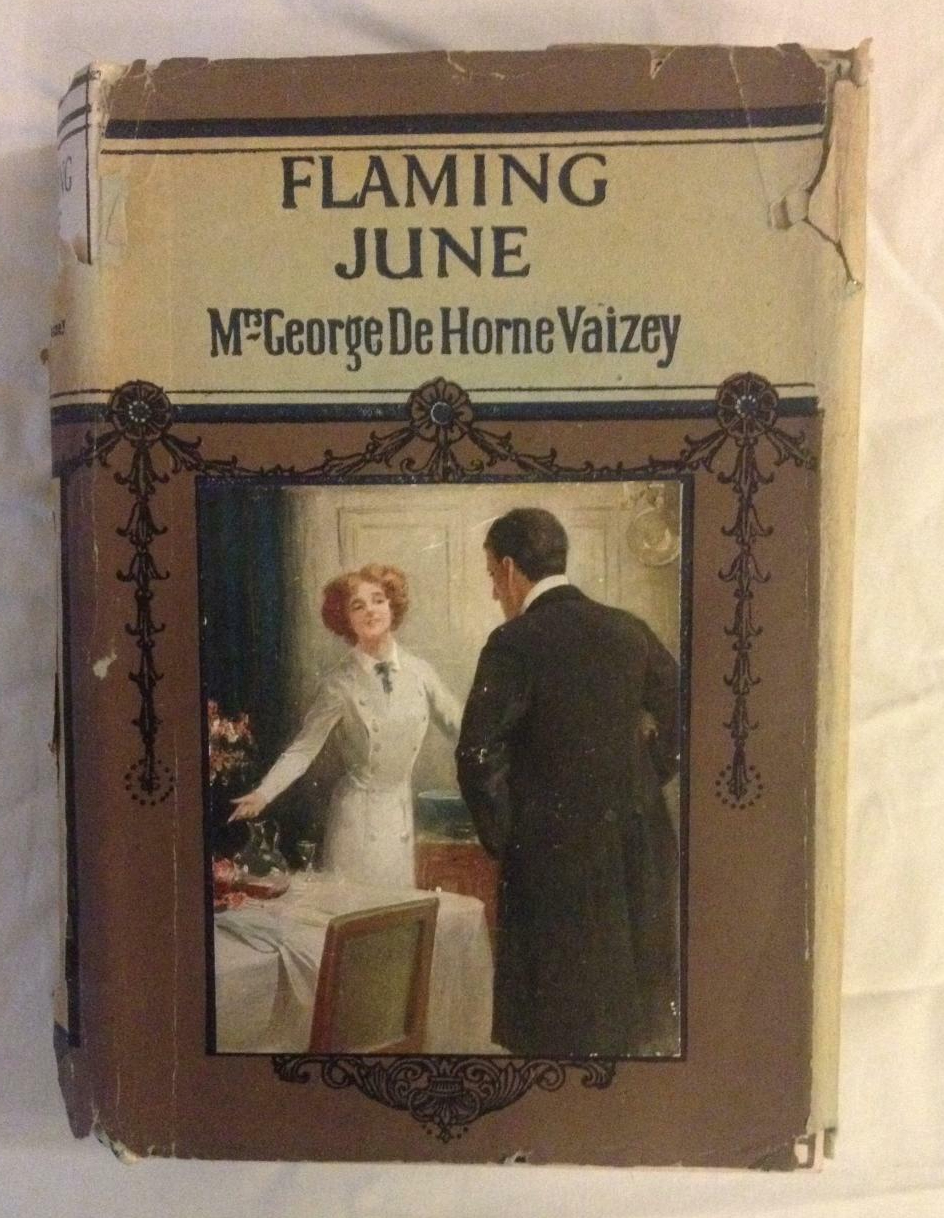
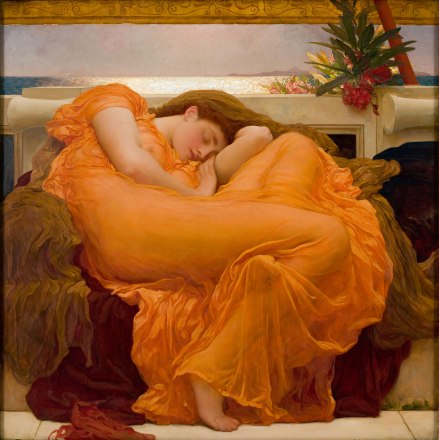
I have been thinking about her heroines as I read and as they grow in interest with her increased skill as a writer. They stop being simply likable (beautiful and loveable – gray eyes, long lashes) fairly early on and start to become more complicated. In Flaming June (note that the painting above is of the same name and was well known at the time – was she making reference to it? Frederic Leighton, 1895 – I say yes!) she has an American main character with a Western accent which, while effective, gets a bit tedious to read after awhile. (She also had a character with a lisp in one volume that started to drive me nuts. It seems to be a fashion for writers of the time to show all the accents they could write with.)
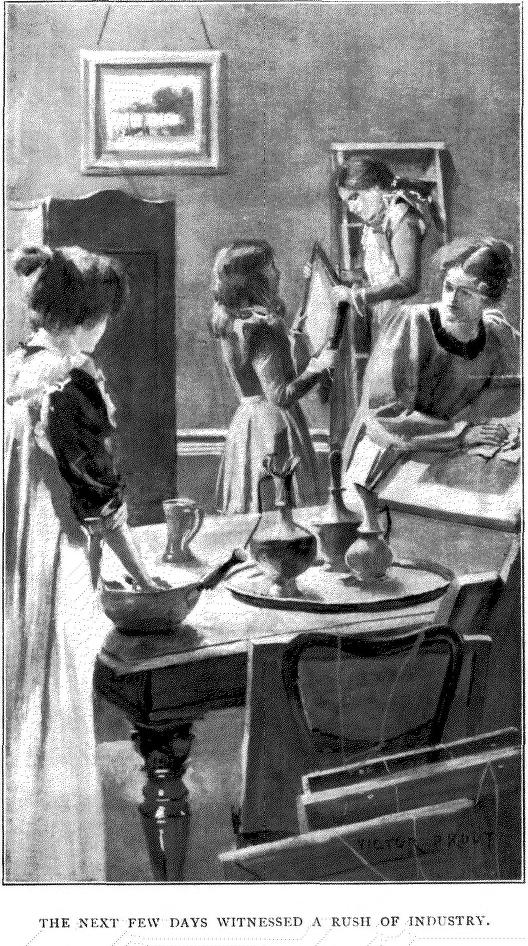
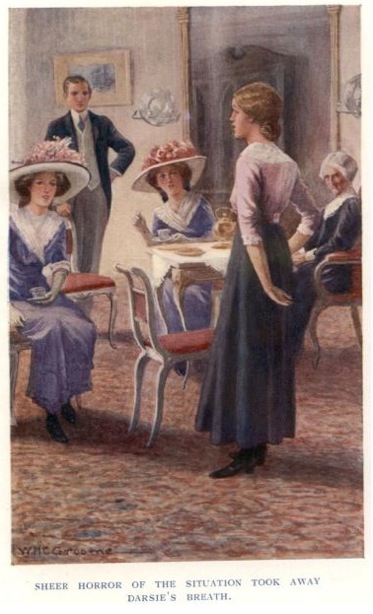
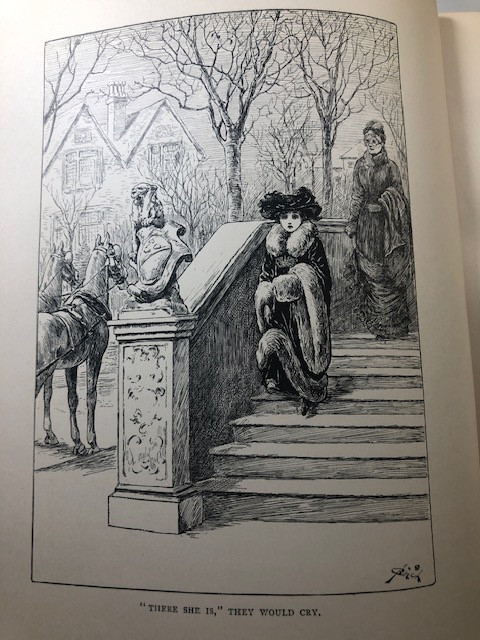
Also from A House Full of Girls.

However, over time her women grow into complex characters who are sometimes more interesting than likeable. For example, the woman in Flaming June is hot tempered and extremely independent. Much of the plot, and what happens to her both good and bad, centers on this quality as well as her stubbornness. It makes the story tick and, without being a spoiler I will say, gives it a somewhat quixotic ending.

In addition to greater character development her plots become more interesting and she leaves off the basic sort of worn tropes about school days and money acquired, lost and acquired again which were the bread and butter of her early writing and certainly for women authors of the day. A young woman of middling income decides to take a basement flat in the city and dress as a much older woman so that she will be free to help people in a way that an attractive young woman could not. (The eponymous volume is The Lady of the Basement Flat, 1917.) The story is worked however so that she also has a life at a country house where she is herself – of course the two weave together at some point. However, what a concept!

From Etheldreda the Ready, which I am currently reading, 1910. Definitely not one of her more likeable heroines! Etheldreda is utterly self-oriented and conceited, thus far anyway!

In What a Man Wills she takes a sort of well trod narrative path with a wealthy, ill, elderly man who invites four nieces and nephews for a long visit to decide who will be his heir. While, again without being a spoiler, I would say she doesn’t manage an entirely new take on it, she does well with expanding it and again, not afraid to make one of her main characters flawed.

Her women, even her heroines, can fall victim to vanity and greed, if not quite all the way to ambition. (She does poke fun at women authors occasionally with a sort of self-deprecation.) They are often a bit forward for the time and space they live in – especially those who reside in or come to find themselves in small rural towns. Financial ruin comes to people and families on a routine basis, but with a sort of detail that makes you think that for those who lived on investment income they way many people did at the time, that this was a very real event.

Her characters opine on the limited options for women – that they are not trained for anything to prepare them for life or possible ways to make a living. Therefore their fortunes hang largely on their ability to marry well – or remain dependent on a male relative or someone else to settle money on them. In the end this depends on how attractive they are and can make themselves and some of the more forward characters have a real struggle with this very real problem.
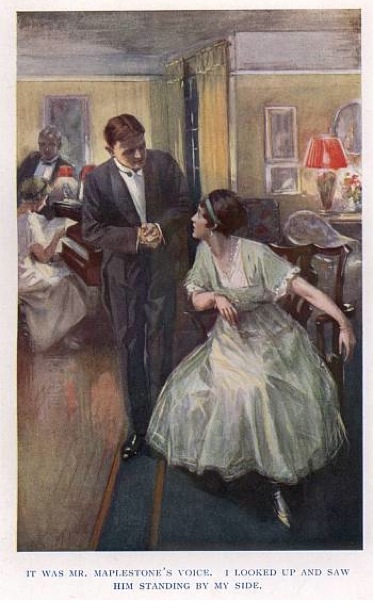
From The Lady of the Basement Flat – sadly I don’t have one of her dress as the elderly version of herself!

Frankly, the male characters tend to be a bit more one dimensional; she came from a large family and almost all of her characters do. Therefore, there are always a few brothers for color and plot development and of course there are suitors, and although we are privy to fewer of their thoughts and motivations, they are generally not fleshed out like the women are having they were often an end goal which offered security and a home in addition to whatever romantic interest was brought to the table.

The closest we come to the male prospective in the somewhat brilliant novel, An Unknown Lover. This is a complicated plot and while there is a woman at the center of it, we do get into the heads of both her epistolatory lover and brother and their motivations which help drive this story. Thus far I would say this is her best, published in ’13 so she is flexing her muscles, but not yet at the end of her life.

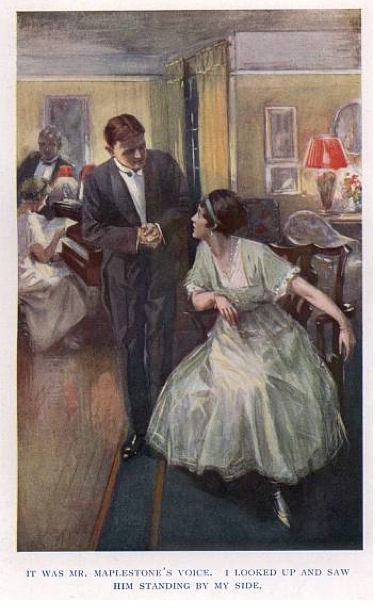
From Daugther of a Genius, 1903. A ner’do well father dies leaving his children to rely on their wits and creativity to make their way.

So my interest in women authors at the turn of the last century continues unabated. Watching them chafe at the conventions that defined their lives and dictated how they could live – sometimes these very conventions sentencing them to penury without a way to survive. It has been interesting to place her historically before some of my other beloved authors such as the adult novels of Frances Hodgson Burnett and Edna Ferber (a few of those posts are here and here, but there are others!) but interesting to add her to the timeline. Also, the play between the British authors and the American is interesting as women in the United States seem to have been freer to pursue a living more broadly than their British counterparts earlier on – and the conventions of our society a smidge less confining.

As stated in my earlier posts, Jessie de Horne Vaizey spends the last years of her life bedridden and dies in 1917. I learned recently however that it was first typhoid, then eventually arthritis which confined her to bed and she died unexpectedly during an operation for an appendicitis – so what made her an invalid is not what killed her. She does some of her characters painful rheumatic complaints, usually elderly men, but clearly she knew what she wrote of – and as someone who suffers from it myself, I can only imagine the kind of pain she must have had without the meds of today to help alleviate them. There are also many plot instances of long recoveries from illness, not unlike her typhoid I assume. She was my age when she died, but she made the most of her almost two decades as an author.
Part 2: Mrs. George de Horne Vaizey Cont.

Pam’s Pictorama Post: Apologies in advance for anyone who was peevish that yesterday was a book-ish post as I am going to wrap up (at least for now) my thoughts on Mrs. George de Horne Vaizey today as she continues to be my reading material of choice. (Yesterday’s post is here.)

I will confess I went for a long fallow period of not reading much and just one off books here and there when I was. Kim powers through all sorts of long and short term reading projects, both for his own edification and for things related to work, so I am jealous when I am without one too. However, I am there with the best when I find a rabbit hole to go down and therefore here we are today.

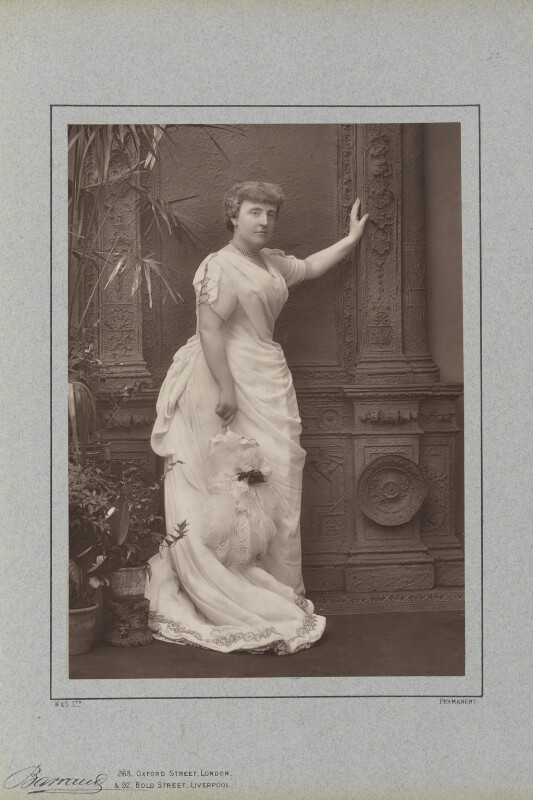
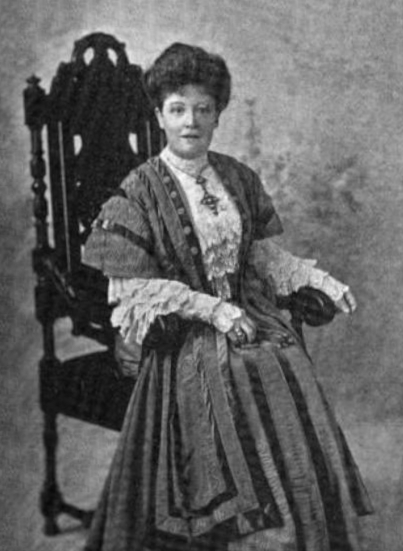
From Wikipedia and the only image of her I can find.

Mrs. G de HV as I like to call her, is fading from consciousness and seems to have barely been rescued for the digital age. If we are to look at the remaining availability of her published volumes, we have to assume that the Pixie books I wrote about yesterday were among her most popular, with a few other titles that seem to stand out. She wrote upwards of 32 books (I say upwards because Wikipedia does not always have every book published by an author although they do a good job of it) and clearly there were short stories. There is a collection of them mentioned as published in 1918. The list of her publications runs from 1897 to 1918, ending with that collection of stories. However, if I really want to read the widest swath of her work I will need to dig some. I would say about half is available online or for sale as antique volumes or occasional reprint.

From “Tom and Some Other Girls”, 1901.

Born Jessie Bell in 1857 as one in a melee of seven children (four brothers, two sisters) she was the daughter of a Scottish insurance broker. Her place of birth was Liverpool. She first married Henry Mansergh, a cotton broker, and published her first volumes under the name Jessie Mansergh. They had a daughter, Gwyneth Alice, in 1886. Mansergh was an addict which seems to have contributed to his early death. Reading between the lines so to speak, one wonders what part her early writing played in supporting them.

While I was certain that hers was a pen name of a type that was often adopted at the time, I learned that no, her second husband was indeed George de Horne Vaizey. She meets him while on a cruise which was a prize awarded for one of her short stories. They marry in ’98 and have a son, also named George, who goes on to be a writer. Sadly her own life ends as an invalid, confined to bed for many years. She dies in 1917 at about age 60 (her precise date of birth unknown) and therefore the final volume is posthumous.

From “A College Girl”, 1914.

Jessie uses her own life as whole cloth for her fiction. Large dynamic families, addiction, illness abound in her pages. Therefore, I have to assume that her evolving views on marriage and the relationships between men and women was also explored on her pages. If you’ve followed my previous musings on women writings of the early 20th century, you know that I found that even the juveniles such as The Radio Girls and Automobile Girls were gently ever pushing the line forward for what was permissible and acceptable for young women. (Some posts on those books here and here.)

Interesting to find Mrs. G de HV who is a bit earlier still than those authors and for me a logical forerunner of some. The line for women, the options they had in society for supporting themselves, is still more nascent although shifting all the time. An ongoing theme she explores is the unmarried middle class woman and her lack of options. I’ve already encountered several books where due to various circumstances the heroine is in some way prohibited or unable to marry and is faced with the issue of how to live their lives, preferably not just dependent on family. She seems to walk a narrow line – clearly a woman married to a man of means is the safest port in the storm.

She also confronts the daily reality of marriage – the idea that you are joining up with a mate who you will continue to make conversation with daily for decades. (I have often said that knowing that I would never be bored talking to Kim helped ensure a good union for us!) The sheer difficulty and exhaustion of running a house and caring for a family.

From “Lady of the Basement Flat”, 1917.

I am going to skip forward to An Unknown Lover, a novel published in 1913. (Some spoiler alerts ahead for those who care.) The author sets herself some unusual tasks. We have a heroine, Katrine, in her late twenties who has spent most of the last decade caring for her older brother who was widowed shortly after marrying. There are rarely effective parents in her books – adult children have either lost them or they are on the sidelines for some reason. I can’t even remember why they weren’t present to stop this hot mess of a situation – dead and forgotten in this case.

Anyway, both characters are beginning to chafe at the situation. The heroine opines on having all the responsibilities of housekeeping without the partnership of a true mate. She is also painfully aware that she is dependent on her brother for her keep, which comes to a hard point when he decides to remarry. She has no marketable skills and living in a small hamlet no prospects of marriage which is more or less what she is trained for. As a literary challenge, our author has placed an epistolary relationship through part of the book, which moves the storyline along. At first it seemed a bit awkward, but it grew on me. Despite some flaws and maybe questionable decisions, it is to date my favorite of her novels.

Love this title and looking forward to this one. Published in 1908.

De Horne Vaizey has beloved tropes – I’ve noted before a preponderance of gray eyed heroines, some have golden eyes as an alternative. An odd one seems to be a fondness for shipwrecks – I believe I may be up to three in her oeuvre to date. An interesting tidbit, while researching this post I came across the following in an Internet Archive version of An Unknown Lover which actually photographs the pages of a hard copy of the novel and included this forward below:

AUTHOR’S NOTE

Lest I should be credited with making literary material out of a disaster still painfully fresh in the minds of readers on both sides of the Atlantic, I should like to record the following rather striking coincidence.

On the fourteenth of April last, I was engaged in writing the description of the collision at sea in which the heroine of the present book plays a part; and after some deliberation as to the most forceful word to employ, wrote the sentence which originally ran as follows: —

”Mercifully it is not one person in many thousands who is called upon to endure so titanic an experience. …”

A few hours later my husband returned home and told me of the news which had that day thrilled the world — the foundering of the steamship Titanic on her maiden voyage.

Many weeks passed by before I could bring myself to continue the narrative.

Hampstead.

Jessie de Horne Vaizey.

Somehow she pulls out two parallel love stories and details the personal growth of Katrine as she makes some rather bold leaps forward to attain a measure of happiness and independence, gently breaking with at least some of society’s conventions.

Sadly Jessie de Horn Vaizey doesn’t live quite long enough to see the shift which occurs even in the early 20’s for women. At six or so volumes I have barely scratched the surface and if it is interesting enough I promise more to come.

Pixie and Mrs. George de Horne Vaizey: Part One

Pam’s Pictorama Post: It has been a very long time indeed since I have posted about a writer or books I have been reading. That is in part because the last year did not lend itself to reading. Helping during my
mother’s last illness and the months that followed, ultimately leading to my changing jobs at the end of the year, certainly there were books, but reading was sporadic. Love or hate my book posts, books are back and today kicks off an interest in Mrs. de Horne Vaizey, nee Jessie Bell, later Mrs. Henry Mansergh and finally Mrs. de Horne Vaizey.

Pictorama readers of long-standing know that in recent years (especially during the at home pandemic years) I chased down the writings of numerous authors including all the Judy Bolton mysteries (a post about those can be found here) and strolled through the collected works of several women who were writing short stories and novels that depicted the emerging woman in the US and Britain at the dawn of the 20th century.

These included the adult novels of Frances Hodgson Burnett (in several parts, but it all starts here),
the (glorious) short stories and novels of Edna Ferber (here) and the various series books including the Red Cross Girls, Ruth Fielding books and the many volumes of my beloved Campfire Girls. (Starting here, here and here if you are game.)

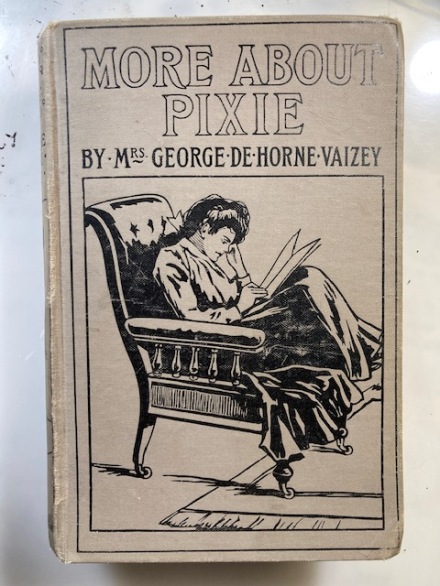
You might remember that my birthday this year turned into a day of poking around bookstores downtown, including The Strand’s re-opened rare book room. I picked up a copy of More About Pixie, the second volume in a three novel series by Mrs. George de Horne Vaizey (Mrs. GdeHV for my purposes going forward)

I was able to find the first volume of the books about Pixie online, Pixie O’Shaughnessy, with relative ease on my old friend Project Gutenberg. (All three volumes mentioned here are available on this free online resource as well as some others, although beyond these books only about half of her publications seem to be readily available. Many volumes of her work are also available at the Internet Archive.) I have largely been able to download illustrated versions of the books which I urge you to try to do as some of the illustrations are very good. (Oddly I can’t seem to open and share them here and show what I was able to find otherwise. I will add that the blog site isn’t actually allowing me to add images today so I apologize for the largely un-illustrated post!)

This first volume is a wonderful depiction of life in Ireland in the waning days of the 19th century. Written in 1902 it is a bit earlier than the copious volumes of my earlier reading I mention above. The impoverished, motherless (a recent loss) family resides in a dilapidated castle which becomes a sort of
character in the book, as does the backdrop of the small Irish town they reside in.

Pixie is a young child still at the start of this book – she is not a physically attractive youngster (this is an oddly defining characteristic that stays with her; her looks do not improve with age), however she has such an outspoken and winning personality that she always everyone’s favorite. To make up for her physical limitations as a beauty, she has two lavishly beautiful sisters (Mrs. GdeHV is a little obsessed with her heroines having gray eyes, they all do), Bridgie and Esmerelda, and attractive brothers in the bargain.
The funds are scraped together to send Pixie off to a private school in London and her adventures there make up the second half or so of the volume. (Esmerelda is hot tempered and so extravagantly stunning that she is somewhat done away with at the close of volume one.)

Written a year later, volume two, the one I picked up at The Strand More About Pixie, takes an interesting turn. It is in fact not so much more about Pixie, as the story is actually told by a young woman neighbor, a
recovering invalid, who lives on the street in London where the family decamps to at the start of this volume. Her encounters with the O’Shaughnessy family include Pixie, but in reality it focuses more on her friendship with one of the older sisters, Bridgie, who plays mother to the clan. Pixie does reassert
herself in the latter part of this volume, but it is Bridgie and the neighbor girl, Sylvia, and their friendship that is at the heart of the book.

Much of the book concerns the slow recovery of Sylvia (an illness which is given no name but has even affected her bones as they gravely consider needing to amputate her foot) who is another motherless child (life of mother’s was evidently cheap), living with an aunt while her father is away in India. (Mrs.
GdeHV likes to send men to India and bring them back after many years. To date I have barely been in India with her books, but wouldn’t be surprised if we end up there one of these days.)

It isn’t until 1914 that the final volume of the three is published, The Love Affairs of Pixie. Our prolific author has penned at least 17 volumes between these so it is a more mature writer who writes this novel. It interests me that she decided to turn her hand back to a now fully adult Pixie who returns as the heroine and focus of this story. Much of this story brings Pixie and the reader back to Esmerelda and Ireland, although the Ireland of this book is less lovingly described. Pixie remains unattractive on the face of things and in fact the book opens with her own discovery of this and is a theme throughout, but the pluckiness and good heartedness of Pixie has her as a sought after mate who (spoiler alert) finds her mate at the close of this volume.

Mrs. GdeHV clearly liked to assign herself challenges to keep things interesting. These are not formulaic series books (not that there’s anything wrong with those!), but instead you can see her making choices and setting up approaches to keep things different and interesting. I’ll cover more of her biography tomorrow, a sort of sad tale despite being a very prolific writer. She must have been popular in her time, but sadly volumes appear to be hard to find and I know she wrote short stories but none of those have turned up yet. However, I have only just begun my research so undoubtedly more to come.


Red Cross Girls!

Pam’s Pictorama Post: I think I will always look back on this year and a half (heading into two year) period as my plucky young woman literary fiesta. It probably isn’t a coincidence that this, difficult period of time has made these stories of achievement under great duress appealing. Working my way through the work of author Margaret Vandercook in particular has been wonderful and these books have contributed to a longer reading project which builds on the changing role of women during the first part of the 20th century. Nursing on the front lines during the war, even driving ambulances there, was an enormous departure for young American women and according to these books they also lead the way for young European women to do the same.

As long-standing readers know, I started my journey with Margaret Vandercook via her many volumes of Camp Fire Girls books, took on the somewhat more raucous Ranch Girls next and am now investigating and celebrating the ten volumes devoted to the Red Cross Girls. (Some of those prior posts can be found here, here and here.)

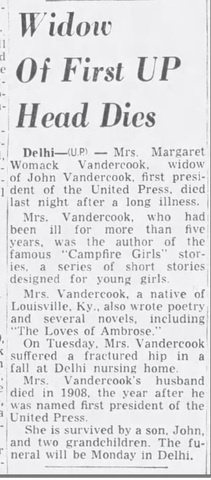
I came across an obit for Marjorie Vandercook clipped from an unknown, undated source – very little information seems to survive on her and this is the first obit I stumbled onto. It doesn’t supply much information, but I include it here for anyone else who might find it of interest. Of course they lead with her husband’s accomplishments and barely touch on her own contribution!

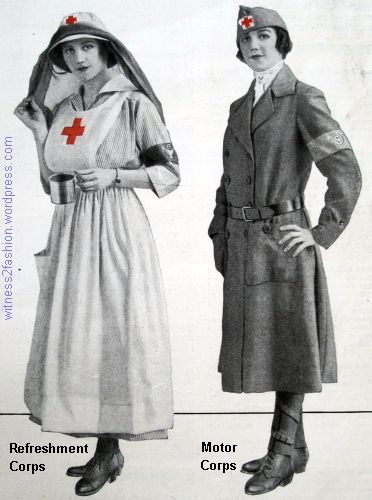
My first question was, did young women really do this? I mean did young women volunteer and head out to Europe to work with the Red Cross? Seems a bit crazy and it’s a bit hard to say. Obviously Red Cross nurses served in Europe during WWI, about 300 lost their lives working on the front lines. It isn’t clear what qualifications were expect however and if young women who had “a nursing course” or even less experience actually went over such as our heroines did, is hard to track down. Nurses, it seems for the most part, were from working class or rural backgrounds although some were indeed from affluent families, a mix like we have in volume one. So let’s assume that the role of our heroines is relatively realistic for starters.

Via witness2fashion.com as noted above.

Certainly the war that was being described was more or less torn from the headlines of the day since these books were published starting in 1915. Four women start out from New York City on a ship heading to Europe. Their first adventures and a few plot points that will reach several volumes occur onboard ship before making landing in Britain which is their first stop before nursing wounded British soldiers in France. (Vandercook must have had several of these books outlined to some degree, dropping in opportunities to come back and layer on plot in future volumes.)

I wondered how Vandercook would handle the sheer horror of nursing on the front lines with the sort of story line she generally develops and I report that she does an admirable job of it. Admirably, somehow she neither downplays the dangers and horrors of war, nor does she dwell too much on the gore. Of course the tales of valor are overblown, but after all these are fictional volumes for younger readers.

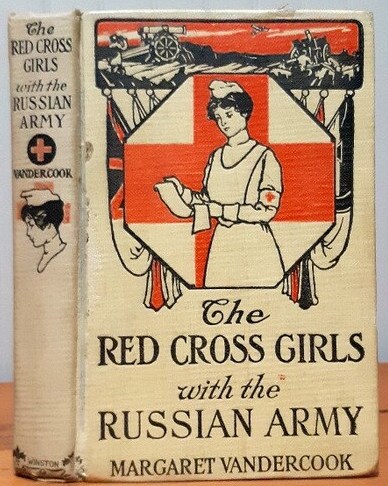
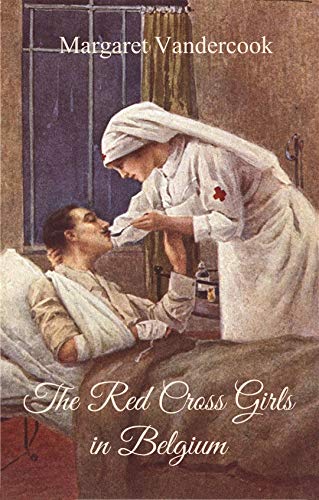
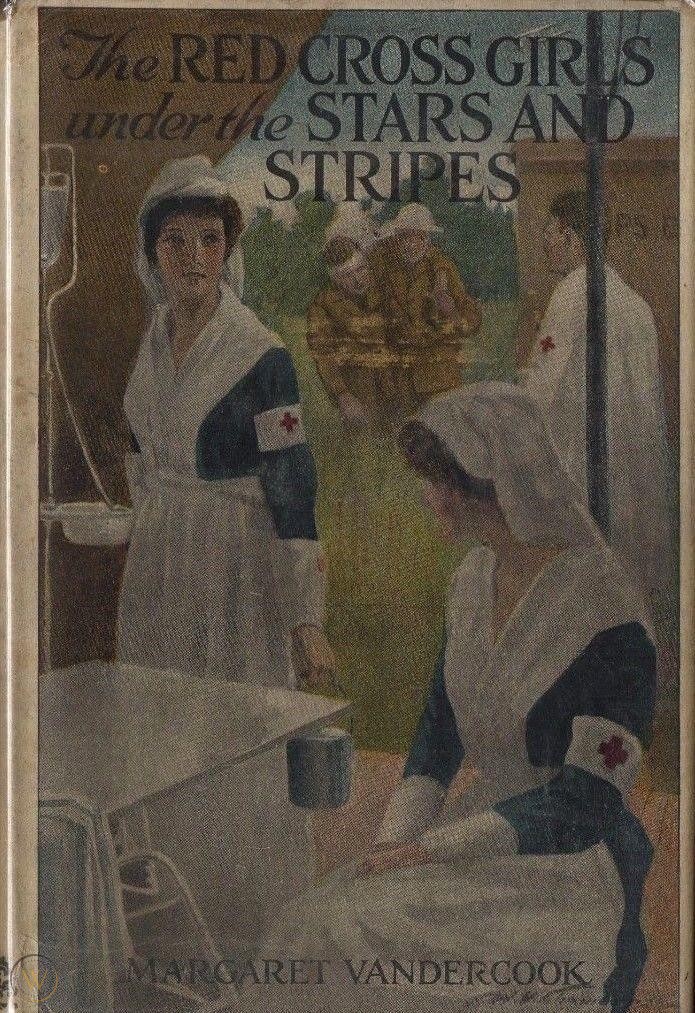
Dust jacket from volume 3.

Plucky indeed these young women are too. While the Campfire Girls had an interesting creed and much ceremony, the Ranch Girls just had a sense of the wild west where they had their origin. The Red Cross girls fall somewhere in the middle – there is a code for behavior and there are references to their need, like soldiers, to follow orders and fall in with the greater good for the whole. It would seem there is a creed – whether it had a basis in reality or not I cannot really say, but I would imagine that the spirit was there at a minimum although it isn’t as codified, nor as lore filled, as that of The Campfire Girls.

It is interesting to be reminded that the Red Cross nurses and doctors were of course technically neutral by definition. The United States would not enter the war until 1917 and the ethos of the Red Cross was (is) apolitical. However, these were stories going out to an American readership and the clear lines of sympathy for the British and French soldiers and a fear of the Germans is evident.

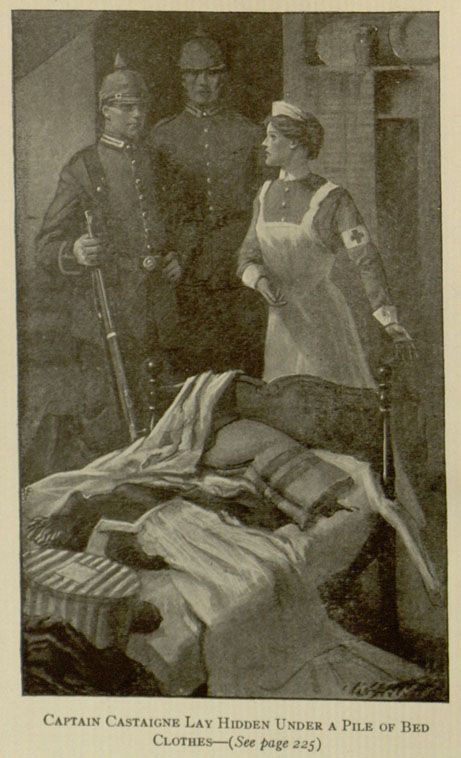
Illustration also from volume 3.

As of the volume I am currently finishing – The Red Cross Girls with the Italian Army – the fifth and published in May of 1918, there is no mention of the influenza epidemic which would certainly take headlines later that year although I assume will find its way into subsequent volumes. The first four volumes form a story arc and the fifth, harder to obtain as an e-book, seems to mostly to be tying up some loose ends and perhaps planting some new plots for the remaining second half of the series. The United States will be entering the war soon, presumably in the next volume.

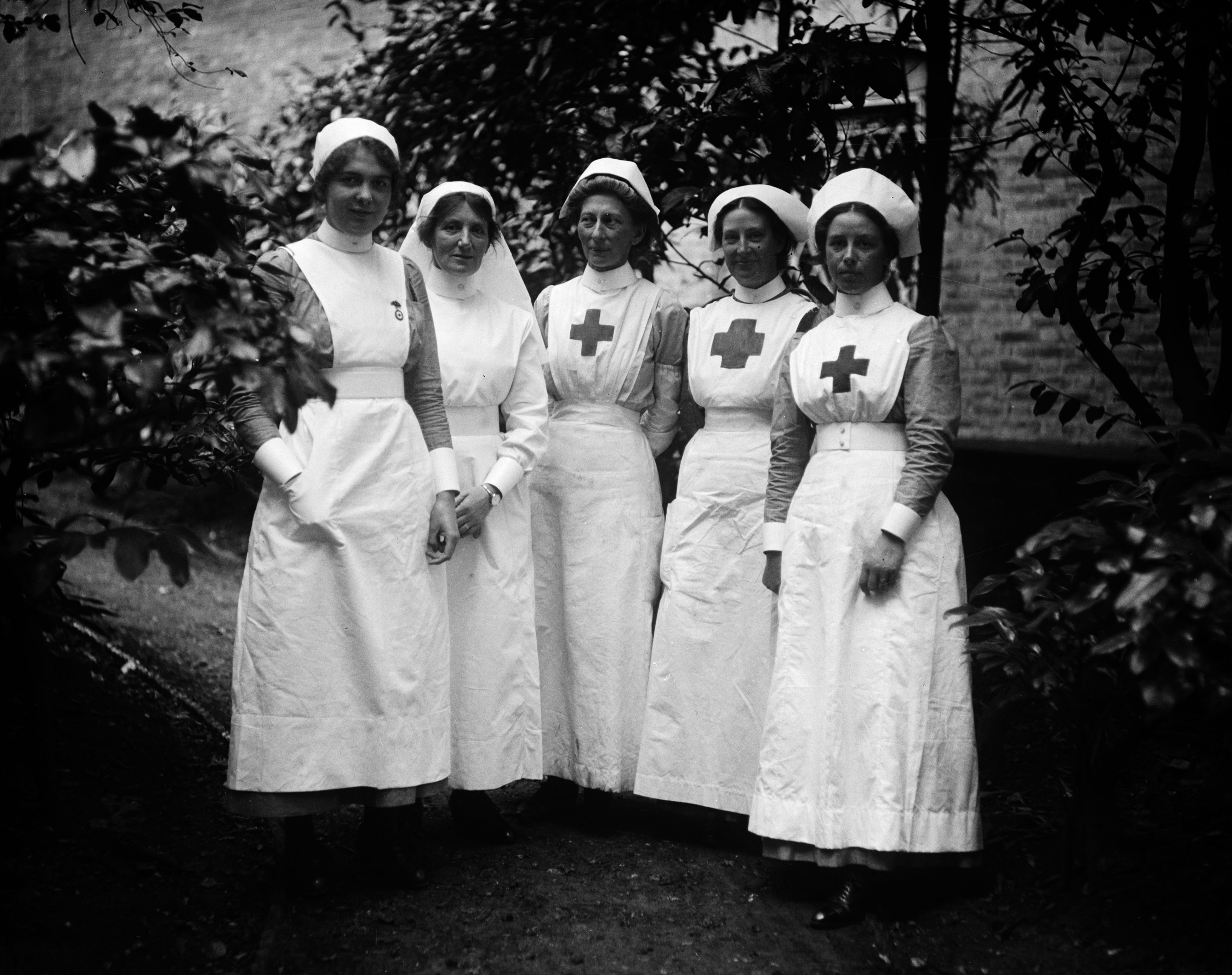
September 1915: A group of nurses at Hamworth Hall which is serving as a Red Cross Hospital during WW1. (Photo by Topical Press Agency/Getty Images) via Time magazine.

I am reminded that we are reading these books with the benefit of historical hindsight. Marjorie Vandercook had no way of knowing that it wouldn’t be be that many years before the world was back at war, barely a generation, and the fictional futures she thought she was securing for her heroines would perhaps be less than untroubled. It is hard not to read them knowing of the tumult of the political upheavals of Russia and that the sons of this generation would be the soldiers of that next enormous war.

The first three volumes of the not quite five I have thus consumed, were the most compelling with The Red Cross Girls in Belgium being my favorite. I found the novel concerning their time in Russia, The Red Cross Girls with the Russian Army, a bit hair raising actually. What on earth were they thinking going to Russia? How did they even get there? Of course you should read it, but I am warning you, it puts you a bit on the edge of your seat.

This may be the only accessible volume from the second half of the series, but you know I will try to ferret them out!

As alluded to above, the first four volumes were easily available on Project Gutenberg as free e-books. After a bit of searching I located the current volume on the Internet Archive site. While they e-books don’t seem to be technically downloadable they are still easily read online and they have bailed me out on obscure volumes before. I think I will have some trouble acquiring the remaining volumes of the series which seem to follow the American army through other parts of Europe and then home. With any luck, I will be able to report on those in subsequent posts.

Judy Bolton, Girl Detective: Part One

Pam’s Pictorama Post: Pictorama readers know that I have a very real soft spot for juvenile novel series and I detour today to begin a fairly long missive about girl detective, Judy Bolton. I have been reading these on and off for the last year or so. While I may tend toward the completist even in my following of favored authors (see my thoughts on Edna Ferber here and my numerous posts on Frances Hodgeson Burnett’s adult novels, which start here and here), I am a persnickety reader of series books, acquiring them and reading them in order. A missing title in one of these is a real fly in the ointment from my perspective. Just a warning before you really settle in, spoiler alert as I will probably end up giving away some of the series plot line.

I did a long stretch of reading and reviewing as I worked my into and through a number of other series. I never read any of them as a child. My sister Loren was the Nancy Drew reader in the family and I can remember admiring how nice they all looked lined up in a bookcase in her bedroom. Somehow they just really belonged to her though and I never read them, although I guess I could have with some wrangling. (The same is true for the Black Beauty books and the Tolkien novels. These were things I associated with her and territory I never entered.)

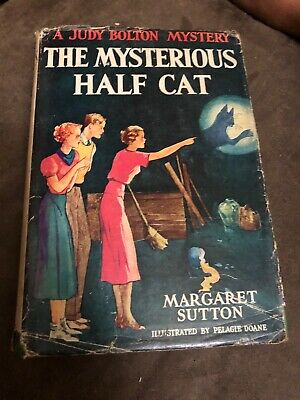
Among my favorite series discoveries are Honey Bunch (my review can be found here), Grace Harlowe, the Automobile Girls and especially The Moving Picture Girls novels. (A post devoted to those can be read here). I had put my series reading on the back burner and was focusing more on authors when Kim got a tip that I might like the Judy Bolton series and purchased one for me appropriately called The Mystery of the Half Cat.

s-l400-1.jpg

I took to Judy Bolton like a duck to water and I have been weaving them into my reading since. As I write today, I am halfway through the 40 volumes in the series, although it should be noted that only 38 were written by the original author, Margaret Sutton. (Margaret Sutton, aka Rachel Beebe.) The books were largely published by Grosset & Dunlap. Unlike the Stratemeyer syndicate books, Margaret Sutton was a real person and wrote all of the novels in the series herself and this is evident in the writing. While these are still all based on formula (mystery introduced in the first quarter of the book, develops in the second, is positively puzzling obfuscation in the third and resolves in the last) Judy develops as a character over these many volumes. Wikipedia offers the interesting comment that it may have been pressure from Stratemeyer that killed the series rather than flagging sales in the interest of Nancy Drew, but nowhere can I find an explanation of how this played out amongst their commingled ownership and whatnot.

****

Judy Bolton as a character is interesting and a bit complex. She appears to age more slowly than the years it takes for these volumes to unfurl, the first twenty books span from 1932-1949 and Judy seems to start at her senior year in high school and then hovers in the year or so just after, time advancing slowly while she works in the newly opened law office of her sweetheart and eventual fiance, Peter Dobbs. (They marry in the 17th volume, The Rainbow Riddle. Marriage does not appear to diminish Judy any.) Her parents would have liked her to consider college, but she has decided that working with Peter and unpaid sleuthing is her destiny. She is an odd mix of a more modern woman and one of her late thirties, early forties decades.

What I like best, in some ways, about Judy Bolton is that she is actually quite unlikeable at times. She is stubborn and sometimes myopic and self-indulgent. Other characters routinely call her out on it, as they should. There is something very human and endearing about her gaffs however and she generally recognizes her mistakes, as most of us do, and makes them right.

Early on Peter gives Judy a black kitten she names Blackberry (he of the half cat above) and he routinely finds his way into most, but not all volumes. This of course endears the series to my black cat loving heart! Her brother Horace acquires a white cat who seems to disappear in later volumes, but he also acquires a rather rude bird who remains prominent. Horace shows up in most of the volumes, playing a bigger role in the early volumes.

Judy’s affections swing between Peter and the wealthiest boy in town, Arthur Farringdon-Pett. Most remarkably, Arthur owns an airplane – how could a girl resist that I guess. Judy and Arthur go so far as to get engaged in later volumes, until Judy realizes her heart really belongs to Peter.

It interests me more than a little that people actually die in this series. Criminals die, people die in car accidents, her grandparents eventually die over time. Meanwhile, a lot of children are being raised by somewhat random people or given to orphanages, and therefore there are several mysteries which resolve in people being related to otherwise unlikely people – long lost heretofore unknown siblings, cousins. Perhaps for someone writing in the post-Depression era this was somewhat less unlikely than it seems today. People found themselves impoverished and left babies for adoption or even just with other people.

The series opens with Judy forced to leave her hometown of Roulsville in favor of higher ground in nearby Farringdon, an imaginary exurb from which recognizable places in Connecticut and Manhattan can be reached within a day’s trip. There are farms, Judy’s grandparents have one in Dry Brook Hollow – a seemingly poorly named area as that is where the flood occurs in book one. It is theoretically based on the Pennsylvania area where Sutton grew up and returned to for the inspiration for her novels.

The stories build on each other and landmark events are retold which advertise earlier books, but also adds to the sense of the created, shared universe. Certain key events, like the flood in the first volume, are mentioned in virtually every volume – sometimes in more or sometimes less detail. Other stories waft in and out of the tale of the moment, depending on the relatedness of the current cast of characters and location. It is said that each book was started from a kernel of a real incident, such as the flood, which inspired Sutton.

Judy’s father is a doctor, but somehow they only hover at the line of middle class. Early on Judy expresses discomfort with the wealthier girls in school – understandably because they treat her poorly at first – but also equal insecurity about how to act around a neighbor who is poor and attends the local secretarial high school, leaving eventually to work in a factory. (I have to just take it on faith that secretarial high school was a thing – like technical schools of other kinds which have morphed more into college years than high school now.) Their town, Farringdon, has a strict dividing line between the “good” area of town and the “poor” area, although one thing that seems to be entirely absent are people of any ethnic group at all, no one is black, Jewish, or hispanic. I believe Gypsies are mentioned, but not in a good way. There are hoboes and all sorts of men who are only marginally employed. They are almost always threatening and have ties to the local underworld.

IMG_1942 2.JPG

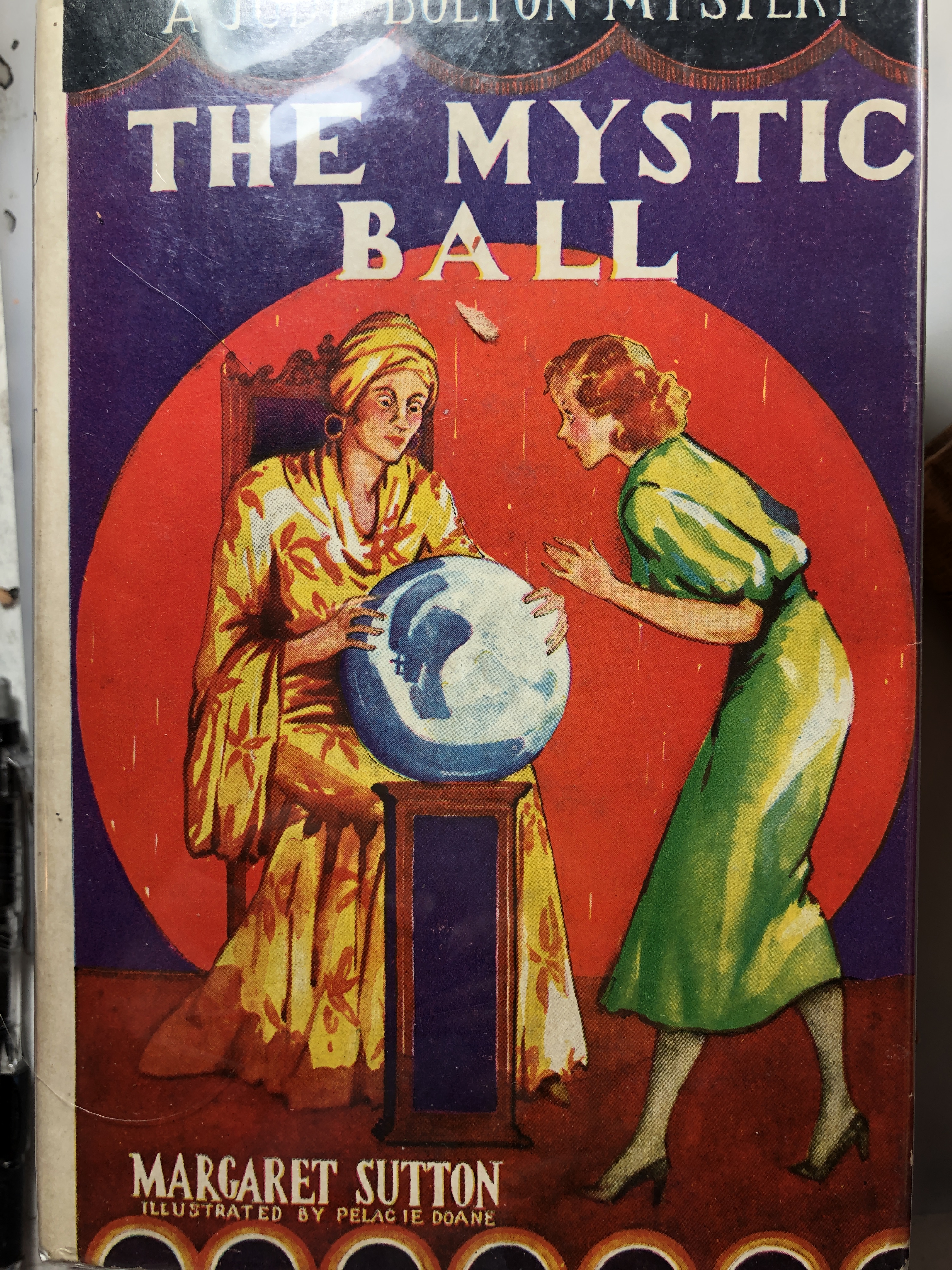
Evil Gypsy fortune teller in this volume.


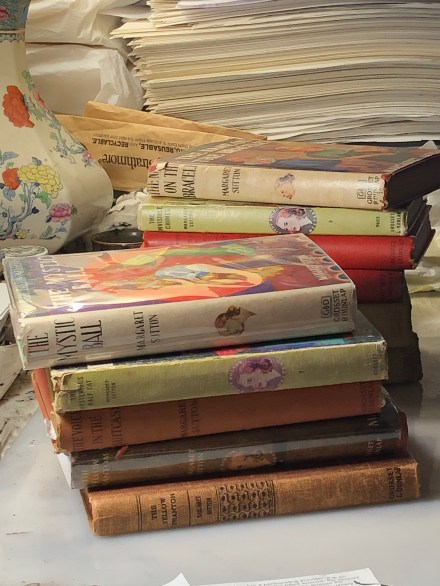
Oddly, these books are not available on Project Gutenberg or other online sources and therefore it has been necessary to purchase the books which I have generally found used on ebay, paying on average about $10 each with shipping. (The series has been reprinted in paperback, which might explain the extension of the copyright, but those tend to be more expensive than just purchasing the old volumes.) For the most part purchasing the old books has been fine; I think only one has fallen to pieces in my hands while reading it and only one other went astray for a period before showing up on 86th Street. A few have even sported dust jackets. (The books are nominally illustrated by Pelacie Doane and I will only offer that they are appropriately period drawings and covers.)

IMG_7926

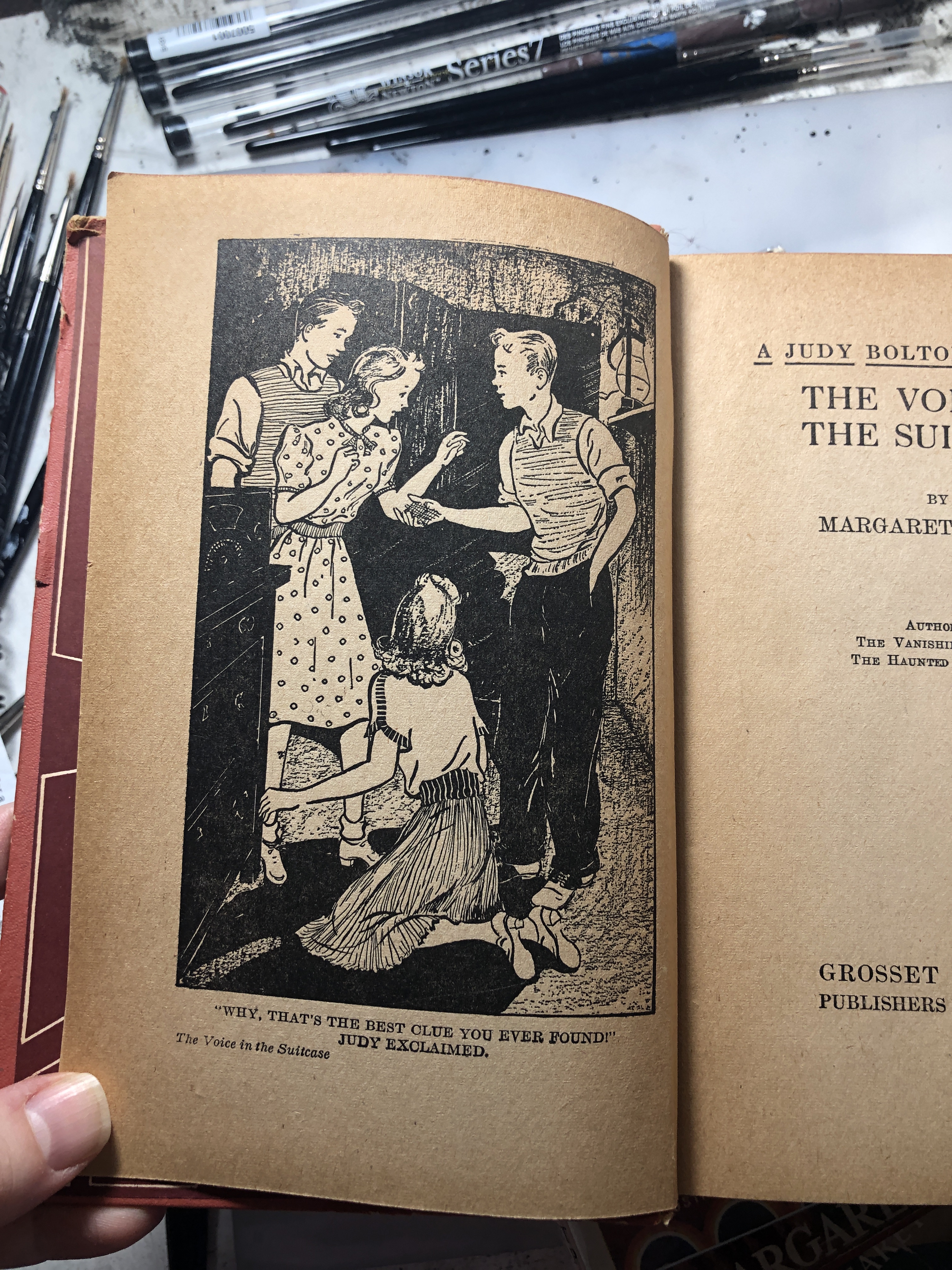
I can’t say I find the (limited) illustrations inspiring and sadly could find none featuring Blackberry.


I’m not sure what happens when I am done with these volumes – we hardly have shelf space to devote to 40 volumes although part of me loves the idea of the long line of matching volumes. I guess I will either resell them or give them away. Kim has expressed interest in reading a few so I will keep them around for awhile. Research online tells me that the later ones may get difficult to find and since I am generally a completest in most things I will be bereft if I can not read them all.

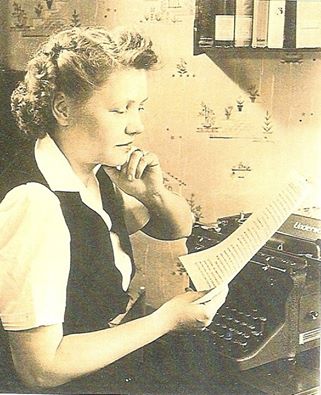
Margaret-at-her-typewriter-courtesy-of-Lindsay-Sutton-Stroh.jpg

Sutton in one of her author photos.

October is the month when the annual Judy Bolton Weekend is held in Cloudersport, Pennsylvania. This four day fiesta celebrates all things Judy and Sutton. I am already working on enlisting Kim in that adventure later this year – although it is admittedly far and the travel route without a car is a bit unclear from New York City. In addition, there is a fan club run out of Mt. Carmel, PA which is devoted to Judy, Nancy, Trixie Belden and the like. All this to say, having already gone on for quite a spell, there is still indeed more likely to come.

Frances Hodgson Burnett: the Fashion, Part 4

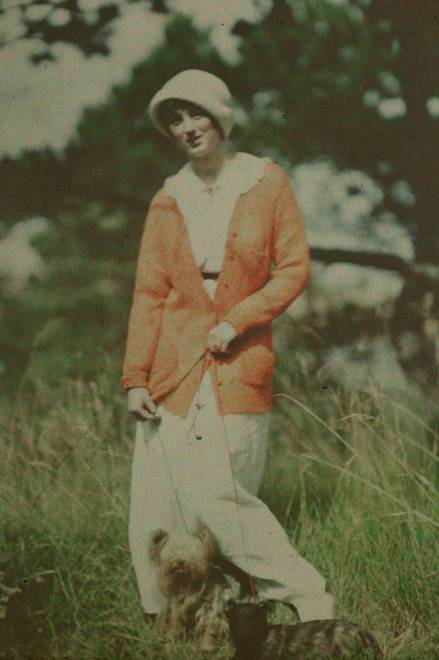
Pams Pictorama Post: I am wrapping up this summer reading series on the adult novels of Frances Hodgson Burnett with this post on the lavish and lovingly described clothing in her stories. It is clear from her detailed descriptions that she loved fashion and had thoughts about clothing and what it meant. I share an autochrome of a well dressed woman of the day by Helen Messing, a French photographer, taken in 1912, as the featured image and to set the tone for today. For anyone who has just wandered in, the first three posts can be found clicking on the following: Frances Hodgson Burnett, an Excellent ReadFrances Hodgson Burnett, Part 2: the Grown-up Books;and Frances Hodgson Burnett, Part 3: The Women.

Frances Hodgson Burnett was one of those people who lived long enough and over a time to experience fashion from the days of whale bone corsets to the nebulous non-supportive skivvies of the 1920’s. One interesting quote which I pulled out off the internet concerned her own wedding dress. The story went that she had a long engagement to her first husband, Swan Burnett, and with the earnings from her writing had a couture wedding dress made for herself on a trip to Paris. They were to be married in Tennessee and she shipped the dress there. For whatever reason, now lost in the telling, it was delayed and despite her urging, he would not postpone the wedding for the arrival of the dress. Writing to a friend about her new husband she had this to say, “Men are so shallow … he does not know the vital importance of the difference between white satin and tulle, and cream coloured brocade …”

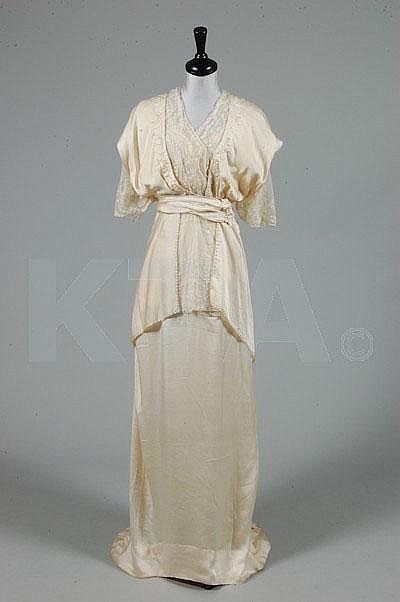
Wedding dresses are a significant point of discussion in T. Tembarom. In this novel of 1913, the hero finds his foothold as a cub reporter taking over the society page of a New York newspaper. Temple realizes that learning how to describe the wedding dresses accurately will win the favor of the socialites (and their dressmakers) who he needs to befriend for material. Therefore loving descriptions of him laboring to learn the nips and tucks of white peau de cyne trimmed with duchess [sic] lace and other fashionable wedding garb of the carriage trade ensues and descriptions of finery become his stock in trade. I share a photo of something like what he was talking about below, from the period and for sale online if  you are so inclined. (Clearly a bit worse for wear but only fair to consider it is over 100 years since it was sewn.)

tumblr_ltweanbtjZ1qidnqfo1_500

Worth gown circa 1913


Later in the same book, Temple’s fondness for his elderly relative is expressed through the wardrobe he has made for her in London. Below is a bit of an excerpt from the novel:

Mrs. Mellish became possessed of an “idea” To create the costume of an exquisite, early-Victorian old lady in a play done for the most fashionable and popular actor manager of the most “drawing-room” of West End theaters, where one saw royalty in the royal box, with bouquets on every side, the orchestra breaking off in the middle of a strain to play “God Save the Queen,” and the audience standing up as the royal party came in—that was her idea. She carried it out, steering Miss Alicia with finished tact through the shoals and rapids of her timidities. And the result was wonderful; color,—or, rather, shades,—textures, and forms were made subservient by real genius. Miss Alicia—as she was turned out when the wardrobe was complete—might have been an elderly little duchess of sweet and modest good taste in the dress of forty years earlier.

In the subsequent pages of the novel, the fragile and shy Miss Alicia is given confidence on several occasions by her extremely well conceived of and thoughtfully considered clothing. (This speaks to my own belief that women’s clothing – and jewelry – are like armor for battle. I urge – choose wisely!)

Like many of her characters, it is reported that Frances turned to her own sewing skills during leaner periods of her life and, among other things, sewed elaborate outfits for her sons – a la Little Lord Fauntleroy. Her writing is peppered with allusions to line and properly made clothes – dresses of old pillaged and remade resourcefully for deserving young, dewy, emerging impoverished belles. I believe I have mentioned the fact of me and sewing – which is that I can re-attached a credible button but not much beyond that. Therefore the idea of remaking dresses and whipping up new ones wholesale is utterly alien to me and vague notions of Project Runway is all I can summon.

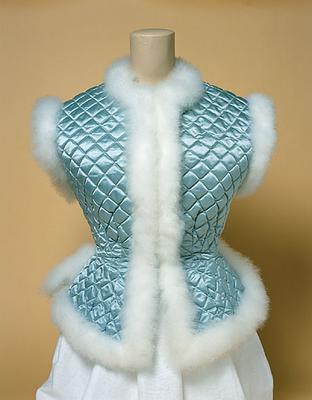
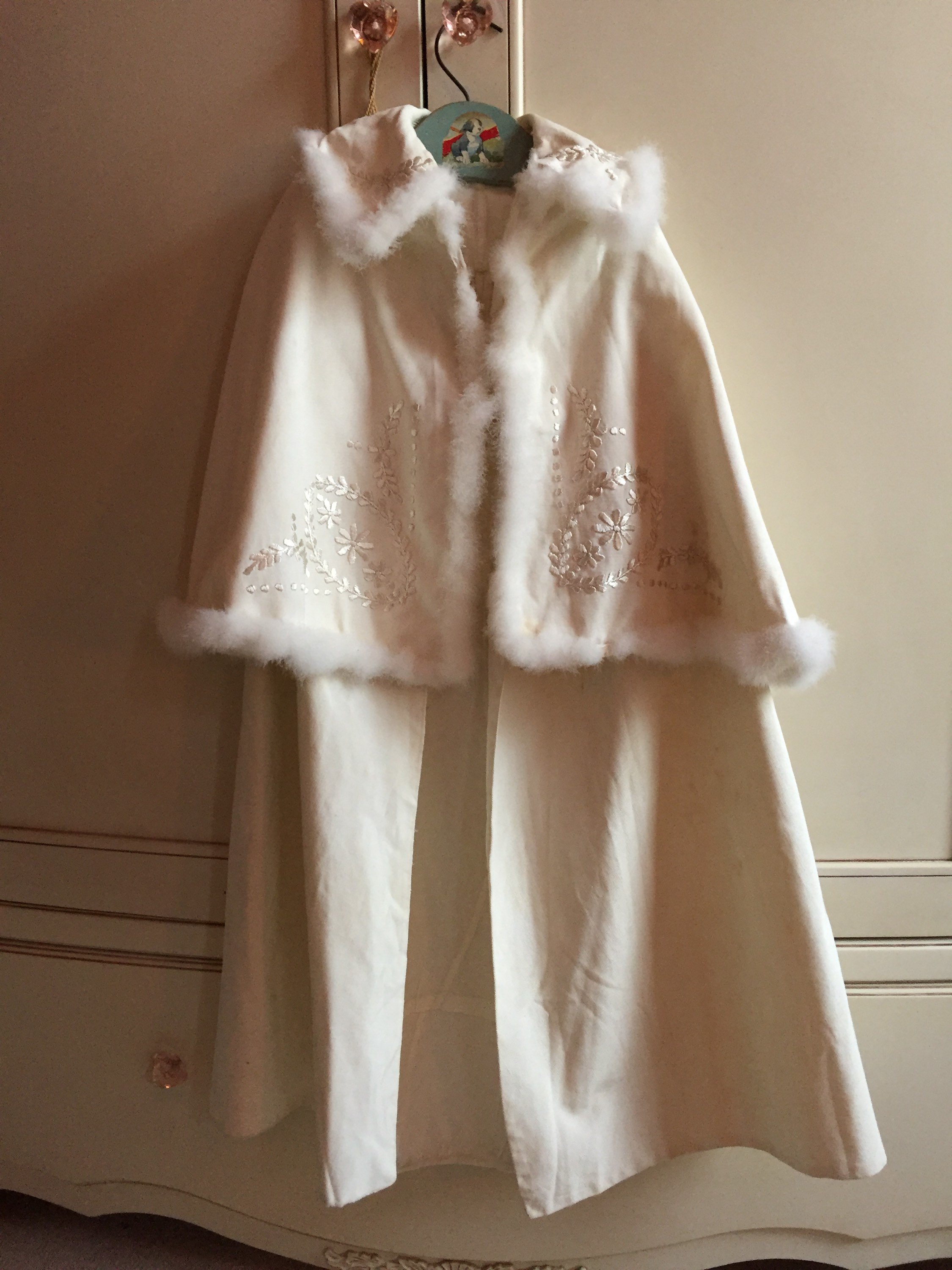
In the novel, Vagabondia, published in 1884 we get a glimpse of even earlier fashion. (This is a slightly different type of book about a happy Bohemian family of artists and their salon of hangers on, both rich and not.) The description of a purple dress as trimmed with swan’s down (really?) gave me pause and sent me running to Google. Evidently swan’s down was used as a less expensive replacement for fur, primarily at the end of the 19th and early 20th century. I will spare you the description of how exactly this is extracted from the unfortunate fowl. It was so popular at one time that swans were in danger of extinction.

WaistcoatManchesterGalleries1

Period blue silk vest trimmed in swans down, via i10.photobucket.com or Pinterest


swans down trip 1900 Etsy

Victorian Edwardian child’s cape/coat trimmed with swan’s down, for sale on Etsy at the time of writing


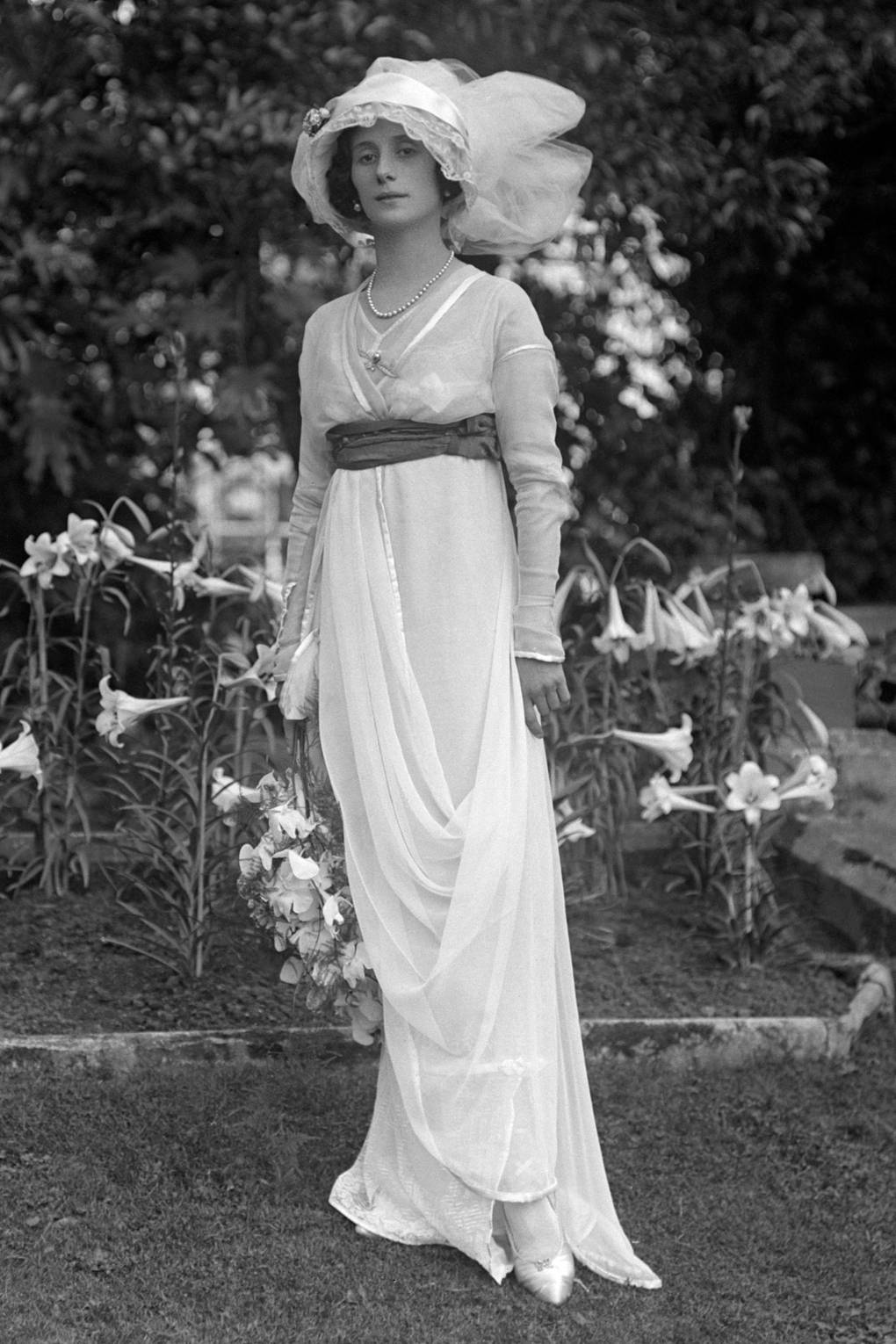
The concept of a simple white muslin frock with a ribbon belt like the one below comes up in virtually every novel and short story – sometimes as a supporting character, sometimes a main event. In its own way this was the little black dress of its late 19th and early 20th century day – although of course it was the exact opposite as instead of sophistication a la Chanel, it was to show off simplicity and innocence. It was the dress that could be simply sewn and easily afforded, and theoretically allowed the native beauty of the wearer to shine. Burnett has wealthy women of the world who embrace the simple muslin gown as a way of showing their simple underlying beauty – while a clever poor good seamstress could whip one up for herself (or sometimes for a beloved sibling) and unusually beautiful this simple dress could let their beauty shine through – and perhaps even show up some catty, wealthier acquaintances.

1912_apavlova_v_12apr12_pa_b

While Frances Hodgson Burnett probably would not have been willing to say that clothing makes the man. However, she had a deep understanding of how critical clothes were to how women defined themselves in the world and used it to a descriptive advantage in her stories. At a time when women didn’t have a lot of tools for defining themselves at their disposal, Frances Hodgson Burnett’s interest in them and use of them in her narrative was not coincidental nor casual. My guess is that she had given a lot of thought and understood it in a personal way.

Frances Hodgson Burnett, an Excellent Read

IMG_2380

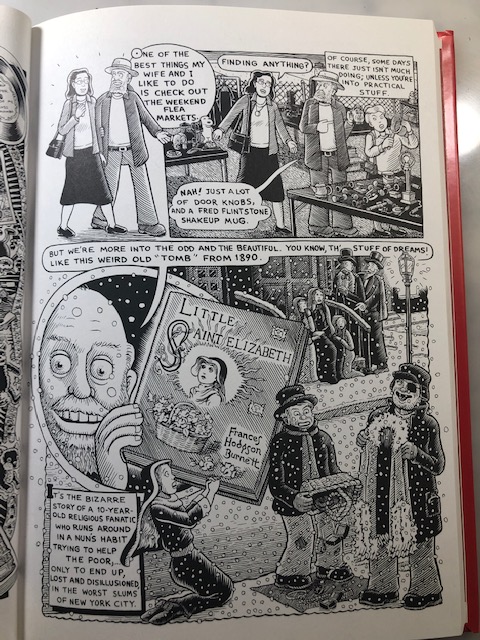
Kim drew Little Saint Elizabeth into this illustration in his Alias the Cat!


Pam’s Pictorama Post: In some ways it is crazy to think I can tackle this subject in a blog post so I will start by saying, this is a warning shot over the bow – I am just skimming the top of very deep water indeed today with an expectation of subsequent entries.

As the author of childhood favorites such as A Little Princess, The Secret Garden and Little Lord Fauntleroy we all know Frances Hodgson Burnett and the classic films (and many remakes) made from her stories. I read them as an adult and especially loved The Secret Garden. As much as I liked the film, the book had much more flavor and depth.

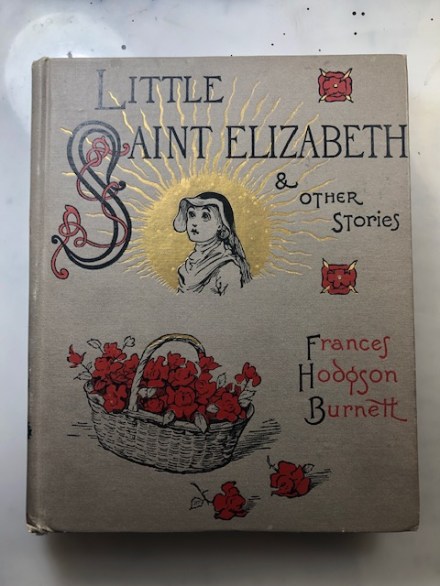
I had not however given these stories or her much thought in years however when Kim stumbled on and purchased Little Saint Elizabeth a beautifully illustrated volume of stories, ostensibly for children although the title story is a bit gruesome and had a similar, appalling ending to Anderson’s Little Match Girl. We found it at the now mostly eradicated flea market on 24th Street here in Manhattan. He purchased it for very little and we considered it quite the score.

IMG_2381

From the story Little Saint Elizabeth


Somehow it did not inspire further digging at the time and it wasn’t until a few months ago, while whining one night in bed about a delay in receiving my next volume of the Judy Bolton series to arrive (future post about that series pending there), that Kim suggested I poke around Burnett’s adult fiction. (May I just take a moment out to say, you really do want to marry someone who is going to make helpful, smart suggestions like this. I do think it is the very best part of being married and no one thinks to tell you that. Choose wisely I say!)

Thanks to Project Gutenberg this could be accomplished with great alacrity, at the speed of a download. For those of you who have yet to be introduced to it, this is a magnificent site it is free downloadable books and stories, generally focused on early works which are out of copyright. This leads to access to many of the more obscure and hard to find works of early authors which would be prohibitively expense to purchase to read, even if you could find them. I read many of Edna Ferber’s short stories from these downloads.

While in general I might say I prefer to read with a book in my hand, about half my reading is done with these downloads these days. (To be fair, another swath is audio books I listen to at the gym – much contemporary fiction is consumed that way.) A great advantage is that I can pull out my phone and read a bit while on line somewhere or on the subway – it is always with me. My Frances Hodgson Burnett mania has been hell on my reading of the New York Times lately, but the news isn’t all that great these days anyways. And as a result I have had a more contented summer commute than most during horrendous subway delays and waits.

mw159110-1

Photo portrait of Burnett from the Smithsonian National Portrait Gallery collection


Born in England in 1850, she evidently always wrote, even as a child. Her own financial fortunes seemed to wax and wane dramatically from childhood through adulthood much like the story lines of her fiction. Born into affluence her father dies when she is young and the family slowly spirals into poverty which ultimately forces a move to Tennessee to live with an uncle, who in turn becomes impoverished. Burnett begins publishing magazine stories to some success when she is 18, in order to help support her family and she quickly becomes a writing and publishing machine. She eventually marries and has two sons. She is living in Washington with her family when in 1879, on a visit to Boston, she meets Louisa May Alcott and Mary Mapes Dodge, editor of St. Nicholas magazine, and that is when she starts to write children’s fiction. This is of course where her fame will live on.

Meanwhile, an interesting aspect of Burnett’s adult fiction for me is she is another entrant in a long line of women who write about the then modern woman of the day. Pictorama readers may remember my posts about the serial books Grace Harlowe and The Automobile Girls and The Moving Picture Girls (which can be read here) as well as my more recent one, mentioned above, about Edna Ferber, Fervent for Ferber (you can find it here).

In my mind there is a fascinating timeline that can be drawn from, let’s say, Louisa May Alcott (1832-1888) and her world of women which by necessity revolved mostly around caring for men and their families, to Burnett – women’s fortunes were still largely dependent on men and marriage, but there is an increasing sense of independence and control of their own destiny. The more independent American woman is frequently brought into contrast with her European (generally British) counterparts, causing all sorts of consternation. After Burnett the truly modern woman slowly emerges – driving cars, working for a living, controlling her own financial destiny – ultimately Edna Ferber’s women sit firmly astride both worlds, working, running businesses and finding their own success. I do hope Burnett and Ferber had a chance to meet, and I am glad Hodgson Burnett lives long enough to have a peek at that world for women. In another universe I believe I am writing a PhD thesis on this.

Even when Hodgson Burnett is writing about men, she is writing about women. I will expand on this theory when I return to this topic and write a bit more about some of the books. For though now I think I have chattered on enough for one Sunday!