Rosa Mulholland: Part One

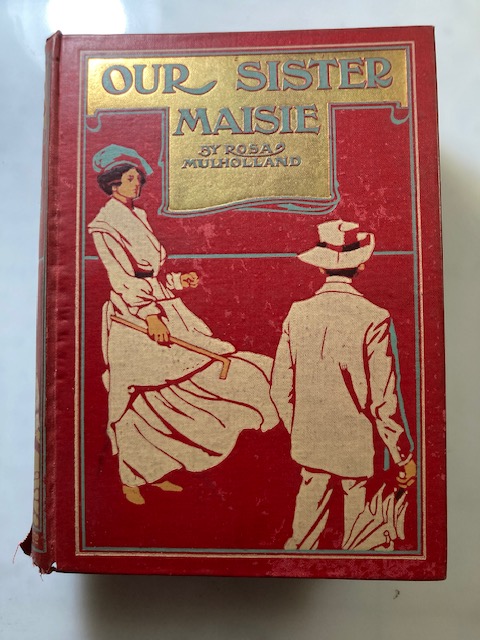
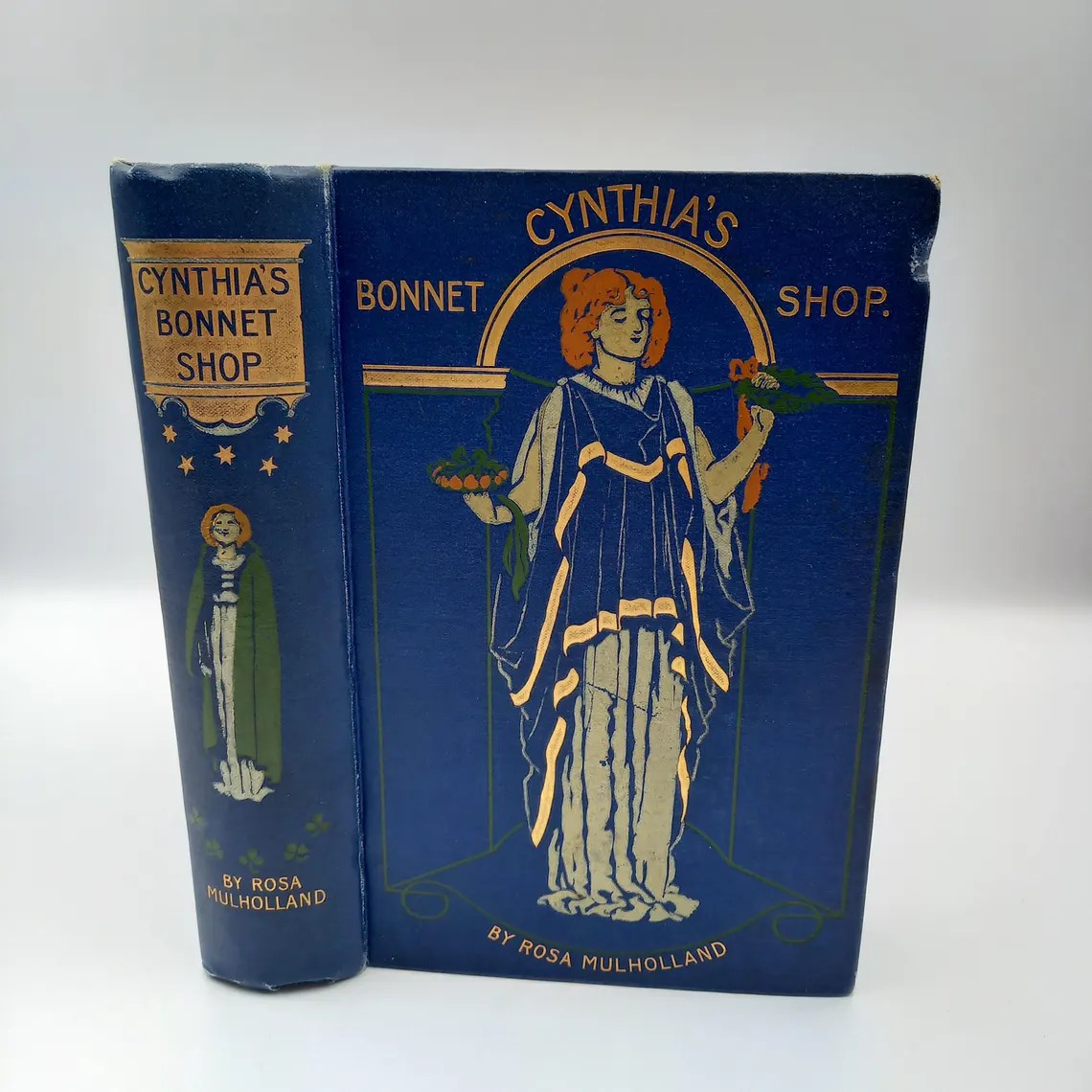
Pam’s Pictorama Post: If yesterday was devoted to a bit of what we’ve been watching here at Deitch Studio, today I will spend some time on what I have been reading. You may remember that as part of a much belated birthday celebration spent wandering around downtown with Kim, I purchased a rather beautifully bound volume by Rosa Mulholland with the intention of reading it. That volume, Our Sister Maisie, turned out to be an interesting sort of a point in her career to stumble onto and, written when she was 66 years old, it seems to have been one of her most popular books.

Volume I purchased as a belated birthday gift to myself in March at The Strand.

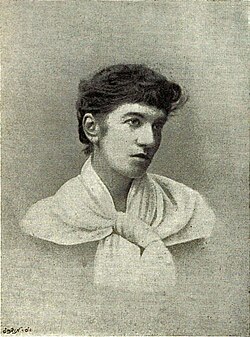
Her biography is interesting when considering her stories which deal a lot with the position of women in terms of money and livelihood at the time which she documents and considers. The daughter of a prominent doctor she came from a fairly well to do Irish family in Dublin. Other she first dabbled in painting (I have seen no evidence of it) she turned her hand to writing early and began trying to get published in her teens, including a novel at 15. One of the most interesting pieces of the tale is that early publication of her work caught the eye of an elderly Charles Dickens who not only encourage her but published her in one of his magazines and in a compilation with one of his own stories.

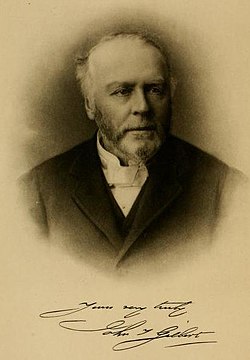
He bet on a good horse. She was very prolific with a list of upward of forty publications, mostly novels, to her credit. She wrote under at least three names I can find, Rosa Mulholland, Rosa Gilbert and very early on, Ruth Murray and seem to have published until a few years before her death and there was a healthy reprinting of her work which continues into the 1940’s. Gilbert is her married name – she married at the age of 50 to a well-known historian, Sir Thomas Gilbert, 12 years her senior. By marriage she therefore became Lady Gilbert.

If any of her writing was used for films I cannot find any evidence of it. I want to say that her books while very popular in Ireland and Great Britain they appear to have been less known here in the US. Really though the only evidence I have of that is that used contemporary copies of her books are mostly available in Britain.

Much like some of the other women authors I have written about previously (for starters, the adult novels of Francis Hodgson Burnett which can be found here, one about Mrs. George de Horne Vaizey here and an earlier one on Edna Ferber here) she is writing about the changing values and culture evolving around women’s emerging role in the late 19th and into the 20th century. Of the above mentioned authors, Francis Hodgson Burnett writes a bit about the other side of the Atlantic and especially the influence of the more forward Americans who visit there – generally very wealthy ones at that. Mrs. George de Horne Vaizey also writes about Britain but is poised a bit later.

A pretty if damaged volume for sale. I am waiting for a less expensive but equally beautiful volume.

Mulholland therefore is a bit unique in her entirely Irish perspective and generally a bit earlier than the women above. She recognizes that there is a problem where women’s only option for survival is the money their family could supply in the form of a life-long bit of capital to earn and be spent down and the marriage they make. Therefore nascent attempts to work among them are plot points – smart and ambitious women (much like herself we have to assume) are trying to break the mold either because they have been left with no money or are a simmering genius whose talent must find an outlet.

For all of that and knowing of her own life she can be a bit hard on these women – perhaps as society at the time was and it was the feeling of the day. I have read three of her books to date and in Our Sister Maisie there is a younger sister who yearns to be an architect – much like the young Mulholland she even has some of her designs used when she is teenager. Against all odds she makes it to architecture school and, although it is a bit unclear, drops out just before completion to marry her wealthy and wonderful heart’s desire.

I don’t have this one yet either but great title and nice opening page.

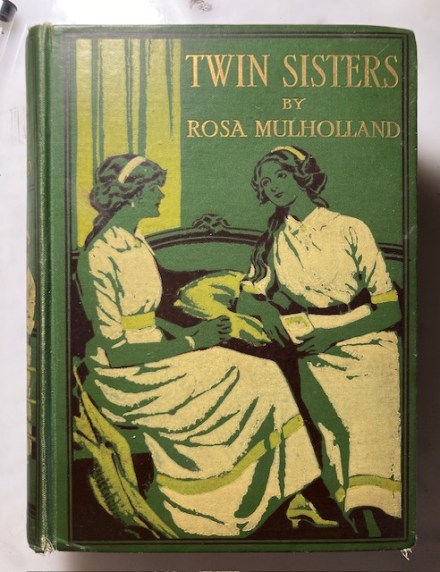
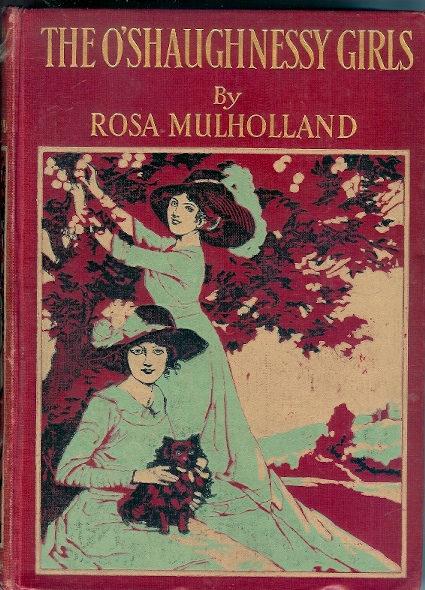
In a later volume, Twin Sisters, An Irish Tale published in 1913 she has a female character who, in charge of her late husband’s estate (it is thought of as her managing it for her son – as if she wasn’t also living off it in the meanwhile) invests aggressively in the stock market and makes but ultimately loses much of the fortune. She is criticized as having had no business trying to do the work of a man. But women like her are frequently left to their own devices and the heroine of the story arrives, along with her twin sister, in Britain from Spain as the wards of a family friend they never met. Penniless, the woman charitably agrees to help launch them into society and make agreeable marriages for them. Our girl Pipa isn’t having it though and takes work in an apple orchard in the country instead. Although she is roundly criticized for this, she is our heroine so needless to say she does the right thing – but of course she will end up with her best mate as well.

I’m also holding out for this illustrated version of this volume.

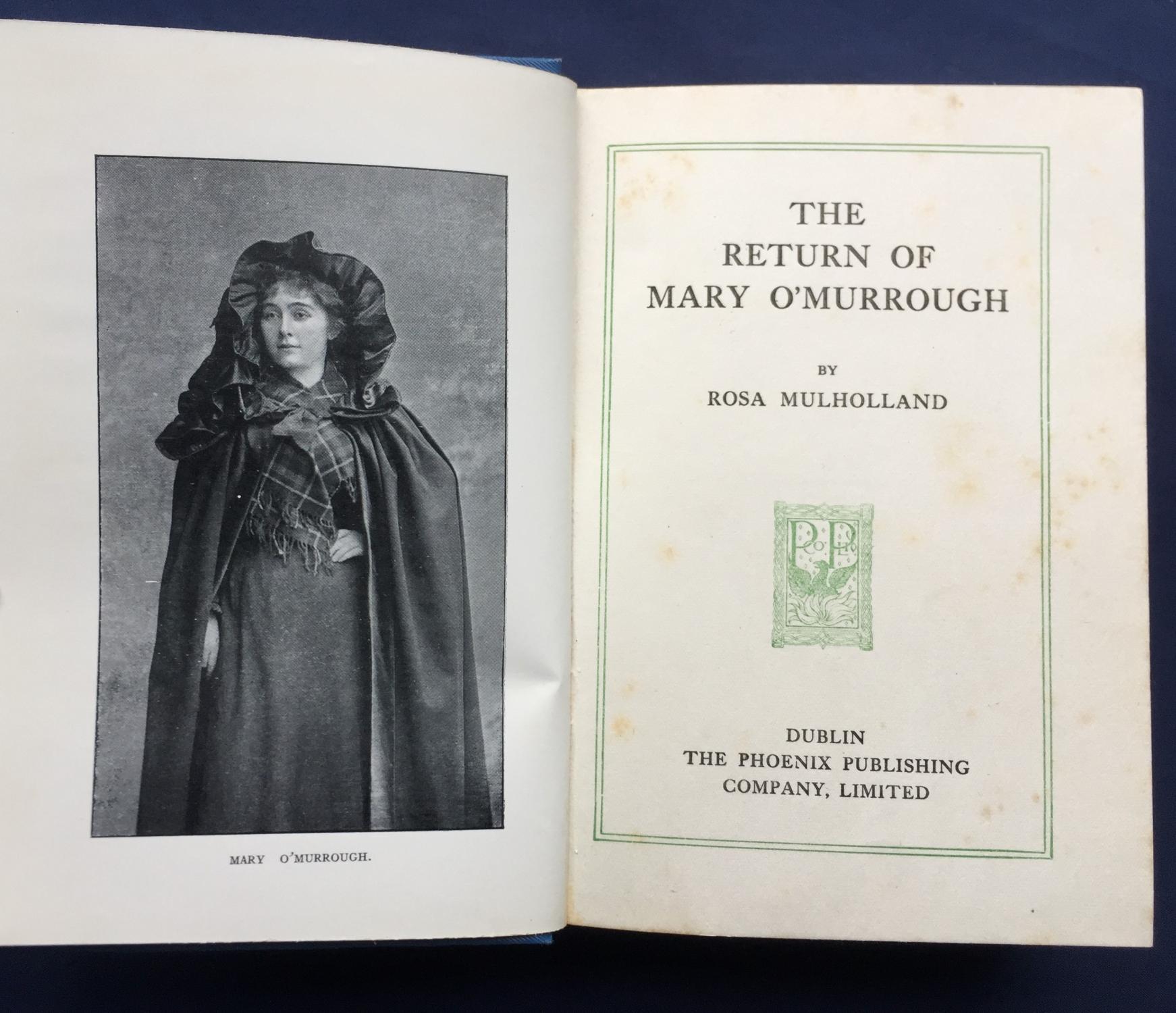
Mulholland’s books are a bit harder to track down than what I have enjoyed in recent years where there has been aplenty available online and in inexpensive used volumes. Rosa Muholland’s books tend to be beautifully bound, illustrated, volumes that are being sold at a premium because of that and despite the fact that there is not much demand to read them. Why more are not available electronically I cannot quite figure out. Perhaps she is just a bit early for for most people – or if the basis of those collections is based on American libraries and universities she may just not be in the right purview.

Clearly it would be a pity not to read this one in a beautiful illustrated volume like this one as well! Not in my collection – yet!
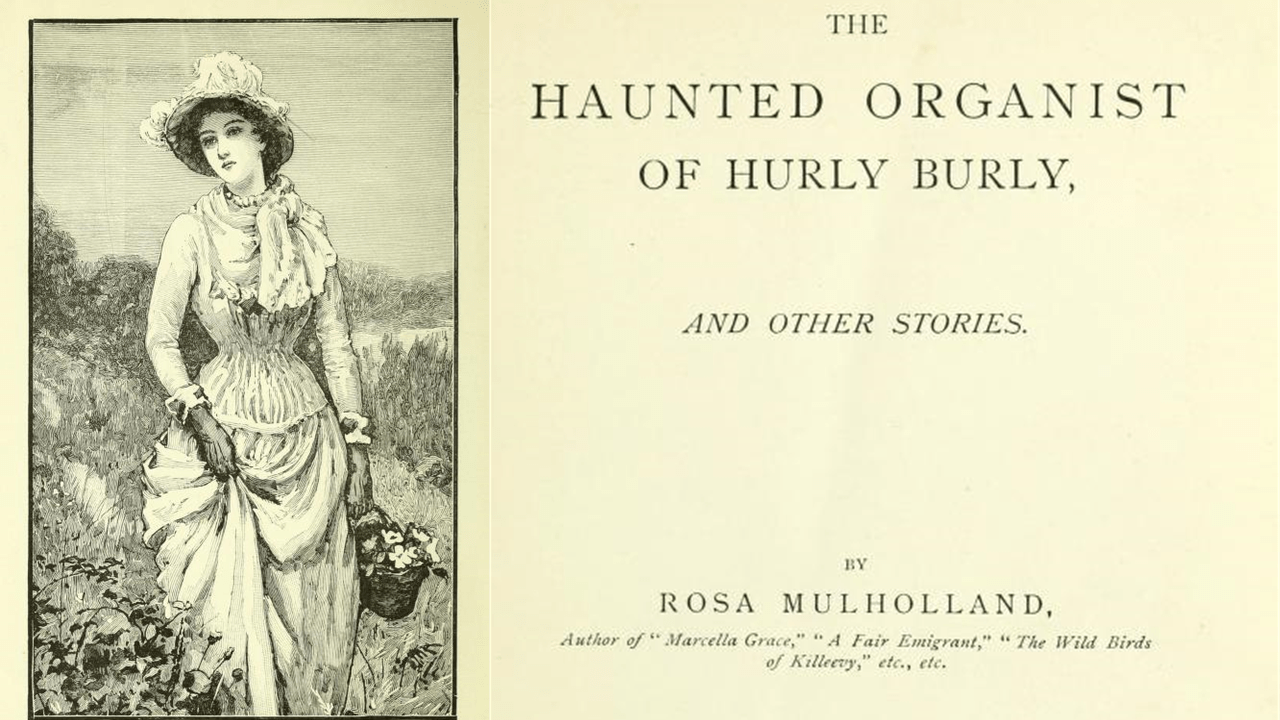
All this to say that while between the acquisition of physical volumes of her books, I grabbed one of her earlier works online and that was interesting and The Late Miss Hollingford was the story of hers, serialized in a magazine, that caught Dickens’s eye. Her descriptive powers were in greater force in her early writing, although her descriptions of the Irish country and seaside are also wonderful in Our Sister Maisie. The descriptions of the farm this young woman goes to live on are just cozy and great. (Yes, another orphaned girl-woman sent off to live with folks she hardly knows – this time her parents, who she barely knew, died of a fever in India leaving her a sufficient income although in reverse this time she is sent to live with people who don’t have money. The father was the perpetrator of a pyramid scheme and those seemed to be rampant at this time – I know the from the de Vaizey books among others!)

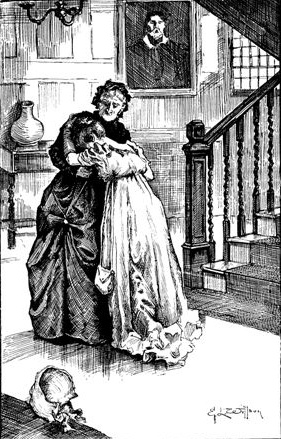
Illustration from the Late Miss Hollingford which I read electronically but with illustrations via Project Gutenberg.

I suspect there will be more to come on Ms. Mulholland and her writing as I am wading into the depths. I also suspect that Abe Books and others can expect to be seeing a whole lot of my pocket change in the near future. Stay tuned.

Belated Birthday Fare

Pam’s Pictorama Post: As those in the New York area know, it was a freakishly warm day here yesterday, topping out around 80 degrees. As a result the denizens of this metropolis poured onto the streets in wrinkled summer garb (or simply lack thereof) all white bellied and sleepy like a city of Rip Van Winkles. Kim and I entered the fray and spent the day hunting small Pam pleasures as is our program for my birthday.

A February birthday girl, this year I was bedeviled first by Kim’s Covid, followed by my own – and then a distressing string of funerals and memorials, plus one wedding! The MoCA comics festival thrown in too. All this to say, yesterday was our first day in a long time when we were left to our own devices.

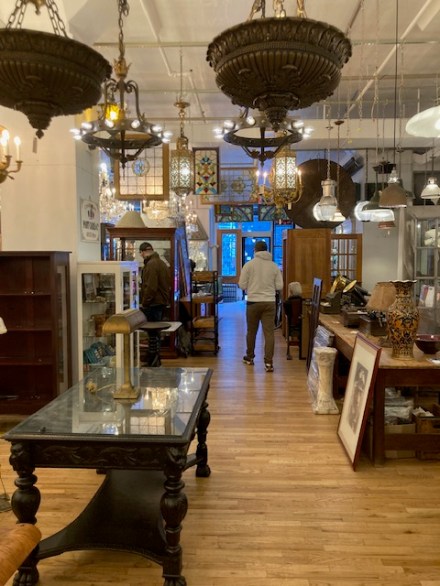
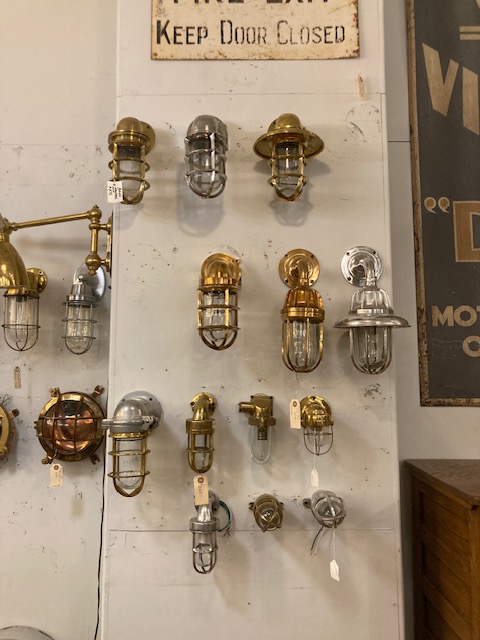
Old Good Things is chock-a-block full of antique fixtures and a lot of brass. My dad was a utter sucker for brass fixtures and I can only imagine he would have come home with one of these. My father’s daughter, I too was tempted…

I started our itinerary with a stop at an antique and architectural salvage store, way over on the westside of midtown called Old Good Things which I have been curious about. (Their website can be found here.) I follow these folks on Instagram and while what they offer is generally just too large for my living situation but I have always wanted to visit the store. I do fantasize about replacing bathroom fixtures, maybe a fireplace mantel in NJ and light fixtures as well, and it sends me musing. There is much wonderful furniture, with an emphasis on wooden cabinets of drawers which is one of my own forms of kryptonite, hard to resist. Still, these are very large pieces for the most part and I live in small spaces.

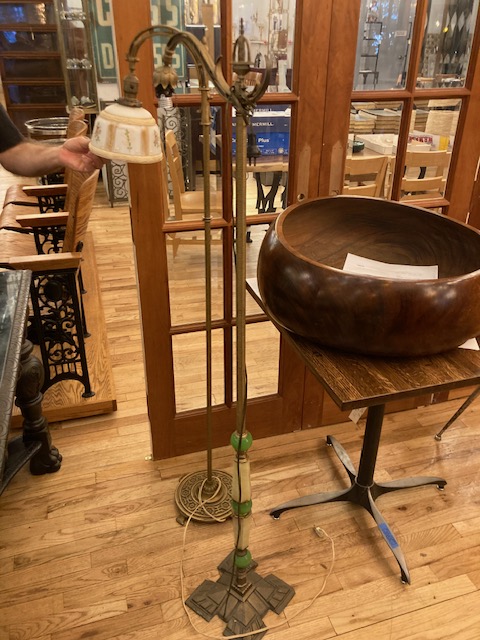
Two intriguing standing lamps that had just come into stock. They are being rewired so I have a minute to think about investing in them.

Notably there were a few rather comfy and wonderful leather arm chairs but all I could see were happy cat claws so I moved along. These two standing lamps which just came into stock and had yet to be rewired were of interest – we could use a standing lamp here in the New York apartment and the weird sort of jadeite on one interests me. They were pricey but I will consider them. A good standing lamp is hard to find.

Then we headed downtown for what I considered the main event – the Metropolitan Postcard Club show and sale. I have not been to one since before Covid when they used to take place on 57th Street at a rundown Howard Johnson’s hotel near 8th Avenue. It was then a much larger affair, easily 3-4 times the size of the group yesterday. However, this just meant I burrowed a bit deeper and a very patient Kim joined me in sorting through boxes of cat postcards, with a few of New Jersey thrown in for good luck.

It was held at a pleasant, small and essentially non-descript church in the West Village called the Church of the Village. About a dozen dealers had a large circle of tables and it was quiet enough that you could sit and patiently go through the labeled boxes. I flashed a picture of yesterday’s Felix card on a few dealers to see if they had ever had any go through their hands. One looked quite stunned and said no, the other gave me a knowing look and said he might have one at home. I gave him my card.

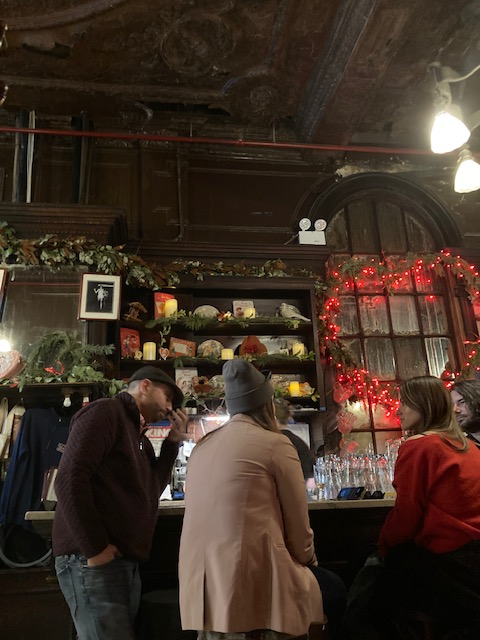
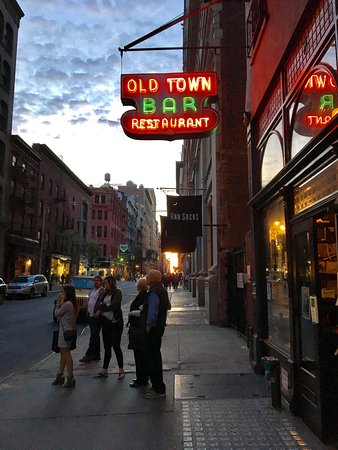
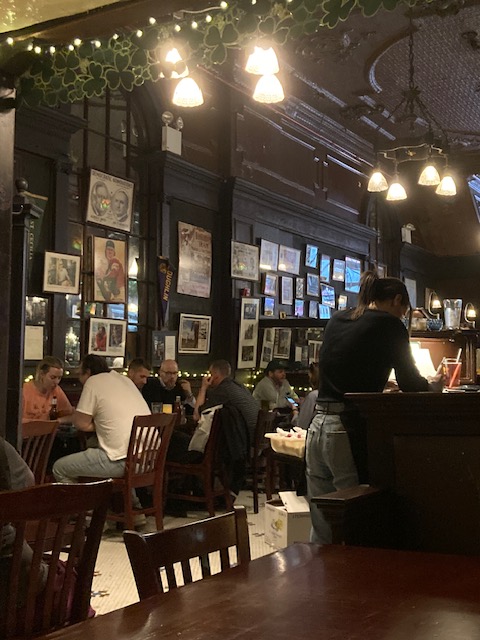
I left the show lighter in dollars but happily heavy in cards and I will commence a liberal dissemination of them here in the coming weeks. It was well passed lunchtime and our tummies called so we wandered over to the Old Town Bar on 18th Street. I had a craving for an old establishment and this fit the bill perfectly. We’d eaten upstairs not that long ago but for lunch were seated at a table in the back.

My view of the main room at lunch yesterday. I would like to be there when it is quiet enough to go around the room and read what is on all the walls.

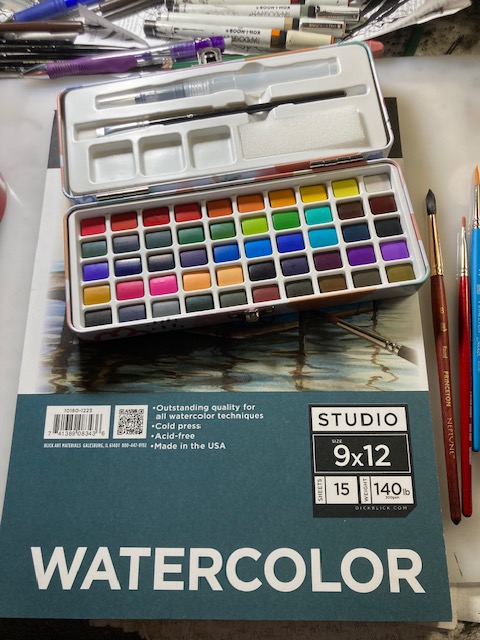
After lunch we made a quick trip to Blick so I could buy some watercolor brushes and paper. My friend Eileen (@EileenTravell) gave me a very lovely birthday gift of a nifty watercolor set for my birthday and I hope to commence playing with them soon.

Thank you again Eileen! I hope to make some use of these.

The next real stop of the day was The Strand bookstore. Our original thought was that we would just pop in to look in used fiction. (Kim looking for Dumas and I for someone named Carol Brink. We just saw a somewhat obscure Barbara Stanwyck 1953 film based on a Brink novel called Stopever. The films was renamed All I Desire, and directed by Douglas Sirk. It is masterful film making and visually stunning, like many of his films although this one in black and white and not the signature saturated color. A good TCM write up of the film, with spoilers, can be found here.) We came up empty handed on both scores but decided to head up to the Rare Book Room.

We’ll see if this acquisition is more than good looking on the outside.

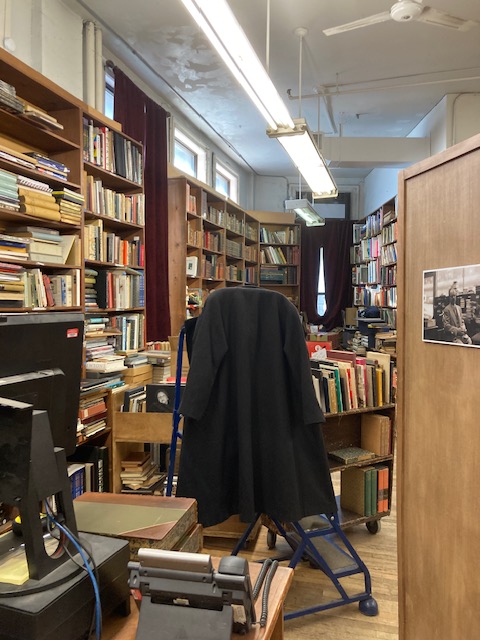
Kim and I more or less nibble at the edges of the Rare Book Room. We aren’t interested in the signed first editions, but instead make our way to a few bookcases of more or less random old books. I have scored several items at this venue, including some that lead me further down the path of interesting authors or series. Despite the name, some of these volumes are very affordable.

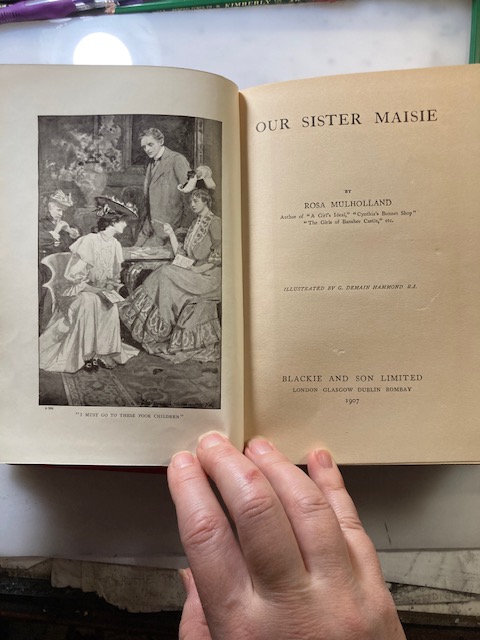
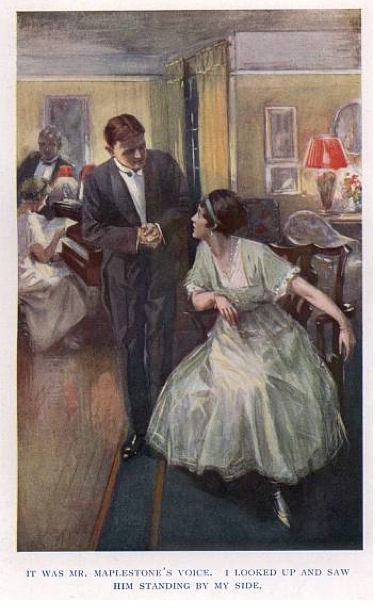
Very competent illustrations by someone named G. Demain Hammond R.I.

However, I did pay up a bit for the book I bought yesterday. Shown here, it is a very pretty looking, illustrated volume which helps its cause. It actually may not need any help. I looked up the author, Rosa Mulholland, and she appears to be quite interesting. She was an Irish writer, very prolific and also wrote under the name of Rosa Gilbert, her married name – aka Lady Gilbert. Rosa appears to have worked the side of the street of fiction I like so maybe more about her to come over time as well.

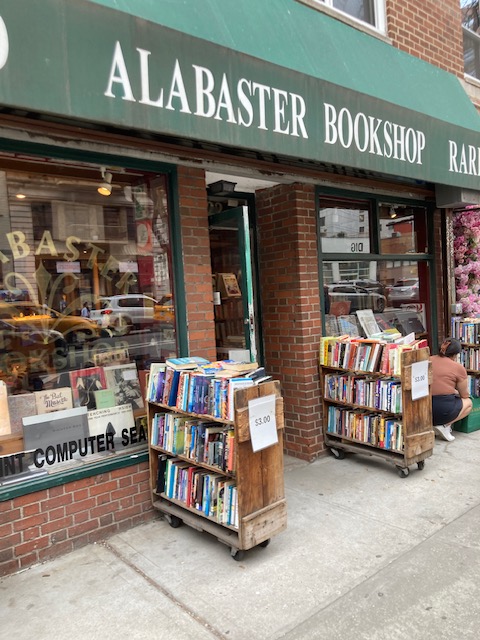
A frequent stop either to or from The Strand.

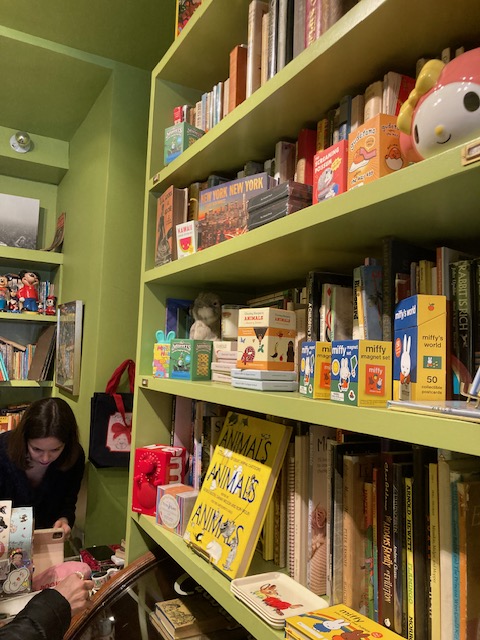
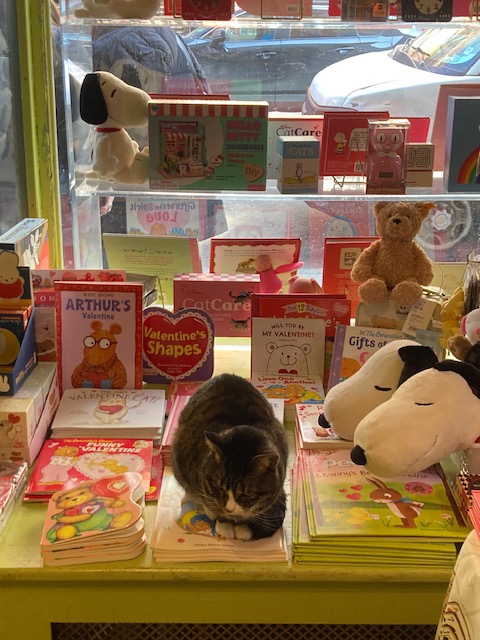
We wrapped up with a quick look in Alabaster Bookshop around the corner from The Strand. Still checking for Dumas and coming up empty handed. I like Alabaster although they focus more on recent books and art volumes and I feel like I haven’t bought anything there in a while. I always check their kids and juvenile books, but it is a somewhat diminished section. I always remember that had a charmingly grumpy calico cat I saw grow from kittenhood on there. Her ghost still wafts through and I miss her.

That was it, a wrap on another birthday, perhaps all the better for the wait this year.

Part 2: Mrs. George de Horne Vaizey Cont.

Pam’s Pictorama Post: Apologies in advance for anyone who was peevish that yesterday was a book-ish post as I am going to wrap up (at least for now) my thoughts on Mrs. George de Horne Vaizey today as she continues to be my reading material of choice. (Yesterday’s post is here.)

I will confess I went for a long fallow period of not reading much and just one off books here and there when I was. Kim powers through all sorts of long and short term reading projects, both for his own edification and for things related to work, so I am jealous when I am without one too. However, I am there with the best when I find a rabbit hole to go down and therefore here we are today.

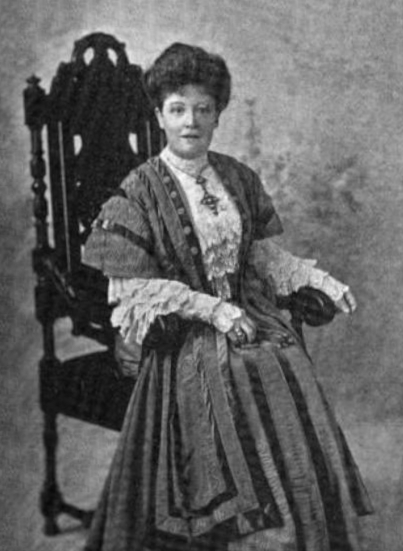
From Wikipedia and the only image of her I can find.

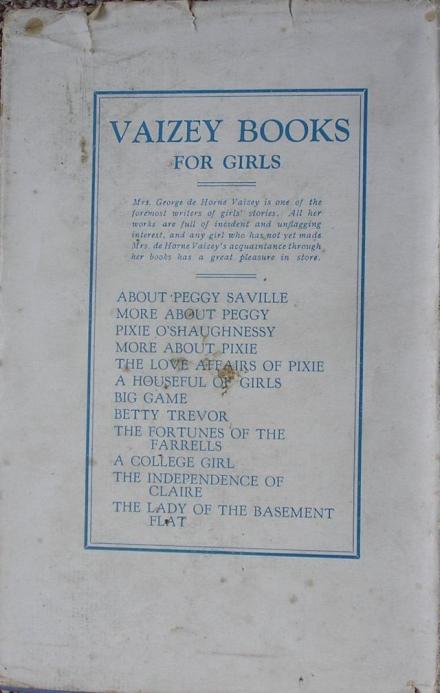
Mrs. G de HV as I like to call her, is fading from consciousness and seems to have barely been rescued for the digital age. If we are to look at the remaining availability of her published volumes, we have to assume that the Pixie books I wrote about yesterday were among her most popular, with a few other titles that seem to stand out. She wrote upwards of 32 books (I say upwards because Wikipedia does not always have every book published by an author although they do a good job of it) and clearly there were short stories. There is a collection of them mentioned as published in 1918. The list of her publications runs from 1897 to 1918, ending with that collection of stories. However, if I really want to read the widest swath of her work I will need to dig some. I would say about half is available online or for sale as antique volumes or occasional reprint.

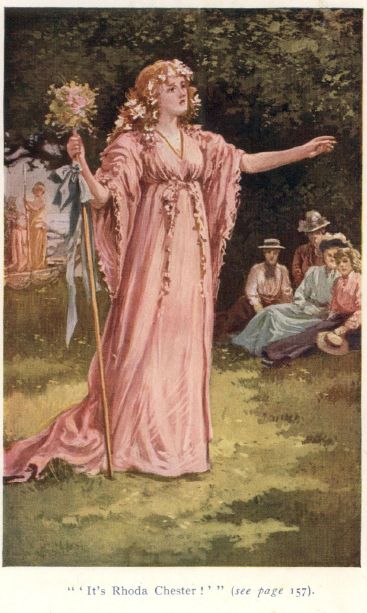
From “Tom and Some Other Girls”, 1901.

Born Jessie Bell in 1857 as one in a melee of seven children (four brothers, two sisters) she was the daughter of a Scottish insurance broker. Her place of birth was Liverpool. She first married Henry Mansergh, a cotton broker, and published her first volumes under the name Jessie Mansergh. They had a daughter, Gwyneth Alice, in 1886. Mansergh was an addict which seems to have contributed to his early death. Reading between the lines so to speak, one wonders what part her early writing played in supporting them.

While I was certain that hers was a pen name of a type that was often adopted at the time, I learned that no, her second husband was indeed George de Horne Vaizey. She meets him while on a cruise which was a prize awarded for one of her short stories. They marry in ’98 and have a son, also named George, who goes on to be a writer. Sadly her own life ends as an invalid, confined to bed for many years. She dies in 1917 at about age 60 (her precise date of birth unknown) and therefore the final volume is posthumous.

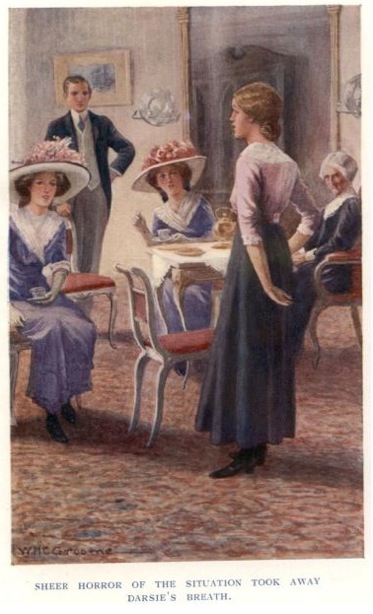
From “A College Girl”, 1914.

Jessie uses her own life as whole cloth for her fiction. Large dynamic families, addiction, illness abound in her pages. Therefore, I have to assume that her evolving views on marriage and the relationships between men and women was also explored on her pages. If you’ve followed my previous musings on women writings of the early 20th century, you know that I found that even the juveniles such as The Radio Girls and Automobile Girls were gently ever pushing the line forward for what was permissible and acceptable for young women. (Some posts on those books here and here.)

Interesting to find Mrs. G de HV who is a bit earlier still than those authors and for me a logical forerunner of some. The line for women, the options they had in society for supporting themselves, is still more nascent although shifting all the time. An ongoing theme she explores is the unmarried middle class woman and her lack of options. I’ve already encountered several books where due to various circumstances the heroine is in some way prohibited or unable to marry and is faced with the issue of how to live their lives, preferably not just dependent on family. She seems to walk a narrow line – clearly a woman married to a man of means is the safest port in the storm.

She also confronts the daily reality of marriage – the idea that you are joining up with a mate who you will continue to make conversation with daily for decades. (I have often said that knowing that I would never be bored talking to Kim helped ensure a good union for us!) The sheer difficulty and exhaustion of running a house and caring for a family.

From “Lady of the Basement Flat”, 1917.

I am going to skip forward to An Unknown Lover, a novel published in 1913. (Some spoiler alerts ahead for those who care.) The author sets herself some unusual tasks. We have a heroine, Katrine, in her late twenties who has spent most of the last decade caring for her older brother who was widowed shortly after marrying. There are rarely effective parents in her books – adult children have either lost them or they are on the sidelines for some reason. I can’t even remember why they weren’t present to stop this hot mess of a situation – dead and forgotten in this case.

Anyway, both characters are beginning to chafe at the situation. The heroine opines on having all the responsibilities of housekeeping without the partnership of a true mate. She is also painfully aware that she is dependent on her brother for her keep, which comes to a hard point when he decides to remarry. She has no marketable skills and living in a small hamlet no prospects of marriage which is more or less what she is trained for. As a literary challenge, our author has placed an epistolary relationship through part of the book, which moves the storyline along. At first it seemed a bit awkward, but it grew on me. Despite some flaws and maybe questionable decisions, it is to date my favorite of her novels.

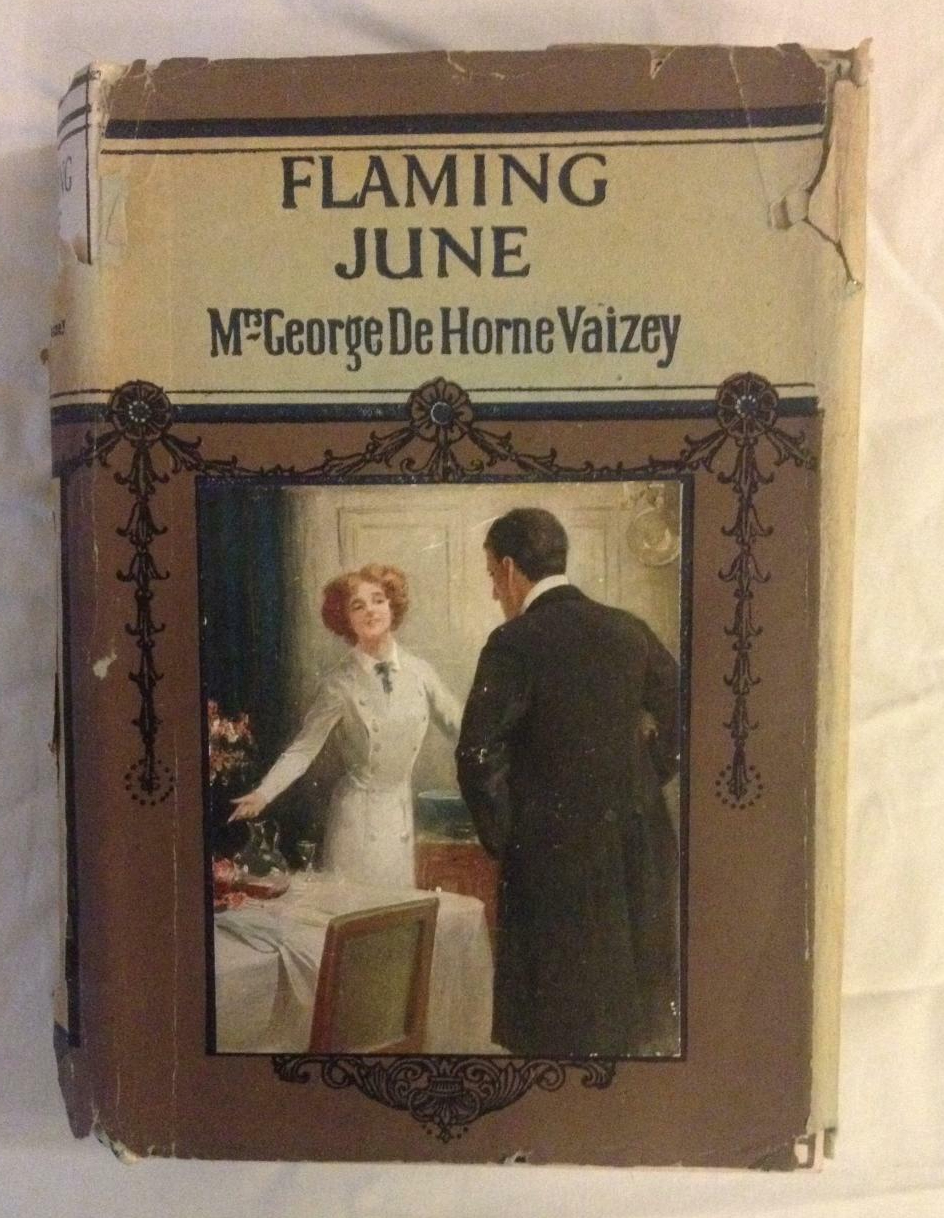
Love this title and looking forward to this one. Published in 1908.

De Horne Vaizey has beloved tropes – I’ve noted before a preponderance of gray eyed heroines, some have golden eyes as an alternative. An odd one seems to be a fondness for shipwrecks – I believe I may be up to three in her oeuvre to date. An interesting tidbit, while researching this post I came across the following in an Internet Archive version of An Unknown Lover which actually photographs the pages of a hard copy of the novel and included this forward below:

AUTHOR’S NOTE

Lest I should be credited with making literary material out of a disaster still painfully fresh in the minds of readers on both sides of the Atlantic, I should like to record the following rather striking coincidence.

On the fourteenth of April last, I was engaged in writing the description of the collision at sea in which the heroine of the present book plays a part; and after some deliberation as to the most forceful word to employ, wrote the sentence which originally ran as follows: —

”Mercifully it is not one person in many thousands who is called upon to endure so titanic an experience. …”

A few hours later my husband returned home and told me of the news which had that day thrilled the world — the foundering of the steamship Titanic on her maiden voyage.

Many weeks passed by before I could bring myself to continue the narrative.

Hampstead.

Jessie de Horne Vaizey.

Somehow she pulls out two parallel love stories and details the personal growth of Katrine as she makes some rather bold leaps forward to attain a measure of happiness and independence, gently breaking with at least some of society’s conventions.

Sadly Jessie de Horn Vaizey doesn’t live quite long enough to see the shift which occurs even in the early 20’s for women. At six or so volumes I have barely scratched the surface and if it is interesting enough I promise more to come.

Pixie and Mrs. George de Horne Vaizey: Part One

Pam’s Pictorama Post: It has been a very long time indeed since I have posted about a writer or books I have been reading. That is in part because the last year did not lend itself to reading. Helping during my
mother’s last illness and the months that followed, ultimately leading to my changing jobs at the end of the year, certainly there were books, but reading was sporadic. Love or hate my book posts, books are back and today kicks off an interest in Mrs. de Horne Vaizey, nee Jessie Bell, later Mrs. Henry Mansergh and finally Mrs. de Horne Vaizey.

Pictorama readers of long-standing know that in recent years (especially during the at home pandemic years) I chased down the writings of numerous authors including all the Judy Bolton mysteries (a post about those can be found here) and strolled through the collected works of several women who were writing short stories and novels that depicted the emerging woman in the US and Britain at the dawn of the 20th century.

These included the adult novels of Frances Hodgson Burnett (in several parts, but it all starts here),
the (glorious) short stories and novels of Edna Ferber (here) and the various series books including the Red Cross Girls, Ruth Fielding books and the many volumes of my beloved Campfire Girls. (Starting here, here and here if you are game.)

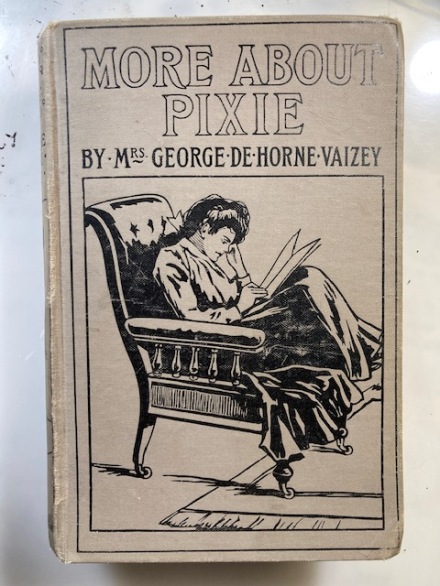
You might remember that my birthday this year turned into a day of poking around bookstores downtown, including The Strand’s re-opened rare book room. I picked up a copy of More About Pixie, the second volume in a three novel series by Mrs. George de Horne Vaizey (Mrs. GdeHV for my purposes going forward)

I was able to find the first volume of the books about Pixie online, Pixie O’Shaughnessy, with relative ease on my old friend Project Gutenberg. (All three volumes mentioned here are available on this free online resource as well as some others, although beyond these books only about half of her publications seem to be readily available. Many volumes of her work are also available at the Internet Archive.) I have largely been able to download illustrated versions of the books which I urge you to try to do as some of the illustrations are very good. (Oddly I can’t seem to open and share them here and show what I was able to find otherwise. I will add that the blog site isn’t actually allowing me to add images today so I apologize for the largely un-illustrated post!)

This first volume is a wonderful depiction of life in Ireland in the waning days of the 19th century. Written in 1902 it is a bit earlier than the copious volumes of my earlier reading I mention above. The impoverished, motherless (a recent loss) family resides in a dilapidated castle which becomes a sort of
character in the book, as does the backdrop of the small Irish town they reside in.

Pixie is a young child still at the start of this book – she is not a physically attractive youngster (this is an oddly defining characteristic that stays with her; her looks do not improve with age), however she has such an outspoken and winning personality that she always everyone’s favorite. To make up for her physical limitations as a beauty, she has two lavishly beautiful sisters (Mrs. GdeHV is a little obsessed with her heroines having gray eyes, they all do), Bridgie and Esmerelda, and attractive brothers in the bargain.
The funds are scraped together to send Pixie off to a private school in London and her adventures there make up the second half or so of the volume. (Esmerelda is hot tempered and so extravagantly stunning that she is somewhat done away with at the close of volume one.)

Written a year later, volume two, the one I picked up at The Strand More About Pixie, takes an interesting turn. It is in fact not so much more about Pixie, as the story is actually told by a young woman neighbor, a
recovering invalid, who lives on the street in London where the family decamps to at the start of this volume. Her encounters with the O’Shaughnessy family include Pixie, but in reality it focuses more on her friendship with one of the older sisters, Bridgie, who plays mother to the clan. Pixie does reassert
herself in the latter part of this volume, but it is Bridgie and the neighbor girl, Sylvia, and their friendship that is at the heart of the book.

Much of the book concerns the slow recovery of Sylvia (an illness which is given no name but has even affected her bones as they gravely consider needing to amputate her foot) who is another motherless child (life of mother’s was evidently cheap), living with an aunt while her father is away in India. (Mrs.
GdeHV likes to send men to India and bring them back after many years. To date I have barely been in India with her books, but wouldn’t be surprised if we end up there one of these days.)

It isn’t until 1914 that the final volume of the three is published, The Love Affairs of Pixie. Our prolific author has penned at least 17 volumes between these so it is a more mature writer who writes this novel. It interests me that she decided to turn her hand back to a now fully adult Pixie who returns as the heroine and focus of this story. Much of this story brings Pixie and the reader back to Esmerelda and Ireland, although the Ireland of this book is less lovingly described. Pixie remains unattractive on the face of things and in fact the book opens with her own discovery of this and is a theme throughout, but the pluckiness and good heartedness of Pixie has her as a sought after mate who (spoiler alert) finds her mate at the close of this volume.

Mrs. GdeHV clearly liked to assign herself challenges to keep things interesting. These are not formulaic series books (not that there’s anything wrong with those!), but instead you can see her making choices and setting up approaches to keep things different and interesting. I’ll cover more of her biography tomorrow, a sort of sad tale despite being a very prolific writer. She must have been popular in her time, but sadly volumes appear to be hard to find and I know she wrote short stories but none of those have turned up yet. However, I have only just begun my research so undoubtedly more to come.


The Antique Cat

Pam’s Pictorama Post: I always like to look at old children’s books and juvenile fiction given the opportunity. Pictorama readers know that I enjoy early chapter books that would be called young adult fiction today. (There are the posts devoted to girl detective Judy Bolton, Honey Bunch and of course several devoted to The Camp Fire Girls, Red Cross and Ranch Girls. A smattering of those can be found here, here and here or search the site for books.) And I have written about some of my childhood favorites, including one illustrated by the great Garth Williams called Push Kitty (post here) which reminds me a bit of this volume. Still, it is rare that a true children’s book that I had no prior knowledge of zooms into a place in my heart as this one has. It is great for kids but a winner for the cat lovers too.

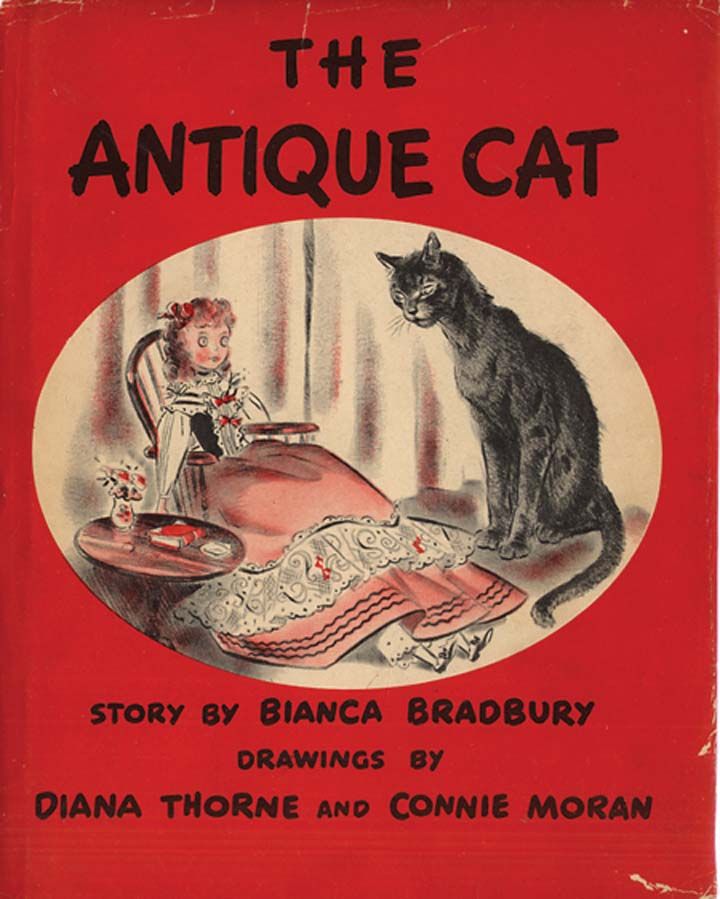
The illustrated cover which my copy does not have.

I stumbled across this title while searching for information on another one on Goodreads. The description was appealing and on a whim I purchased a (much) used library copy, sans cover and with a heavily taped spine, (stamped throughout as from the School of the Japanese Martyrs, Leavenworth, Minnesota!) for a nominal amount. With an unexpected trip to my mom in New Jersey and other pressing life matters I didn’t have a chance to read it until last night and it is a gem! I can only say I am sorry I didn’t know it when I was a kid, it would have been a favorite in rotation and my parents would have loved it too.

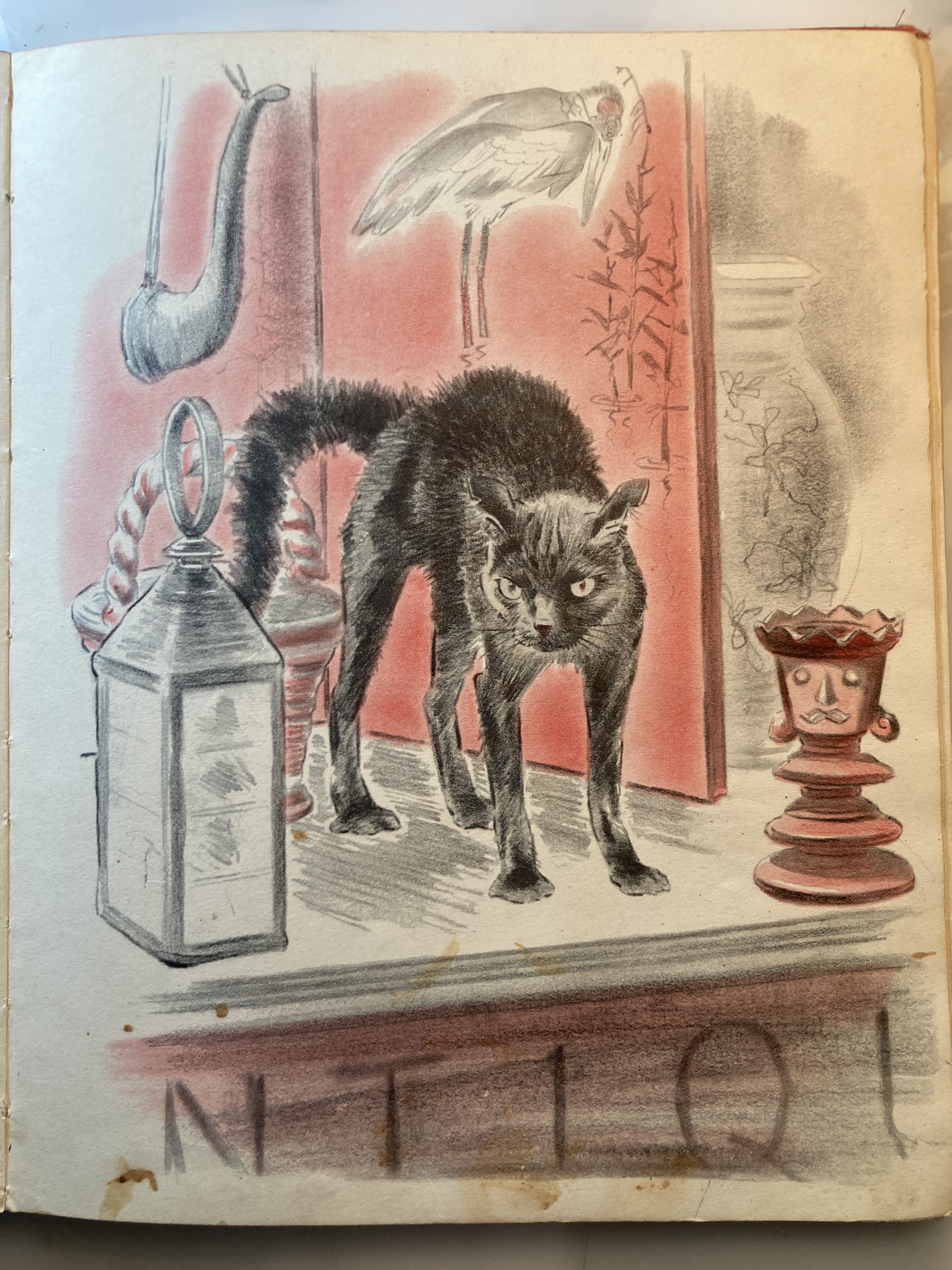
Solomon in the store window at night entertaining passersby.

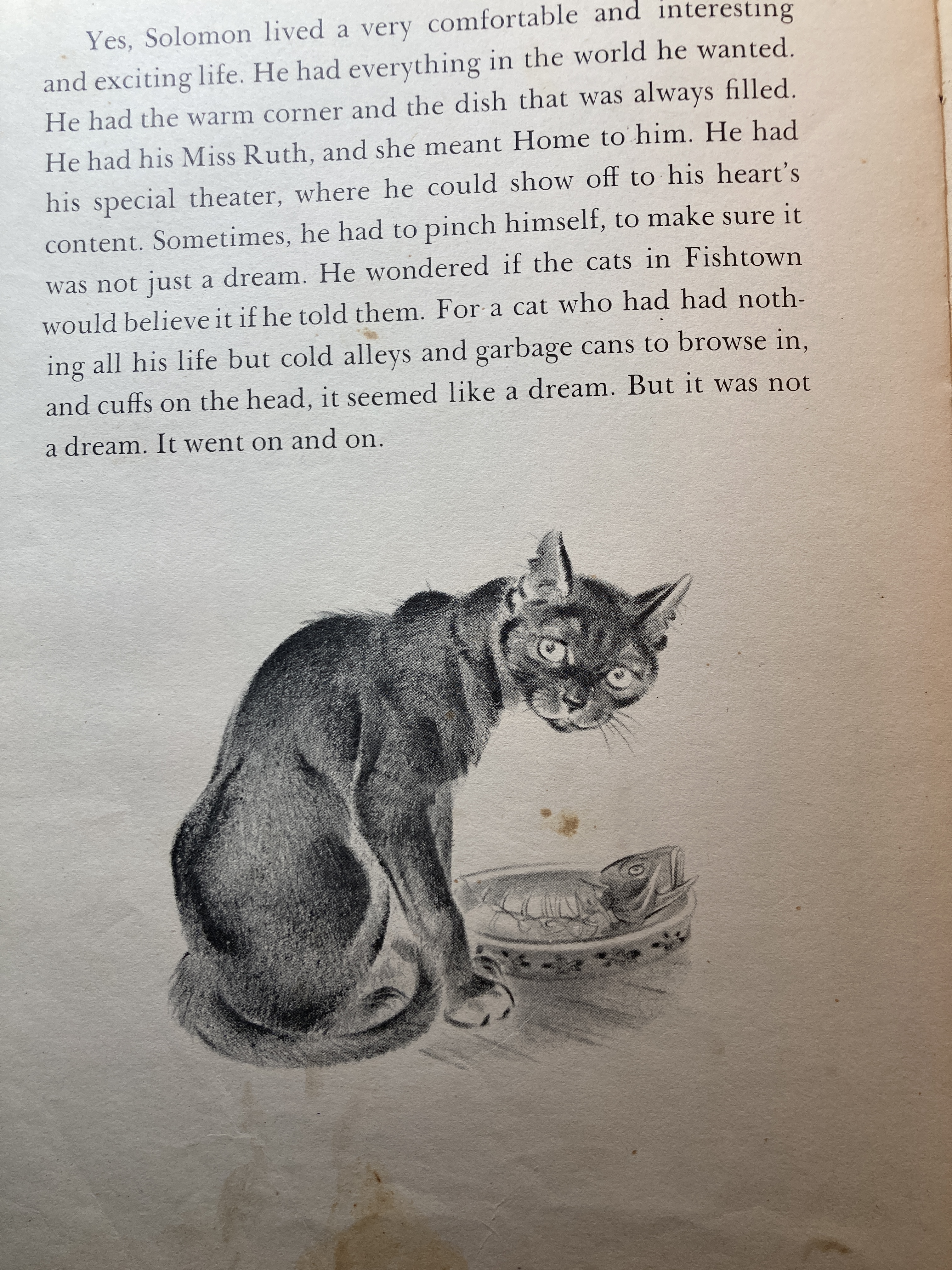
The story is a simple one – a skinny stray (all black) cat is taken in by the owner of an antiques shop. It is told from the cat’s point of view and he has some simple adventures – most involve his love of eating fish – and all ends well with him installed as the beloved master and mascot of the establishment. An antique store makes for an interesting setting for cat adventures – while fear of breaking fragile items is mentioned, claw paws and scratching are not. However his nemesis ultimately is an antique doll who receives too much of his mistress’s attention and affection. Fortunately his human loves him above all else and forgives some minor feline transgressions.

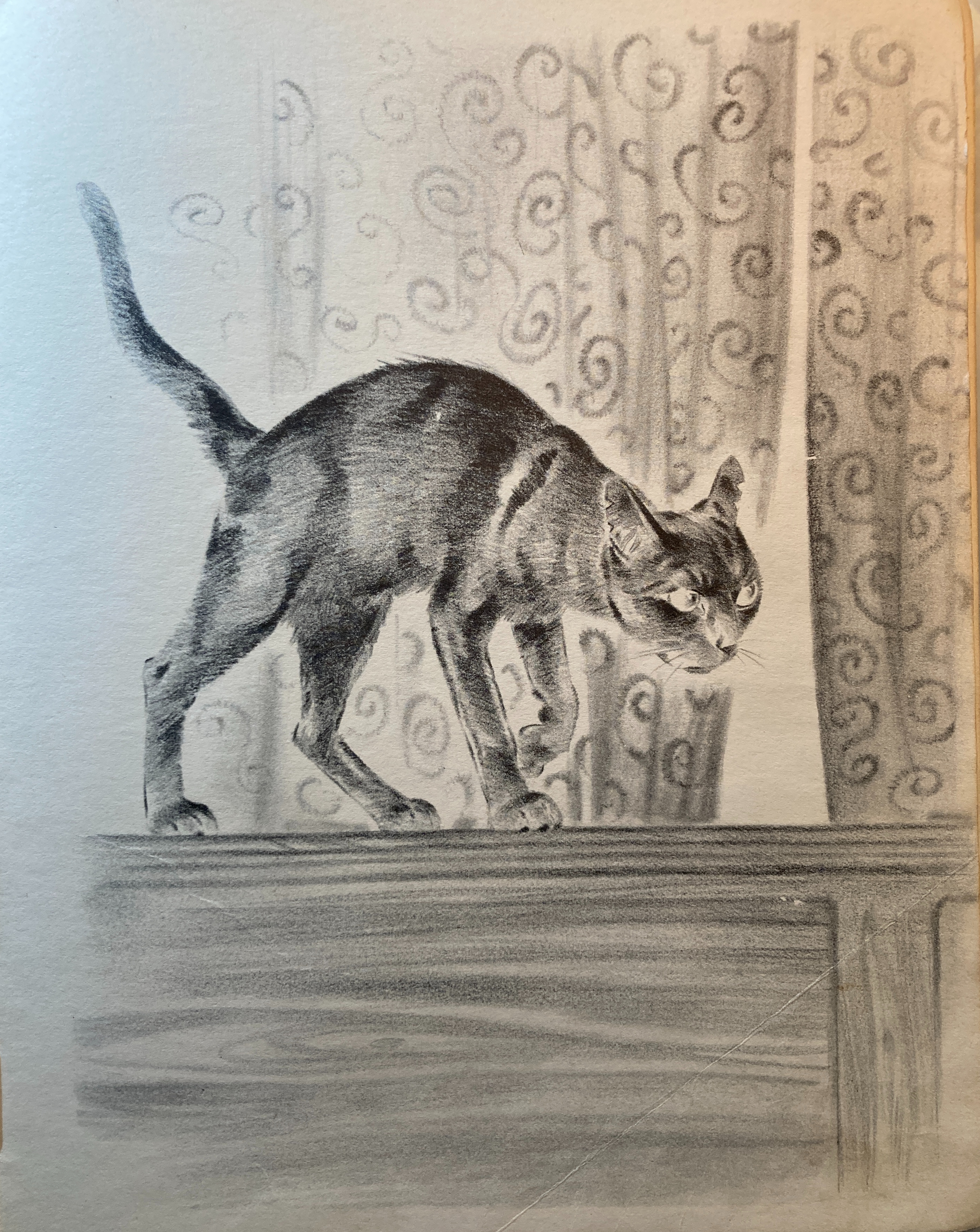
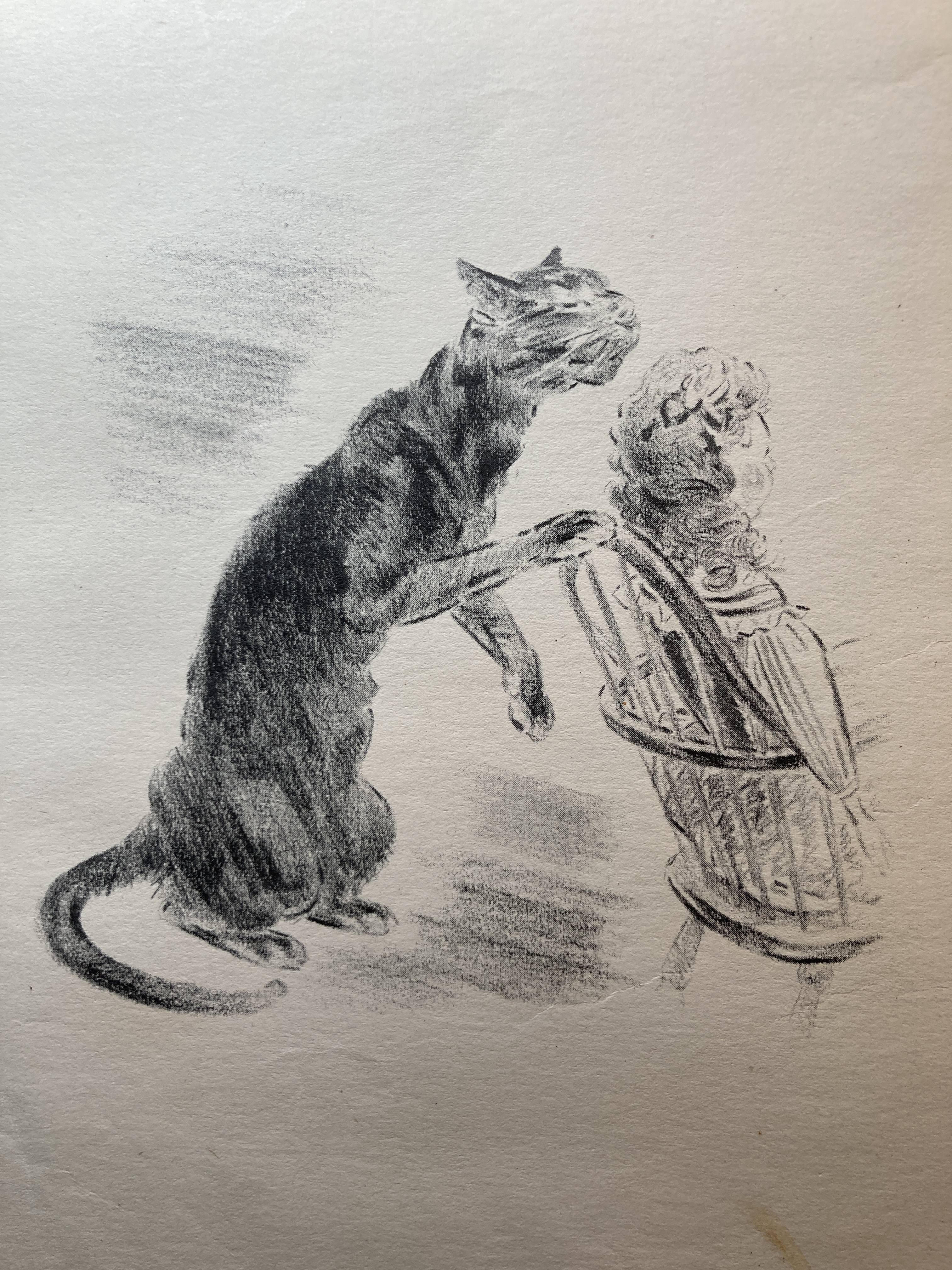
Undeniably great cat poses!

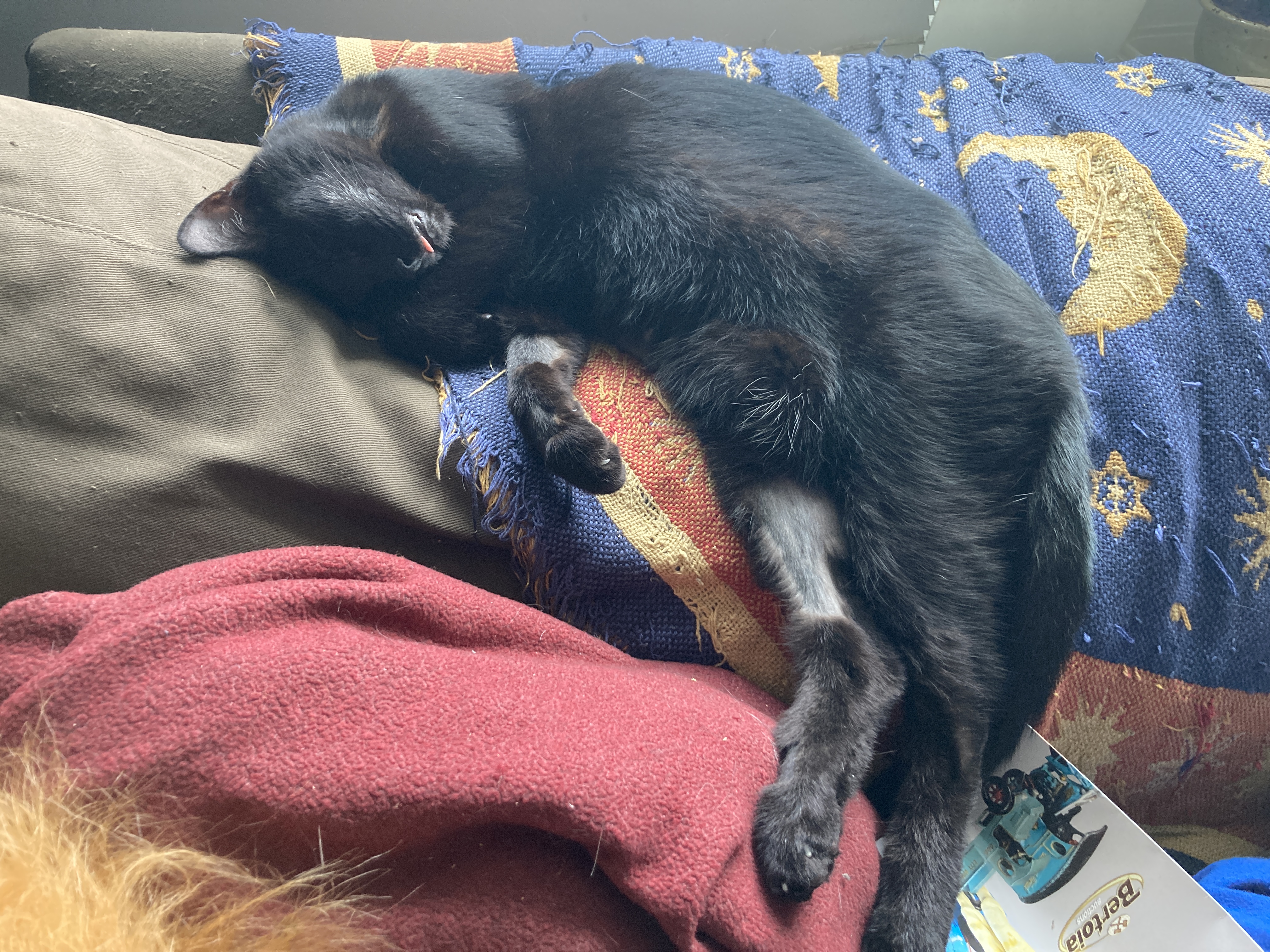
The all black protagonist of our story, Solomon (we are not told how he acquired his moniker), looks like my own Blackie and the early drawings of him as a street cat sadly corresponding to our boy recovering (shaved and thin) from his recent stint of illness. (No mention of black cats and bad luck are mentioned and Bradbury gets points for me with this.) Solomon progresses to shining glory although I guess some of his battle scars around the ears and whatnot remain as badges of feline honor.

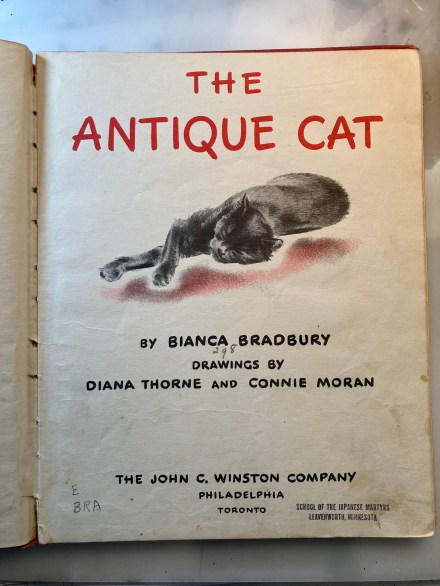
I easily could have found this book as a child. The copyright in this edition, the first, is 1945. It was published by The John Winston Company of Philadelphia and Toronto and the copyright notes that it was also copyrighted in Great Britain (Dominions and Possessions as well) and in the Philippines. It was written by Bianca Bradbury with drawings credited to Diana Thorne and Connie Moran.

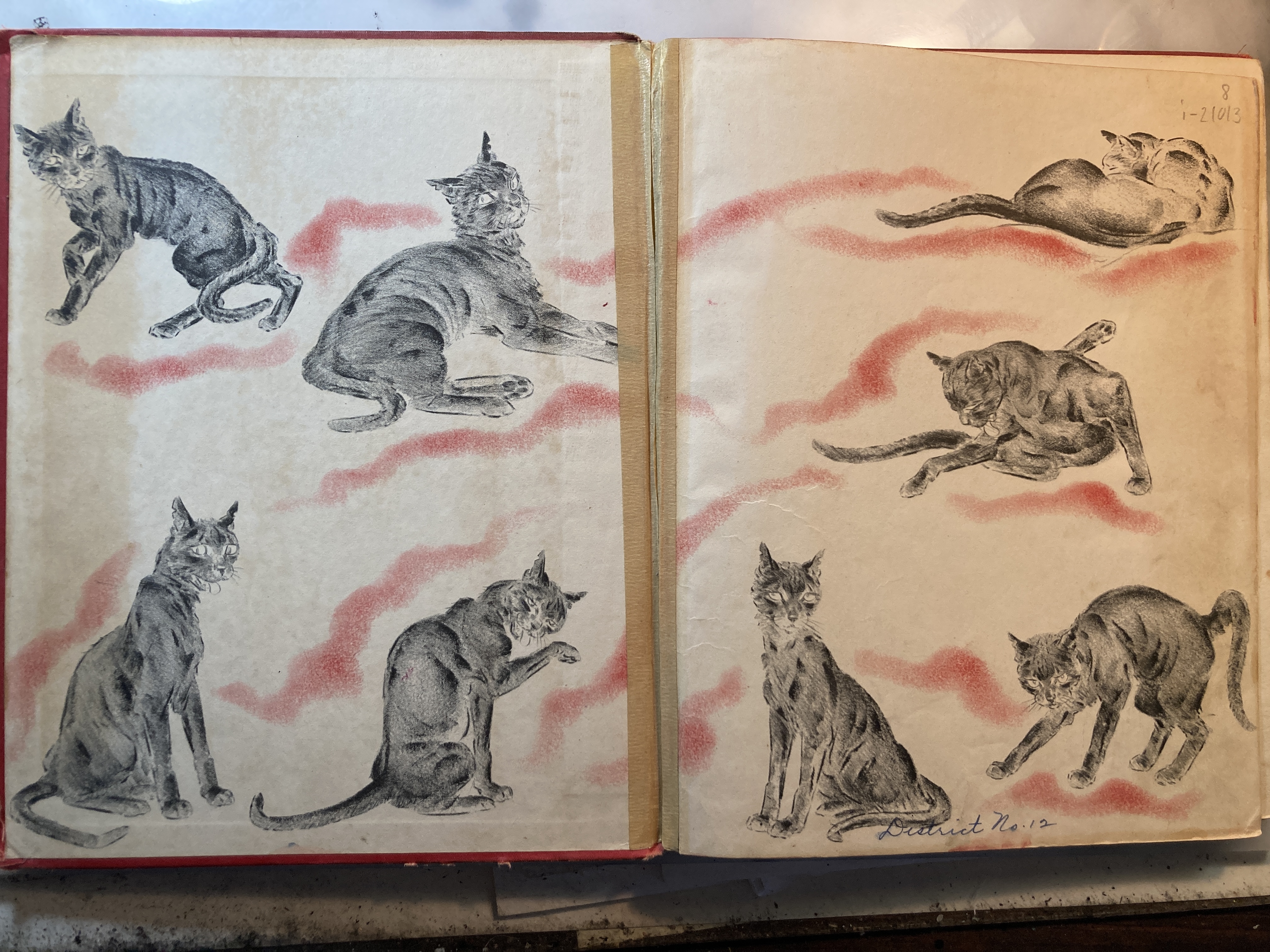
Front papers.

Bradbury was born in New Milford, Connecticut in 1908. A brief online bio outlines that as a young wife she published verse and short pieces in magazines and eventually, after her sons were born her worked morphed into children’s books and ultimately into young adult chapter books. She evidently wrote realistically about the issues of the day for kids in those later books, not balking at difficult subjects. This book and that bio intrigues me enough to look into some of her other books. (One Kitten Too Many may be where I start, but I will look for the longer ones as e-publications perhaps.) She was prolific and wrote 46 books in her 40 year career.

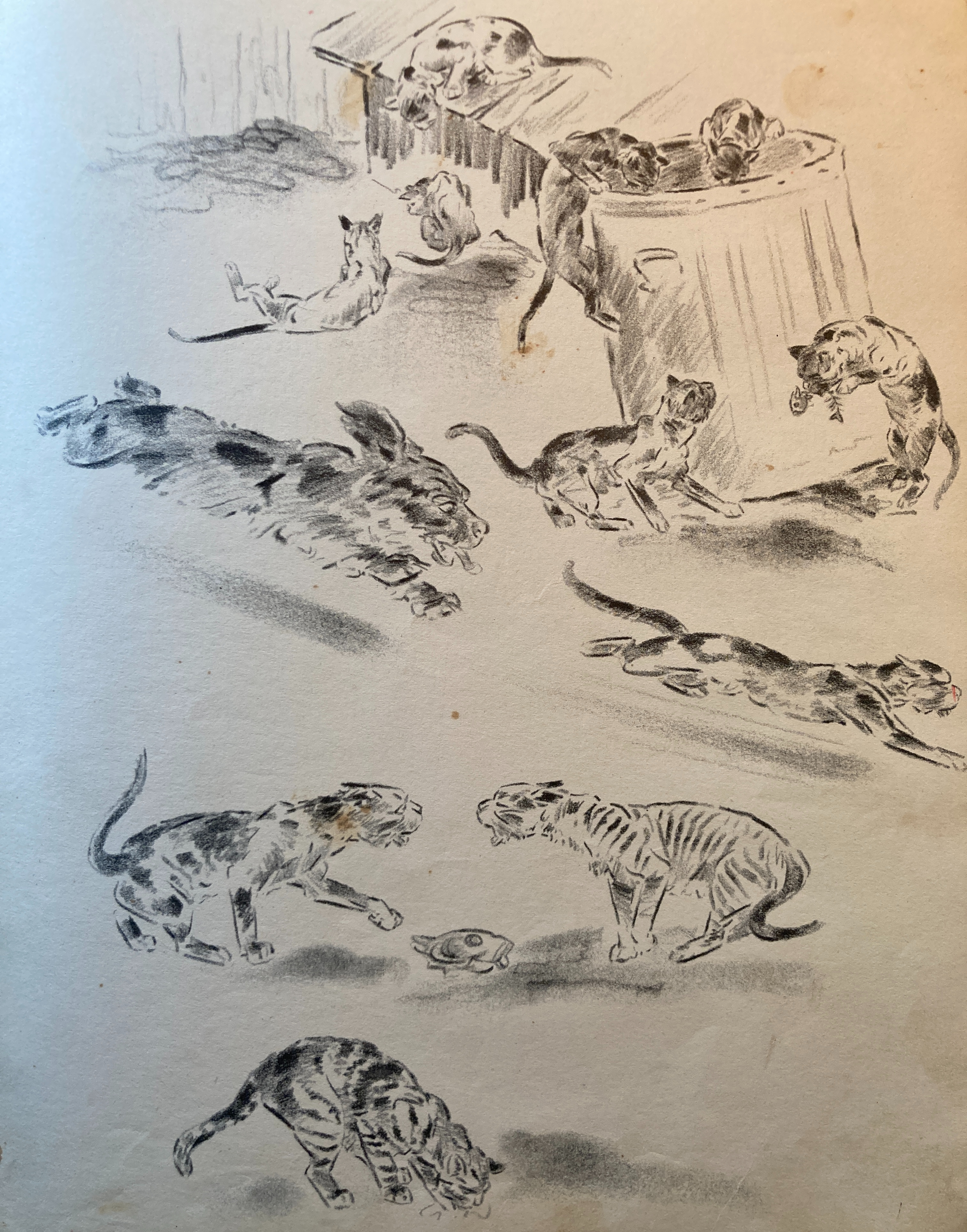
Solomon thinking back on his stray cat compatriots!

Meanwhile, Diana Thorne gets top illustrator billing here and she deserves it. Her cat illustrations are perfect. It seems she is best known for her illustrations of dogs (these seem to be well known and collected), but she certainly lived amongst cats as the poses are spot on for us cat lovers. Her illustrations are pitch perfect and absolutely put the story over. While her illustrations and drawings are widely available on the internet, there is little biographical information about her. It seems, oddly, that she was either born in Odessa, Ukraine, or as she was later to claim, on a ranch in Winnipeg, Manitoba, in 1895 (d. 1965) – her love and knowledge of animals would argue some time on a ranch I think. Her work is collected in numerous museums in the United States and Great Britain including the Smithsonian.

Something “fishy” about this doll…

The other illustrator credited, Connie Moran, seems to have teamed up with Thorne on a number of similar illustrated children’s books. I can only assume that Thorne was only interested in the animals and left the humans (and in this case some antique furniture) to Moran. She is from Chicago, born in 1898 and dies in 1964 so she and Thorne are contemporaries. Her illustrations are, for me, more commonplace and would be forgettable without the Thorne cats among them.

Solomon loves his dish of fish.

The Antique Cat is much shorter than May Sarton’s The Fur Person, (you can find that post here), but reminds me of it in tone and the way it is told from the cat’s perspective. It is a very worthy entry into cat related literature and certainly deserves a place in the Pam’s Pictorama library.

Blackie this morning. Hopefully on the road to recovery.

Red Cross Girls!

Pam’s Pictorama Post: I think I will always look back on this year and a half (heading into two year) period as my plucky young woman literary fiesta. It probably isn’t a coincidence that this, difficult period of time has made these stories of achievement under great duress appealing. Working my way through the work of author Margaret Vandercook in particular has been wonderful and these books have contributed to a longer reading project which builds on the changing role of women during the first part of the 20th century. Nursing on the front lines during the war, even driving ambulances there, was an enormous departure for young American women and according to these books they also lead the way for young European women to do the same.

As long-standing readers know, I started my journey with Margaret Vandercook via her many volumes of Camp Fire Girls books, took on the somewhat more raucous Ranch Girls next and am now investigating and celebrating the ten volumes devoted to the Red Cross Girls. (Some of those prior posts can be found here, here and here.)

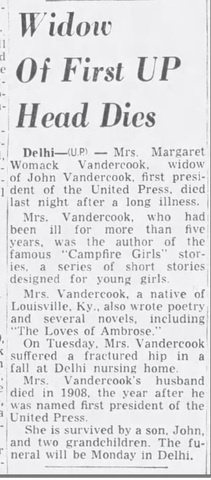
I came across an obit for Marjorie Vandercook clipped from an unknown, undated source – very little information seems to survive on her and this is the first obit I stumbled onto. It doesn’t supply much information, but I include it here for anyone else who might find it of interest. Of course they lead with her husband’s accomplishments and barely touch on her own contribution!

My first question was, did young women really do this? I mean did young women volunteer and head out to Europe to work with the Red Cross? Seems a bit crazy and it’s a bit hard to say. Obviously Red Cross nurses served in Europe during WWI, about 300 lost their lives working on the front lines. It isn’t clear what qualifications were expect however and if young women who had “a nursing course” or even less experience actually went over such as our heroines did, is hard to track down. Nurses, it seems for the most part, were from working class or rural backgrounds although some were indeed from affluent families, a mix like we have in volume one. So let’s assume that the role of our heroines is relatively realistic for starters.

Via witness2fashion.com as noted above.

Certainly the war that was being described was more or less torn from the headlines of the day since these books were published starting in 1915. Four women start out from New York City on a ship heading to Europe. Their first adventures and a few plot points that will reach several volumes occur onboard ship before making landing in Britain which is their first stop before nursing wounded British soldiers in France. (Vandercook must have had several of these books outlined to some degree, dropping in opportunities to come back and layer on plot in future volumes.)

I wondered how Vandercook would handle the sheer horror of nursing on the front lines with the sort of story line she generally develops and I report that she does an admirable job of it. Admirably, somehow she neither downplays the dangers and horrors of war, nor does she dwell too much on the gore. Of course the tales of valor are overblown, but after all these are fictional volumes for younger readers.

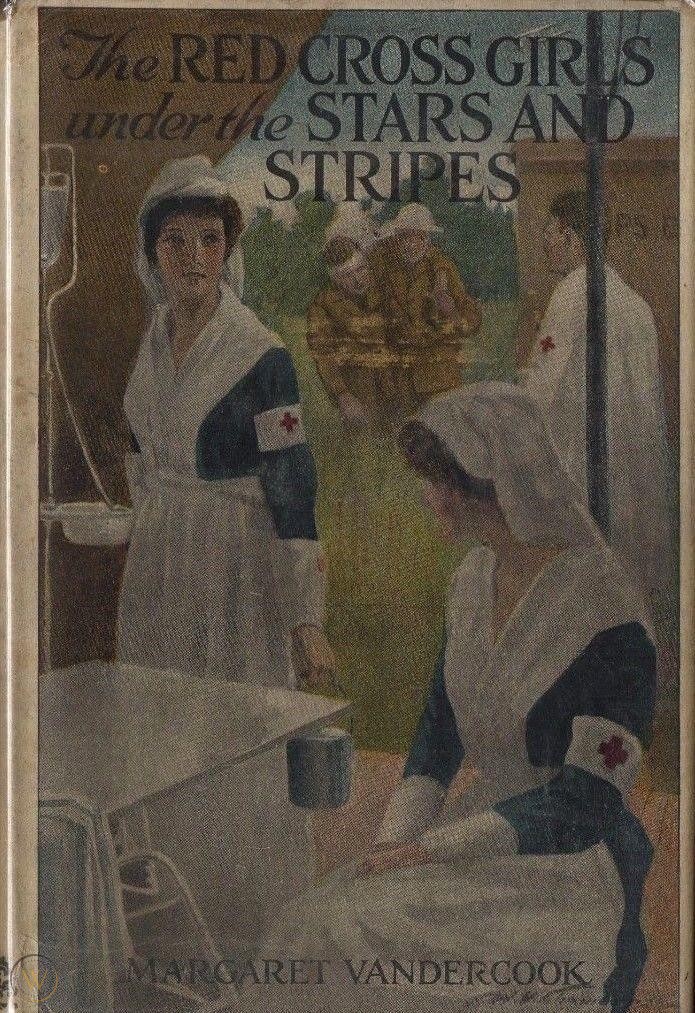
Dust jacket from volume 3.

Plucky indeed these young women are too. While the Campfire Girls had an interesting creed and much ceremony, the Ranch Girls just had a sense of the wild west where they had their origin. The Red Cross girls fall somewhere in the middle – there is a code for behavior and there are references to their need, like soldiers, to follow orders and fall in with the greater good for the whole. It would seem there is a creed – whether it had a basis in reality or not I cannot really say, but I would imagine that the spirit was there at a minimum although it isn’t as codified, nor as lore filled, as that of The Campfire Girls.

It is interesting to be reminded that the Red Cross nurses and doctors were of course technically neutral by definition. The United States would not enter the war until 1917 and the ethos of the Red Cross was (is) apolitical. However, these were stories going out to an American readership and the clear lines of sympathy for the British and French soldiers and a fear of the Germans is evident.

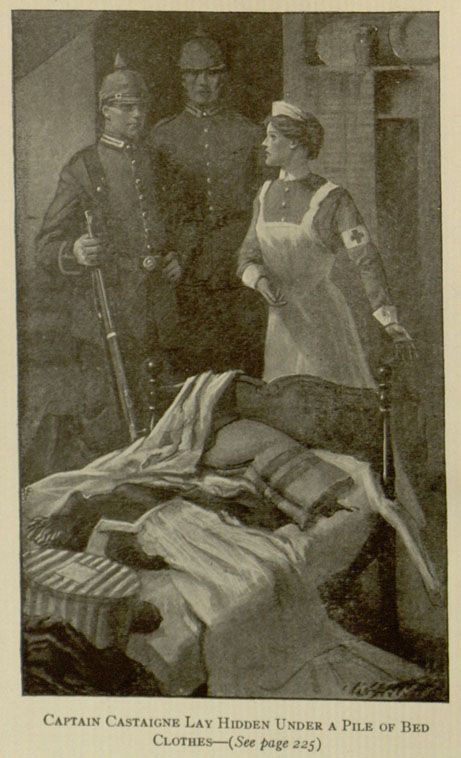
Illustration also from volume 3.

As of the volume I am currently finishing – The Red Cross Girls with the Italian Army – the fifth and published in May of 1918, there is no mention of the influenza epidemic which would certainly take headlines later that year although I assume will find its way into subsequent volumes. The first four volumes form a story arc and the fifth, harder to obtain as an e-book, seems to mostly to be tying up some loose ends and perhaps planting some new plots for the remaining second half of the series. The United States will be entering the war soon, presumably in the next volume.

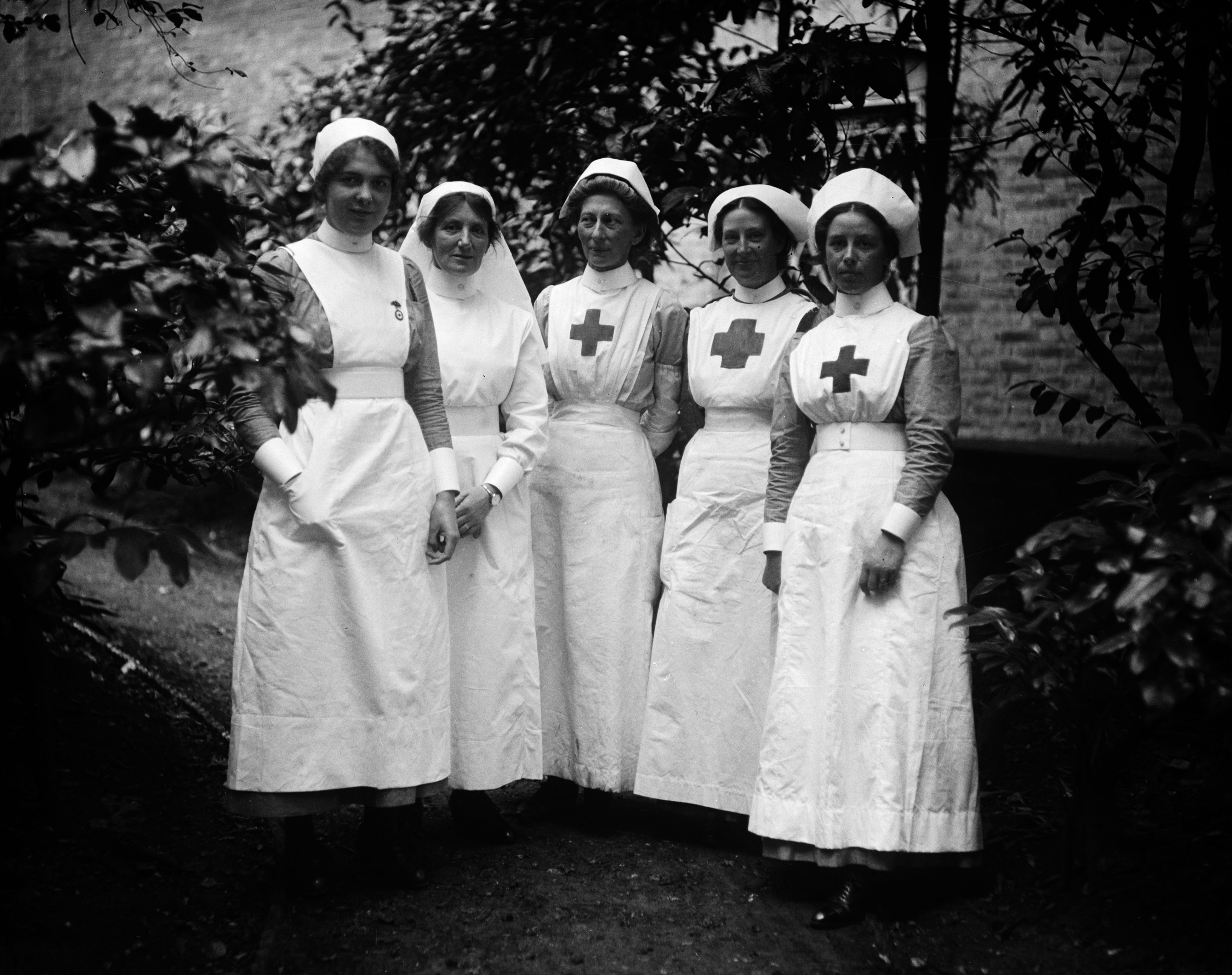
September 1915: A group of nurses at Hamworth Hall which is serving as a Red Cross Hospital during WW1. (Photo by Topical Press Agency/Getty Images) via Time magazine.

I am reminded that we are reading these books with the benefit of historical hindsight. Marjorie Vandercook had no way of knowing that it wouldn’t be be that many years before the world was back at war, barely a generation, and the fictional futures she thought she was securing for her heroines would perhaps be less than untroubled. It is hard not to read them knowing of the tumult of the political upheavals of Russia and that the sons of this generation would be the soldiers of that next enormous war.

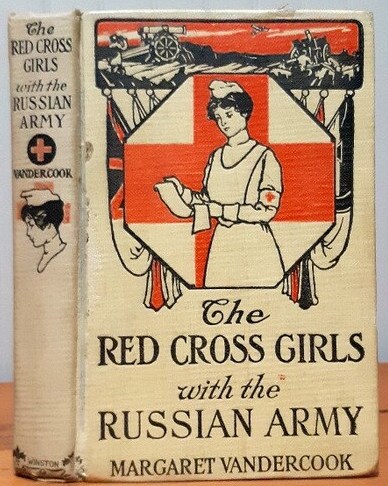
The first three volumes of the not quite five I have thus consumed, were the most compelling with The Red Cross Girls in Belgium being my favorite. I found the novel concerning their time in Russia, The Red Cross Girls with the Russian Army, a bit hair raising actually. What on earth were they thinking going to Russia? How did they even get there? Of course you should read it, but I am warning you, it puts you a bit on the edge of your seat.

This may be the only accessible volume from the second half of the series, but you know I will try to ferret them out!

As alluded to above, the first four volumes were easily available on Project Gutenberg as free e-books. After a bit of searching I located the current volume on the Internet Archive site. While they e-books don’t seem to be technically downloadable they are still easily read online and they have bailed me out on obscure volumes before. I think I will have some trouble acquiring the remaining volumes of the series which seem to follow the American army through other parts of Europe and then home. With any luck, I will be able to report on those in subsequent posts.

The Camp Fire Girls at Top ‘o the World

Pam’s Pictorama Post: Another pastime that will remind me of our long Covid year will be discovering and tearing my way through a large swath of Camp Fire Girls novels. While my past reading obsessions included all the adult fiction of Francis Hodgson Burnett (discussed in one of several posts here), the short works and then novels of Edna Ferber (found here), and Judy Bolton Girl Detective (first of two posts here) saw me through the sleepless nights during the early months of the pandemic, it will be The Camp Fire Girls that will bring back memories of recent months.

Illustration from The Camp Fire Girls at Driftwood Heights – none of the illustrations in this series is worthy of note!

I will never think of sitting in the ER at Lenox Hill Hospital waiting for a hand surgeon to work on my broken fingers on Memorial Day without also thinking about The Camp Fire Girls at Driftwood Heights, which I read on my phone throughout that long afternoon.

Reading about these plucky young heroines who are endlessly resourceful while constantly poking at the confines of what a respectable young woman could be at the dawn of the 20th century has provided the right stuff for managing through our own trying times.

I have been tackling this reading project in as organized a way as the acquisition of these aged books allows – most are at or just beyond the centennial of their having been penned, after all. I have been fortunate to find the lion’s share available for free on Project Gutenberg or other free, or virtually free, platforms. (Walmart e-books anyone? Internet Archive.com?) The book I am pulling out today is an exception and in an effort to lay down some tracks for a future reader with the same endeavor in mind I am making some notes here. It had to be purchased in its original form, busted spine, and a bit dear.

This series of books is nothing short of sprawling in scope. There seem to be maybe three main authors (and other lesser entries) over several decades. In an effort to follow story lines I have taken one author, Margaret Vandercook and read all under her name, and then all under her alternate nom de plume, Margaret Love Sanderson. When I have written previously about these novels (oh gosh, here, here and here) it was all the Vandercook novels – which I will label a superior group. I was very sorry to finish reading them and even after two generations of Camp Fire Girls, I could have happily stuck around for a third. They are her earliest efforts and I think she took what she learned about pacing and applied it to the latter series – these teens grow up much more slowly.

The series which I believe she intended to wrap up with one more volume, ends with the primary heroine, Bettina, leaving off the life of Washington debutante to follow settlement house work on Manhattan’s upper east side. These books play constantly with the shifting roles of women and forcefully promotes the interaction between the wealthy and the poor in associations and ways that were clearly still controversial at the time of writing. I would have liked to cap the series with a final book and the last two and my most beloved characters settled with their choice of mate and set on the path of their adult lives, but I guess it wasn’t meant to be. Alas! (Wikipedia sites her as the author of 21 books in the series – /i have found about two thirds – where are the others?)

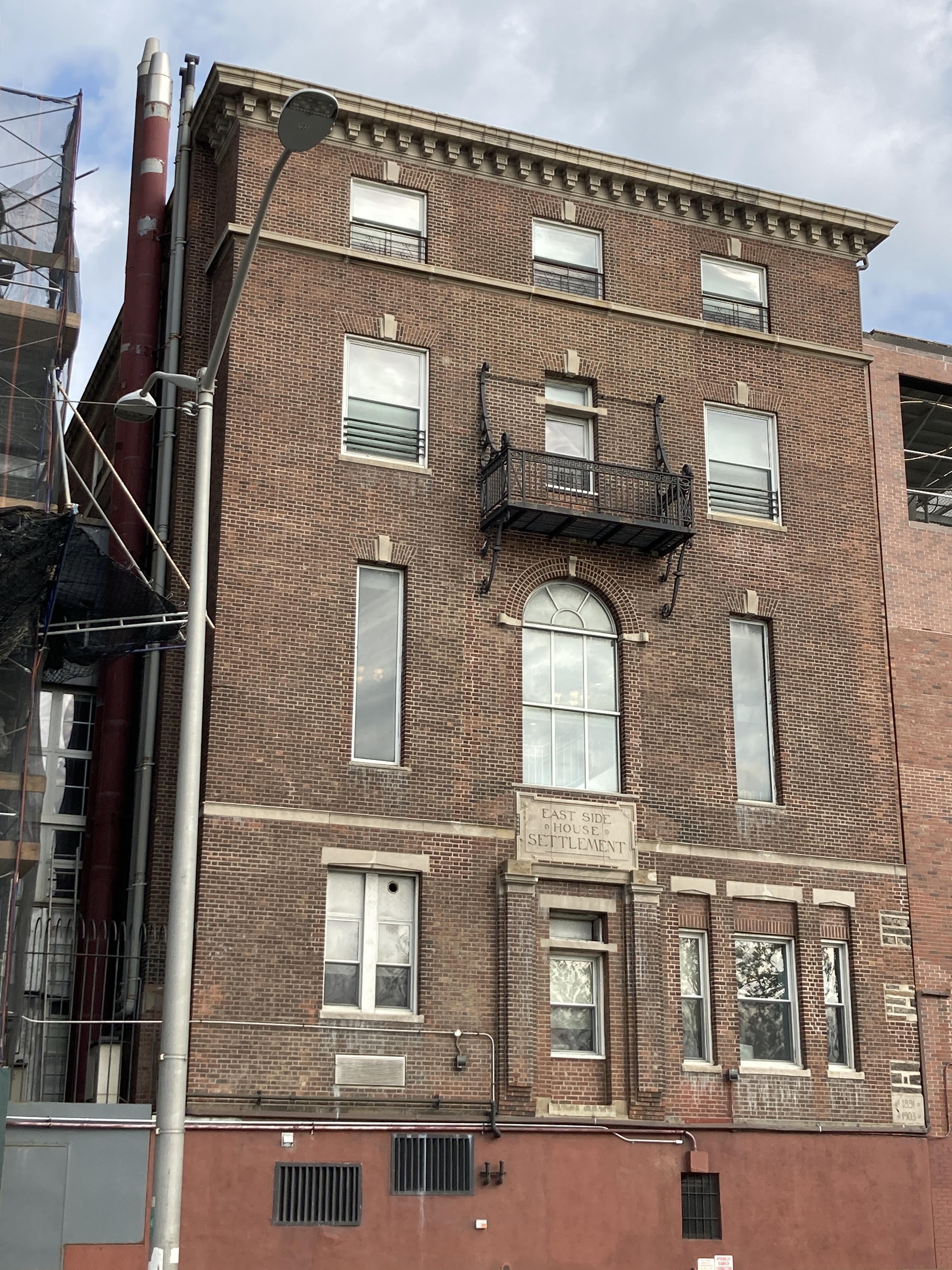
I actually run (now walk0 past the East Side Settlement House most mornings! This was where Bettina was learning settlement work in the final volume of that series.

Margaret was so prolific I cannot imagine how she had time to eat or sleep between about 1915 and 1921, let alone raise her son alone after her husband died. While pounding out these volumes at an astounding rate, it appears she kept at least three other robust series underway The Red Cross Girls, The Ranch Girls, and contributed to The Girl Scout series as well. I would very much like to get to the roots of her story, but I don’t see anything beyond bare bones in my searches to date. After this frenzy of work in the teens and into the early twenties, she seems to have stopped writing novels, done some magazine work and disappeared, although living until 1958. Re-married? Other pen names?

To further confuse the reader, Margaret had certain character names which she used constantly. Bettys and Mollys (as well as Mollies and Pollys) proliferate. I include lists of the books by story lines I have followed below in the hope that it might prove helpful to someone in the future. I wonder how even she kept it all straight.

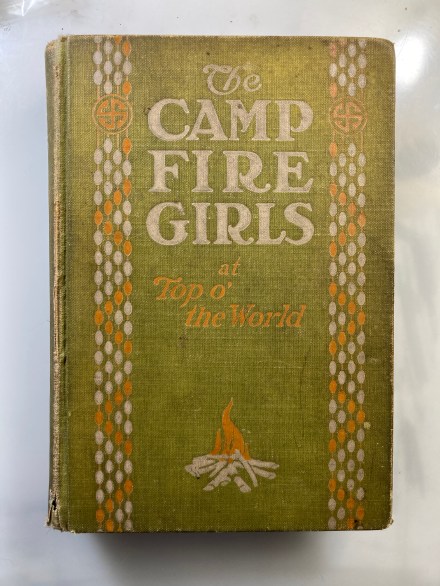
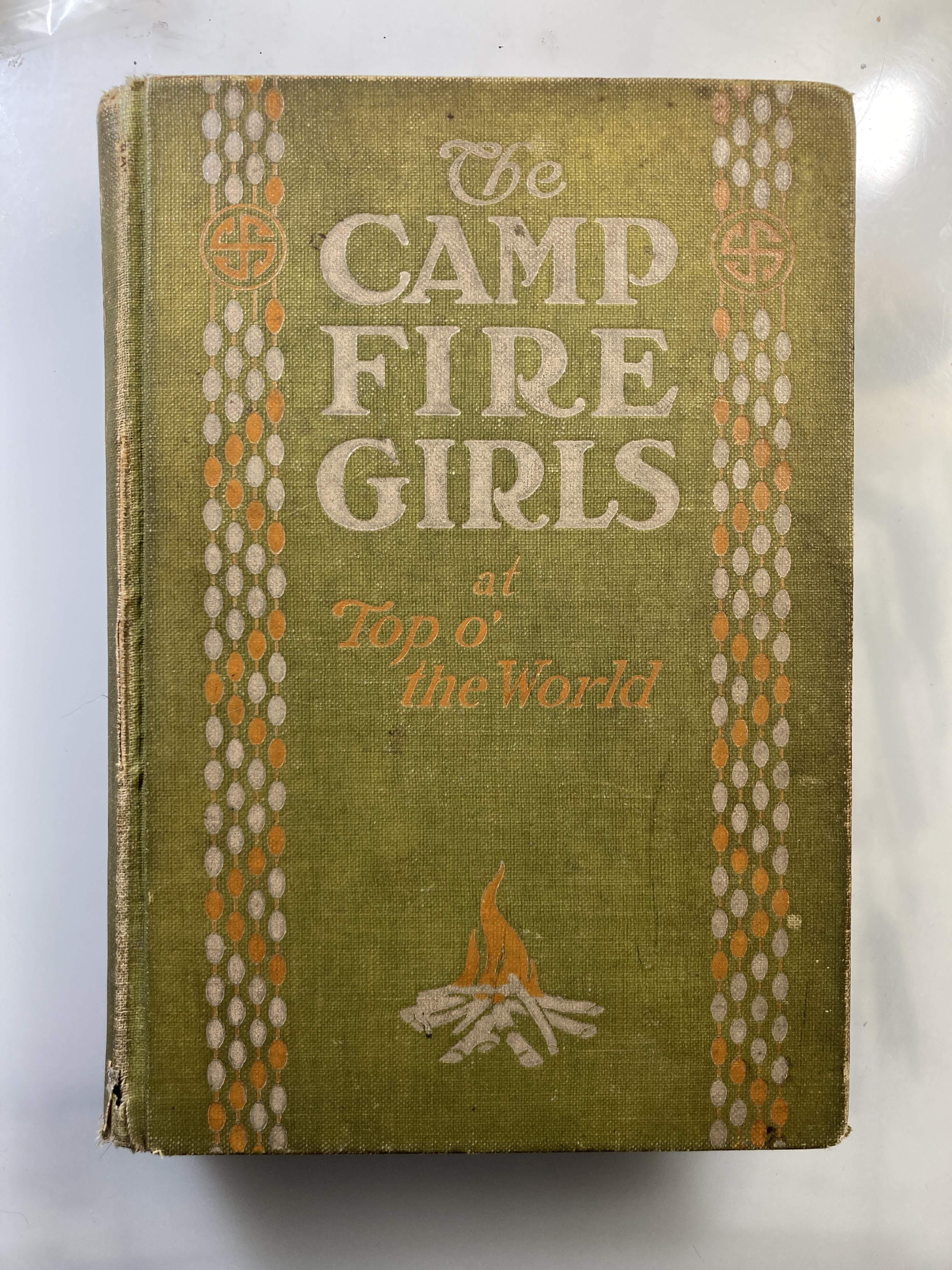
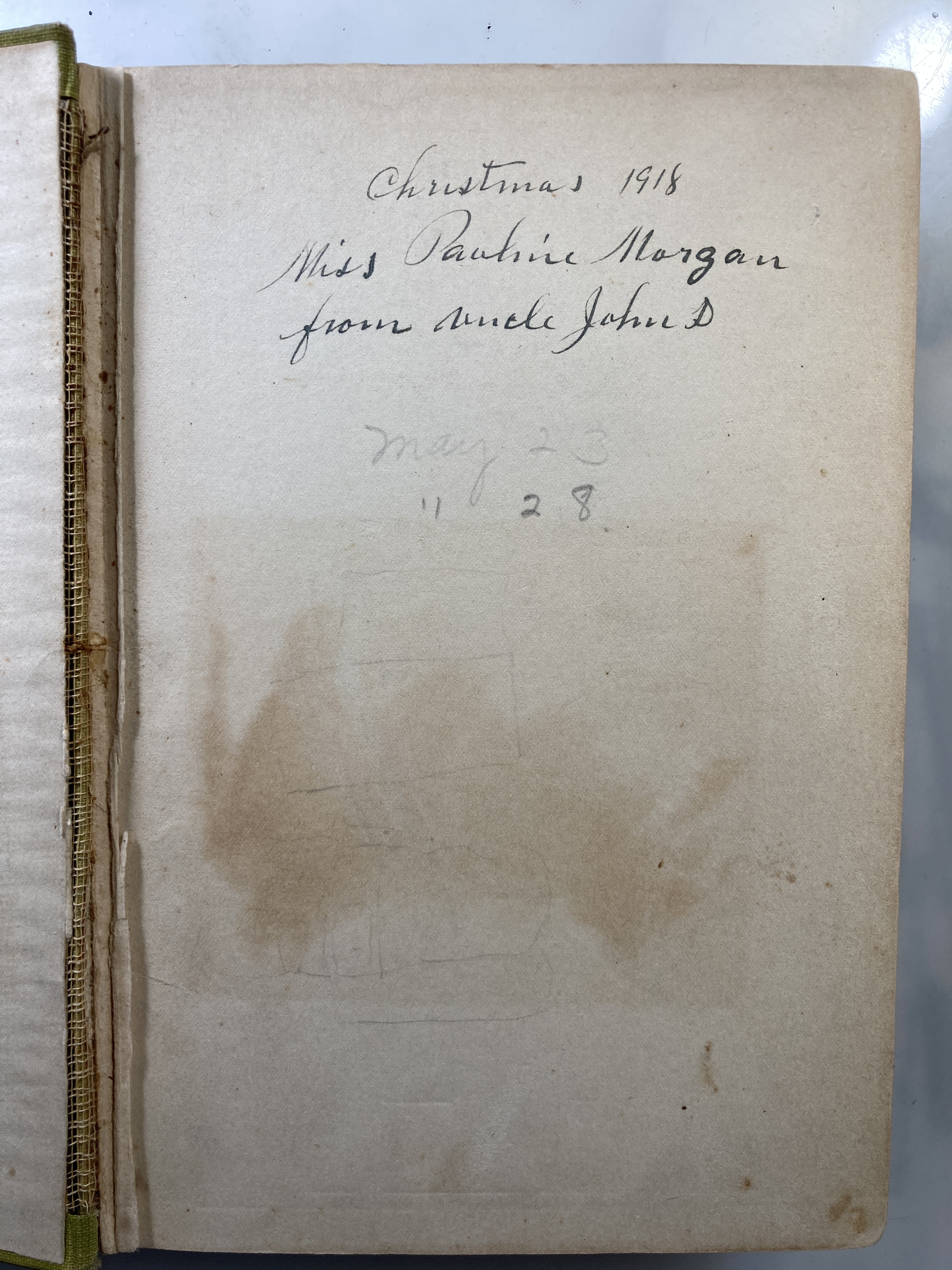
The Camp Fire Girls at Top ‘o the World (a great title, right?) is an outlier. Published in 1916 (my volume sweetly inscribed for Christmas of 1918) it introduces a new set of characters (Mollie Wren is our girl and she is of the from a poor, large family model, but with great Camp Fire Girl grit), who are gathered rather randomly from all over the country for a summer at the farm of authoress Julia Allen – not sure it is made clear where, but somewhere called Lakewood, most likely in Wisconsin.

It is a somewhat plot heavy volume – Margaret S. didn’t shy away from plot! A stray Russian girl from a New York factory is thrown into the mix (this isn’t her first Russian immigrant girl character, which makes me think it was part of the culture at the time – my own grandparents showing up on these shores as young adults in those years), a Southern belle and a wealthy New York niece who is a bit older and more sophisticated than the others. Dialect is rendered liberally and sometimes painfully around the Russian girl and Southerner. I won’t give more of the plot than this, but it is an enjoyable ride.

It would appear that this is the only volume produced for these characters and for whatever reason it seems to be an isolated volume. This probably explains its relative scarcity. I would love to find a way to donate this and another hard to find volume (The Camp Fire Girls in Merrie England) somewhere to have them scanned and made available for other completists like myself. Give a shout if you are acquainted with the process.

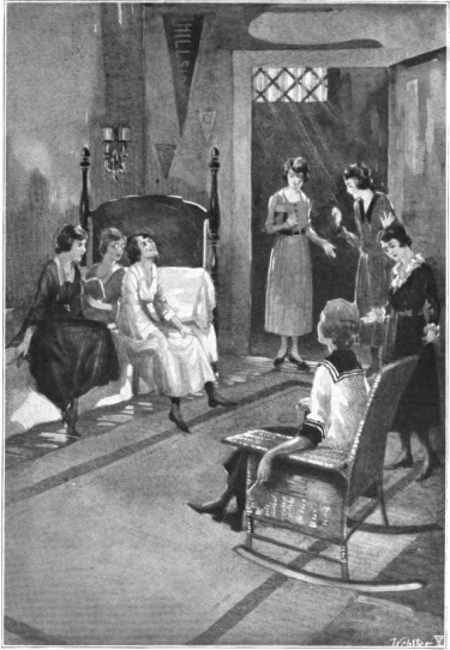
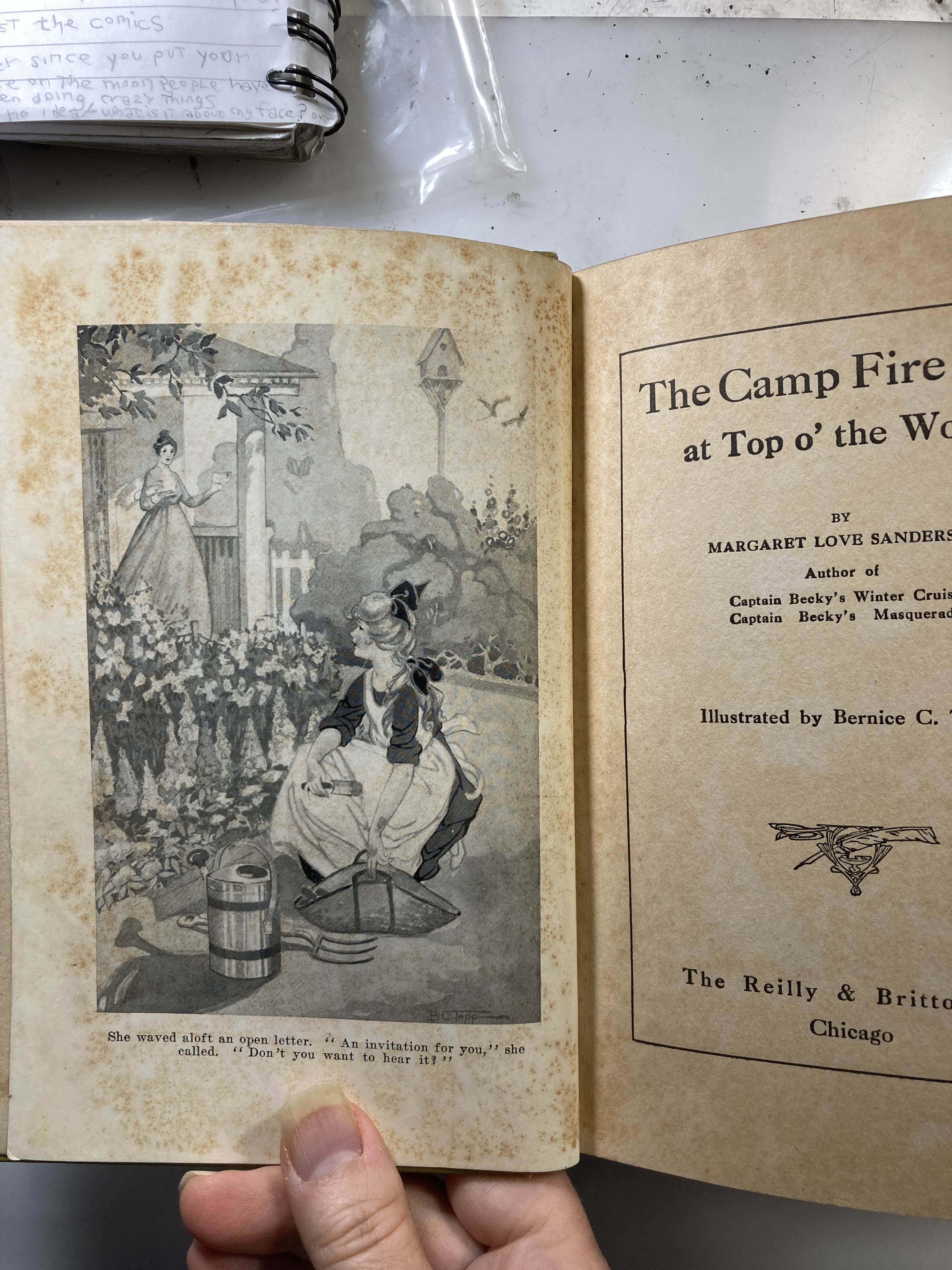
A sadly insipid frontispiece from The Campfire Girls at Top ‘o the World.

In closing a quick shout out to Jennifer White at whose wonderful eBay guide list to these books can be found at her blog Series Books for Girls and who kindly answered a burning question I had about a missing volume mentioned at the close of The Camp Fire Girls at Drift at Driftwood Heights The Camp Fire Girls at Sweetwater Ranch – which is a ghost volume that, never published. Her blog Series Books for Girls contains some all important lists including one that appears to be the complete list for the Margaret Love Sanderson books above. The list below is from Wikipedia and is for the Margaret Vandercook ones. (Please note that Wikipedia has the order wrong on the last two volumes – it is correct as below.)

‘The Camp Fire Girls Books by Margaret Vandercook

The Camp Fire Girls at Sunrise Hill (1913)
The Camp Fire Girls Amid the Snows (1913)
The Camp Fire Girls in the Outside World (1914)
The Camp Fire Girls Across the Seas (1914)
The Camp Fire Girls’ Careers (1915)
The Camp Fire Girls in After Years (1915)
The Camp Fire Girls on the Edge of the Desert (1917)
The Camp Fire Girls at the End of the Trail (1917)
The Camp Fire Girls Behind the Lines (1918)
The Camp Fire Girls on the Field of Honor (1918)
The Camp Fire Girls in Glorious France (1919)
The Camp Fire Girls in Merrie England (1920)
The Camp Fire Girls at Half Moon Lake (1921)
The Camp Fire Girls by the Blue Lagoon (1921)

Socialism, Pacifism and Then War: Politics in the Campfire Girls

Pam’s Pictorama Post: Preemptive apologies for those of you who don’t share my passion for early 20th Century young adult literature, because today I am posting about the Campfire Girls as they head into WWI. Also, a warning that I give away some key plot points so be forewarned if you are reading as a review and perhaps come back later after reading if that concerns you.

I have written about this series before (those posts can be found here and here), but this series is a bit hard to get your hands around because as I can best piece it together several authors were contributing books published at the same time so you think you are reading them in order, but you have picked up another story line. Also, many of the sources have listed the order of the books incorrectly further confounding my efforts to read them in some sort of order. The good news, and there is a lot of good news, is that they are widely available by free download, although I have been forced to read them on a variety of platforms – some decidedly less friendly than others, but after all, free is free. Most are available on the very user friendly Project Gutenberg website.

Camp Fire Girls, circa 1918.  Photo courtesy of Latah County Historical Society.

My best effort to rectify this was to find one author and follow her and I have been reading the books of Margaret Vandercook, aka Margaret Love Sanderson (warning however, that nom de plume was also used by a Emma Keats Speed Sampson), who was known as The Queen of the Camp Fire writers according to a brief Wikipedia entry, one which is especially useful in correctly listing her books. (Love you Goodreads, but you don’t have it straight and neither does the Wikipedia entry under The Campfire Girls overall.) There are 21 Camp Fire Girls books to her name (although oddly Wikipedia only lists 14) and she also wrote the Ranch Girls, Red Cross Girls and Girl Scout novels.

Her bio is brief, born in 1877 in Kentucky, she lived until 1958. Married for eight years to John Filkin Vandercook who eventually became the first President of the United Press Association, so we will assume he was a writer too. After his death in 1908 she started to write professionally and, man, she was prolific – churning out several of these novels a year. Strangely though, she appears to stop writing abruptly, at least in this genre and as far as I can tell, in the early 1920’s. I wonder if she remarried at that time and no longer needed to support herself and her son? A mention is made of magazine work, articles, poems and stories. Also, perhaps they run longer since as I pointed out the list I am working from appears to be incomplete.

From Campfire Girls at Camp Keewaydin

There’s a lot of charm in these books and I really took a bath in the lore and accoutrements of the Camp Fire Girls as outlined in the early books – rings, costumes, poems and all. While this remains a backdrop Vandercook stealthily moves us into other territory and as the century turns from the early and mid-teens to 1918 and beyond she is writing stories that are almost contemporaneous accounts of the country preparing for and entering in WWI. There is a strange sense in reading them one after the other, that perhaps they were written in larger chunks and then parsed into pieces that make up the novels. The story continuity from one to another is seamless and more like the next chapter in a book than a new book in many of these.

From Campfire Girls at Camp Keewaydin

Much to my surprise in The Camp Fire Girls at the End of the Trail (1917) Socialism pops up. The Camp Fire Girls have been out west for a volume already (also, we are on the second generation of girls here and Vandercook wised up and they age a bit more slowly in the second half of the series) and the younger brother of one is sent to stay with them to recover from the sort of mysterious wasting diseases that seemed to permeate the pre-antibiotic world. He is portrayed as an usual young man, only about 15 years old, and among his peculiarities it emerges that he is a Socialist.

Group portrait of Socialist Party members gathered for the Socialist Convention and Eugen V. Debs picnic in Canton, Ohio 1918.

In the first volume of their time out west there is an effort to address the situation for Native Americans which I think was sincere, if ham-handed and wrong by today’s standards. Socialism, which is addressed in the form of young Billy getting involved with railroad union organizing. Seems Billy had gotten an earful of Socialist propaganda from a Russian immigrant working on his father’s farm in New Hampshire. He finds his way into an enclave of railroad workers and becomes a leader among them – but pushing a non-violent agenda among. It ends badly, with violence, for which he is ultimately blamed, but in a glossing over it is quickly remedied by his family’s wealth and connections. It manages to be both sympathetic and yet illustrate what was probably the more accepted feeling of the day about unions and Socialism. While it seemed a bit surprising, again, these were novels that were addressing the current events of the day in almost real time.

End paper for Camp Fire Girls at the End of the Trail via Project Gutenberg.

Without ruining the plot, I will just say that his pacifism is treated with some thoughtfulness considering how enthusiastically we are told Americans generally geared up for that war. It is fair to say it is presented as an untenable view, but not without sympathy for his position. Frankly, I was surprised and would have expected these books to be full only of endorsement for our entrance into the war.

Vandercook wasn’t done with this character yet and uses him to address pacifism in the next volume as the country tunes up for entry into the war. Published in 1918 The Camp Fire Girls Behind the Lines still has them in the West, but now near a newly established army training base in the country, somewhere in Southern California. Billy has been joined by his brother who is anxious to enlist. Billy, on the other hand, is a vocal pacifist and decries the military approach to solving the world’s problems. He wiles his way into working at the army base and makes friends with the fellows working there, becoming very popular with them. It would seem he intends to infiltrate them and then convert them to his way of thinking, but again, things take a very different turn in the end.

In case you are wondering, these are just sub-plots in these novels which still very much manage to be about this clutch of Campfire Girls and told from their perspective.

Finally, I found myself at the group of novels which deal directly with the war and takes a slightly smaller group of girls to France to help with the reclamation work which evidently began there even before the war ended. First I will volunteer that I thought this was likely where I would get off this trolley because this seemed like an absurd idea and this sort of girls in the Red Cross thing was profoundly uninteresting to me. (As I said to Kim, these kinds of books going to war is a bit like most series going out west, the beginning of the end.)

However, I learned that there is historical precedent for a small number of self-financed women who actually did this – driving cars (a skill which many of their French counterparts did not possess), bringing first aide, childhood education to a generation of orphans and semi-orphans, and all sorts of similar endeavors – a small but determined league of women did do this work taking on six month hitches at a go. (All of the photos snatched here can be found on Mashable, 1914-1918 Working Women of WWI here. A rather excellent entry about some of this history can be found here on the Morgan Library site from one of their exhibitions.)

Women shoveling snow from the road Paris France

Therefore the storyline was an acceptable one and doesn’t entirely stretch credulity as I originally thought. (Learning these somewhat forgotten bits of history along the way is one of the decided byproducts of reading these books.) Again, these books were written almost in real time so I would think she did know what would be believable and acceptable to her audience. If the idea that the Campfire Girls were establishing their first roots in France this way has any historical reality or not.

Women grease and inspect the signals Gare du Nord Paris France

Perhaps more to the point Vandercook makes these compelling stories and her descriptions of war torn France have the ring of truth and reality. Although well traveled there is no indication that she actually was in Europe during or immediately following the war and I assume it was newsreels and news accounts that informed her writing – and the tales of these women abroad must have captured her imagination.

Women making missiles in a munitions factory England

Not surprisingly, there is a strong underlying patriotism to these stories, as to be expected. Then again though, there are details which we get from this real time account – the feeling of Paris on the day the armistice was declared; the reaction to Wilson as part of the Peace Conference there which is fascinating and wonderful. She writes about a post-war ambivalence between American and French troops which must have been a real issue. of the day. Incidentally, my pandemic pals, the 1918 Influenza epidemic is entirely ignored.

It is a bit painful to read about as their hopes for a lasting world peace is detailed and never suspecting that we would be back at war a scant twenty plus years later. Sadly we know what the future held and that these hopes for a lasting world peace were not to be.

Judy Bolton Mysteries: Part 2

Pam’s Pictorama Post: While bunker-style living here in Manhattan during our modern plague has not resulted in an increase in reading time (quite the opposite as days seem to somehow blur into seven-day-a-week, 14 hour day work-a-thons), I do make time every night for a bit of Judy Bolton before bed. With the last few volumes looming on the horizon I know I will miss her and the dollop of her 1940’s daily life when I eventually finish the last volume. However, today I offer this next Judy installment as suggested reading for those of you hunting a little escapism from your current reality.

judy3.2

I have always believed that in stressful times that one should be extremely thoughtful about what one is reading. (Kim is currently deep in Max Brand – I thought he’d already read all of him – and of course Little Orphan Annie on weekends, but none of this is different, just business as usual for him.) These days I read only what I feel is necessary of the newspaper in the morning and quickly move on.

In the evening, I need something to lead me into a relaxed enough state to sleep. Therefore, I try to put down the phone (Wynton Marsalis, please take note) and pick up my Judy Bolton novel to read a chapter or so. I am finishing up volume 20 currently, The Warning on the Window, and am fascinated by the fact that my copy, with a 1949 copyright, sporting a dust jacket and purchased on ebay, had never been read! I found several pages that had never been split. Imagine this book being passed from hand to hand over seventy years and never read. Extraordinary!


As I mentioned in my first post about Judy (which can be found here) about halfway through the series Judy marries one of her two suitors throughout the earlier volumes. While Judy’s role is not diminished to one of housewife, some of the aspects of 1940’s pre-feminism jabs at me in these latter volumes. Judy’s husband leaves his nascent law practice to join the FBI after one of their adventures and somehow the series that was about her with him occasionally helping becomes about her helping him. Although hers always does end up being the star role the author now feels the need to work at storylines that allow for this. (Meanwhile, reality has never been a strong suit of these books, but the evidence of this sticks in my crawl a bit.)

Meanwhile, Judy and Peter have acquired a child along the way, Roberta, whose father is mysteriously “at sea” and from what I can tell they have never heard a peep from him. As a result they now have a ready made family and Roberta’s mystery solving abilities, given her age, somewhat make up for Judy’s post-marital status.

204004417.0.l


As part of this shift in storyline, I was a bit worried about Judy’s black cat, Blackberry, who seemed to be meeting his demise in The Living Portrait. A puppy, Tuffy, was introduced in this volume as Roberta’s pet and I was quite peevish when it seemed that Blackberry would be sacrificed for him. I hope I am not giving away too much plot when I assure readers that he makes a strong eventual comeback and remains part of the family. (In fact up next, The Black Cat’s Clue.)

The thing that interests me most about the second half of the series is that Margaret Sutton’s writing style seems to morph in tandem with Judy’s role as wife. Almost immediately the books become a bit more complex. The mysteries go from being excuses for a storyline with unreal plots to more logical storylines. They are still stuffed with really bad criminals and if anything Judy appears to be in actual danger in some of these stories. In particular The Secret of the Musical Tree managed to have me a bit worried about her at one point. (Even if harrowing at times, all is of course viewed from the safety of knowing that Judy appears in another volume, waiting patiently for me next to the bed.) Judy as an adult clearly meant that Sutton could step out a little in a different direction.

unnamed.jpg

Undated photo of Margaret Sutton


To both Judy and Sutton’s credit, Judy spends little if any time worrying about her appearance (Judy’s attire is only ever noted if it is a plot point) and only glancingly makes mention about things like cleaning the house or cooking a meal. Judy’s mother tends to worry about Judy’s mystery solving ways and one gets the sense that this is the evolution of young women of the times moving yet another notch out of the home and into the working world.

Still, plot devices are needed in order to get Judy away from her husband and let her do her stuff, which by today’s standards is unnecessary and even insulting. Peter can therefore expect to be conked on the head unconscious, or to find that somehow Judy is off in another town, unable to phone, and turns out to be knee deep in trouble. Despite being dated in this way, these books are a more or less perfect antidote for the stresses of the spring of 2020 for me. Just intriguing enough to lead me peacefully down the garden path, again and again each night. I highly recommend them if you like me need a bit of evening escapism.


Letters from a Cat

Pam’s Pictorama Post: Today feline dedicated post was a birthday gift from my good friend Eileen Travell. She acquired this precious, slim volume at a store I long to experience one day and that I wrote about in an earlier post, 3 Little Kittens, which can be found here, and describes that gift purchased there as well, The Salem, New York shop is 1786 Wilson Homestead (1117 Chamberlin Mill Road, Salem, NY; their website which can be found here). It has set me to dreaming about a future summer day digging through their wares. My copy is stamped School Library, Saranac Lake, N.Y. on both front and back fly leafs.

img1

While this book is clearly meant for children, complete with very large and easily read text, I am not sure I would say race out and grab this book to read to your small child. Suffice it to say life was cheaper and harder in 1879 and that is evidenced in this book. The overall premise of the book is that while a little girl is away visiting her aunt she receives a series of letters penned by her puss in her absence. (Yes, the remarkable nature of a cat writing letters, however sloppily printed, is covered in the story, although never fully explained. The methods of post are detailed however.)

423px-Letters_From_a_Cat_Plate_9

Sadly kit has a hard time of it in the absence of her mistress with everything from a spring cleaning of the house, which terrifies her, to an accident with a barrel of soft soap, which I assume is either lye or the lye and fat makings for soap, which almost does her in. All about the plot is is given away in the first part of the book which is penned in the voice of the young mistress now grown.

However, when the little mistress describes how much she loves her kitty and what a glorious cat she is you know that H.H. was herself a cat lover and an understander of the feline nature. (Kim speculated that the timing is right for this book to have inspired Archy and Mehitabel, first created by Don Marquis in 1916 and collected first in 1927. As many of you know, it is best known for being illustrated by George Herriman of Krazy Kat fame.)

Letters from a Cat Published by Her Mistress for the Benefit of all Cats and the Amusement of Little Children has an original copyright of 1879. My edition is from 1930. It has seventeen illustrations by Addie Ledyard. The author H.H. turns out to be Helen Hunt Jackson (b. 1830 and d. 1885, née Helen Maria Fiske) a famous poet and writer of her day.

Jackson was the daughter of a minister, author, and professor of Latin, Greek, and philosophy at Amherst College. Her mother having died when Helen was 14, she and her sister were fully orphaned three years later. However, the father had provided for Helen’s education and she attended a boarding school where she was the classmate of Emily Dickinson with whom she corresponded throughout her life. Helen Hunt Jackson was very much a part of the interesting and broad group of writers and thinkers in the greater Amherst area of the day.

Helen_Hunt_Jackson_NYPL.jpg

Jackson begins writing after the loss of husband and sons over a handful of years and before she was much more than 30 years old. (Hunt was the surname of this husband, she eventually remarries while taking the cure for TB in Colorado years later and takes the name Jackson.) Her earliest works are published under the H.H. nom de plume. She became interested in issues surrounding the poor treatment of Native Americans after hearing a lecture in Boston by Chief Standing Bear in 1879 (interestingly, the year Letters from a Cat was published).

Her best known work, Ramona, published in 1884, is a story of a young woman of mixed Scots and Native American heritage, was hugely popular and spawned five films and even was thought to expand the tourism industry of Southern California at the time. While it may have been the romance of the story that made it so popular, Jackson wrote it as a way of showing the plight of the native people. She kept up a very real and fierce lifelong battle with Washington over the treatment of the Indians and fighting for the return of their land and rights.

Of the illustrator, Addie Ledyard, there is really no information except for the trail of books she illustrated which are still available. At a glance I would say cats were a specialty, although she seems to have illustrated at least one volume of Louisa May Alcott stories. Following my nose on her illustrations may lead to some other interesting discoveries.

800px-Letters_From_a_Cat_Plate_15.jpg

This illustration shows Ceasar, the handsome, huge black cat who arrives in town and is an  important plot point.


I am reminded of an obscure, antique volume I had years ago and gave to my mother, written by another poet who also wrote from the perspective of her cat. If I can remember it and find it I will share it in a subsequent post. I always think of it when I see a cat watching out a window as her cat called that reading the newspaper daily.

426px-Letters_From_a_Cat_Plate_10


Letters from a Cat is available on Project Gutenberg (with illustrations) and Google Books, as well as in reproduction and various earlier reprints over time. With renewed thanks to Eileen, I suggest all you cat collectors get on this one.

61kw1050bGL.jpg

Earlier volume of the book.