Mourning

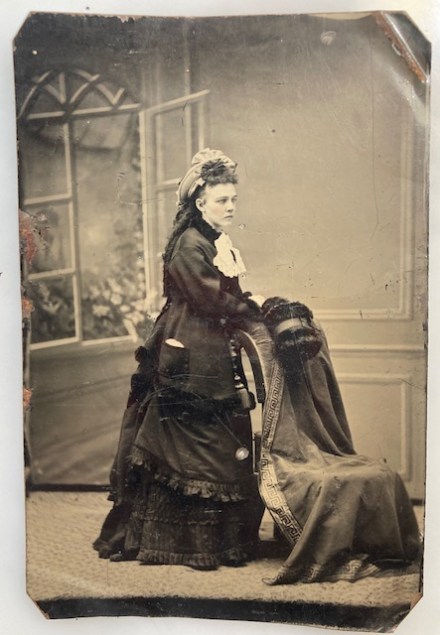
Pam’s Pictorama Post: This unusual photo was a birthday gift from a good friend (thank you @eileentravell) which she gave me recently. It a large, half plate, tintype. Aside from a bent corner, some chewed up edges and that odd ding on her dress near the chair, it is in fairly good shape.

As I started spending time with the image it confused me a bit admittedly. She is in what I have to assume is mourning, her all black attire, down to her black fur muff. Her clothing best dates this to my mind is probably the 1890’s. There is some relief in the white lace ruffle and the middle to light gray of her hat, something light colored like a handkerchief peeping out of her pocket.
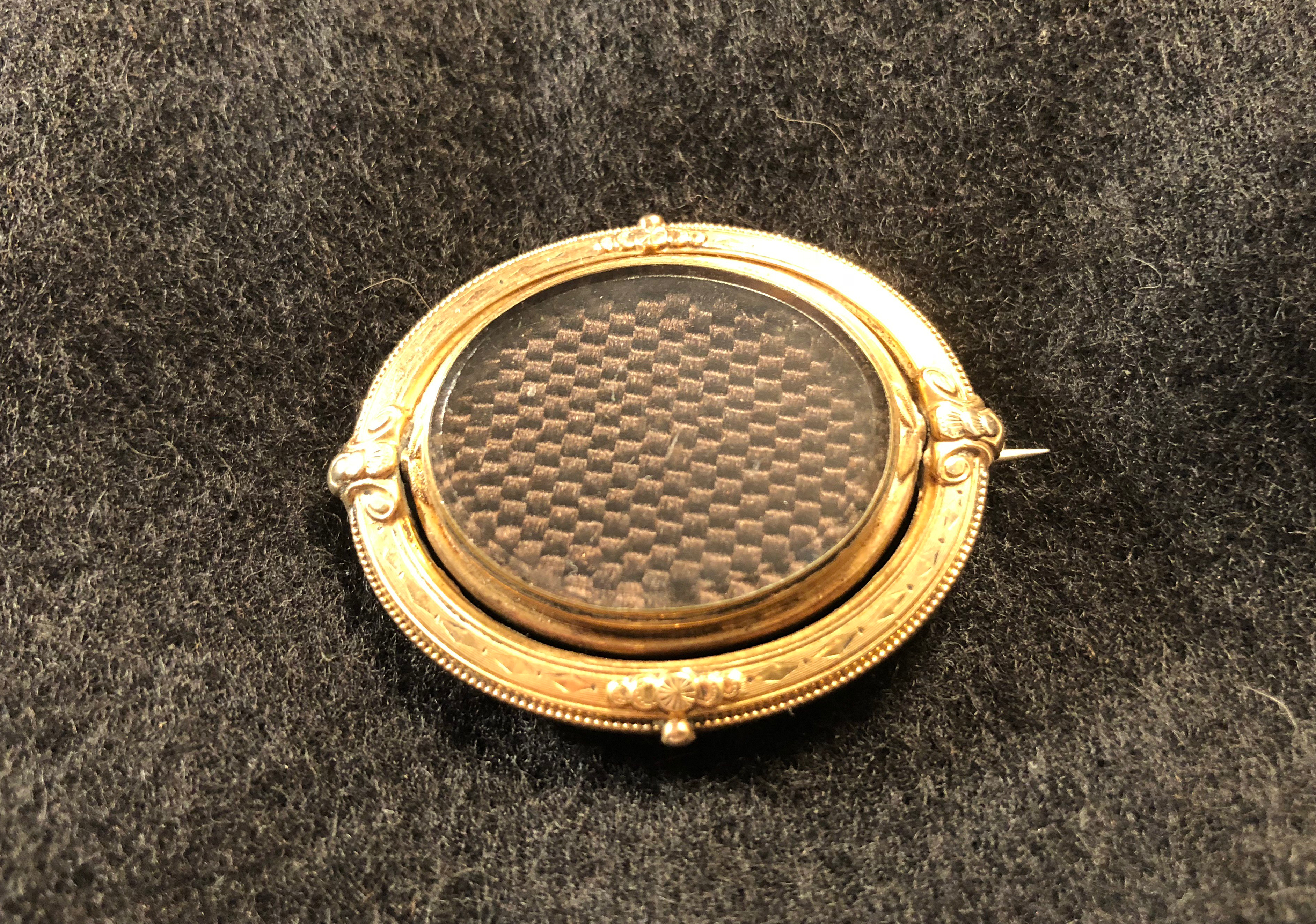
Hair mourning brooch given to me by a friend. Pams-Pictorama.com Collection.

She looks grave and pale as she leans on the prop chair, covered in this cloth with a patterned edge. The background prop is a bit sad and cheesy as well, a view out a faux window, hangs a bit askew and folds below it. The carpet defines the space that she is atop, but that too ends at the front edge of the picture.
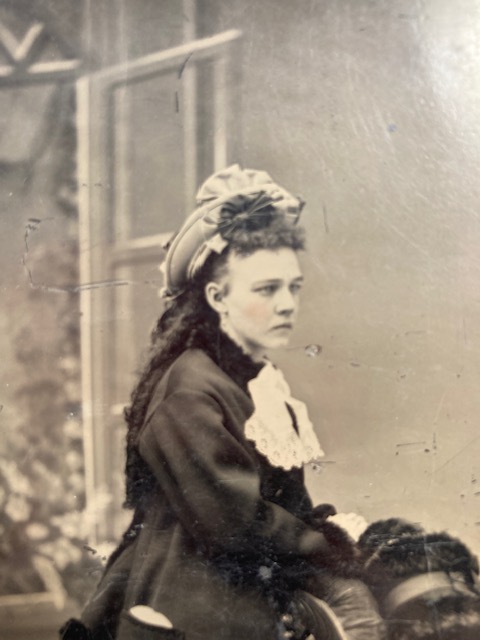
Detail. Pams-Pictorama.com Collection.

Most interesting to me is that her cheeks have ever so slightly and delicately been pinkened by a gentle hand, which is not at all always the case in the toning of such photos. Yet, looking at her I wonder why they bothered as she is deeply in her own world of grief.

In fact, I find it interesting that such a photo was even made. Why would you want to record this period of grief in this young woman’s life? (If you look closely, she is young despite these trappings which bring a sort of middle age to mind.) I don’t know if that sort of recording of mourning was part of the intricate ways of observing the various rituals or not.
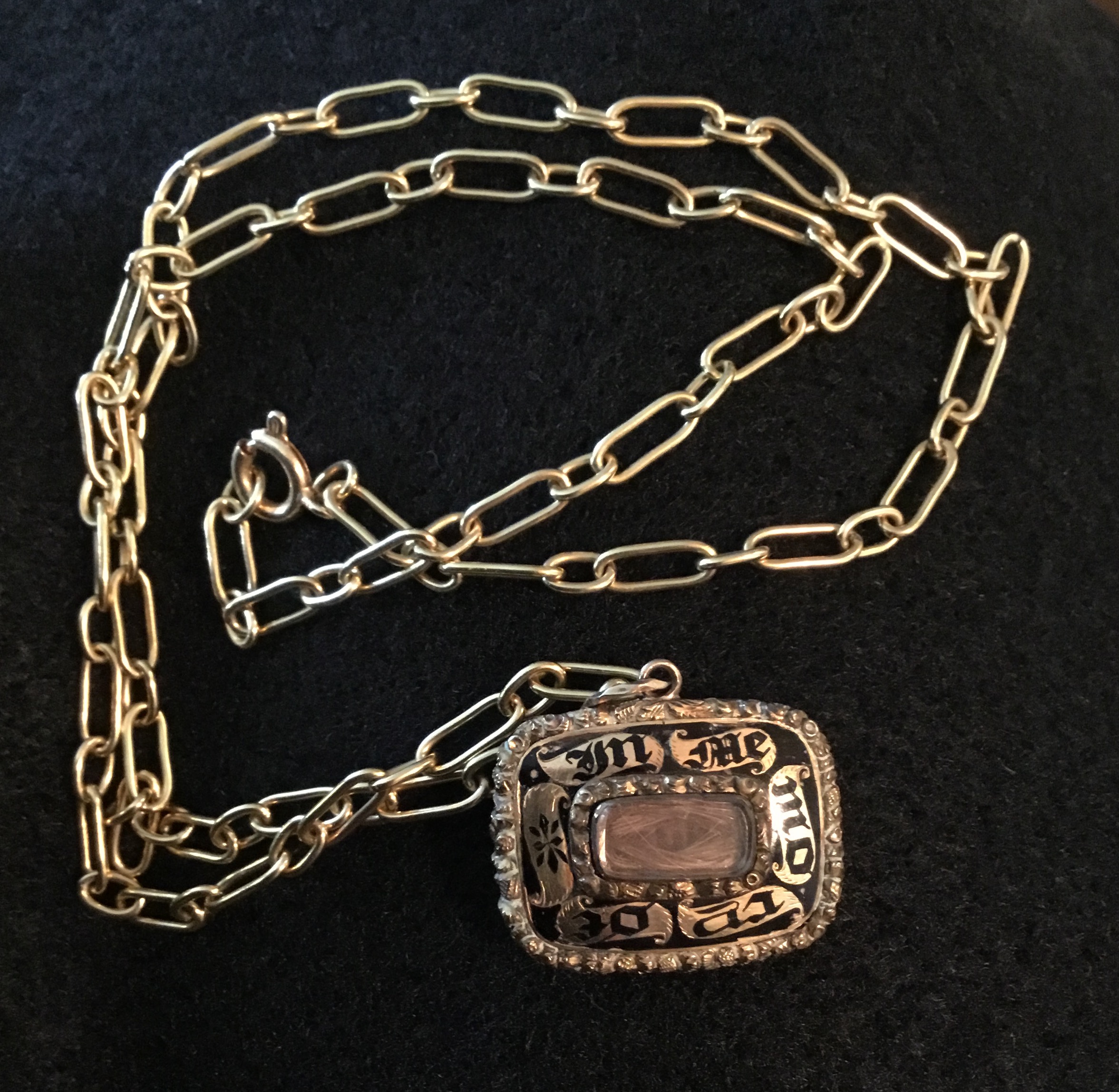
Pams-Pictorama.com Collection. This mourning locket tells a whole story in the March of ’22 post highlighted below.

I never realized until recently that beyond black and gray there were lighter shades of mourning and that people would progress to lavender and even light blue. I found this out recently when someone was selling a light blue enamel piece of mourning jewelry online. While it certainly predates her, Queen Victoria really kicked off the dictates of the all black mourning of the time and rigid rules of society bound the clothing jewelry and behavior of the bereaved. At least a year of wearing black and that included jewelry which was largely made of jet or black glass which was less temperamental and therefore less expensive. Much is said about the clothing, jewelry and rituals in the late 19th to early 20th century novels I have been reading.
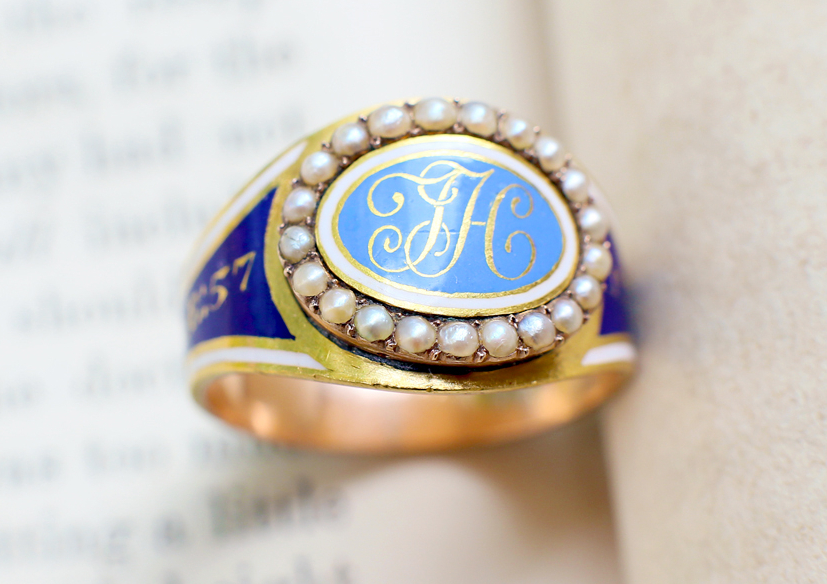
An example in blue enamel pulled off the internet. Ring dated 1794.

Rings and brooches adorned with bits of hair, images and later even photographs record the attachment to the lost beloved.

After the first year a progression to gray, mauve and purple were acceptable over time and that included jewelry of amethyst and garnet stones. Pearls were allusions to the tears of the wearer which I had never heard before, but many mourning pieces are decorated with them. (I recently heard that some Asian cultures view pearls that way as well.) I have written about some mourning pieces in my own collection, most given to me but others I purchased. These wearable memorials fascinate me. Those posts can be found here, here and here. (Oddly each of these posts have appeared in late March in different years – a spring thing?)

The idea of lavender and even light blue (enamel rings and lockets) in the latter stages of mourning, probably two years or more out, interests me – the point of emerging, yet still recognizing your loss and the process. I have seen lavender clothing as well from that state, but not sure I ever saw blue associated with it. For me the light blue, that final stage perhaps, is a sign of sending you back into the world of spring and blue skies again.
In the Memory of CP OE

Pam’s Pictorama Post: I am devoting today to an article of jewelry I purchased several months ago, but have only just started wearing. When I purchased it I was rarely leaving the house except to run in the mornings so there weren’t many opportunities. However, it also seems so fragile (and special) that it took me awhile to get my head around wearing it even now that I find myself putting jewelry on again more frequently.

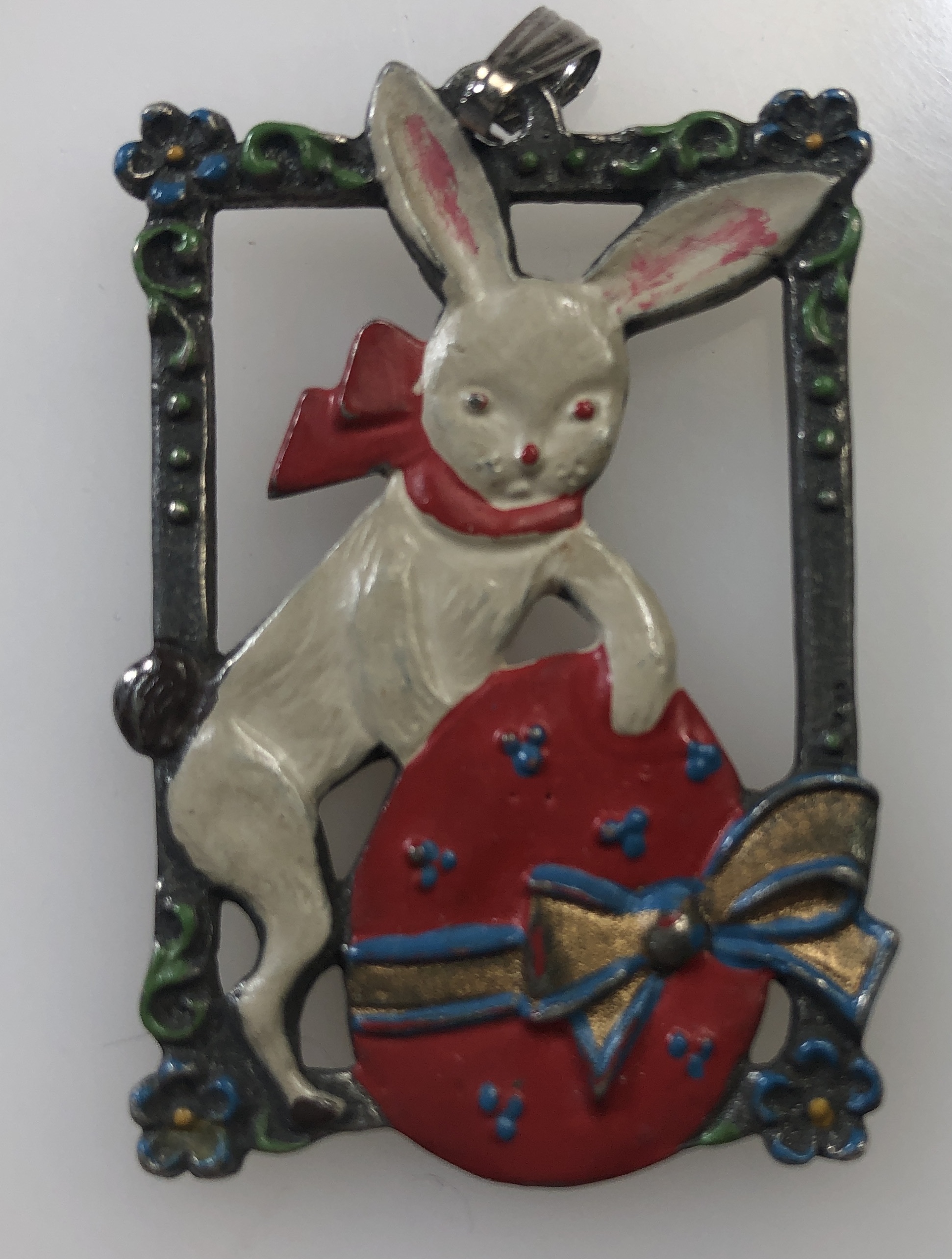
It was sold to me by a very thoughtful purveyor of jewelry on Instagram, @marsh.and.meadow. (Heather Hagans lives in the Midwest with her daughter Opal who appears, even at a young age, to have inherited her mother’s excellent eye as they travel the US trolling for items.) I began buying photographs from her on another account, but quickly morphed to jewelry as well. I have mentioned her in a prior jewelry post which can be found here. (A very wonderful Easter Bunny pin was one item featured, shown below, which I must dig out to sport over the next few weeks!)

Pams-Pictorama.com Collection.

This type of memorial jewelry took hold in the 1800’s and exploded into popularity toward the end of the century. Queen Victoria honored the memory of her beloved husband Phillip by wearing mourning jewelry after his death in 1861 which helped to entrench the trend further. It gets very elaborate and decorative, but to the extent I am interested in it I like the most personal pieces.

I own a few other pieces of Victorian mourning jewelry. Most notably I have a larger gold brooch given to me by a close family friend. Our family histories entwine over several generations and somehow it feels appropriately like family to own and wear that piece, which does sport a superlative decorative bit of braided hair within.

I have also acquired two memorial rings (one with my initials!) as well that just sort of crossed my path, which maybe I will consider further in a future post. It isn’t something I actively collect, but these objects were so lovingly constructed I suppose I feel it honors the memories they hold for them to continue to be worn.

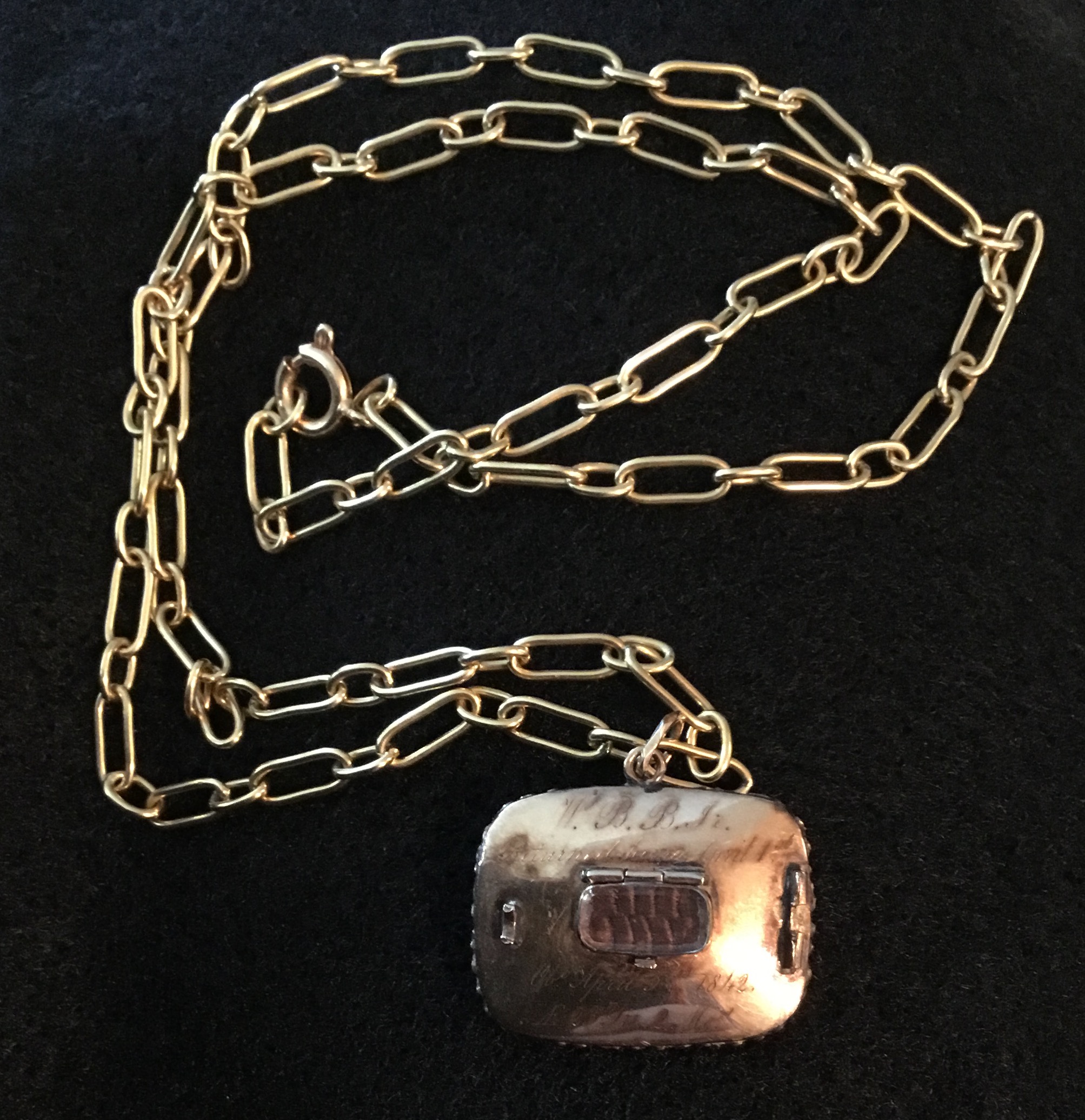
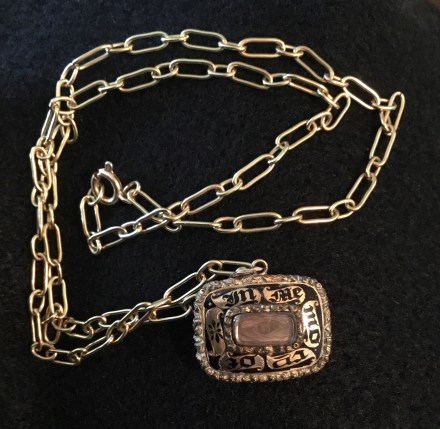
Front of pendant. The chain shown was made by a contemporary jeweler, Muriel Chastanet Jewelers in LA. Both Pams-Pictorama.com Collection.

I purchased this item because it was especially interesting and for something that isn’t even two inches long it packs a lot of history. On one side of the piece is the inscription, In the MO RP OE. I believe it is an abbreviation for, In the memory of RP OE, so probably Rest in Peace OE? OE could be another Latin abbreviation, but I cannot find reference to it. (OB for example would mean died as a bachelor according to one article I read which also said that some of these references are hard to trace.)

This side has a tiny window revealing a small snippet of hair. It is a black enamel paint on gold, the sides are crimped, as is the decoration around the window. It has a bezel for it to be a pendant and I consider this the front of the piece and the direction outward that I display.

The back, or what I think of as the back, is more unusual and very touching. Etched into the gold in tiny script it states, WBB, Jr. returned home April 1 and then below another window, this time tiny hair is tightly braided decoratively, it reads Obt April 5th…1842.AE 23 yrs. 2. mos. WBB returned home (from where we wonder) and died four days later in 1842. Died from illness? Wounds? Accident? For me it is also the notation of the two months after 23 years that is notable – each day and moment was precious and noted.

Verso of pendant. Pams-Pictorama.com Collection.

The object has an outer hinge, but the tiny window for the braided hair also has a hinge so small you don’t see it at first. It is beautifully constructed and I can only imagine how the act of engaging someone to make this, designing it, and then wearing it must have been for the owner. I hope the act gave her some solace as did wearing it hopefully.

Frankly I am somewhat puzzled by my desire to own this piece, although it is undeniably beautiful it is sad. There was just something so poignant about it and how lovingly constructed and designed it is however that it reached out to me. I think for me these pieces are a reminder not only about honoring those who are gone and remembering them, but to remember to embrace the moment of today as well. Meanwhile I am the willing steward of them for this period of time.

London Fog: Chapter 2

Pam’s Pictorama (Adventure) Post: When I left off of my last entry I was wandering around a sodden, snowy London, briefly cheered by my encounter at Marchpane books and meeting the lovely Natalie Kay-Thatcher. (London Fog, Chapter 1 for those of you just tuning in.) After a cozy solo lunch and a run off to another part of town for an appointment, I found my brain chanting buy the Louis Wain book! Therefore, before heading up to Covent Garden to look up Natalie’s toy friend, Simon at Benjamin Pollocks Toy Shop, I wandered back to Marchpane and purchased the coveted volume. By that time Natalie was ensconced in conversation with a musician named Stuart, who was stuck in London on his way to a gig out-of-town. (Yes, clearly this children’s antiquarian bookshop is some sort of crossroads of the universe.) Stuart was going to a Pinter play that evening and enticing Natalie to come along. (I would have happily horned in if I could, however I was to spend my evening at a Pizza Express with a jazz contact who turned out to be very nice and whose job is to book jazz and other music for the numerous venues of this oddly named chain.) Louis Wain indulgence tucked safely in my bag I wandered up to Convent Garden.

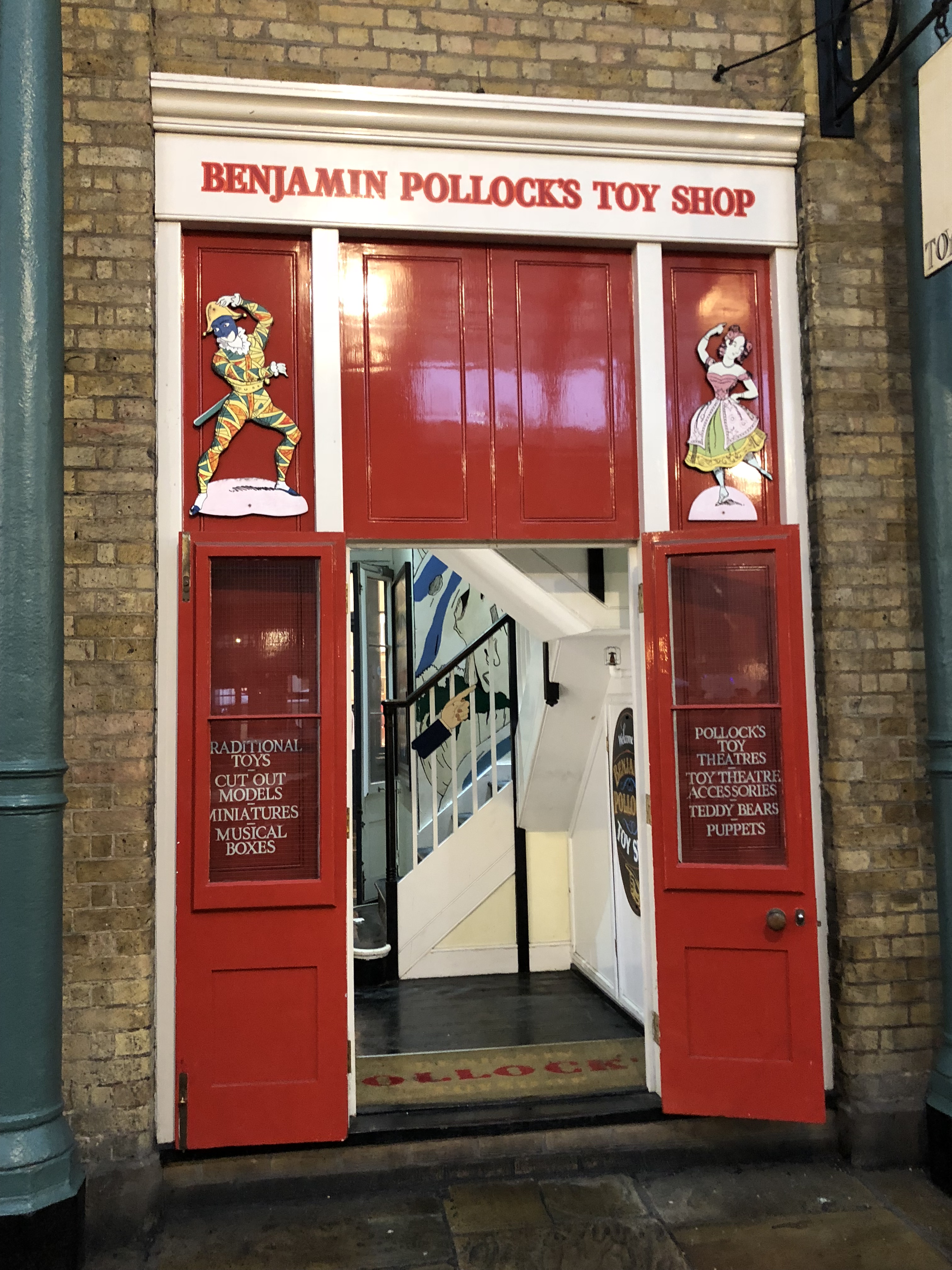
By now on this trip I have also acquired snow boots and on this day, despite layers under a good, heavy wool coat, umbrella and all, I am a soaking mess, as is all of London. Nonetheless, a long buried walking map of the city floats up in my brain and I find my way to the above mentioned toy store, which specializes in toy theaters. (I have always thought Kim and I should design one of these – can we just pause to imagine how great a Kim Deitch toy theater would be?) Although they have a small section of antique toys, I did not make a purchase there. However, I had a splendid conversation about the state of purchasing antique toys with Simon, who gave me a few toy tips while I informed him of the existence of photo postcards of mostly denizens of Britain’s seaside past, posing with giant Felix dolls – those of course Pictorama readers know I collect. His family is from a small seaside town and he promised to keep an eye out for such items.

Pollock toy shop

Undeterred by Bermondsey as a no show and by Natalie and Stuart’s warnings that the snow would deter dealers, the next morning at dawn and with hotel room tea and a muffin under my belt, I was up and out to get to the long anticipated and much beloved Portobello market as early as possible. Much as I remember from other trips, crowds gather several blocks away, tourists and interested locals, building in numbers and snaking their way up the narrow street which serves as a quiet avenue of expensive homes the rest of the week. I will however get to the point – there were no toy dealers at Portobello market! I was very sad indeed. I emailed Kim who sent words of sympathy.

That is not to say there were no dealers however, and with what I like to think of as amazing adaptability and fortitude, I rallied and dove into what was available – jewelry. I know I am going to lose some of you on this tributary, but I have long been interested in Victorian mourning jewelry and it abounded at this market. A close friend, whose family has been intertwined with mine for several generations, gave me this stunning hair brooch for Christmas last year and mourning rings had always interested me.

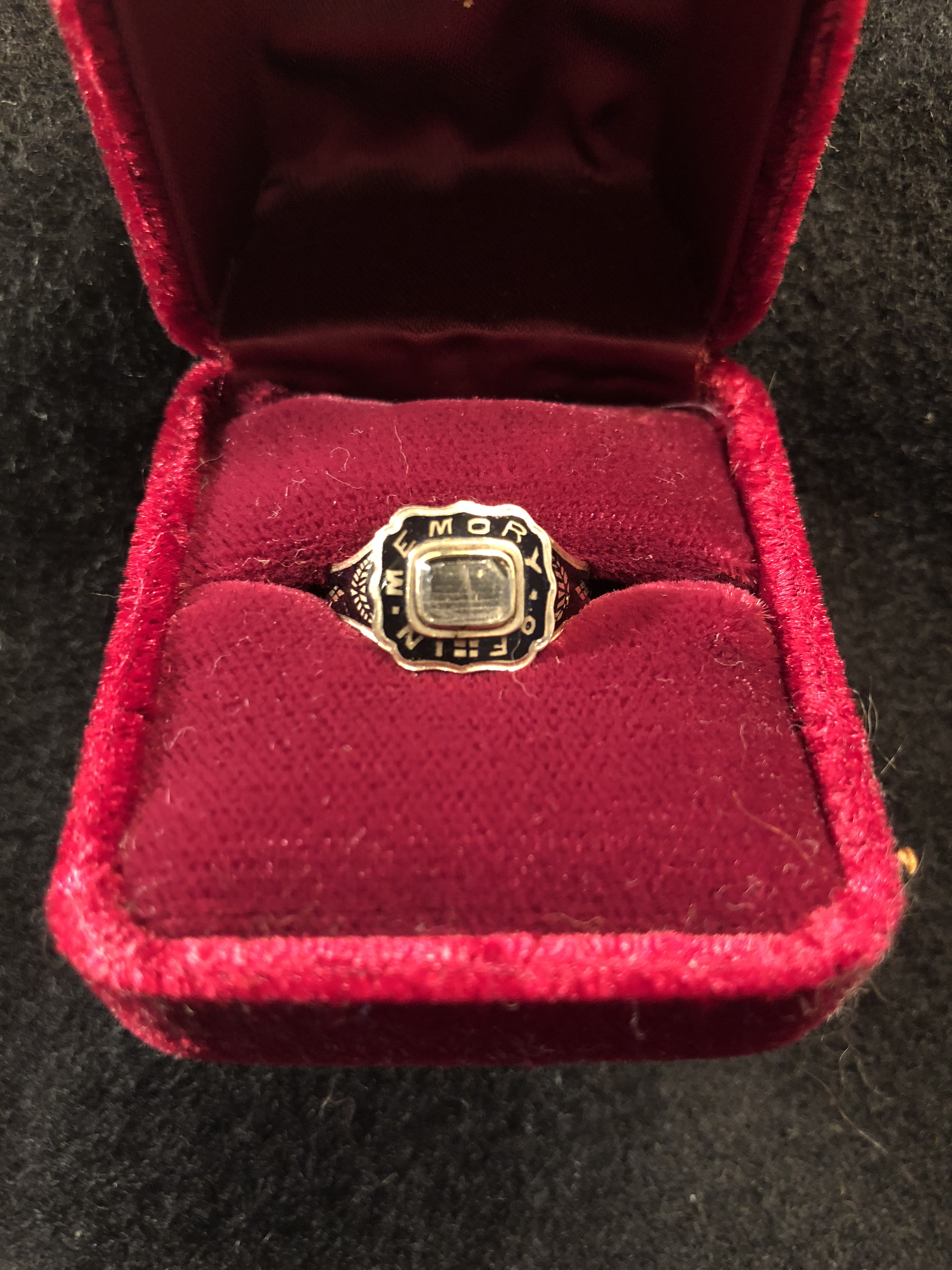
Memorializing and remembering loved ones gone with a physical memento, such as this jewelry, lockets or in other cases a daguerreotype or other photo, has always fascinated me. While these were not always made with the hair of the dead, that is what they have become most associated with. In the end I treated myself to the ring shown here. It does not have an inscription inside the band as many do, but it does appear to contain a tiny bit of hair, and in gold around the outside it reads in memory of.

ring

Victorian memorial hair ring, Pams-Pictorama.com collection.

Although no Felix toys were purchased, I will wrap this travel tale tomorrow with an interesting Felix connection and shift to the important work of a closer look at the cat-related loot I did manage to bring home.