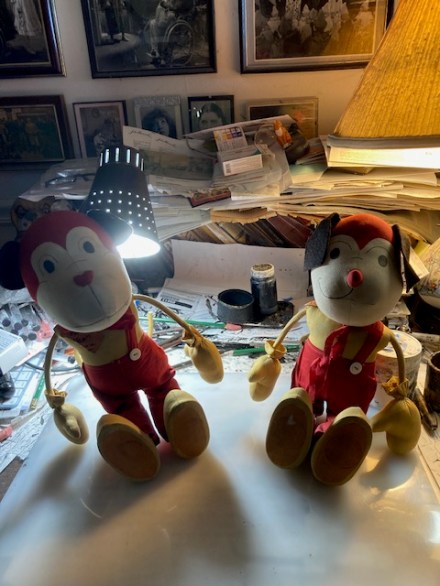
Pam’s Pictorama Post: Pictorama readers may have sussed out that there are strata to each of my areas of collecting. Photo postcards of people posing with Felix rate very high but people posing on giant black cats are a bit more due to rarity, a stuffed Felix that I have not seen is extremely rarified and I haven’t purchased one in years.
Yet somehow an Aesop Fable doll that is sufficiently unusual and requires purchase these days is a whole other thing. I don’t think I have purchased a doll since I scored one in a box back in 2018. And today I have not one but two, purchased together, and seem to be of a piece. While my longstanding lust for these toys has been documented back to 2014 and the early days of this blog, the most recent acquisition before this was a bit of ephemera, a piece of related stationary, in 2019 and can be found in a post here. A purchase of these is unusual indeed.
Unlike the off-model madness that was Felix production at one point in Great Britain, the production of these dolls was limited to, I believe, one company and a brief period of time. Therefore the survivors are decidedly more finite. As someone who has been purchasing them, and the occasional related item, for a few decades now, I rarely have the opportunity to make a significant purchase. (To be clear however, I am still searching for some of the cast including Milton Mouse should he make an appearance among others.) Notably though, the other morning, a listing for these showed up in my inbox and as seems to often be the case, with utter disregard for the well being of my bank account (Kim made a contribution), something had to be done about it immediately.
Before I get to the heart of this today’s story allow me to backtrack a bit further for anyone who is just entering the fray and encountering these toys for the first time. These items were made based on Paul Terry’s Aesop’s Fable cartoons of the 1920’s and early ’30’s – a delightful never ending saga of cartoon cats, mice, bears and other animals in a world dominated by them and the occasional visage of a human, often the frustrated Farmer Al Falfa. In some ways they represent my ideal of silent cartoons.
A sample of the cartoons can be found below.
However, if the scant information the internet provides about the W.R. Woodard toy company of Los Angeles is true, the production years of the dolls seems to be limited to the years of ’29 and ’30 – the years of the company’s existence. (A post about the company and an original box of one of the toys which helped me research it can be found here.) These recently purchased additions seem to clearly beg to tell a story as well.
As far as I have been able to tell, there was always a certain amount of variation among these dolls. For example the Princes (cat) toy seems to bear several versions of skirt. Sometimes other outfit swaps are made and maybe a bit of variation even on features. I have an especially prized possession which is a variation on the Princess made for a theater raffle. A post devoted to her can be found here.
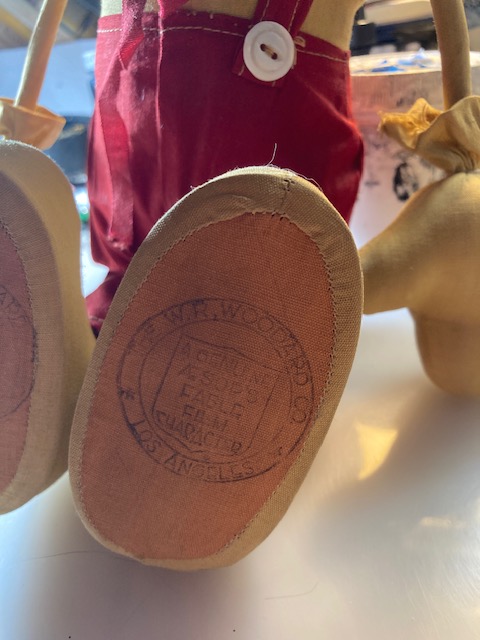
These two recently purchased dolls, both bearing the same W.R. Woodard stamp on the bottom of their feet as some of my others (not all are stamped) and both still have fragments of their original tags – Don the Dog and Mike the Monkey, which appear to be the same as the rare ones I have seen on other toys. While their red trousers, held up by a single strap, are similar in design to some of my other toys. The differences seem to mount up from there.
These two toys are a bit smaller than what I will call the standard toys. (The raffle doll is also a tad smaller than the standard ones but not as small as these and other than a special design on her skirt; a marker testifying to her as a theatrical raffle prize but otherwise is made the same as the standard toys.) Rather than standing, these are in a permanently seated position. Instead of a sort of velveteen fabric for the heads, feet and clothing, they are entirely made of a sort of cotton fabric. As a result they look newer than their counterparts.
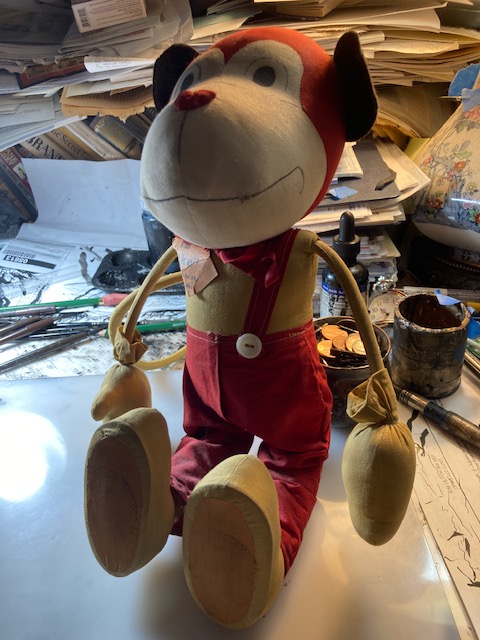
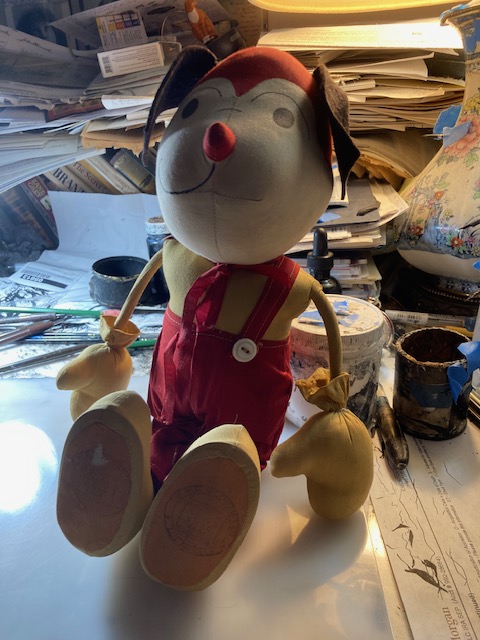
Meanwhile, the features are printed onto the faces rather than being stitched on. Their hands do not have defined fingers (the standard ones have fully defined five finger hands), and even their sewn on noses are more of a piece of the fabric, rather than the (admittedly vulnerable) more defined and stitched on noses of the other dolls. shown together below, the standard version of Don has the same square ears and similar but not identical facial design and he does not sport the same single button overall style trousers. Where the feet join the legs seems to also be produced differently too.
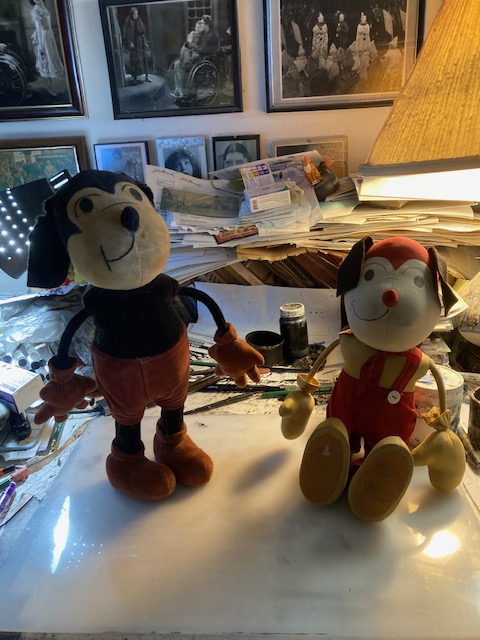
In short, they appear to be a less expensive line of these dolls, either made contemporaneously or later than the others. Was it another promotional item which had to be less expensive? A last ditch effort to produce them for less? Or was it some later production under the company name and these designs – perhaps in conjunction with a revival of the cartoons? I don’t think we’ll likely get the answer any time soon if ever. In my decades of collecting these dolls (and looking at them – those I missed at auction!) I have never seen them but they have come now to live for a spell at Deitch Studio in the Pictorama collection.
 Pam's Pictorama