And What a Party We Had!

20170217-00002 copy copy.jpg

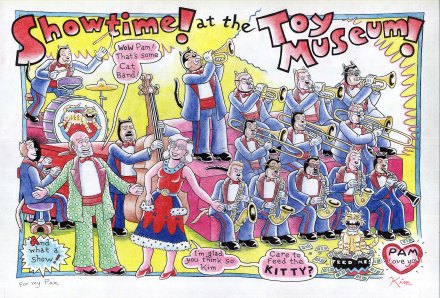
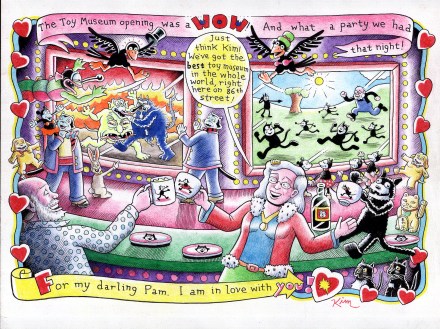
Pam’s Pictorama Post-Valentine Special: I am going to let you in on a secret. One of the really great things about being married to Kim Deitch is that whenever I want, I toss the dull, day-to-day world aside and enter the vastly more entertaining Deitchian world of anthropomorphic animals, demons in cat bodies and slightly sinister cartoon landscapes. This circus is going on right here – all the time! Yep, the front door of Deitch Studio is the portal to an amazing world of delight and fright – the rabbit hole you climb down every time you pick up one of Kim’s stories and that I come home to after a day out in the world. And once a year, in honor of Valentine’s Day, Kim pulls back the curtain and reveals a behind-the-scenes glimpse for everyone who has wondered and as a testimonial to the love and joy of our corner of the universe. To that end, I share this year’s Valentine.

While recent prior years focused on King Kitty and his dominion over the toys – especially the mice – starting in 2015, Kim picked up the theme of a glorious cat toy museum run by me, the Queen of Catland, as the nexus. I think it is fair to say that in this third year, the Valentine intersects squarely and gloriously with the final chapter of Reincarnation Stories, his latest book – as some of you who have been following that progress on Facebook know. The phenomenal cat toy museum revealed at last!

This slideshow requires JavaScript.

And what will future years bring? You will have to stay tuned each February. Meanwhile, sure stop by Deitch Studio sometime, but remember you could get sucked down the rabbit hole too.

Big Kitty

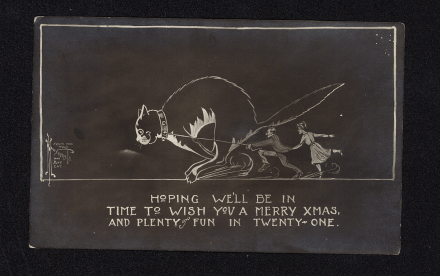
Pam’s Pictorama Post: This card almost slipped through my fingers due to an email that went astray with the seller, but I am ever so glad it did not! This surreal image of a giant cat (a tuxedo cat no less) dragging this man and woman along as they clutch his (or her) leash is splendid and bizarre indeed. It falls soundly into the category of I have never seen another like it – although I would love to see more if anyone can send me in that direction. This card was mailed on December 23 (8 AM) Sierra Mac, CAL, 1920. It was mailed to Mr. & Mrs. H.H. Wear (?) & Family, 431-14th Street, San Bernadino, CA. I was tempted to save this until the end of the year and do a seasonally appropriate post, but who could resist sharing this sooner? Not to mention that it is not really a very Christmas-y holiday card.

For me what this card brings to mind is chalk talks. For any of you who haven’t encountered these before, it is an act where a cartoonist very quickly draws a drawing, or series of drawings, in front of an audience – stunning them with skill and speed. It took hold as early as the late 1800’s, had a hot five minutes first during vaudeville, then early film and finally once again in early television. (There is also an interesting tributary of bible chalk talks – the Methodists claim to have founded the practice.)

Kim was giving me some tips and tales earlier about it – some folks sketching in outlines that couldn’t be seen by the audience as a bit of a cheat, that sort of thing. Windsor McCay is one of the most famous practitioners of the chalk talk (think Gertie the Dinosaur) and when I think of it I tend to think of folks like him in the teens and twenties, but there are legions of others. Here is a link to The Enchanted Drawing from an Edison short in 1900 showing J. Stuart Blackton at work.

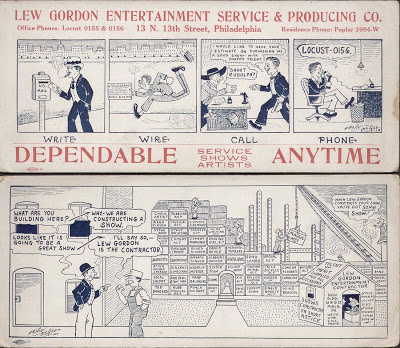
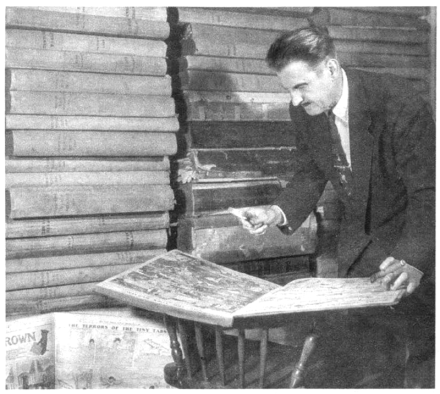
As I stumbled and bumbled around researching this, Kim also gave me an interesting lead – he met chalk talk (lightening cartoonist) Ernie McGee decades ago at a comic book convention here in NYC. Kim was carrying copies of Gothic Blimp Works and he gave Ernie a copy featuring his then strip – evidently an Uncle Ed strip gave the man a chuckle of approval, much to the surprise of a young Kim Deitch. Ernie McGee seems to have had his heyday in vaudeville. Cole Johnson gives a thumbnail blog post history of Ernie here at Stripper’s Guide 4/19/09 including the photo (look at all those bound volumes!) and strip drawn by Ernie below. Spoiler alert – it’s a bit of a sad tale ending with a down and out Ernie living in Philadelphia in the 1960’s, drinking too much and doing his act in his bathrobe at a lectern, in front of rows of chairs in his apartment, for his sole visitor.

mcgee-blotters

Ernie McGee strips, not in my collection

mcgee-article2.png

Photo of Ernie McGee, not in my collection

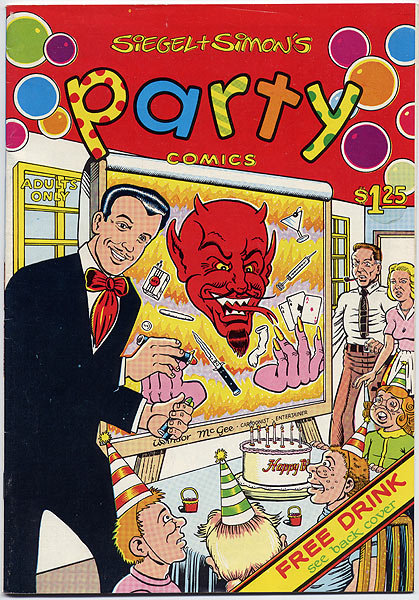
West coast buddy Bruce Simon also did a strip about Ernie, published in Siegel and Simon’s Party Comics shown in a 2009 re-issue below. In an online write-up about the re-issue Bruce says, Party Comics came out in July, 1980 and the UG scene was just about moribund by then. We printed 5,000 copies and maybe sold half of them, about what a Vertigo book sells now…I screwed up on the color sep and the devil’s hands came out pink instead of red, too cheap to pull a proof. The cover character was based on a real 1930’s era ‘chalk-talk’ cartoonist named Ernie McGee who I had met in New York in 1971. Why I thought anyone would know what a ‘chalk-talk’ cartoonist was in 1980 is anyone’s guess.  

9245_640

Party Comics by Bruce Simon, not in my collection

Kim tells me that he thinks the drawing of Ernie here is from his business card which he remembers fondly – he once had a copy, but couldn’t put his hands on it if he does indeed still possess it.

I have once again strayed somewhat from my cat material, but their plenty of fun in ’21 may very well have included seeing Ernie or maybe even Windsor McCay.


Periquito, the Spanish Felix of Chocolate Cards

This slideshow requires JavaScript.

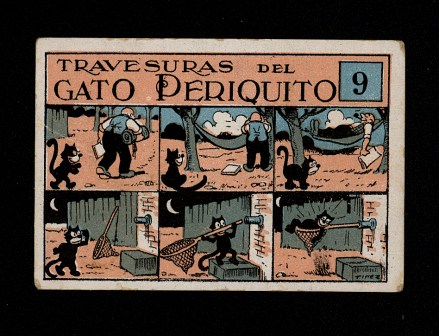
Pam’s Pictorama Post: I considered these quite a find. There were at least another three, but they went high and this was as many as (perhaps more than!) I could afford. It is evident that these were chocolate cards – sort of the Spanish version of Felix meet Bazooka Joe of the 1920’s, and needless to say (all due respect Joe) a heck of a lot better. This Felix doppelganger is pretty charming in his own right, even if he is an knock off. I can only find a passing reference to this series of cards. (Admittedly, I might do better if I read Spanish.) Each one is numbered and the back seems to say there are 25 cards in the series. The one reference I found said there was a total of 48 images. As you can see, I have numbers 9, 13 and 21. I am especially partial to #9 where Faux Felix makes a nice little hammock for himself after seeing the human enjoying one. However, all of them are very charming indeed.

Each card has an explanation of the comic on the back – for those who can’t get the joke on their own I guess. The cat’s name translates to something along the line of Parakeet or Budgie the Mischief Cat. I can’t quite figure out where the bird element comes in, but it may be the limitations of the Google translation. I invite Spanish readers to enlighten me on any of these points.

This slideshow requires JavaScript.

Below is a useful thumbnail history from a Spanish site, Tebeosfera, and translated by our friend, Mr. Google:

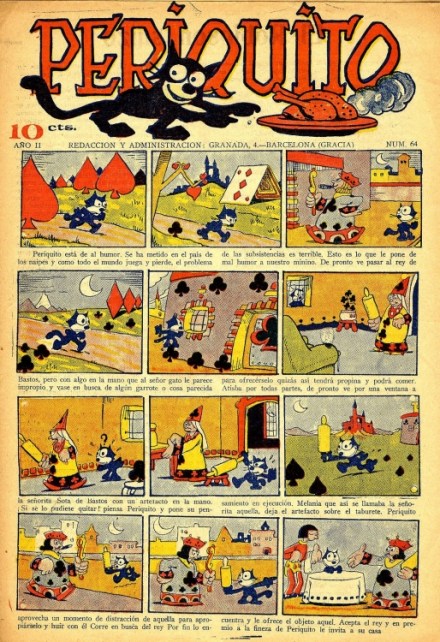
Series of comic strips featuring the cat “Periquito”, which included translations (probably unlicensed), copies and imitations of the famous character of animation “Felix the Cat” (Felix the Cat) made by several Spanish authors of the Editorial Marco as Regúlez in his own head parakeet (1927) and other publications of the house asRin-tin-tin by authors such as Juan Martinez and Castillo Osete. Subsequently, these cartoons also appear in La Risa in 1950.

In the twenties several collections of character trading cards as dumb cartoons were cartoons, advertising various chocolatiers on the back, as they were also published as Adventures Budgie Cat by Tinez and New Adventures of Periquito Cat by Bofarull.

The name “Jack Budgie” was the most common translation in Spain the popular Felix the cat in the animated short films released in cinemas in the mid-twenties of the twentieth century, which also went on to become the usual nickname followers football club Espanyol (still in force), thanks to the jokes Castanys for satirical football weekly the Xut (1922) and others like the sports Whip (1930), where fans of that team is parodied, calling them ” four cats”. [This piece mystifies me a bit.]

Black Cat editorial also published a similar character named “Jack Periquín” in the Children ‘s Joy (1930).

The site above also has this page of comics which is a much clearer Felix rip off of sorts, sample below. After looking carefully however, it seems that just the logo is the rip-off Felix and the comic is a real one in translation.

573-998-210

Not in my collection, found at Tebeosfara.com

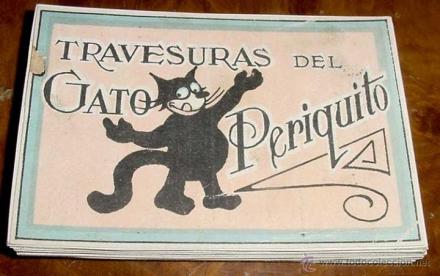
I have also found this nifty book on Google images which would have held your collection of Periquito cards below.The cards can be found for sale on some Spanish auction sites. I love the fact that he is a bit tubby and he has that extra long tail. He’s like the good living, European cousin of our man.

38247008

Periquito Card Book, not in my collection

I am not sure I understand entirely, but I think the term Gato Periquito is still in use to describe mischievous kitties and therefore if you search on this you will also get a lot of Spanish cat videos and photos of cats getting into all sorts of trouble. As for me, having discovered this kissin’ cousin of my man Felix, you know I will be looking for Gato Periquito toys and other items.

Snowy


unnamed

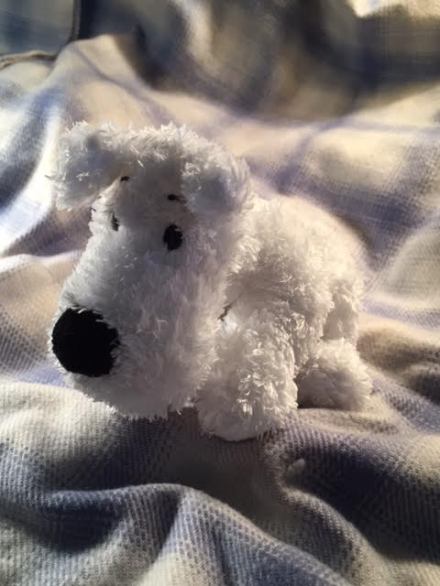
My Snowy at home


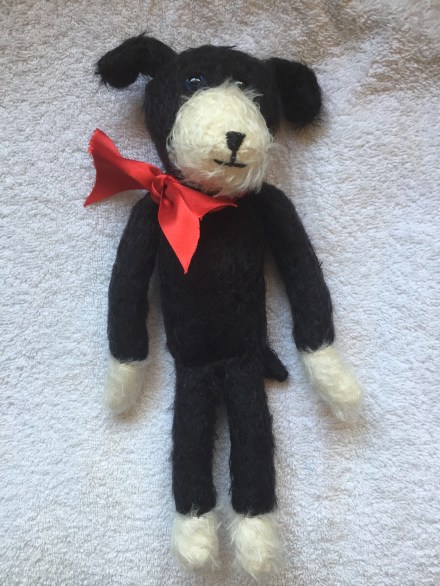
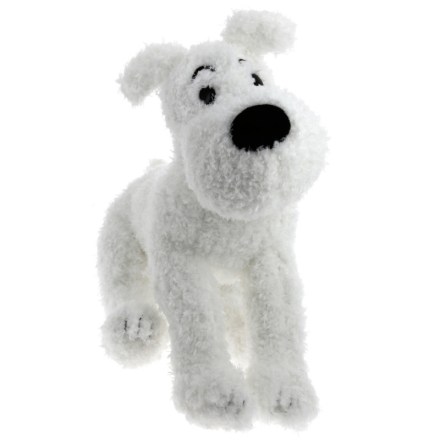
Pam’s Pictorama Toy Post: I am, frankly, a bit weak on the Tintin comics in general. I believe Tintin in Tibet might be the only one I have read – and as a traveler to Tibet I enjoyed it greatly. It hit as many of the highlights of Tibet travel as I could have hoped from a comic book and then some. (The Dalai Lama even liked it enough to present it with the Light of Truth award.) In addition, I almost never buy new toys, so it is a bit surprising that while traveling at a mad pace through the South of France on business recently I stopped dead in my tracks over a stuffed Snowy in the window of a store. However, my responsibilities of the moment did not allow for me to break off long enough to go in and investigate, but this is where living in the internet age is a great benefit. I tucked this image into my mind and upon my return home I found him online and Kim, being the very best husband in the world, purchased him for me as an anniversary gift. Snowy took his own good time getting here however and I present him to you now. Don’t you agree that he was worth the trouble?

the_adventures_of_tintin_-_20_-_tintin_in_tibet

Seems that Snowy was on the scene from the first, appearing in Tintin in the Land of the Soviets in January 1921. He was a wry, wise-cracking sidekick with his own balloons of chatter for many years, evidently he gets demoted later in the strip and then only Tintin can read his thoughts. I read that he was inspired by a Fox Terrier at a cafe Hergé frequented, and named (Milou in the French) for his first girlfriend – despite the fact that Snowy is a boy dog and the translation – if that – is a bit mystical. Snowy, although an utterly dependable companion was, like most dogs has an extreme weakness for bones. (Who doesn’t have their Achilles heel?) In addition, I understand that he suffers from arachnophobia – I would prefer my dog (and cat) defend me against multi-legged intruders, but again, no one is perfect and if a dog constantly rescued me from all sorts of peril, saved my life and defended us against enemies many times his size, I could be forgiving on these points. I read that Snowy was known to frequently have a good snort and really tie one on too.

Somehow this toy seems to have the unusual characteristic of really embodying the drawing it is from. I find that is rarely the case – when it comes to Felix I enjoy the wildly off-model nature of the early British ones – but with many toys derived from comics I find it just annoying, especially in contemporary toys. Things are called Krazy Kat that bear no resemblance to even the film version of the character. There is a general disregard for the design of characters – so to find one that has the right spirit and appears to be well made alerted my radar.

Westerns have brought Tintin to Tibet in a big way and his image graces everything from bars to t-shirts, existing in high contrast to things like the Potala. (Until recently Kim was wearing one of these machine embroidered t-shirts with Tintin and Snowy, drawn somewhat free hand, that I brought back years ago.) It goes almost without saying that your average Tibetan has absolutely no idea who or what Tintin is (let alone Snowy), and I have wondered what they make of this persistent symbol of the West, lurking from far beyond their mountain home.

potala-full-view

Potala Palace, Lhasa

Sticky Wicket?

s-l1600

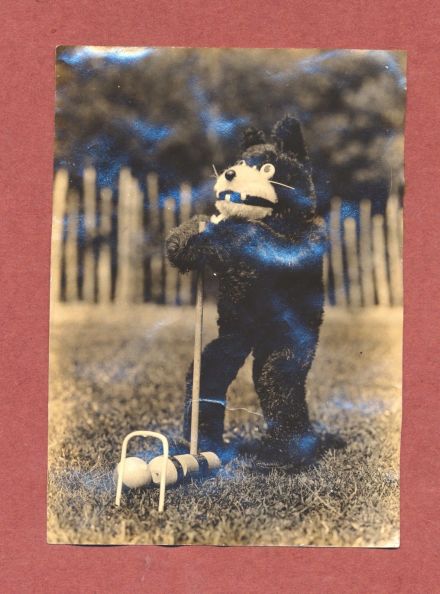
Pam Photo Post: These bizarre Felix photos are like catnip to me and I went to the wall to acquire this one recently, despite its damage. It appears to have been glued into an album (Felix’s family album perhaps?) and somewhat rudely peeled away. It has left it somewhat crinkly. It is a wonderful trick of the camera’s focus (and a tiny croquette set) that makes Felix appear to be human-sized. It was in fact advertised as a child in a Felix costume. I am pretty sure I recognize (and own) the model toy here. (He was featured in the post Toy Hospital earlier this year.)

It is a fascinating photo – it is not a postcard, although it is roughly that size, a bit bigger. It sets my imagination ablaze – what exactly did the photographer have in mind and how did it end up in an album? Who had the doll-sized croquet set if my assumptions are correct? It would have been taken by a canny photographer which, as I mention above, created the illusion. Or am I wrong and it is an extra-large size Felix? It  does remind me of the utterly extraordinary larger-than-life Felixes in my post Greetings from Felix in Kuala Lumpur where he appears to be directing traffic or something along those lines on the streets of the city.

As for croquet – it was well established in the United States by the late 1860’s, although its origin is in Britain. Some folks might be surprised to know that Central Park has long been a permanent home to croquet and lawn bowling societies. Although a very long-standing feature of the Park, I doubt an original one dubbed by Olmsted who preferred only seasonal entertainments and no permanent playgrounds or facilities in his original design. Still, there is something distinctly British about our American man Felix here. As we know, the Brits embraced Felix even more deeply than we in his homeland and indeed, this photograph was wrested from a dealer in Great Britain.

I will seek some advice from friends who restore photos at the Met to see if there is anything to be done for this little beauty – or at least the best way to frame and preserve it from further damage. If we make any significant improvement I promise to a follow up post.

Cat Tales, John Rosol

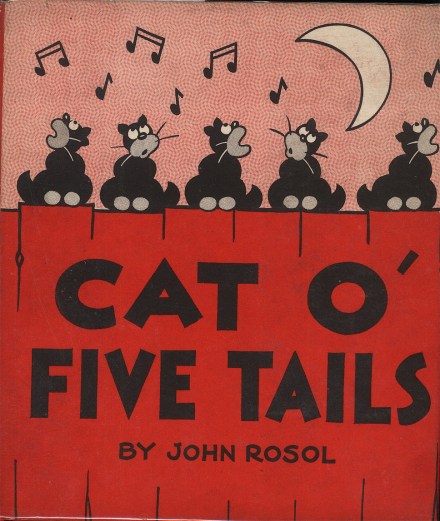
Pam’s Pictorama Post: This great little book was a thoughtful gift of our friends Tony and Sue Eastman who know of my love of all things black cat. An initial search of the author and artist, John Rosol, turned up surprisingly little. (I am very spoiled and have gotten used to information on even the most obscure topics turning up with ease, I admit.) To start with however, the comics in this book were all published in the Saturday Evening Post and all feature his cat, Tommy.

As per the dust cover, Tommy was a stray who strolled into Mr. Rosol’s Philadelphia studio and calmly seated himself on the drawing board. Rosol got Tommy’s idea immediately and went to work. In exchange for small steaks, liver, cream and catnip (no wonder he was a fat cat!) Tommy consented to stay for a while and be Caterer Rosol’s idea man…When he finally took his leave – destination unknown – he had trained Mr. Rosol so well that not even an expert can tell where Tommy left off and John began…P.S. Mr. Rosol hopes if this little books happens to come under the eye of Tommy, he will drop into the studio and turn off the light which is always burning for him. I, of course, teared up at the idea of the disappearance of Tommy. While my edition dates from 1944, the first printing appears to go back to 1934.

The cartoons are simple and cheerfully fun. The idea that he turned one cat into a consistent five identical twins brings certain very busy cats to mind. I have had several who had such a penchant for trouble that you would swear that there was more than one cat underfoot. (Cookie!)  The gags are mostly of the kind assigned to cats – attempts to obtain fish and milk and to chase mice for food. Most notably the Tommy quints are patriotic during these WWII years and even turn their fat cat noses up at crab meat when they realize it was shipped from Japan, abandon their mouse chase when reminded to embrace a “meatless day”, round up dogs for service, and even help a female soldier who is afraid of mice.

A fellow blogger over at Comics Kingdom has the scoop on Rosol’s two brief syndicated strips, The Boy and the Cat (1939-1941) and Here and There (1941). Comics Kingdom offers some samples of Here and There and the black cat/s are tucked into these as well. In the style of earlier comics these are large single panel tableaus, with a different strip (about the cat) running occasionally up one side. This entry, combined with his obit, add the following facts: Rosol was trained as a commercial artist at the Philadelphia Museum School of Art, which later became the Philadelphia College of Art. His full name was John Rolosowicz and he died at the age of 85, still living in Philadelphia. In addition to his comics which were syndicated to numerous papers across the country, and his work for the Saturday Evening Post, he also worked for Bazooka bubblegum. He published a children’s book The Cat’s Meow which I can find no evidence of online and evidently was working up until his death.

So I salute John Rosol, a cat loving cartoonist, barely saved from disappearing entirely from view by the internet and this popular volume.

Anniversary Special

7475

Pam’s Pictorama Anniversary Post: Happy Anniversary to us! Twenty years ago today Kim and I went on our first date. Important disclaimer – I’m very bad with dates, but it was Veteran’s Day so that helps. I had just ended a relationship and Kim and I knew each other slightly from openings and whatnot, mutual friends. When Kim found out that I was at loose ends, he got my number and called me up – yea Kim! I was a big fan of the work, and I had always thought he was a very handsome guy. Beyond the Pale was the first book of his I had read and I was crazy about it, just over the moon when I met him. I made sure I got all the Kim Deitch comics, books and silk screen print in the break up.

Kim and I went to a de Kooning exhibit at the Met; I was already working there. Funny because Kim more or less hates de Kooning. That is self-evident now, but I didn’t have a clue then. It didn’t seem to have a bad impact on the date however. Afterward we ate at a small Italian restaurant in my neighborhood where I was a regular at the time. The owner, a young man from Italy, took an interest in my love life and vetted the various men I brought in.  Marino seemed a tad dubious about Kim at first, but grew to like him over time.

In honor of the occasion I offer some of Kim’s pencil sketches for our wedding invitation – I art directed Kim on this one, but he went to town on it. Noah’s Ark seemed perfect – and Kim did not disappoint. The original inked work is huge and glorious – and requires a drum scan so I can’t show it here. it was a long invitation that opened as a gate-fold and revealed me and Kim as kitties getting hitched inside. I especially like the inclusion of the sea monster among the animals!

Lastly I offer an undated photo strip of us smooching!  We were at a party where there was a photo machine – you know I love those. Here’s to the next 20!

73