The Corticelli Kitten

Pam’s Pictorama Post: Continuing on a bit with our classic cat theme here at Pictorama, this wonderful bit of early advertising came in the door this week. A former IG seller messaged me and asked if I was interested, remembering my feline predilections. I paid up a bit for it, but I think it is a great piece of advertising which I have never seen before.
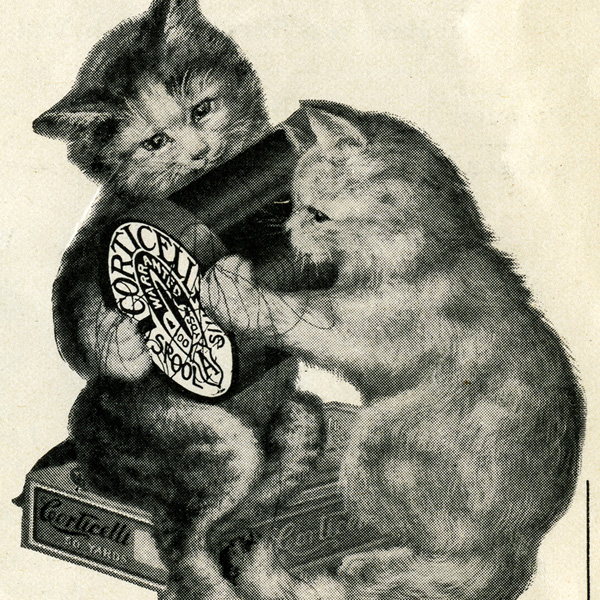
Go cats, go! Early print advertising for Corticelli using kittens.

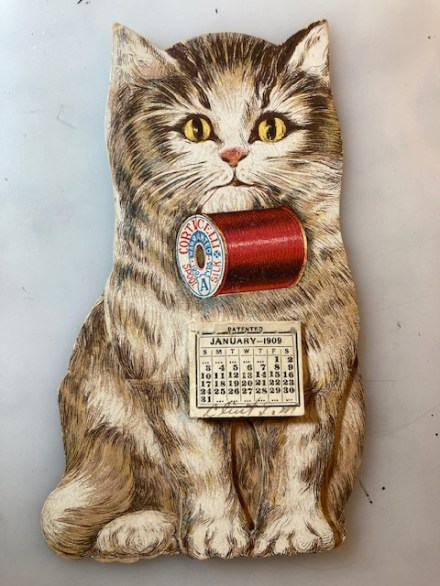
Evidently the Corticelli kitten began his (or her) advertising career all the way back in 1900, making it in the earlier era of emerging cat advertising. A kitten was stamped as a logo on each spool and advertisements showed a kitten or kittens playing with and chewing on the thread to show how strong it was – also that as superior thread that it was unlikely to tangle. Anyone with cats and threads knows pretty much what is likely to happen when the two are together and, strong or not, I would not want to put any thread to the test.

On the back it reads:

I am the Corticelli Kitten. As Corticelli silk costs you no more than poor silk you are saving your own time and money when you ask the cleark especially for Corticelli silk, because while you may pay as much you are sure of getting more silk, better silk, purer silk, brighter silk, longer silk and stronger silks every time you as for “Corticelli.”

When I Tell You that for over 70 years Corticelli silk has held the World’s Record for Superiority, having won 40 Highest Awards at Expositions at home and abroad,

You Will Know it was not the Corticelli Kitten that first made Corticelli silk famous – it was the remarkable smoothness, length and strength of the Silk itself.

The next time you buy silk for any purpose (sewing, stiching, crocheting or art needlework) JUST THINK of the Corticelli Kitten and the superiority of my silk and tell the clerk you just must have Corticelli or you will go to some other store.

FUN FOR THE CHILDREN. A Cortecelli Kitten given free by any dealer selling Corticelli silk in exchange for 2 empty Corticelli spools or send to us for one. As your mother to save all the Corticelli Spools for you.

Corticelli Silk Mills, Florence, Mass.
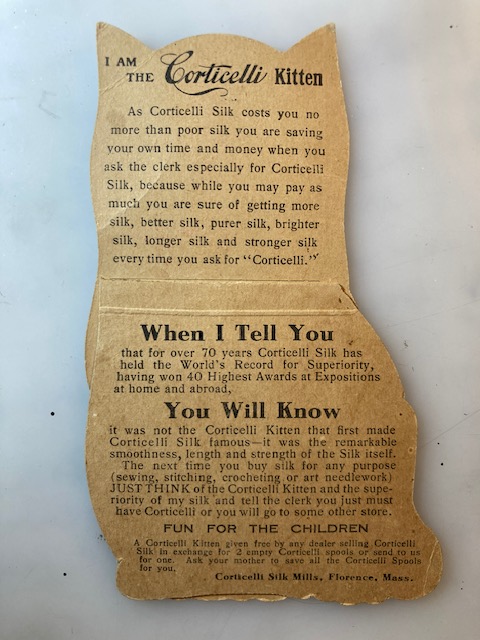
Back of the card. You can see where the bit folds out so it can stand.

The company, its roots go back to the 1830’s, has an interesting history which includes a period as part of a Utopian commune from 1842-46. It was purchased and in 1852 had a revolutionary development when the company figured out spool silk thread strong enough for sewing machines. The Northampton town where the factory called home was renamed Florence to capitalize on a desire for European millinery.

Meanwhile, the company had a vast expansion in the early years of the 20th century and their products included a line of hosiery. Their apex of their advertising is said to have been a neon sign in Times Square. I share the only image of it I could find. The company folds in the post WW1 years for a variety of reasons, around 1932.
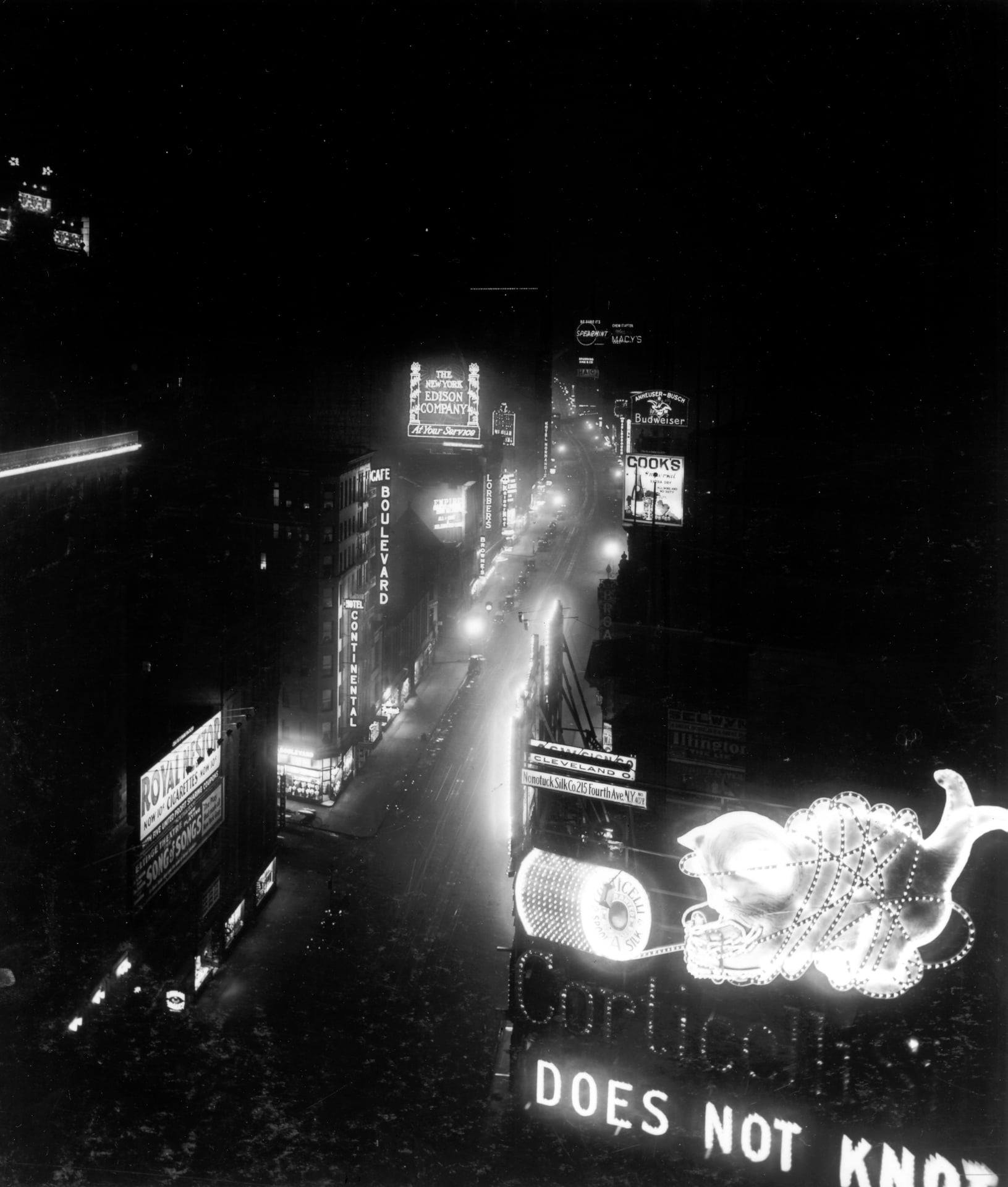
Corticelli Kitten neon sign in Times Square, undated photo.

I think it is hard for us to imagine what a major role spools of thread played in the world of 1900. Ready-made-to-wear clothes for the rank and file had entered the public consciousness in this country with the rise of department stores and catalogue buying in the 1880’s but a majority of Americans still sewed either to make clothes, tailor or repair them.
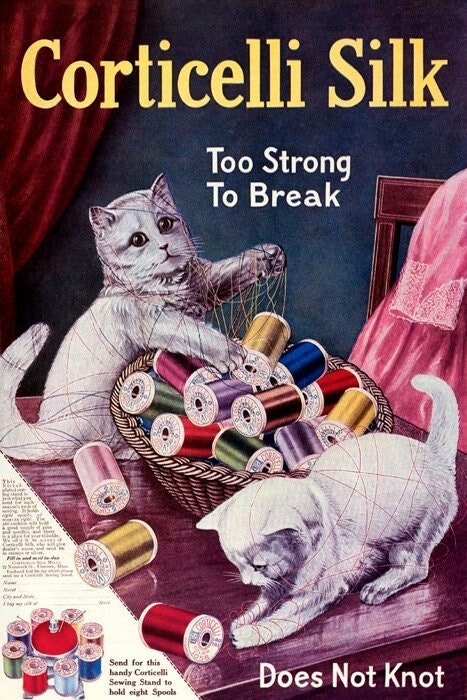
Reproduction advertising available on Etsy.

A well supplied sewing box was a necessity in every home – I can remember my grandmother’s (Ann, my mother’s mother – I have written about her here and here) sewing box which was substantial and she wasn’t even an especially good seamstress but could swing a hem, a button or a simple adjustment.

So while today it is hard to even find a notions store, the idea of not being well stocked with thread, needles and buttons was unimaginable for the early years of the 20th century.

This little fellow has a spool of bright red silk thread under his chin, as if he was wearing it like St. Bernard out rescuing folks with a bit of whiskey in a cask. A careful look shows however, that he holds the spool in his mouth by a thread – proving how strong it is! The label is cheated toward the viewer and of course he has this nice, tiny date calendar, still fully intact, on his chest for the year 1909. He is designed to stand up and still does – sort of. The calendar appears to have Clint E.M. written at the bottom.

While my own skill with a needle and thread is extremely limited, I do love the early advertising for thread. I have been tempted by the beautiful display cabinets from stores so we’ll see. If a Corticelli kitten one every came my way I think I would have to snag it.
Cheerio!

Pam’s Pictorama Post: First let us here in New York give thanks to the sun which has come out at long last! We intend to dry out today and those of you who follow my runs on Instagram will (hopefully) be treated to some views of the UES in a bit. I haven’t run outside in a week due largely to rain – which eventually even flooded our basement and gym! But now onward to an odd little piece (only 2.5″x 3.5″) that I bought on a whim one night on Instagram.

I purchased it from one of my secret buying weapons, @missmollystlantiques, who lives here in the Midwest. So exactly how this very British little item, a datebook hailing from the year 1940, came to our shores is a bit of a mystery. Whether it traveled here back in ’40 or after is of course also unknown, but interests me.

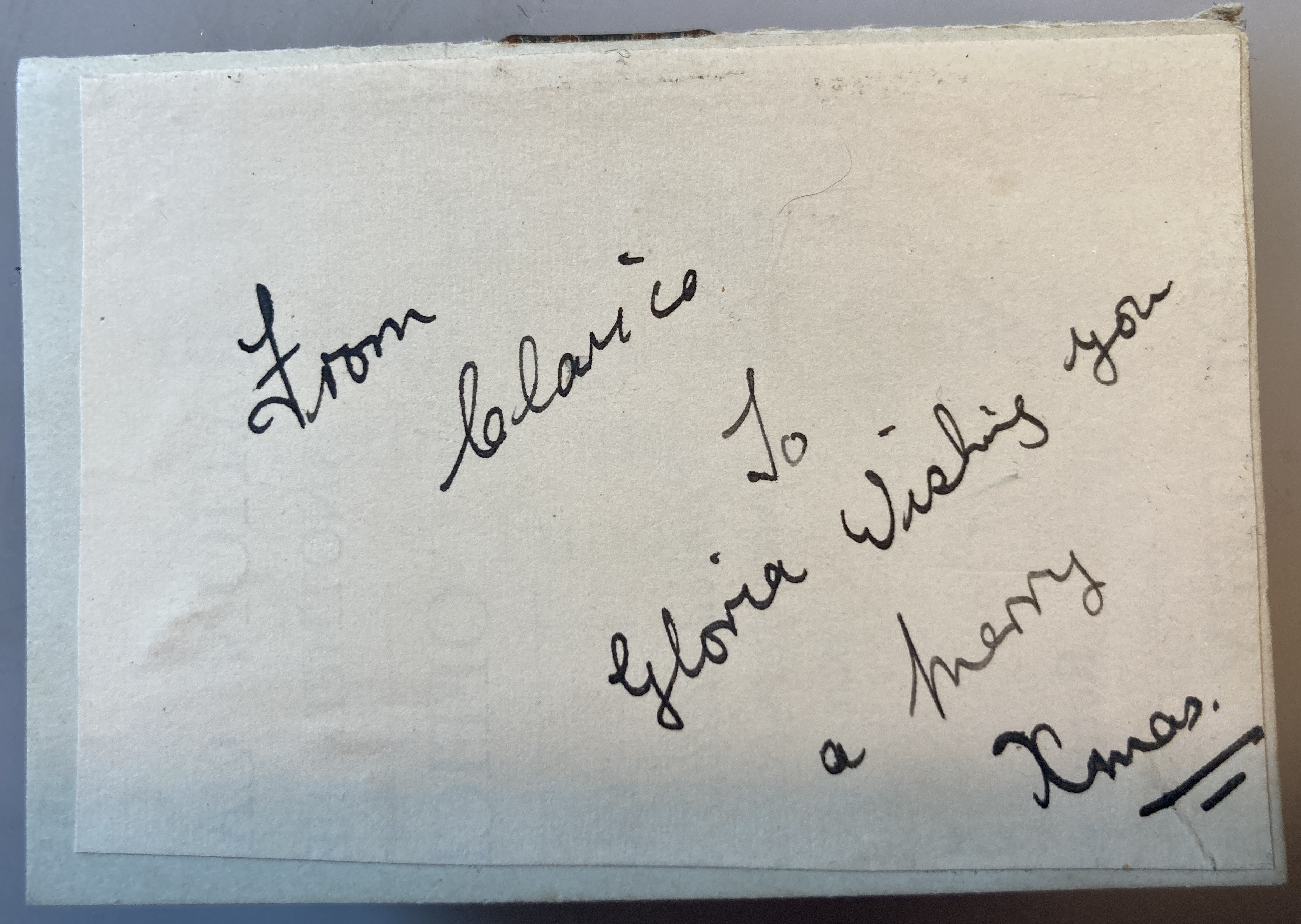
Inscription on back of book.

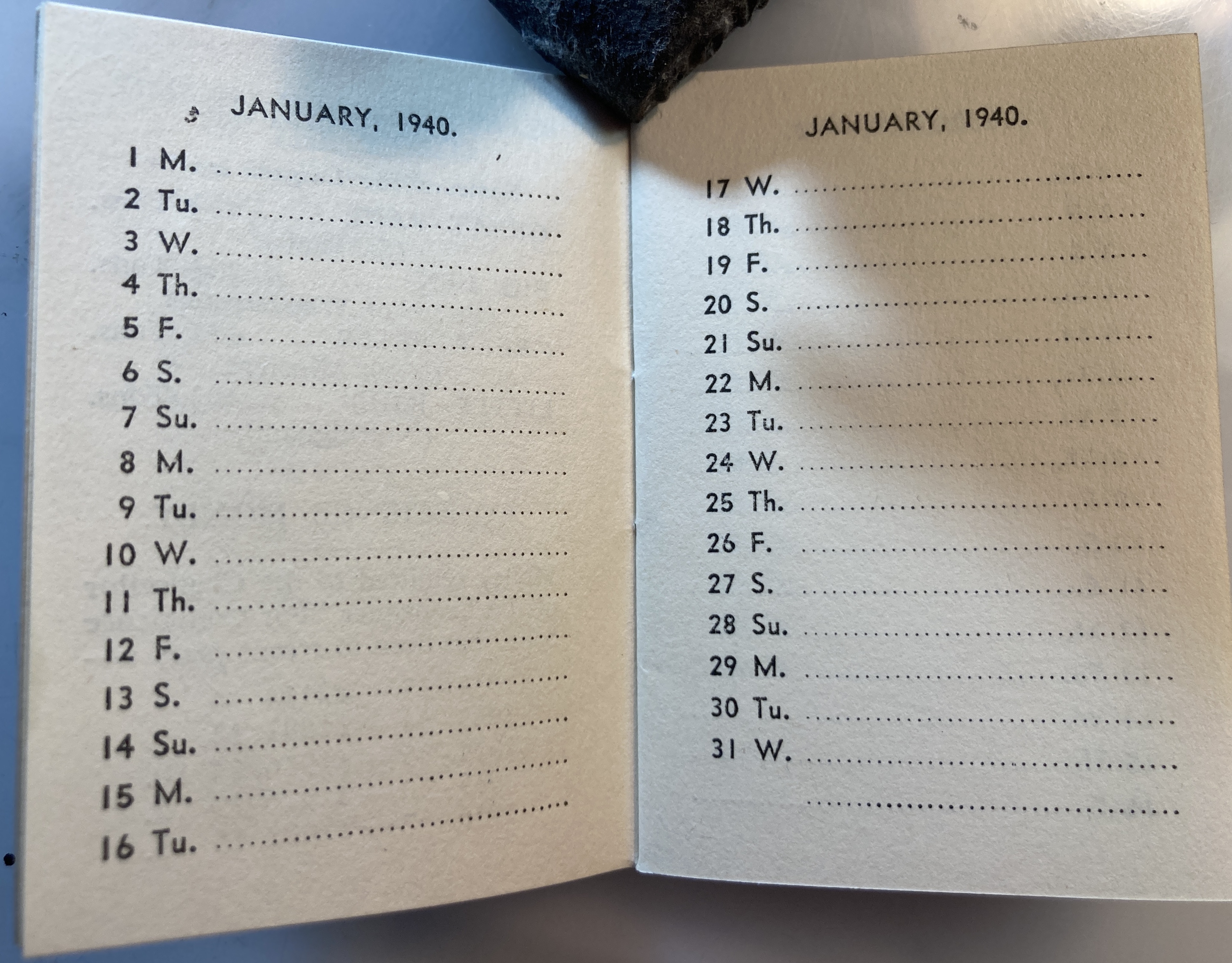
On the back of this tiny missive is an inscription, From Claudia to Gloria Wishing You a Merry Xmas. Gloria liked her gift enough to keep it and pass it on, but never attempted to write in it. In all fairness, it is very small and while perhaps handy to keep on you, has very limited real estate for scribbling within.

Limited real estate for notes within. It is unused.

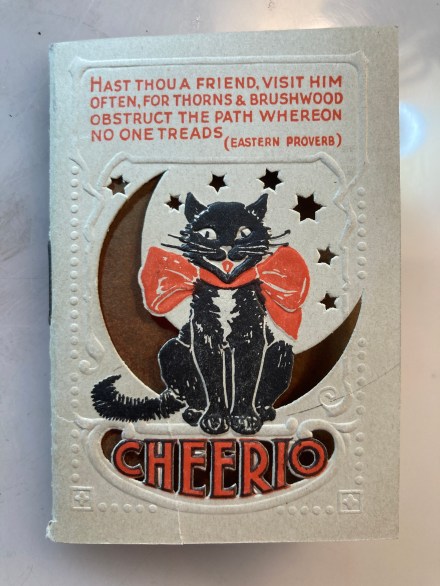
It’s a nifty item. On the front, in addition to this great, classic grinning beribboned kitty, there is written at the top what is inscribed as an Eastern Proverb, Has thou a friend, visit him often, for thorns & brushwood obstruct the path whereon no one treads. I can’t vouch for the origin, but I like the sentiment. And of course there is the bright orange Cheerio, cut out to reveal a gold page behind for emphasis at the bottom.

The cat sits on a slice of moon and has stars around him, highlighted in gold with a cut out on the cover. Although the British consider black cats lucky, you’ll note that this fellow has a white chest making him a sort of tuxie instead. (Although our Blackie is all black save a white daub there too and we consider him a black cat – go figure.)

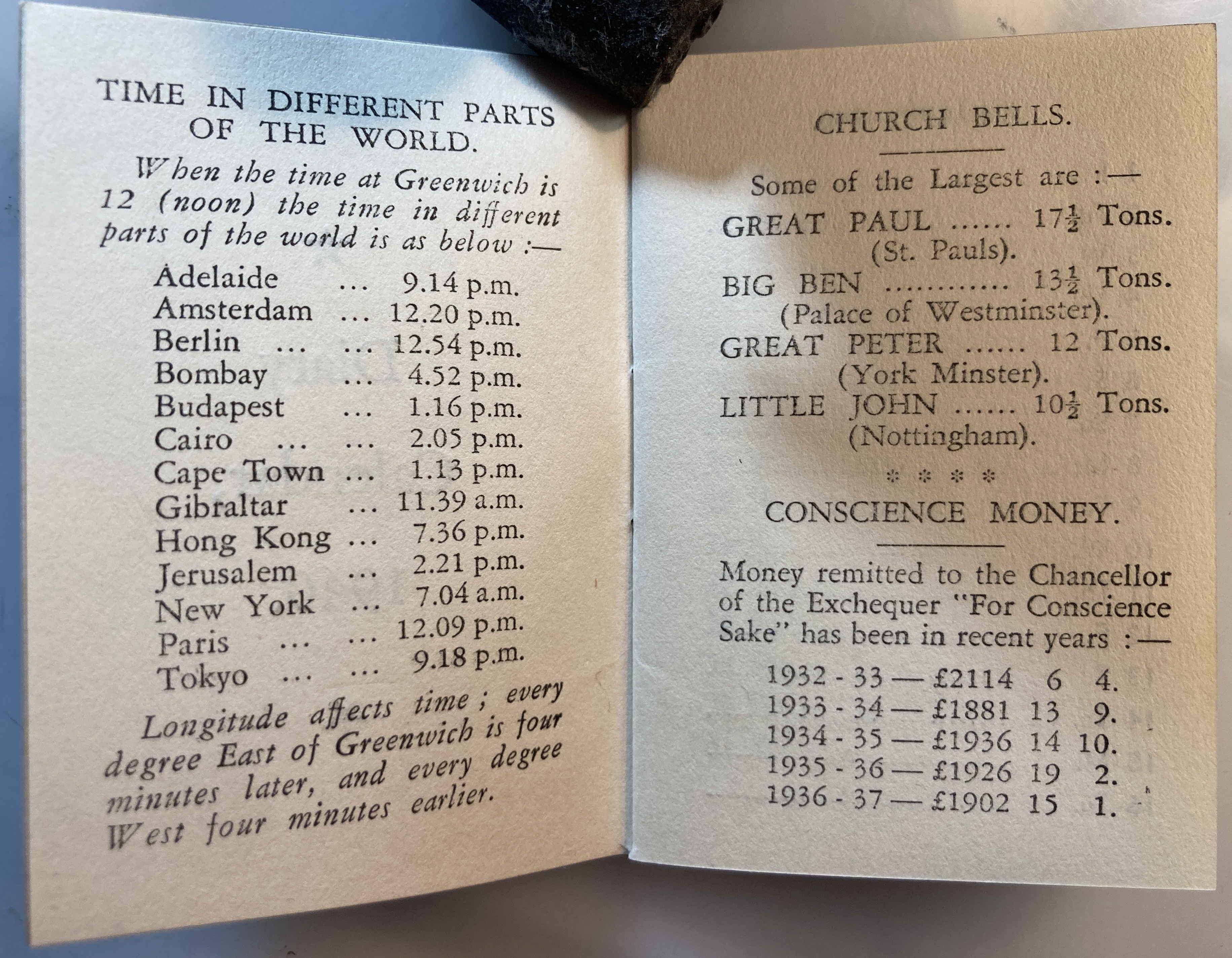
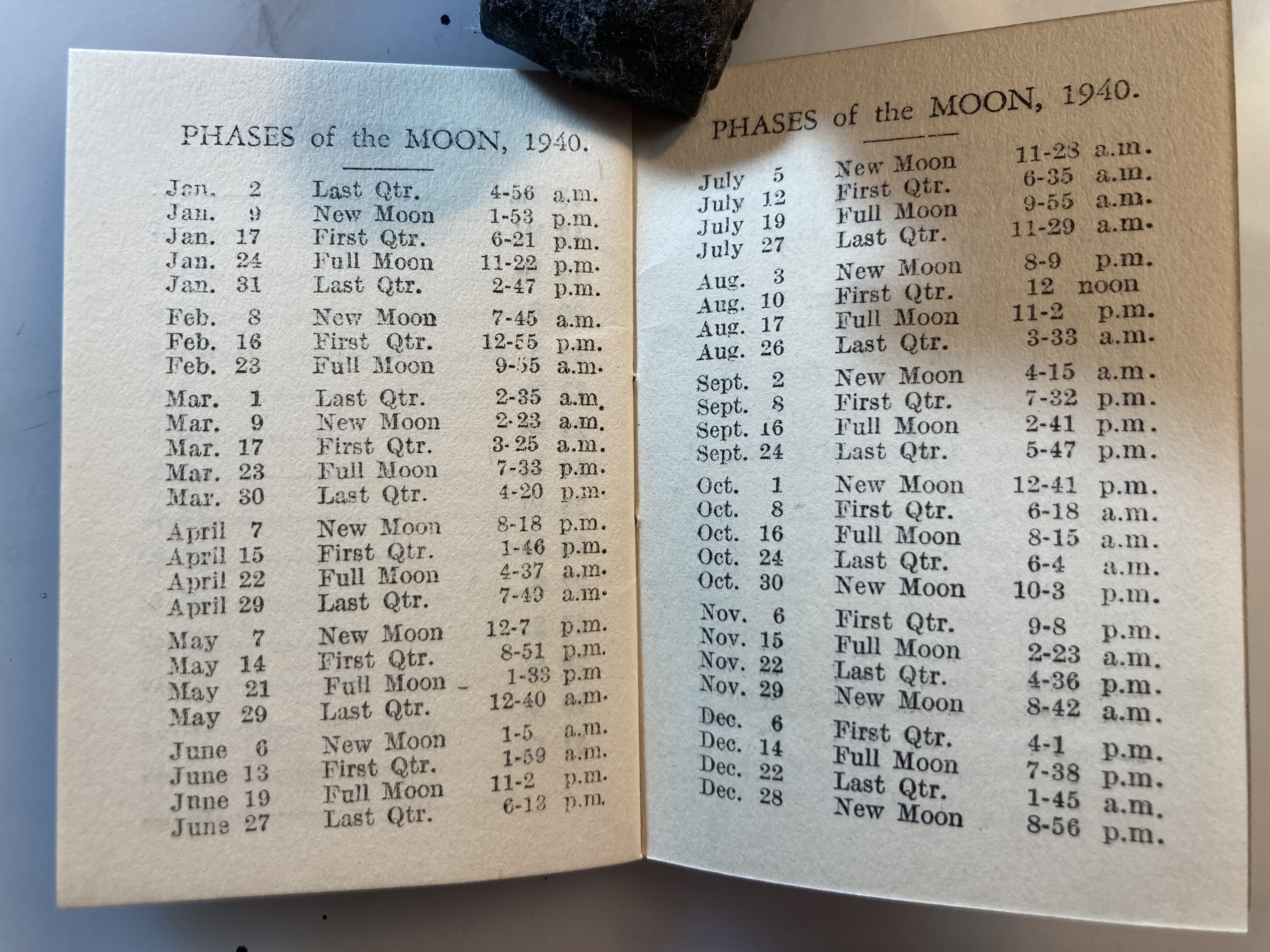
For a tidy little book it actually contains a lot of information, some of it very British in nature. The first pages are devoted to a reminder of the difference in time across the world, using noon Greenwich time as the basis. (It also reminds the reader that the longitude affects time, every degree East of Greenwich is four minutes later and every degree West four minutes earlier – I guess in case we wish to do the calculation ourselves?)

Then a page devoted (strangely) to the weight of the four largest church bells in Britain, Great Paul (St. Pauls), Big Ben (Palace of Westminster), Great Peter (York Minster) and Little John (Nottingham) – 10.5 – 17.5 tons in reverse order of above. Below that is a chart of Conscience Money which frankly I don’t understand but appears to be some sort of tax?

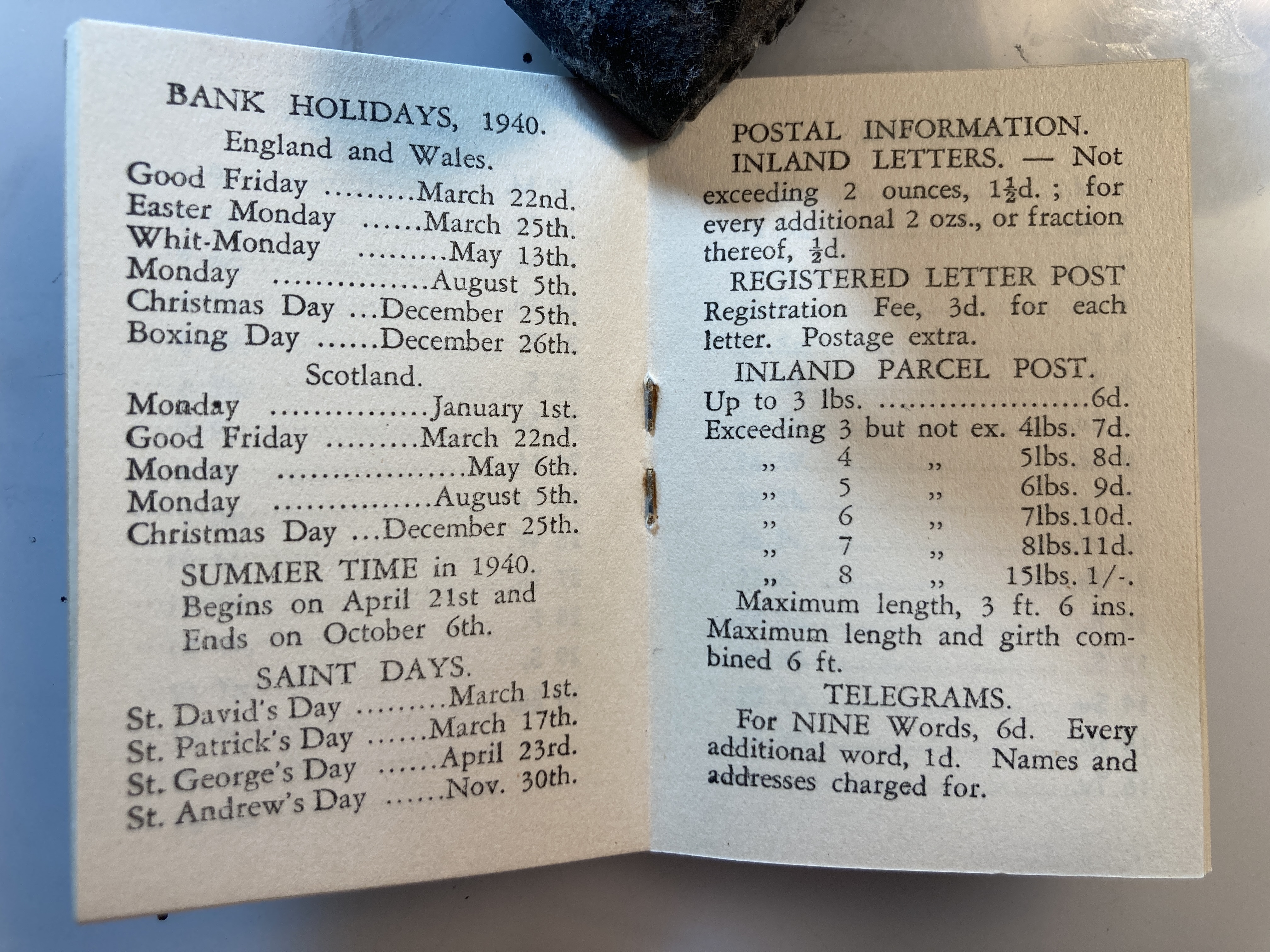
The calendar pages follow uninterrupted until the centerfold which provides a list of Bank Holidays (they include summer’s commencement and end) as well as Saint Days, St. Patrick’s being the only one familiar to this author. There’s something called Whit Monday which I was also unfamiliar with and below it just Monday which is confusing – another Whit Monday?

The opposite page gives a reference for postal weights and regulations and at the bottom the charge for a telegram – the email of the day. Nine words for 6d (6 cents, I think) and an additional 1d a word! Names and addresses were an additional charge.

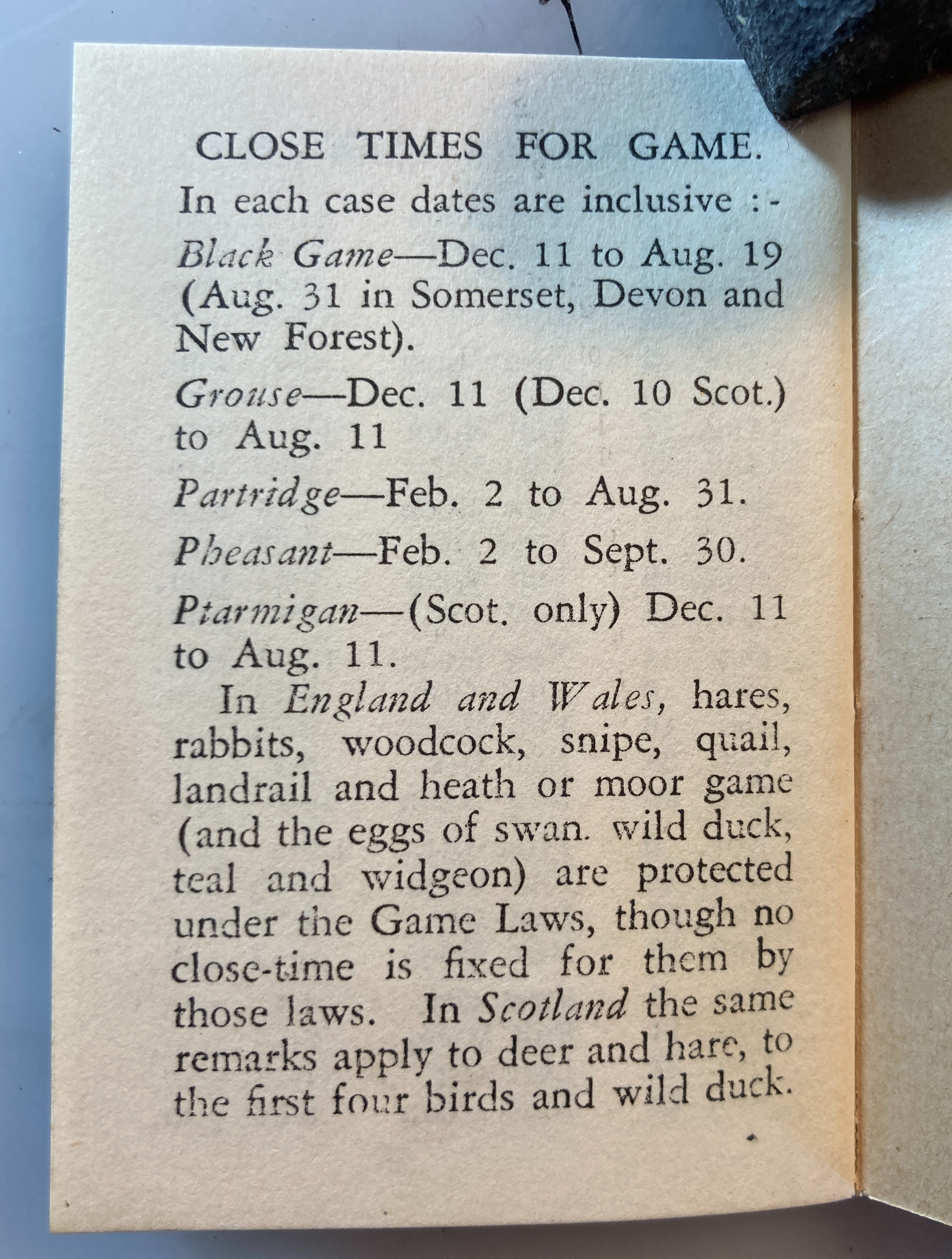
Two pages at the back of the book are taken up with the phases of the moon and the last page (and this is so British) are the Close Times for Game, referring to the hunting season of various game – black game (a category of grouse?), grouse, partridge, pheasant and ptarmigan – which appears to be another, white, grouse. Then a long paragraph on non-fowl hunting with rule for everything from snipe to moor game and widgeon. Hmmm, I can see why you might need to carry that around with you?

There is no maker’s imprint for this and I have not run across anything quite like it before, although I assume most people didn’t keep them – let alone in such pristine condition. I went through a long datebook stage starting with the small and decorative and moving to the strictly utilitarian as my burgeoning work life demanded, this in the years before our lives were kept electronically of course.

My first electronic device was one that kept my calendar and contacts only – sans phone which was the great innovation. I adored it and I have to admit it was like magic. Still, there was an intimacy of keeping a book with a handwritten record of your year. (I still keep paper calendars – I need to be able to see how a month lays out when planning.)

I would hang onto the books for a period of time after for reference and they formed a sort of unconscious diary – friends visited and those rescheduled, even the meetings which sometimes became work landmark events when launching a new initiative. The convenience of our electronic lives is without question, but as always, a tiny something is lost to the shifting times.

Cardboard Cats

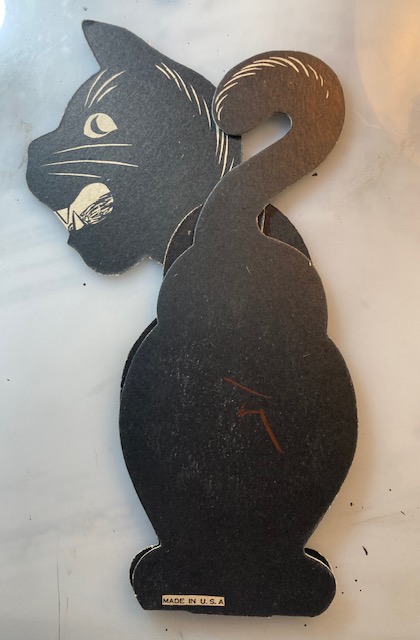
Pam’s Pictorama Post: This is one of two very special cardboard kitties I have to offer at the moment, purchased in recent months but who have not yet had their premiere here at Pictorama. First I focus on this nifty fellow.

I have seen him offered once or twice before and chased him around the internet some, but never acquiring him. Then he fell in my lap at a most unexpected moment, late one hectic night a few weeks ago when I was having a quick look at my phone and found him being offered to my by my Mid-west maven, Miss Molly (@missmollysantiques) via Instagram. I scooped up some other fine Halloween decorations (one from a few weeks ago can be found here), however this one interests me in part because he’s almost not quite a Halloween fellow, although I assume that is his origin. A black cat for all seasons in my book.

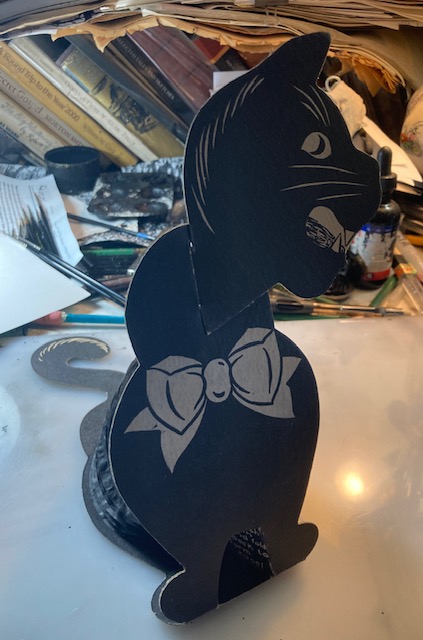
Kitty expanded for posing here on Kim’s desk. Pams-Pictorama.com collection.

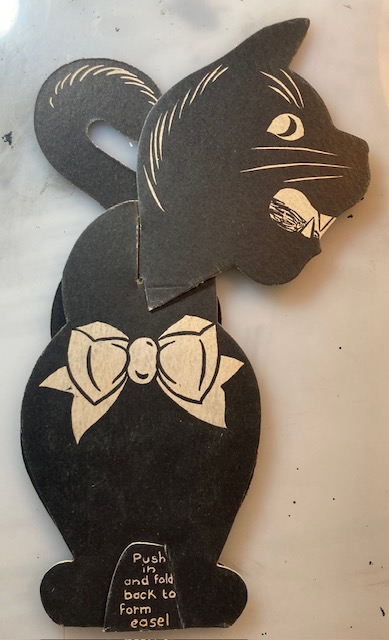
He offers only that he was Made in the USA by way of markings and is small, only about 12 inches. His monochromatic black and white works for me for being bold with his big what bow which makes me think of a tuxedo kitty. He bares his fangs though and looks reasonably fierce for a guy in a bow and his tail curls up behind him in a question mark. Despite his snarl he has a certain come hither charm.

The back side of Kitty flat. A bit of crayon here from an errant child! Not visible when displayed however. Pams-Pictorama.com.

It is the design of Mr. Kitty that makes him special. For storage he lies flat, but at the bottom we are encouraged to Push in and fold back to form easel. This takes a few minutes to exactly figure out, but then you do and an accordion middle made of a honeycomb of tissue paper allows him to expand into an almost 3-D feline, using his tail for extra ballast.

What exact role he was intended to play I am unsure, as his size makes him a bit small as Halloween decor goes. However with his neat design and snappy appearance he rates a place at my table any day of the year.

Black Cat Fiesta

Pam’s Pictorama Post: We’re speeding down October’s path on a less than 24 hour countdown to another Halloween. It is a truly dark and stormy morning as I write this and I do hope it clears sufficiently for the activities of tomorrow for the local little ones – the holiday seems challenged enough in its Covid incarnation this year. Here at Pictorama I am sharing a few additional howlin’ Halloween bits I collected over the last few months in my search for all things early 20th century black cat related. Today’s items are from my go-to girl for Halloween items (and some other interesting bits) who hails from the Midwest, @missmollystlantiques, aka Molly Simms.

I have written recently about how Miss Molly has helped me achieve some of my early Halloween collecting goals. (One of those posts can be found here.) These little items today are some icing on the collecting cake and a reminder that one of the nice things about holiday decorations is that they were used and often lovingly stored each year, making for a great survival rate.

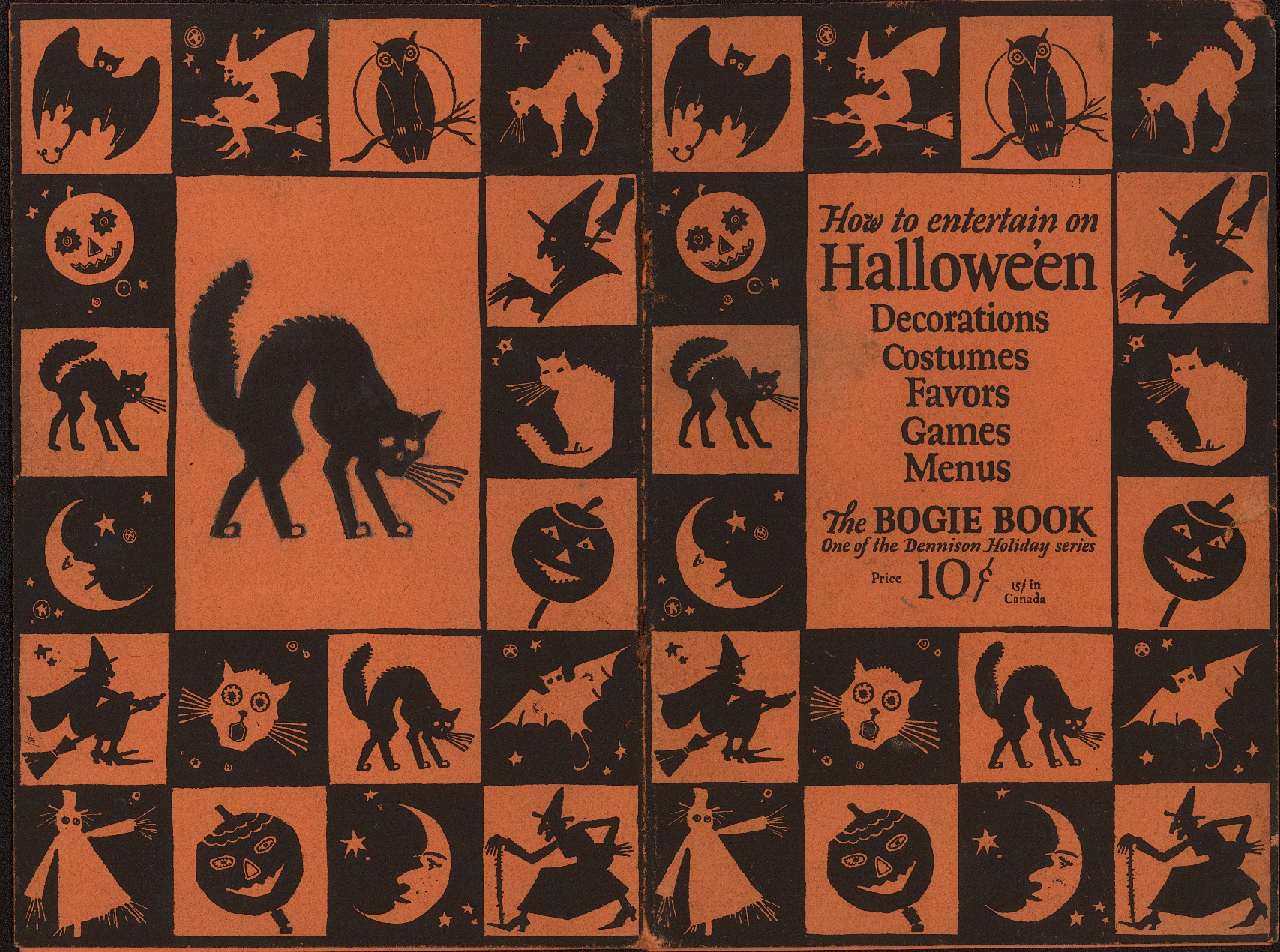
Dennison’s Bogie Book from the teens. Pams-Pictorama.com collection.

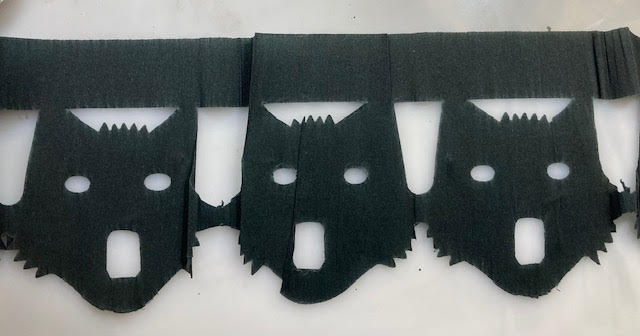
I can only say I wish the Dennison’s Black Cat streamer was sufficiently sturdy to put up in the apartment. They are very jolly and I can imagine them decorating the space above our bookcases nicely. (Perhaps I could press them in plexi? I wonder if they would survive the light? It is so fragile!)

Pams-Pictorama.com Collection.

This black cat banner immediately stirs an image of a much earlier Halloween party, say 1916, dripping with such decorations – table groaning with paper mache jack-o-lanterns and nut cups. I was collecting the Dennison books years ago, as below (that early 2015 post can be found here). Some wonderful copies were being put out for awhile – for you fellow collectors who may have missed them, poke around. The image that they present of the well appointed Halloween party from the teens has stayed with me – one chock-a-block and dripping with crepe paper creations. Those folks at Dennison’s knew how to sell crepe paper! I cannot help but feel there is a better steward of this particular fragile paper bit of history. Nevertheless, I will do my best until the next person comes along.

Pams-Pictorama.com Collection.

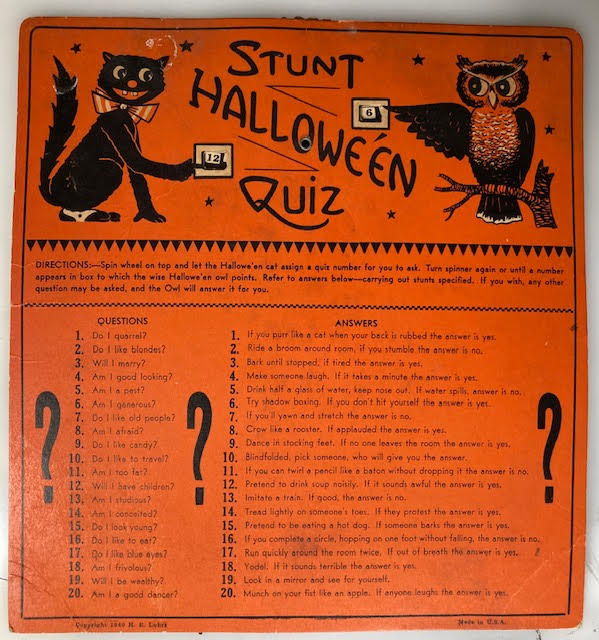
Less fragile and easier to revel in, is this cardboard Halloween Quiz overseen by a grinning bow-tied black cat and this serious owl. There is a 1940 copyright to H. E. Luhrs and a quick internet search shows that the Luhrs name was a significant one in ’40’s and ’50’s Halloween decorations and die-cuts. They were the maker of what I think of as the classic skeleton decoration (the one I would want if I wanted a skeleton) and evidently the “spinning” (it doesn’t really spin and I somehow doubt it ever did) fortune teller which they employed with several designs. While I could not find a proper history of the company, at a glance I would say they were the poor man’s version of Beistle, a somewhat more substantial maker of Halloween ephemera.

Pams-Pictorama.com Collection.

Questions run down one side of my version of the Quiz with answers on the right. Two spins would give you both a question and an answer – the answer might require that you perform the required stunt to achieve it. Questions range from Am I studious? to Do I like old people? and answers are along the lines of If you can twirl a pencil like a baton without dropping it the answer is no.

Pams-Pictorama.com Collection.

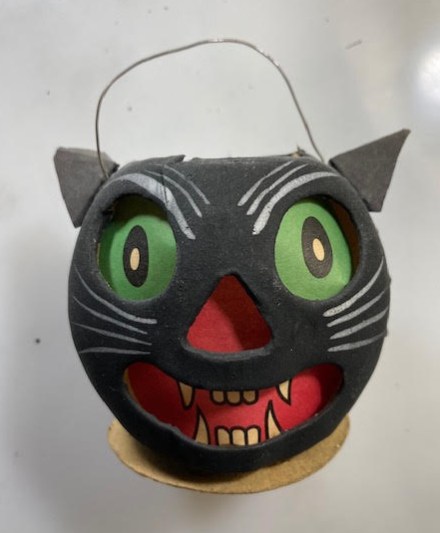
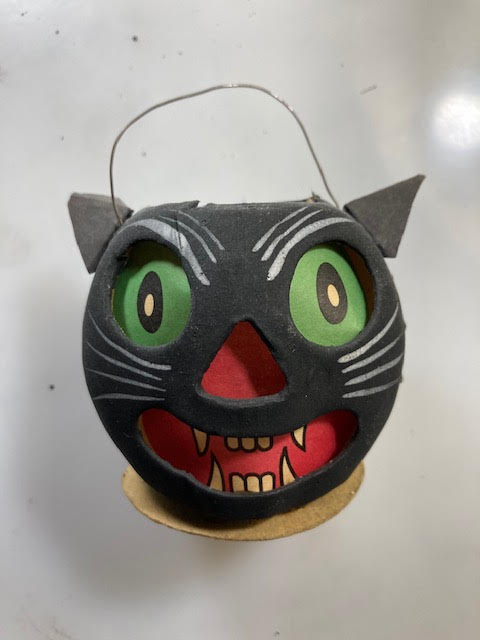
I end with this small black cat jack-o-lantern style container which probably held treats on a very well appointed Halloween table. It survives in virtually pristine condition. No tricks, only treats here at Pictorama today. Have a Happy Black Cat Halloween!