Tuning In

Pam’s Pictorama.com: Last week I mentioned stumbling onto Radio Dismuke in passing. While in Cold Spring over our anniversary we happened into a shop where it was playing. They had thoughtfully provided a printout page by the register with the log on info. I snapped a photo. Later that week I remembered it and tuned in while at work. It is a glorious discovery.

From what I have gathered, the station started as one man’s hobby, programming and playing his vast collection. The documentation of it online seems to mostly date from 2016 when he (Dismuke) made the decision to place his collection and the station in the hands of an Austin, Texas archive. There is a Board and donations can be made to it as a 501(c) (3) organization. He continues to program it, although I gather there are evidently occasional guest programmers (I haven’t hit on those yet). It rolls along 24 hours a day, seven days a week, like an alternate reality.

Although occasional period commercials play and there are periodic station identifications, there is no disc jockey or voice of. The playlist is vast and the throughlines can be mercurial. The quality of the recordings is fairly universally good. There are radio transcription, 78’s and who knows what else. The variety is blissfully wide. I bless Mr. Dismuke for having the foresight to attempt to ensure and secure the future of his station this way.

Today while wandering around the site I discovered that there is a section of program notes and essays with music as well. I have to explore further. I have also subscribed to their emails so we’ll see what that brings.

As a young adult, even a teen, I shopped around for a music that suited me. Of course as a Jersey girl of age in the 1980’s, I listened to a bit of Bruce and other contemporaries of the time. My sister Loren had a prodigious interest in music and collected albums of both popular and classical music. She was musically gifted. Violin was her primary instrument, but she played piano and flute, and was even known to hop on bassoon in a pinch. Music both from her own making and from her stereo issued forth at all hours and whenever she was home.

I am old enough that radios were certainly ubiquitous and hugely inexpensively available. While there was a kitchen radio for family consumption, it sat atop of the fridge where we couldn’t reach it until we were old enough, tall enough. It was generally on news radio, (CBS News radio where mom’s brother worked), but mom would give into music occasionally.

This is remarkably close to the model I had.

I had a transistor radio that I was extremely proud of when I was about 8. It was a small black Sony. It really seemed like the height of technology and vaguely magical. It was later replaced by, in turn, a very swinging 70’s model that was sort of a twisting plastic donut that kept its radio bits where it swung apart. This was very cool, but didn’t have legs. At some point I found or was given a white table model with gold trim and all were eventually replaced by a series of clock radios. (We were a clock radio family – my father rose to one daily and I guess he figured we all should. In New York I still use one, although in New Jersey and for travel I depend on my phone.) This eliminated the need for batteries and as I often listened in my room I only missed the magic of portability slightly.

Found on Pinterest. I think mine was even yellow…

I loved finding radio programs where stories were told or books read. Think Jean Shepard. I’m not so old that I remember dramas or series acted out on radio. However, there were shows where snippets of books were read or the sorts of things that would be podcasts were broadcast. I wasn’t very good at remembering when these shows were broadcast so it was hit or miss, but I’d go looking on a weekend afternoon or lazy summer day an occasionally be rewarded.

In true Butler tradition I still use a clock radio and this Sony cube has long been the current incarnation. I wake to WQXR classical music.

Jazz started to interest me fairly early on, but what I heard was sort of largely to one side of what really appealed to me. Almost without realizing it became apparent that what I liked was early jazz, pre-1940, but it was awhile before I think I entirely put that together. And it was hard to find. Like the stories, I would stumble on it here or there, but certainly didn’t find anything dedicated to it until I was in college.

I have written at length about the period of listening in college and ultimately discovering Rich Conaty’s show. (That tribute post to him can be found here.) Therefore, I won’t go over that territory again. Rich helped me quantify that it wasn’t only jazz, but really all popular music of the 20’s and 30’s (and perhaps a bit on either side) that I most coveted.

Rich Conaty. While researching this I found that WFUV has made his shows available digitally on their website.

However, with Rich’s death I never found a radio replacement. His station, WFUV, is an eclectic college station and there is, to my knowledge, no attempt to replace his show, nor to play the many decades of archived material. Phil Schaap filled the bill, if differently, at Columbia University and on their station. Kim and I became weekend listeners to his show, trading Rich’s Sunday night spot for a longer one on Saturday nights. Sadly, Phil lost his battle with cancer in 2021. His daily morning show Birdflight, about the life and music of Charlie Parker, is still played in its morning slot.

Phil was also a fixture at Jazz at Lincoln Center where he had taught their Swing U adult ed courses for many years. I would catch up with him in the kitchen and chat – always jazz or baseball. (I know nothing about baseball and very little about jazz compared to Phil. He’d quiz me and I would fail.) Once in awhile he’d lope into my office and have a chat. That was more rare. His presence accounted in part for my interest in taking the job there. Despite my inability to remember dates and details, Phil was overwhelmingly supportive of my fundraising efforts on behalf of the music and always expressed his gratitude with enthusiastic abundance.

A young Phil Schaap.

I find it hard to listen to Phil or Rich now, both their voices so very distinctive, without getting sad so I don’t listen to the rebroadcasts of Phil’s shows. WKCR continues dedicated presentations of jazz beyond Birdflight, but I lost the habit of listening while I work entirely during the pandemic. Kim loves the music, but he finds it distracting when he’s working so unlike my office, I didn’t play it while working from home during the pandemic years.

Ironically, my discovery of Radio Dismuke has come as I finish my time at Jazz at Lincoln Center and popular music of the 20’s and 30’s pours out of my office there again for now. (The internet has of course long replaced the desktop radio that I had while at the Met – although I still have it and could probably put my hands on it right now.) It is of some comfort to me that when I am sitting in a new chair in a different office in a few months that I will take Radio Dismuke along with me. In recognition I made my first online gift to them. I hope that it will be the first of many.
Fine Tuning: Country Music

Pam’s Pictorama Post: I arrived home from a concert last night (more about that in a minute) and discovered that our scanner had died on Kim. As this will inhibit photo reproduction somewhat in the near future, please bear with me while I take the opportunity to meander down a path and bring those of you who follow the personal aspects of my life up-to-speed.

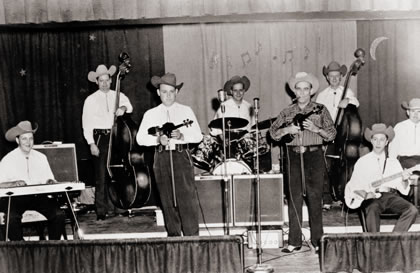
Last week I hit the two year mark at Jazz at Lincoln Center. Since it also happened to be our Gala I didn’t really have the bandwidth to pay much attention to the fact – nothing like more than 600 people for dinner and a concert to distract you. Subsequent to that I was knocked low by a stomach virus which only left me considering whether or not to head to the ER or if urgent care would do. Mostly recovered with the help of time and the miracles of medicine, last night I attended a concert featuring highlights of Ken Burns’s upcoming documentary on country music (to air on PBS in mid-September) paired with our Jazz at Lincoln Center orchestra which I had been looking forward to and I was pleased not to be denied the pleasure of it.

I will begin by stating that I know almost nothing really about country music. Unlike Kim’s family, my folks didn’t listen to a lot of music, but they did have a handful of folk music albums and as I stumbled into nascent consciousness about music I gravitated for a bit in that direction. My father had worked on a documentary for ABC News on Woody Guthrie and for some reason the soundtrack had to be recorded on our home stereo (resulting in a day of tip toeing around the house, interesting equipment and strange people for small child Pam which I still remember) and a pile of those albums remained with us. (Meanwhile, my mother was a fan of Joan Baez and the sound of her singing takes me immediately back to my childhood in a way few things can.)

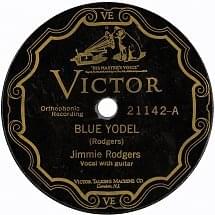
As I poked and stumbled through what appealed to me musically I found my way to people like Jimmie Rodgers. (Blue Yodel No. 9 was featured in the concert last night with Wynton on the trumpet doing the Louis Armstrong part and Marty Stuart on guitar and vocal as Jimmie Rodgers. The 1930 recording of Rodgers and Armstrong found here via Youtube.) I liked the stories and the music stayed with me, but I didn’t have access to a lot of it and my musical attention, such as it was, strayed. I eventually found radio stations that played jazz and suddenly I was getting warmer. Some of you already know that in college I stumbled across early popular music genius Rich Conaty (memorialized fondly in a post here) who introduced me to the broader music of the 1920’s and 30’s that ultimately became the mainstay of my music diet.

I first discovered Rich’s show when spending the weekends in Manhattan during the fall of my senior year in college. I had exhausted the opportunities I had to work in life from the figure in the art program at my Connecticut college. I had been passionate about drawing and sculpting the figure from life since high school and so I arranged my classes in a way so I could come to New York on Saturday and take an early all-day life class at the Art Student’s League on Sunday and head back to New London early on Monday. I stayed in a small apartment my father kept so he wasn’t forced to commute everyday during the final years of his long career.

It was sort of exhausting and I didn’t know anyone in New York so most of those evenings I spent alone in the apartment, listening to the radio while I ate and before bed. (Yes folks, actual radio. Someday I will expound here on my love of the radio – I adored it as a child and have never entirely deserted my fondness for it. While I mostly access it via the internet these days, I will never forget my childhood fascination with my first transistor radio. It was simply, a really great thing.)

It was during one of those New York weekend stays that I first discovered Rich, who at the time, and on and off over his many decades at Fordham’s WFUV radio station, had both the Saturday and Sunday night slot. His Sunday night show was the one I grew to love and listen to faithfully over the years however and it rarely strayed out of the popular music genre or period. The Saturday night show was a tad more freewheeling – at least this is how I remember it all. I couldn’t say for sure, but I believe it was the Saturday show that featured early country music. It was a revelation and I always wanted to know more.

I lost touch with Rich’s show for a year or so after I stopped coming to Manhattan on weekends. The radio signal was weak and I could not pick it up in Connecticut although I did try repeatedly. It was a year or more later before I was back in New York and resumed listening to him, although another couple of years before life was settled into enough of a routine that I became a regular and devoted listener.

Over time I got to know Rich and in retrospect I could really kick myself for not asking him about that country music show. I am not aware of his devoting any substantial air time to the subject subsequently, not in a dedicated way. I think country swing was probably the tributary that beckoned and was new to my ears, but hard to say how reliable memory like that of decades ago actually is. It stayed with me, but in the fall of 1985 with limited knowledge of Manhattan’s resources, nor armed with much information, it was never an avenue I really explored.

(Bob Wills, San Antonio Rose, 1938 can be found here.)

wills1

Bob Wills and the Texas Playboys


Last night, listening to Ken Burns talk about the dawn of country music those dusty musical memories started to emerge again and the musical curiosity of a 21 year old Pam stirred and itched at my brain anew. As someone said to me after discussing how great the concert was, however, just another Friday night for you at Jazz at Lincoln Center and I thought, not quite, but it is the very best part of my job indeed.


Leaving the Met

This slideshow requires JavaScript.

Pam’s Pictorama Post: This is one of those posts where I veer wildly off into an essay on my personal life (where the All Pam, All the Time comes from), so those of you who are in it for the toys and photos might want to pass this one by.

Much has been written in the press about The Metropolitan Museum of Art recently, and for the most part I guess I am not especially interested in commenting on that. Instead I thought I would take the opportunity to write a little bit about what kept me working at the Met for the better part of 30 years.

To dial back to the beginning of the story, after graduating college I had a vague idea about working my way through grad school in painting and drawing, and to this end I began cooking professionally here in New York. To collapse this part of the story, I was working for a young Jean-George Vongerichten at his first restaurant here in New York when diagnosed with arthritis in my hips and back. It would be years before a balance of meds and exercise would set things right and meanwhile, it was evident that I had chosen the wrong way to support myself. My good friend Frances (whose last name happened to be de Montebello) got me a job in the bookstore at the Met, as seasonal help – just something to do and make some money while figuring out what would come next.

Much to my surprise, the next months saw me, in rapid succession, hired away from the bookstore and into the Department of Ancient Near East; then hired into Human Resources Office, which we then called Personnel, as an assistant. Along that path I made fast friends among other aspiring artists in the bookstore, stockroom and eventually among the technicians, and even nascent curatorial staff. It seemed like something of the artist’s haven you are looking for after leaving the warm cocoon of college or art school – the grad school I never made it to. People always wanted to talk about art, invited me to participate in exhibitions, art jams and publications.

Some of those friendships and affiliations have lasted this long test of time, especially among those folks who are also still working there. One of two others from those earliest days I stay in touch with, despite having moved far and wide, and a few others – such as my friend Jennifer Pellman – sadly died young; or like another friend Drew Curtis, just slipped away from me. (Drew had a great story about how he had actually left home in Oklahoma to join the circus – his description of hosing down the elephants in the morning will always stay with me.) My more or less 30 year tenure at the Met meant I was always easy for folks to find if they came calling, sometimes even after decades. Still, even from my earliest days there, it was clear to me that this place was a community for artists and people who cared about art.

Surprisingly my casual approach to my career eventually landed me in the Development Office. With hard work (a work ethic instilled early on by my parents, and honed to a fine edge in my various incarnations as waitress, short order cook, house cleaner and chef) and the faith of those who supervised me, combined with some luck, and I continued to learn, grow and get promoted to something that almost equaled a living wage. Turns out I was good at this fundraising thing with its attention to detail and rewards for someone with good listening skills, patience and who likes people.

Curators were pretty much gods to us. I was trained to protect them at all costs as they are the talent of the Museum, and their time should be used judiciously. Of course at the highest end there was the Director, the President and our Vice President. They were to be shielded to the extent possible and never surprised under any circumstances if possible. There were many small things that I learned that stayed with me – always have a discreet pad and pen, even at events, so you can take notes for follow up; grace under pressure will get you through most things – never panic, and try not to allow yourself to be rushed. That’s when mistakes occur, when you are rushed.

A friend of mine who worked at the Met for about six years once said that it is the only place you’ll ever work where if you leave after ten years people will look at you and say, “I guess it just didn’t work out.” No one wanted to bother to learn your name until you had been there for several years, and therefore perhaps you were staying. Many alliances were forged at lunches in the staff cafeteria and the Amity diner on Madison. It sounds snobby and perhaps it was, but the end result was if you stayed and worked hard and actually cared, you found yourself working among a brilliant and interesting milieu.

Like family we fought hard as much as we played well together – there were some we thought were favored and others who were black sheep. As a part of the administrative staff we traveled along a slightly different path than the curators – frankly a lower rung. Had our own gossip and issues. However, together we all celebrated weddings, birthdays, the arrival of babies and attended funerals. I am always moved to tears when I think of how many people made the long trip to Long Branch, New Jersey for my sister’s funeral – and how a group of about six of my closest friends helped me decorate the vegetarian restaurant in Chinatown where our wedding was held.

Some of those people remain at the Met – others have also dispersed, but remain valued colleagues and friends. I find myself writing this three weeks after leaving the Museum, and two weeks into my new job with Jazz at Lincoln Center. While I already miss the warm arms of the Metropolitan family, being surrounded by the glorious art and all those wonderful people, I embrace the devoted earnestness of my new colleagues who believe that jazz, the great indigenous American art form, is also a path for living a creative and collaborative life. An organization which is having its own financial struggle as it strives to grow into a world-wide advocate and educator, the dedication of the staff is astounding. So, despite the distinctly exposed feeling of a chick who has flown out of the nest, I feel I have landed on the perch I was meant to. It’s a big challenge and there are already days when I just hope my skills are up to it, but deep down I know I am paying it forward now as I should be. Everything I learned at the Museum I will plow into helping Wynton Marsalis and the folks at Jazz realize their vision.

I am already using my ears more now these days than my eyes, but listening is an important thing to learn. These days I can’t help but feel Rich Conaty on my shoulder as well, always reminding me of the line he used to close his show with, remember that music saved the world – aloha!


Rich Conaty

Pam’s Pictorama: A bit of a disclaimer on this post, as it is a radical departure from my usual posts. The recent loss of our friend Rich Conaty has me thinking and seems to require that I get a few thoughts down. For those of you who did not know Rich, he was an extraordinarily talented disc jockey who had a radio show for decades devoted to music of the 20’s and 30’s. Rich launched his career at the Fordham, NY college radio station, WFUV, in the 1970’s when he was still in high school. I caught up with him more than a decade later when I was in my senior year at college. I was commuting into NYC on weekends for a day-long life drawing class at the Art Student’s League and spending Sunday nights alone in an apartment my father used during most of the week here in Manhattan.

I just never was much of a fan of the music of my own day (the 1980’s for the most part) and while I had experimented with listening to jazz and while it held some charm, it ultimately disappointed me. Slowly as I started to discover Ella Fitzgerald and Billie Holiday it dawned on me that what I liked was music, mostly but not only vocal, from the 1920’s and 30’s. I bought some tapes (yep, 1986 and this was before cd’s) and started to get the lay of the land. Radio shows might touch on this music, but nothing seemed to focus on it. Somehow I stumbled onto Rich’s show one Sunday night in Manhattan and I listened weekly. That was great while I was in New York, but in those pre-internet days there was no way to pick it up from New London, Connecticut. Therefore, once my class in Manhattan ended, I was left high and dry.

Post graduation I ended up back in New York, cooking professionally. The hours I kept curtailed any late night radio listening, but I did manage to tune in occasionally. My cooking career ended with a bad fall and injury early on, and I found myself working at the Metropolitan Museum with regular hours. I rediscovered Rich’s show on a road trip with my then boyfriend, Kevin Hein. We were coming home from South Jersey late one Sunday night – must have been visiting his parents. I was hooked for good at that point and became a devoted weekly listener. In fact, I would tape them each week and play them throughout the rest of the week. Kevin liked the show too, and we could usually schedule ourselves to be home on Sunday night.

Another disclaimer – unlike Kim, I am not someone who can address and debate the finer points of this music and my brain has always been a bit of a sieve for these kinds of facts, so I cannot do Rich justice on this point despite listening dutifully all those years. (It’s a good thing I managed to marry someone who verges on being a savant for remembering dates and things associated with music and recordings.) I did begin to figure out what I liked and names like Smith Belew and Annette Henshaw, Connie Boswell became familiar. The fact was though, I pretty much liked it all, even Arthur Tracy grew on me over time – well, sort of. In looking back on it, especially in that first decade, I associated Rich and the Big Broadcast with the life I made for myself in New York. Like so many kids from the suburbs who move here, there are touchstones for how we found our way to who we wanted to be – and Rich’s show and the world of that music was that for me.

Over the almost three decades of listening, Rich was sharing bits of his personal life over his show until all us listeners felt like we knew him. Show anniversaries, AA, meeting and then eventually marrying his girlfriend Mary. As for me, after more than seven years together Kevin and I called it quits. I dated a few people, some who shared my musical interest – or at least had interests that intersected. I don’t think Kim knows this, but it was a passing comment about the Boswell sisters he made at a party once that really got me thinking about him. His comics were steeped in period musical references too – it piqued my interest indeed.

I guess Kim was thinking about me as well, but evidently he was surprised to find Fats Waller playing when he walked into my apartment for our first date – a random tape of one of Rich’s shows – Fats with Ted Lewis, Crazy About My Baby, Kim reminds me now. Kim focused on it right away and wanted to know more about the show – he became a devoted follower of the show and my boyfriend that night. A little more than a month later he and I made our only ever New Year’s Eve foray out to the New Yorker Hotel where Vince Giordano and the Nighthawks were performing, an event Rich had mentioned on his show. He and Mary were there, but we didn’t know them. I had heard the Nighthawks live once or twice before – at a film, an outside concert downtown, but it was the first time Kim and I heard them together. I was recovering from a horrible flu that night and we didn’t stay too long though and were amazed to get a taxi in that locale, not so far from Times Square.

13062994_10208117326723866_6048120244730733970_o

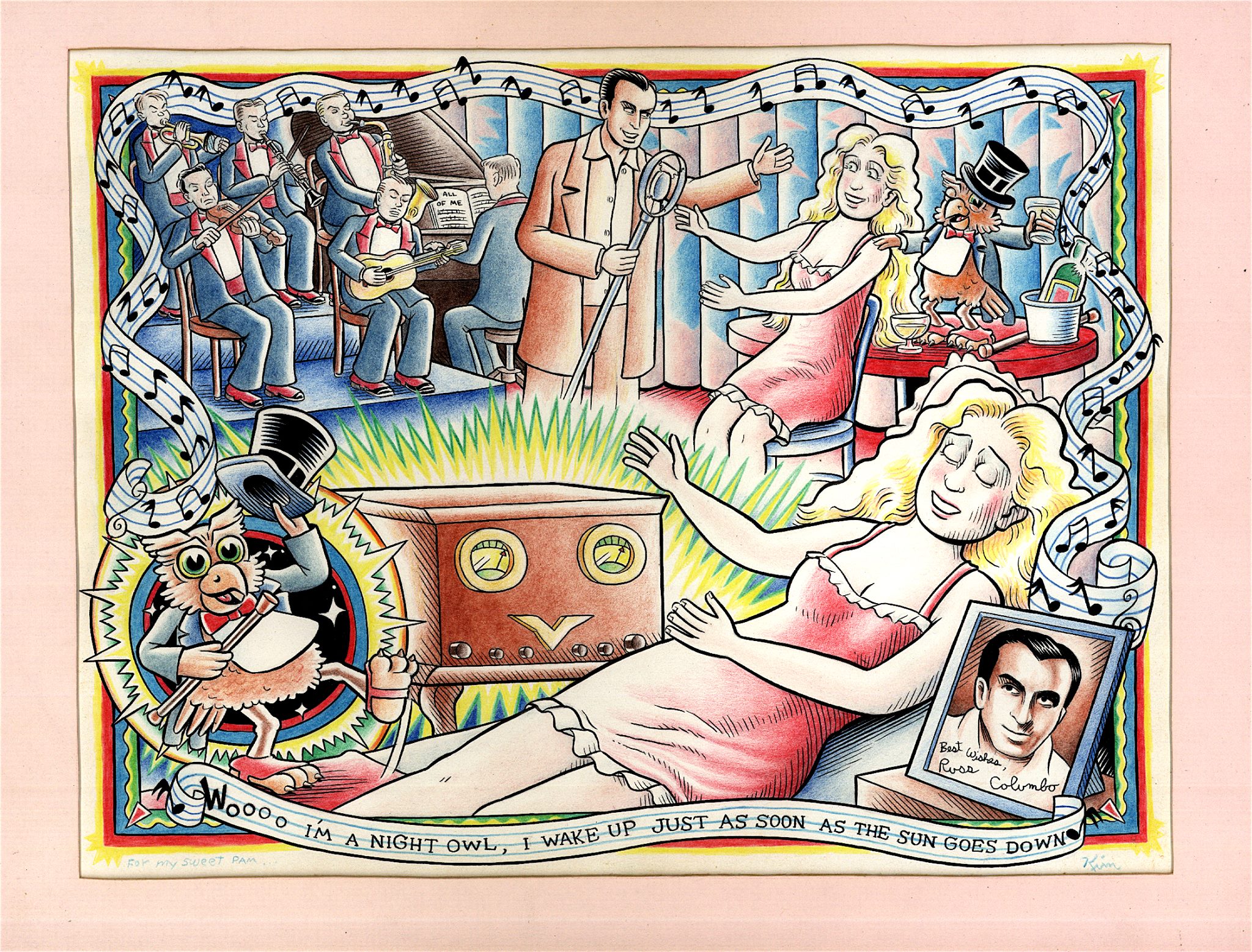
A music infused drawing that Kim did for me, Pams-Pictorama.com


Life burbled along. Kim and I moved in together. Sunday nights were pretty sacred and always reserved for the Big Broadcast. Rich left WFUV for a brief foray into commercial radio and we followed the best we could. It was a square peg in a round hole however, with playlists and other limitations, and eventually he found his way back to WFUV, to our great relief. He had his first bout with cancer, but seemed to recover quickly. His marriage ultimately ended over time; we eventually got hitched ourselves in 2000. Sadly, later Rich’s former wife Mary died years later.

On occasion we would go hear the Nighthawks at a restaurant in Chelsea, once or twice alone, but more often when someone with an interest in music was visiting from out of town. And somewhere in the years that followed Rich recognized Kim’s name and called it out as a thank you for being a supporter of the show. This lead to that over time and Rich invited us to join him to hear Vince and the Nighthawks at their then current gig at a place in the basement of a Times Square building that appeared to have once been a speakeasy, Sophia’s. Hard to find, but worth the effort.

I was beyond excited to meet Rich – yep, a total fan girl after all this time. I wasn’t disappointed. Rich was just the sweetest, most generous guy on the face of the earth. Despite the late hour he drove out of his way to drop us off at home after the show. After that Kim and I joined him several times, most recently at a new venue for the Nighthawks, The Iguana. He loved the story of Kim hearing Fats the first time he visited me and would always ask Vince to play it on those subsequent visits to hear the Nighthawks with him. He remembered Kim’s birthday too after we had a musical evening as a birthday foray for him. One night at a large table we met Rich’s mom. I was seated next to her and she was already a bit vague, but I had a good time talking to her.

13906964_10208815041566301_3360791569507566542_n

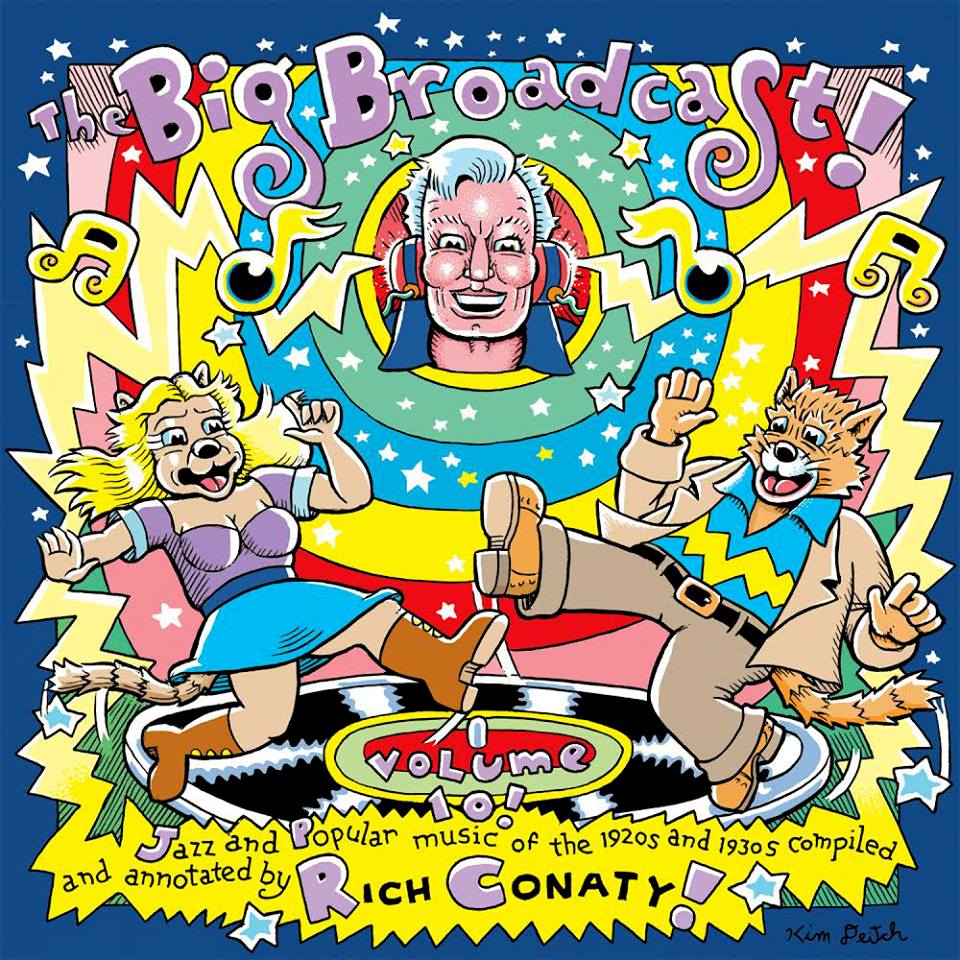
Kim’s cover art for the Big Broadcast Vol. 10

15823412_10154815542416684_2491074049654296670_n

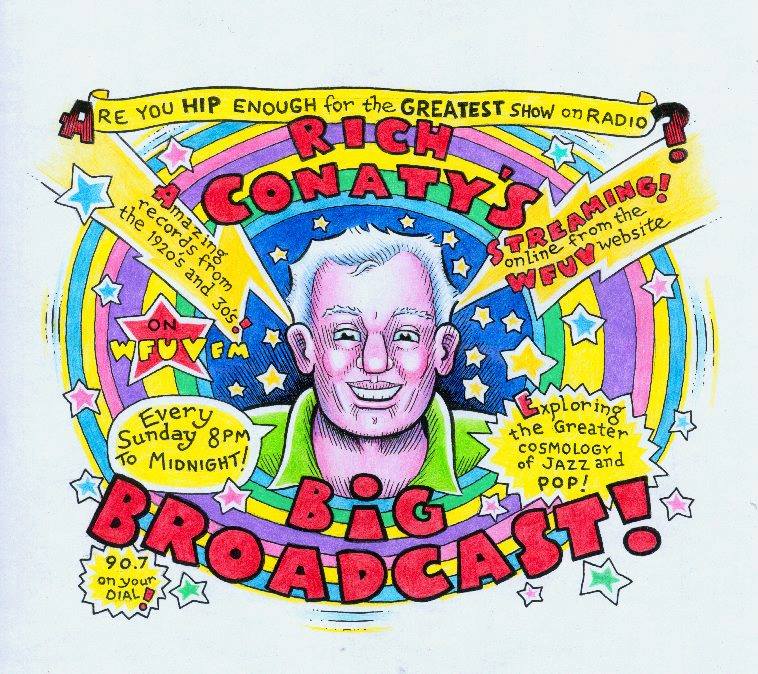
An ad and calling card Kim drew for Rich


Kim did a great ad for the Big Broadcast for Rich to use and we have used it on our Facebook page to remind people of and introduce them to the show on Sunday nights. My good friend Betsy was one unexpected convert. Kim also did the cover art for one of the Big Broadcast annual premium disks for giving to the show. I counseled Rich on fundraising for his program – it was always so important to him that the show be seen as carrying its weight at the cash starved not-for-profit station. (We would also talk about his cats and, although I am sure he made provision for them, I worry about them now. I’m sure they miss him so much!)

While we would communicate via Facebook and Twitter and see each other periodically, our paths intersecting on and off throughout the last ten or more years, we were not in touch enough that I can fully adjust to the idea that he is gone. A second round of cancer came on hard and fast and claimed him this time. However, in my mind he remains at home upstate working on the next Big Broadcast and our next date to hear the Nighthawks remains alluringly in the near future.

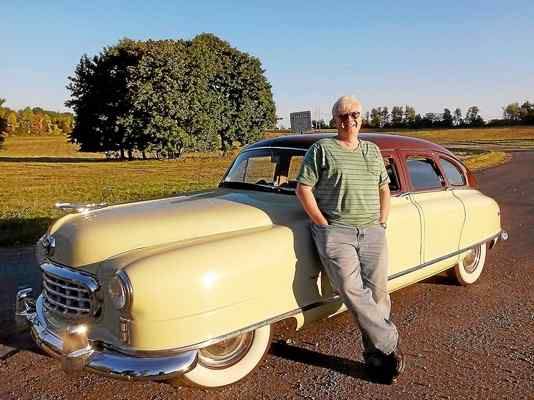
rich-and-his-53-nash

Rich and his ’53 Nash