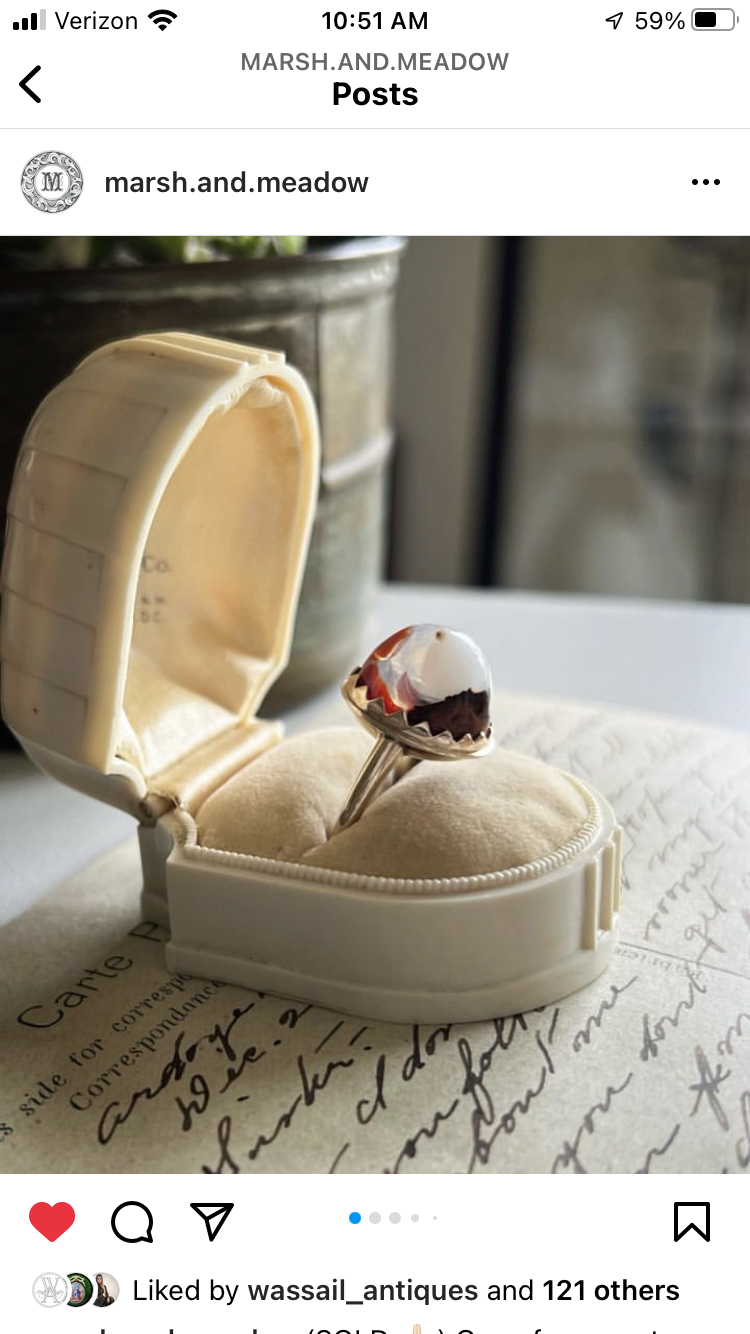
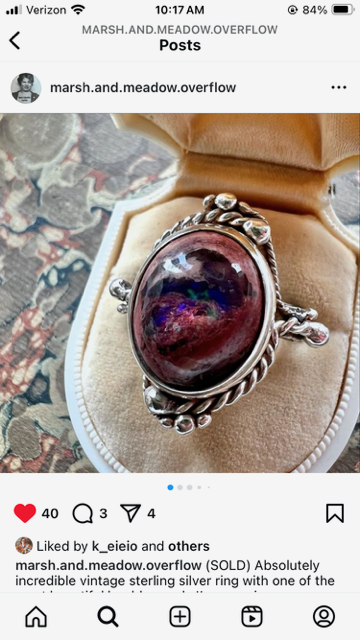
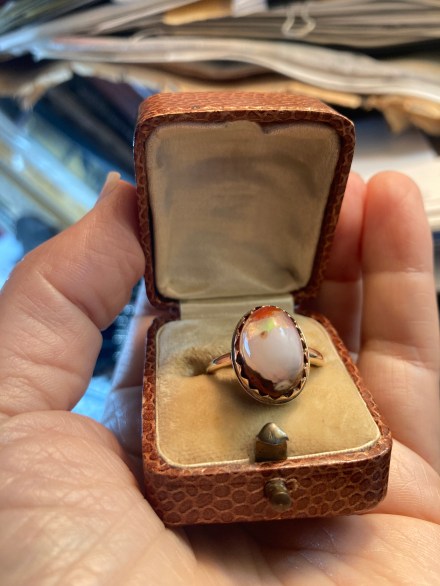
Pam’s Pictorama Post: In the rhythm of Pictorama posting, jewelry posts tend to appear a bit randomly, as items are purchased or catch my imagination over again. I have written about my passion for opals before and in particular for a ring I wear very often which is referred to as a boulder opal. (That post can be read here.) This is a recent acquisition post.
The charm of the boulder opal (for me) is that it was caught in the act of becoming an opal – forever frozen in the process of change. Wearing this ring so often I have had time to reflect on how much I like that aspect of it. Embracing growth and ongoing change is such an important aspect of life, I like reflecting on it when I look down at the ring and see it’s tiny flares of opal fire.
Yesterday a friend was looking at some gem stones at a jeweler we know. One stone she mentioned seeing was lapis on one side and malachite on the other – fascinating! Forever frozen in their native fusion in a shared atmosphere for their evolution. I haven’t seen the stone, but the concept makes my mind twirl a bit.
Therefore, as a result, I keep my eye out for boulder opals which have been snatched from the wilds and made into jewelry. I saw a newer silver ring recently and agonized a bit – I didn’t like the setting so I would want to reset it and the stone was hard to see in the online posting. It sold and I still have mixed feelings about my choice not to buy it.
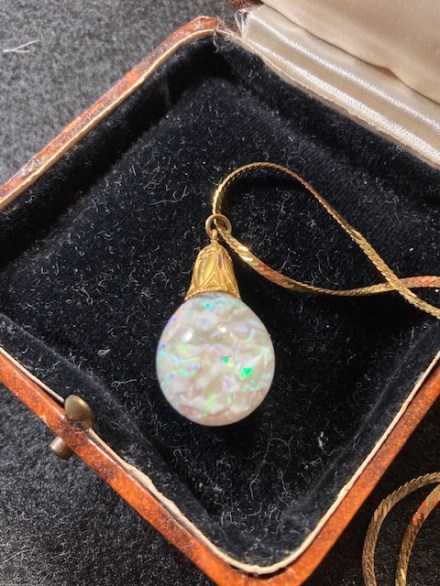
However, a few months later this necklace came up and from a seller I have never bought from or much seen in my feed before. (The seller can be found at http://trademarkantiques.com.) They were celebrating and promoting October’s birthstone, the opal. The pendant flashed before me in a video in a series of opal items and I snatched it up immediately.
The setting is such that it is clear it is the same dawn of the 20th century period as my ring. (This makes me wonder, was it a sort of thing at the time that fell out of fashion? If I keep looking is this the period I will largely find them from?) Upon receiving it in the mail, I realized that the bezel (the do-hickey where you string the chain through) is unusually small. Luckily I had a very thin gold chain the belonged to my sister, but the fragility and weight of it on the chain worries me a bit.
I gather that the idea of a boulder opal is that it retains some of its “host” rock. I am not clear if that is what is happening in this pendant or if it was manmade or something else entirely. I’ve done my best here to show you that it is a clear sphere chock full of tiny opal bits. These bits are full of fire when the light catches them – the essence of the charm of opals. A little research turns up the answers to my questions – once I figured out the right question to ask, always a trick with Mr. Google.
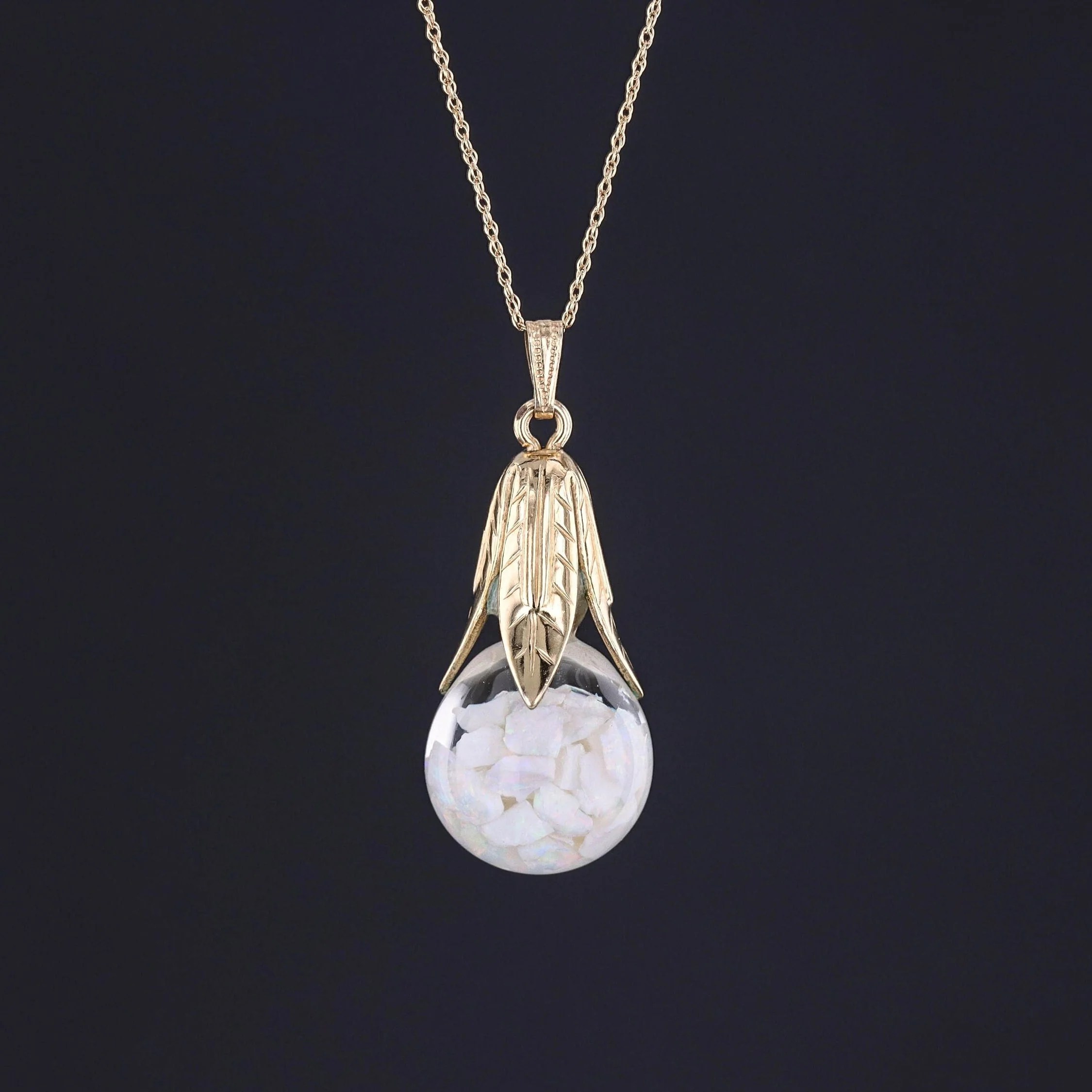
It turns out that this is a technique called floating opals. This method of suspending bits of opal in a glass orb filled with liquid. The idea for floating opals was created and patented by Horace Welch, a mechanical engineer, in 1920. From what I can find online this would be one of those early designs although others snatched up the technique after his death in the late 1940’s.
While the development of this may sound straightforward as a technique it was fraught with issues. Most notably, opals have a large percentage of water in them. This is in fact one of the things that contributes to their being quite fragile. (I once met a woman who sold fabulous high-end vintage jewelry and she told me never to wear my opals on an airplane, especially large ones. The altitude makes them crack. I worry about even shipping them by air now as a result.)
Just floating them in glass didn’t allow for their natural expansion and the sphere would crack. Ultimately Welch settled on the newly discovered Pyrex as his medium and a design where there is a space, hidden by the bezel, which allows for natural expansion and contraction. The “liquid” suspension appears to be confirmed as glycerin which also allows for the natural expansion and contraction of the tiny flecks of opals stones.
Mine has a patent mark (barely visible under a strong loupe) of 1931, the third of four patent marks on his jewelry. The site I found with much of this information gives tips for storing the pendant which I am grateful for (away from other pieces which could damage it), in an upright position if possible (have to think about that…) and of course away from temperature extremes. The chamber can be damaged it seems and air can get into it.
The pendant, which I have not done justice to here, is like a tiny snow globe (I love those too!), worn around my neck. It is infinitely cheering.
I will of course continue to look for boulder and now early floating opals. There is something else called a fire opal (bright orange!) and I have yet to find one that fits my collection. Opal lovers, more to come I hope.


 Pam's Pictorama