Christmas Greetings From All

20161210-00005-copy

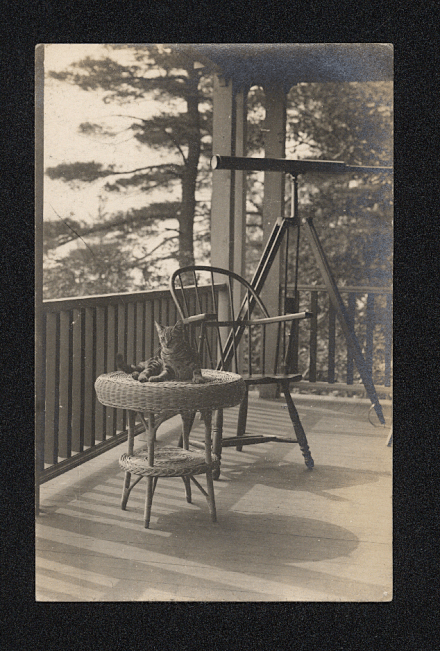
Pam’s Pictorama Photo Post: This photo caught my attention for a certain kind of crystal clear beauty and atmosphere. It is timeless and I was somewhat surprised to realize it was sent on Christmas Day, all the way back in 1909. The message, in a clear beautiful hand, reads, Christmas Greetings from all at “560 Beech.” It is not signed however and it is addressed to Mrs. Harry S. Additon, Dover, New Hampshire. It was sent from Manchester, New Hampshire (I believe, although the state is a bit hard to read where the stamp is canceled) and sent at 12M – midnight? Midday?

It looks like a lovely porch and we are ready to have a look out the telescope and curl up in the chair with a good book. No sign of winter either (there is snow out my New York City window as I write this mid-December) and the evergreens are no indicator as to the time of year. Of course, just because this was mailed on December 25 doesn’t mean it wasn’t taken earlier in the year, and we can’t be sure. Kitty seems very relaxed on his perch for winter in New Hampshire however. (And yes, in 1909 it appears you could mail something on December 25!)

There is nothing like a good porch for sitting on. My grandmother had a splendid one and it is probably the only porch I have had the pleasure of spending any real amount of time on. It was deep and shaded, and the heavy wooden chairs rocked. There was a small table had a red basket made of a thin woody material placed in the middle of it – perhaps with a pumpkin or holding some gourds in the fall. The arms of the chairs were big enough to hold a sweating, heavy glass of ice tea (for the adults) or sweet lemonade (mostly for the kids). There was a bird in the large, old, leafy trees which provided additional shade on a hot summer day, and an old tree stump that held a potted geranium. A whirligig too, but in all fairness I can’t remember if you could see him saw his wood from there or if he was around the other side of the house. That porch was a universe to small kids like me and my sister circa 1970 or so.

My grandmother’s house was on the corner lot of a fairly busy street in a small town, several towns over from where we lived. It was the house my mother grew up in, for the most part anyway, there  having been another when she was very little. (She showed us that house and a candy store had opened in it – fascinating!) My grandmother’s was a neighborhood that still had sidewalks, entirely residential and people did walk by and sometimes they would say hello, mostly not. The back porch was a place where my grandmother could see everything going on in her neighborhood and be seen. There was sometimes a wave from her neighbors, especially her friend Elaine on the opposite corner, across the street. She was a stout woman and she’d say how big we kids were getting. It was the kind of porch that made you more or less the unofficial mayor of your neighborhood, news central.

The porch in this photo is a more private one – shaded like my grandmother’s, but out in the country. This one is for communing with nature and contemplating it, watching birds at their business and spotting the occasional fox or badger, daydreaming. It is a country porch, not a suburban one. Both have their own charms. Funny how it has made me think of long ago summer and fall, but not Christmas and winter. Not yet!


Let the Toys Begin!

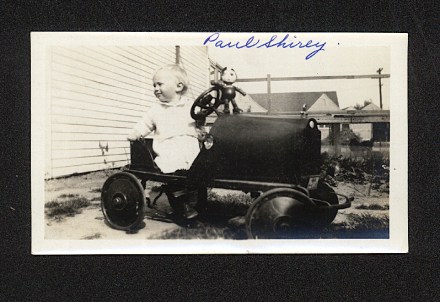
Pam’s Pictorama Toy Post: With Christmas rapidly approaching we at Pictorama are focused, as we so often are, on toys. Today is this splendid pedal car and nice, extra large, jointed Schoenhut Felix which appear to be the property of the toddler labeled Paul Shirley. There is no date and no writing on the photo, except the name near the top.

In some ways this is a timeless photo – or at least considering the toys within a certain period of time, between about 1925 and 1940’s. (Although the type of photo print places this firmly in the latter decade.) It is an extraordinary pedal car owned by Master Shirley. Built solidly like a tank, this toy car looks like it might weigh in at the poundage of a real car today. There is a vague farm vehicle utilitarian design about it. Felix is atop – helping to direct the operation no doubt. Despite the somewhat down at the heels nature of the yard shown, this is a pretty lucky kid toy-wise. One has to imagine that this was an expensive toy car – although I might also consider that it was home constructed. Is that possible? Quite a feat for someone if true, well beyond the average soap derby model.

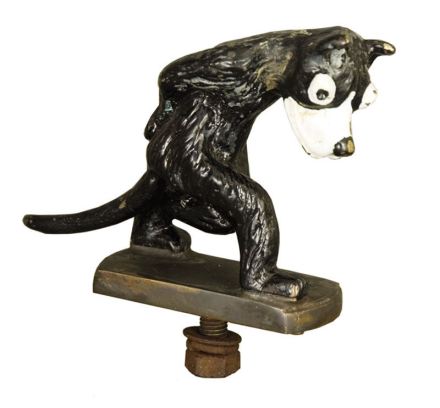
Was Felix a favorite toy I wonder – or did he end up perched there for other reasons? There is a motometer or hood ornament on this car – sadly it does not appear to be the Felix model – the Felix toy makes me think of it. I have included a very nice example here from a Hake’s sale below in case you are not familiar with this item – I have never had the chance to buy one with nice paint on it like this. I do dream of living in a time when cars were decorated with Felix however – talk about jolly!

image

Felix hood ornament, not in my collection


As children we all seem addicted to movement and locomotion at an early age. Funny that as tots we immediately want scooters, tricycles, bikes, roller skates, ice skates, sleds and toy cars. Why is that? Nothing like the sight of a bike under the Christmas tree or with a birthday bow to wind you up. We love the movement and speed – a taste of independence perhaps. You started dreaming of the adventures you’d have the moment you saw them. Paul actually seems a bit young and overwhelmed by his toy good fortune – or at least indifferent.

I have a vague memory of a bright red trike early on, but my purple and white two wheeler is the one I really remember. Never owned roller skates, they were not in fashion then I guess. I have very fond memory of sleds, first a wooden one with runners and later a metal one, a sort of flexible flyer, that especially pleased me. Sadly we lived near the ocean where snow did not accumulate and we rarely had very good sledding. We made up for it however with bodies of water that frequently froze for skating – a small pond near our house that froze easily, as well as two rivers that also occasionally froze for our ice skating pleasure. I hope Paul grew to love his toy car over time – not to mention his nice Felix toy – and remembered them both fondly.

Blackpool, Felix Cutout Continued

20161210-00001 copy.png

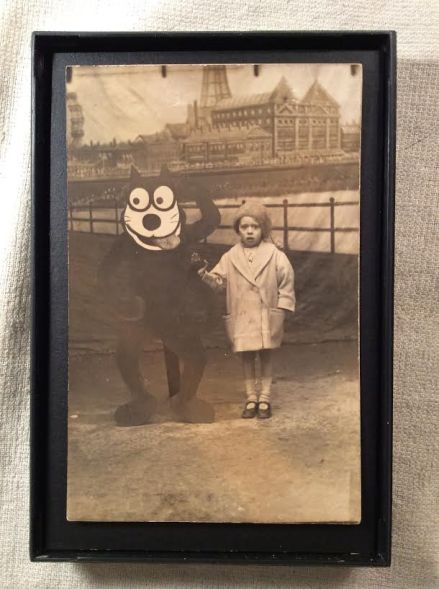
Posing with Felix at Blackpool, Pams-Pictorama.com


Pam’s Pictorama Photo Post:  Devoting ourselves further today to the ever-important work of discovering and discussing Felix the cat photos! This is the second in a three part series of photo postcards taken with a wooden, handmade Felix. When you think about it, despite having to find someone to draw and paint Felix freehand, it was a much smaller investment and less of a commitment than the life-size doll, took up less space in the studio too. Still, a general sense of jolliness prevails.

Here we have a card which is a recent acquisition of mine taken of these two roguish fellows having a holiday in Blackpool, England. (It was never sent and nothing written on the back, therefore I am taking the seller’s word for the fact it was taken in Blackpool.) There are fewer of these photo postcards where Felix is merely a board cut-out to be posed with – or were fewer saved for me to find? While they may not offer the glory of the larger than life-size stuffed Felix at the seaside, someone was still having a mighty fine time posing with him while on holiday. I scooped this one up on eBay, what appeared to be minutes after it having been posted in England as a buy it now. Didn’t even have to wait for an auction. It was waiting for me.

Without any real firsthand knowledge, it appears that Blackpool is a holiday spot which may be a working class, distinctly family oriented holiday locale. A quick look online shows Blackpool on the seashore and sites that rent houses and RV’s and continues as a resort today. Despite their suits, these fellows look less prosperous and less devil may care than last week’s subject in Felix Photo, the Cut-outs, Part 1, and the painted background is also less evocative and interesting. This Felix offers his arm, just like that one, however these guys aren’t having any of that. Unlike that Felix in his happy dancing pose, this one is a bit lascivious. (What’s with the tongue Felix? Can we really imagine small children posing with him?) In fact, these gentleman stand behind Felix as if they are friends of his, taking him home after a long night at the pub, before he can really get himself in trouble. However, here these gentlemen are, in suit and tie – handkerchief and hat for one – posing for the camera; their holiday visit recorded for us to consider, barreling on toward a century later.

In closing, just for the heck of it, I am including a link to a 1920 Felix cartoon, The Circus to help put you in the high mystic mood. It has lots of mice and one of them even does the Felix dance!

Felix Photo, the Cut-outs, Part 1

unnamed

Photo postcard from the Pictorama Collection


Pam’s Pictorama Photo Post: I am writing this in anticipation of receiving a similar card I just purchased, another of folks with a Felix cut-out prop. I consider these Felix cut-out cards a sub-genre of the photo postcards posing with the stuffed Felix which I collect- admittedly with some passion! I originally thought them lesser, but I have developed an affection for these, each Felix painted freehand and obviously off-model by whoever they were able to hire for the job – some better, some less skillful – and I decided an examination of them might be fun. I have owned this one for a long time – it sits cheerfully on the wall near the kitchen with many of the other Felix postcards. The stage set in this one has a nice background too. I wonder if it was only used for Felix or if it had multiple uses – Mickey perhaps?

This Felix is in the happy dancing pose (in the very early cartoons he would dance around in a circle when especially pleased with himself) an attempt which was nicely ambitious on the part of the creator. The face could be a bit more Felix-y, and this version looks like he could lose a few pounds in the tummy too. I never thought of Felix a tubby guy. Still, the spirit of the cat is there!

The posing fellow in question is looking fashionably casual in his white ducks and blazer – I think I detect argyle socks – open collar shirt. I suspect that linking his arm through Felix’s wasn’t his own idea, but that of the photographer. The background makes us think he and Felix are on embarking on a sea voyage – I get the feeling that this was likely taken at a seaside resort in Britain or Australia, but is unidentified. We don’t know if it was the fellow in the photo, but someone thought enough of this photo to keep it for almost 100 years.

The link here, Felix Saves the Day, is for an early Felix cartoon, one mixed with a lot of live action. At the very end you can catch his happy dance which inspired this pose.

Kitten Class

Pam’s Pictorama: Okay, admittedly, I have proven that I have a soft spot for this kind of advertising cards. I recently wrote about advertising from another thread company, J&P Coats, in my post By a Thread. (This company, Clark’s Mile-End Spool Cotton predates J&P Coats by a bit.) That one examined the early thread industry a bit, as well as bemoaning the lack of notion stores today. The card featured in that post featured a cheeky bunch of kits teasing an angry dog, held by thread.

This card takes the Louis Wain-esque approach to advertising with these rambunctious kittens being taught a somewhat mysterious lesson in rats and threads – which the kittens seem to enjoy. (I like the way the trousers were drawn to allow for fluffy cat tails to hang out.) These fellows, and they are all boy kitties, are ready to go after those rats! Are they going to use thread to do it? The rats jumped over the thread on the moon and the little dog laughed? I’m not sure. If it did have a meaning it is lost on me – love the image though.

Evidently from the heyday of Victorian trade cards, this card would actually predate Wain’s success (his first drawings were published in 1886), or at best overlap with his first years of publication – therefore perhaps it is this tradition he came out of rather than the other way around and someone riffing on him. Cats having long provided fodder for the trade card business. By way of reminder and comparison, I stole this great Wain image below off the internet – I have not entered into the high flying world of Louis Wain cards – yet!

man_postcard1_front

Louis Wain Postcard, not in my collection


Wild Bill

Pam’s Pictorama Photo Post: These came as a bundle buy on eBay and I gather they had been kept together over the years. The only objection I have to this otherwise great photo is that it is overexposed, which interferes with my ability to study some of the wonderful images a bit closer which I are itching to do. Empress is a common name for a theater (which seems a bit odd if you think about it; I mean, why?) and from a quick search I was not able to locate one with an entrance that matched this so I do not know where it was or is. I only know that this is the Empress Theatre because of a holiday card which was also included in the sale. Hearty Xmas Greetings and Good Wishes – The management of the ‘Empress Theatre’ wishes it’s ever increasing circle of patrons and friends a Merry Christmas and A Happy New Year. Unfortunately no address, nor is a year, is indicated; there is nothing on the back as this one was never mailed.

Clearly this theater was very excited about showing the William S. Hart film, Wild Bill Hickok because in addition to the poster with the lobby cards surrounding there is even an extra lobby card hanging in back – and somehow this postcard of him, below, has remained with this photo as well. William S. Hart, who rates near the very top of my list for silent film stars in Westerns, could be shown to better advantage than he is in this photo. He was a good looking guy, but could easily look like he is all nose and oddly proportioned if caught at the wrong angle.

20161120-00004-copy-copy

I wasn’t a big fan of Westerns when I met Kim. I had seen one or two in passing, She Wore a Yellow Ribbon and that sort of thing, but despite an interest in early and silent film, did not count a Western among them. Kim quickly took care of that and Westerns of all sorts were daily fare pretty much from the first day we settled into life together. It took me a little while to warm up to them, but eventually the beautiful photography began to intrigue me and soon I too was a fan, especially of the early silents. I love the chance to see long vistas of untouched, wild looking countryside, horses running through them. William S. Hart was one of first I took to and I remember a glorious festival over several days devoted to him at the Museum of the Moving Image where I got a crash course under my belt over a few days. (Kim and I caught up with a few newly restored ones at the Museum of Modern Art a few months ago – they do turn up.) Below is a superior still from the film, Wild Bill Hickok (found at True West Magazine) and a nifty description of everyone in the photo. (Kim brought this one to my attention.)

jack-gardner_bert-lindley_william-s-hart_hickok_

Bert Lindley as Wyatt Earp in 1923’s Wild Bill Hickok.
The studio caption reads: “The Dodge City Peace Commission meets the pompous buffalo hide buyers, the silk hat brigade, from Boston.” William S. Hart as Hickok, Jack Gardner as Masterson and Bert Lindley as Earp make up the commission, with unknown actors in the group playing Doc Holliday, Bill Tilghman, Luke Short and Charlie Bassett.

Of course, to my great joy an unidentified Felix cartoon is also playing at this theater and that is what led me to this photo in the first place. It may just be too overexposed to see the title, but I guess not. I think this was their generic Felix poster they put out whenever Felix was the cartoon that day or week.The theater team is a dapper looking group – from the woman with carefully done hair, to the bow-tie wearing gentleman, the older solid citizen who I am going to assume was the manager, and the young squirt with hair combed and a tie as well. That’s today’s tribute to festive theater going in an age past – W.S. Hart films, neatly dressed theater proprietor’s having their photo in front of their glorious entrance, and a holiday card sent to thank their patrons. Although Wild Bill Hickok is out there for viewing, it is not available online. I leave you instead with a jolly early Felix, also from 1923, which may have been shown that day – and no less, look for the cameo by our cowboy in Felix the Cat in Hollywood.


Feathers, the Fat Cat

20161120-00002-copy-copy

Pam’s Pictorama Photo Post: As you can see Feathers is a robust fellow and at 40 pounds an extraordinarily large one. Unlike most fat cats, Feathers seems to wear his weight handsomely and is well proportioned. I have a soft spot (so to speak) for cats with spotty noses and this further endears this guy to me. Interesting, an idle online search on Feathers turned up a fellow blogger (Another Enormous Cat with a Postcard of His Own) who owns this card, but with the added bonus that the writing on the back reveals that the people had actually visited Feathers, then 19 and up to 46 lbs. Go Feathers! Sadly, my card is postally unused without a great tale.

It is impressive that Feathers not only worked his girth up to more than 40 pounds, but also lived to a ripe old age. While my cat Zippy made it to 20 – with diabetes and other issues, and my mother has had several cats live into their 20’s – one would think that the size of the cat would have shortened his lifespan. (I can’t imagine the lecture one would get from a vet today.) Somehow Feathers managed to figure out how to have his cake and eat it too! One wonders if he was already rotund as a kitten as we will assume he was given his moniker of Feathers at a young age.

Longevity among cats seems to be on the rise and it now seems unusual if a cat doesn’t live into its late teens at least. Kim has pointed out that cat life was cheaper when he was young and that it is amazing how much longer they are living in these days of premium cat foods and vet visits. Cookie and Blackie are on what he calls the 20 year plan which includes a rather precise diet as prescribed by our vet who insisted that these kits take a few pounds off. (We are not even allow to speak the words cat treats to these kits.) Cookie in particular curses that day (and the vet) and she is clearly of the opinion that she would rather live well than long, but she does not really get a say in the matter.

I did search, but could not find articles relating to Feathers and his Colorado Springs family, Mr. and Mrs. James George; although clearly, given the evidence of the professional postcard and the family from another state having visited, word about Feathers must have spread via some form of media at the time. However, Feathers is not forgotten and we celebrate his evident long life as well as his place in the pantheon of cats as a very portly puss.


“Will write a letter soon…Mother”

20161120-00005-copy-copy

Pam’s Pictorama Photo Post: Sometimes I wonder about photos like this – in person it appears to be a homemade photo postcard, although the image did strike me as potentially professional. The bow on the cat, the reflection below – but then again, it is so poorly printed, over exposed and under-developed (Kim has actually given it a bit of a lift in Photoshop and darkened it some). There is the sense that it was some sort of pre-made card with the image supplied by the individual. What a fine looking fellow (or girl?) this is! Such a nice bow and well-defined stripes – if you look carefully you will note an extra toe on the left paw. I have written before about my polydactyl cat, Winkie, (blog post Tom the Bruiser and Good Doggie) and I have long held the view that they are special indeed. (You may remember I mentioned that Winks actually taught herself to use the toilet – my mother woke me up one night to show me and to make sure she wasn’t imagining it.)

For me it is always surprising when someone uses a photo postcard like this and does not refer to the image. You know, “Here’s Kit and we miss you…” sort of thing. Strange. I guess it went without saying that this was Kitty. Did a pile of these sit on her desk? Was it the only one? Instead she has written (sans punctuation), We are all well will write a letter soon hope you are well and having as good weather as we are Mother. It was mailed from Newport on December 18, 1905 at 9:30 AM and received in Louisville, KY on December 20 at an AM time I cannot read. It was addressed to Mr. J. Herbert Shaw, 2510 First Street, Louisville, Kentucky. (Today Google earth shows that as an extraordinarily anonymous brick building, although on a leafy street. I will spare you the image however.)

This postcard lived in a time of US residential mail delivery twice a day – businesses four times. (In Victorian England mail delivery peaked at 12 times a day! Not a wonder that so many postcards come from Britain.) The second residential mail delivery was dropped in 1950. While email today has taken a huge bite out of mail – certainly postcards are an anachronism let alone letters and occasionally those cards I send do take a week to travel from New York to New Jersey – the chattiness of early letters and postcards has returned with email. The snippets of news that my mom and I pass back and forth with our, mostly evening, emails reminds me a bit of these newsy missives. More immediate and without the middle man delivering – but sometimes even with photos of Cookie and Blackie, the grandkits!

Snowy


unnamed

My Snowy at home


Pam’s Pictorama Toy Post: I am, frankly, a bit weak on the Tintin comics in general. I believe Tintin in Tibet might be the only one I have read – and as a traveler to Tibet I enjoyed it greatly. It hit as many of the highlights of Tibet travel as I could have hoped from a comic book and then some. (The Dalai Lama even liked it enough to present it with the Light of Truth award.) In addition, I almost never buy new toys, so it is a bit surprising that while traveling at a mad pace through the South of France on business recently I stopped dead in my tracks over a stuffed Snowy in the window of a store. However, my responsibilities of the moment did not allow for me to break off long enough to go in and investigate, but this is where living in the internet age is a great benefit. I tucked this image into my mind and upon my return home I found him online and Kim, being the very best husband in the world, purchased him for me as an anniversary gift. Snowy took his own good time getting here however and I present him to you now. Don’t you agree that he was worth the trouble?

the_adventures_of_tintin_-_20_-_tintin_in_tibet

Seems that Snowy was on the scene from the first, appearing in Tintin in the Land of the Soviets in January 1921. He was a wry, wise-cracking sidekick with his own balloons of chatter for many years, evidently he gets demoted later in the strip and then only Tintin can read his thoughts. I read that he was inspired by a Fox Terrier at a cafe Hergé frequented, and named (Milou in the French) for his first girlfriend – despite the fact that Snowy is a boy dog and the translation – if that – is a bit mystical. Snowy, although an utterly dependable companion was, like most dogs has an extreme weakness for bones. (Who doesn’t have their Achilles heel?) In addition, I understand that he suffers from arachnophobia – I would prefer my dog (and cat) defend me against multi-legged intruders, but again, no one is perfect and if a dog constantly rescued me from all sorts of peril, saved my life and defended us against enemies many times his size, I could be forgiving on these points. I read that Snowy was known to frequently have a good snort and really tie one on too.

Somehow this toy seems to have the unusual characteristic of really embodying the drawing it is from. I find that is rarely the case – when it comes to Felix I enjoy the wildly off-model nature of the early British ones – but with many toys derived from comics I find it just annoying, especially in contemporary toys. Things are called Krazy Kat that bear no resemblance to even the film version of the character. There is a general disregard for the design of characters – so to find one that has the right spirit and appears to be well made alerted my radar.

Westerns have brought Tintin to Tibet in a big way and his image graces everything from bars to t-shirts, existing in high contrast to things like the Potala. (Until recently Kim was wearing one of these machine embroidered t-shirts with Tintin and Snowy, drawn somewhat free hand, that I brought back years ago.) It goes almost without saying that your average Tibetan has absolutely no idea who or what Tintin is (let alone Snowy), and I have wondered what they make of this persistent symbol of the West, lurking from far beyond their mountain home.

potala-full-view

Potala Palace, Lhasa

Grace Harlowe, the Automobile Girls and the Moving Picture Girls Novels

harlowe1a


Pam’s Pictorama Post: So I am going to go way off my usual course and take a moment to discuss some early 20th Century series books I have been reading over recent months. Thanks to Project Gutenberg and the availability of some of these books online, I have been able to read many more of these than I ever would have been able (or could have afforded) to do otherwise. I started some of this reading with the Honey Bunch books, but was buying the books which was becoming expensive and taking up considerable room. (I wrote about those in May in my post Honey Bunch.)

I began my online reading adventure with the Grace Harlowe books, first the four volumes covering her high school years and then another five taking place when she and her friends head to college. I have been unable to locate the six books that take Grace to Europe during WWI or the ten devoted to adventures out west, although I would love to at least sample them. The volumes I read were all written by a single author, Josephine Chase, under the name Jessie Graham Flower. (I believe some of the later ones were written by others.) Out of the three series I am talking about today, the adventures of Grace Harlowe were the best written. (I would happily scoop up the remaining books if I could find them.)  Grace and other characters are well define – Grace is sort of a girl’s Frank Merriwell. She is generous, smart and, even when it is at great personal cost, always does the right thing; she is noble. As a result, even those who start out hating her ultimately become her ardent defenders.

These books commence in 1910 and the last of Grace’s pre-war stories is published in 1917. This means it was written in ’16 and while war was on the horizon for the United States, we weren’t in it until April of ’17. Grace Harlowe is very much a young woman of her time, striving toward being a modern woman. However, they are careful with the character, and the most strident ideas – women voting, driving – are expressed through one of her close friends. In that way, Grace can remain a model for everyone. (Grace likes to run and that raises eyebrows – even riding a bike was still strange and questionable for women, as was attending college.) It is an interesting and sobering reminder that the move toward greater freedom and independence for women was not at all a straight line forward. Women were unsure of this path.

A bit more slapdash, but very charming nonetheless, are the six Automobile Girls books published between 1910 and 1913. Written under the name Laura Dent Crane and published by the Henry Altemus Company. I am very glad these have not been lost to the sands of time. Plucky, poor sisters Barbara and Mollie Thurston become friends with the wealthy Ruth Stuart who owns the fabulous motorcar christened Mr. Bubble. The sisters are fatherless and Ruth without a mother, but Ruth has an Aunt Sallie who chaperones the driving adventures. Ruth driving and the girls alone, even with Aunt Sallie in tow, draw considerable consternation throughout these stories. The tension between being a nice girl, but independent and becoming freer, is evident here too. Unlike Grace Harlowe, Ruth Stuart, while generous, very lovable and smart, does not need to embody propriety too – Babs Thurston balances her out somewhat – supplying some of the grit and simpler qualities and values of the time. (I found a postcard which, in a bizarre way, almost illustrates these books and can be found at Buster.)

imgres.jpg

Pushing forward a tiny bit is the Moving Picture Girls series of seven books published between 1914 and 1916 by the Stratemeyer Syndicate under the name Laura Lee Hope – the famous pseudonym of the author of the Nancy Drew series. This series depicts the story of the DeVere family, father Hosmer and daughters Ruth and Alice, as they are drawn into the world of silent films in the making. The father, a stage actor, is initially forced into silent films due to a throat ailment (one that does not ever seem to clear during the course of the books) which leads to his daughters acting in them as well. There is a great deal of discussion about stage theater and vaudeville and movies – and the need to justify films as legitimate and those who make them not necessarily “improper” is ongoing.

This series – presumably written by numerous people – is a bit more uneven and the characters have less definition. However, the enormous charm of this book is the contemporaneous descriptions of the making of early films which they take great pleasure in describing. The head of the troupe, Mr. Pertell, takes the Comet Film Company on all sorts of locations and, aside from the occasional non-film related mystery, there are film patents to be protected and even other companies trying to steal shots of the Comet players at work. While this is less pointed about women (there is a bit of a line drawn between these two ‘good’ girl daughters acting and the vaudeville actresses also in the troupe) and their emergence, these cover the changing world as represented by film in its infancy here. It was a time when a couple of hundred dollars and some pluck and you too could set up in the film business.

3551.2L.jpg

As we now know from history, 1917 comes and WWI changes everything, and the sort of wonderful emerging world of the infant 20th century is quickly shaken with massive changes and the world charges forward. For me these books are a portrait of that very vibrant incubation period before the war and especially revealing to see women finding their sea legs in a bold new world.