Spooning with Felix

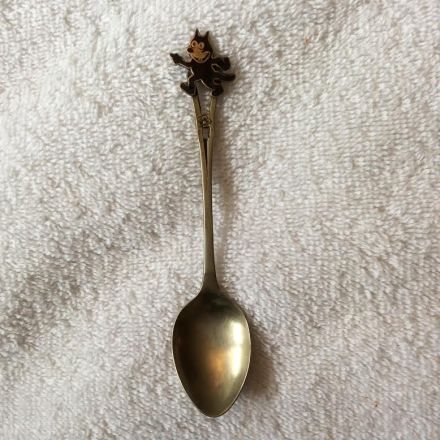
Pam’s Pictorama: I have been giving these Felix spoons the sideways look on eBay for years now. Suddenly there was this one and no one was bidding on it and the next thing I know…I  own it! I am surprised to find that there is very little information available about the maker, or anything much at all about it at all. It is marked nickel silver, but no maker that I can see, and the smiling, dashing Felix is silver and black enamel. Someone selling one on a website claims that these spoons were made by Charles Horner of Halifax who was an Art Deco designer of jewelry. At first glance Mr. Horner seems a bit higher end than our friend Felix appears. Still, he seems to have produced a broad line of products so perhaps it is possible. It is a nicely made spoon. Like I said in my post, Living the Felix Life, when my ship comes in I plan to use Felix china for our everyday dishes and now I will make sure all the spoons are Felix as well!

When I informed Kim I had purchased the Felix spoon and showed it to him, he told me of his memory of owning an Ollie spoon as a child – part of a Kukla Fran and Ollie set of ice cream spoons with distinctly designed squared off shovel-like bowls at the end. Of course I immediately went to eBay and found a Kukla spoon – no Ollie spoon, except for one that had been made into a ring. It did make an attractive, if somewhat bizarre, ring and I briefly considered buying it – but really, where could I wear it?

Spoons are a surprisingly affordable collectible. The excellent design on some was a bit of a revelation – I saw a rather remarkably well designed W.C. Fields spoon for example – and the actual existence of others being the revelation, such as the Charlie McCarthy spoon or the Dionne quintuplets.  I wouldn’t be the least bit surprised if there are some future spoon entries heading your way, dear reader, a future edition of Blame It on the Blog.
West Coast Kitties

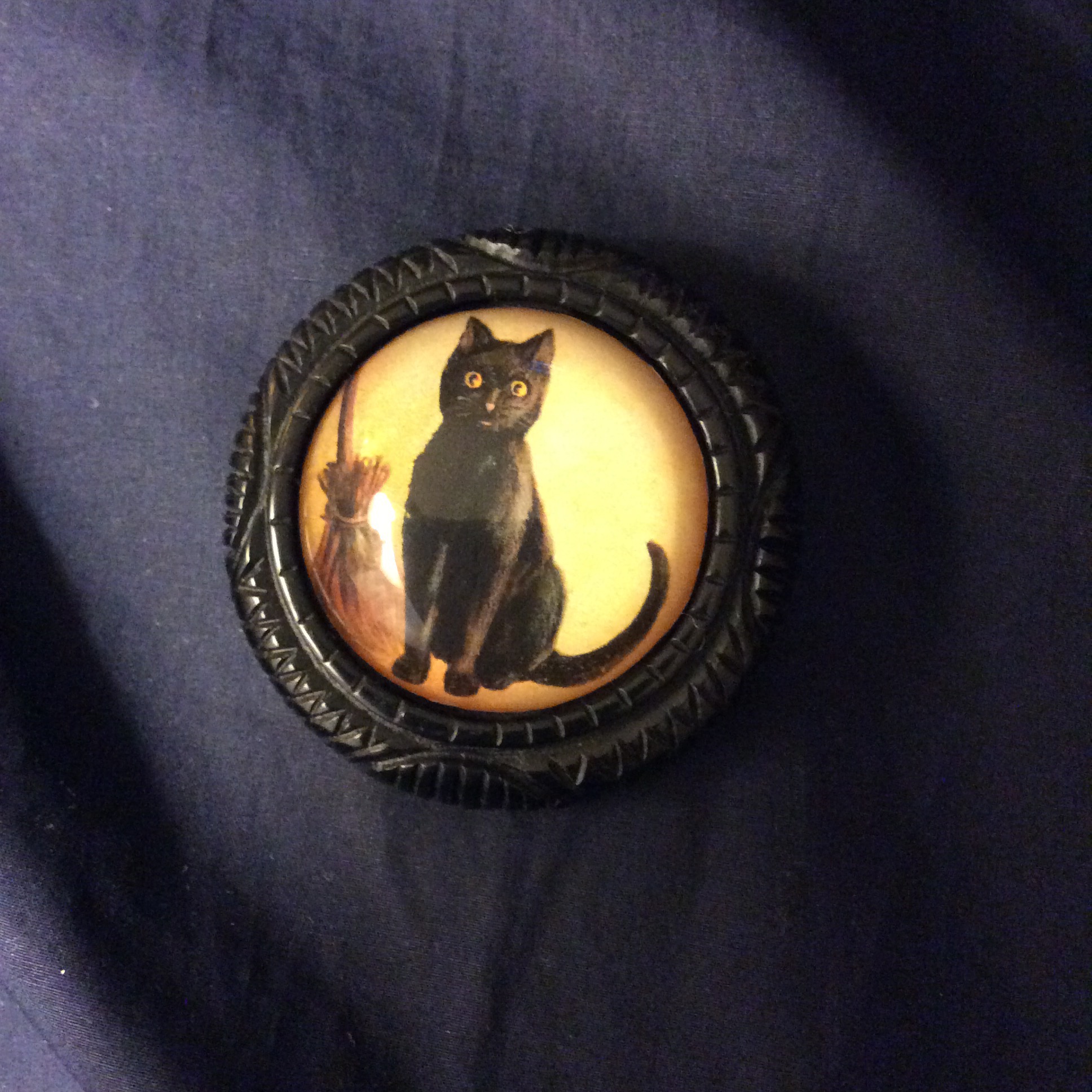
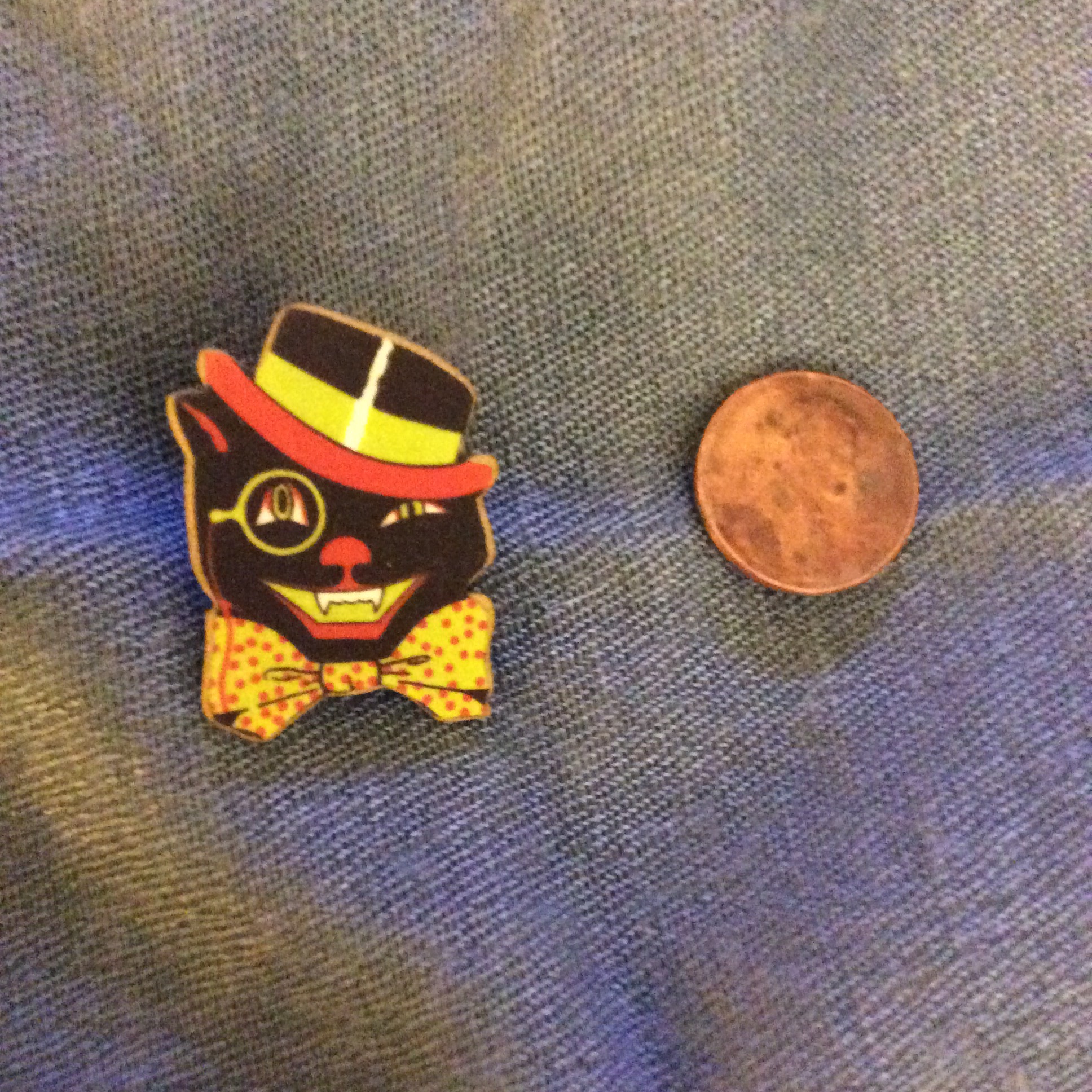
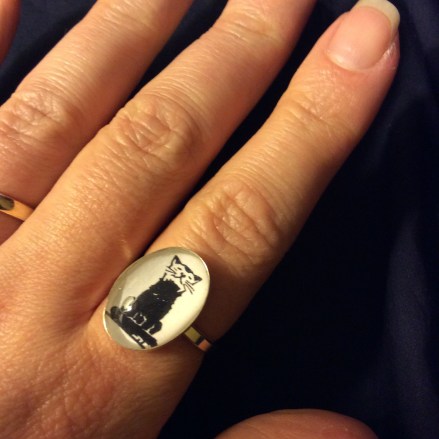
Pam’s Pictorama: Bonus post. Some of you may know that I am currently on the west coast traveling for business. Frankly, it hasn’t been an especially good trip so far, however I stumbled into a store yesterday and picked up this cheerful cache of cat gems which have helped rally me. The store is called Favor, on Sutter about a block from the Hotel Rex where I am staying. Cat folks take note.

Dinner with friends tonight – next leg Santa Barbara tomorrow!


East London Toy Factory, Ltd.

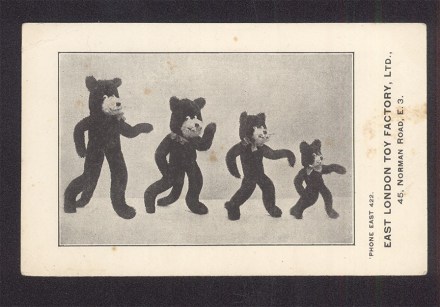
Pam’s Pictorama Photo Post: This parade of multiple off-model Felix fellows advertises the East London Toy Factory at 45, Norman Road, E. 3. It is unused and undated. A quick look around and I found this out about the history of this factory on the site Grace’s Guide:

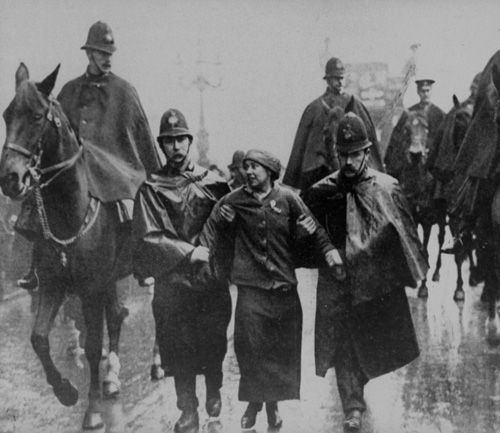
WWI. Sylvia Pankhurst opened a new toy factory as an answer to the dozens of tiny failing workshops where women were paid a pittance. Toys were no longer being imported from Germany, so Sylvia’s factory employed 59 women to fill the gap. It was a haven for them. First they turned out wooden toys and then dolls: black, white and yellow, followed by stuffed cats, dogs and bears. One day, Sylvia took a taxi full of her wares to Selfridges new store in Oxford Street and cajoled Gordon Selfridge himself to become a stockist. 

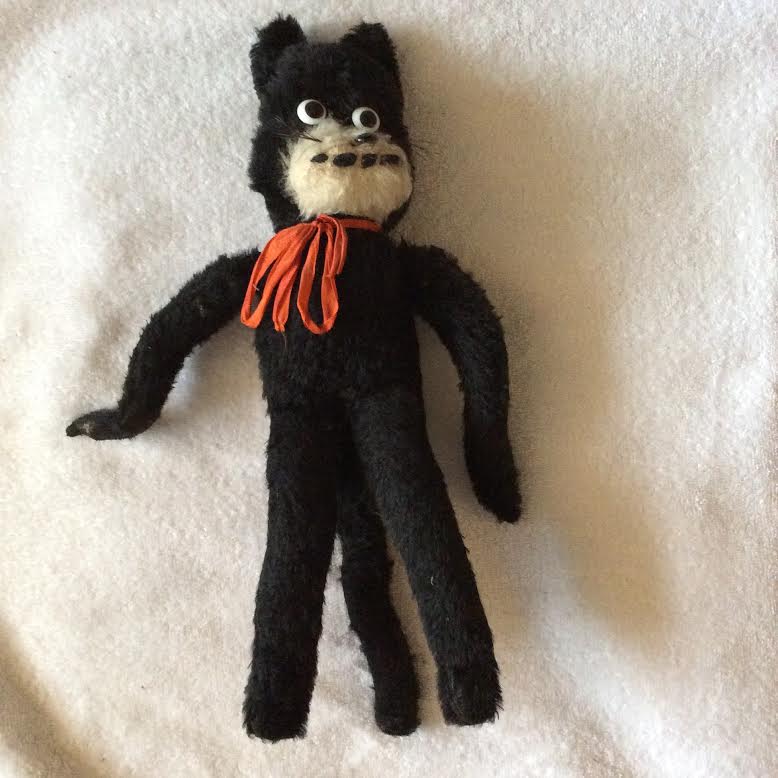
A further listing says that in 1922 East London Toy Factory was noted for exhibiting Soft Animals with Voice…and Riding Animals on Wheels. By 1947 they were listed with Animals with Electric Eyes. Hotsy totsy I say!  An undated ad on another site declares, East London Toy Factory, Ltd, high-class soft toys, artistic rag dolls, mascots, fancy toys and all kinds of novelties. Fancy toys and novelties indeed – let’s talk! I am not absolutely positive, but I think there is a very good chance that my Felix below is a East London Toy Factory fellow. As far as I can find out, they did not place a maker’s mark on them. The company was liquidated in 1952.

unnamed-19

Sylvia Pankhurst was a real pip. In addition to opening the East London Toy Factory, which as above, employed women and at a higher wage (not to mention supplying off-model Felix dolls to the masses) Sylvia Pankhurst was a suffragette, born of a family of reformers and left wing activists. She started life as a painter, illustrating the plight of poor women and families and then she became an activist and reformer with a vengeance. In addition to the toy factory, she opened food distribution centers, and a free clinic. Shown below, she is being arrested for protesting WW1.

sylvia_pankhurst_being_arrested_1

Subsequently, she moved to the countryside and lived with her Italian anarchist paramour where they opened a cafe and she wrote what one website calls subversive literature. (This seems to mean Communist.) She was against marriage and taking a man’s name and when she gave birth to a son when she was 45 – it is unclear if it was the child of the Italian lover of if she had moved on by then – her refusal to marry resulted in her mother never speaking to her again. (So much for being a liberal parent – I guess there were limits in 1927.) Later in life Pankhurst was a supporter of Ethiopian independence and moves there in 1956. Continuing in the same lifelong vein, she opens the first teaching hospital there and supports anti-imperialist causes. Sylvia Pankhurst dies in Ethiopia, where she is given a state funeral, in 1960 at the age of 78. Clearly I am not able to do her full justice here, but there are robust sites devoted to her that are well worth the read. Fascinating! I am very pleased that Felix took me down this particular road, and I offer it to you today as a slightly unusual Mother’s Day fare.

Cat Purse

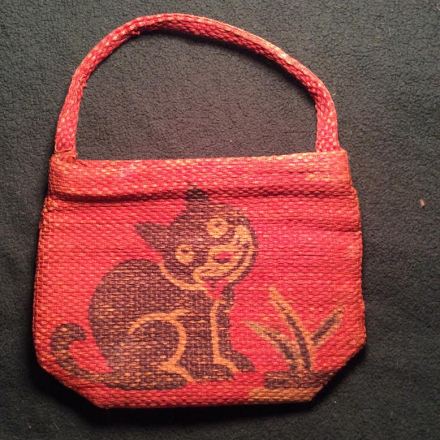
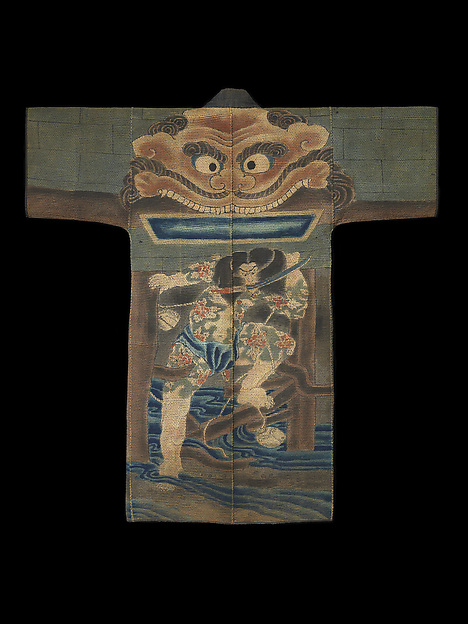
Pam’s Pictorama: This was very much an impulse buy on eBay a few months back. Perhaps because I had recently seen an exhibition of kimono at the Met with these fabulous fireman’s coats made with heavy woven fabric and this reminded me of them. (One is shown below – they had amazing designs on them. Images from this wonderful exhibition can still be found on the Met’s website at Kimono: A Modern History. Full disclosure for those who may not know – I work at the Met.) The cat image just made me laugh! It is the same image on both sides – the other side a bit faded.

Needless to say I would have loved this when I was a kid. I was trying to remember if I was especially enamored of a particular toy purse in childhood. There are a few vague memories that tug at the edges of my mind, but I don’t remember any special purses. I do remember that for a while I carried around a toy doctor’s bag. It was complete with fake pills (somehow I have trouble imagining that children today get fake pills in their doctor’s bags) and I am quite sure that the idea of being a doctor didn’t especially interest me, but carrying this case around did. I am not entirely sure what this says about me.

I also remember being pleased when it appeared that I had reached an age to carry a purse. Perhaps if you are a boy you have pockets in everything and therefore you don’t need a purse. However, it seemed very necessary to me – having a place to put the things I wanted to carry with me. In my twenties I graduated to very jolly vintage alligator bags that would sit on a table or bar like a proud little work of art. (Kim didn’t like them, felt bad for the alligators; I gave them up. He was right.) Shoulder injuries brought me to a world of lightweight bags recently – and last year’s foot surgery left me with a backpack in order to use a knee wheelie and then crutches – which I will need again in July, so I am hanging onto the backpack for now. Perhaps after I will find something a bit more interesting. Maybe I will just throw my phone and a credit card in this one!

Here is one of the fireman’s jackets from the Met’s exhibition, above:

From the exhibition,

From the exhibition, “Kimono: A Modern History” at the Metropolitan Museum of Art

Felix on an Outing

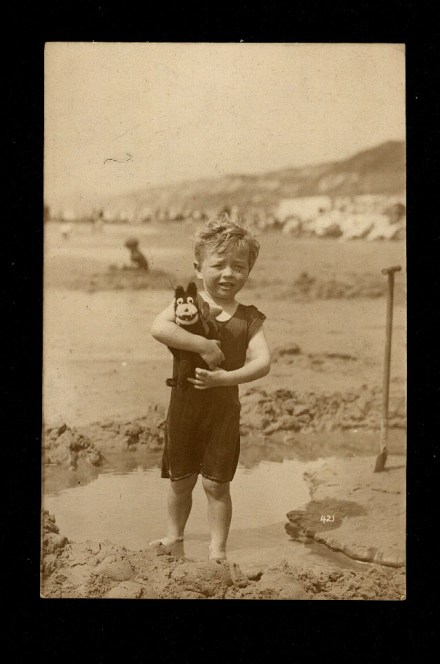
Pam’s Pictorama Photo Post: Those of you who are regular readers (or among Kim’s Facebook friends) will know of my ongoing passion for photos of Felix as a prop for beach photos. It is pretty much the cornerstone of my photo collecting, and makes up the bulk of my collection. This is one of two recent acquisitions in this area and I especially like it because the Felix toy does not appear to be a prop just for the photo. Instead this seems to be a much beloved toy, taking a trip to the beach with this little boy who is grasping him firmly in his arms. (Understandable – Felix does have a tendency to run off. See my recent post, Felix on a Leash for more on this. Felix joins another family photo in Felix Family Photo.) Written on the back, Dear All – hope you are all well  having a nice time weather glorious – Best love to all Ronie. (Could also be signed Rorrie.) Oddly, there is no stamp or postmark so if it was mailed it was in an envelope. Therefore, no date either. We’ll have to assume that Ronie/Rorrie expected that everyone knew the little nipper on the front of the card and did not comment on him, or Felix, in particular.

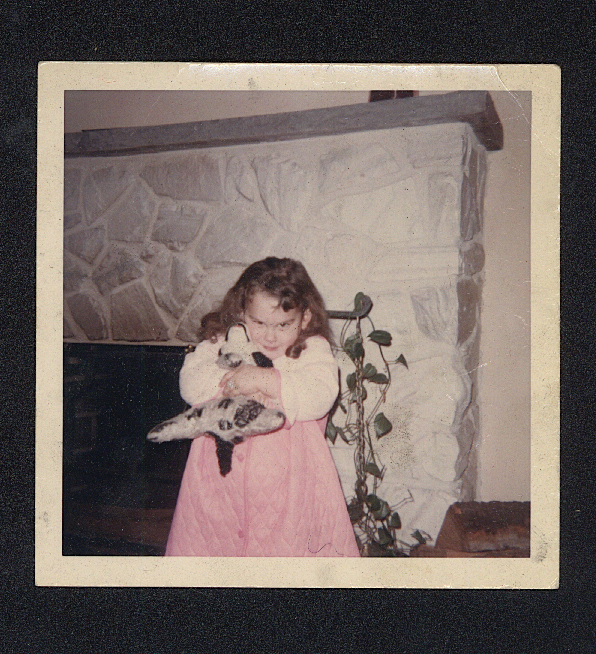
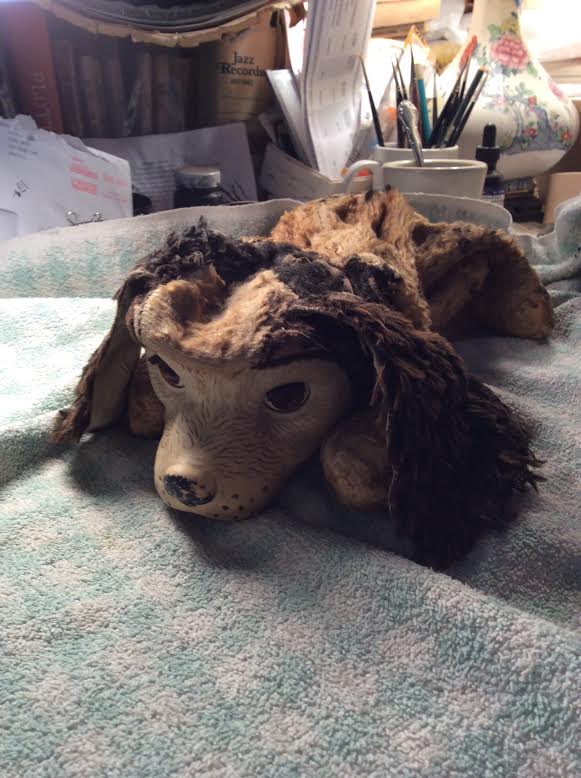
It is of some interest to me that our parents seem to mostly take photos of us with beloved toys when the toys are new. You rarely see a photo of a child holding some really ratty old toy that he or she has been dragging around with them forever. Yet, in some ways that torn-up, faded toy with the food stains, is the one that lives on in memory. Although I guess in our mind’s eye we still see them shining and new. I offer a photo here of me with my stuffed dog, Squeaky, when he was freshly new and immediately adored. And, of course, a photo of Squeaky today. He lives a careful life on a bookshelf now, He now longer squeaks, but his long-lashed brown eyes still open and close. Squeaky saw a lot of miles early in life and we are glad that he is enjoying his retirement here in the apartment with us.

Pam w: SqueakySqueaky in 2015

Smokin’ Cats!

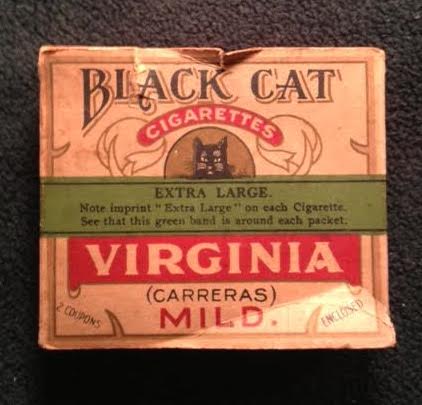
Black cat tobaccoblack cat cigs 3

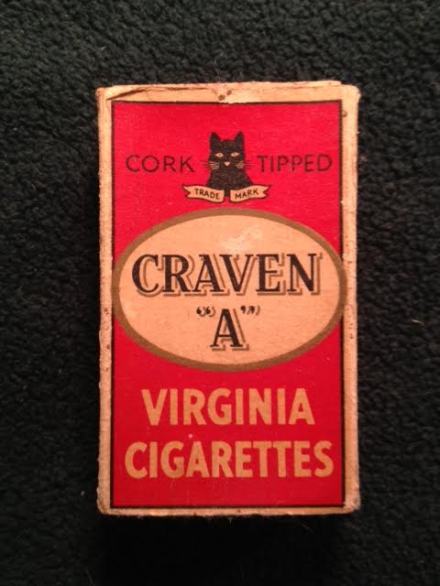
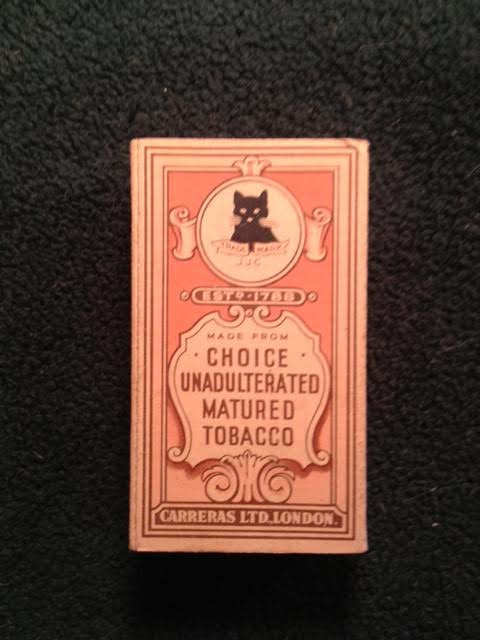
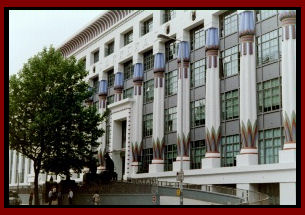
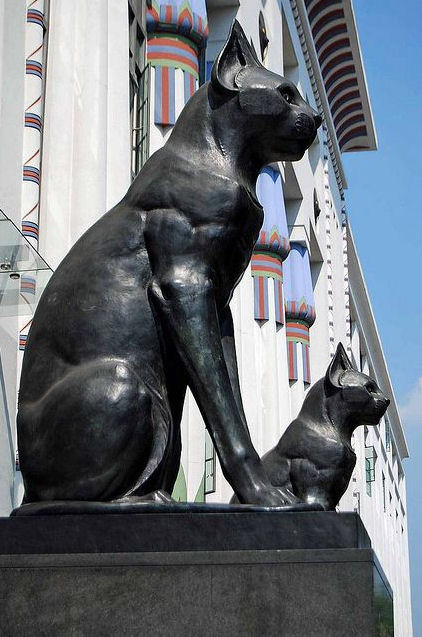
Pam’s Pictorama: My brief foray into advertising continues (see last week’s Time Out for Our Sponsor) with these examples of Black Cat tobacco and cigarettes. Considering that these proclaim the use of Virginia Tobacco it seemed surprising at first that I purchased all the examples at the same time at a flea market in London. However, it is an English company. See the wonderful art deco facade of the building below and a few sharp black cat details! All of these courtesy a website post devoted to the subject at: Black Cat Factory. I must make a pilgrimage there one day.

Art_Deco_BC_Restored_Fac Art_Deco_BC_Guardians Art_Deco_BC_Roundel

It has always seemed strange to me that while some folks think of black cats as unlucky (Blackie, it’s not true!!) they are frequently used in advertising. I am not sure I can exactly figure out the logic there – but I am always pleased to see it.

Time Out for Our Sponsor

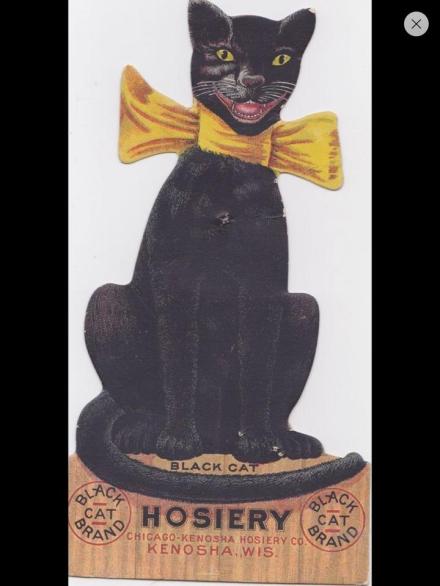
Pam’s Pictorama Post: We all know it – cats sell! Here are two classic examples. I fell hard for the Black Cat Hosiery cat early on in my collecting days. He’s popular and the large free-standing displays go for big money. This was an early acquisition for my collection and he sits framed on a wall over my desk at home. He has a stand tucked behind him that makes him free-standing as well. Sadly over time the company moved to just a black cat logo – nowhere near as compelling as this fine feline. Our cat Blackie bears an extraordinary resemblance to this fellow, despite have a white spot or two that would show in this pose. Blackie is among the few cats I have known who has a distinct smile. Perhaps because he is so black around his mouth you can see it clearly – when cats smile they show their fangs though. Some people may not think it is the friendliest of looks – but we know he means well.

Hoffmann's ad

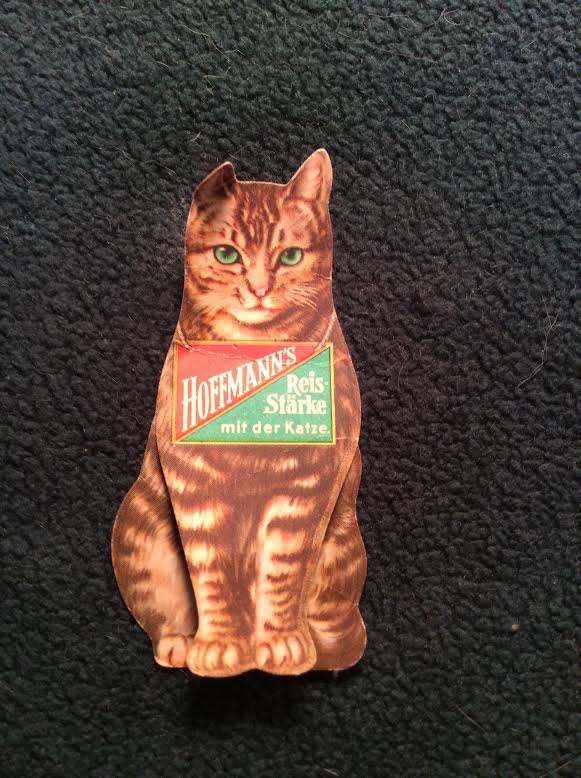
I have paired our hosiery friend with this serious German chap advertising, of all things, rice. It seems to translate as Hoffmann’s Rice, Starch with the cat. I gather starchy rice was viewed as a good thing under the circumstances – I wonder if there’s a word pun that translation isn’t sharing with us? As far as I can tell this rice company eventually morphed into one that still exists internationally today, but I am not entirely positive about that link. Meanwhile, this little piece of advertising is especially pleasing – as a result they are fairly ubiquitous it seems. People kept them. You can probably see that he too is meant to be freestanding by moving his feet forward. I bought this particular card at a flea market in Berlin around ’07 – they were inexpensive and plentiful there. He is a classic bit of advertising and it is easy to see why both of these were beloved and survive in large numbers even today.

Try a Skyrocket!

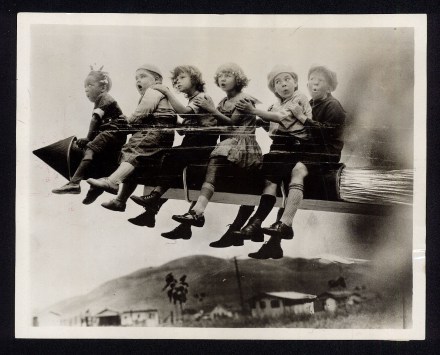
Pam’s Pictorama Photo Post:This was a surprising find – it is a press photo of the Our Gang kids. It is dated July 28, 1925 and says, The Cleveland News, Reference (something I can’t read) Cleveland, Ohio. Also written on the back it says, Don’t Hitch Your Wagon to a Star! Try a Skyrocket! Here are the diminutive Pathy comedians of Roach’s “Our Gang” celebrating the Fourth in their own fashion. Quite the fire crackers, yes? I have always thought that if I was going to have a still from Our Gang that I would want one of the crazy machines or cars in it and this is pretty dandy, even though it isn’t a still, but a photo made expressly for this purpose. I just wish they could have gotten Pete up there too! The photo is a collage montage of images and the “flames” shooting out the back and the lines indicating speed seem to have actually been scratched onto the negative. Very resourceful.

Like many people, I guess, some of my earliest television memories is a wonderful, never-ending unspooling of Our Gang and Little Rascal shorts on weekend afternoons. These films informed our childhoods and convinced us that we should have a neighborhood gang of kids and dogs, and be capable of building glorious fire engine go-carts, our own taxi cabs, other cars, and club houses – and sit around eating huge cream puff donuts the like of which you never see in real life. (Having said that, I actually finally had a cream puff donut of the kind I am describing the other day – it was on special at Le Pain Quotidien and I split it with a friend – absolutely glorious. I now understand why they were always longing for them in the shorts.) It was years before it occurred to me that those wonderful go-carts and club houses were built by talented adults with virtually endless resources – not a superior kind of extinct child from an earlier generation. It was probably good to have the bar set high however.

Although I watched them all with impunity, it was the earliest generation of them that I liked best. (However, I did not catch up with the silent ones until adulthood so I am thinking of the first generation of sound ones.) I loved this image when I saw it and it set me thinking about a short where they do indeed build a rocket and take off around the neighborhood. Surely there was one like that, wasn’t there?

Tom the Bruiser

Tom the Bruiser

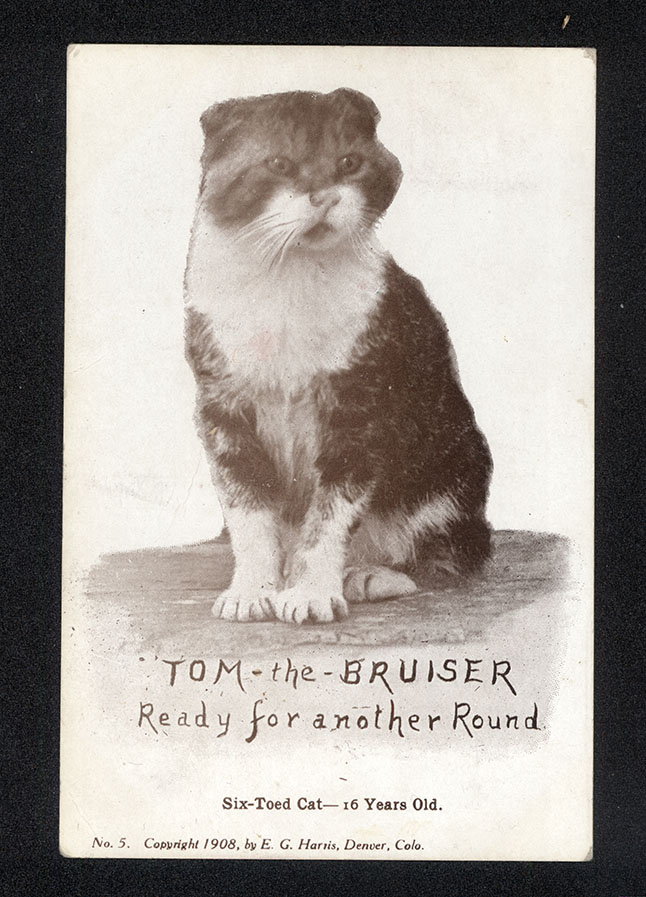
Pam’s Pictorama Photo Post: Tom is my kinda fella. What a guy! I have long harbored a passion for six-toed (polydactyl?) cats. A commercial card, the copyright information at the bottom reads, No. 5. Copyright 1908, by E. G. Harris, Denver, Colorado. E.G. Harris seems to have had a line of animal novelty cards, but I can’t find much information about them as a company. The back of the card reads, in a child’s handwriting, Dear Cousin Elsie, how are you. we are all well. why don’t you write. answer this card soon. from your loving cousin, Ollie Nitsch. It is addressed to Miss Elsie Pugler, Ellis Kansas. It is dated November 21, 5 PM. You can’t read the 1908, but Ollie dated it as well. Isn’t it interesting that people rarely seem to comment on the photo on the card they send?

Tom clearly spent his sixteen years living hard, and either lost those ears fighting, or was perhaps also a short-ear to begin with. Those six-toed feet look like little boxing gloves on him. Hemingway was famously said to be partial to extra-toed cats, having been given one by a ship’s captain. Evidently polydactyls were prized for ship’s cats and considered good luck to have on board. One imagines that those extra toes might have made for superior mousing ability. When I was a kid I was told all the six-toed cats came from Boston and were descended from a single cat who arrived on board a ship.

One of my very best cat friends was a multi-toed cat – I believe she had seven, not six on each foot, but one was sort of small and hard to see. She had large thumbs and her front toes seemed oddly jointed and made her look like she was standing on tip toes. She was a calico and her name was Winkie. Winks, named by my brother who was very small at the time, was a wickedly smart cat and somehow those giant paws with thumbs made her appear like she was evolving into a new kind of superhuman cat. She had silky soft hair and was endlessly happy to be held and petted. Winkie discovered a stair she could sit on which would allow her to look out a door window and to the driveway when waiting for me to come home from a date; I would be greeted with a meow. She was a chatty cat. There are many stories about Winkie (she taught herself to use the toilet for one), but for now I will mention that she actually replaced an earlier multi-toed kitten who only lived a few days. My father had been filming a story with Roger Caras (famous reporter of all things animal) and brought the little guy home. Sadly he died in his sleep a few days later. When a friend of my mother’s heard that the kitten had died suddenly she sent us Winkie, fresh off a farm in South Jersey.

I have not had a cat with extra toes since Winkie, but remain convinced they are indeed special and I feel an extra sort of kinship with any and all I meet which is why I snatched up this card immediately.

Ann’s Glass

grandmother's glass

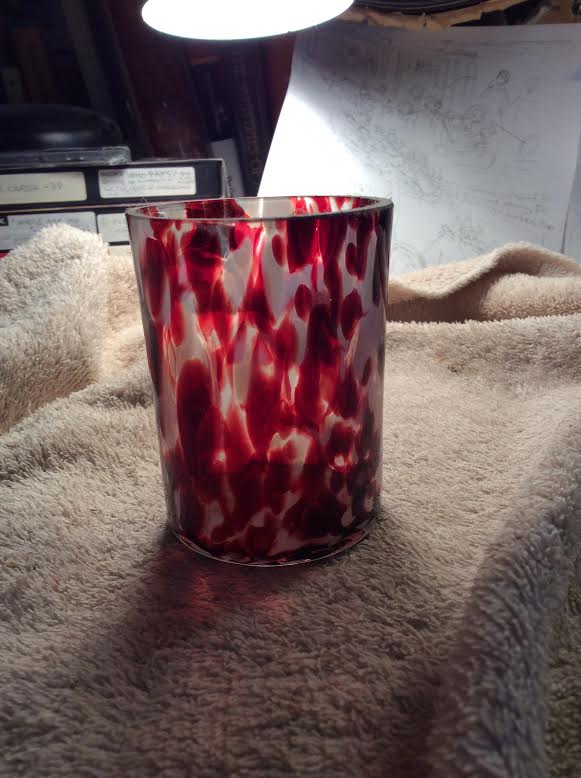
Pam’s Pictorama: This post has been on my mind since Easter when I first started thinking about it. The glass shown here is one of a few things I have that belonged to my maternal grandmother, Ann Wheeling. There are some dishes, a ring that served as her engagement ring (what was called a cocktail ring – set with a smattering of tiny diamonds – which I wear frequently on my little finger) and this glass. When my grandmother’s household was broken up as she was moving into a nursing home, my mother asked me what if anything I would like from the house. I immediately requested this glass. It had sat on a sunny windowsill in her kitchen over the sink forever. My mother laughed and said everyone in the family had said the same thing so I didn’t think much more about it. But somehow, to my surprise, it ended up with me.

As a child I was entranced by it. The red glass with the light coming through it, perched on the window sill – I would always stare at it while sitting in her kitchen for delicious meals, table groaning with food, while the grown-ups talked and talked. As a kid I was told that it was something called spatterware and was made with the ends of glass at the close of the day. (This appears to be true.) Growing up at the beach, I collected sea glass. (With recycling I understand that there isn’t much any more, probably for the best – but I did love to gather it as a kid.) The pretty pieces of green glass in a  myriad of different shades were wonderful. However, very rare pieces of blue and the almost non-existent red were highly prized amongst us. This glass always made me think of that. Dark red glass. I’m not sure that I ever held it until it was given to me. It is a bit heavier than expected and the lip of the glass isn’t rounded off – the edges are almost sharp. Unfortunately, I do not have a spot for it where the sun comes through it (think cats!) but it sits on a shelf near a window where I see it most days from our couch.

There is a lot to be said about my grandmother who was a woman with an excellent head for figures (did the books for the family bar from the time she was a teenager; see the post Living the Felix Life for the story of the dinner plates from her family) and perhaps more of it will be covered over time. However, I think of her at Easter because she made the most heavenly bread – always with extra loaves for the family to take, at Easter and Christmas. Easter brunch held for the extended family at her house was, among other things, marked by the bread. Some of the dough would be fried into sumptuous hand-size pizzas. Oh my! My sister Loren learned how to make a fair version of the bread – my own hands developed arthritis early on, making bread kneading impossible, so I did not. Sadly the recipe and skill died with my grandmother and then Loren’s untimely death. Although it has now been many years, Easter will always make me think of that bread as much as the vinegar smell of colored eggs and chocolate ones in cardboard baskets.