Billiken Button

s-l1600-1

Billiken button


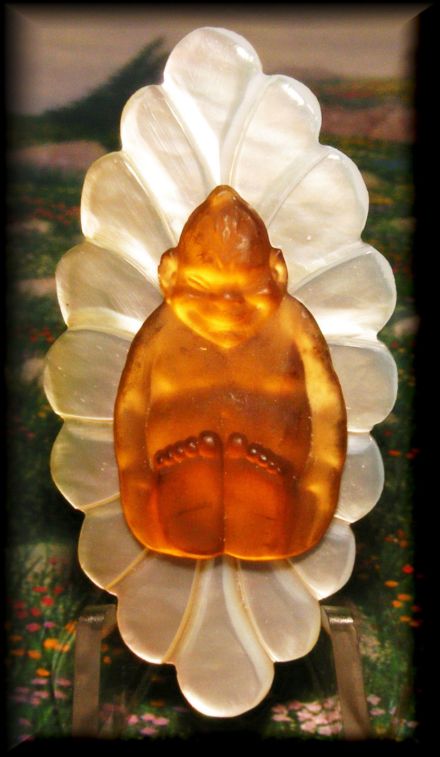
Pam’s Pictorama Post: Seems that with the gift of this Billiken button from my husband I am, as I always knew, a lucky girl indeed! The wonderous Mr. Deitch surprised me with this acquisition a couple of weeks ago while he was burrowing deep into Billiken lore on a Facebook post. For those of you who missed that, it appears to have been inspired by a Billiken image on a cigar box – Kim was having a good time with cigar box pics a few weeks ago. Seems that research turned up the origin of the Billiken as a pretty good story – the creator Florence Pretz, art teacher and illustrator, brought it into existence it after seeing it in a dream. She christened him (it?) Billiken based on a poem, Mr. Moon: Song of the Little People, the appropriate passage below:

O Mr. Moon,
We’re all here!
Honey-bug, Thistledrift,
White-imp, Weird,
Wryface, Billiken,
Quidunc, Queered;
We’re all here, 
And the cost is clear!
Moon, Mr. Moon,
When you comin’ down?


Ms. Pretz did obtain a patent on Billiken, but where she made her mistake would appear to be in selling it to what became the Billiken Company of Chicago, which ultimately managed to merchandise him into a crazy cash cow nothing short of an international mania – his likeness was borne by toys, figurines, tobacco products, at least one football team, several early 20th century minor league baseball teams, and of course and evidently, clothing buttons. Strangely asian and eskimo cultures seem to be especially susceptible to his charms.

The other especially compelling fact about Billikens are that they are said to be the god of things as they ought to be. That’s a pretty interesting idea and I can see how it could be a double-edged sword as I consider it. Nevertheless, it is said to be good luck to purchase one – and even better luck to be given one. (Thank you Kim! I can use all the luck I can get.)

I hardly have to remark on the pearlized wonderfulness of this item. It fairly glows. It is actually beyond even my imagination to consider what an item of clothing might have looked like with a fewof these sewn on. Wowza!
 

Getting a Grip on Kitty

Scan(2)

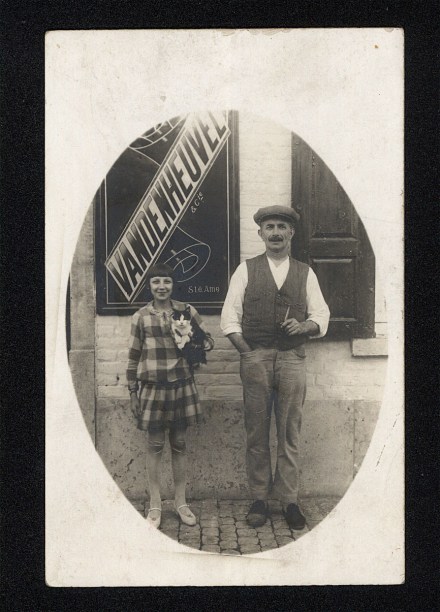
Pam’s Pictorama Photo Post: Just like something out of a Lilian Harvey film from 1930, this German photo of man, child and katze caught my eye recently. A bit of google search tells me that Vandenheuvel is a surname, although obviously also an advertisement here. It could perhaps, be the name of the man and girl. I like the little girl – she is at a gangly stage with her legs a bit out of proportion (tights bagging at the knees) to the rest of her, big smile and of course clutching her tuxedo cat; him, one ear cocked in vague irritation, tucked neatly under her arm. The man, smoking a pipe, with a smile more in his eyes than on his lips, looks like a nice man. While everything about them is a bit worn, there is a sense of ease if not actual prosperity about them.

A girl and her cat – a favorite theme of mine. While cats have been my friends and confidents since childhood they, like me and especially the childhood me, are also notoriously willful. It is very hard to get a cat to do something that wasn’t the cat’s own idea to begin with, as we all know. This includes getting them to sit still in a photo.

The way she is holding the cat is what my family refers to as cat prison. Obviously cat prison is a gotcha grip on a cat that guarantees the best result for holding onto said puss. The hold in the photo is one of the dependable ones and certainly one of the few that can be employed for photo taking – although in looking over some photos we’ve also been know to employ the method of flipping them over on their back like a baby. As a kid I used to carry our huge orange tabby Pumpkin around like the girl in the photo – which he allowed if not actually encouraged. (Pumpkin and I were close. He would have taken anyone else’s arm off.) My father coined the phrase cat prison – his preferred hold is on his lap with his two large hands holding the cat on his lap – nothing fancy for him. Usually employed in his case for brushing said kitty. It can be the only way to get a photo of some cats – but it is also the struggle of man against the determination of cat – a never ending battle.


Cat Tales, John Rosol

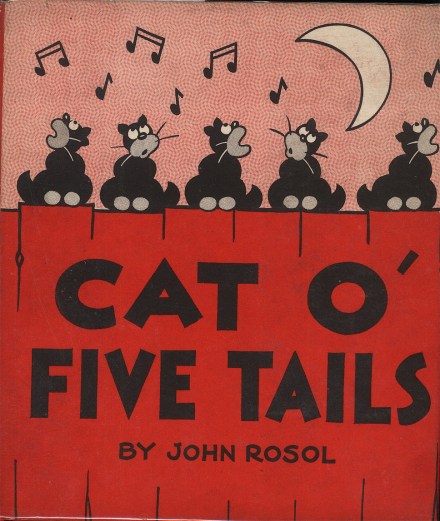
Pam’s Pictorama Post: This great little book was a thoughtful gift of our friends Tony and Sue Eastman who know of my love of all things black cat. An initial search of the author and artist, John Rosol, turned up surprisingly little. (I am very spoiled and have gotten used to information on even the most obscure topics turning up with ease, I admit.) To start with however, the comics in this book were all published in the Saturday Evening Post and all feature his cat, Tommy.

As per the dust cover, Tommy was a stray who strolled into Mr. Rosol’s Philadelphia studio and calmly seated himself on the drawing board. Rosol got Tommy’s idea immediately and went to work. In exchange for small steaks, liver, cream and catnip (no wonder he was a fat cat!) Tommy consented to stay for a while and be Caterer Rosol’s idea man…When he finally took his leave – destination unknown – he had trained Mr. Rosol so well that not even an expert can tell where Tommy left off and John began…P.S. Mr. Rosol hopes if this little books happens to come under the eye of Tommy, he will drop into the studio and turn off the light which is always burning for him. I, of course, teared up at the idea of the disappearance of Tommy. While my edition dates from 1944, the first printing appears to go back to 1934.

The cartoons are simple and cheerfully fun. The idea that he turned one cat into a consistent five identical twins brings certain very busy cats to mind. I have had several who had such a penchant for trouble that you would swear that there was more than one cat underfoot. (Cookie!)  The gags are mostly of the kind assigned to cats – attempts to obtain fish and milk and to chase mice for food. Most notably the Tommy quints are patriotic during these WWII years and even turn their fat cat noses up at crab meat when they realize it was shipped from Japan, abandon their mouse chase when reminded to embrace a “meatless day”, round up dogs for service, and even help a female soldier who is afraid of mice.

A fellow blogger over at Comics Kingdom has the scoop on Rosol’s two brief syndicated strips, The Boy and the Cat (1939-1941) and Here and There (1941). Comics Kingdom offers some samples of Here and There and the black cat/s are tucked into these as well. In the style of earlier comics these are large single panel tableaus, with a different strip (about the cat) running occasionally up one side. This entry, combined with his obit, add the following facts: Rosol was trained as a commercial artist at the Philadelphia Museum School of Art, which later became the Philadelphia College of Art. His full name was John Rolosowicz and he died at the age of 85, still living in Philadelphia. In addition to his comics which were syndicated to numerous papers across the country, and his work for the Saturday Evening Post, he also worked for Bazooka bubblegum. He published a children’s book The Cat’s Meow which I can find no evidence of online and evidently was working up until his death.

So I salute John Rosol, a cat loving cartoonist, barely saved from disappearing entirely from view by the internet and this popular volume.

Tweet, Tweet, Tweet

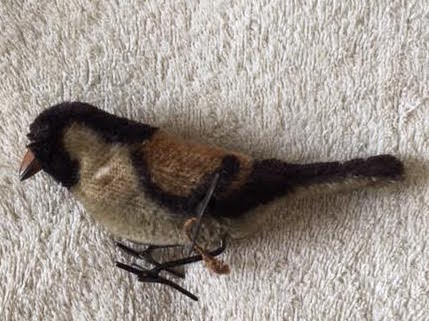
Pam’s Pictorama Toy Post: In past posts I have discussed how I have supplemented my cat collection with toy mice for their pleasure – Starting Small with Mice is a prime example. However, even toy cats need other diversions too and with that in mind, many years ago I purchased this lovely Schuco bird. I bought him at a flea market in London, a small item among a rather huge toy haul. Sometimes these get identified as Steiff, but I believe that the ones that wind up are Schuco and their real name is Pick Pick Bird – with the action making the name self-evident. According to Wikipedia production on them started in 1920’s and over 6 million were produced and sold through 1960’s. From what I can tell they do not vary substantially in design during that period. Therefore, should you decide you too need one it will not be difficult to obtain.

Heinrich Schuco was evidently a bit of a toy prodigy who began patenting toy designs when he was 17. It is unclear if the Pick Pick bird was already a staple of the company when he joined it or if it was one of his winning designs. The company remains in existence today.

So what is it about cat and bird? There’s nothing like the movement of a bird, or tweet, to snap a feline to attention. I watch videos with cats playing with birds and you can say what you want, but the cat always seems to have a bit of killer lust in its eyes even as it plays nice. Cats have generally been portrayed poorly in cartoons in the cat-bird relationship. I have always felt that there was something particularly mean spirited about the Sylvester and Tweetie cartoons. It isn’t that I am saying I want a cartoon where he catches and manages to eat the annoying little yellow bird (and keep him down – there seem to be many where Tweetie escapes Sylvester’s digestion of him and he pops back up), but it is sort of demeaning to cats.

Having said that I am certainly as unhappy as the next person to be confronted with the hunting prowess of my kitty in either bird or mouse form. Cookie and Blackie have virtually no opportunity to polish this bird skill (we are hopeful they don’t get a shot at mice either, although more likely in a NY apartment) we are glad to report. However, there was a morning, years ago now, when I was meditating very early and the window of the apartment was cracked open a few inches. (Our windows are never open because even with screens I don’t believe these two – and their predecessors – would not pop out the screen if sitting in the window and we live on the 16th floor.) Much to my amazement, a sparrow came and sat on the window sill and serenaded me. Mysteriously, both cats (probably Roscoe and Zippy at the time) slept through the event; it did not rouse them. Birds rarely visit us this high up – the occasional pigeon might fly off the roof, but we rarely see small birds parking themselves here. He sang, looking right at me with head cocked, for what seemed like several minutes, before flying off.

Below is a Pick Pick Bird video from Youtube – I think they called it a Peck Peck instead. I was trying to make my own video and I will report that yes, Blackie and Cookie came running to check out that bird toy!

Schuco Pick Pick Bird video.


Pins and Needles

Pam’s Pictorama: A discussion of somewhat disparate topics continues with this absolutely splendid item which was given to me the other day. I know this nice couple via the Met and had not seen them in quite a while. Evidently they remembered my passion for all things cats and put aside this wonderful little item for me, and I couldn’t be more pleased.

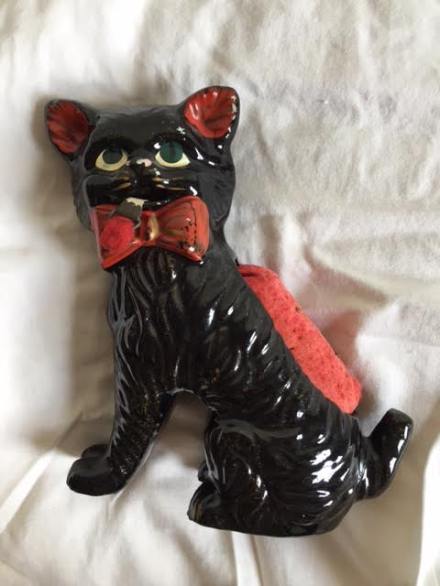
As it happens, one of the first black cat items I acquired was a soft tape measure and pin cushion kitty. (For those of you who have been following in recent weeks you will understand that this cat, and most of the others, is packed away for the duration of our building’s HVAC work which required the dusty dirty demise of our ceiling. I am sorry not to be able to share a photo of him.) I was in an antiques market Kim and I frequent in Red Bank, NJ – not far from the Butler family ancestral home – when I happened on it. Like this fellow, he has a tape measure tongue you can pull out and was entirely soft so you could stick pins in him, I suppose.

This guy would have sat proudly on your sewing stand, at attention, waiting for the sewing to commence, never lost or misplaced, as I constantly loose both my stashes of needles and tape measures – not to mention thread. I especially like his red felt tongue which is the pull on the tape measure and matches his red bow and of course the nice velvet pincushion on his back. He is a tad too fragile to resume his responsibilities keeping my needles, but he will have a proud safe shelf to perch on in his retirement as soon as the dust, quite literally, clears here.

While I admit I always wished to be a gifted seamstress, nothing could be further from the truth I am afraid. Thanks to the efforts of a roommate in London during a stint in college, I can sew a button on with great confidence it will stay. However, aside from that there has never been a sewing machine bobbin I didn’t destroy on sight and, beyond buttons, my hand stitching tends toward the lopsided and, shall we say, organic. I appear to come from a long line of barely functional sewers. My maternal grandmother could do a hem under duress, but neither grandmothers or my mother were churning out daily wear. My sister showed promise in this area and made a number of garments before drifting away from it. (She also made bread well which is another skill I can’t master. Of course, she was also a PhD in Math – need I say more? I can barely balance a checkbook.)

I am the first to say, one can’t be good at everything so I long ago ceded to my ineptness in this, and other areas. However, that is not to say I don’t enjoy the related accoutrements for these activities – especially if a cat is involved.

Honey Bunch

Pam’s Pictorama: I am going to swerve way off topic today and discuss my affection for the Honey Bunch series. Before I drill down on that specifically I should confess that since childhood, whenever under tremendous stress, it is my habit to curl up in bed with what I shall describe as incredibly light reading. I trace this practice back to when I was about twelve and saw my sister Loren get hit by a car (it was summer and we were walking to the beach; she was hit from behind by a car going around an obstruction that blocked her from view) which was unsettling to say the least. She was knocked unconscious, smashed the windshield, had a severe concussion and a very badly broken leg. The broken leg, which resulted in a huge plaster cast, sidetracked her from her many beloved sports for a number of months. Anyway, all this to say that the evening it happened a visiting mother of a friend looked at me and said, “You’ve had an awful fright. You find something nonsense to read before you go to bed tonight so you don’t have bad dreams.” And I still have been following that advice ever since, whenever I am very stressed or sad.

A Honey Bunch book is about as benign a book as you can get. Clearly meant for the early reading set – or those still being read to, although they are “chapter books” – Honey Bunch is an adorable small child and the books describe various minor adventures she has, such as a trip to the seashore (not to be confused with her first trip to the ocean), a trip on a plane or to a farm. She has a lovely kitty friend – as every small child should – named Lady Clare, and she has a garden. Honey Bunch is a pretty well traveled kid for the pre-school set of her day, but she enjoys routine as much as most small children, all cats, and myself. A plot might include the temporary loss of a treasured doll, a misunderstanding with a friend, or amazement at getting on a train, but you can be pretty sure all loose ends will indeed be sewn up nicely in the end.

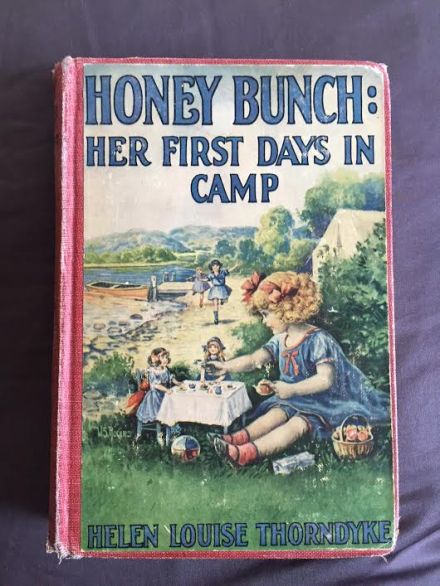
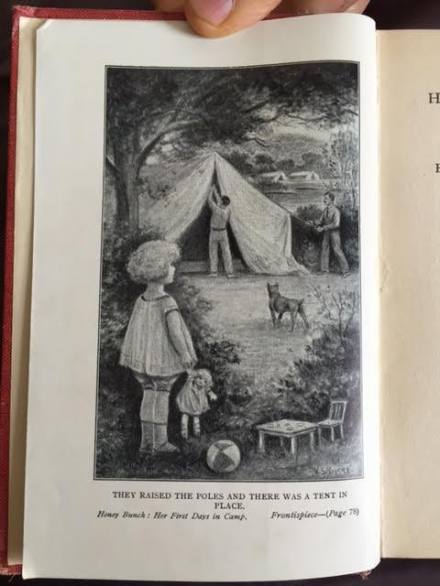
For those of you not in the Honey Bunch know, it was another of the famed Stratemeyer Syndicate, along with the slightly better known Nancy Drew and Hardy Boys mystery series. The books were written under the name of Helen Louise Thorndyke, which is a nome de plume for a series of writers. Josephine Lawrence wrote 17 of the 32 volumes and the most by far, with Mildred Wirth Benson running a distance second at five. (Josephine Lawrence also wrote a number of adult novels, include Make Way for Tomorrow, which was made into a brilliant tear-jerker film by Leo McCarey.) The majority were published by Grosset and Dunlap and the cover art by Walter S. Rogers makes them nice objects as well, as you can see above with one of my copies. I think there would be less satisfaction in reading a Honey Bunch book that wasn’t one of these beautiful editions. You are usually provided with a single handsome inside illustration as well.

While even I cannot recommend a full diet of Honey Bunch, or reading of this genre, the occasional mental rest of a Honey Bunch books has stood me in excellent stead, and I do believe has contributed to ongoing good mental health. I suggest purchasing a few and keeping them in the house. You never know when you might need to sink into bed with Honey Bunch: Her First Little Circus.

Honey Bunch inside cover

Honey Bunch inside illustration.


Tuxedo on the Job

Scan(1)

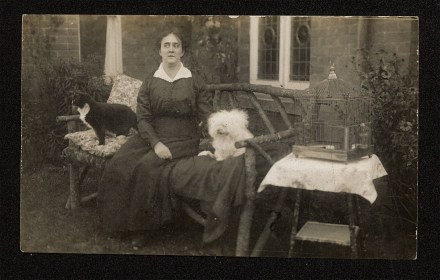
Pam’s Pictorama Photo Post: The slide back over to photographs continues with this recent acquisition. It made me laugh out loud – not sure that was its intended purpose, but it did. It was never sent and there is nothing written on it. Somehow the woman and the dog look like sister and brother. The birdcage appears to be empty – that little fellow has flown the coop one way or another I guess. For me, best of all of course, is that sharp looking tuxedo cat; all a-point, looking like the only one with any sense in the family. This woman looks as if she can use the help.

For regular readers it is not news that I tend to favor tuxedo cats. Although my very first cat was white with black cow-spots, and the one I really considered my furry sister was a calico, it has been tuxedoes that I have been drawn to adopting in my adult life. My first tux was a childhood pet, Mitzy. She was a pretty and precise little black and white girl who lived an extraordinarily long life considering I believe I was a teenager when we acquired her and she lived long enough that Kim met her. I forget now exactly how we ended up with her – I have a vague memory of a neighbor boy coming over with her and announcing that he knew we had cats and did we want this one? The young man in question was not a model citizen and I guess Mom had no real choice, but to take Mitz in.

Mitzy seemed to end up as my brother’s cat to some degree, although I think it would be fair to say that we were what I will call cat wealthy at the time. There were a few dogs too. I think my parents were taking the in for a penny in for a pound approach with animals and kids abounding at that time. Mitzy was a precise cat – as girl cats and especially tuxedoes tend to be. Kept her whites white and her black hair shining. Would always enjoy a few pets and didn’t fight with the other cats or cause much trouble, a model citizen. As I mentioned, she lived into her twenties. A Methuselah of cats. A series of tuxedoes in the family followed: Otto, Milkbone, Zippy, Roscoe and now the mantel is worn by Cookie who is asking for dinner as I write this. If it was Miss Cookie in this photo she probably would have eaten the bird and struck up a fight with the pooch. Not all tuxedoes have the same sense of responsibility.

Girls with Bikes

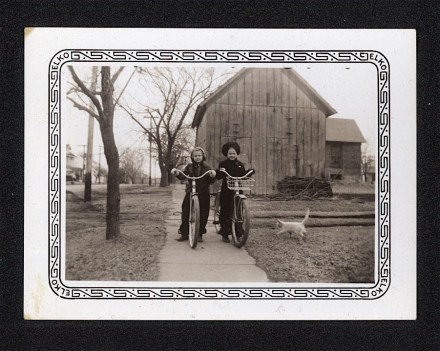
Scan(4)Pam’s Pictorama Photo Post: I recently snatched up this undated photo, with its snazzy Elko logo boarder. It came up in my search because of the cat – who I love as he or she is caught in motion here, about to trot behind these two little girls. It was however, more the little girls and the early winter day that attracted me. Someone who knows their bikes can probably date this photo from that, the clothes make me think 1940’s, but it can be hard to tell with kids clothing.
The bikes look slightly oversized – probably purchased for these kids to grow into with an eye toward saving money. It might be Christmas but somehow it doesn’t quite feel like it. These two are bike proud, the one in the plaid jacket looks like she is ready to take on the world, and we can see the nice badge on the front of her bike. The one I fancy is the older sister, dressed more like an adult of the day, sports not only a basket but, upon careful examination, a bell. There is something about the light and the scene though that brings me back to my childhood and many such chilly days playing outside. We didn’t have that nice barn, but I can remember doing my best to extend outdoor play into the early cold weather, bundled up like they are, with my sister or friends from down the street. They’ve got the world on a string and they know it.

A Mystery Bonzo…and Questions

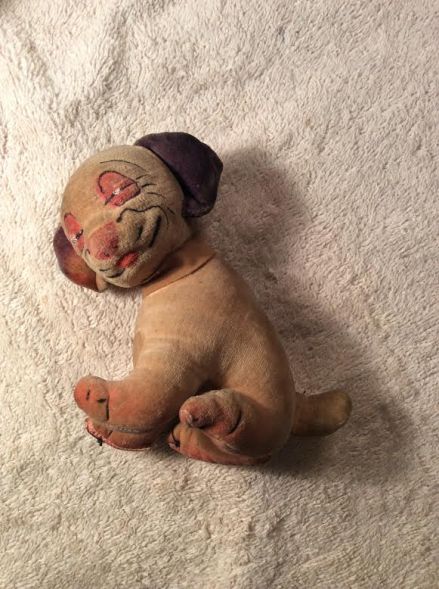
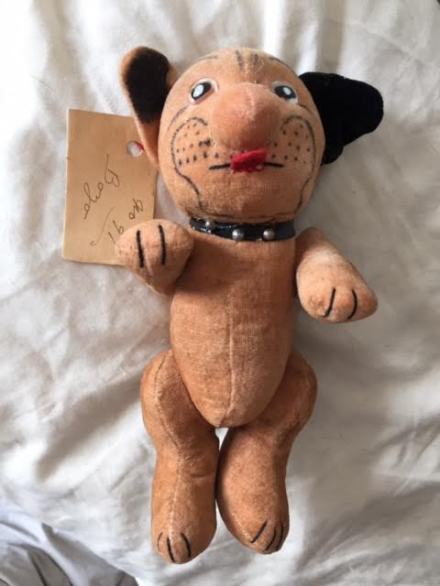
Pam’s Pictorama Toy Post: We changing direction a bit today and I present for your consideration, this newly acquired Bonzo dog toy. I found this toy on eBay, made a mistake and didn’t bid – but fortunately for me he did not sell and I purchased him from the seller. I have photographed his wonderful, handwritten tag which seems very old as well. As far as I can tell it say, Bonzo and no 91 on one side and on the other Viola & Madeline Falkenthal 210-08 93rd Ave Bellaire Gardens, Cullens, Long Island. There is an online record of them living in Queens, Madeline Conlon nee Falkenthal 1902-1993 and Viola Albertina Connell, nee Falkenthal, 1906-1983. So strange what you can find on the internet. (I can only assume that they were very fond of their Bonzo toy, and I will of course keep the tag and their link to him.)

Bonzo is unusual in that he seems to only have one moveable arm, his left. There are no repairs so I assume this was intentional, but it does seem odd. He is in very good shape. His tongue seems to have been stitched back on but other than that he seems entirely original and intact. Bonzo also has a wide-eyed, open eyes which are found, but are less typical. That and the very black one ear left me wondering if instead of Bonzo, like Ooloo, he is another character in the Bonzo chronicle. I cannot find any evidence of this, but I am open to suggestions.

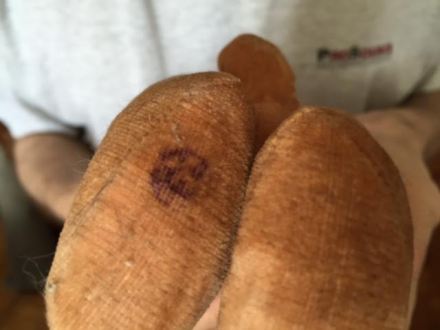
I assumed he was made by Chad Valley – the maker of most of the Bonzo dolls from this period seen today – as per my fairly long discourse on them in my posts Blame it on the Blog 2: Bonzo Dog Edition and the more recent Happy Ooloo to Me!. However, once in my possession, I realized he does not have the distinctive Chad Valley label on his foot, nor a Chad Valley pin. The eyes are glass, which is common for the period but not used on the Chad Valley Bonzo toys I have seen. There is, as shown below, a somewhat indistinct face as the only marker. My next thought was a company called Merrythought. They were evidently started in the thirties, in Great Britain, by some folks who left the larger Chad Valley toys. Although I have had trouble tracking down their early trademark, it seems to have been more distinctive label as well.

0f0f7f4e-01d9-412f-8668-96a7053b599c

So folks, a mystery Bonzo! I am interested in hearing back with any thoughts or clues. Meanwhile I have also included a photo of my Chad Valley fellow for comparison. More on this as my toy sleuthing continues!

unnamed-29

Chad Valley Bonzo

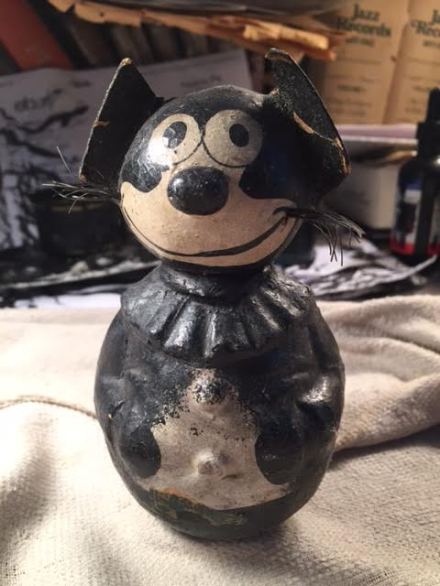
Felix Roly Poly

bf004ba2-395c-47cd-be02-7818aaaae6f9

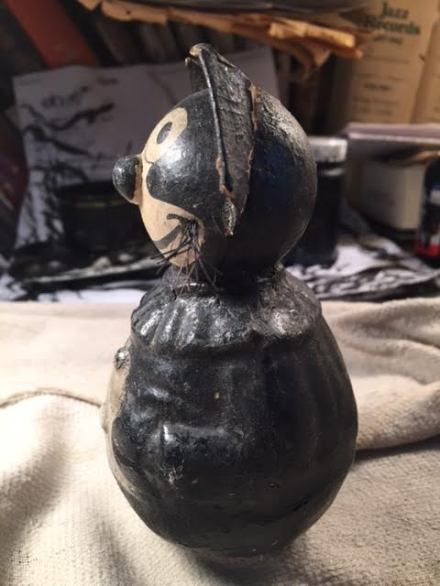
Felix side view – check out the whiskers!

Pam’s Pictorama Toy Post: The parade of toys emerging as a result of our recent big pack up continues with this fellow who I kept out of a box so I could write about him. This Felix was made by Schoenhut in Germany and appears to have been made around 1922-1924, according to my research. Felix is made of paper mache and appears very sturdy indeed. Therefore, it was a surprise when my research turned up that he was actually a candy container. He only stands about 7″ high so I have to assume that the candy was small and there wasn’t much of it. I cannot see where he would have opened, nor how he has been re-sealed. (Leaving me to wonder – is it possible that the now old, old candy is still in there? Or is this misinformation?)

It is almost beyond my imagination to consider such a wonderful world where candy might have been delivered in such a container into the happy and greedy hands of children. These roly poly toys do not appear to be in short supply so children must have liked Felix more than the candy. In the mugshots above, you can just barely see that he maintains part of a Schoenhut sticker on his tummy and to my especial amazement, he has kept his whiskers all these years!

If Felix was not your roly poly of choice, you could have Santa, goblins, golliwogs, fat men and bunnies – among others. I do own some other black cat candy containers (covered in mohair) made in Germany. Alas, they are packed away and will have to await their moment in the spotlight at some future date.

Roly poly toys seem to have been around for a long time but I could not find out much about their origin. It seems that numerous cultures – Russian, Chinese and European – actually have versions of the toy. Quite simply, the toy is weighted and rounded on the bottom so if you push it over it bounces right back up. I guess this was devised for small children to entertain themselves with since they couldn’t actually knock it over. Wikipedia sites Weebles (by the Fischer Price company with the memorable tagline, Weebles wobble but they don’t fall down!) as a contemporary manifestation of the roly poly. They do not mention the bottom-heavy, blow up knockdown clown toys of my youth which I adored. As big as a small child (I found the sheer size thrilling – I always liked big toys) you could sidle on up to it and give it a poke and it would go down – and bounce right back up! Wonderful! I think I could go out and buy one now and still enjoy it.