Tulip Time: Part One

Pam’s Pictorama Post: It’s spring time in full bloom here at Deitch Studio and I bring you a somewhat unorthodox Pictorama post about tulips today. It’s a two part post where Kim and Pam meeting of the minds post as our nascent floral interests convened this month.

I will start by saying that I have loved tulips since college where I remember seeing my first gorgeous bunch of them in someone’s room, a wonderful harbinger of spring. I think they were apricot colored and I guess the whole concept of cut flowers was very adult as well. While we grew flowers in New Jersey my mother, at that time, was not so big on harvesting them, preferring to let them run their course in the yard.

I am a big fan of vases filled with tulips, all colors and types. Trim the stems and add a couple of pennies – if in the sun or a warm spot they will force quickly. A cooler shaded spot to keep them longer.

Those yards of my youth consisted of sandy stony soil and were resistant to cultivation, despite my mother’s best efforts. As a result her purview was focused. She produced a credible vegetable and ultimately herb garden and managed to get shrubs and trees to grow, but less so bulbs of the annual variety like tulips. (Although someone gave her stunning and unusual iris bulbs which were perennial and a few of which exist in my yard today. Perhaps a future post on them.)
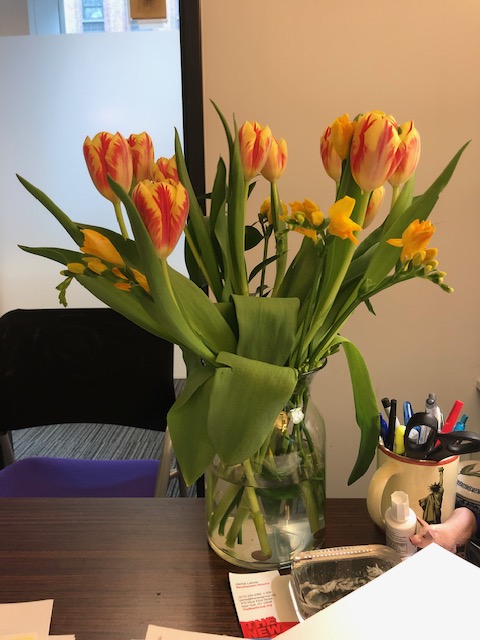
From my former office at Jazz. I generally had cut flowers on my desk each week.

Meanwhile, the lovely if extremely finite, nature of tulips fascinated me. I always say, there’s nothing more dead than a dead tulip. However, if true, in some ways there’s nothing more vibrant than one it its prime – their life and death cycle perhaps being part of the appeal. As plants they hit the ground running, so to speak, and once they hatch from their bulb they race to a full stem, bloom tightly folded. And then, bam! It opens. Amazing! Before you know it, the plant is spent and that’s pretty much it.

If left in the ground you can get a second showing the following year. When I worked for Central Park we had an annual Tulip Toss where the spent bulbs were dug up and replaced with fresh. The bulbs were given to smaller parks and interested individuals who would plant them the following year with a less reliable yield.

Now, I have mostly enjoyed my tulips as cut flowers indoors. However, as Pictorama readers know, I went gardener last year after inheriting the house in Fair Haven. Although I confined myself largely to herbs and veggies, one of my final acts of gardening in the fall was to plant some tulips out in the front yard.
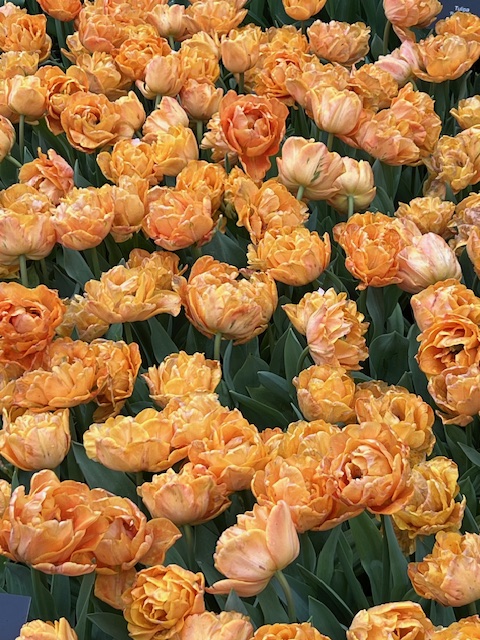
Photo from a friend’s trip to Amsterdam this year.

As many know, a siren call to all wildlife are bulbs, seeds and flowering plants. Now, I try to take a pretty philosophical view of critters munching my blueberries and strawberries (read about that a bit here if you like), and I think mom planted the berries for the birds, but the seeds, bulbs and flowering plants (think geraniums) make me a bit sad. Anyway, understanding that it could result in spring disappointment, I planted a row of tulips and one of daffodils (less tasty it seems) in the front yard.

Our backyard is fenced and I generally do not have deer visit back there (although bunnies, chipmunks and squirrels abound, as well as myriad birds), but the front yard is fair game and can pretty much be considered a buffet for the plant munchers.

Nonetheless, I ordered some bulbs from a nursery and spent a chilly, dirty and backbreaking afternoon of planting last fall. I was a bit late getting them in which was a strike against me.
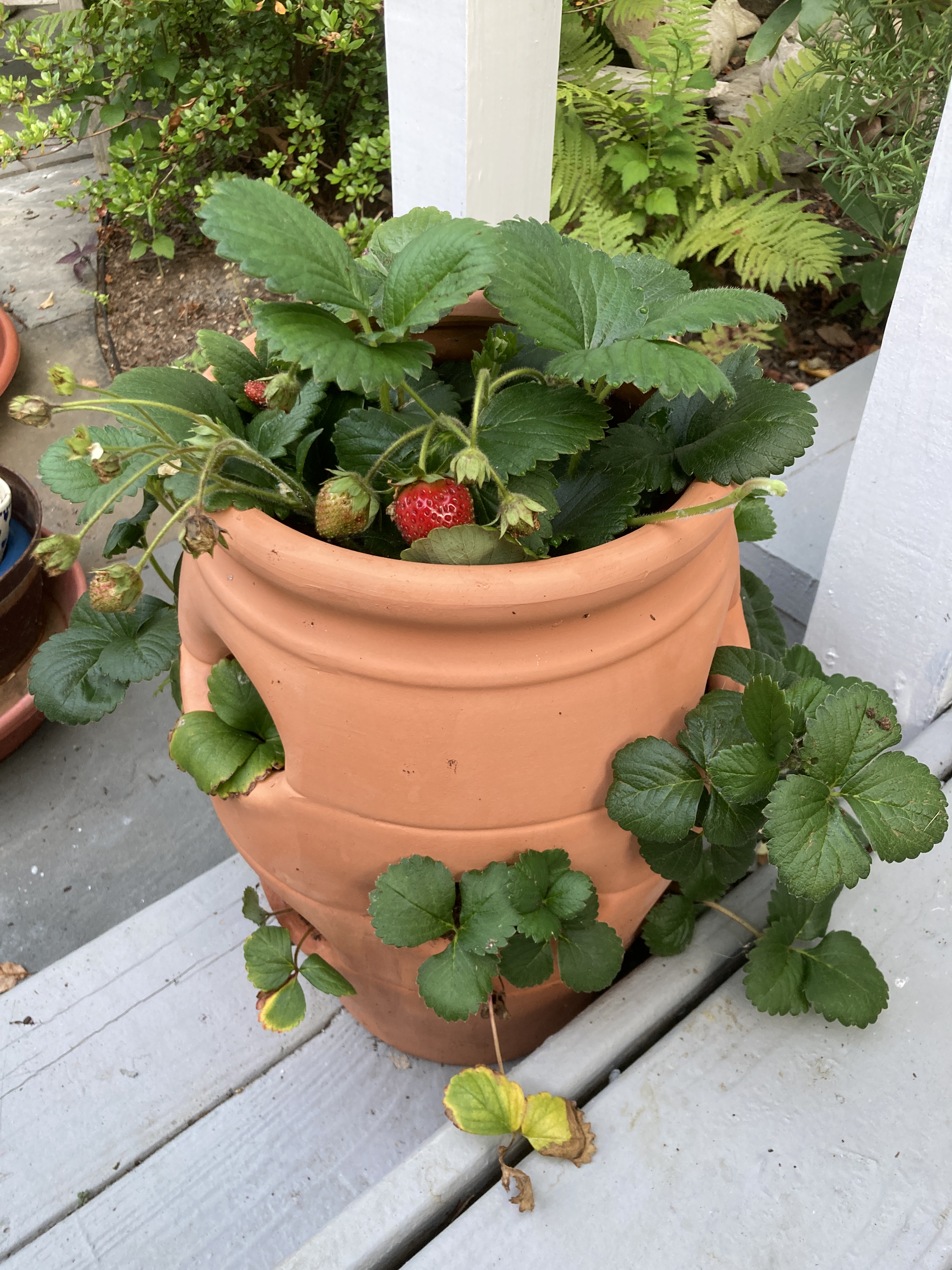
Last year’s strawberry plant. It wintered over and is laden with blooms already. The birds, bunnies and I will have strawberries galore this year.

My trips to New Jersey are somewhat sporadic and dictated by both things that need to be done there or other things which need to be done in Manhattan and keep me here. However, the women who look after the house and cats keep a weather eye on my garden as well and send frequent reports.

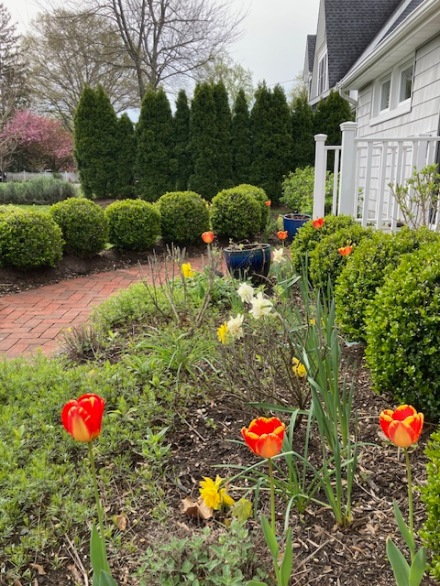
The tulips were not eaten as bulbs and low and behold – they came up unmolested. Now the race was on for me to get to New Jersey before a strolling four-legged resident feasted on them.

I had forgotten that I had purchased these brilliant bright orange and red ones. I zipped down to New Jersey and caught them in their full glory. So cheerful! Their straight stems and gaping blossoms opening to the sun and sky in the morning and shutting down again at night. I must say, I thoroughly enjoyed them.

I left on a Monday night and by Tuesday morning the report came – they were gone. I am so grateful that the critters waited for me, but I guess ultimately they proved to be an irresistible nosh.

By coincidence, last night I was catching up with a Frank Borzage directed film I had never seen, Seven Sweethearts. I am a huge Borzage fan and will sit down for any film of his I haven’t seen and TCM is doing a sort of mini-tribute to him this month. They appear to be focusing on the later films. (Why anyone would show Borzage and not show Lucky Star – an all-time favorite film – I have no idea. I collect stills from them and have written extensively about my love of his silent films here and here for starters.)

Charmingly artificial Borzage background on this still from Seven Sweethearts.

Now, I can’t really recommend this 1942 era film, except Katheryn Grayson (dressed of course in Dutch girl garb) is in fine voice. I wouldn’t say I didn’t enjoy it – there are some unmistakable Borzage touches including some very charming fields of faux tulips. The setting is an imaginary location called New Delft, a sleepy tourist town where some people come and never leave. Central to the town and the plot is a hotel owned by S. Z. Sakall who is Papa to seven daughters – five with sweethearts at the start of the film. Alas, none can marry until the oldest sister and she’s an aspiring actress so no interest in marriage there. You can fill in the rest. It is pretty available to be streamed online (free or nominal fee) and at the time of writing I caught it on the TCM app after a showing late on Thursday night.

All this to say tulips figure largely in the film and there are scenes, glass shots and charmingly artificial sets, of acres of tulips. I especially liked a scene where Katheryn Grayson tells Van Heflin that these tulips can tell the weather – that they close up with the darkening of the sky before the rain. It reminded me of mine, gently opening and closing in the front yard.
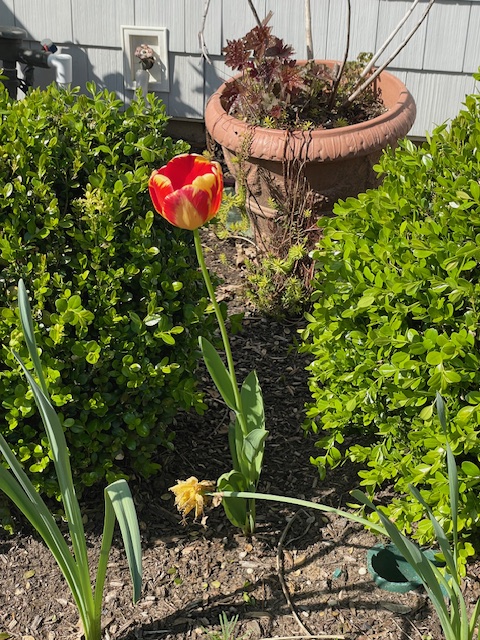
Last little fellow who popped up after all the others.

Meanwhile, I got a report that one lone little tulip showed up after the fact and I have the photo you can see above. Tomorrow, a bit more on the background of tulips and, oddly enough, where they intersect with comics.
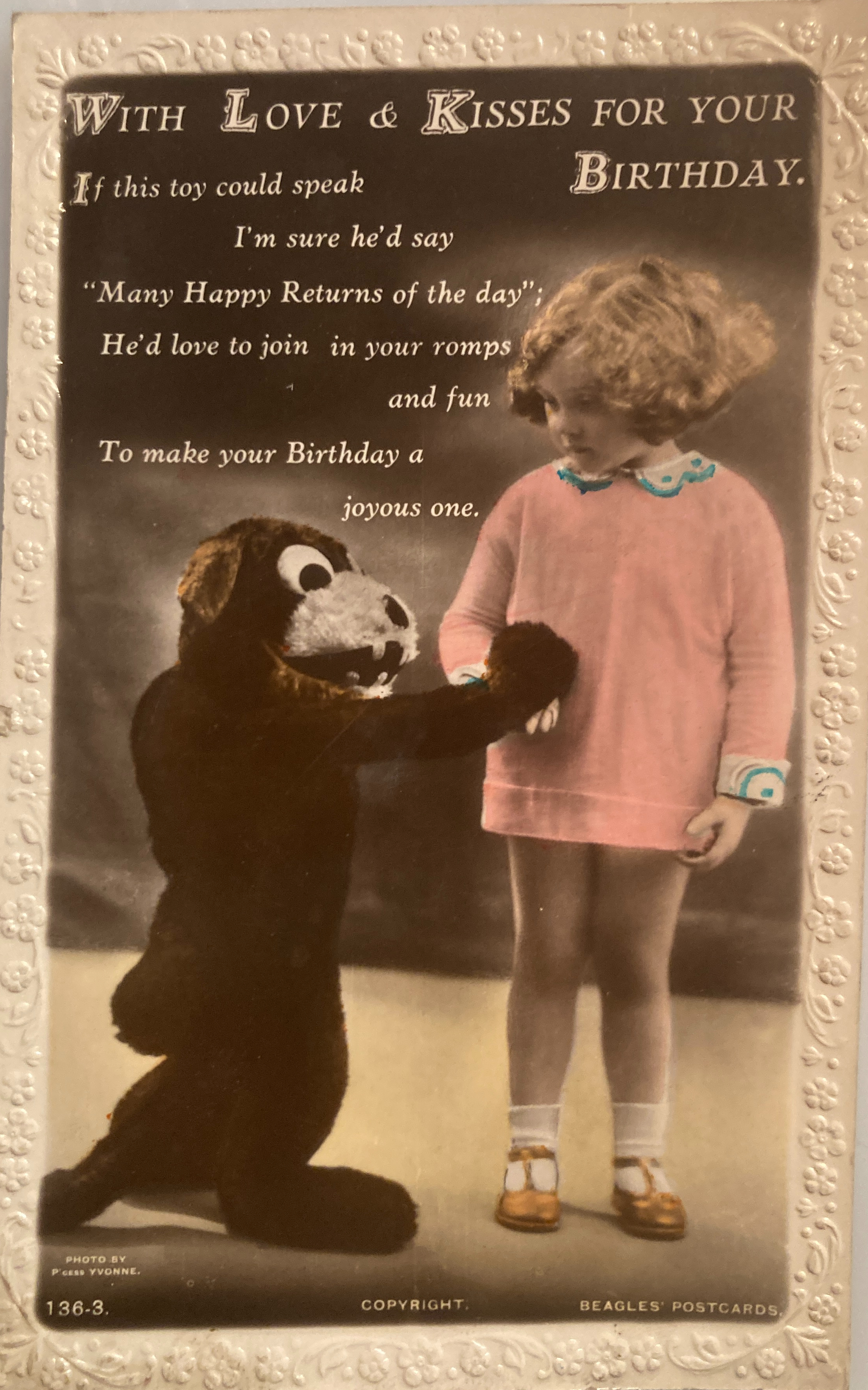
Borzage Birthday

Pam’s Pictorama Post: It’s a today is my birthday post. We’ve had some other post on the day or very close – here and here. The day will be spent, as is our habit, wandering around downtown, poking into stores or flea markets – precious few of both left here in NYC though! Kim will sport me to lunch and if we are in the East Village that will be a plate of perogies or matzoh brie. If it turns out to be Chinatown (which will likely still be ringing in the Year of the Dragon so maybe not) it may be dumplings. I will give a full report next week – which will also be a Deitchian Valentine reveal – an event unequaled except by the holiday card annually!

From last year’s birthday post! Pams-Pictorama.com collection.

However, despite birthday prep, I do have a post for you today – this rather spectacular press photo from Lucky Star, an all-time favorite silent film directed by Frank Borzage. Kim and I found it on eBay about 10 days ago and snatched it up as a birthday gift (another one, a toy, to follow in a subsequent post – such riches) for me and I just opened it this morning. (I have written about these films at more length in posts here and here.)

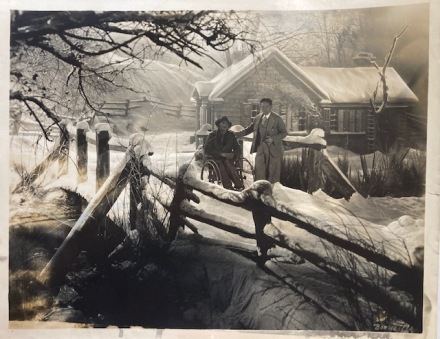
In Lucky Star Charles Farrell, who is playing the main character becomes confined to a wheelchair after fighting in WWI. He is seen on the faux snowy set with Borzage. (The artifice of the snow is especially evident under the the fence in the front.) There is something about the nature of the artifice on an early Borzage set that I love – like a painting or a diorama. The snow is my favorite however and this film has about a third of it in the snow including the wonderful climax at the end. For a long time Lucky Star was not easily available but now you can (and should!) watch it on youtube here. The cottage in the background, this little bridge and pond which is seen at various seasons in the film, and the rickety fence are all Borzage perfection.

From Lucky Star. Pams-Pictorama.com collection.

There are some contemporaneous pencil notations on the back, but nothing of note. There is a very unfortunate modern sticker with the name of the film which concerns us as the glue may do a chemical chew through over time. One corner has a pushpin mark in the upper left corner.

Like my scant other stills from Lucky Star and another great film called Lazy Bones – the developer was sloppily applied and the result is odd bleaching and an unintentional sepia tone in the upper right corner. The lower left is the worst though, with a bit of uneven printer alignment too, a blob of chemical ooze is recorded on the lower right. (I have not watched Lazy Bones on youtube but you can try it here. It features Buck Jones in an atypical role – just darn great!)

From the opening of Lazy Bones. Not in my collection.

By coincidence, but perhaps also a bit of a tribute considering the purchase of the photo, last night over dinner we caught up with a later Borzage film we’d never seen via youtube as well – Until We Meet Again. (Find it here.) It would be hard to put this in the same category as the silents above, although some of Borzage’s signature aspects remain - star crossed romance, those interesting sets. Sound film, 1940. There is a rushed, low budget quality to it that works against it. Still, I was glad to see it. His films are still showing back up after years of languishing. We saw The Lady in an Italian silent film festival (via the internet) in ’22. It was good, although not really memorable. (The youtube of it is a wretched print and I cannot recommend it.)

Not in my collection.

I’m not entirely sure what it is about Borzage that speaks to me so specifically, but I will always go out of my way to see any of his work. It’s a combination of his esthetic and storytelling that speaks to some part of me deeply. Maybe I was a fan in a past life – seeing each of the silents as they came out. If you follow that logic, I will still be watching them, again and again, in a future life too. Meanwhile, it’s one of those “big” birthdays, so I will let you know what I think after I have digested it a bit.

More Lucky Star

Pam’s Pictorama Photo Post: The purchase of this film still allows me to return to a favorite topic today, the films of Frank Borzage and in particular one of my favorites the 1929 film, Lucky Star. My original 2014 post can be found here, but as of writing now I can share a link for the entire film which can be found here. That post was inspired by the purchase of another Lucky Star still and one from another Borzage film, Back Pay. (For Borzage fans who may not know, a great restored version of Back Pay recently became available and as of writing it can be found here.)

This morning I was puzzling through my fondness for this film. Visually, the setting which is a wonderful mix of artificial and realistic and paints its own world is part of it. It is undeniably bleak, but there is something about the self-evidently constructed ponds, paths and buildings that seem to put my mind in a pleasing place. We know now that these sets at Fox were in use morning and night, a young Janet Gaynor was working day and night there on two films at one point and you wonder when she might have slept or ate a meal.

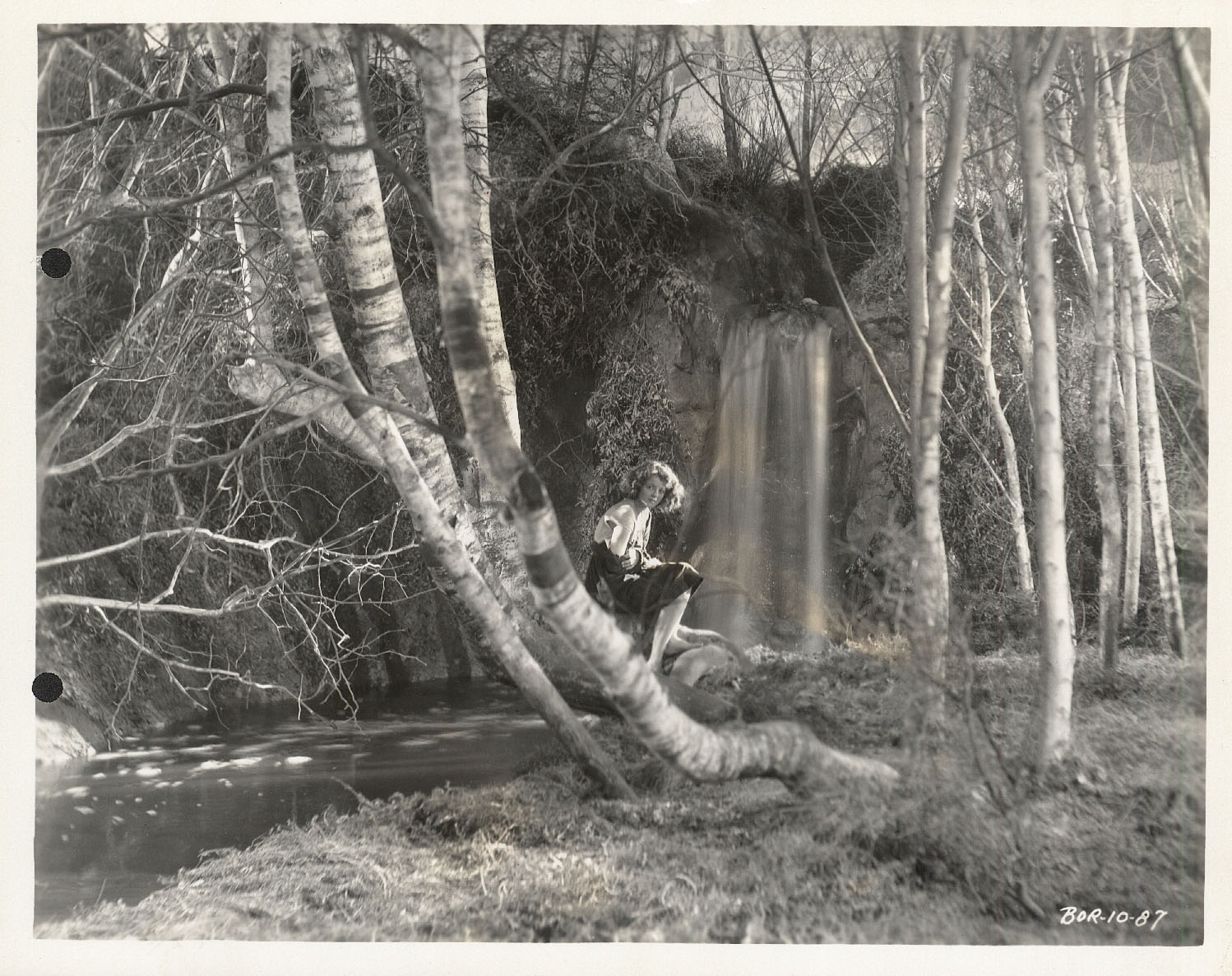
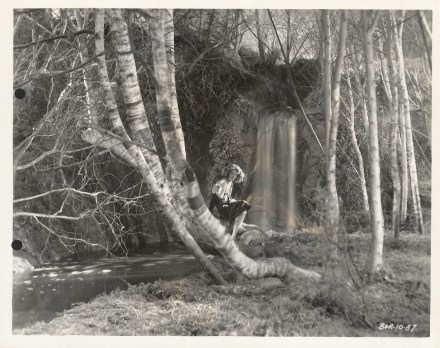
Lucky Star still from a scene never used in the film. Pams-Pictorama.com Collection.

In this story an impoverished young woman is mentored by a war-damaged WWI soldier in a sort of Svengali-esque remake of her. Ultimately his love of her ultimately eliminates all obstacles; this is the sort of perfect Borzage pathos leading to a love conquers all ending. In my opinion Bozage is at his best when given this sort of material and clearly he had a pretty free hand over the making of it. He’d give you a glorious wrap up with a sad ending if he had to (I’m thinking of his A Farewell to Arms as one example; you need to find the unedited version if you are going to watch it – makes a lot more sense including his ending), but he was in his glory building to a happy ending against all adversity.

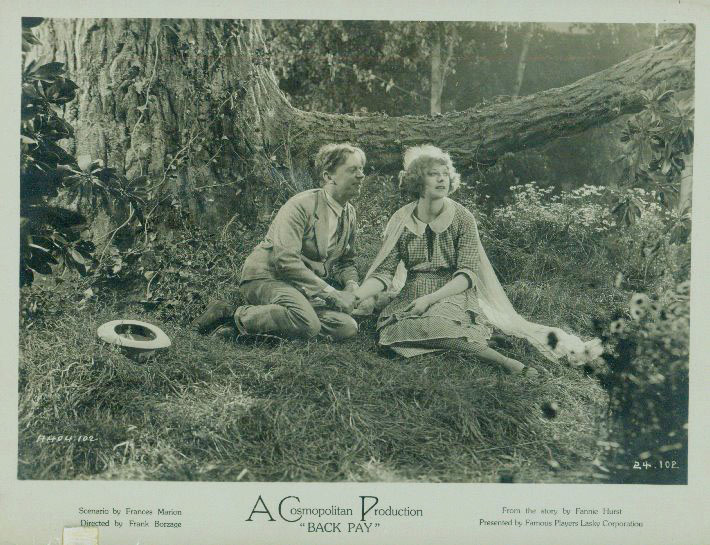
Still from Back Pay, another Frank Borzage silent film. Pams-Pictorama.com Collection.

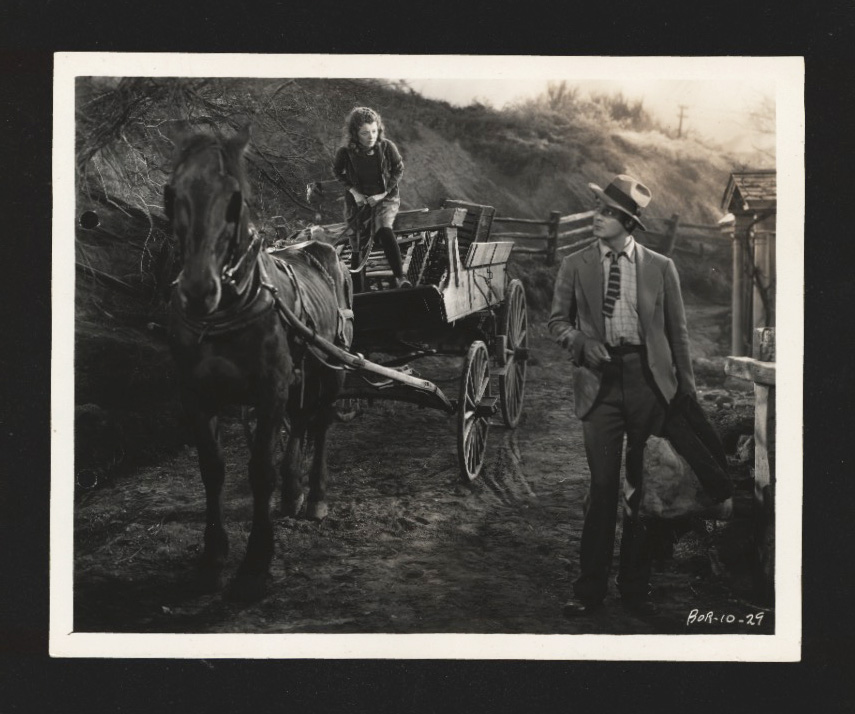
This photo is from early in the film, in the pre-War day to day world of the far reaches of a nowhere backwater. One of the through lines of this story is the way World War and ultimately change comes even to such a remote corner. Here Janet Gaynor is a wily and feral child to Charles Farrell’s relatively sophisticated adult. The lighting is dramatic and bright where it hits in high relief. The ribs of the poor elderly horse stand out and as does the fence. There’s something about Charles Farrell’s hat which is a tip off that the change he is going to undergo has begun.

I can cheerfully tell you that there are definitely other scenes from this film which, should I be lucky enough to find photos of, I would snatch up in a heartbeat. Should that come to pass I assume I will likely pass those onto Pictorama readers as well, understanding of course, that some of you may not share or understand my enthusiasm. However, the last part of the film takes place during a long scene in the snow and I would love to own some of those so I could lose myself daily in the wonderful silent film world of Frank Borzage and Lucky Star.

Lucky Star

417634_3077504629536_1189269752_n

Check out some of Lucky Star:


Pam Pictorama photo post, From one of my all time favorite films, Frank Borzage’s silent, Lucky Star.  I say silent, although evidently a part talkie was also made which I have not seen, but may exist at least partially.  I have seen stills from it.  I do not think this still represents a scene that actually made it into the film, although the appropriate part of the film is in the outtake YouTube I have linked to here.  Take a stroll through it – or even better, tuck in and watch the whole film!  I can and have watched it again and again.

The Back Pay still is one we’ve had for a while – framed up on the wall right next to our computer where I am sitting right now.  I have never seen the film and it may be lost.  Both of these stills embody what I like best about Frank Borzage films – a sort of magical artificial world.  For me, Frank Borzage is one of the more or less unsung heroes of film – working shoulder to shoulder with the likes of John Ford in those early years.  Another favorite to look out for Lazy Bones stars Buck Jones – as sweet a movie as you could ever want to see! While these are not yet entirely common place viewing, a giant Frank Borzage set put out a few years ago has made some of these available.  And I think my friends over at TCM are starting to promote at least his later work a bit.

Although my first viewing of Lucky Star was at MoMA we were lucky enough to catch up with a multi-day Borzage fest at the Museum of the Moving Image.  (Where we also attended several days of William S. Hart films – bliss!) Sadly that venue doesn’t seem to be showing many silents any longer, let alone those glorious festivals!  However, I hope I have done my part to introduce Lucky Star to even a few more people.  Enjoy!