Living the Felix Life

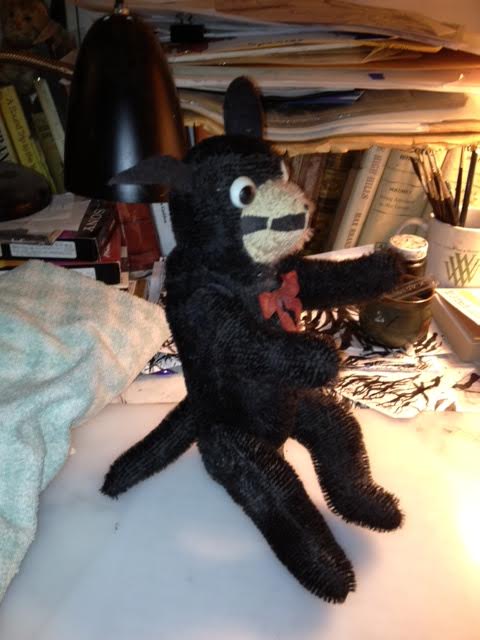
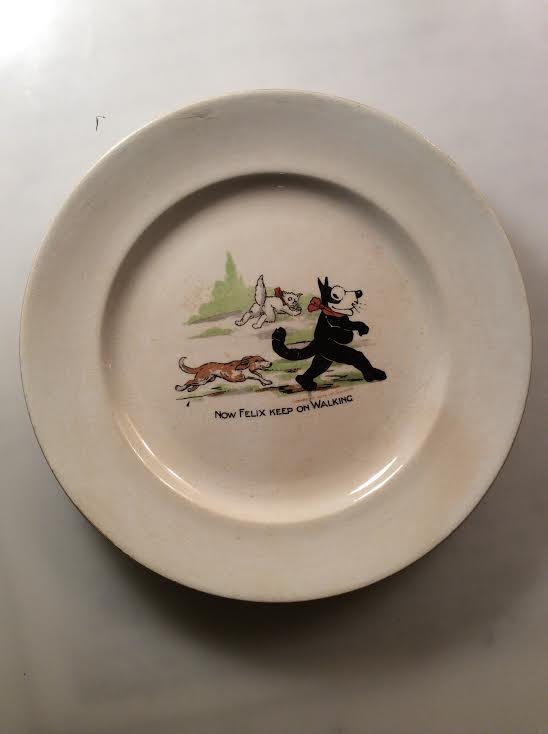
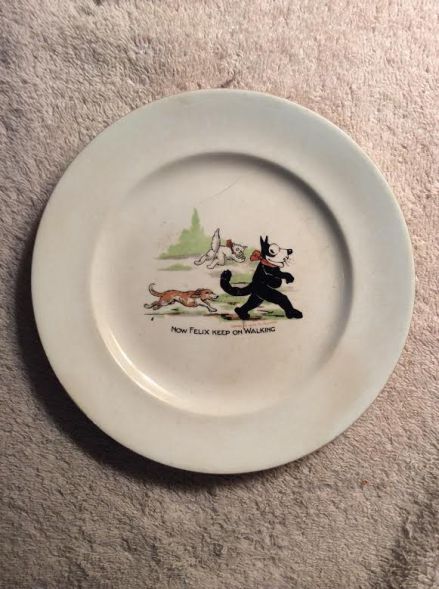
Pam’s Pictorama Post: This plate is the single piece of Felix china I own. Sometimes I fantasize that if I was very wealthy our daily dishes would be a full set of Felix china – perhaps switching off occasionally for Mickey on special occasions. The appealing image of drinking my coffee out of a Felix mug comes to me periodically and I have considered purchasing one for this purpose alone. However, we are a bit hard on the things we use daily around here – cats always leaping and knocking things over, stuffed cabinets where things collide, daily dishwasher wear and tear. Although admittedly the actual destruction of household dishware here is fairly low, the idea of worrying about it is more than I can deal with. Sadly, in such a small apartment, we have little room for displaying china as well so I remain reticent about investing in it.  That is too bad because there is a wealth of it available and the charm for me is seeing it in large quantity and with all the small variations.

My plate is unmarked and I have some question about its origin. I believe I have landed on Wellsville China of Wellsville, Ohio as the maker.  Wellsville China was founded in 1902 was in business until 1959. I believe it was then sold and was in existence in one form or another until the demolition of the building in 2004. Frankly though, the history of the company is a bit hard to piece together. A competitor in the Felix dishware race seems to have been Baltimore’s Bennett China – although the design very similar those dishes seem to be distinguished by an apricot colored edge to their plates whereas mine still has traces of gold around the edges. The Felix images and sayings seem to come from the postcard series – which is huge and I believe British in origin.

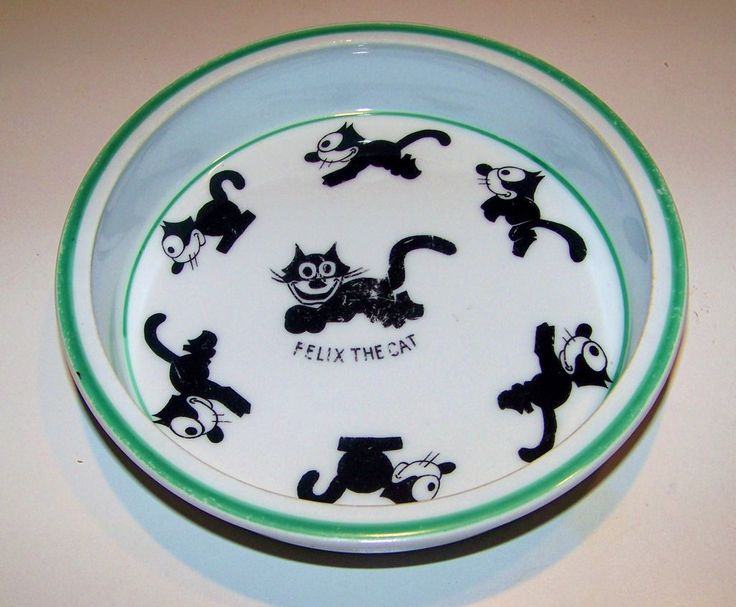
A very desirable variation is the Royal Rudolstadt design. I pulled this one off the internet – for sale on Rubylane’s site as I write this – as an example.  (Maybe I need to buy this as a birthday gift to myself…but I digress.) I like this Felix design – squarely between the earliest bony-looking Felix and the later rounded one.
6f902893f7cd13531a3d62aca821c33a

The reality is that we actually do eat off of historic plates – heavy blue and white wear sectioned plates, made in Britain – hard even for us to break. I love them. They came to me through my mother’s family. My great-grandfather owned a bar at the Jersey shore throughout my mother’s childhood and those plates were used to serve the daily blue plate special. Oddly, our other dishes are decorated with a series of New Yorker cartoons and fell into our hands via my father who purchased them, in the box, for under five dollars – his purchase limit on most things. And the tradition of novelty china continues.
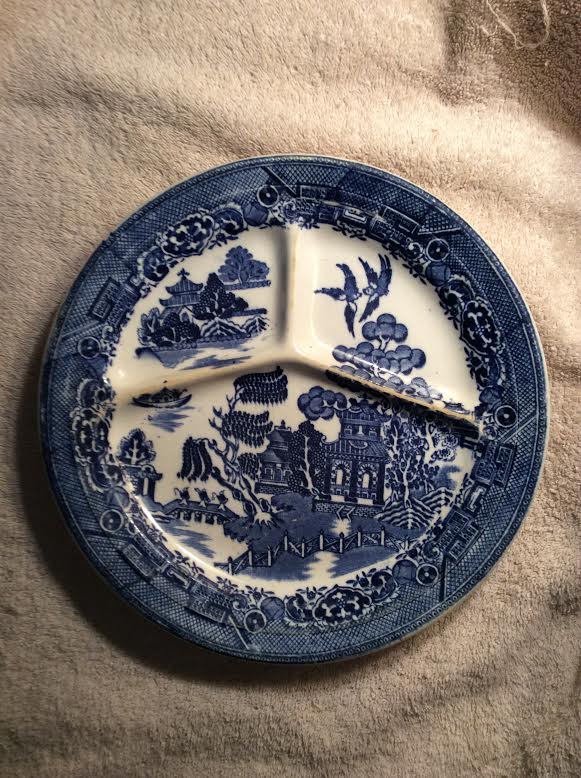
Willow plate, our daily china
Willow plate, our daily china
 

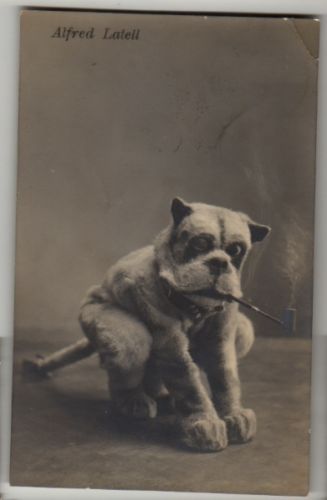
Alfred Latell


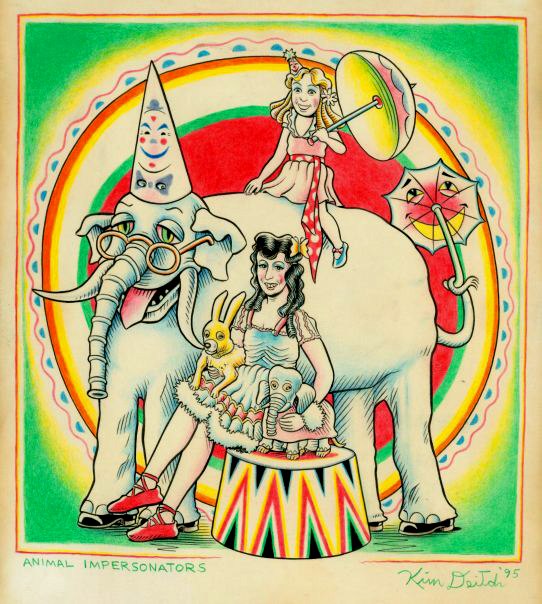
Pam’s Pictorama Photo Post:  I had my eye on this postcard on eBay for a while – holiday purchases needed to all be complete before I could justify the splurge and buy it. I adore animal imitators from the turn-of-the-century – starting with the 1907 Dancing Pig from France (possibly the very best short film ever) to George Ali as Nana in the 1925 Peter Pan – and all those wonderful early Wizard of Oz films. I love them all! Kim knows my passion for them and this is one of the first drawings he ever gave me – Animal Impersonators – a play on the idea.

282170_4271781325707_2117525682_n

This postcard was used. Addressed on the back to The two Brothers “Mathuss” Cassimo si Paris Theater, Burner Pesth, Hungary. The postmark is illegible but the message reads, in English, Dear Boys, good wishes to you. great success. My sincere good thoughts. Your father. The photo studio is Atelier & Bromsilber which seems to have been a well-known studio.

This photo is my introduction to Alfred Latell whose career evidently started in 1902 and lasted into the 1940’s. Online I found a 1936 ad for a show with Alfred Latell as, yep you guessed it, Bonzo Dog – which is how this card was also advertised. An online Encyclopedia of Vaudeville calls Latell one of the most curious acts in vaudeville. It says, He specialized in the impersonation of animals, not only dressing in various guises but also providing the appropriate noises. He began his career in 1902 and by 1909 had gained considerable notoriety for his imitations of monkeys, billy goats, bears, and dogs. It was the last animal that Latell found the most difficult to imitate, for as he explained in an article in The New York Dramatic Mirror, ‘To play the part of a dog and not to buffoon him, one is obliged to make a close study of his every action. The dog is so close to mankind that he is know more intimately than any other of the domestic beasts, with the exception possibly of the horse…The cat is a difficult animal to impersonate, though not so much as the dog, because of the fact of its slower movements. I have gone out at night with my cat suit on and have sat for hours watching the smaller back yard cats as they stalked along the fence or sat watching the moon rise o’er some neighboring buildings.’

He went to great lengths – rigged up a hind leg, improving his dog movement, and had a special tube made for his mouth which allowed him to appear like he was lapping up milk.  With a string he could raise the fur on the back of the cat suit! He also impersonated birds, ‘The parrot was one of my first bird impersonations, and I found it one of the most difficult of all, because of its crouching posture and the consequent tendency to fall over while walking.  There are nine strings which have to be operated in working the head, bill and wings, and the work is laborious in every sense of the word.” (The Art of Animal Acting, The New York Dramatic Mirror, May 1, 1909.)

Evidently Latell had an act with one and then a subsequent wife – his characters did not speak and he had to perform with a partner who would introduce him and do the talking. The internet is spotted with a mention in Green Book here and an ad in a theatrical paper there. His career peters out with a random performance or two on Broadway in the 1940’s. I was not able to find any film clips of him to share. For another photo of him and a bit more information, I refer you to another WordPress blog post Stars of Vaudeville #561.As a salute to great anthropomorphic animal entertainment, a link to the wonderful French dancing pig below!

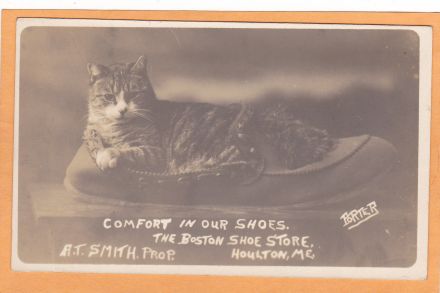
Comfort in Our Shoes

Pam’s Pictorama Photo Post: This one has been nagging at me for quite a while. I saw it immediately after it went up for sale on eBay, but it was just too expensive. I made an offer – it was refused. I sulked and waited. Luckily my brother in-law, Seth Deitch, saved me by sending me an eBay gift certificate for Christmas and I decided I would apply it to the card which was available and I still had a yen for. Yay! Thank you Seth!

This fellow who manages to hang onto his cat dignity while tucked in this comfy shoe just delights me. My goodness, he’s a real little fussbudget, yes? He would give Cookie a run for her money, I think. He looks so very comfortable and at home in that shoe – I like to believe he really liked sleeping there and they captured him doing it. As cat owners know, for some kitties there is simply nothing like a smelly old shoe.  Mine are still kittenish enough to go for the laces first and foremost – you can barely tie a shoe in this house without tussling, mostly with Blackie.

This card was never used and I was unable to trace the photographer, Mr. or Ms. Porter. No date to be found and we do wish the photographer had managed a slightly higher contrast in either the taking or the printing. I was able to find evidence of the Boston Shoe Store in Maine from the 1910’s.  In a 1913 issue of the Boot and Shoe Recorder (yep, an early shoe store trade mag now digitized online) there is reference to it in Calais, Maine. At the time it was under the proprietorship of N. A. Olsen and was noted to be a good up to date shoe store with a modern front. It continues, Lewis, the shoe man, is a great believer in advertising. He uses a number of novel methods of advertising successfully.

Since this card is undated it is a bit hard to put the picture together, but on the same page you can read about our friend, A. T. Smith, when this photo was taken and he had just returned from a trip to California according to the shoe pub. He is mentioned under a section devoted to the shoe business in Houlton, Maine. Seems he was the then shoe man for something called McGary’s Co. the only significant competitor to a larger farmer owned corporation (and department store) called The Grange – and they seemed to have most of the local shoe business sewn up. After noting that only high shoes, in tan and black, sold well in Houlton (I take this to mean high on the leg, not high-heeled) the author goes on to say about the other local shoe stores, All they need is a little time, and they will be satisfied to quit the shoe game. 

Assuming our card is post 1913, his prediction was wrong and A. T. Smith was ultimately the proprietor of Boston Shoes in Houlton. (I will spare you the details but there is further evidence that Mr. Smith and his wife were prominent citizens in Houlton, ME and were active in city policy, etc.) Or this is earlier and the Boston Shoe Store did indeed migrate to Calais. Either way, I wonder if this great card is the work of the snappy advertising guy Lewis!

Houlton, Maine, a farm community, was noted to have a population of 5,845 in 1913 and said to be located in the potato belt. It has grown modestly in all these years and only boasted a population of 6,123 in the 2010 census. A map shows it sticking way out on the furthermost edge of the state, surrounded by water. I include an early postcard of the business district pulled from the town’s online historical site. Sadly, no other cat images were to be found in association with the town or the shoe stores – I believe that is a dog in the photo below.

North_Side_Market_Square,_Houlton,_ME


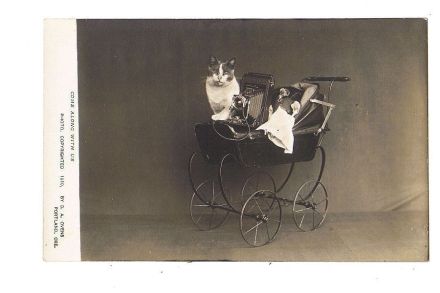
The Cat Card Comes Back


Pam’s Pictorama Photo Post: This is a story of one that got away, but came back and gave me another shot. I loved this card, but lost it to an insanely high bid on eBay several months ago. I was very unhappy about it – it combines my favorite elements of early photography and, of course, a great, dignified cat who seems to know something about posing for the camera. Last week what I assume is another copy showed up on eBay and I bid as high as I could – and won it! It is wonderful – a crystal clear photo. I took a loop to it in order to check out the strange doll in the carriage – yes, it appears to have a monkey head. I guess that got the kiddies going with a smile if Mr. Cat could not. The tag line reads COME ALONG WITH US.

Like so many of my best photo postcards, this one hails from Portland, Oregon, the origin of great, early photo postcards. The copyright is 1910, also inscribed on the front and it was taken by D.A. Ovens. It is unused and otherwise undated. I did not have brilliant results in finding out about our photographer, Mr. Ovens.  I found some copyrights on his photos with no images and this one image below off a Oregon library history site:

getimage

Assuming he had a photo studio in Portland I am unable to uncover any information about it.

For myself, I fantasize that Mr. Ovens traveled around pushing this baby carriage with doll, cat and camera and stopping to take your photo. How splendid that would have been to encounter on a downtown street in Portland, Oregon in 1910 and pose to have our photo taken with the kitty!


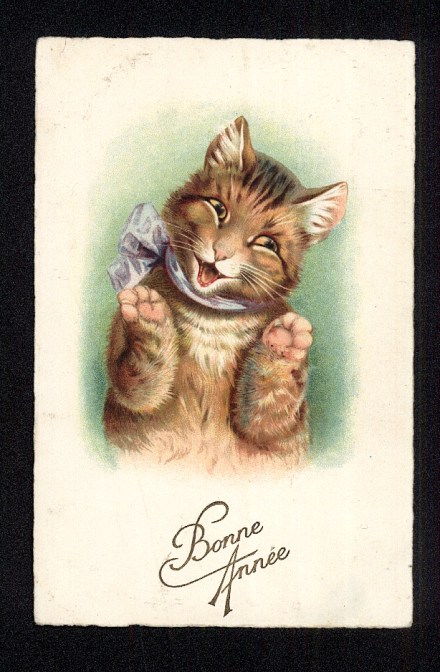
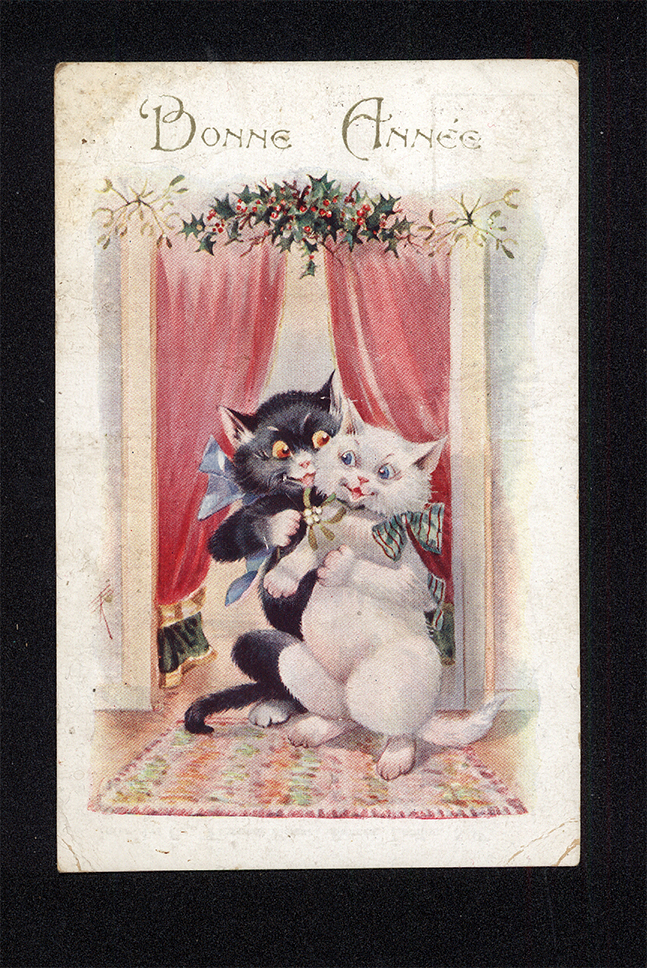
Bonne Annee!

Kute Kate #1Kute Kat #21484240_10202127843150520_1138775871_n

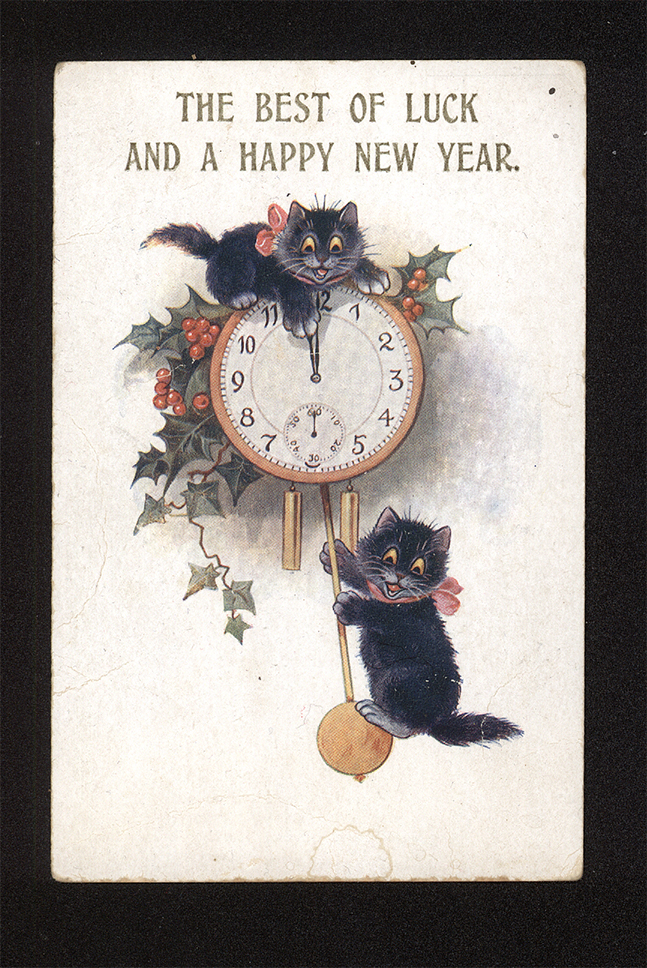
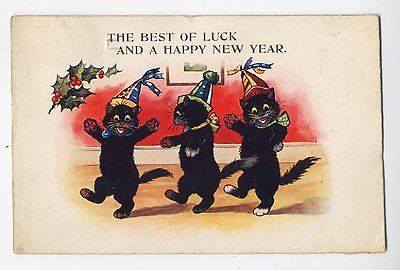
Pam’s Pictorama Post: Happy New Year! Featured here is a small clutch of New Year’s cards that I purchased last year while contemplating the then New Year ahead. The ever sensible French have a cultural preference for New Year cards over Christmas cards – thus allowing themselves more time to enjoy the holidays. I have two examples from France above and two are British. Evidently dancing black cats were all the craze for ringing in the New Year in the 20’s which is the period of these cards, ’29 (black and white cat) and ’25 (three black kitties) are the postmark dates on those that were used.

The Bonne Annee card is dated December 27, 1929 and is addressed to Mademoiselle Dora Cordova, L’rue Guy-Patini, Paris, X. The brief message, as closely as I can read it, is Meilleurs voeux et vous (?) souvenirs, Yoorssie (?) Lehmann. The other, in English, is dated 4:45 PM, December, ’25 but the day is obscured.  It says, From your Loving Sister in Law and Family with best wishes for the new year and better Luck. From Ada xxxxxx. It is addressed to Mrs. Thornton 22 St. James Street, Walthamstow.

I love the tubby black kittens – especially that party trio! But my favorite is the very mischievous brown and white fellow. He has a sort of Devil-may-care Maurice Chevalier charm about him. Quite a New Year’s bash at his house! Something makes him just short of cute. While I don’t think I am capable of tossing my habits aside and moving to New Year’s cards, I like the thought. Non-denominational well wishes for the coming year make more sense and cards arriving during the brief lull between Christmas and New Year’s or just beyond seems nice. As a small child I was always quite serious about the changeover in years – solemnly writing down resolutions, something I no longer do. Somehow I approach the whole affair with some trepidation as an adult. So, crossing my fingers and hoping for the best, here’s to 2015 to one and all!

Tricks

P#2

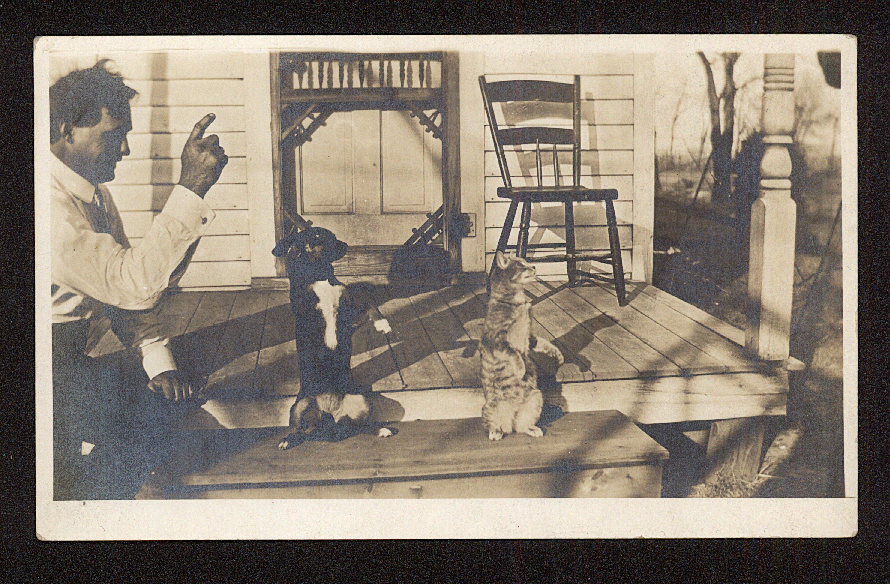
Pam’s Pictorama Photo Post: Sometimes when I look at photos like this I wonder if someone is merely recording an event (Sam does this with the cat and the dog everyday at four and I think I’ll take a photo…) or if it is specifically set-up with the photo in mind. Considering how hard it is to catch your pets doing amusing things, even with a handy iPhone camera that can be grabbed quickly, more went into getting a photo like this than we might remember today. (I know. I have been trying to record Cookie giving Kim a ‘high five’ for weeks now – she likes to do this starfish paw in the air when she is over-stimulated and wants something. Kim say Blackie will have to learn the brother handshake to keep up.)

The dog and cat seem to be looking at something – it amuses me up that they are really the same size. If anything, it seems the man’s hand is the indication for the pets to get on their hind legs, but what are they looking at in unison? (As an aside, Cookie and Blackie are the most standing on their hind leg cats I have ever had – I wonder if this is an evolutionary trait in kitties? They like tummy rubbing too.) It is a well-composed shot and I like the late in the day winter sun here with the long shadows cast of the three of them.

The card is unused and undated, although all indications of early 20th Century. Easy to see why it survived – too bad all the names and the places are lost to us. It doubles my resolve to get that photo of Cookie however.

Flying Dutch Kitties


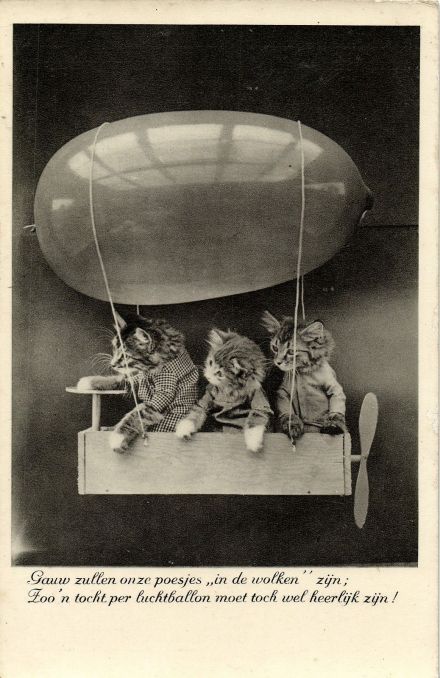
Pam’s Pictorama Photo Post: There are endless examples of early images of kittens dressed up and doing cute human-type things. However, I have never purchased one until this one hit my radar recently. It just cracks me up! As you can see by the writing, it is Dutch. A very rough translation gratis Google tells me that this is a bit of advertising and the back informs the recipient (this one not used) that the vendors hope to see them this week and that they offer high value for their orders – whatever those might be. The front makes reference to “our kitties which will soon be in the air!” (Any readers who speak Dutch please reply below!) What were these kitties selling? I’m buying!

I am always threatening to dress the cats up and take their photo – Kim begs me not to injure their dignity that way and I am brought to my senses. This image strikes me as a perfect marriage of low tech and professional – like those glorious ‘homemade’ cars and machines the Little Rascals used to have. I especially love the balloon!

I gather the key mover behind the cats-dressed-as-people movement was Harry Whittier Frees (1879-1953) – sort of a Louis Wain of early photography. I snatched the quote below from Wikipedia and it come from his own book, Animal Land on the Air, discussing the superiority of kittens as models,

Rabbits are the easiest to photograph in costume, but incapable of taking many ‘human’ parts. Puppies are tractable when rightly understood, but the kitten is the most versatile animal actor, and possesses the greatest variety of appeal. Yay kittens!

The practice spread widely beyond Whittier Frees – as we can assume this card was made by someone else. For a healthy serving of these I suggest this site on littlethings.com. I have stolen a single image from it, shown below by an unidentified photographer.

enhanced-buzz-29484-1401720903-18


The Old George

818MXFISc6L._SL1103_

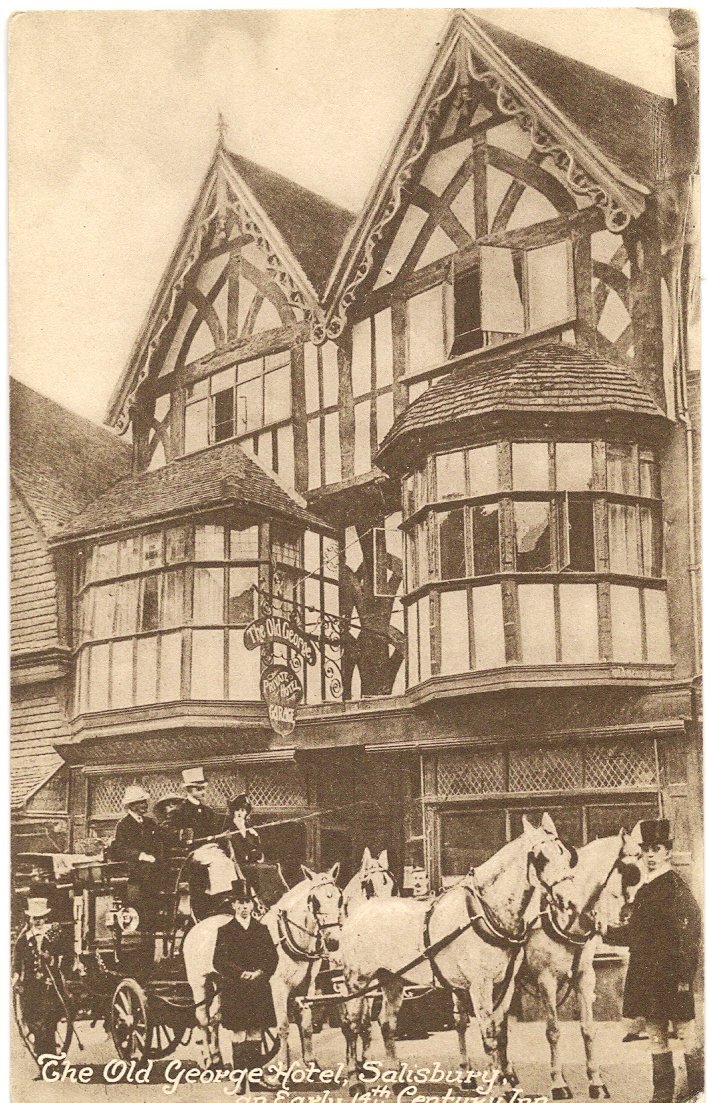
Offered as a reproduction on Amazon, The Old George Hotel, in an earlier incarnation.

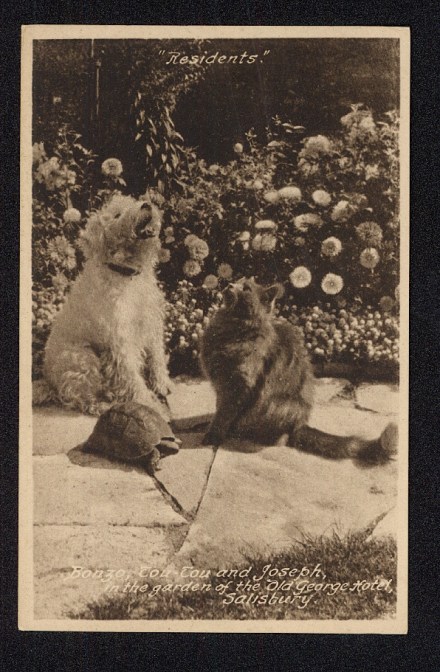
Pam’s Pictorama Photo Post: The Residents shown here are identified as Bonzo, Tou-Tou and Joseph. Silly me, I assumed the dog was Bonzo until I looked up Tou-Tou and realized it is French for doggie. So that leaves us to wonder if the cat is Joseph (my guess) and the turtle Bonzo or otherways around – or, of course, the cat or turtle could be named Tou-Tou and the dog Bonzo. Both the cat and the dog (and the turtle?) seem to be looking upward at where Residents is written – very nifty indeed.

Evidently the original Old George Hotel building dates back to 1314, although very little of it remains today – it’s ground floor knocked out to become the entrance to the Old George Mall shopping precinct. As recently as 1994 there was a restaurant, the Bay Tree, in residence – followed by the Old George Tearooms, which closed in ’09.  I gather that the building is open to the public on special occasions such as Heritage Days, whatever those might be. All this according to a BBC history site which goes on to share a short list of some of the famous guests which include Oliver Cromwell, Samuel Pepys and Buddy Holly – quite a diverse list. Pepys recorded the following in his famous diary:

Lay in a silk bed, and a very good diet…

The next day he wrote:

…paid the reckoning, which was so exorbitant…that I was mad and resolved to trouble the mistress about it and get something for the poor.

Actually, pretty tame for Pepys!  In addition, Shakespeare and his players are believed to have played in the courtyard, which had room for 50 horses. Last, but not least, Dickens mentions it in Martin Chuzzlewit. H.G. Wells has a turn in The Secret Places of the Heart referring to the Old George smoking room and he writes,

 The Old George at Salisbury is really old; it shows it, and Miss Seyffert laced the entire evening with her recognition of the fact. ‘Just look at that old beam!’she would cry suddenly. ‘To think it was exactly where it is before there was a Cabot in America!’

Of course, with the possible exception of H.G. Wells and Buddy Holly, all of this was most likely well before Bonzo, Tou-Tou and Joseph arrived on the scene and had their photo taken in the garden. (Of course, hard to tell with turtles.) No date on this photo postcard, nothing on the back. Photo postcards stopped being marketed by Kodak in 1930 although I am sure, like tintypes, they continued to be used for quite a while beyond – and since this is a promotional postcard for a hotel it could easily be much later.

In the end, I imagine it was a lovely place to stay and can see myself, drink in hand, enjoying the garden with Bonzo, Tou-Tou and Joseph and all those interesting ghosts from its earlier incarnations.

The garden at the Old George Hotel, 1928 in a photo for sale online.

Felix for a Cause

d#2

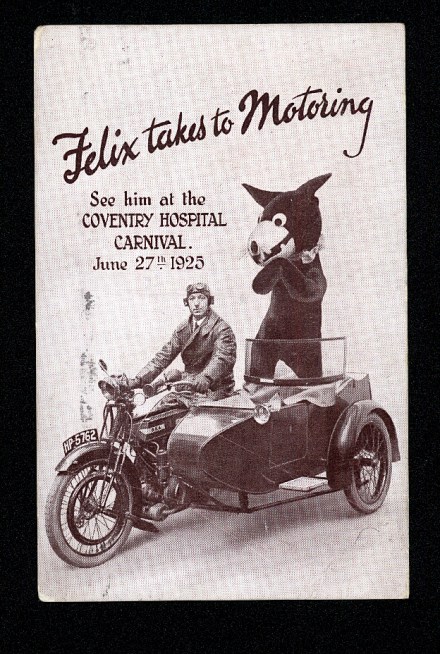
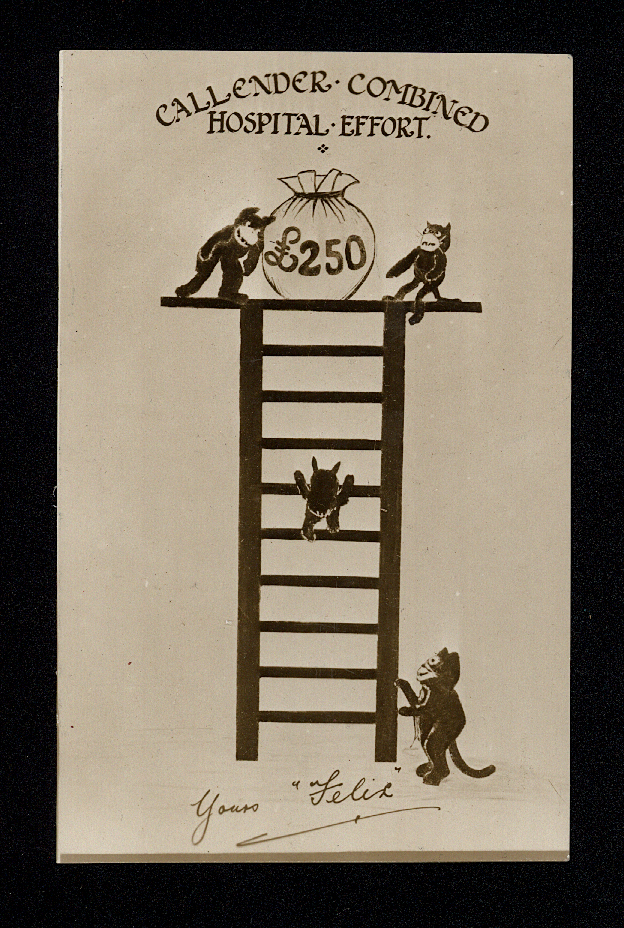
Pam’s Pictorama Photo Post: Let us return once again to Felix, one of my favorite subjects. These two outstandingly unusual and interesting photo postcards capitalized on Felix’s appeal to attract an audience for their respective hospital fundraisers (Something in my role as a professional fundraiser I can really get behind.) One can only imagine they did brilliantly – after all, who could resist Felix?

The top card, and the first I acquired, was postally used, but has lost its stamp and postmark. The following (some writing faded or rubbed away) was written on the back in pencil, addressed to Mrs. J. W. Stoodley, Folly Farm, Crewkerne, Som (which appears to be short for Somerset):

Dear Mother, ….. am glad it is much cooler now but our place is cooler inside than out. The children had their carnival yesterday, but this is the one. Will

One can’t help but wonder if you got to ride with Felix in that nifty sidecar motorcycle if you attended?  I cannot answer that question, but much to my great surprise, I found a few minutes of footage of this very Carnival in June of 1925 to support Coventry Hospital and I offer it here:


While it is minus Felix, if you watched you did see that motorcycles seem to play an interesting role. The other pressing question – is that an enormous stuffed Felix (like someday I might find for sale on eBay and mortgage my house to purchase?) or a rather excellent Felix costume? (Which I would, of course, also be willing to go into hock to acquire.)

Then, just when I thought I would never see another postcard that was comparable, the second one showed up on eBay. While it is hard to see, if you look carefully you find out that each Felix is a tiny photo of a stuffed Felix toy, collaged on. I have supplied a photo of one of my beloved Felixes of the same type, an early addition to my collection, below. I adore this particular style of Felix and much to my surprise I came across someone with an entire basket of them at the Atlantic City antique toy show. That person told me that they were prizes at fairs in the twenties and thirties. They seem too well made for that, and I remain curious but have never heard anything more on the subject.

unnamed-24

I cannot find any reference to this event – no idea what the ladder is about or what the 250 (bps) refers to – a prize of some sort.  This one is unused postally and there is nothing to indicate a date. The person I bought it from said he had no idea what it referred to nor had he ever seen anything like it. (He was entertained by the image of the other one I emailed him however.) All this to say, call in Felix when you want to attract a crowd.


Felix – Here He Is Again

Pam’s Pictorama Post: I had completely forgotten that I owned this when it found its way to the top of the pile earlier today. Evidently the successor to Felix Kept on Walking (1923) in Great Britain, and cooked up by Ed. E. Bryant and Hubert W. David in 1924 to capitalize on the success of the previous year. The full title, the grammatically curious, Here He is Again Being More Adventures of Felix. He seems to be popping out of a stage door with a rather apologetic look on his face. I gather that these songs were never used in the cartoons, but creating dance songs was a way of opening promotion on a separate front. As I mentioned recently in Musical Meow we know that a few years later in 1928 Felix was making big bucks with Fred Waring introducing a Felix the Cat Fox Trot in France.

The Felix Kept on Walking sheet music entered my collection very early on after a trip to London years ago, and I had it in my early post, Me-ow Kitty Sing A-Long. Kim is not a fan of the art of either of these pieces of sheet music, but I like having them around. (In my possession is a third which he likes more – future post.)  While I cannot offer you the tune of Here He Is Again I have two jolly Youtube versions of Felix Kept on Walking. (Full disclosure – there are several more on Youtube if you love it!) This was such a hit that the title spawned other products and further promotion, and ultimately it became something of a catch phrase. Shown here is the single Felix Keep on Walking plate from my collection. Yes, full services do exist and one of my fantasies is to replace all of our dishes with period Felix plates, bowls and mugs!

unnamed-12

.