Louise Groody with a Little Bit of Felix

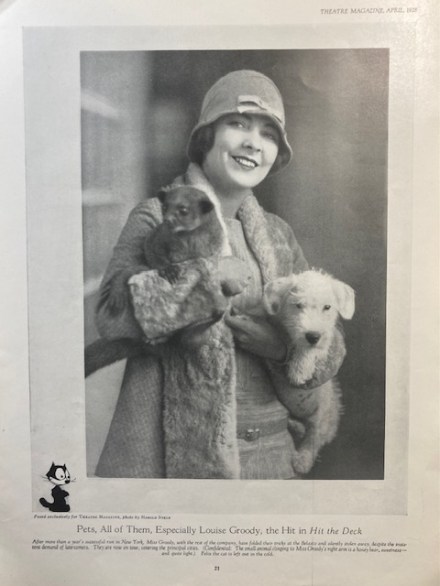
Pams-Pictorama.com Post: Today’s Pictorama oddball exclusive is this April, 1928 Theater Magazine page featuring stage star of the day Louise Groody. Shown here at age 21 by my calculation she grasps a perfectly delightful fluffy white pooch and a mysterious equally fluffy (if unable to achieve the same level of actual cuteness) creature in the other arm. She herself is dressed in fur. A very of-the-moment cloche hat covers her hair and shades her eyes in this carefully composed composition. A well trained smile outlined in carefully colored lips and revealing very even pearly teeth.

The bottom of the page reads, Pets, All of Them, Especially Louise Groody, the Hit in Hit the Deck. Below: After more than a year’s successful run in New York, Miss Groody, with the rest of the company, have folded their tricks at the Belasco and silently stolen away, despite the insistent demand of late-comers. They are now on tour, covering the principal cities. (Confidential: The small animal clinging to Miss Groody’s right arm is a honey bear, sweetness – and quite light.) Felix the cat is left out in the cold.

Hit the Deck was one of Groody’s most popular hits. Here she sings Sometimes I’m Happy from the show.

The little Felix is odd – no idea really why he is there, arms folded, smiling. Below him it says, Posed exclusively for THEATER MAGAZINE, photo by Harold Stein. He is indeed the little bit of Felix in this photo and post. (He does not appear on the back of the page where there is a similar of June Collyer.) Just a small paid advertisement? An inside joke about the show long forgotten? I wondered that about the dog and baby bear too – did they have some bearing on the show? Or does she always travel with a menagerie? A quick look at the storyline of the 1955 film version doesn’t show any reason for a baby bear. And no, Felix does not seem to have appeared in the show!
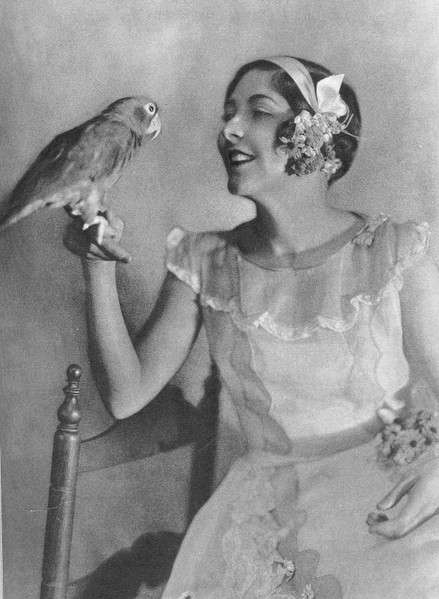
Unidentified photo of a young Louise with a parrot, continuing the pet theme.

According to Wikipedia, Louise was on the stage and discovered in her teens. Groody was in ten Broadway shows, four were major hits with hundreds of performances. The same article claims that Hit the Deck was a favorite of hers. She was perhaps best known as Nanette in No, No, Nanette and for her rendition of Tea for Two, although I was unconsciously familiar with her singing Sometimes I’m Happy.
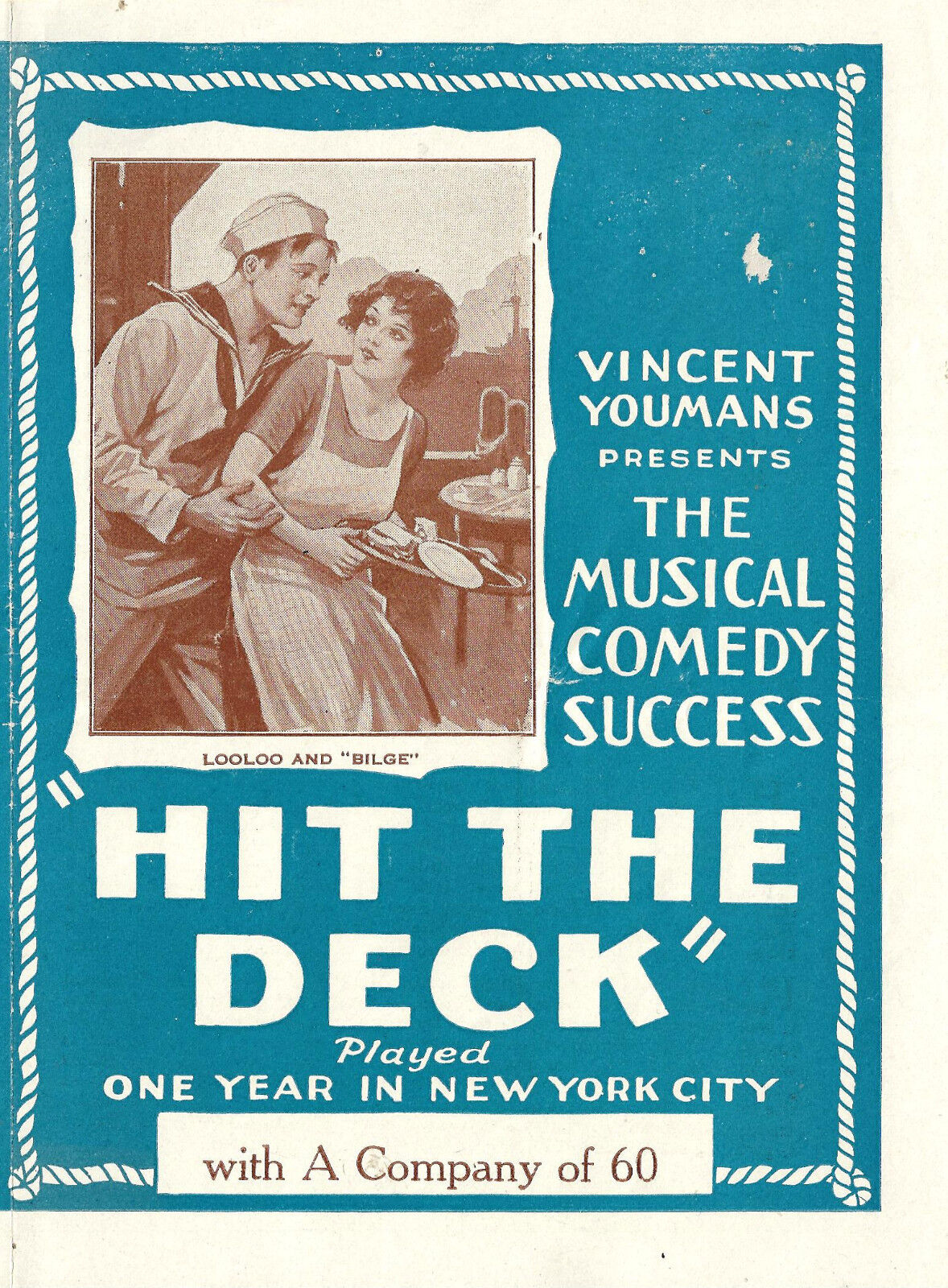
Kinda looks like Louise here. LooLoo was evidently one of her favorite roles.

Louise married a few times. Number two was a shyster who chiseled money out of folks, her included – although she was originally named in the indictment. She divorced him while he was in Sing Sing and moved onto husband number three who seems to have stuck. Groody made a pile of dough in her early years on Broadway, subsequently lost most of it in the crash, but continued to work and lived affluently again by the forties. Louise joined the Red Cross during WWII and has a small discography of early recordings. As far as I can tell, she doesn’t appear to have much of a film career, although I can’t imagine she wasn’t in any films before becoming a fixture on early television.

As for Felix I can only say that he was so ubiquitous in 1928 that even a theater publication was sneaking him in, odd considering that in some ways film was slowly eating into and ultimately eclipsing their business. However, in 1928 no one seems to have been able to resist his charms entirely.

Felix, Keeping It Clean

Pam’s Pictorama Post: Today’s post is the last piece of the advertising haul from Britain I started posting about a few weeks ago. (That post and some great ads can be found here.) Persil, the subject of today’s post, is a British detergent which is still quite extant today. This ad is from an unknown publication, but dated May 24, 1924.

It was founded in 1907 and according to an internet article Persil claims to be the first first self-acting detergent. Its revolutionary formula that released oxygen during washing made strenuous rubbing of the laundry superfluous. According to another site it mixed a high oxygen soap with salt into the detergent which caused a chemical reaction that cleaned clothes without damaging or scrubbing. This is of course something we take for granted today, but quite revolutionary indeed when you think about it.

A couple of these clocks appear to survive in Germany. They are wonderful! I guess to remind you that Persil would save you time?

Persil got its name from its original ingredients: Per from Perborate and Sil from Silicate. Originally the Persil powder had to be stirred into a paste before use. At the bottom of this ad it announces that you can write for a free booklet which tells how to use Persil. At first I wondered why you would need a booklet with instructions confused me at first, but after the outline above I realized it was perhaps a bit complicated.

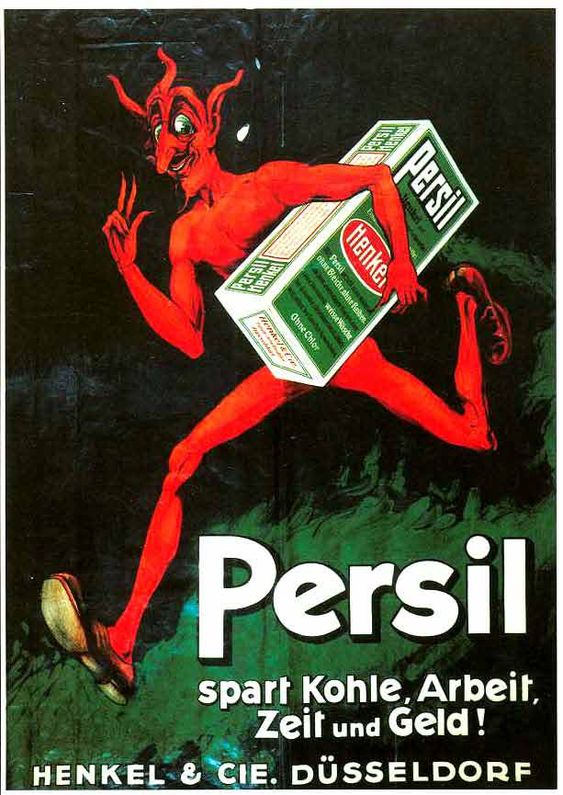
A slightly earlier German advertisement with an even more Devilish mascot from 1914. The copy roughly translates to saves coal, labor, time and money!

The tie-in to Felix is a somewhat elliptical one – Time for the pictures on wash-day. Felix is perhaps a bit more off-model than usual, mouse dangling in hand and the writing on the film poster, beyond his name, is gibberish. The little girl looks at him joyfully while a well dressed (and well-heeled) mom pays for the tickets to someone who is barely part of a face behind the ticket counter. The jolly jacketed usher has his back to us.

The copy reads, Time for the pictures on wash-day – Of course there is. She wouldn’t miss Felix for worlds. So she hands over the washing to Persil. That means five minutes for getting things ready, and thirty minutes for Persil to do the work. Out come the clothes, clean, fresh, white and undamaged, and off she goes with a clear conscience and a clear day.

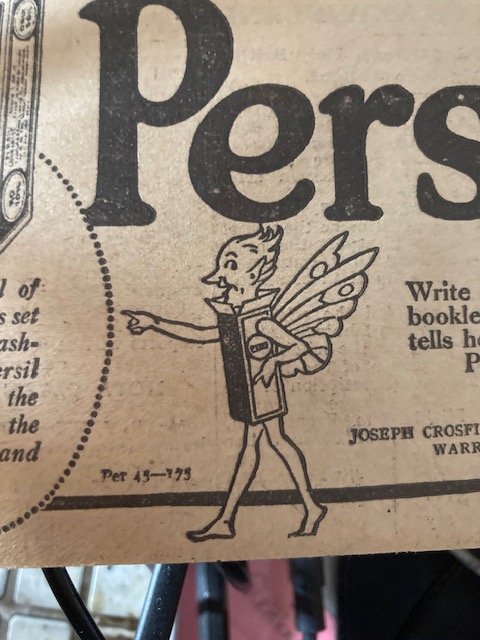
Detail of ad.

Persil’s mascot, the early ’20’s version, is down at the bottom, odd little fairy made of a box with wings – less sly than the Devil above. He’s barefoot and is all pointy ears, nose and hair. Oddly, and it may be my own inferior search skills, I cannot find any information on his history or why he was composed this way.

The advertising I have supplied here was the most notable I could find on the internet so Persil didn’t go in for a lot of premiums or campaigns, that survive anyway. The green box shown here held by the friendly Devil was their persistent look into the mid-twentieth century when they eventually morphed to a plastic jug and presumably stopped being a powder.

I assume that Felix picked up his paycheck for this and kept it moving. Lastly, for another real eyeball kick, check out my other Felix advertising post from a few weeks ago – a rare, entire short comic for Sportex shirts – which can be found here. Enjoy!

Sportex: Felix Meets His Match

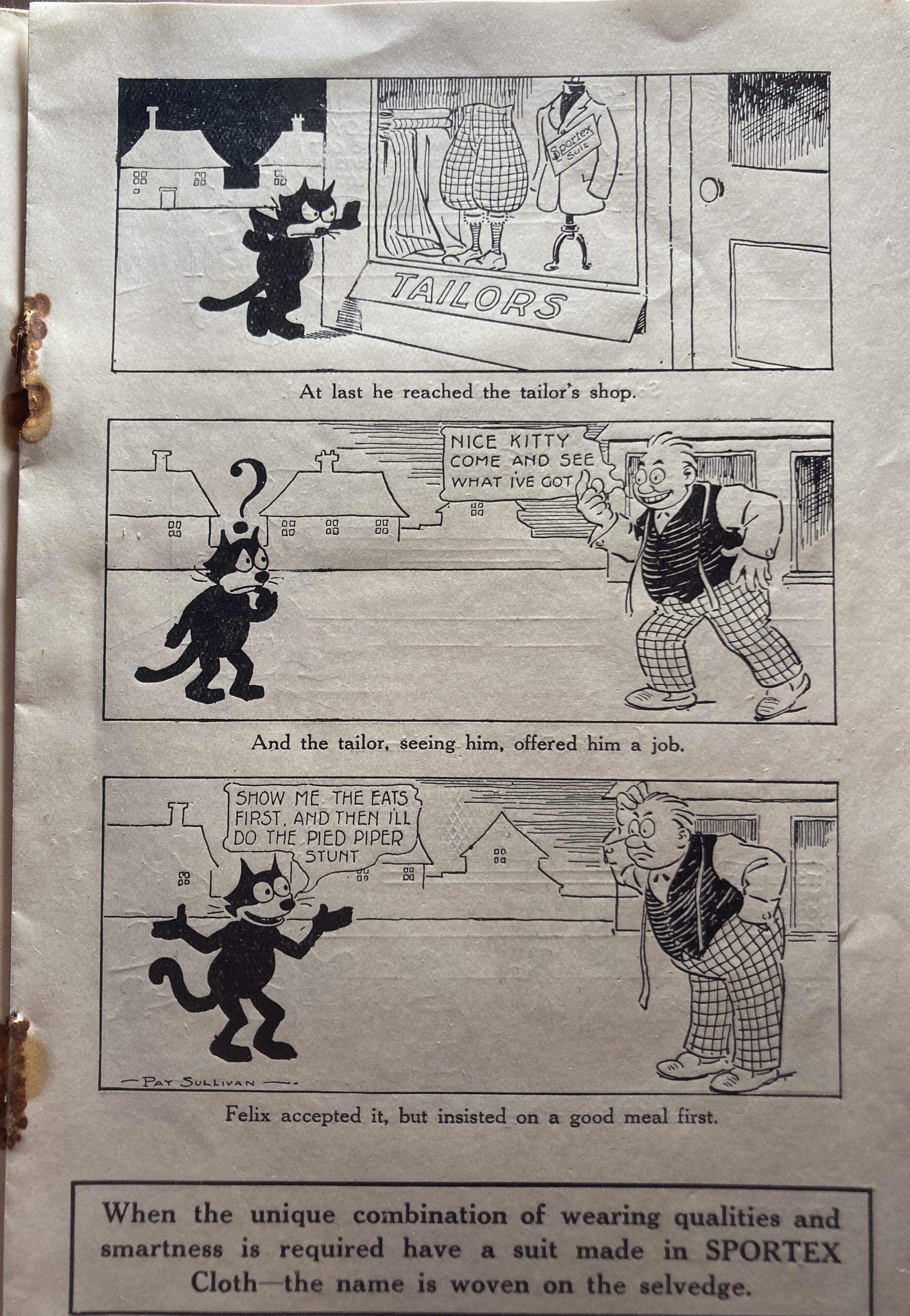
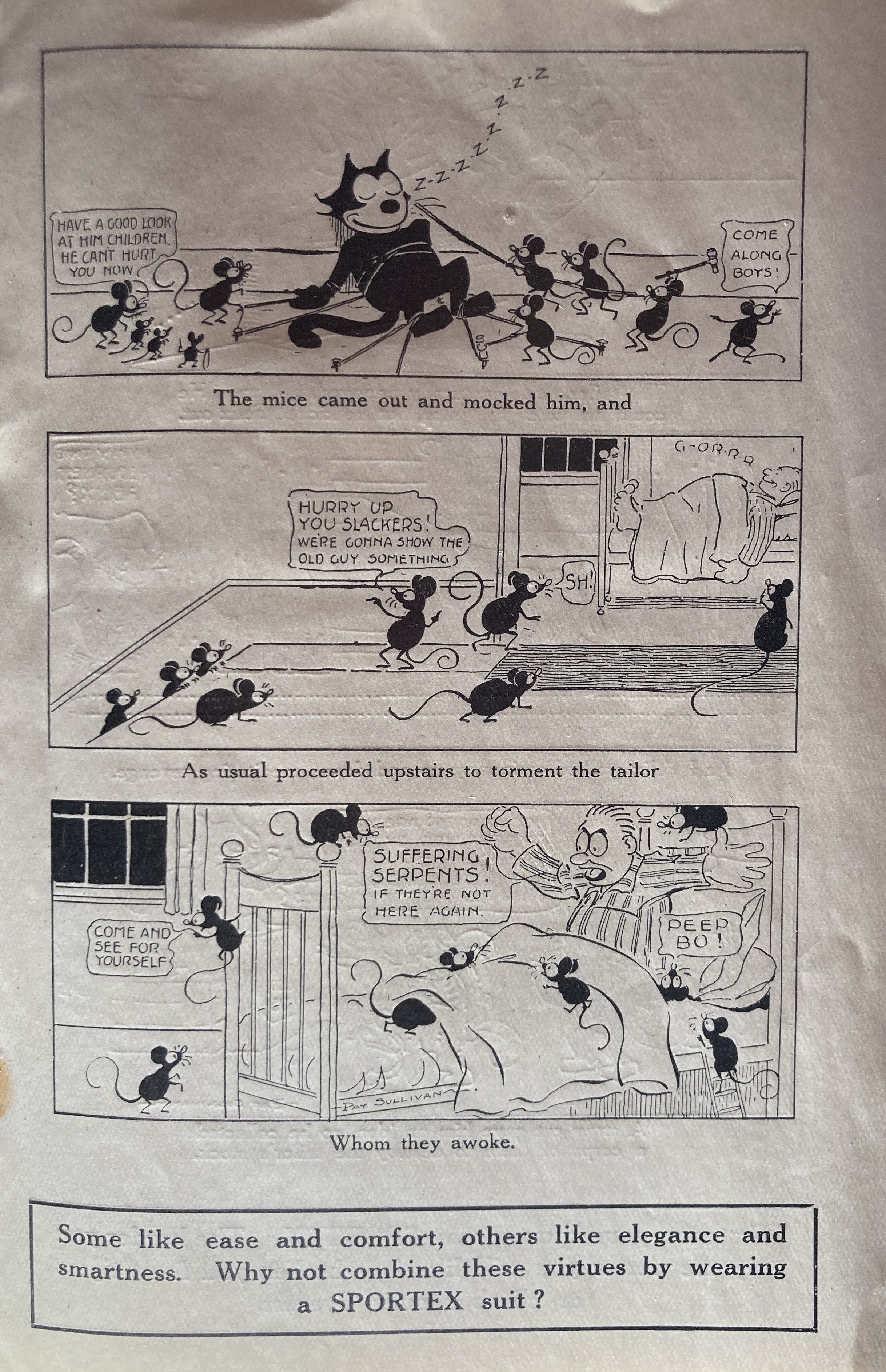
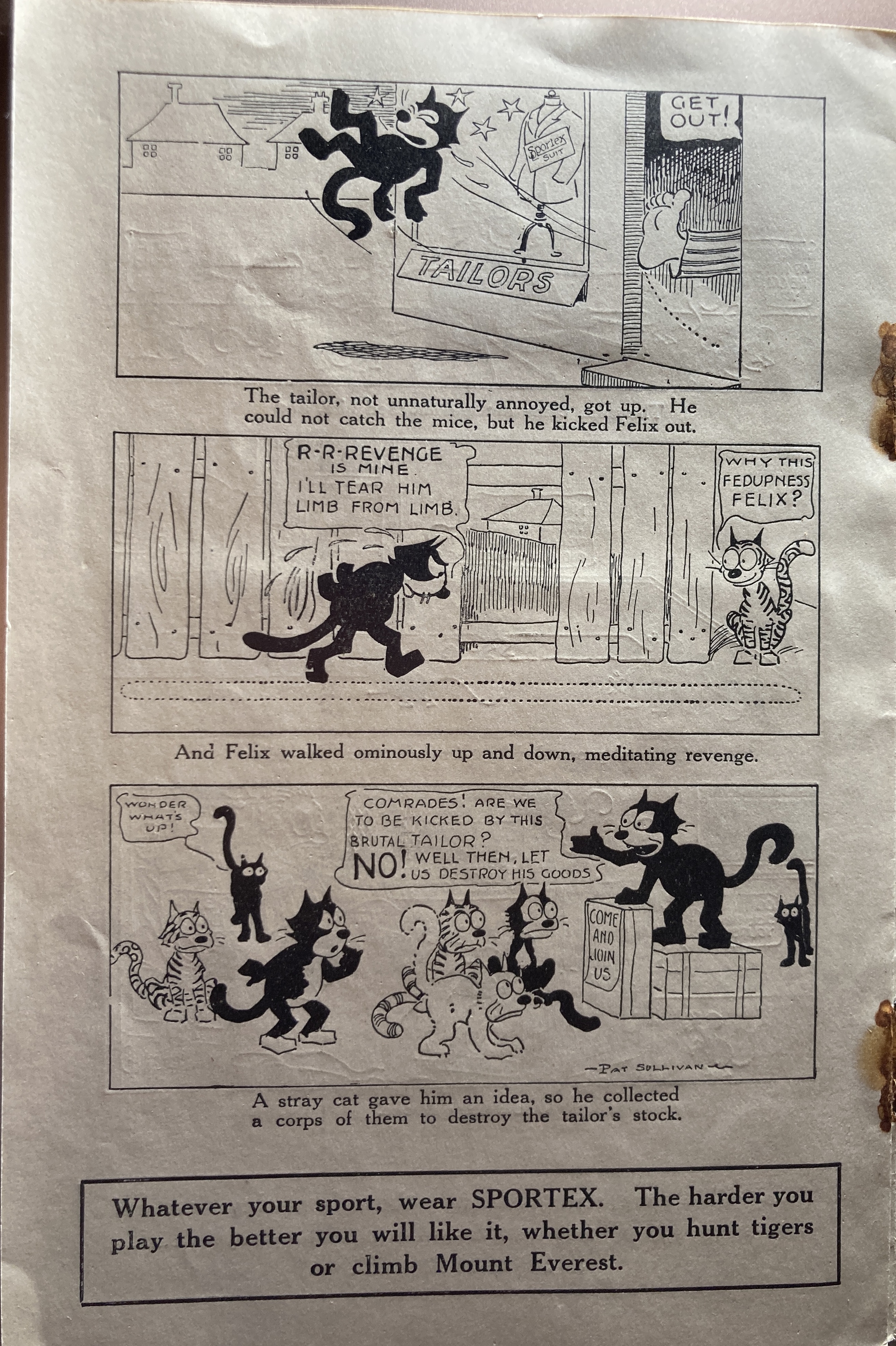
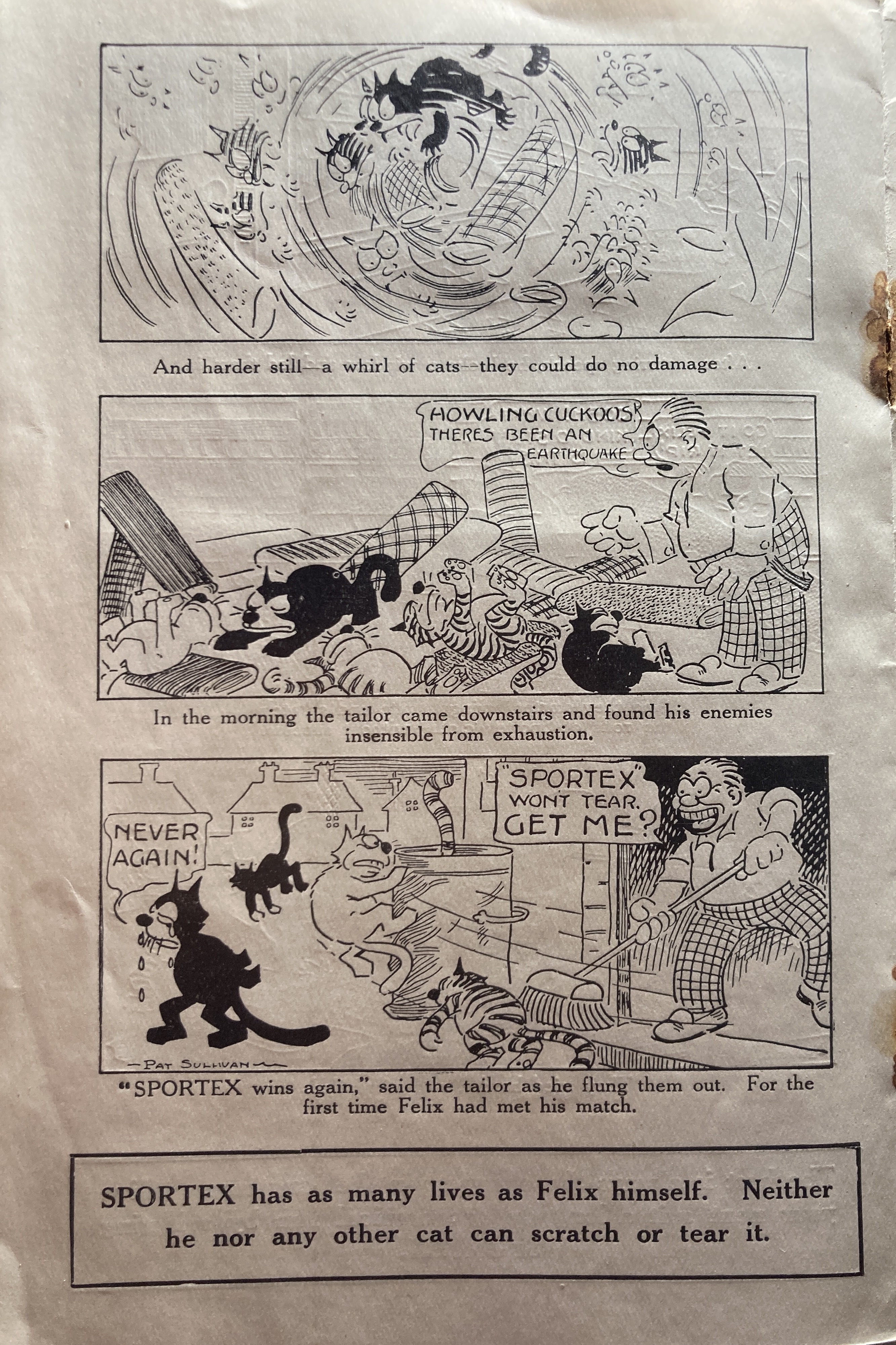
Pam’s Pictorama Post: Yesterday I shared a rather wonderful wind-up bear which came as part of a buy from a British auction in July. I alluded to a small but rather magnificent box of Felix items which I have been lovingly posting about over the last few months. (See yesterday’s post which rounds up the earlier ones too here.) This is the final goodie disgorged from that buy and arguably the most interesting, a Felix special comic as advertising for Sportex Fabric.

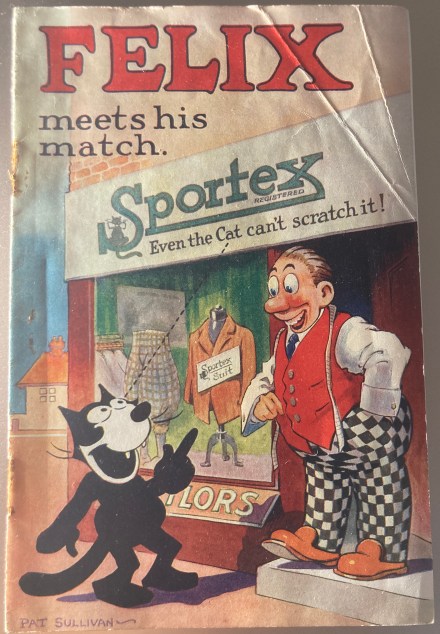
Sportex was evidently a miracle sports clothes fabric invented in Scotland in 1923 and it would appear that they are still making men’s sportswear today. Even in its earliest incarnation it was said to be a durable, creaseproof fabric for sportswear. As the cover of the comic hails, Even the cat can’t scratch it! For those of us who groan over the pulls in our sweaters and the holes in our trousers made lovingly by our kits, this holds some real appeal and you know this advertising campaign was spearheaded by someone who had cats. Evidently they even made suits out of it so not just sport shirts or athletic wear.

The comic book story goes something like this:

A tailor is tormented by very cheeky mice in his house which eat his dinner and annoy him, dancing around and mocking him while he tries to sleep. The next day he runs into Felix, who is on hard times and for the price of a meal agrees to come to the tailor’s house and rid him of the mice. However, he is so redolent with food after the meal that he falls into a sound sleep and is subsequently tied up Gulliver style by the mice (these are the most entertaining pictures for me) who, after making fun of Felix resume their tormenting of the tailor. The tailor kicks Felix out unceremoniously upon which Felix forswears revenge on him. This revenge takes the form of inviting other cats in to shred the wares of the tailor. Alas, the fabric is Sportex and the cats are unable to shred it! They fall in exhausted heaps (another especially good picture) and the tailor sweeps them out the door.

Along the bottom of each page you can see some Sportex facts such as Sportex was awarded the Grand Prix, Paris 1924. (Were the drivers wearing Sportex? Sponsored by them? I couldn’t find out.) On the back of the book, above a forlorn looking Felix in verse it states, Sportex defies the toughest stains – No cloth on earth can match it/A pin drawn sharply over its face/Will simply bend and leave no trace/And “Felix” and his feline race/Can neither tear nor scratch it.

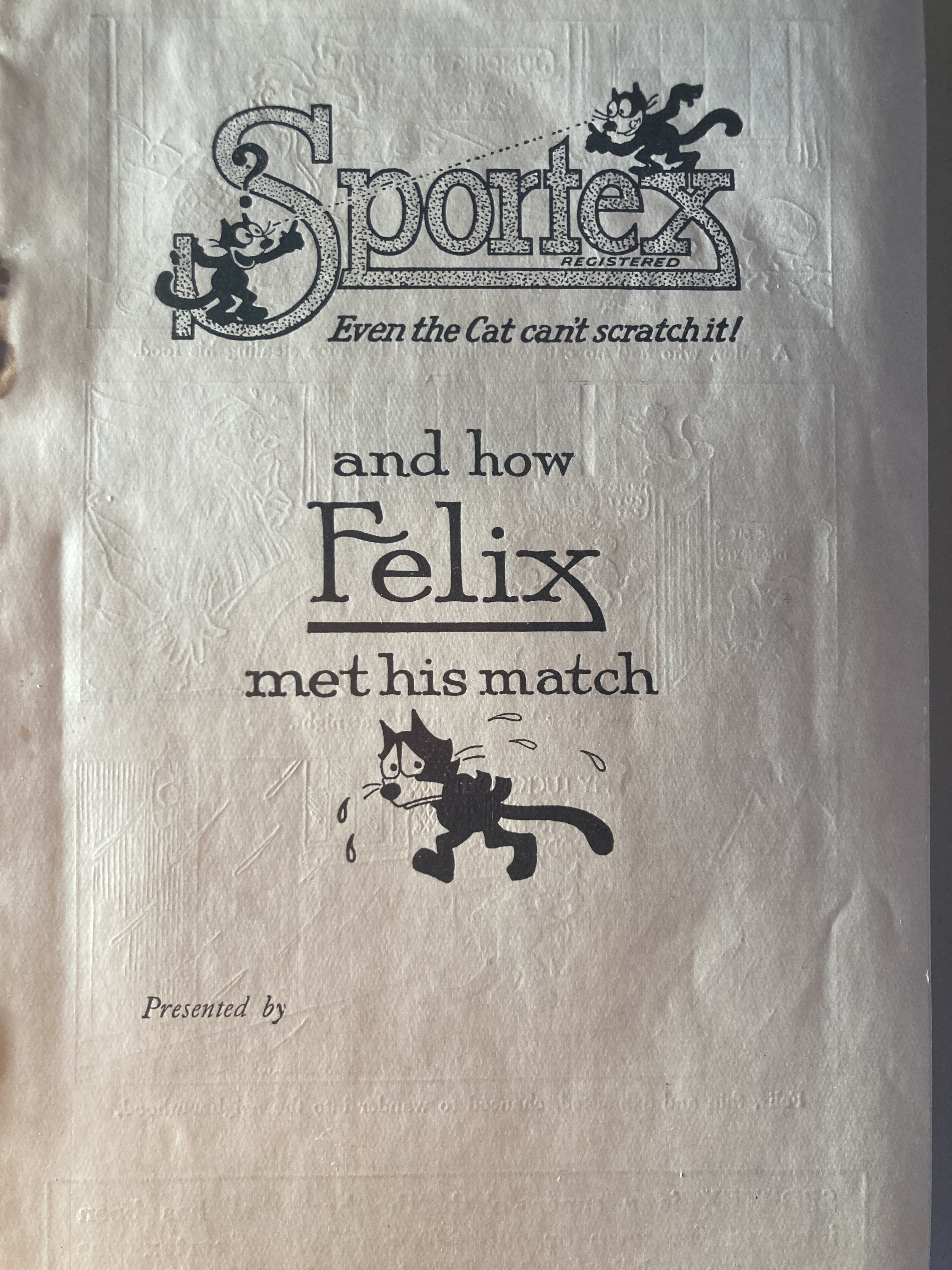
Copyright is printed on the back but without a date. It was Designed, Engraved and Printer by Henry Stone & Son. Ltd. London and Banbury, England. On the front flyleaf there is a spot for Presented by and presumably this is where a salesman would put his name when he left the book. In this case it is blank.

The Felix drawings appear are credited to Pat Sullivan (see the cover) and are in the earliest blocky Felix design style with squared off feet and a toothy grin. The mice are consistent with the way they were portrayed in the earliest cartoons too.

Felix was of course no stranger to his sideline as ad man. One of my favorite shills is an entire cartoon done for Mazda car lamps which I featured in a post here. Meanwhile, his slightly off-model dopple ganger was featured in a bit of low rent Spanish advertising for girdles in a prior post here and a children’s laxative here. Obviously he did a lot of advertising for his own films and I’m sure a lot more will show up here at Pictorama.

I tried but I couldn’t find any tracks on the internet for this item, nor had I seen it before. I’m glad I could bring it to my Pictorama readers in all its glory!

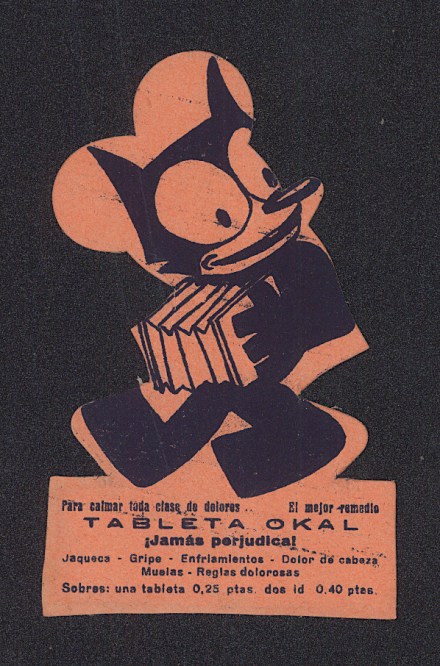
Tableta Okal

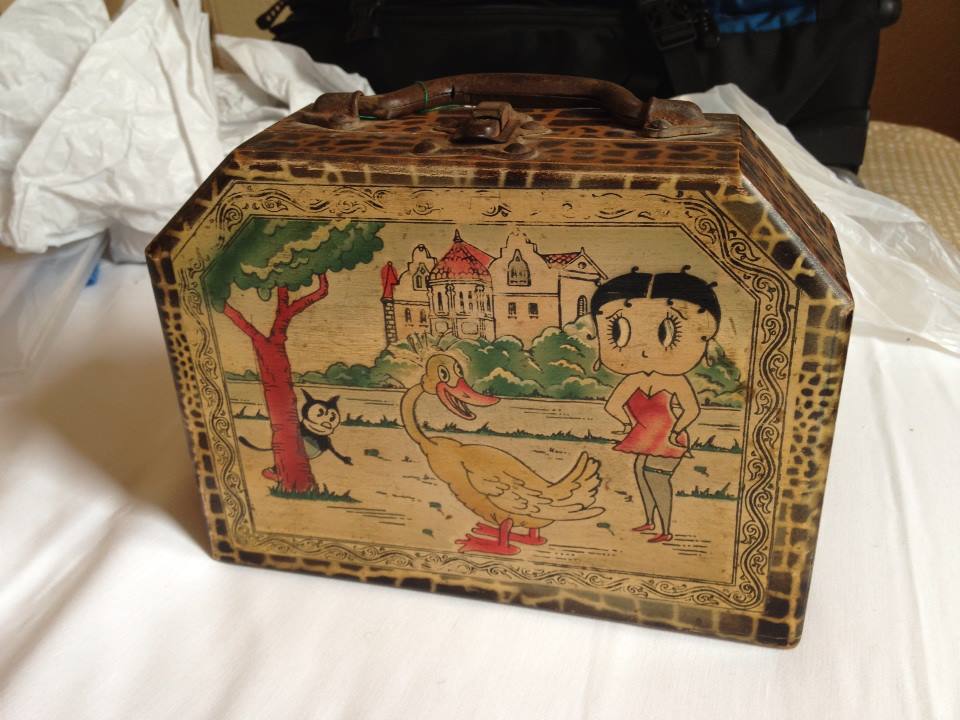
Pam’s Pictorama Post: This very odd bit came up on eBay recently and it was decidedly more interesting than good. There seems to be something of an influx of Spanish related Felix items being sold be an American seller or sellers and I have dabbled a bit, but mostly watched from the sidelines. I did purchase and write about Periquito, the Spanish Felix of Chocolate Cards awhile back, and recently a different line of chocolate cards has also appeared which may eventually lure me in. There’s also a brand of very appealing and rarified off-model Felix decorated tin toys which is extremely high end. Unlikely I will add any of those to my collection, although I never say never. I have wondered if the item featured in The Strangeness of French Betty and Felix (and shown below) while purchased in Paris and wooden, not tine, wasn’t actually of this origin, but it is without maker’s mark so I cannot say for sure.

943394_10200675105912997_1975051838_n

As many of you Spanish speakers probably already realize, this card actually advertises a children’s laxative. Ick! It has employed the double whammy of invoking Mickey Mouse’s shape along with (a version of shall we say?) of Felix playing an accordion. Since children, Spanish or otherwise, don’t tend to buy their own laxative I wonder a bit at the practice.  We will assume if asked Disney and Sullivan wouldn’t have approved of it. I have devoted many posts to the various ways that Felix was pressed into service by ambitious advertisers of generations past. Meanwhile, this item is also a clear descendent of the Victorian trade cards I have written about, although clearly not so lovingly lithographed as those in Bogue’s Soap.

Gratefully I do not remember a parallel item in my childhood. I do remember bubble bath in child friendly character containers, which is clearly far more benign. By the time my brother, almost seven years younger than me, arrived on the scene advertising tie ins had graduated to child themed cereals – Count Chocula being an example and vitamins in the shape of, if I remember correctly, The Flintstones. Of course we live in a different world of advertising (well, of almost everything I sometimes think) and we now have everything from Gummy Bear Hair Vitamins and melatonin (thank you Eileen for pointing those out recently) to Choco Chimps Organic cereal, which I guess has taken the place of the aforementioned Count Chocula? Caveat emptor I say! But let the collecting continue.

Felix Sells

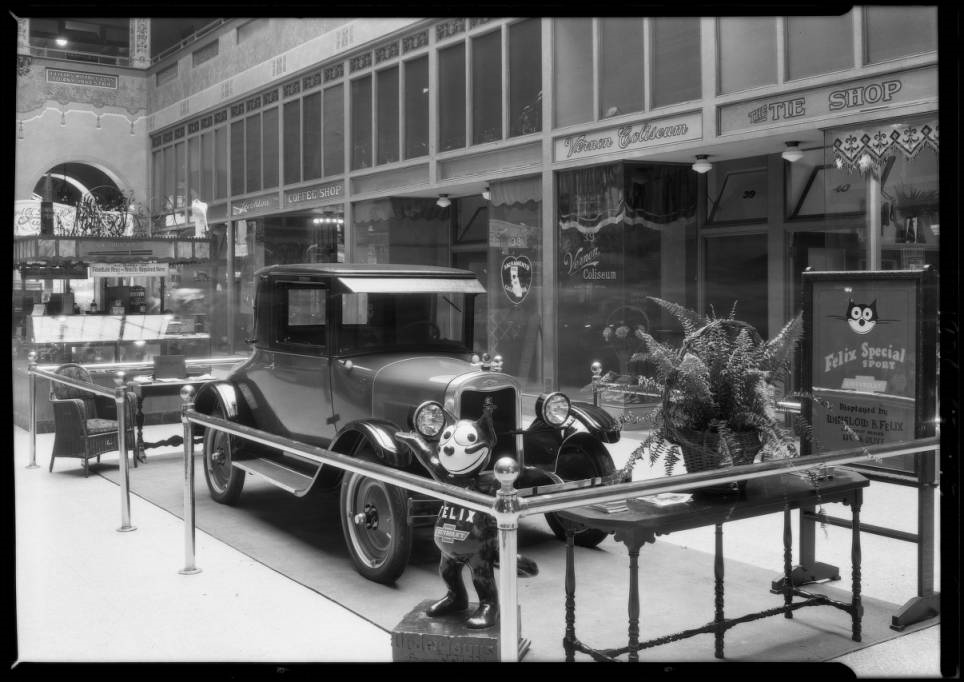
Pam’s Pictorama: Today I am breaking my own blog rules to bring you a Felix post on a subject I find interesting, but unlike my usual posts, I (sadly) do not own any of the photos or items shown in this post about the brief history of the Winslow B. Felix Chevrolet dealership in Los Angeles.

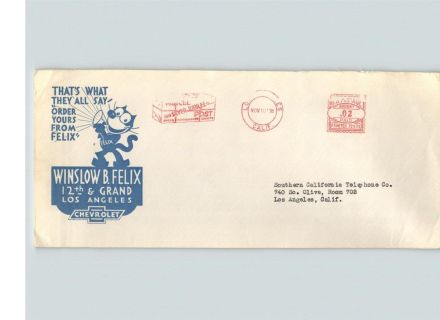
Living on the other side of the country, I have never had the pleasure of seeing the neon Felix sign in person. As a collector of Felix images I have been aware of it for many years and wouldn’t mind making a pilgrimage one of these days. However, it is the early images of this advertising relationship that really provokes my interest. Shown above, an envelope (currently for sale on eBay as I write this) with an impressive Felix logo. Postmarked November 10, 1938, with two cents metered postage and addressed to the Southern California Telephone Co. (begging the question, why and how did it get saved?) it got me thinking a bit. By coincidence, Kim had just pulled the photo below off of Pinterest to show me and share on Facebook so we had just been discussing the dealership.

tumblr_nqjfmy16u01rvj62ro1_500

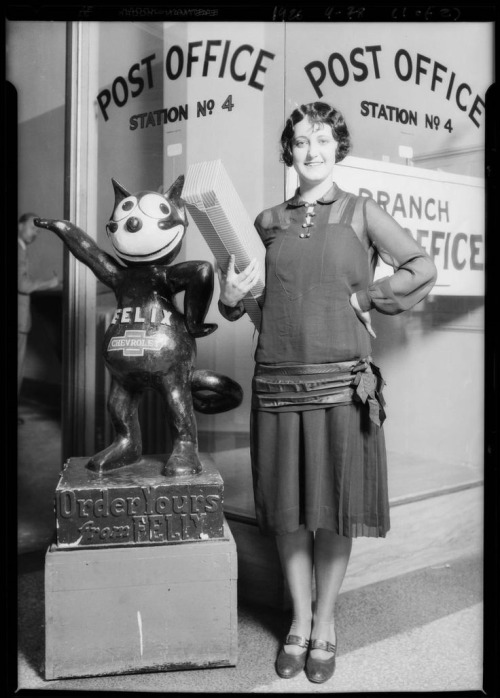
This is quite curious, the woman, holding a package, is posing in front of the post office, with this wonderful Felix who not only has the Chevrolet sign across his tummy, but boasts, Order Yours from FelixI doubt the post office was planning on delivering them, but this three-way advertising bonanza remains a visually pleasing mystery to me as well.

As far as I can gather, it seems the story of the Felix Chevrolet advertising goes something along the lines of this: Winslow B. Felix was a bit of a genius at inventing advertising and selling ploys for his dealership. As the inventor of sales innovations such as the two-day trial for new cars, asking his friend Pat Sullivan for the use of Felix the Cat’s image for advertising – the deal sweetened with the gift of a new car – was a natural. Soon after Felix makes his first appearance on behalf of Chevrolet in 1923 with signs, stationary, statues and who knows what all evolved that is lost to us. Shown below is another one of his advertising tableaus snatched from the Google image file.

8576249344_db64ebee10_o

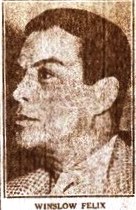
Sadly, a victim of living the high life, Winslow Felix died of head injuries following a polo accident in 1923. He was only 42 years old. Clearly his marketing lives on today. Apologies for the sort of dreadful photo of him below – he deserves better – but it was the only one the internet coughed up for my use.

61101864_1412304138