The Devil’s Circus

Pam’s Pictorama Post: Today I have an unusual post and not just because it is a dog day, but I am going down the rabbit hole of silent film, an occasional tributary. However, it has been a very long time since the films of Deitch Studio have been up for discussion. Those of you who know us, or have been readers for a long time, know that silent and early films are among the programming here at Deitch Studio. There are lots of film links and recommendations here so get ready.

While I have devoted some space to silent cartoons, stills like this one are most likely to turn up in my collection. My affection for Frank Borzage has lead me to several (nonanimal) acquisitions which adorn the walls here (posts about those can be found here and here for starters) and of course Felix, who posed with a number of actresses of the silent era, is robustly represented on our walls. Dogs do occasionally turn up and a post with Peter the Great can be found here based on a still of him with Bonzo. Sometimes even short stories of the period lead to a silent film discovery such as in this post here.
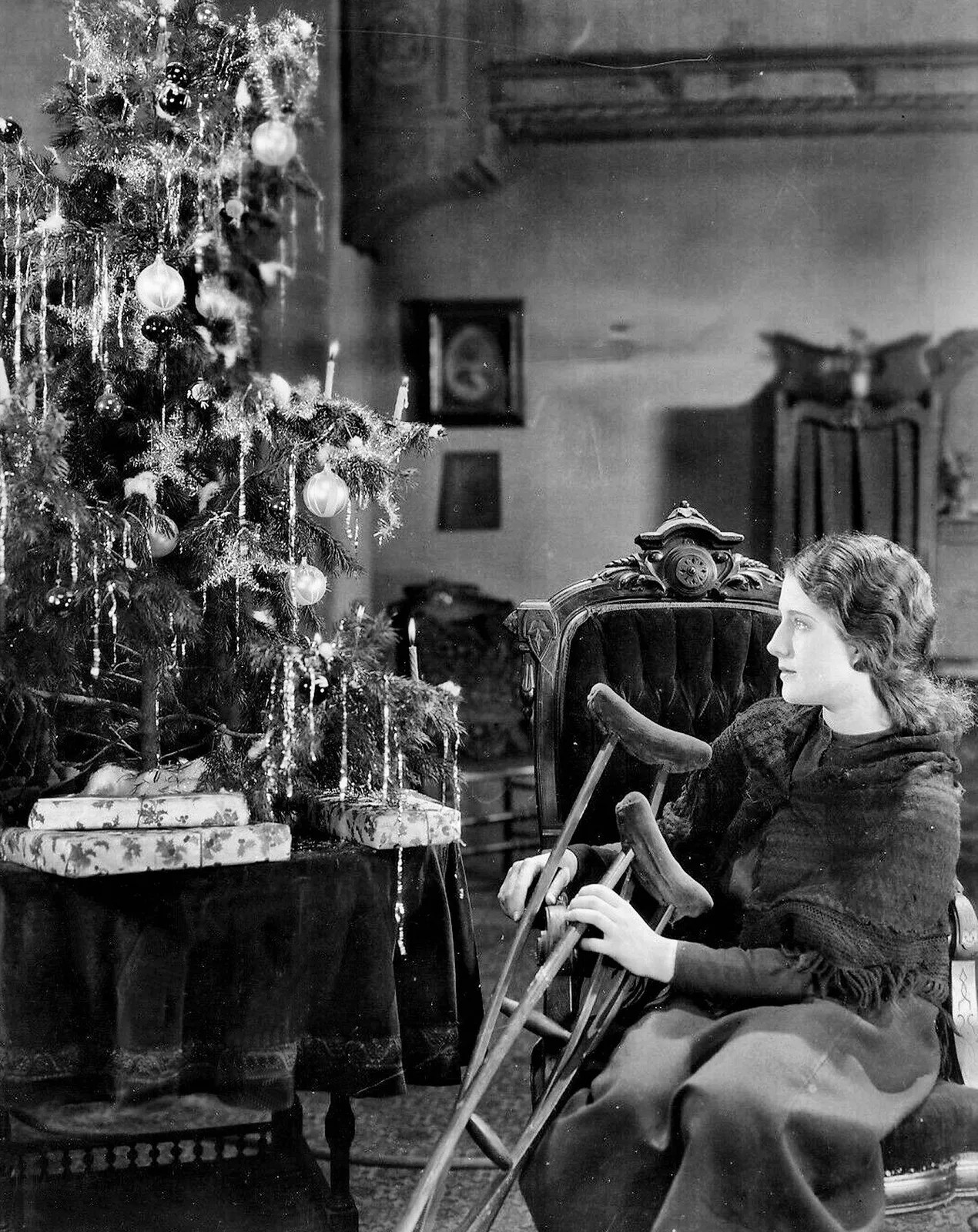
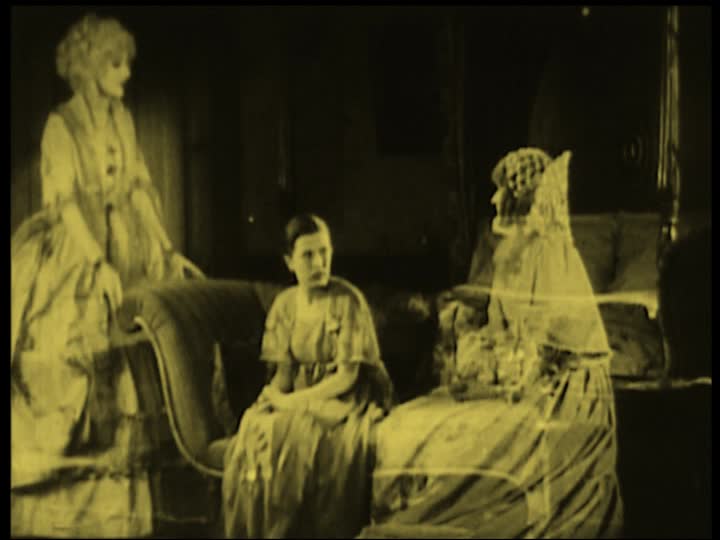
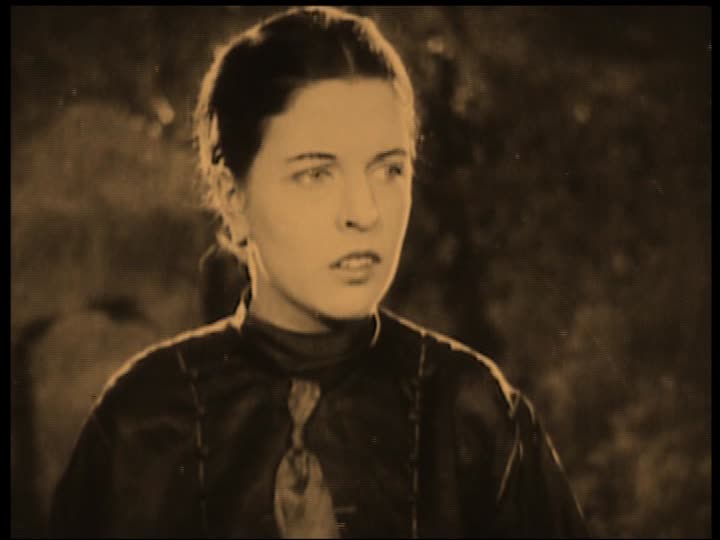
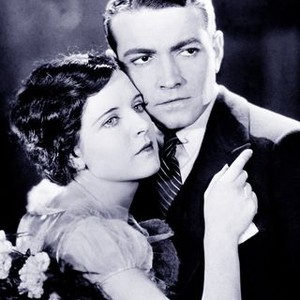
Another still from The Devil’s Circus. Not in Pams-Pictorama.com Collection.

Today we started with the film, not the photo which was acquired after. Recently Kim stumbled on this splendid Norma Shearer silent film, The Devil’s Circus, a 1926 film which neither of us had ever seen or heard of. We watched it on Youtube and a stunningly gorgeous print can be found there. I am unable to share the link but it is easily searchable there. (There are some much lesser bad print versions so look for the one in excellent condition.)

Directed by Benjamin Christensen, a young Norma Shearer is already getting her name above the title in this drama with co-stars Charles Emmett Mack and Carmel Myers well below. (Full credits for the film can be found on the IMDb database here.) A 24 year old Norma Shearer is playing a bit younger as a girl who, with her dog, is looking for work in a circus in a non-specific European locale, when she meets Mack and they become a couple. I won’t spoil the plot for you, but there are great circus scenes and my only complaint is that is would have been even better if Mary had come with a dog act for the circus because this little fellow was up for even more screen time. Buddy the dog emerges as the star of this post today, but really, I can’t say enough good about this film. Run, don’t walk, to Youtube to watch it.

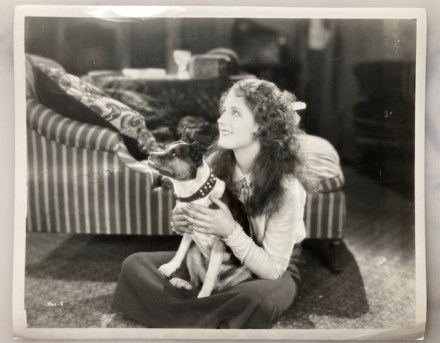
Buddy does his turns admirably with Shearer for about half of The Devil’s Circus and we miss him when he’s disappears. It is clear that they clicked together and he is very believable as her pup. This photo Kim found on eBay embodies it best – the two of them looking together off screen, joyfully ready for action. This photo was identified as having come from a print made in the 1970’s but it must have been from the negative as it does not appear duped. It came from the Marvin Paige collection and he was evidently a longstanding casting director in Hollywood. It is identified only with the name of the film written in pencil on the back. Additional photos of Buddy are not easily available online and are probably best found unidentified in film stills like this one.

The story goes that Buddy, a stray terrier or terrier mix, was found and trained, and was well into his film career when he made The Devil’s Circus. His working life seems to start back in a 1923 film call F.O.B., a Lloyd Hamilton short. (It’s unclear if F.O.B. still exists; I cannot find it at this time.) His big break was with Charley Chase in something called Speed Mad (1925, while prints appear to exist I cannot find it to show at the time of writing) and then he’s off to the races with one called What Price Goofy in 1925 where his name morphs from Duke the Dog to Buddy the Dog and sticks.

So his early days and his entree into films seems to be with Hal Roach and Leo McCarey. All in he makes about 25 films, a mix of shorts and features, from 1923 to his last film credit in 1932 in the sound film Hypnotized also linked below. The Devil’s Circus appears to be right after his rechristening.

So there you have a capsule history of film dog star Buddy, a somewhat forgotten but very talented canine from the early days of film and ample examples to watch him at his craft. Settle in and have a little film festival (like we are – catching up with these additions) celebrating this fine fellow.
Amazing! Aesop’s Additions

Pam’s Pictorama Post: Pictorama readers may have sussed out that there are strata to each of my areas of collecting. Photo postcards of people posing with Felix rate very high but people posing on giant black cats are a bit more due to rarity, a stuffed Felix that I have not seen is extremely rarified and I haven’t purchased one in years.

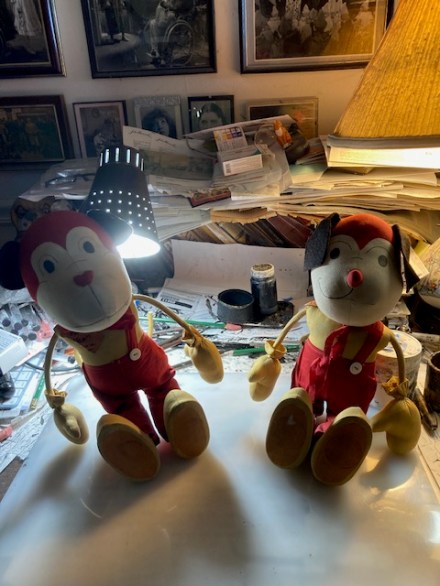
Yet somehow an Aesop Fable doll that is sufficiently unusual and requires purchase these days is a whole other thing. I don’t think I have purchased a doll since I scored one in a box back in 2018. And today I have not one but two, purchased together, and seem to be of a piece. While my longstanding lust for these toys has been documented back to 2014 and the early days of this blog, the most recent acquisition before this was a bit of ephemera, a piece of related stationary, in 2019 and can be found in a post here. A purchase of these is unusual indeed.

Unlike the off-model madness that was Felix production at one point in Great Britain, the production of these dolls was limited to, I believe, one company and a brief period of time. Therefore the survivors are decidedly more finite. As someone who has been purchasing them, and the occasional related item, for a few decades now, I rarely have the opportunity to make a significant purchase. (To be clear however, I am still searching for some of the cast including Milton Mouse should he make an appearance among others.) Notably though, the other morning, a listing for these showed up in my inbox and as seems to often be the case, with utter disregard for the well being of my bank account (Kim made a contribution), something had to be done about it immediately.

Before I get to the heart of this today’s story allow me to backtrack a bit further for anyone who is just entering the fray and encountering these toys for the first time. These items were made based on Paul Terry’s Aesop’s Fable cartoons of the 1920’s and early ’30’s – a delightful never ending saga of cartoon cats, mice, bears and other animals in a world dominated by them and the occasional visage of a human, often the frustrated Farmer Al Falfa. In some ways they represent my ideal of silent cartoons.

A sample of the cartoons can be found below.
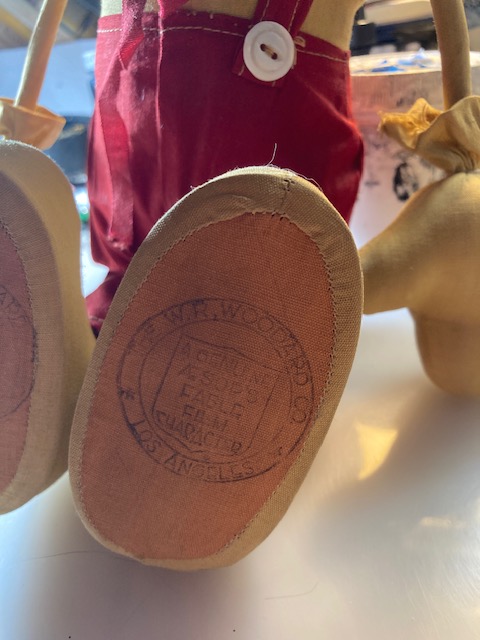
However, if the scant information the internet provides about the W.R. Woodard toy company of Los Angeles is true, the production years of the dolls seems to be limited to the years of ’29 and ’30 – the years of the company’s existence. (A post about the company and an original box of one of the toys which helped me research it can be found here.) These recently purchased additions seem to clearly beg to tell a story as well.

As far as I have been able to tell, there was always a certain amount of variation among these dolls. For example the Princes (cat) toy seems to bear several versions of skirt. Sometimes other outfit swaps are made and maybe a bit of variation even on features. I have an especially prized possession which is a variation on the Princess made for a theater raffle. A post devoted to her can be found here.

The same standard company stamp that is found on the standard toys.

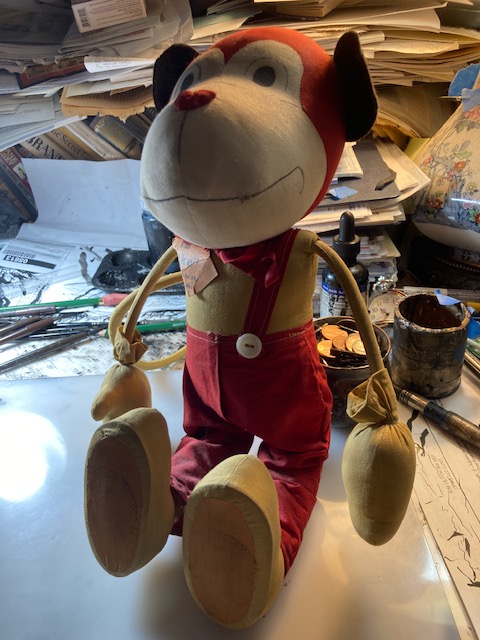
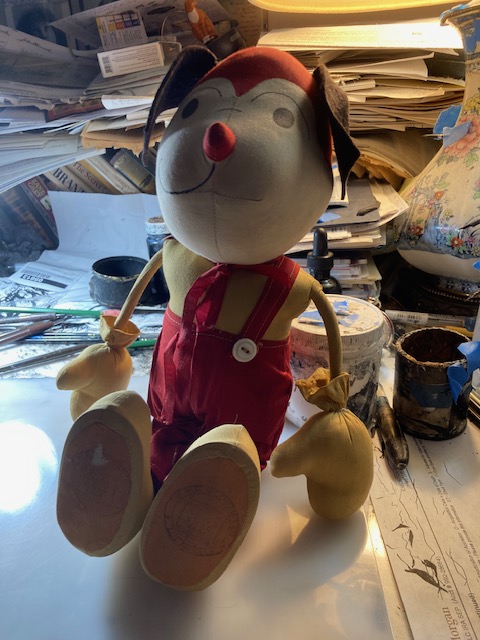
These two recently purchased dolls, both bearing the same W.R. Woodard stamp on the bottom of their feet as some of my others (not all are stamped) and both still have fragments of their original tags – Don the Dog and Mike the Monkey, which appear to be the same as the rare ones I have seen on other toys. While their red trousers, held up by a single strap, are similar in design to some of my other toys. The differences seem to mount up from there.

These two toys are a bit smaller than what I will call the standard toys. (The raffle doll is also a tad smaller than the standard ones but not as small as these and other than a special design on her skirt; a marker testifying to her as a theatrical raffle prize but otherwise is made the same as the standard toys.) Rather than standing, these are in a permanently seated position. Instead of a sort of velveteen fabric for the heads, feet and clothing, they are entirely made of a sort of cotton fabric. As a result they look newer than their counterparts.

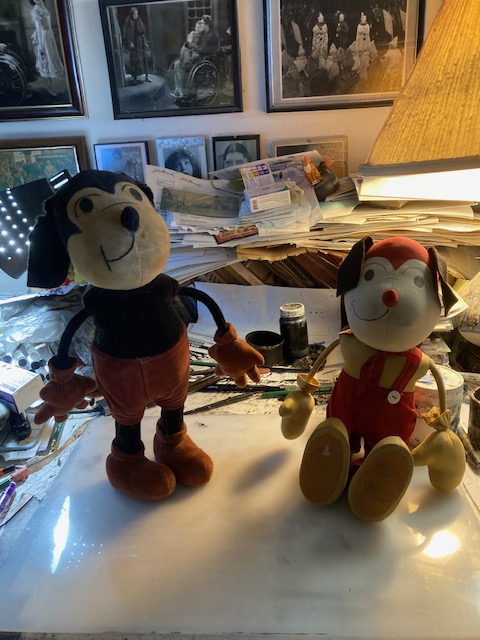
Meanwhile, the features are printed onto the faces rather than being stitched on. Their hands do not have defined fingers (the standard ones have fully defined five finger hands), and even their sewn on noses are more of a piece of the fabric, rather than the (admittedly vulnerable) more defined and stitched on noses of the other dolls. shown together below, the standard version of Don has the same square ears and similar but not identical facial design and he does not sport the same single button overall style trousers. Where the feet join the legs seems to also be produced differently too.

Pams-Pictorama.com Collection. The variations on Don the Dog side-by-side.

In short, they appear to be a less expensive line of these dolls, either made contemporaneously or later than the others. Was it another promotional item which had to be less expensive? A last ditch effort to produce them for less? Or was it some later production under the company name and these designs – perhaps in conjunction with a revival of the cartoons? I don’t think we’ll likely get the answer any time soon if ever. In my decades of collecting these dolls (and looking at them – those I missed at auction!) I have never seen them but they have come now to live for a spell at Deitch Studio in the Pictorama collection.

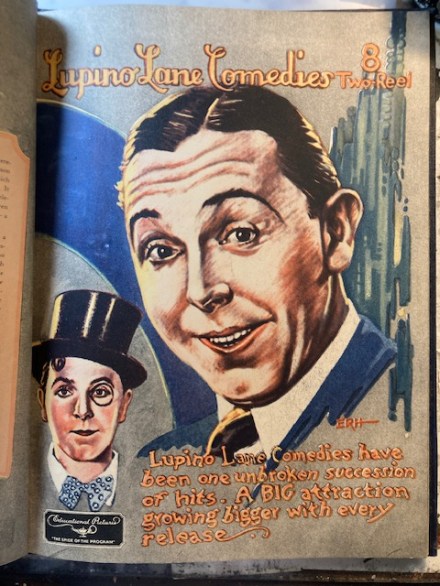
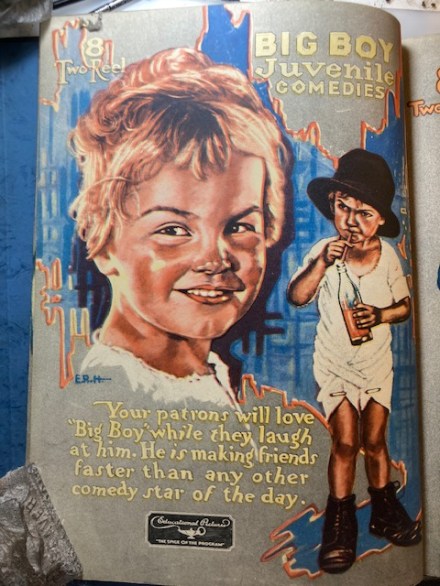
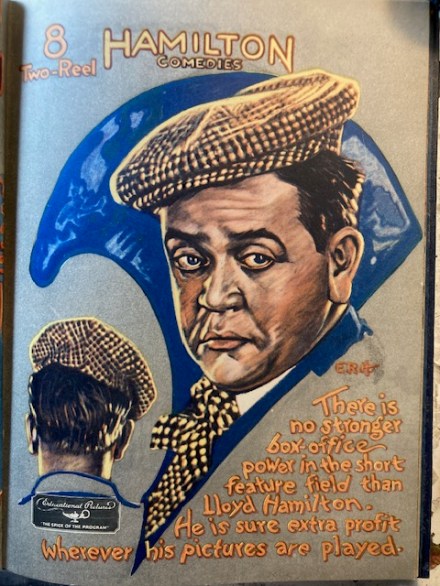
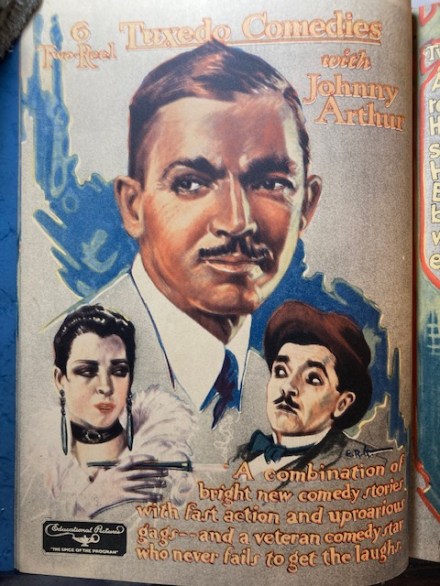
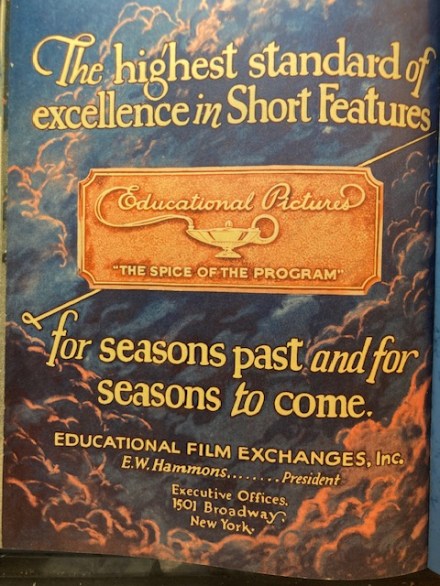
The Spice of the Program, 1927-1928

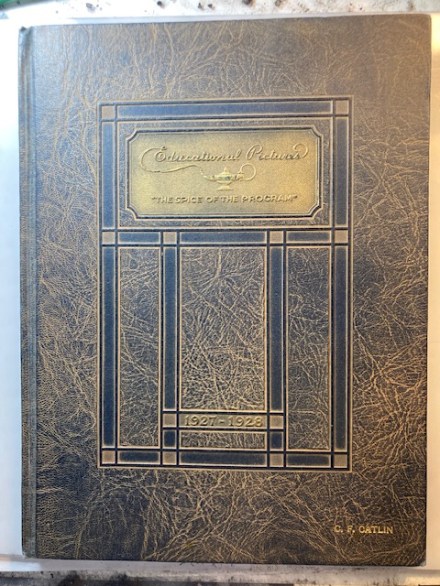
Pam’s Pictorama Post: I’ve had this interesting advertising book in my possession for a number of weeks and am just getting around to sharing it with you all. Obviously I purchased it for the Felix page, but I do find the whole publication of interest.

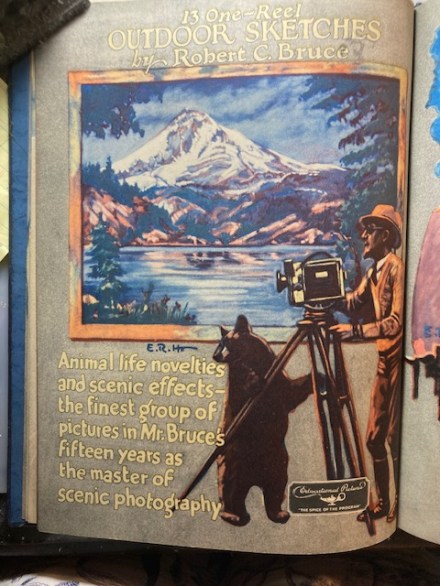
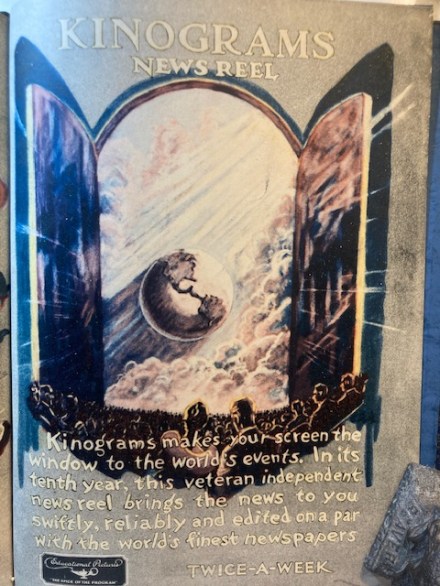
For starters I am impressed with the idea that these were sent out en masse to theaters to encourage bookings. For all of it’s heft and embossed-ness it doesn’t go into any detail about the packages you would be ordering for your theater. These were all short subjects, like Felix, so each page highlights a topic.

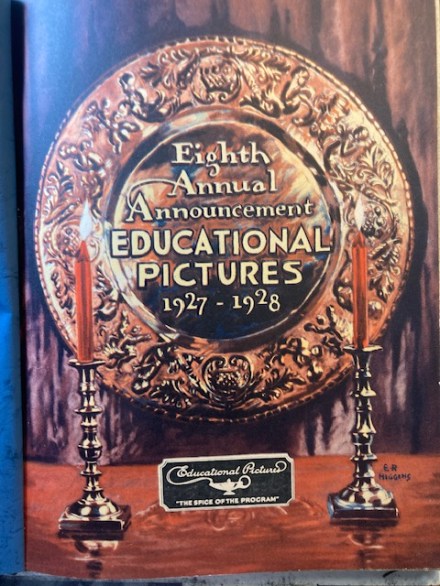
Frontispiece and introduction.

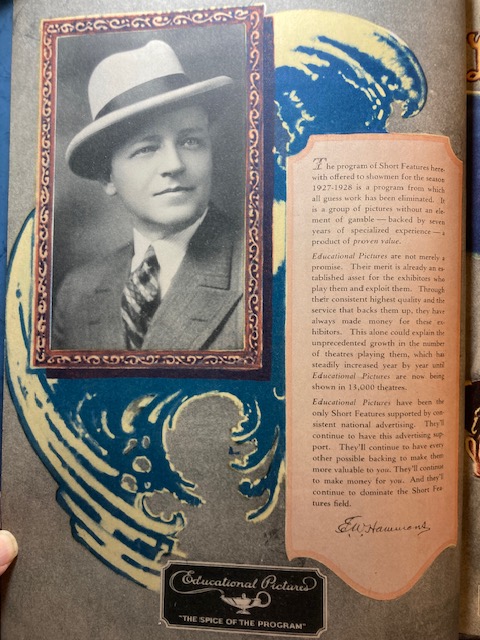
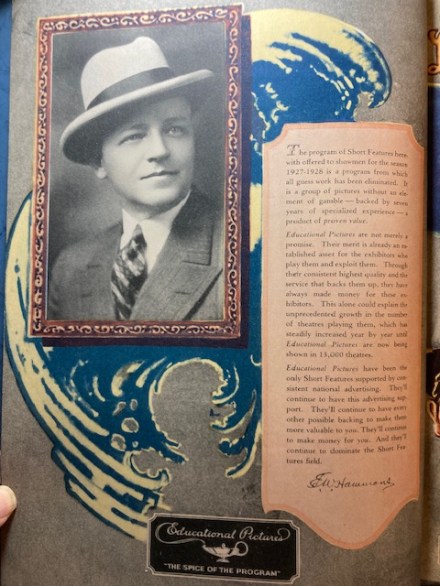
The opening page, with a photo and a letter from E. W. Hammond. While I cannot seem to trace his title over at Educational Films, I have run across him advertising Felix films previously. The link to two rollicking pages advertising Felix cartoons can be found here. In his letter at the front of this volume he refers to the proven success of these shorts. He writes, It is a group of pictures without an element of a gamble – backed by seven years of specialized experience – a product of proven value.

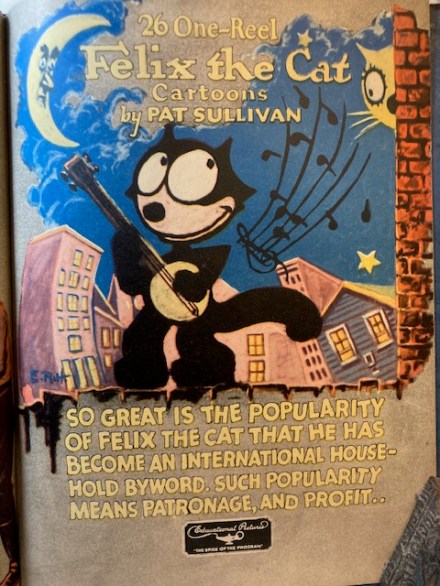
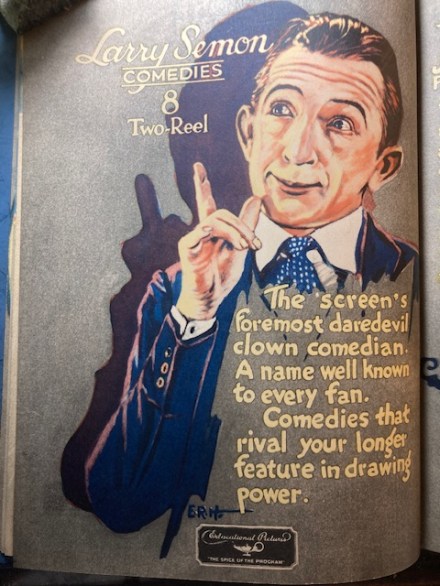
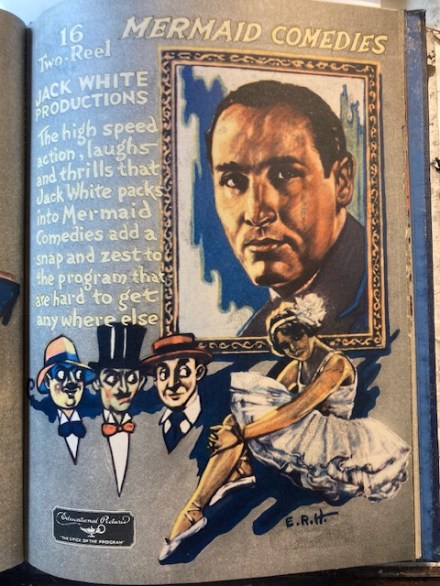
I am giving you a slide show to page through the entire holding at the end of the post but want to highlight a few. I will start with Felix, although he is found toward the back of the volume. These years were Felix in his heyday and 26 new one-reel cartoons were in the offing. He strums his banjo and eyes the girl cat, Kitty, peering out around a building. There is a frowning faced moon on the other side. Felix is perched on a bit of fence but I like the way the buildings curve in around behind him like they want to break loose and frolic. It is a jolly nighttime scene with stars in the sky and all the buildings lit up – occupants no doubt listening to Felix’s serenade for better or worse. A careful look shows that his snout, as it were, is the same pink as the buildings. Someone named E. Ritt claims illustration credit and that is someone other than who has executed the other images. Such popularity means patronage and profit…

These are the ones I am curious about.

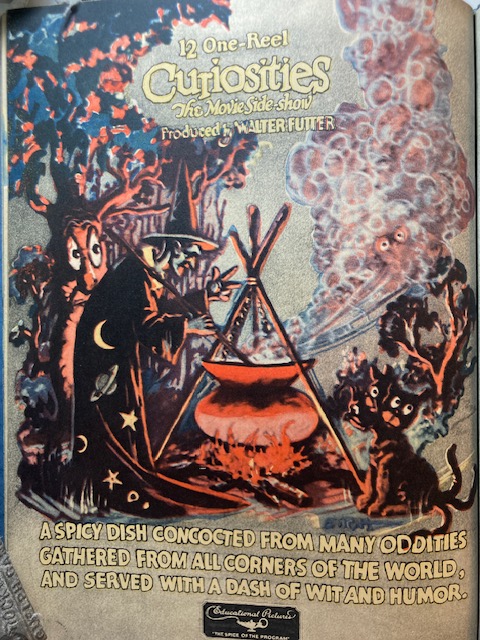
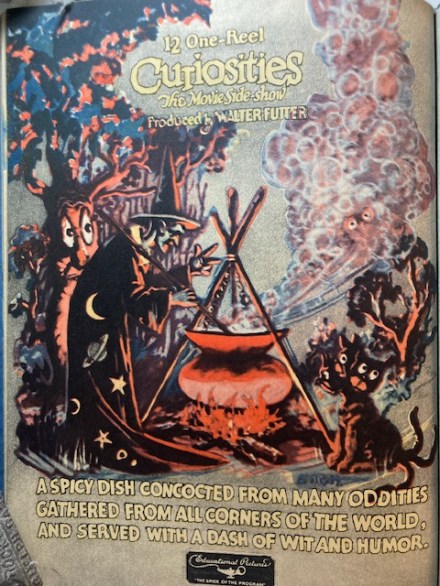
Beyond Felix there are a few other highlights for me. 12 One-Reel Curiosities The Movie Side-show catches my eye. This one is also signed by E. Ritt and here his imagination has been let loose a bit. We have a tree with eyes watching a witch stir a caldron producing smoke which reveals owl eyes, and a three-headed cat eyes us! A spicy dish concocted from many oddities gathered from all corners of the world, and served with a dash of wit and humor. Oh man, I wonder how they delivered on this?

Dorothy was already in her 20’s here.

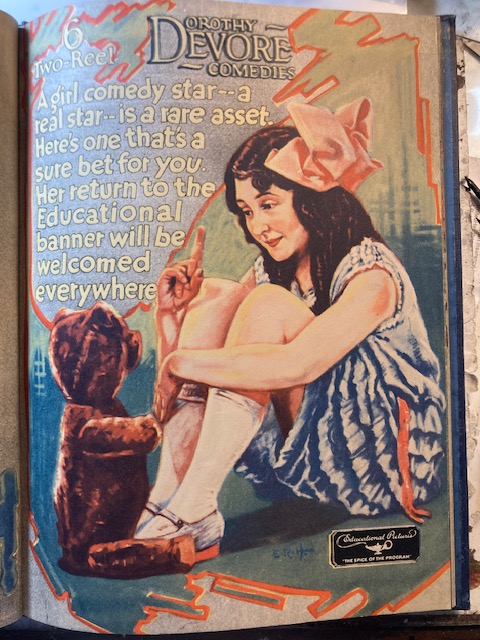
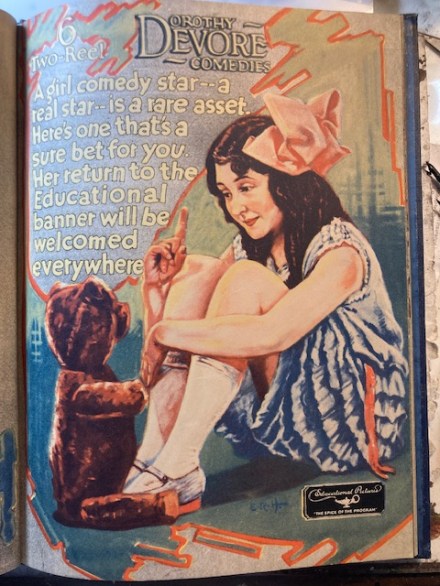
I like the page of Dorothy Devore comedies – she’s shown with this nice teddy bear. The artist of the spread seems to be someone else and they are identified as E.R.H. It states, A girl comedy start — a real star — is a rare asset. Well, I like that! This was toward the end of Dorothy’s working life. Wikipedia says she stopped making films in 1930.

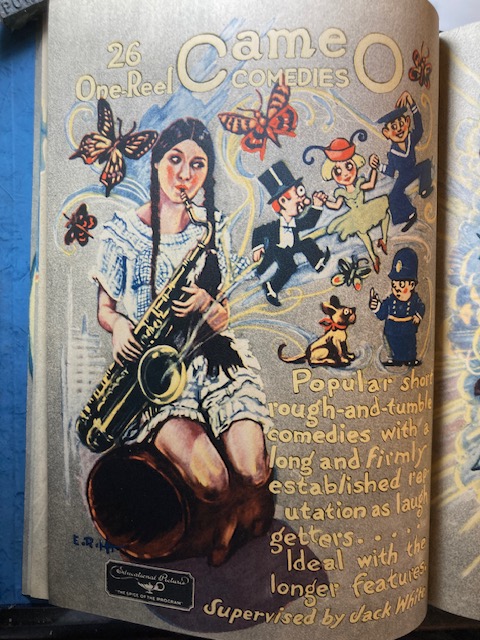
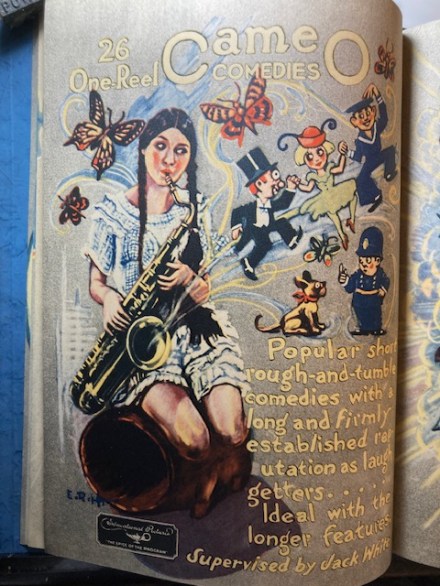
And who is the girl on the sax?

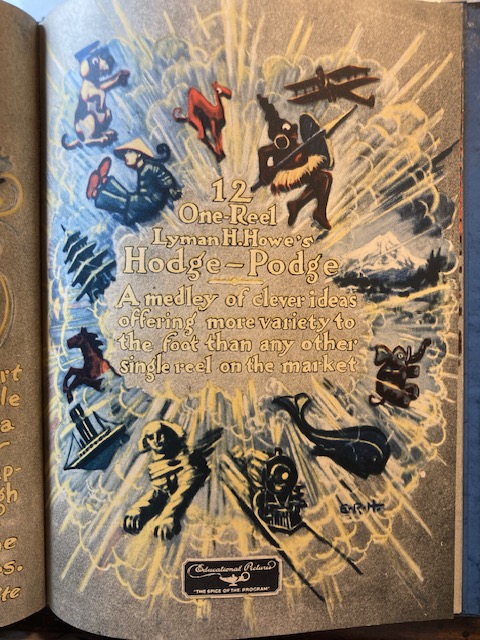
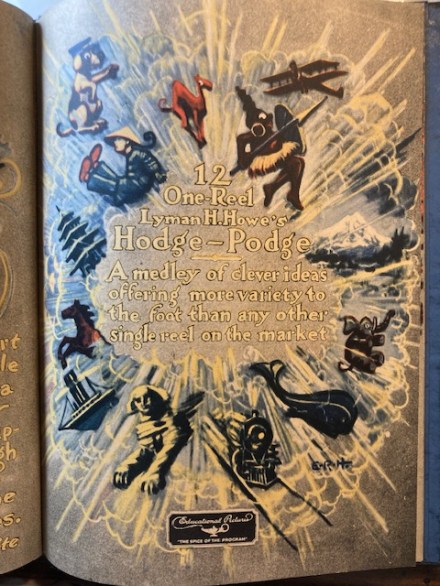
There is a sort of centerspread which has Cameo Comedies on one side and 12 One-Reel Lyman H. Howe’s Hodge-Podge, a medley of clever ideas offering more variety to the foot than any other sing reel on the market. Across these two pages we see everything from a girl with her sax to camels, African-type natives and a coolie to whales and the Sphinx. I assume these were largely cartoons – a fact also confirmed by Wikipedia.

A smattering of cartoon images.

So quite a year, ’27-’28. A fraction of these films may still exist – luckily with a good survival rate on Felix. I’ll likely never really get to judge the one-reel curiosities, although you never know what will turn up.

Flip through the whole book below.
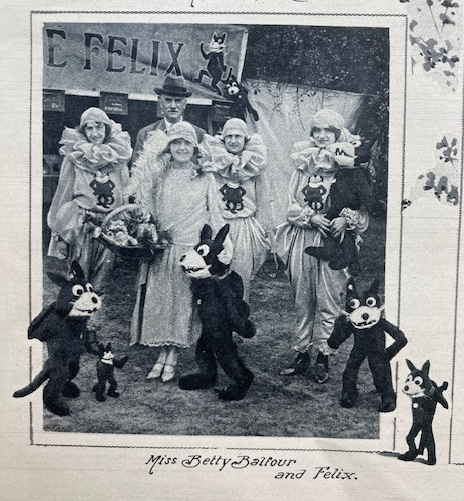
Miss Betty Balfour and Felix

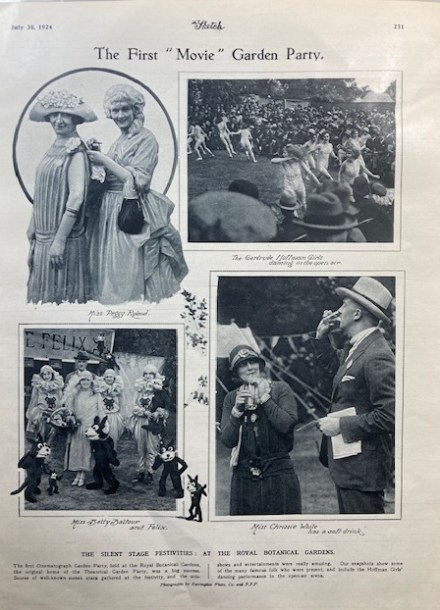
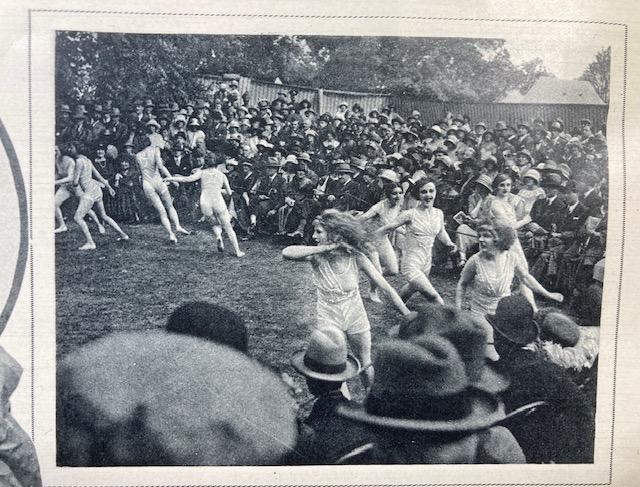
Pam’s Pictorama Post: Returning to our rollicking Felix roots today with this odd page which was sold on its own via eBay. I was the only one interested in it and I actually really love it. The overall page has a fair amount of interest – the Gertrude Hoffman Girls dancing in the open air appeared naked at first glance with their brief, thin costumes. That certainly would have been unusual on July 30, 1924, the date on this sheet. Closer inspection shows sort of cotton playsuits.
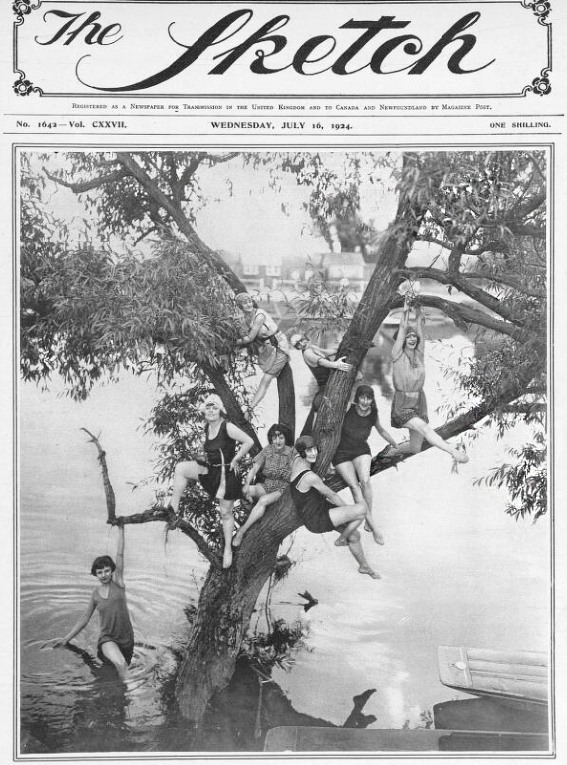
Found this issue which I assume is the one before mine, July 16, 1924. Looks like fun!

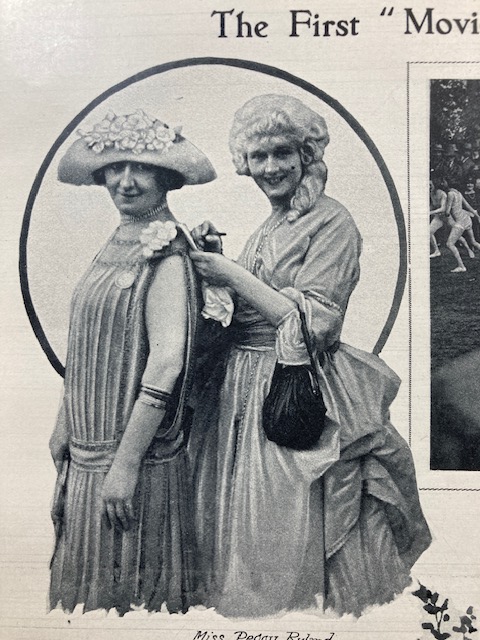
The First “Movie” Garden Party is the heading on this extracted page. It appears to have come out of something called The Sketch magazine. The Sketch had an extremely long life it turns out, running from 1893-1958; it was an illustrated British weekly journal. It is most notable perhaps for having launched the George Studdy Bonzo illustrations in 1921.

Close up on the Gertrude Hoffman Girls dancing.

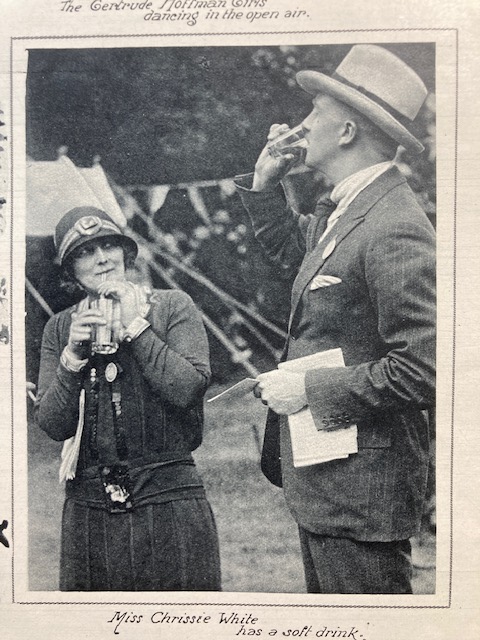
At the bottom of the page it boasts, The Silent Stage Festivities: at the Royal Botanical Gardens. Below it, The first Cinematograph Garden Party, held at the Royal Botanical Gardens, the original home of the Theatrical Garden Party, was a big success. Scores of well-known screen starts gathered at the festivity, and the sideshows and entertainments were really amusing. Our snapshots show some of the many famous folk who were present, and include the Hoffman Girls’ dancing performance in the open-air arena.

Miss Peggy Ryland has left no tracks online.

This page has four features, upper left, Miss Peggy Ryland – I am on the fence about whether Peggy, close up above, is a man in drag or not, Kim says no. The almost naked dancers are next over and below them, Miss Chrissie White has a soft drink. Unlike Peggy Ryland who has left no tracks, Chrissie White made 180 movies between 1908 and 1933 and was quite a star. Given this I assume I have at least seen her in passing, but don’t recognize her in the least – nor does Kim. I assume she is with her husband here, Henry Edwards, occasionally her co-star and director. They were evidently a famous couple seen about town at the time. She retired from film early but lived until 1989 and the ripe old age of 94. I am enjoying her outfit shown here – period perfect.

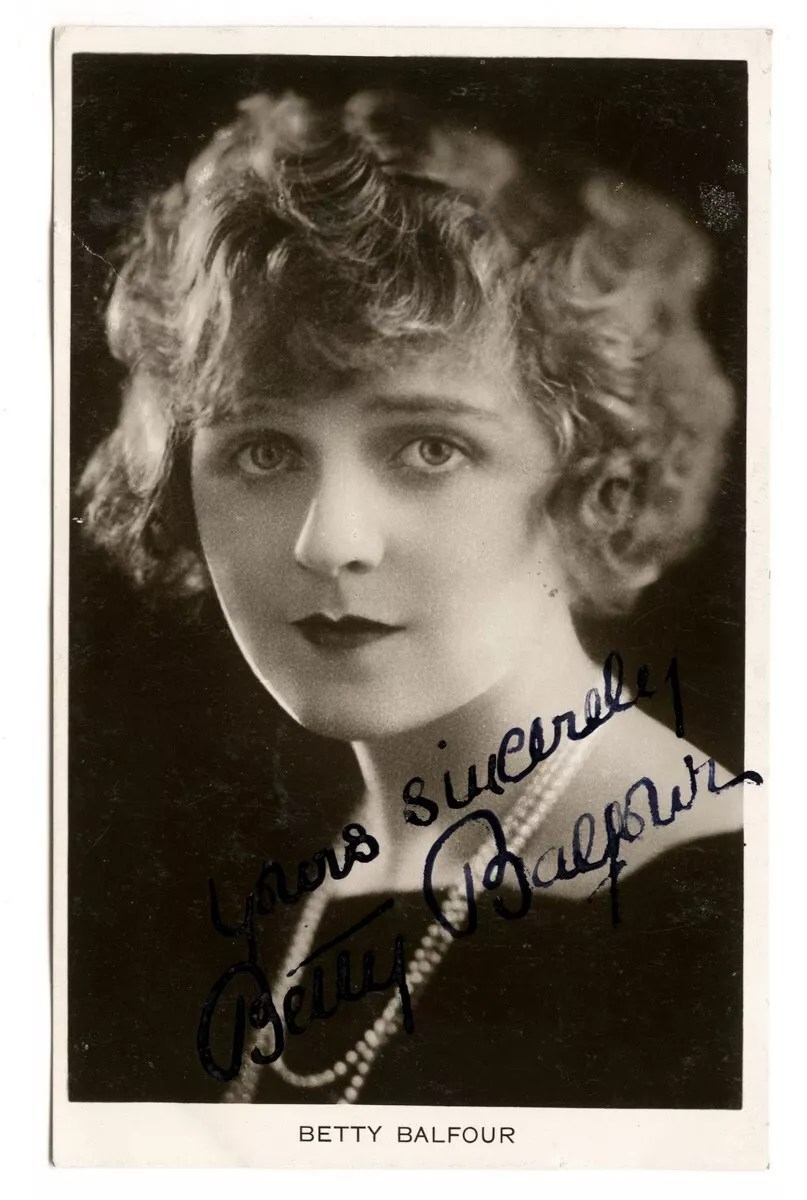
Speaking of perfection! Now onto the main event – ohhhhh how I wish I could have attended this! Felix-es galore in all sizes, on their costumes, a sign above them sporting him. Here Miss Betty Balfour holds court. Betty I know from her work in the Jessie Matthews film, Evergreen although she is even better known for her turn in an early silent Hitchcock comedy called Champagne. (Kim has seen it and I do not think I have.)

Be still my heart!

Betty’s got her hand on one lovely huge Felix which comes up to her waist, but so many others lurk around. I love how they fall out of the confines of the photo and into the margins. A small one hangs off the sign at the top and one of the minions is holding a sizable one. A close look at Betty’s basket says flowers – I was thinking a Felix might be tucked in there too. Of course if it were me I would want to be in one of the Felix decorated costumes – with a grinning maybe winking Felix embroidered onto my chest! Oh to find one or even this original photo!

Signed postcard for sale on eBay at the time of publication.

That’s it folks, the back of the sheet is devoted to lawn-tennis notes I am sorry to say. Completely lost on me I am afraid. Nonetheless, I will treasure this particular sheet for its Felix fun and preserve it in the Pictorama archive for posterity.

Enchanted

Pam’s Pictorama Post: I guess I should put out a sort of spoiler alert here if you have a hankering to watch one of these versions before reading this post today! This post will be musings on both the 1924 (recent restoration) and the 1945 film. It’s likely I will touch on plot points. In addition to these two films, there is a 2016 version which I have not seen and I do not endeavor to comment on.

The first time I saw the 1945 version of The Enchanted Cottage I was in high school and getting ready to leave one morning and it was on television. I can’t imagine now what channel it could have been on since this was in the days before TCM. I must have caught about half of it. It was long before the internet so I had to hold onto this snippet of film for many years before I was able to catch up with it or even know much about it.

Full radio version with the 1945 cast.

Eventually I was able to catch up with it and have enjoyed multiple viewings over the years. (As a total aside, in researching this I also found a full contemporaneous radio version by Young and McGuire as above.) For those who aren’t in the know, the story centers around an unlikely couple who find happiness in a gently enchanted cottage in the British countryside. The man is a wealthy former bon vivant who has been disfigured in the war and the woman is an unattractive (in a plain Jane sort of way) local who helps out at the house. They enter into a marriage of convenience and thus the story unfolds.

Only image from the play I could find available. A bit confusing if she is to be the unattractive maid here getting married.

The genesis of the plot appears to be a play of 1921 by the English playwright Arthur Wing Pinero. The outline of the play’s history is somewhat scant, appears to have premiered on Broadway in ’23 with Katherine Cornell and run for a scant 65 performances. For something that has had such legs on film, it did not have an auspicious beginning.

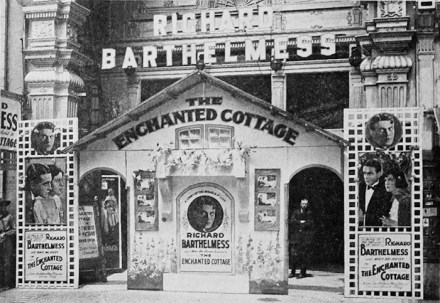
However, it was clearly enough to kick the early film production launching the 1924 version which Edward Lorussa has recently so thoughtfully and thoroughly restored and released via a Kickstarter campaign. (The info on the restoration and the availability of the disk can be found here.)

Although we generally get on board with supporting all of Mr. Lorussa’s restorations, I was bouncing up and down excited for this one. Kim and I had seen a really ratty print a long time ago, I believe, at a branch of the New York Public Library – what used to be the branch across the street from MoMA. It really only served to make me want to see a better restoration.

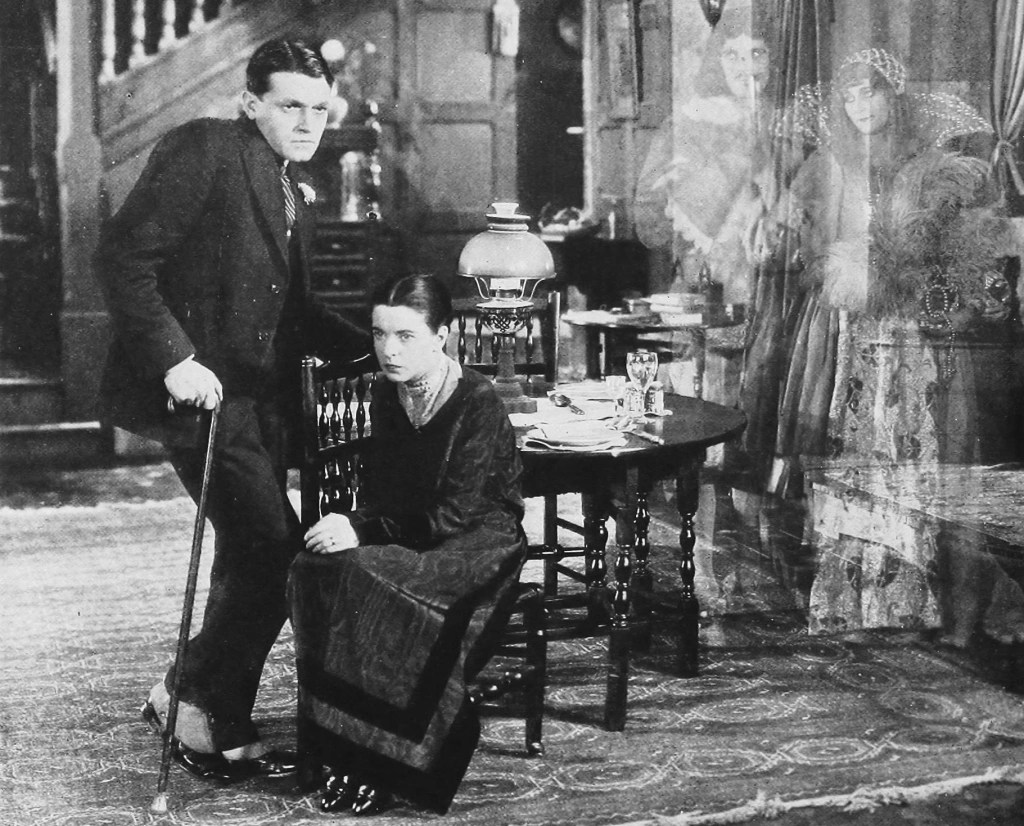
A ghostly couple considers the plight of these two, joined in a marriage of convenience only.

By now the 1945 film has become a longstanding, much viewed favorite of mine. (It does not appear to be available in full on Youtube, but you can find it on most streaming services.) Robert Young is the young war vet. In this version he and his fiance visit the cottage with the intention of renting it after they are married. They are gaily happy and somewhat dismissive of those around them. However, the war interrupts their plans and he returns from the battlefield a scarred and broken man.

Refusing to marry her after witnessing the shock that his transformation has had on her, he returns to the cottage alone where he shuts himself up and away from family and friends.

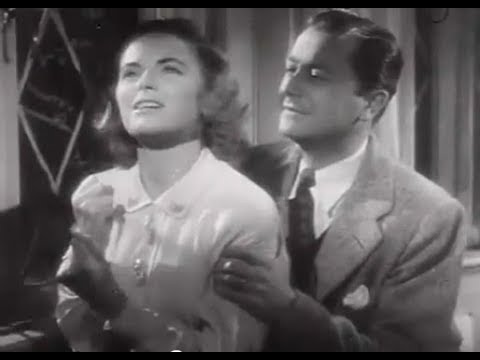
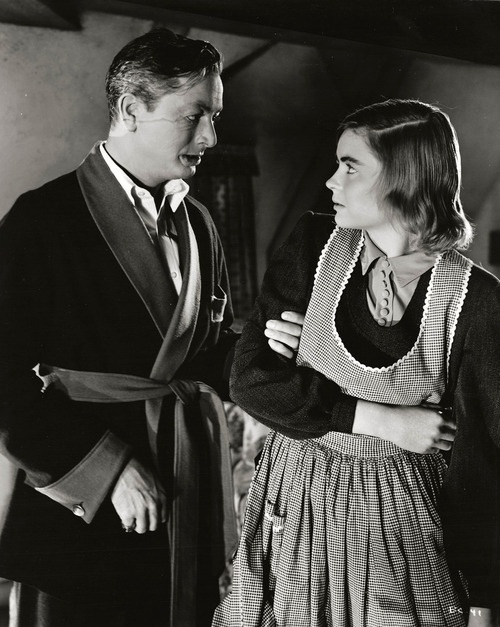
Pre-transformation McGuire and Young.

He eventually meets a blind Herbert Marshall and in this version I believe the allusion is to Marshall’s blindness having occurred as a result of the earlier world war. He is well adapted and embracing of his own life, complete with a nephew and pup who are his companions and help him navigate the world. Dorothy McGuire is the female lead. Always tricky to have to make an actress look unattractive or even plain. I would say they do a reasonable job with it.

Post transformation McGuire and Young.

At the heart of the film is the transformation of the couple, by their growing affection and an allusion to the magic of the cottage. This is tricky. You need Robert Young to change, but should his disabilities actually heal? They do a good job of transforming him short of his full-on Hollywood self. A variation would apply to Dorothy McGuire too. While it is a bit hard not to at least see her as a diamond in the rough, she is dutifully dulled down and restored to her requisite glory.

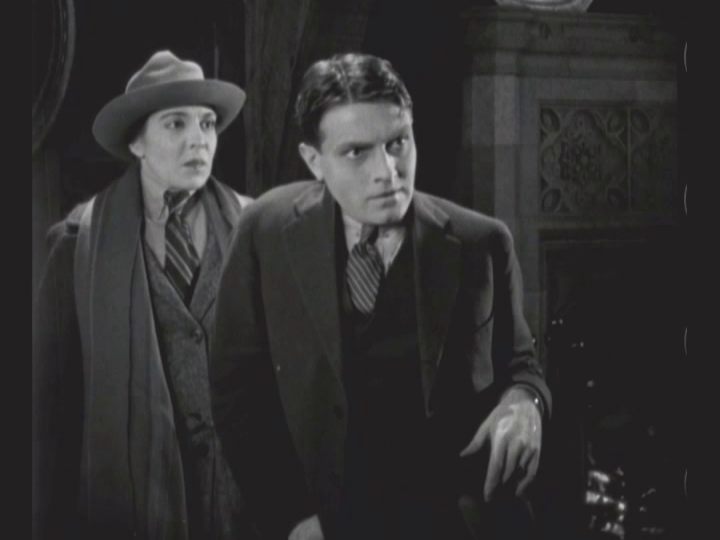
Barthemess with his sister – the specter of her coming to live with him chases him into his marriage of convenience.

Cold water is thrown on their cocoon of grace as they realize the outside world does not in fact see them as transformed. Their love ultimately conquers this turn and the cottage rewards them with it’s only real moment of magic in this version, when it spontaneously inscribes their name on a lovers window in the cottage.

At 91 minutes this version is somehow infused with a bit more background story and color than the 1924 version which is a scant ten minutes shorter. The ’24 version is darker, both literally and in essence. We have no opportunity to meet the vet in better days and while his fawning weak mother is a bigger part in the ’45 film a somewhat masculine and very bossy sister is added to a good effect. She even bosses the mother and father. In this version the fiance is also made fairly short shrift of as well.

Friendly female ghost visitation.

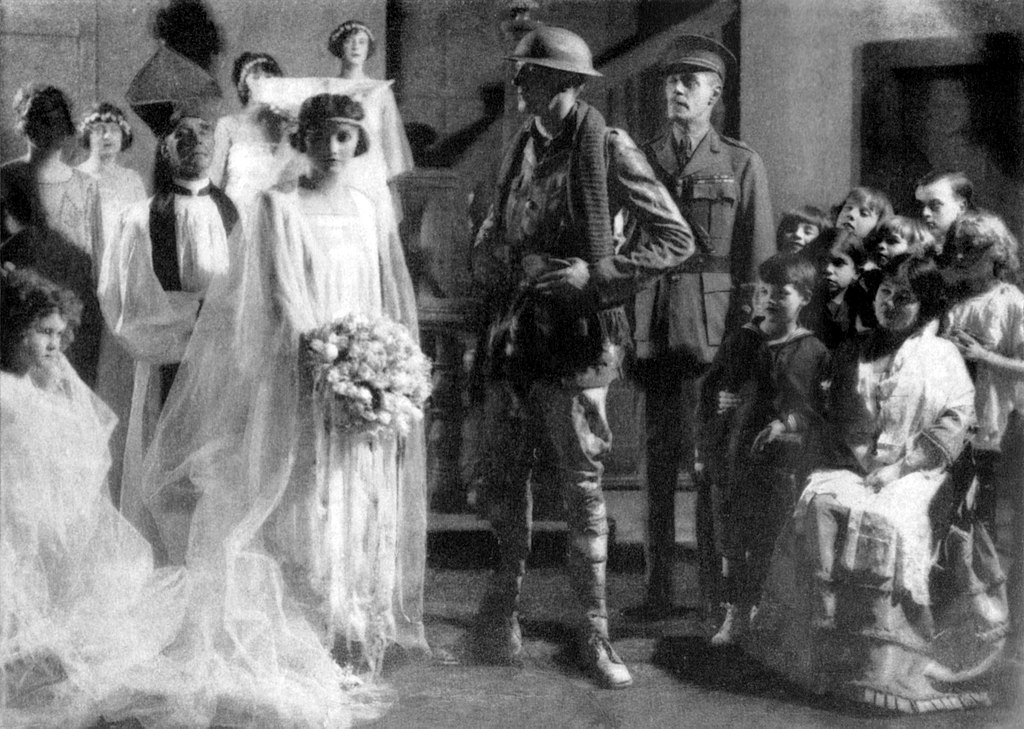
This cottage is kept quite dark for much of the film and unlike the later version we are treated to ghostly couples of the past romping throughout and one assumes they play a helpful role in getting this couple together. This time the lovers are played by Richard Barthelmess and May McAvoy.

Barthelmess has impairment of leg and arm on one side, in addition to scars on his face. Even transformed, he maintains some trouble walking and a limited use of his arm. Meanwhile, May McAvoy is taunted by unthinking schoolchildren for looking like a witch. They walk a good line with her looking quite plain and her transformation is, I think, more pronounced than the Dorothy McGuire one.

McAvoy before being transformed.

I think the real difference here is there is a rawness post WWI which plays out differently in the post WWII version. The blind Major Hillgrove (Holmes Herbert in this version) is perhaps the most poignant difference. In this version they were actually in a war torn hospital together briefly and his own pain over his blindness is still visceral. At one point when asked about their transformation he longs for it to be true so that maybe he too will be healed. Perhaps the very real and sometimes raw sadness of the film accounts for the fact that it did not do well upon release. It was dubbed too cerebral among other things by critics.

The couple transformed in the ’24 version.

Mr. Lorusso has done a splendid job (as always!) with the restoration. Rodney Sauer of the Mont Alto Motion Picture Orchestra to create a piano and violin score for the film which helps create the overall ambiance. As you will see if you read the above description by Lorusso, you will see it was made from a rare 35mm print and it is largely beautiful if a bit soft in places. He speculates that there was originally tinting.

Also, freakishly, this print was somehow made over the sound track of an entirely different film. The story about how that came about is lost to the sands of time. Fortunately however the film is not and I highly recommend purchasing a copy and settling in to watch a double feature with it and the 1945 version. Three cheers for Edward Lorusso!