Tavern Trip

Pam’s Pictorama Post: Yesterday on a whim Kim and I spent the Independence Day holiday in a remarkably patriotic way with a trip to the Fraunces Tavern museum in lower Manhattan. This important Revolutionary War landmark, where George Washington said farewell to his troops, is tucked among towering modern edifices, near the water and Wall Street. Kim just finished Washington Irving’s biography of Washington and it occurred to me that neither of us had ever been before.
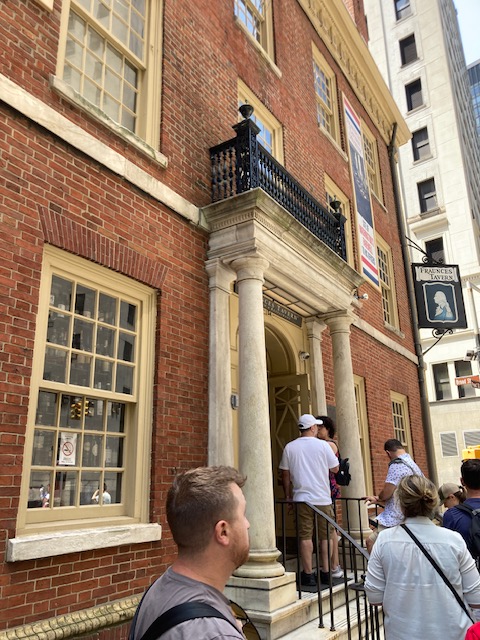
Waiting in line out front for it to open.

The Tavern remains a restaurant and pub (I don’t believe it has operated continuously as there was information about a renovation and restoration at one time in one of the exhibits) and, unsure if it would be the holiday destination for many, I made a lunch reservation in one of the several dining rooms just to be safe. We had a 12:45 reservation which turned out to be about right to see the museum first.
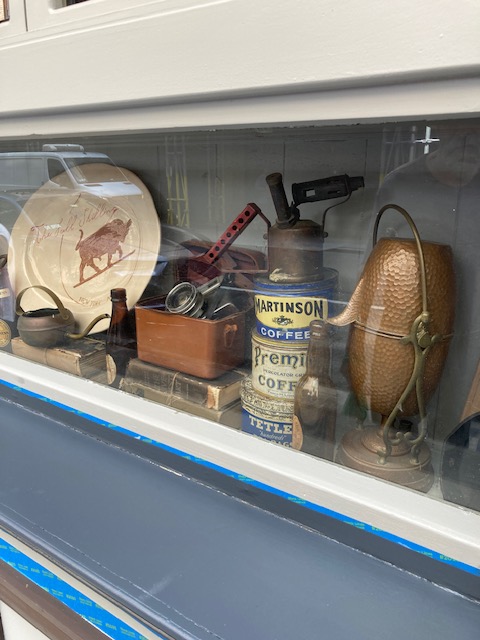
Funny little display in the front wall of the building near where we waited on line.

Luckily it was a glorious day and we hopped on a ferry running along the East River and took it all the way to Wall Street from 90th Street, convenient to our Yorkville neighborhood here. July 4 is one of those holidays when Manhattan generally empties out and aside from some tourists, there is a group of us left to our devices here and that was represented by folks who were lined up to take this local ferry to the beach, biking or like activities. The result was a fairly full but not crowded ferry ride. (I became enamored of the ferry system, running up and down the east side, to Queens, Brooklyn and even New Jersey during Covid and have written about my introduction to the longer on to Jersey here .)

A snippet of the ferry in the East River about to go under, I think, the Manhattan bridge.

It was fun to travel to the museum by water rather than subway, a period appropriate way as the water would have frequently been used for transport in the 18th century. It was also a fraction of travel time – although the wait was longer than for a train and this was exacerbated by the mercurial holiday schedule it seemed to be on.

The museum is just a few blocks from the ferry terminal although Google lead us on a bit of a roundabout merry chase in an attempt to use maps. I think in part the problem is with so many tall buildings that reception is iffy there and the map would not reload properly. Anyway, we arrived as a small parade of folks in period clothes seemed to be wrapping up. (I overhead that they were here from Virginia but I am not sure if I caught the broader reason for their costumed attendance there.)
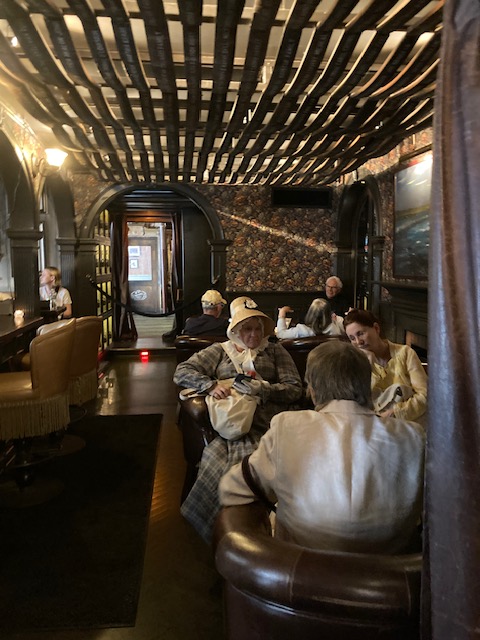
The Dingle Wiskey Bar, closed, but where we waited for the museum to open. Woman in 18th century dress using her cellphone a bit of a bonus here.

For those of you who don’t know the city, downtown Manhattan is entirely different than the rest of the island. As the area that was first built up, the streets are tiny and narrow. Because it is now the seat of commerce and business, enormous towers have risen and largely block the light from the clutches of tiny, historic buildings. I cannot imagine living or working in the area – it would be like living in an entirely different city. Unlike the rest of the city, lower Manhattan is not on a grid and hence the need for a map to find your way among unfamiliar and twisting streets.
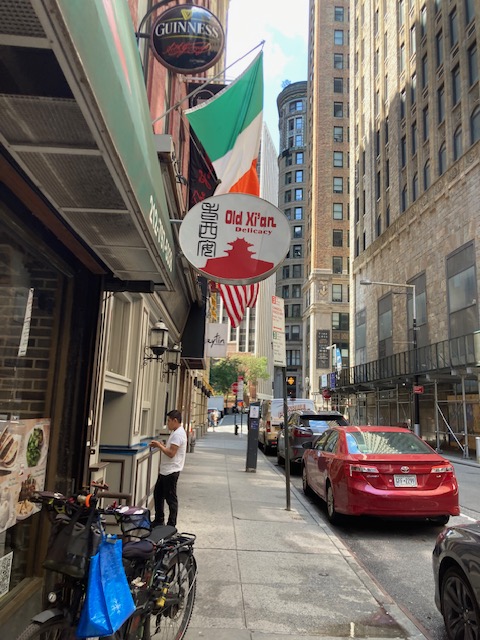
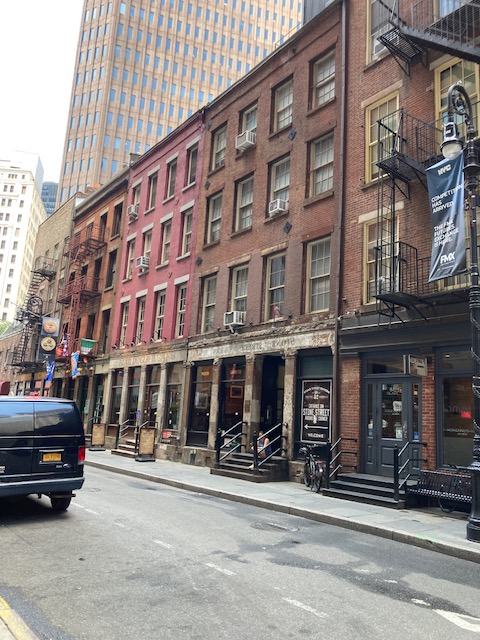
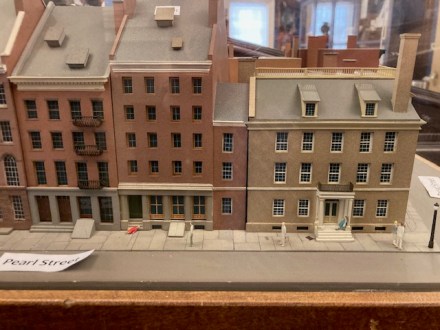
A block or so of historic buildings approaching the museum’s block.

Even for all of that, we arrived early for the noon opening of the museum. There was a line outside but that was really just waiting for it to open – it did not have a persistent line throughout the day although they seemed largely booked for dining.

We were herded into one of the bar spaces to wait which gave us a chance to study that room a bit. There are, I believe, six different dining and drinking spaces (although there was a private dining area which may be a seventh – I lost count.) I was unable to figure out if the configuration was based on the original layout – many small rooms being typical of such an early building. There is evidently a piano bar occupying the fourth, top floor, but it was not open and we didn’t get to see it.
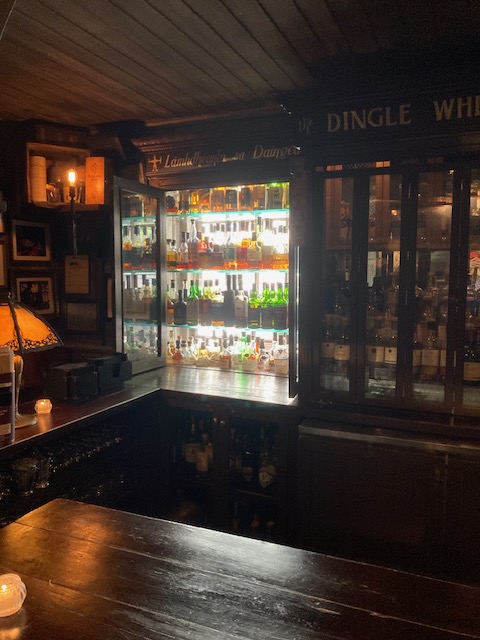
Another view of the Dingle Wiskey Bar.

The museum commences on the second floor which, in its day, would have also been serving spaces. It is not clear to me that this edifice was anything other than an eatery so perhaps all the floors were dining areas. (It isn’t clear that Mr. Fraunces or subsequent others lived there. It seems that in Washington’s day it was open day and night so my guess is he did live on the premises.) A large room on the second floor is said to be where Washington addressed his troops – it seems too small for that leaving us wondering how that worked. A firsthand account of the event is on display but also written on wall text for easy reading.
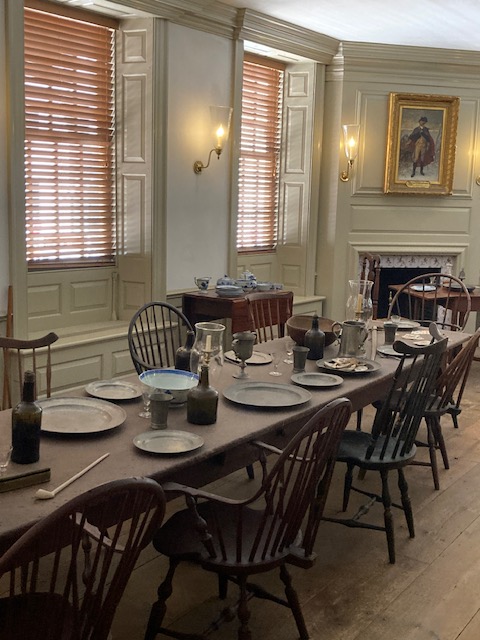
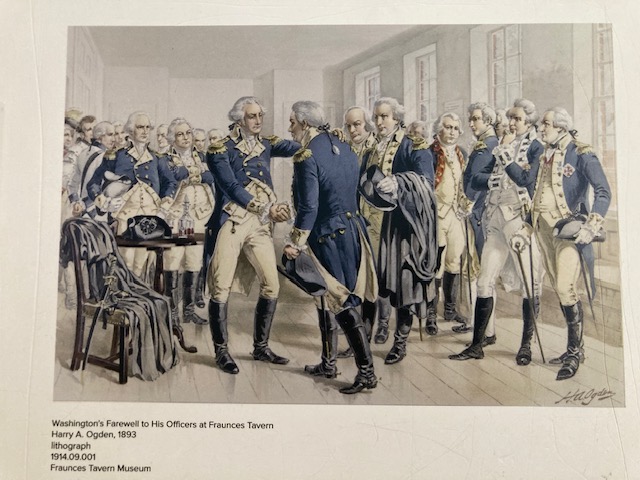
Arguably the reason we were there – said to be the space where Washington address his troops.
A later rendering of the event on display.

The tavern was also used to house some of the governmental staff during that first Presidential term which was served in New York and not Washington DC. I think it housed foreign relations and another arm of government I have forgotten. There is a small special exhibit about the discussion of the British evacuating New York and the trails that were held for traitors to the American cause.

In culinary history, the restaurant is known as being among the first to have a la carte table services while others still only offered family style meals at large tables. As mentioned above, it was also open 24 hours a day – all making it a bit ground breaking in that sense.
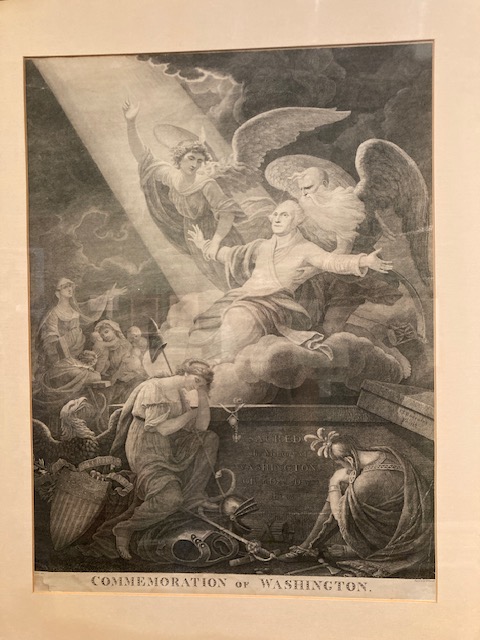
Not surprisingly, images of Washington and ephemera abound on virtually every surface.

While the second floor has the one period room (also where you pay admission, usually $10 but only $1 yesterday for the holiday, a small shop there as well) and an exhibition space. The third floor are the larger galleries and a room set up auditorium style. (They were actually preparing for a lecture later that afternoon.) The exhibitions are largely reproductions of documents and a smattering of items. The old maps were of interest and some of the letters (the original of Hale’s last letter before he was captured and executed as a spy) are available to be read more easily online with a QR code.
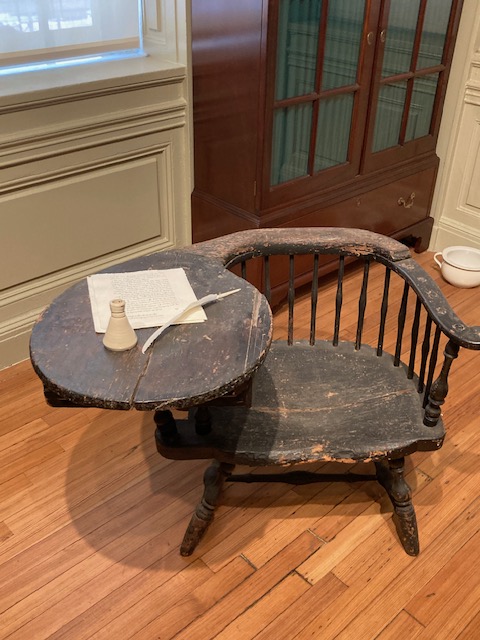
Fewer actual ancient bits are on display than anticipated, but this very old desk/chair was one.

The physical space is a mishmash of period styles and bits. For example, the enormous original plank floors are only in the smallest area with a mix of wooden floors from different periods throughout. Early wallpaper is noted to be from an indeterminant early but later period. Ceilings are low and rooms are intimate – fireplaces in all the original rooms. However obviously the space has been renovated, constructed and reconstructed to make it (somewhat) accessible and work for modern displays.
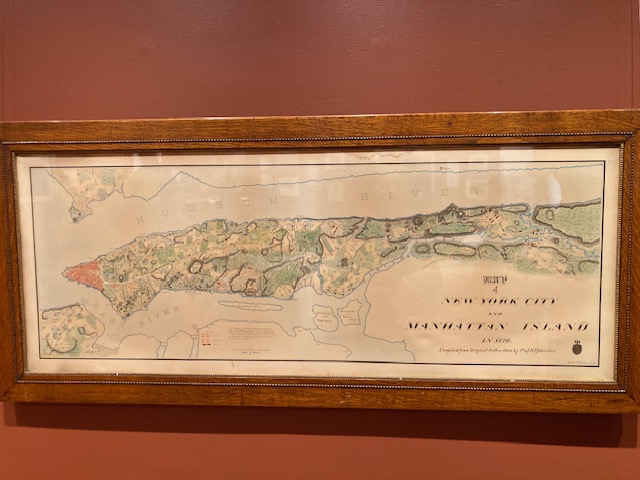
It was easy to locate where we reside, about halfway down this map, given the islands and waterfront outline.

The displays, as mentioned, are a bit ricky ticky, if you need sophistication you will be disappointed. However, the museum appears to have a robust program of lectures, symposium and especially family activities and while it certainly attracts tourists it is clearly also a part of its community for those who live in the area. (Events around period games, quilts and story time are scheduled for the remainder of July.) I got the feeling that for some folks it is a regular neighborhood hang for food and drink.
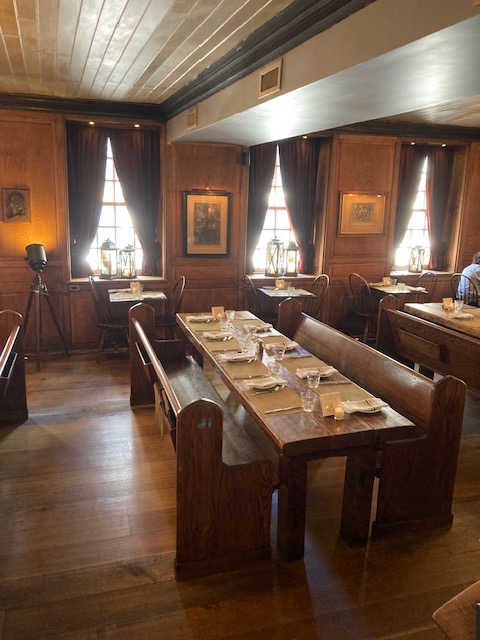
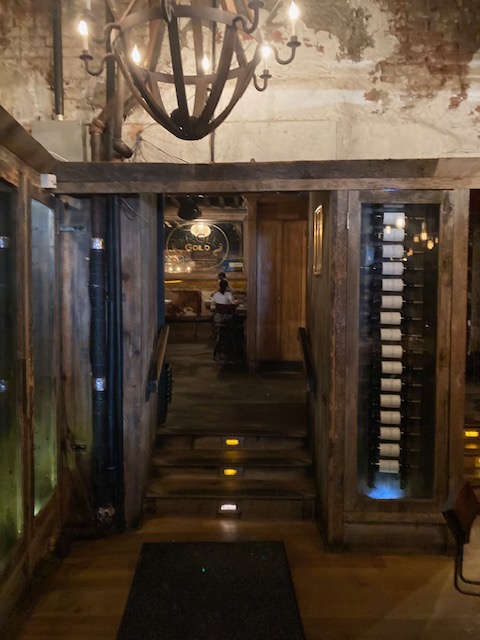
With that I would say the same about the food establishments. There are programs of live music most evenings and at least one of the bars is for walk ins only. I was pleasantly surprised to find that the prices are not touristy gouge-y, but actually quite average for New York City. I made a reservation through Open Table online and we were put in a long bar space in the front of the building. The other large dining room, running along the side of the building, is somewhat more formal.

Incongruously perhaps, soft rock music circa the 1990’s played (loud but not hideously so) in the bar space we occupied for lunch. Kim had a burger and fries and I had a blackened salmon sandwich with sweet potato fries. Kim had one of a number of non-alcohlic beers and I had a large (very good) extremely local Frances Tavern pale ale. While I was very tempted by the idea of a sticky toffee pudding (I generally cannot resist that description) I decided to be good and allow for the possibility of an ice cream later.
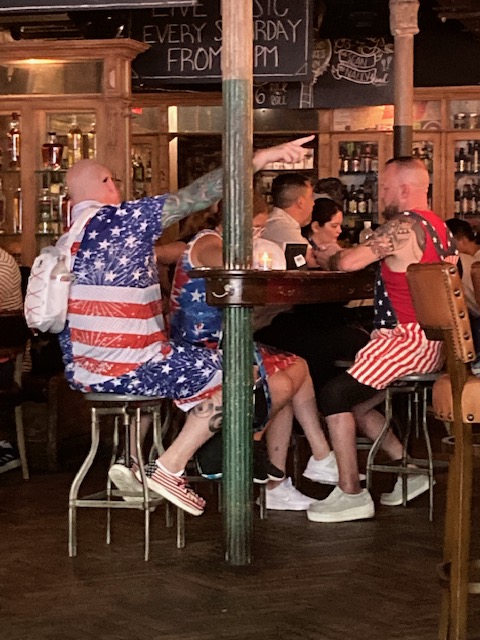
Holiday themed celebrants at the bar restaurant where we ate lunch.

The ice cream never materialized. After leaving Fraunces Tavern we attempted a visit to the nearby Seaport Museum but they had (mysteriously) opted to be closed for the Fourth. Our day ended with ferry mishaps as they decided to run the last ferry earlier than published and police barricades (anticipating crowds along the waterfront for the fireworks which wouldn’t start for many hours) kept us from hopping on the final one. So the day ended on the 4 train speeding uptown and ultimately a happy collapse in air conditioning and with cats as the conclusion to our holiday adventure.
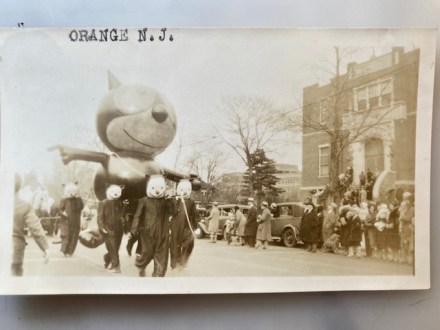
Orange, New Jersey

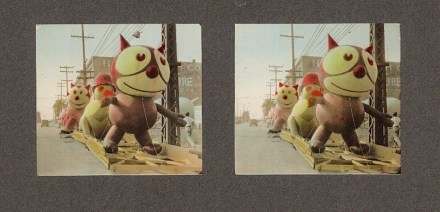
Pam’s Pictorama Photo Post: Today’s Felilx loving post is an unseasonal Thanksgiving tribute, but I couldn’t possibly wait that long to share it.

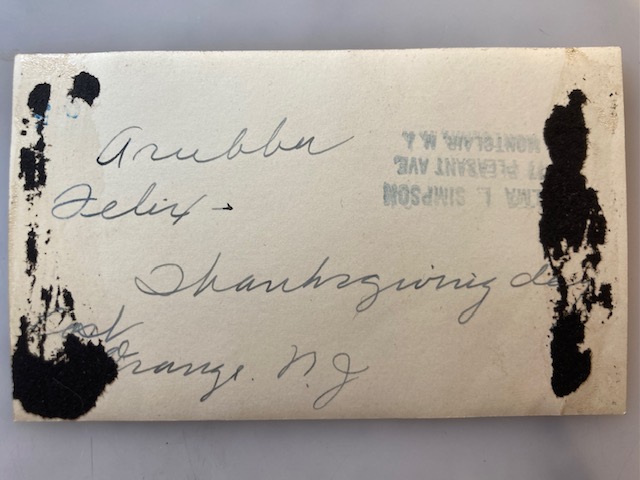
In addition to the neatly typed ORANGE NJ on the front of the photo, handwritten on the back it reads A Rubber Felix Thanksgiving Day East Orange, NJ. It is also stamped with what appears to be…CMA L. Simpson…17 Pleasant Ave. Montclair, NJ. It was glued onto something black at one point much of which remains here, likely a photo album, and the full address is obscured.

Back of the photo.

This is an overexposed and not especially good print so this establishment must have just processed and printed pictures for people.

Still, it clearly has its charms and I am glad to take the trip back in time to see the scene. In addition to this large Felix balloon, what I like best is the Felix headed and clad retinue around him, like Felix-y mice around the big cat! We can see four, my guess is there was at least one more who is out of the shot.

I thought at first that this could be the same balloon butclose inspection says no. Pams-Pictorama.com Collection.

It is sadly undated but a very close look reveals that many of the women are wearing distinctive cloche hats. Those were popular from the early 20’s to the early 30’s. Randomly I would guess this is the mid-to-late 20’s given Felix’s rise to popularity and the rest of the clothing I can discern. Someone smarter about cars could probably tell more about the date from the one or two in this shot.

Thanksgiving is already a wintery scene here and people are bundled up to watch this parade. A close look reveals that the crowd extends up the stairs of this unidentified but official looking building. (If there are any Montclair historians or residents who can identify this building give a shout.) You can’t see it without magnification but in reality most of the people across the street seem to already be looking at and pointing to something coming up next.

Pams-Pictorama.com Collection.

I have written before about my love of Thanksgiving Day balloons in the parade and how I always wanted to go see them as a child. As a young adult here in New York City I would often go to see them blown up and strapped down the night before although I have never made it to the parade. My father had the freezing detail of filming it and the night before in his days as a junior cameraman for ABC News and there was no enticement I could find to get him to take me.

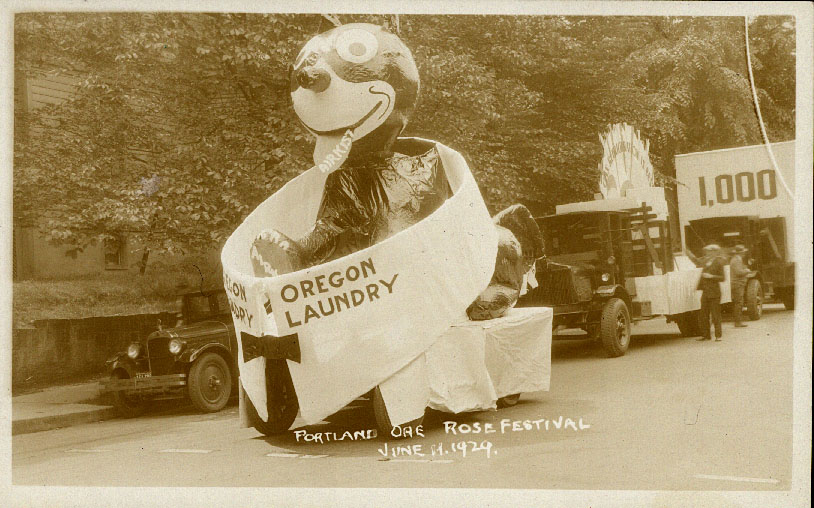
I love that New Jersey had their own rival, early Thanksgiving parades complete with balloons and I have shared a few parade pics here from my collection. Felix was popular coast to coast and one of these photos which lives by our front door in NYC is from Portland. The posts for those photos can be found here and here.

So while today would have been more appropriate to have an Easter parade this weekend, I conjure up another long past if somewhat unseasonable holiday for you today.

A Mr. Peanuts for Pam

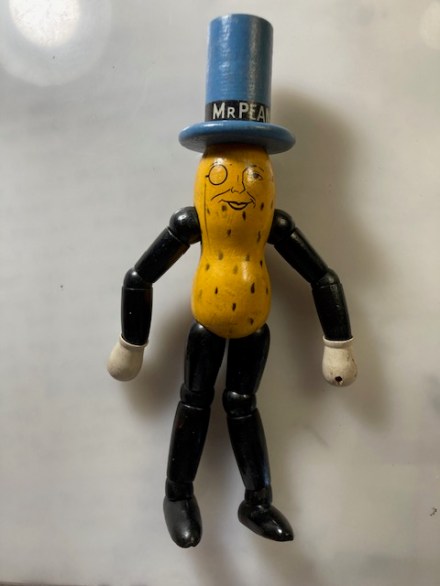
Pam’s Pictorama Toy Post: This just in – my first ever Mr. Peanut! He comes via an auction house that sends me endless listings and from which I rarely win anything. (The first item I ever won from them were these nice metal dogs featured in a post here.) On the rare occasion that I do win something, it was because no one else wanted it or was looking at the moment I think and therefore I got it for a good price. I do believe that part of the method of buying from these folks is to actually participate in the live auction but I am almost never able to do that and so, mostly I lose.

I had spotted this fellow in a listing along with a bunch of jointed Felix toys and admired him. Never seen the likes of him. I put a watch on it but expected that like many things (I keep trying to get a deal on cat andirons for the fireplace in New Jersey) it would go high and slip away. In fact, I never got around to putting a bid on it.

However, I was at loose ends the other day and a reminder that the he was going live in the auction. I believe I was feeling a bit burned by something I had just lost on eBay and I thought what the heck and put a live bid in just as the bidding was closing. Low and behold – I won Mr. Peanut!

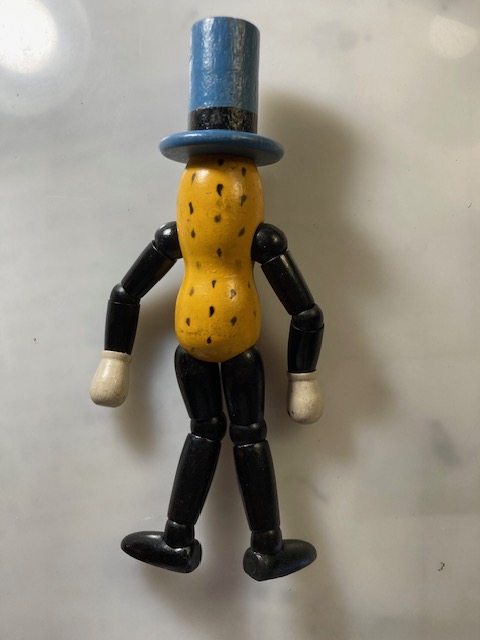
Nothing much unexpected on his back side. Schoenhut has no markings on these toys but they are very distinctive.

He is an early product of the Schoenhut Toy Company, circa the 1930’s. He is of course, an early example of an advertising to toy crossover. My fellow is missing his cane which would have stuck in one hand. And yes, if I was about 100% handier I could replace it easily! I especially like his blue hat with Mr. Peanut boldly printed! (Was his hat always blue? I think not.) When you look closely at his peanut body you see small black spots to create the peanut shell surface of his body.

Insert jaunty cane here.

What I never knew is that Mr. Peanut was originally conceived of by a 14 year old boy, Antonio Gentile, who won a contest to design a mascot for the company back in 1916. The charming monocle, top hat and spats were added subsequently by commercial artist Andrew S. Wallach. (Fascinating that spats manage to carryover on him – common in 1916 but unheard of now, of course he just appears to be wearing socks.)

To jump down a tributary – it turns out that although Antonio Gentile only won $5 for the contest, it was his lifelong friendship with the founder of the company that was significant. Amedeo Obici befriended the boy and helped put him through medical school. He pursued a life of service as a doctor and surgeon. A moving quote from an article in Smithsonian Magazine, evidently published in a newspaper as part of an obituary article (sadly Dr. Gentile died quite young, only a year after getting married) and is summed up below:

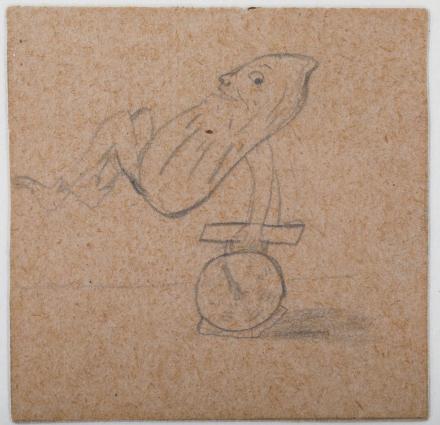
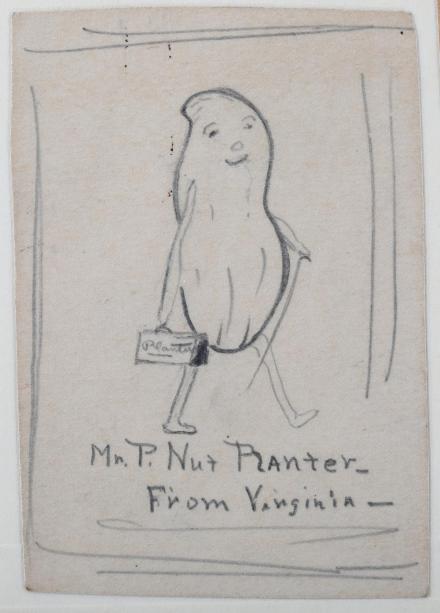
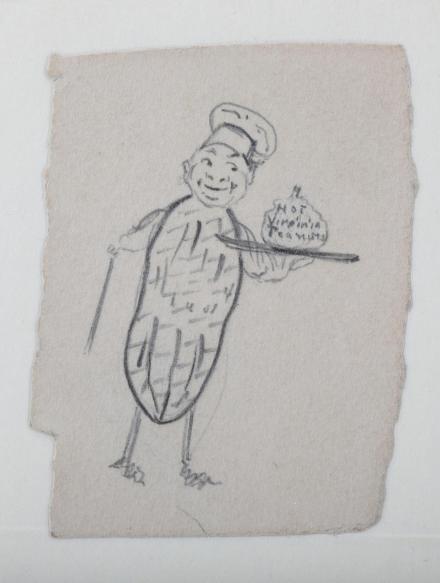
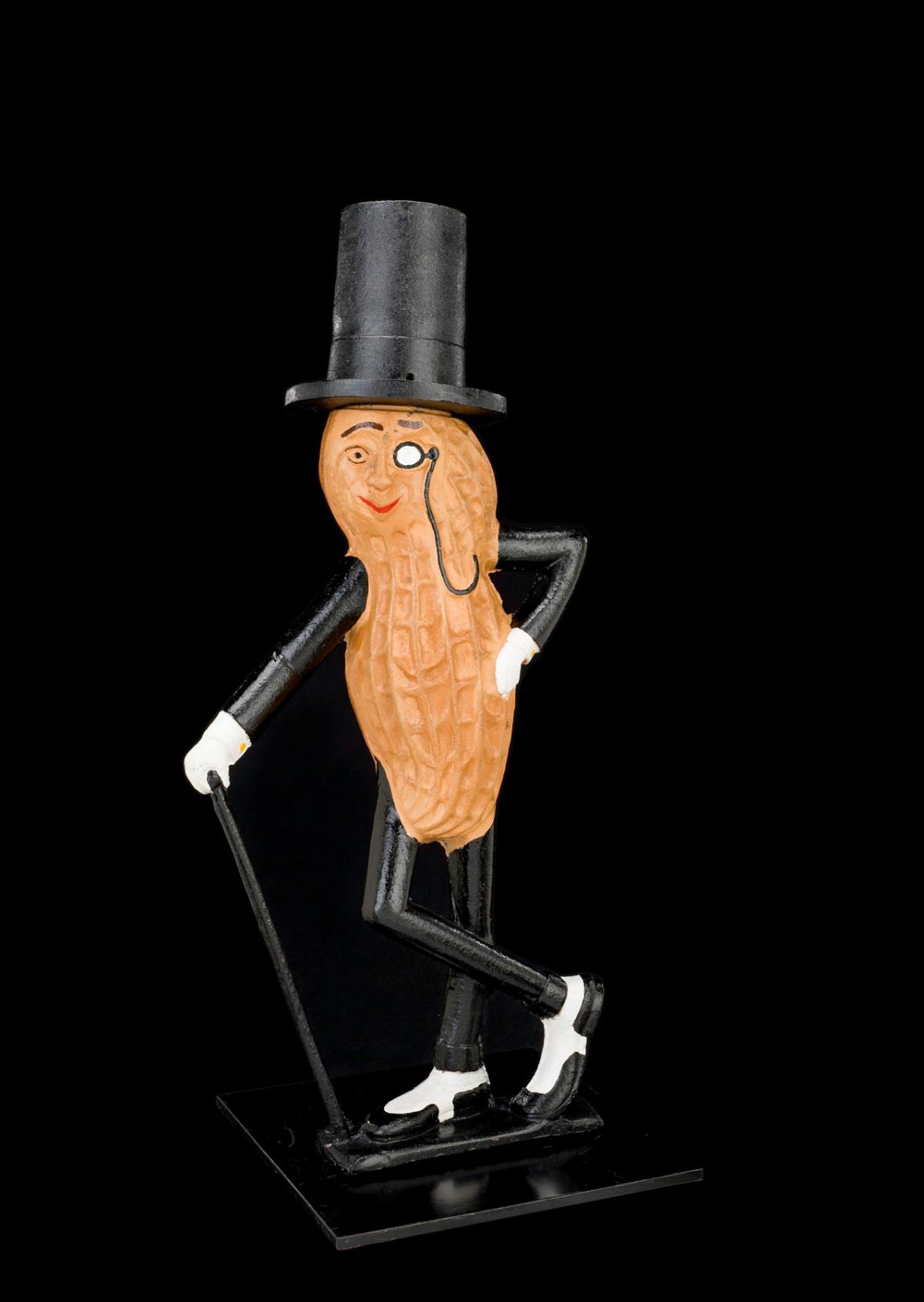
For Dr. Antonio Gentile, skilled physician and surgeon, loved by a paying clientele who admired his ability and his personality, was perhaps held dearer to those who were not a paying clientele, whose money was gratitude only but whom he served as freely, as fully and as willingly as though they had been able to return wealth for service. (The full and rather touching article can be found here.) The Smithsonian owns the original drawings and the dapper cast iron version below.

You may be saying to yourself, what’s up with Mr. Peanut and why, given how much stuff I have found over the years, have I long neglected this particular desire. I asked myself that as well, I admit. My interest in Mr. Peanut advertising predates my current collecting passions. The first time I remember seeing an early bit of Mr. Peanut advertising was on a trip to Paris in my 20’s. I saw a nice early metal one and was entranced but it was too dear for my extremely limited budget, but it stayed with me.

Of course I have encountered this and that small item over time but none really spoke to me. I do remember that on American Pickers once they found the giant Mr. Peanut peanut butter producing machine! Oh my goodness, I was in love! I gather one like it was in use and on display in Atlantic City. Shown below, this one hails from a Peanut Shop in Columbus, Ohio. Their site can be found here and it would be absolutely top of my list if visiting Columbus.

From The Peanut Shop in Columbus Ohio.

In looking online at Mr. Peanut items I am reminded that even as a child I very much wanted the Mr. Peanut hand crank peanut butter maker. Alas, this was not the kind of toy that made its way into the Butler house (I can see my mom thinking, complicated and very messy) and I don’t believe I ever had the pleasure of acquainting myself with one via a friend in those formative years.

I believe it was a less impressive version of this figure that made me salivate in Paris those many years ago.

However, if there is a Mr. Peanut item I still long for, it would be that long ago cast iron one in Paris. I found it online and actually, it would appear that it is indeed quite rarified and remains too expensive for me to acquire – certainly in this pristine condition.

Meanwhile, I intend to bring my Mr. Peanut to New Jersey where the heat in the house is less dry than here at Deitch Studio. This in the hopes of keeping his stringing in order. Somehow now that I have acquired him I think more Mr. Peanut may be forthcoming – increasing rather than sated my appetite for this natty fellow.

Open Sez Me: Part Two

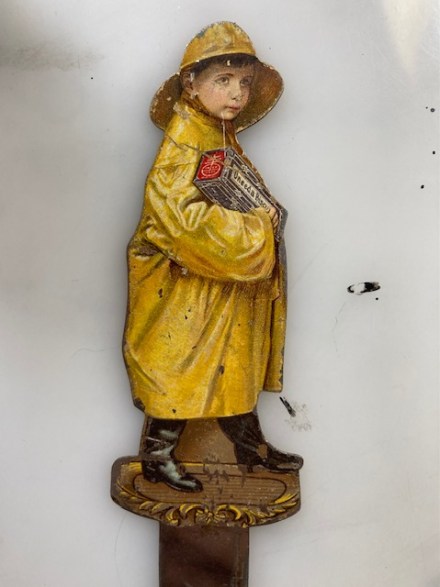
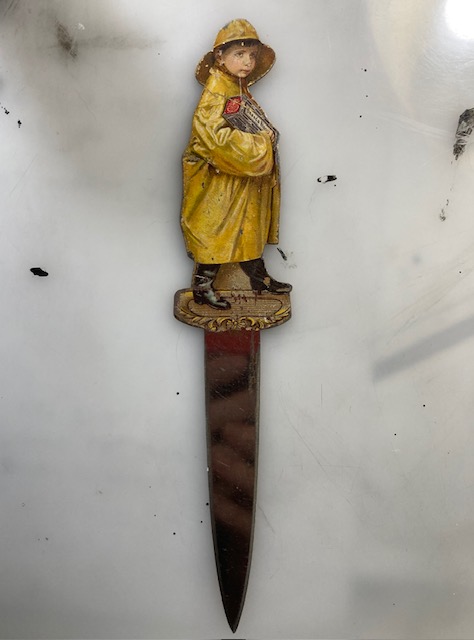
Pam’s Pictorama Post: In yesterday’s postal post I went on a long tangent about my recent interactions with the post office. Today, I will focus a bit more on the advertising aspect of the other letter opener I purchased, one for Oneeda Biscuit.

I tend to think this one will be designated to go to the office although I am realizing that on my messy desk at home (as opposed to my messy desk at work) I might more easily located this one in order to use it, rather than the smaller Red Lodge Montana souvenir one I wrote about in my prior post. I used this one yesterday for the first time. I’ll have to give that some thought.

Pams-Pictorama.com Collection.

This letter opener only has the image on one side which I find disappointing although I guess the trouble to create art for the back of this little boy in his raincoat seemed unnecessary for a give away item like this. (I am pausing for a moment to reflect on the idea that this sort of give away doesn’t really exist any longer, does it? Sad for the future collectors of the universe.) Nonetheless, it was a tad disappointing.

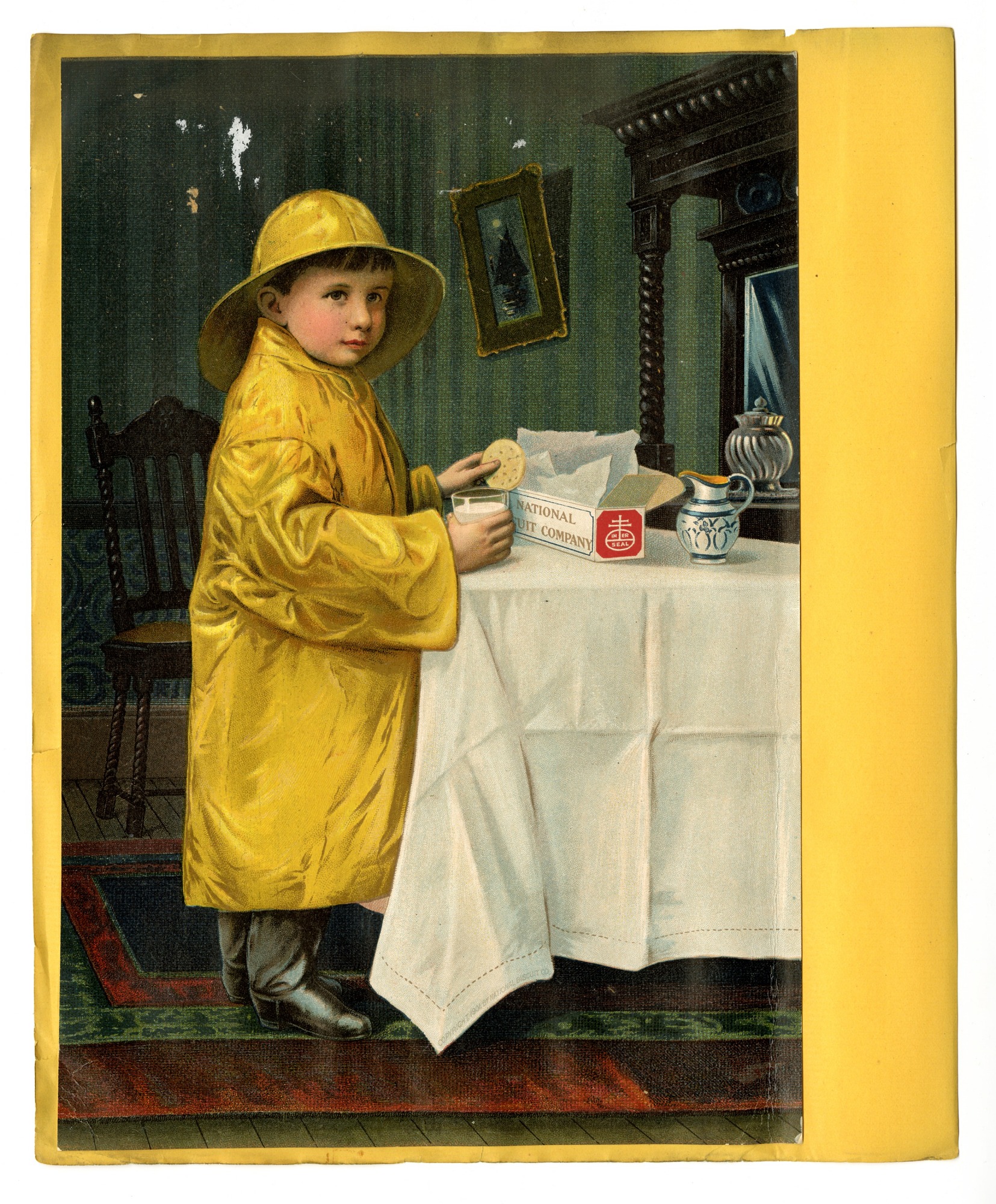
Artwork from an undated Uneeda ad.

Having said that, The art on this is sort of splendid and although slightly chipped in places, in good condition overall. A quick look for these online shows everything from pristine to really ratty. If this makes your pulse quicken and you set your heart on owning one you have ample opportunity.

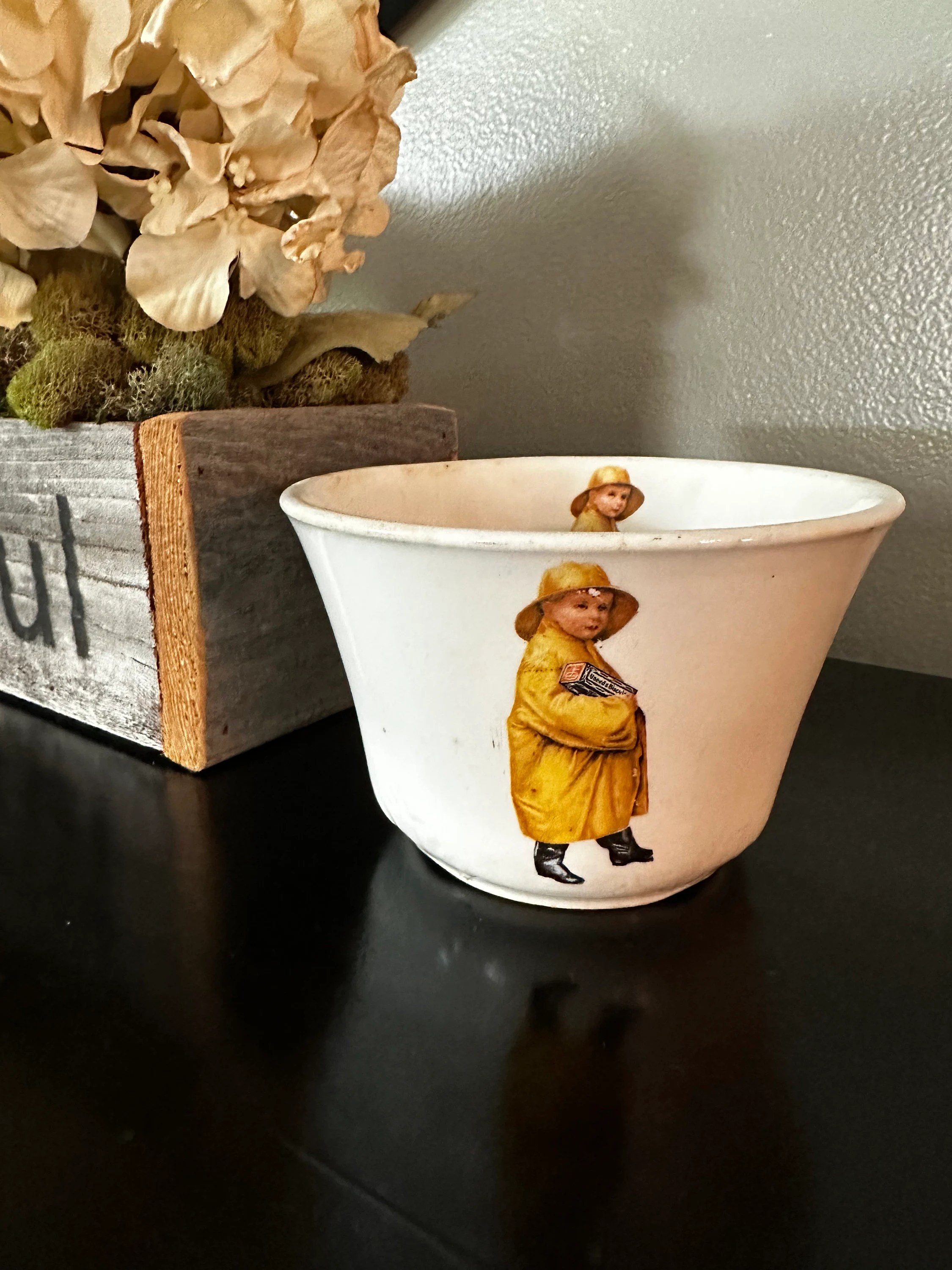
Uneeda Boy items proliferate with online.

Oneeda Biscuit, as many Pictorama readers may already know, was the forerunner to today’s enormous corporation Nabisco. Founded at the dawn of the 20th century, it played the food field with the likes of nascent Heinz, Kellogg, Hershey, Campbell Soup and Wrigley.

The early days Uneeda produced hard tack, crackers for seamen and soldiers that had a more or less infinite shelf life having figured out a way to ship and store crackers in something other than a barrel. However these folks ultimately brought us beloved snacks such as Oreos, Saltines, Ritz Crackers and Nilla wafers. Theirs is a fast paced history through the early growth of a US company through competition, war and peace. (The full history can be found on a site devoted to its history as touched on here.)

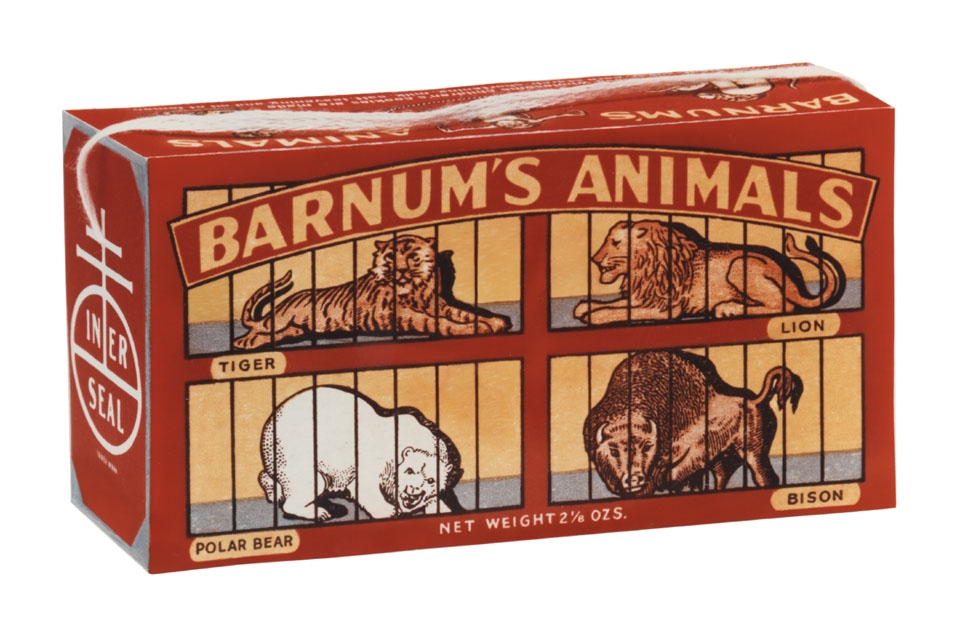
Animal Crackers packaged the way I remember, with the string for handy carrying and the animals in the cages – they have subsequently been “uncaged” evidently.

Enterprising rival companies tried to trade on the early version of the name and efforts to stamp out the likes of Uwanna Biscuit and Iwanna Biscuit were tracked down and eradicated. Uneeda cadets were sent out to ensure cracker freshness in the field as well as these copyright infringers.

As indicated above, Uneeda figured out the moisture proof packaging needed to deliver crackers in individual packages to consumers. The wax paper wrapper was the industrial breakthrough and this little fellow in his slicker is meant to illustrate the moisture proof nature of the packaging. (It took me a bit of research to figure that part out and I would say, at least in this day and age, it isn’t entirely self evident.)

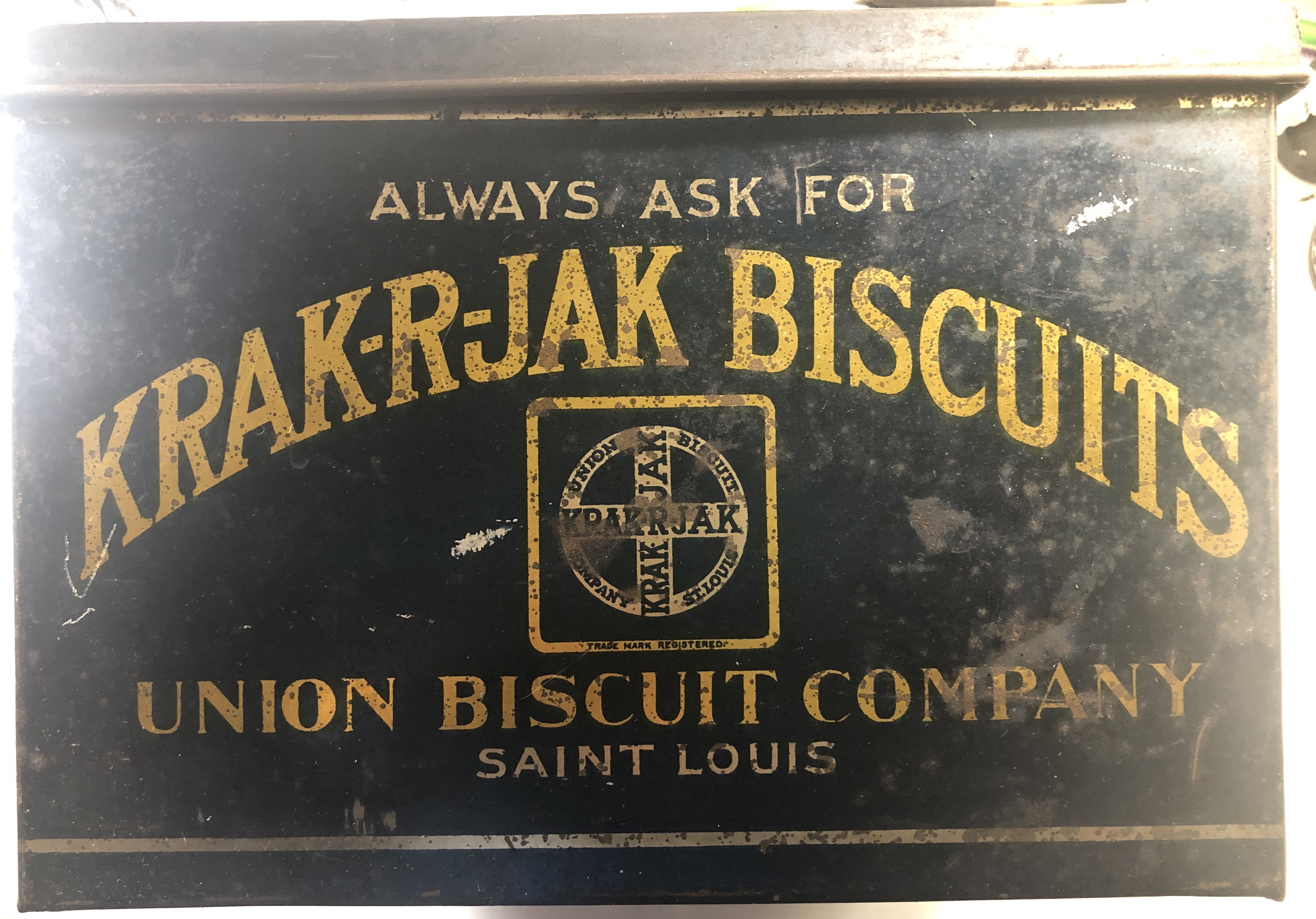
From a popular 2021 post – this cracker tin sits on my home office desk.

This little fellow, Biscuit Boy, becomes the center of their national advertising campaign in 1901, two years after its founding. (Arguably the very first national advertising campaign ever.) Its forerunner was the slogan, Lest you forget, we say it yet, Uneeda Biscuit, but they decided they needed something more.

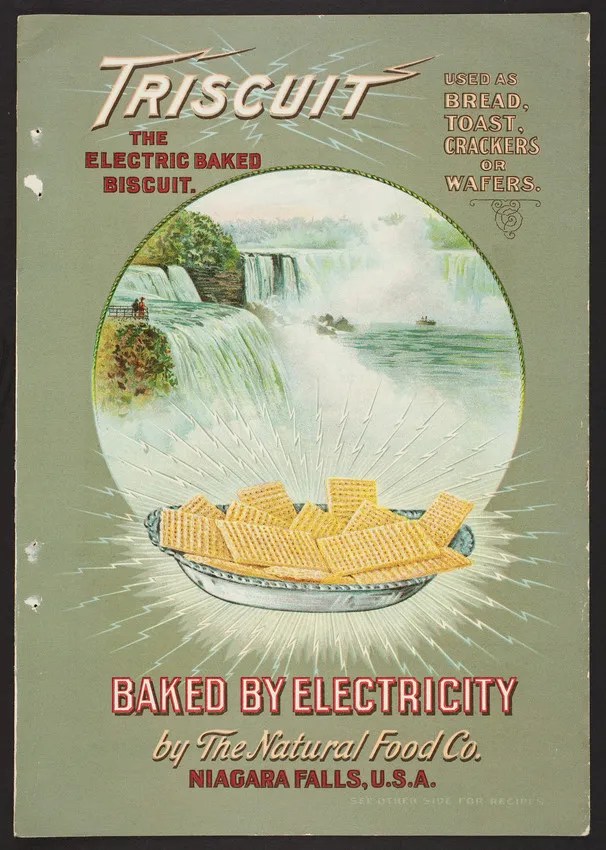
In addition to the treats already mentioned, they were the early creators of Animal Crackers – always a personal favorite. Later in the tale, Triscuits, a Deitch Studio favorite, were also created and added to the long-lived line up.

Is it possible that the name is meant to invoke the baked by electricity process?

Meanwhile, the Biscuit Boy himself was the nephew of the ad exec who created the campaign. His name was Gordon Stille and he was five in 1900 when he was photographed in a slicker and boots for this campaign. He was paid the princely sum of $100 for his services, but given the popularity of the image he ultimately felt he was undercompensated and sued, but died an elderly man without resolution. (All of this and more entertaining information about the history of the company can be found on this blog site devoted to food history here.)

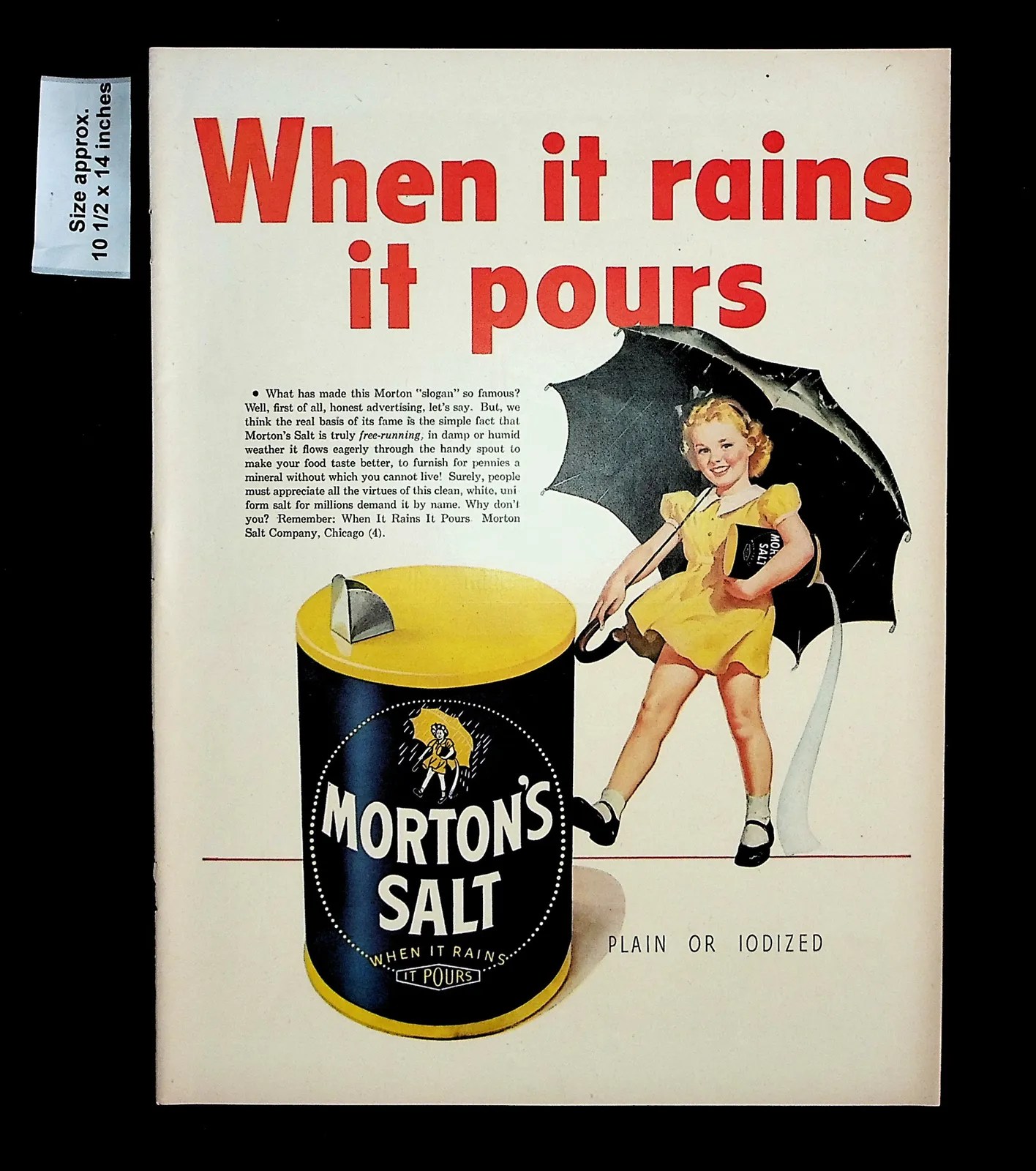
From an eBay offering, the Morton Salt Girl in one of her numerous guises.

Kim and I both immediately began to wonder about how this Uneeda boy advertising might relate to the Morton Salt girl of our youth. She makes her debut a few years later in 1914 with the brilliant slogan of When it rains it pours, and one can’t help but wonder if they weren’t somewhat inspired by the trench coat kid when they designed her. (I remember studying this salt container as a child!) I can find no evidence of this however online, only statements that images like Morton Salt, Aunt Jemima, Fisk Tires, etc. became very much in vogue for advertising in the period. However, the idea that this jolly little girl (significantly less dour and damp looking than our friend from Uneeda) is also out in the rain to prove that Morton Salt would still pour in the rain – another triumph over humidity and the nature of food storage.

My hat’s off to my friend at Red’s Antiques (@reds_antiques or www.ebay.com/usr/reds_antiques) for supplying these two items which will be used daily as mail is still received here at Deitch Studio as well as, hopefully increasingly, at my office.

Women’s World Cheer-up Club

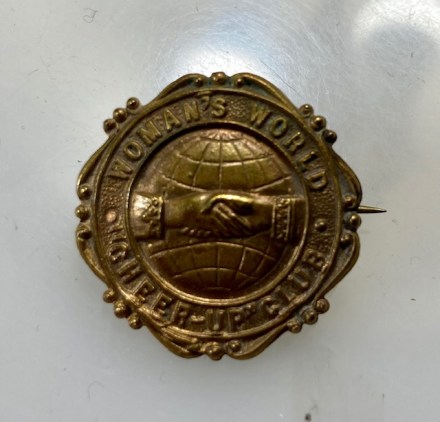
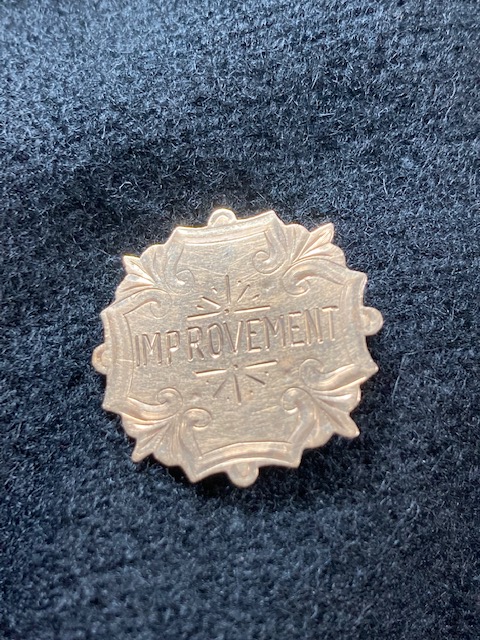
Pam’s Pictorama Post: Here at Pictorama in recent years we’ve developed a particular soft spot for medals. My discovery of school medals lead to recent post (which can be found here) about these emblems of encouragement that seemed to proliferate as awards in schools in the early part of the 20th century. Improvement! Excellence! Who doesn’t want a daily reminder of these qualities cheering them on? Somehow I imagine accumulating numerous ones to wear on a lapel together although this has not yet manifested.

These school award are not the beribboned ones for athletic prowess or competition, but smaller and sweeter in my opinion. I have both a US example and one from Canada. I have to believe that equivalents existed in Europe. Somehow I like to imagine an earlier society where pins like these proliferated. This one is brass and appears a bit more mass produced than my school awards which would have been, I think, produced blank and then etched with cheering motivations subsequently.

Improvement, Pams-Pictorama.com collection.

I am reminded of those pins by this odd kissing cousin of an item I purchased a few months back from a British jewelry dealer (I have written about purchases from @Wassail_antiques frequently before, a recent post can be found here – hey Rachel!) and while making another purchase I decided that I would acquire this pin from her shop too. I had been eyeing it and in the end I would be disappointed to see it go to someone else. It seems to belong here with me.

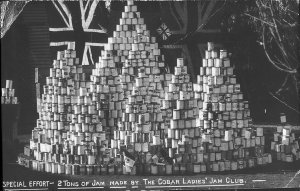
Australian. 2 tons of jam made for the troops!

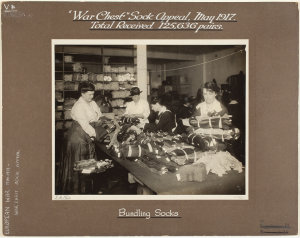
I did think it would be easier to find information about the Women’s Cheer-up Club than it has turned out to be. My limited research skills finally confirmed what I more or less thought I would discover, which is that the Cheer-ups were British societies in WWI. It seems to be an umbrella term for a loosely defined group of organizations which provided comfort and entertainment for troops during the war, raising money for these activities and also to create other resources for soldiers such as physiotherapy and the development of remedial skills. Drives were held for food, clothing and books for the troops as well and I believe some of these ultimately became veterans associations.

Australia. More than 125,000 pairs of socks made and sent to the troops.

I found one other of these pins while doing my research – for sale on Etsy – and it was the exact same one, although it seems there must have been variations on the theme I could find none. The references I ultimately found were largely archival period newspaper articles writing up the activities of a local branch of a Cheer-up Club. The references I found were not specifically to it as a women’s association.

Australian. Instruction book for knitting socks for the troops circa 1915.

Southern Australia had an active equivalent and I was able to find more about those than the British clubs, the establishment of them and the doings of the groups. The Australian Society Cheer-up also seeked to care for their troops abroad as well as at home and there are articles about Cheer-up Huts for Australian soldiers in Britain during the war.

In addition to, of course, urging people to cheer up these pins were a brand of patriotism during that time. I imagine that sporting such a pin might also show a soldier, perhaps on leave in an unfamiliar place, where he might find a hot meal and gathering spot in the area. Of course, it also encouraged people to cheer up during a dark time and now it sits on a shelf near my desk where it does that for me as needed too.