Yearly Felix, the Annuals: Part One

Pam’s Pictorama Post: Today’s Pictorama post is brought to you with love and thanks to our friend Bruce Simon who contributed this to the Pictorama archive recently. (Yay and thank you Bruce!) Bruce, involved in all things cartoon, comic and animation has been a decades long friend to Deitch Studio, but known Kim even longer. He has previously plied me with a supply of wonderful early cartoons – Felix, Krazy and others.

Bruce, his wife Jackie and their peppy pup live on the west coast so we are mostly online and postal pals these days, although we look forward to their upcoming sojourn to NYC in June and also perhaps seeing them at our trip to Comic Con in July. (Kim and I heading out to Comic Con this year as he is receiving an Eisner lifetime achievement award – certainly a future travel post there!)

Onto Felix however and this wonderful little item. An interesting Pictorama secret is that I actually own several of these annuals, three came in the group buy from an auction last year. In addition, I own a few other extremely rarified ones that are not Felix related and all of these will likely make their way into future posts.
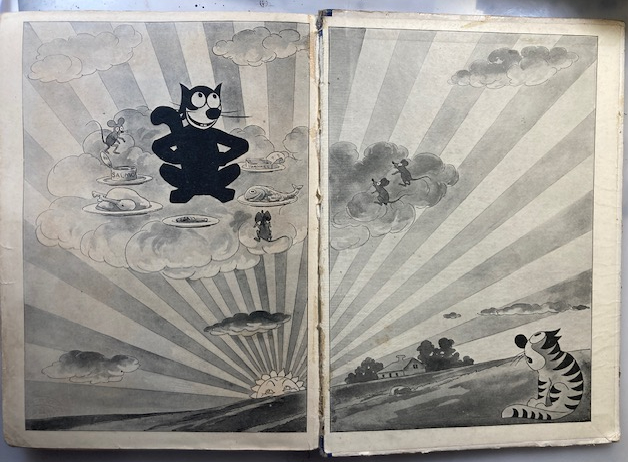
Endpapers for this 1925 Felix Annual. Pams-Pictorama.com Collection.

While I have tackled my Pip, Squeak and Wilfred annuals (one early post can be found here and another here) I am a bit confounded by conveying the wealth of Felix entertainment in one of these volumes. Virtually every page is sort of a gem – either early Messmer strips or those beloved boxy off-model Felix-es supplied by a British artist. Felix’s British alter ego. I don’t mean to be stingy, just a bit overwhelming to feel I am doing them justice. Let’s see how I do today.

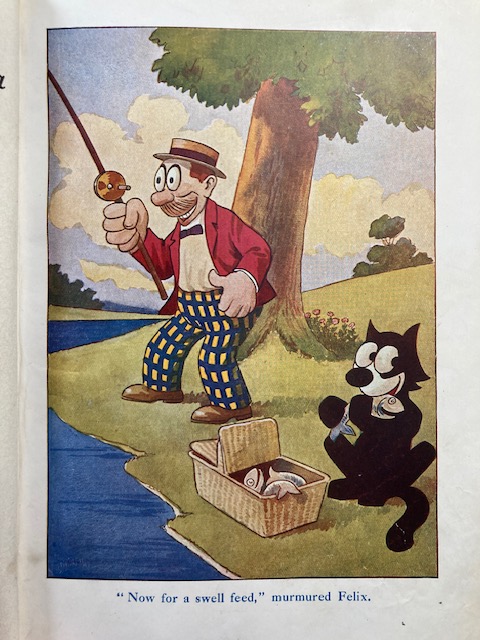
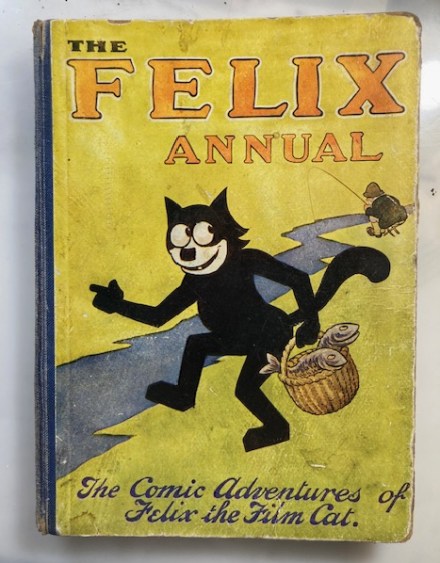
I think Felix is Easter ready on the cover of this 1925 annual (a nod to those of you who are celebrating today) with his basket of fish instead of Easter eggs! This is the great squared off Felix which I note above and ongoing readers know how much I like a square Felix! He is stealing away with the fisherman’s catch, the fisherman is either so deeply involved in his rod or nodding off – I can’t tell.
1925 appears to be the second year of the annuals and for some reason it is said to be less available, although you could buy one right now from what I can see. They are said to have lasted at least through 1929, which would give me all but one of them if true. Published through the Daily Sketch and Sunday Herald Ltd. the years of publication are nowhere in evidence in these books. For the devoted reader these can be had if a tad dear.
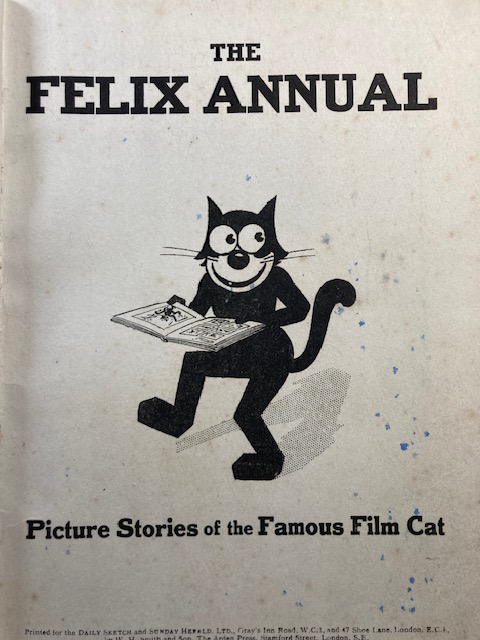
Title page. Pams-Pictorama.com Collection.
Damaged back page. Pams-Pictorama.com Collection.

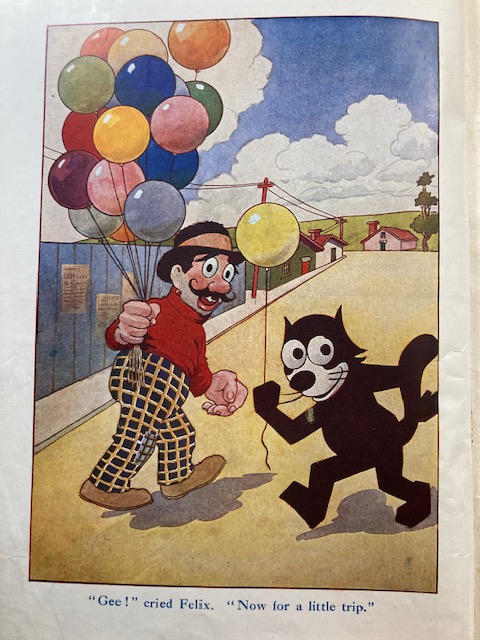
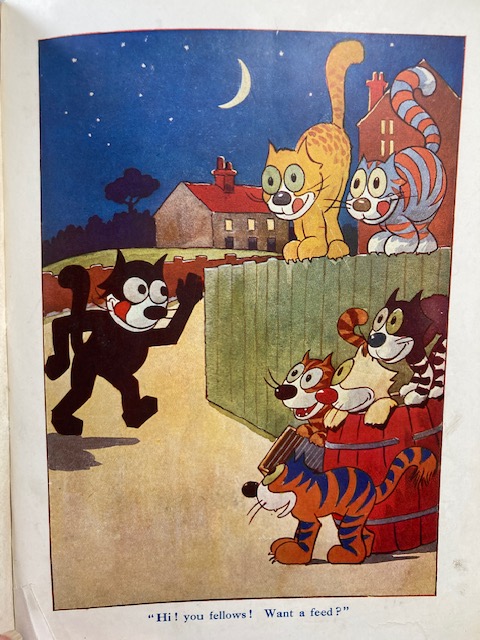
While the book is made up largely of black and white, presumably Sunday, strips, there are what I assume are British produced full color plates throughout which almost, loosely tell a story too. Then there is a center spread of four or so strips which are printed in red and black. This seems to roughly be the format of these annuals. It is interesting to me that the Pip, Squeak and Wilfred ones ran so much longer than Felix, despite his popularity. Those have a run from roughly ’22-’39. The British comics reading public did love their annuals however.

This volume also has hand painted embellishments on a few pages from a well meaning child. This is also very common indeed and not a surprise to anyone who collects children’s volumes of any kind.
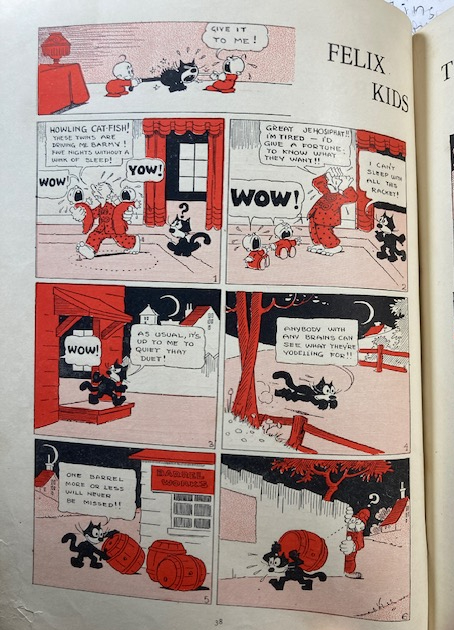
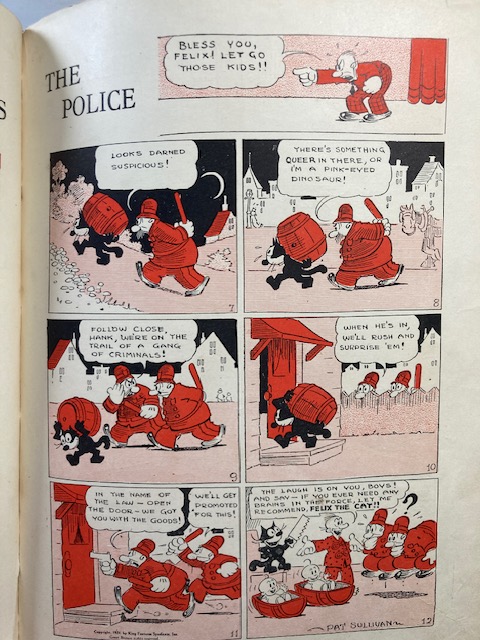
The inside front and back covers are the same goofy design where Felix seems to have ascended to the heavens where he is surrounded by good things to eat (including mice) and admired by an anonymous cat below. There is also a front and back plate of him – sadly the back one is marred by a strange remnant of something unidentified which is on several pages of the book.
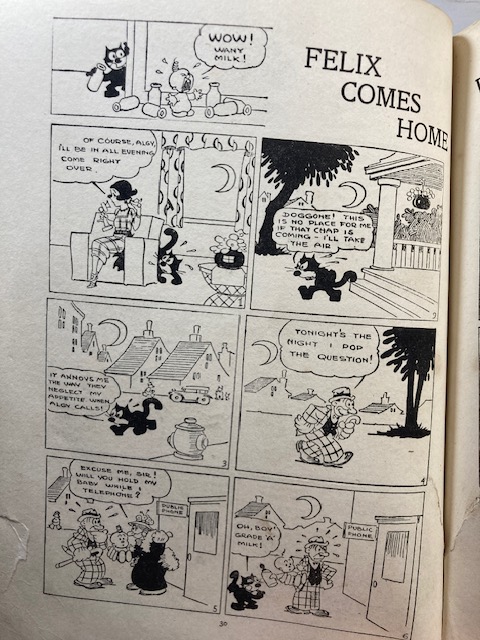
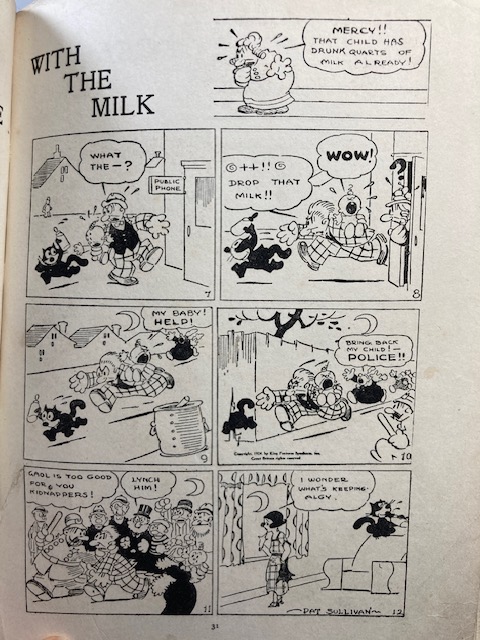
These annuals were sturdy in their construction – well bound and with thick pages. Even with that some of the pages in this 100 year old volume are worn right through with years of thumbing. The back outside cover is a not especially interesting ad for Ovaltine.

The comics within are worthy and I am enjoying reading them in bits here and there. I am more a fan of daily strips than Sundays in general, but these are fun and very much like the cartoons.

I promise more to come on these, but I hope today has been a tantalizing taste.
Mourning

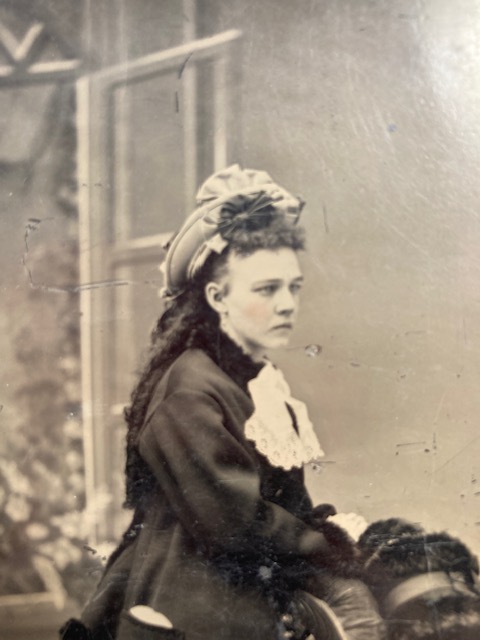
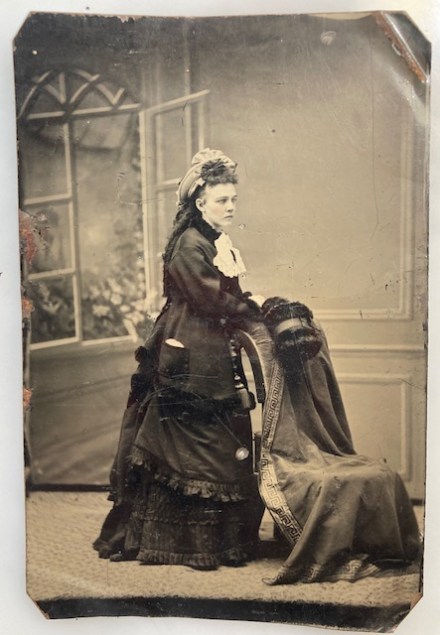
Pam’s Pictorama Post: This unusual photo was a birthday gift from a good friend (thank you @eileentravell) which she gave me recently. It a large, half plate, tintype. Aside from a bent corner, some chewed up edges and that odd ding on her dress near the chair, it is in fairly good shape.

As I started spending time with the image it confused me a bit admittedly. She is in what I have to assume is mourning, her all black attire, down to her black fur muff. Her clothing best dates this to my mind is probably the 1890’s. There is some relief in the white lace ruffle and the middle to light gray of her hat, something light colored like a handkerchief peeping out of her pocket.

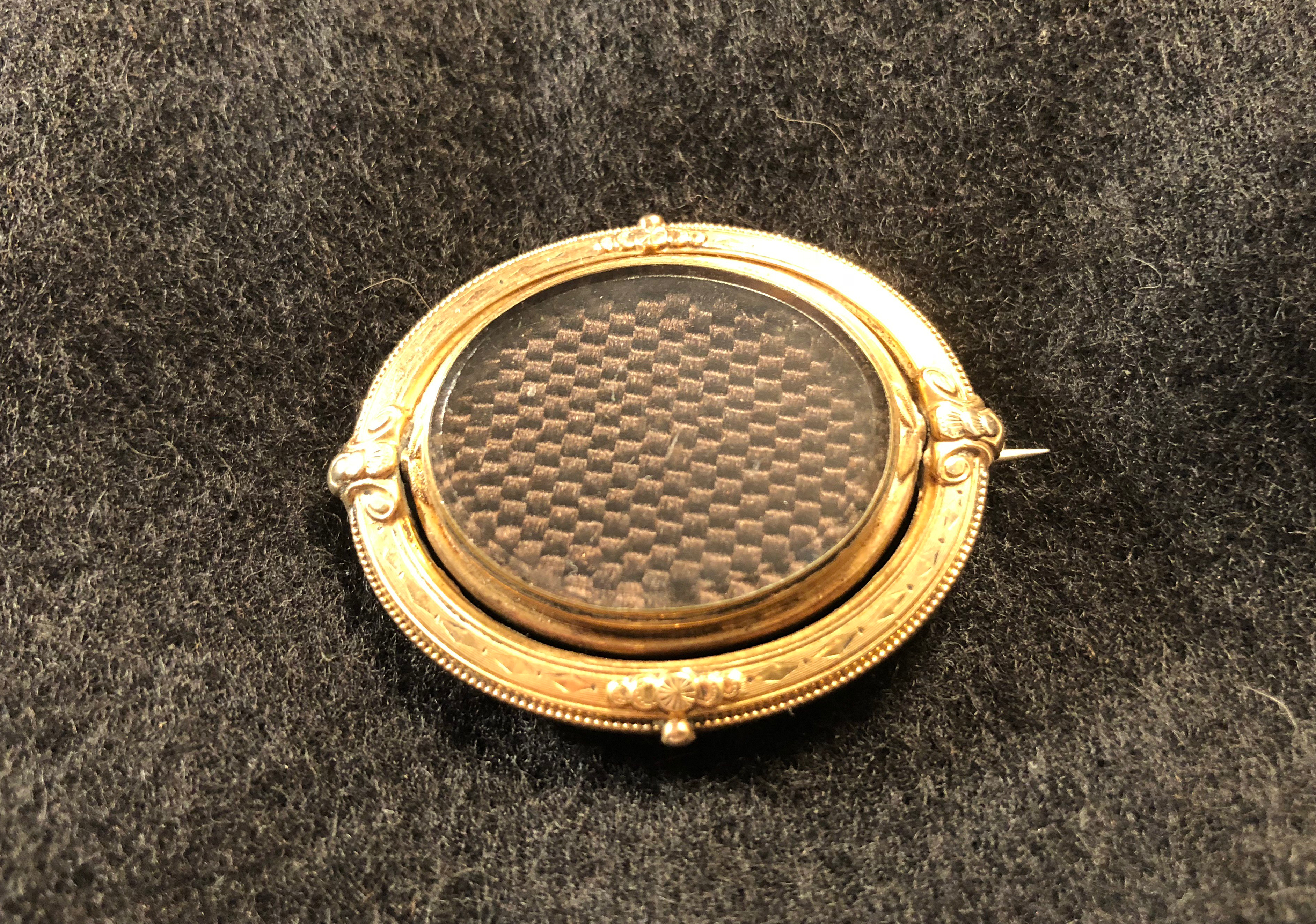
Hair mourning brooch given to me by a friend. Pams-Pictorama.com Collection.

She looks grave and pale as she leans on the prop chair, covered in this cloth with a patterned edge. The background prop is a bit sad and cheesy as well, a view out a faux window, hangs a bit askew and folds below it. The carpet defines the space that she is atop, but that too ends at the front edge of the picture.

Detail. Pams-Pictorama.com Collection.

Most interesting to me is that her cheeks have ever so slightly and delicately been pinkened by a gentle hand, which is not at all always the case in the toning of such photos. Yet, looking at her I wonder why they bothered as she is deeply in her own world of grief.

In fact, I find it interesting that such a photo was even made. Why would you want to record this period of grief in this young woman’s life? (If you look closely, she is young despite these trappings which bring a sort of middle age to mind.) I don’t know if that sort of recording of mourning was part of the intricate ways of observing the various rituals or not.

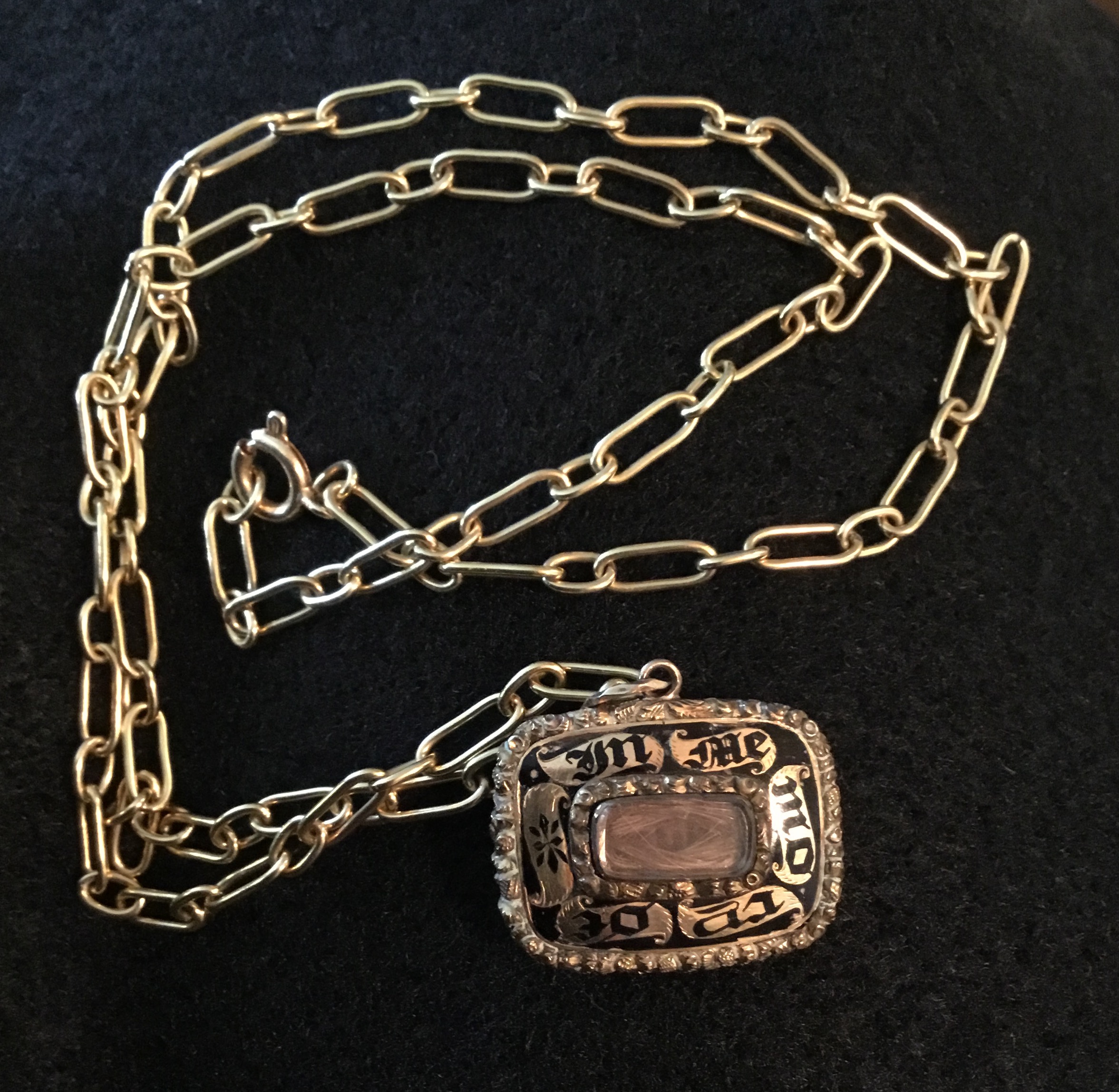
Pams-Pictorama.com Collection. This mourning locket tells a whole story in the March of ’22 post highlighted below.

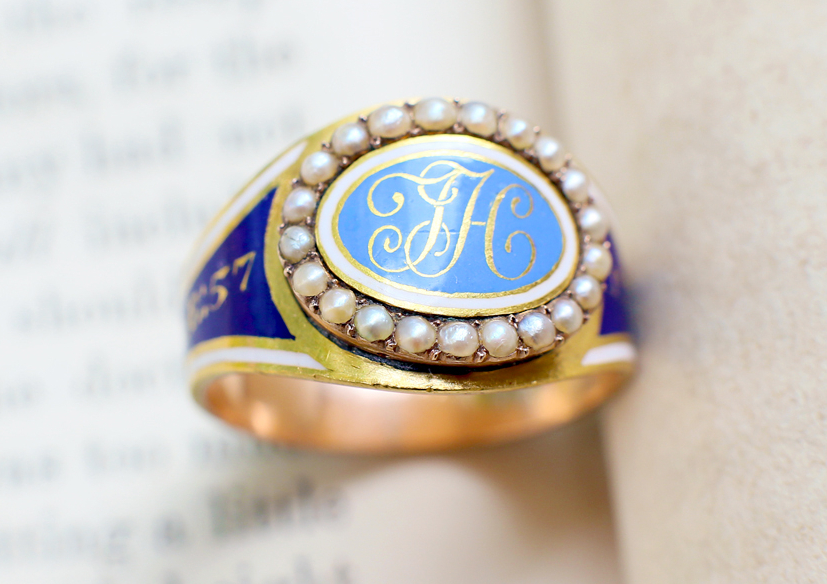
I never realized until recently that beyond black and gray there were lighter shades of mourning and that people would progress to lavender and even light blue. I found this out recently when someone was selling a light blue enamel piece of mourning jewelry online. While it certainly predates her, Queen Victoria really kicked off the dictates of the all black mourning of the time and rigid rules of society bound the clothing jewelry and behavior of the bereaved. At least a year of wearing black and that included jewelry which was largely made of jet or black glass which was less temperamental and therefore less expensive. Much is said about the clothing, jewelry and rituals in the late 19th to early 20th century novels I have been reading.

An example in blue enamel pulled off the internet. Ring dated 1794.

Rings and brooches adorned with bits of hair, images and later even photographs record the attachment to the lost beloved.

After the first year a progression to gray, mauve and purple were acceptable over time and that included jewelry of amethyst and garnet stones. Pearls were allusions to the tears of the wearer which I had never heard before, but many mourning pieces are decorated with them. (I recently heard that some Asian cultures view pearls that way as well.) I have written about some mourning pieces in my own collection, most given to me but others I purchased. These wearable memorials fascinate me. Those posts can be found here, here and here. (Oddly each of these posts have appeared in late March in different years – a spring thing?)

The idea of lavender and even light blue (enamel rings and lockets) in the latter stages of mourning, probably two years or more out, interests me – the point of emerging, yet still recognizing your loss and the process. I have seen lavender clothing as well from that state, but not sure I ever saw blue associated with it. For me the light blue, that final stage perhaps, is a sign of sending you back into the world of spring and blue skies again.

Part 2: Mrs. George de Horne Vaizey Cont.

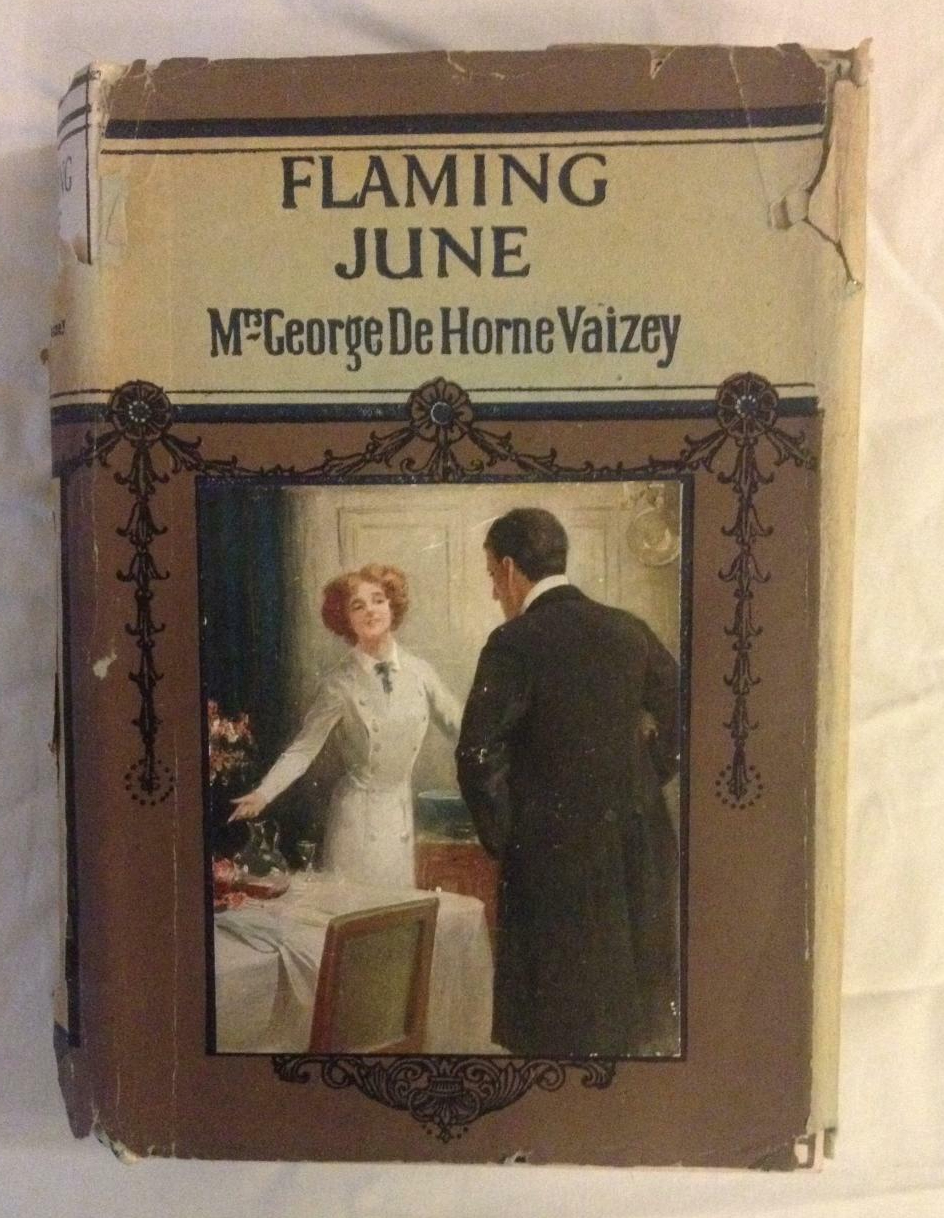
Pam’s Pictorama Post: Apologies in advance for anyone who was peevish that yesterday was a book-ish post as I am going to wrap up (at least for now) my thoughts on Mrs. George de Horne Vaizey today as she continues to be my reading material of choice. (Yesterday’s post is here.)

I will confess I went for a long fallow period of not reading much and just one off books here and there when I was. Kim powers through all sorts of long and short term reading projects, both for his own edification and for things related to work, so I am jealous when I am without one too. However, I am there with the best when I find a rabbit hole to go down and therefore here we are today.

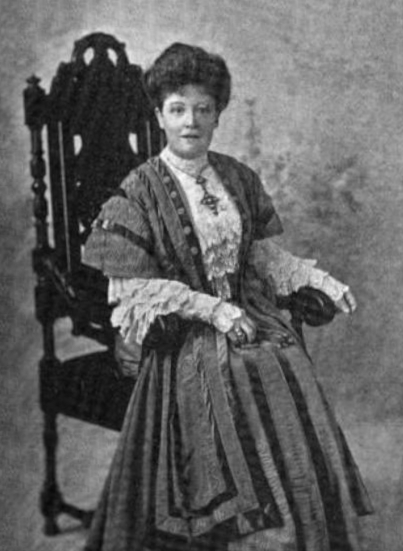
From Wikipedia and the only image of her I can find.

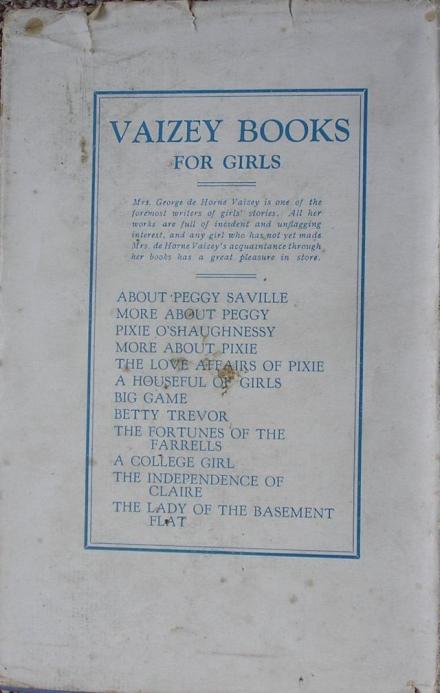
Mrs. G de HV as I like to call her, is fading from consciousness and seems to have barely been rescued for the digital age. If we are to look at the remaining availability of her published volumes, we have to assume that the Pixie books I wrote about yesterday were among her most popular, with a few other titles that seem to stand out. She wrote upwards of 32 books (I say upwards because Wikipedia does not always have every book published by an author although they do a good job of it) and clearly there were short stories. There is a collection of them mentioned as published in 1918. The list of her publications runs from 1897 to 1918, ending with that collection of stories. However, if I really want to read the widest swath of her work I will need to dig some. I would say about half is available online or for sale as antique volumes or occasional reprint.

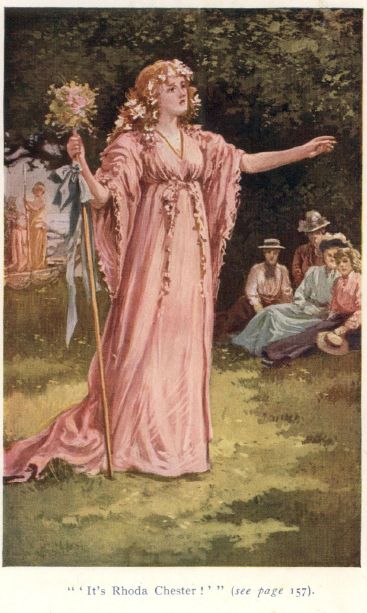
From “Tom and Some Other Girls”, 1901.

Born Jessie Bell in 1857 as one in a melee of seven children (four brothers, two sisters) she was the daughter of a Scottish insurance broker. Her place of birth was Liverpool. She first married Henry Mansergh, a cotton broker, and published her first volumes under the name Jessie Mansergh. They had a daughter, Gwyneth Alice, in 1886. Mansergh was an addict which seems to have contributed to his early death. Reading between the lines so to speak, one wonders what part her early writing played in supporting them.

While I was certain that hers was a pen name of a type that was often adopted at the time, I learned that no, her second husband was indeed George de Horne Vaizey. She meets him while on a cruise which was a prize awarded for one of her short stories. They marry in ’98 and have a son, also named George, who goes on to be a writer. Sadly her own life ends as an invalid, confined to bed for many years. She dies in 1917 at about age 60 (her precise date of birth unknown) and therefore the final volume is posthumous.

From “A College Girl”, 1914.

Jessie uses her own life as whole cloth for her fiction. Large dynamic families, addiction, illness abound in her pages. Therefore, I have to assume that her evolving views on marriage and the relationships between men and women was also explored on her pages. If you’ve followed my previous musings on women writings of the early 20th century, you know that I found that even the juveniles such as The Radio Girls and Automobile Girls were gently ever pushing the line forward for what was permissible and acceptable for young women. (Some posts on those books here and here.)

Interesting to find Mrs. G de HV who is a bit earlier still than those authors and for me a logical forerunner of some. The line for women, the options they had in society for supporting themselves, is still more nascent although shifting all the time. An ongoing theme she explores is the unmarried middle class woman and her lack of options. I’ve already encountered several books where due to various circumstances the heroine is in some way prohibited or unable to marry and is faced with the issue of how to live their lives, preferably not just dependent on family. She seems to walk a narrow line – clearly a woman married to a man of means is the safest port in the storm.

She also confronts the daily reality of marriage – the idea that you are joining up with a mate who you will continue to make conversation with daily for decades. (I have often said that knowing that I would never be bored talking to Kim helped ensure a good union for us!) The sheer difficulty and exhaustion of running a house and caring for a family.

From “Lady of the Basement Flat”, 1917.

I am going to skip forward to An Unknown Lover, a novel published in 1913. (Some spoiler alerts ahead for those who care.) The author sets herself some unusual tasks. We have a heroine, Katrine, in her late twenties who has spent most of the last decade caring for her older brother who was widowed shortly after marrying. There are rarely effective parents in her books – adult children have either lost them or they are on the sidelines for some reason. I can’t even remember why they weren’t present to stop this hot mess of a situation – dead and forgotten in this case.

Anyway, both characters are beginning to chafe at the situation. The heroine opines on having all the responsibilities of housekeeping without the partnership of a true mate. She is also painfully aware that she is dependent on her brother for her keep, which comes to a hard point when he decides to remarry. She has no marketable skills and living in a small hamlet no prospects of marriage which is more or less what she is trained for. As a literary challenge, our author has placed an epistolary relationship through part of the book, which moves the storyline along. At first it seemed a bit awkward, but it grew on me. Despite some flaws and maybe questionable decisions, it is to date my favorite of her novels.

Love this title and looking forward to this one. Published in 1908.

De Horne Vaizey has beloved tropes – I’ve noted before a preponderance of gray eyed heroines, some have golden eyes as an alternative. An odd one seems to be a fondness for shipwrecks – I believe I may be up to three in her oeuvre to date. An interesting tidbit, while researching this post I came across the following in an Internet Archive version of An Unknown Lover which actually photographs the pages of a hard copy of the novel and included this forward below:

AUTHOR’S NOTE

Lest I should be credited with making literary material out of a disaster still painfully fresh in the minds of readers on both sides of the Atlantic, I should like to record the following rather striking coincidence.

On the fourteenth of April last, I was engaged in writing the description of the collision at sea in which the heroine of the present book plays a part; and after some deliberation as to the most forceful word to employ, wrote the sentence which originally ran as follows: —

”Mercifully it is not one person in many thousands who is called upon to endure so titanic an experience. …”

A few hours later my husband returned home and told me of the news which had that day thrilled the world — the foundering of the steamship Titanic on her maiden voyage.

Many weeks passed by before I could bring myself to continue the narrative.

Hampstead.

Jessie de Horne Vaizey.

Somehow she pulls out two parallel love stories and details the personal growth of Katrine as she makes some rather bold leaps forward to attain a measure of happiness and independence, gently breaking with at least some of society’s conventions.

Sadly Jessie de Horn Vaizey doesn’t live quite long enough to see the shift which occurs even in the early 20’s for women. At six or so volumes I have barely scratched the surface and if it is interesting enough I promise more to come.

Pixie and Mrs. George de Horne Vaizey: Part One

Pam’s Pictorama Post: It has been a very long time indeed since I have posted about a writer or books I have been reading. That is in part because the last year did not lend itself to reading. Helping during my
mother’s last illness and the months that followed, ultimately leading to my changing jobs at the end of the year, certainly there were books, but reading was sporadic. Love or hate my book posts, books are back and today kicks off an interest in Mrs. de Horne Vaizey, nee Jessie Bell, later Mrs. Henry Mansergh and finally Mrs. de Horne Vaizey.

Pictorama readers of long-standing know that in recent years (especially during the at home pandemic years) I chased down the writings of numerous authors including all the Judy Bolton mysteries (a post about those can be found here) and strolled through the collected works of several women who were writing short stories and novels that depicted the emerging woman in the US and Britain at the dawn of the 20th century.

These included the adult novels of Frances Hodgson Burnett (in several parts, but it all starts here),
the (glorious) short stories and novels of Edna Ferber (here) and the various series books including the Red Cross Girls, Ruth Fielding books and the many volumes of my beloved Campfire Girls. (Starting here, here and here if you are game.)

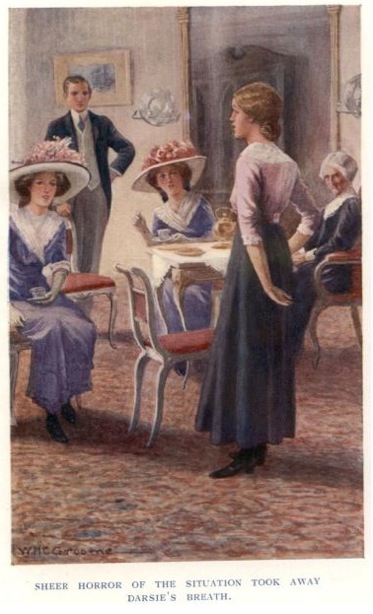
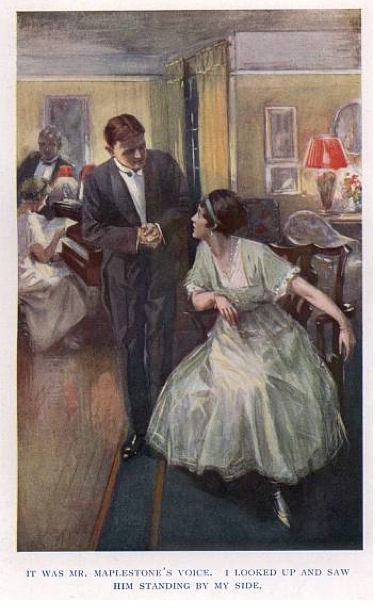
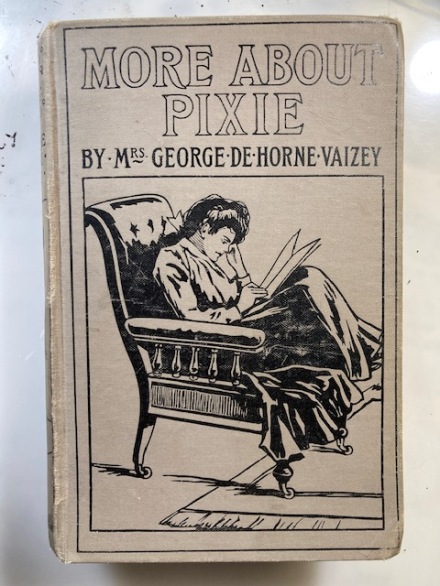
You might remember that my birthday this year turned into a day of poking around bookstores downtown, including The Strand’s re-opened rare book room. I picked up a copy of More About Pixie, the second volume in a three novel series by Mrs. George de Horne Vaizey (Mrs. GdeHV for my purposes going forward)

I was able to find the first volume of the books about Pixie online, Pixie O’Shaughnessy, with relative ease on my old friend Project Gutenberg. (All three volumes mentioned here are available on this free online resource as well as some others, although beyond these books only about half of her publications seem to be readily available. Many volumes of her work are also available at the Internet Archive.) I have largely been able to download illustrated versions of the books which I urge you to try to do as some of the illustrations are very good. (Oddly I can’t seem to open and share them here and show what I was able to find otherwise. I will add that the blog site isn’t actually allowing me to add images today so I apologize for the largely un-illustrated post!)

This first volume is a wonderful depiction of life in Ireland in the waning days of the 19th century. Written in 1902 it is a bit earlier than the copious volumes of my earlier reading I mention above. The impoverished, motherless (a recent loss) family resides in a dilapidated castle which becomes a sort of
character in the book, as does the backdrop of the small Irish town they reside in.

Pixie is a young child still at the start of this book – she is not a physically attractive youngster (this is an oddly defining characteristic that stays with her; her looks do not improve with age), however she has such an outspoken and winning personality that she always everyone’s favorite. To make up for her physical limitations as a beauty, she has two lavishly beautiful sisters (Mrs. GdeHV is a little obsessed with her heroines having gray eyes, they all do), Bridgie and Esmerelda, and attractive brothers in the bargain.
The funds are scraped together to send Pixie off to a private school in London and her adventures there make up the second half or so of the volume. (Esmerelda is hot tempered and so extravagantly stunning that she is somewhat done away with at the close of volume one.)

Written a year later, volume two, the one I picked up at The Strand More About Pixie, takes an interesting turn. It is in fact not so much more about Pixie, as the story is actually told by a young woman neighbor, a
recovering invalid, who lives on the street in London where the family decamps to at the start of this volume. Her encounters with the O’Shaughnessy family include Pixie, but in reality it focuses more on her friendship with one of the older sisters, Bridgie, who plays mother to the clan. Pixie does reassert
herself in the latter part of this volume, but it is Bridgie and the neighbor girl, Sylvia, and their friendship that is at the heart of the book.

Much of the book concerns the slow recovery of Sylvia (an illness which is given no name but has even affected her bones as they gravely consider needing to amputate her foot) who is another motherless child (life of mother’s was evidently cheap), living with an aunt while her father is away in India. (Mrs.
GdeHV likes to send men to India and bring them back after many years. To date I have barely been in India with her books, but wouldn’t be surprised if we end up there one of these days.)

It isn’t until 1914 that the final volume of the three is published, The Love Affairs of Pixie. Our prolific author has penned at least 17 volumes between these so it is a more mature writer who writes this novel. It interests me that she decided to turn her hand back to a now fully adult Pixie who returns as the heroine and focus of this story. Much of this story brings Pixie and the reader back to Esmerelda and Ireland, although the Ireland of this book is less lovingly described. Pixie remains unattractive on the face of things and in fact the book opens with her own discovery of this and is a theme throughout, but the pluckiness and good heartedness of Pixie has her as a sought after mate who (spoiler alert) finds her mate at the close of this volume.

Mrs. GdeHV clearly liked to assign herself challenges to keep things interesting. These are not formulaic series books (not that there’s anything wrong with those!), but instead you can see her making choices and setting up approaches to keep things different and interesting. I’ll cover more of her biography tomorrow, a sort of sad tale despite being a very prolific writer. She must have been popular in her time, but sadly volumes appear to be hard to find and I know she wrote short stories but none of those have turned up yet. However, I have only just begun my research so undoubtedly more to come.


Aspirational

Pam’s Pictorama Post: It’s a rare, I don’t own ’em but wish I did post here at Pictorama today. To the extent that I have set ground rules here, one general one is that if I feature it I own it. (Some readers will remember that I broke it recently to bring you a wonderful cat chair photo. It was a family photo which a reader shared with me and the post can be found here.)

However, to some degree rules exist to be broken and this image came to me both via Mel Birnkrant (his endlessly fascinating FB page can be found here – it is a rabbit hole to go down and possibly never emerge from) and some folks sent it to me via both the Old London FB page and also via X (that we used to call Twitter). The caption reads, Felix the Cat dolls leaving their Acton factory, 100 years ago.

Allow me to start by saying this image just floors me altogether. Admittedly, Felix lust immediately filled my soul! Oh the riches of the past! Truckloads of precious, giant Felix dolls making their way from Acton, out into the 1924 world of of extremely fortunate children and itinerant photographers.

It is also of interest to me to learn that at least one factory making these dolls was in Acton. Unlike the bit of history I uncovered previously (in a post from 2015 I very much favor and can be found here) which indicated that unemployed women were given jobs making smaller ones in a factory on the East End of London. Acton is a suburban area to the west so now I know Felix was being made all over London.

Collection of Pams-Pictorama.com

These are truly splendid huge Felix toys. Are they large enough to be the ones people posed with? Could be, but hard to say. If for kids, very luxe indeed. I certainly have photos of people posing with this size Felix although it isn’t the very largest size which I judge to be about the size of a midget. However, over time my collection has come to include period photos from British beach resorts with Felix dolls smaller than these. (A post on the one above can be found here.) None of the dolls in my collection (yet!) reach these size of the ones in the truck. Hope springs eternal however.

An admittedly soft grab off the film, but a nice close up of the Felixes.

While chatting with Mel and researching this earlier today, I realized that this is actually a British Pathé newsreel short. It can be seen in its entirety here. (I was unable to place the video here – I am experiencing mechanical stupidity today.) Note the unruly little fellow who looks like he wants to make a break for it by falling off the cart.

Of interest that most of these Felix toys were sensibly wrapped in brown paper, precious little parcels being piled up. However, someone must have realized that some should fill the back unpacked in order to get this wonderful image.

I think what I have here is actually a frame grab rather than a still, although hopefully stills do exist so I have a chance at one some day in the future.

Bookplate not in Pams-Pictorama.com Collection.

While we are having a posting moment focused on things shared but not owned, I am adding this Felix-y bookplate which came to me via J. J. Sedelmaier a few weeks ago. It would appear that Mr. Lowell and our cartoon friend shared a moniker. I assume he had these made – very pro job though. A nicely squared off, early looking Felix here. Something sort of smart about how his hand rests on the edge of the “shelf” and the lettering. Oh for the days of book ownership pride which would result in special bookplates like this!

Back to stuff I own next week!

Cathouse

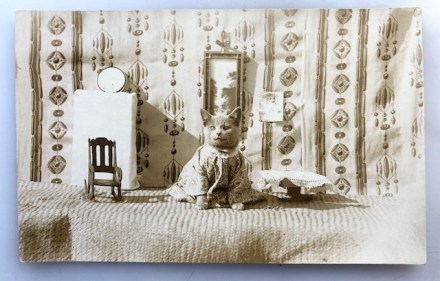
Pam’s Pictorama Photo Post: A dollhouse setting and a kitten in doll’s clothes – what’s not to like? I was speeding along my feed in Instagram when I stopped in my tracks for this one (sold by @baileighfaucz) and had to buy it. She has a beautifully curated stream of photos, virtually all for sale and I am often tempted. It is only fiscal responsibility that binds me, until I find one like this I just have to have.

There is something about the scale of the furniture in this picture which appeals to me. The kitten is too big for the space but only by a little, like a fluffy oversized giant kitty in his or her space, unable to sit in the tiny chair or at the little table. The wallpaper (wall covering?) is closer to kitty’s scale, just a little too big for the furniture. Somehow the little landscape is precisely above the cat’s head, right in the middle of the picture.

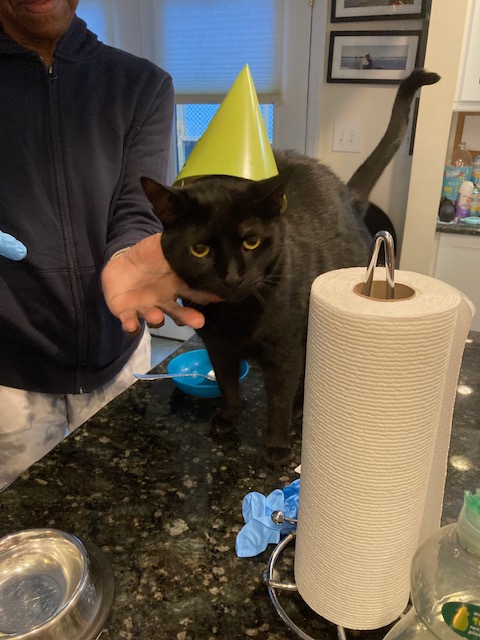
Beau last week, very reluctantly wearing a party hat.

There are many textures between the fabric wall covering, the blanket or towel on the floor, a little lacy tablecloth, and the cat’s dress. There is that little landscape which we can read as a painting or even think about it as a window to the outside. I like to think the thing next to it is a calendar, but I think it is another picture. The wrapped white box (is that a tiny mirror atop it?) reads as a refrigerator to me although it could be a clothing cupboard too.

Kit is right in the middle of this evenly divided picture. It is well lit, but a bit heavier from stage right or our left, casting shadows on the carpet for the chair, cat and other objects. (It is also quite overexposed drifts all the way to a white out in the lower right corner.) This kitten is a solid citizen, fluffy and gray. He or she looks barely patient with this process.

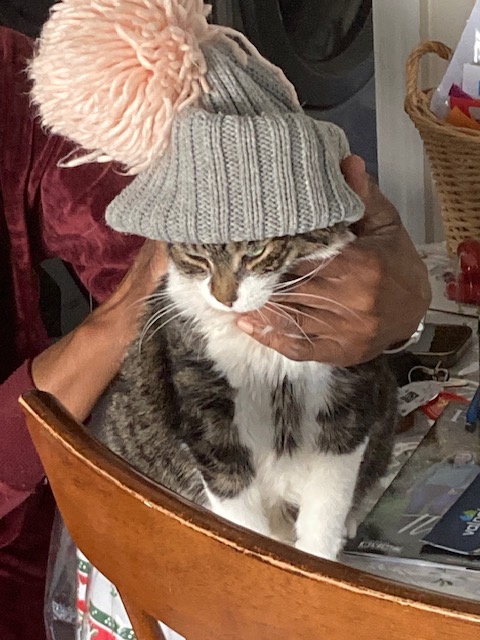
Miltie sporting Winsome’s hat.

Kim has gently suggested that it isn’t nice to dress our kitties up and take pictures of them, so I mostly contain myself on the subject. Winsome and I have made a few attempts at cats in hats in New Jersey recently. There is part of me that would love to be setting them up in dioramas and taking their photos. Perhaps it was my profession in a past life – or maybe I was the cat!

Pams-Pictorama.com Collection.

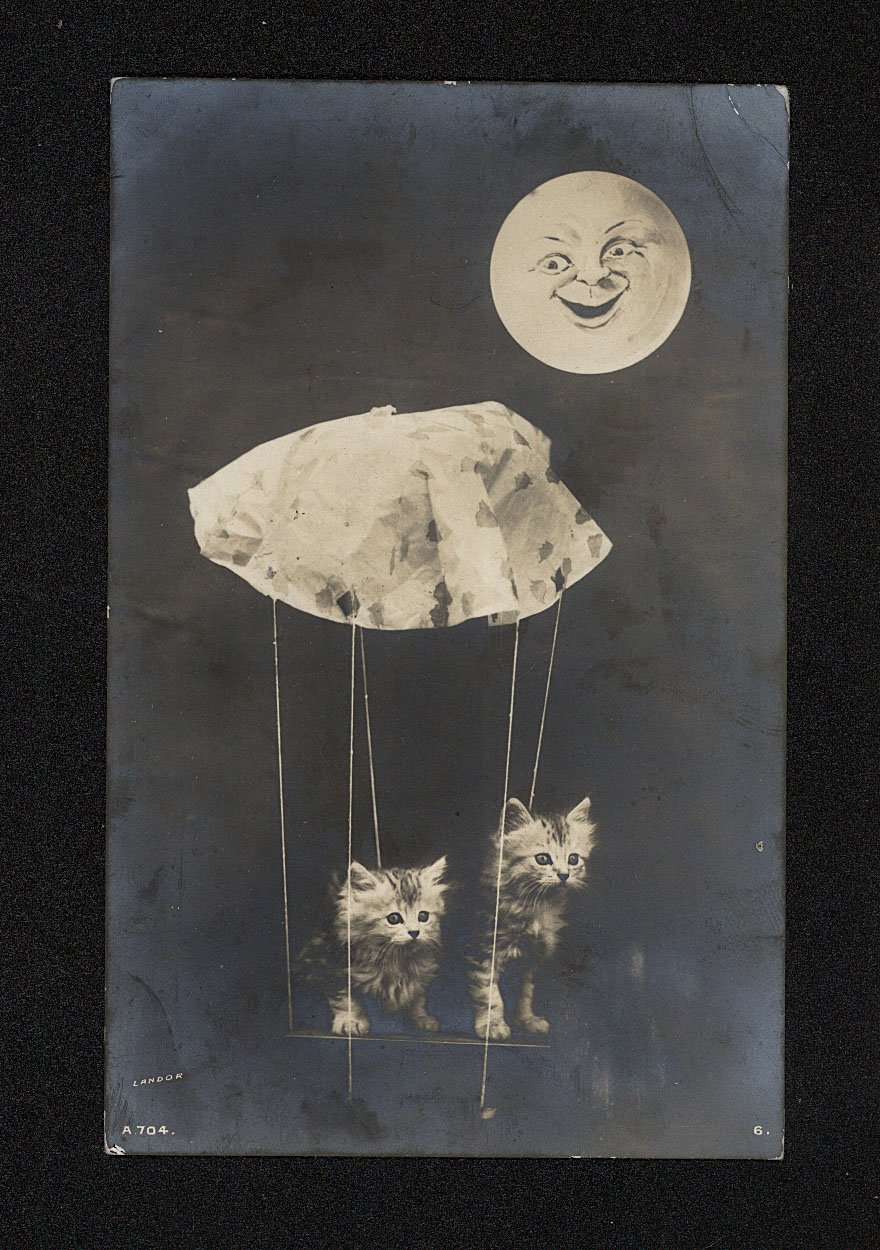
The Pictorama collection does not tend to a lot of this genre of postcard (I think of them as the equivalent of the Dogville Comedies for cats, for those of you who are in the know about those) – kittens dressed up and posed in various scenes. The rather superb one of kittens in a faux balloon above was the only that I could think of off the top of my head. (That early post can be found here.)

There were several others from the same set, but while tempting none of them were quite as engaging for me and no others were purchased. While professionally made, there is a charmingly homemade quality to this one (for the record, there’s no identifying photo studio, nothing written on the back and it was never sent) and I think the photographer just happened to hit it right on the nose.

Louise Groody with a Little Bit of Felix

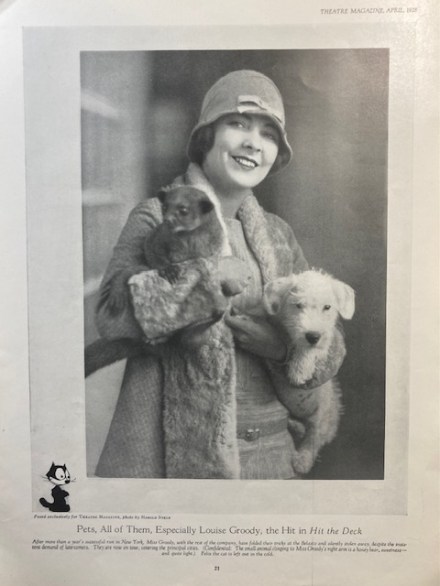
Pams-Pictorama.com Post: Today’s Pictorama oddball exclusive is this April, 1928 Theater Magazine page featuring stage star of the day Louise Groody. Shown here at age 21 by my calculation she grasps a perfectly delightful fluffy white pooch and a mysterious equally fluffy (if unable to achieve the same level of actual cuteness) creature in the other arm. She herself is dressed in fur. A very of-the-moment cloche hat covers her hair and shades her eyes in this carefully composed composition. A well trained smile outlined in carefully colored lips and revealing very even pearly teeth.

The bottom of the page reads, Pets, All of Them, Especially Louise Groody, the Hit in Hit the Deck. Below: After more than a year’s successful run in New York, Miss Groody, with the rest of the company, have folded their tricks at the Belasco and silently stolen away, despite the insistent demand of late-comers. They are now on tour, covering the principal cities. (Confidential: The small animal clinging to Miss Groody’s right arm is a honey bear, sweetness – and quite light.) Felix the cat is left out in the cold.

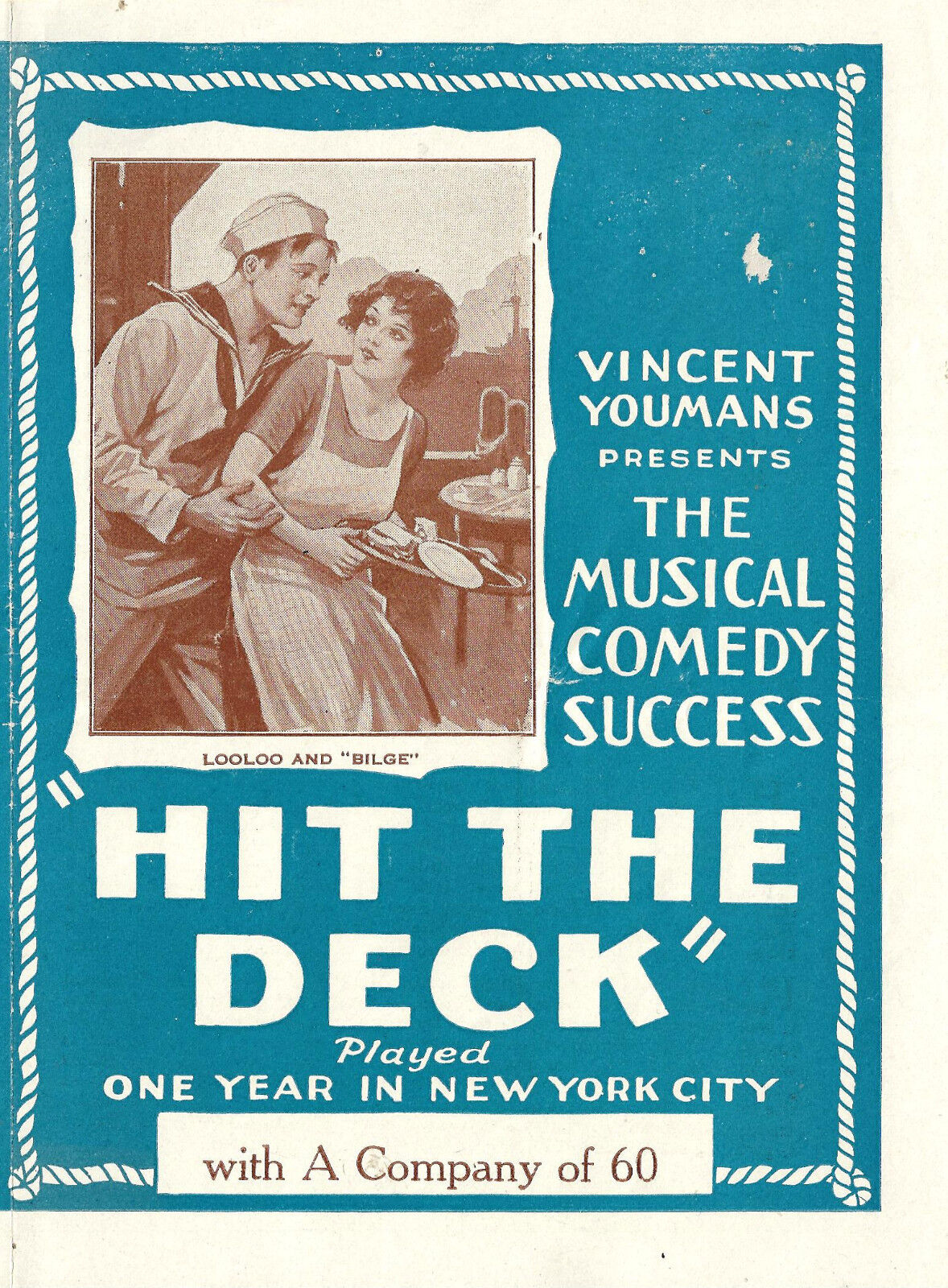
Hit the Deck was one of Groody’s most popular hits. Here she sings Sometimes I’m Happy from the show.

The little Felix is odd – no idea really why he is there, arms folded, smiling. Below him it says, Posed exclusively for THEATER MAGAZINE, photo by Harold Stein. He is indeed the little bit of Felix in this photo and post. (He does not appear on the back of the page where there is a similar of June Collyer.) Just a small paid advertisement? An inside joke about the show long forgotten? I wondered that about the dog and baby bear too – did they have some bearing on the show? Or does she always travel with a menagerie? A quick look at the storyline of the 1955 film version doesn’t show any reason for a baby bear. And no, Felix does not seem to have appeared in the show!

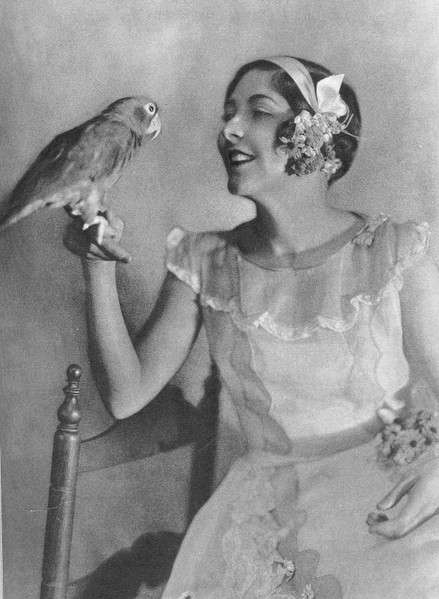
Unidentified photo of a young Louise with a parrot, continuing the pet theme.

According to Wikipedia, Louise was on the stage and discovered in her teens. Groody was in ten Broadway shows, four were major hits with hundreds of performances. The same article claims that Hit the Deck was a favorite of hers. She was perhaps best known as Nanette in No, No, Nanette and for her rendition of Tea for Two, although I was unconsciously familiar with her singing Sometimes I’m Happy.

Kinda looks like Louise here. LooLoo was evidently one of her favorite roles.

Louise married a few times. Number two was a shyster who chiseled money out of folks, her included – although she was originally named in the indictment. She divorced him while he was in Sing Sing and moved onto husband number three who seems to have stuck. Groody made a pile of dough in her early years on Broadway, subsequently lost most of it in the crash, but continued to work and lived affluently again by the forties. Louise joined the Red Cross during WWII and has a small discography of early recordings. As far as I can tell, she doesn’t appear to have much of a film career, although I can’t imagine she wasn’t in any films before becoming a fixture on early television.

As for Felix I can only say that he was so ubiquitous in 1928 that even a theater publication was sneaking him in, odd considering that in some ways film was slowly eating into and ultimately eclipsing their business. However, in 1928 no one seems to have been able to resist his charms entirely.

Ma Cheri Petit Josette

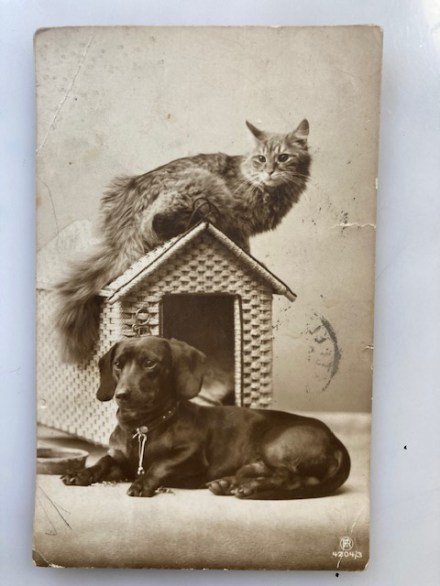
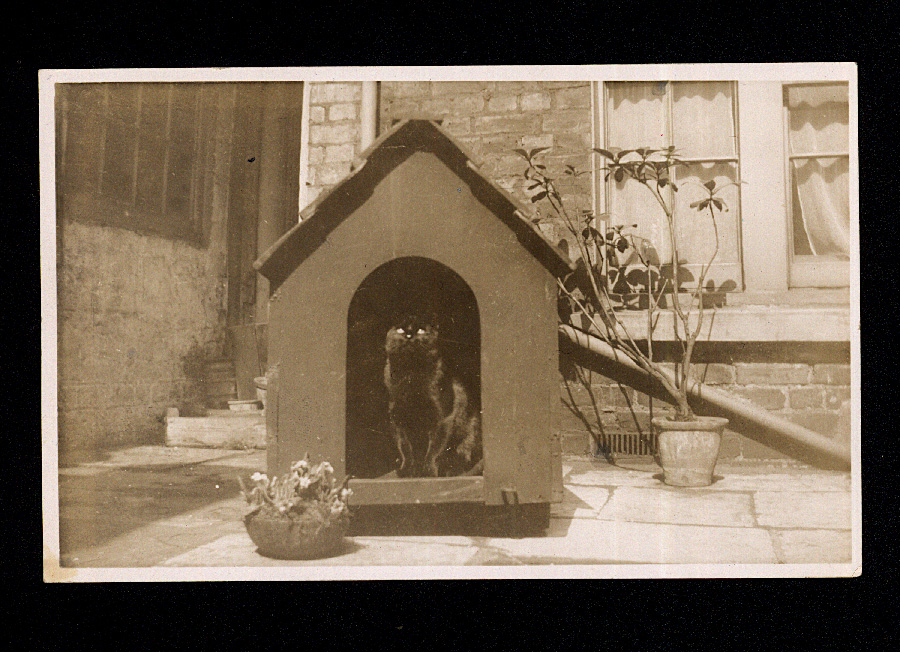
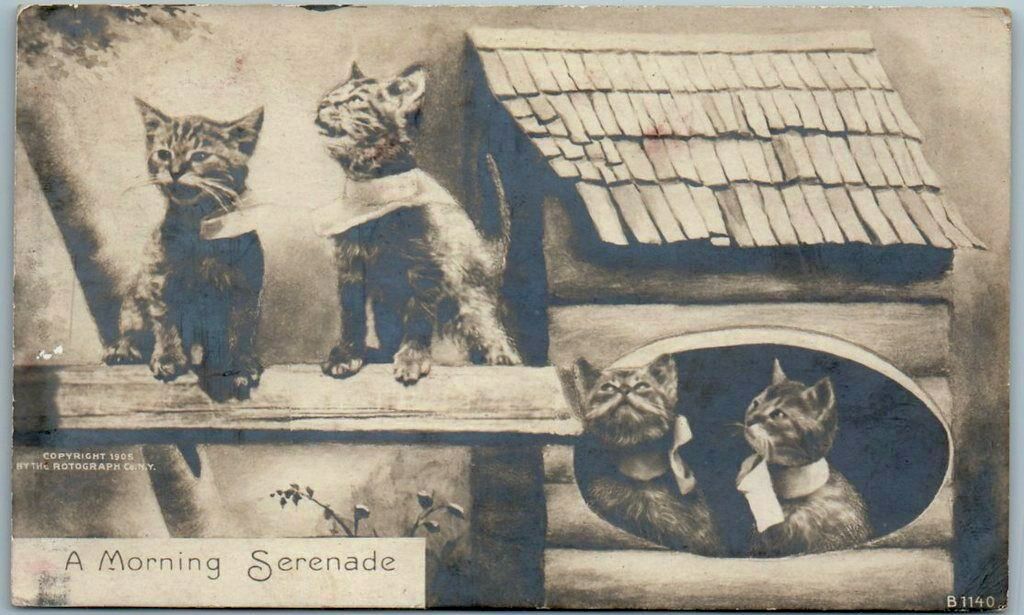
Pam’s Pictorama Photo Post: Cat annoyance and dog acquiescence seems to be the theme of this card. Kit and pup are about the same size and both qualify for this nice little comfy looking house. Although kitty has laid claim from atop, this little doggy fellow guards the entrance. Feline high ground notwithstanding, the dog blocks the door – although he isn’t really as this is a set and I don’t think the cat or the dog would especially choose to curl up inside this adorable little house. In fact I am not sure either would comfortably fit, although we all know that wouldn’t stop the cat if indeed inclined.

The animals of my past have generally preferred without rather than within. For example, there was briefly a doghouse in our backyard. My dad purchased it secondhand somewhere, perhaps one of his beloved garage sales, and painted it up, making it a fair replica of our house. A neighbor with a sense of humor supplied a tv antennae. (Oh gosh, how many readers don’t even know what that is?) It very much resembled Snoopy’s doghouse in the comic strip which would have appealed to my father. He liked to read it to us as kids.

A black cat in cat house card I entirely forgot I own, from a 2018 post called Cat House. Pams-Pictorama.com collection.

A large pen of open rails and wire surrounded it and our German Shepard, Duchess, was invited within. I have no memory of Duchess in that doghouse however and she was rarely in the pen as she mostly lived in the house. Although our cats were free-range, our dogs never were and considering she was a sizable German Shepard of somewhat mercurial affections, that made sense. (Another doggy denizen of Waterman Avenue actually spent more time in it, a naughty rescue named Charley Brown – beagle mix. Perhaps the doghouse influenced my mother’s naming convention.)

The pooch in this card is wearing a leash it might be noted, although he is clearly placid. So while seated quietly enough here, he was not wandering at will. Kitty is beautiful and fluffy, very photogenic indeed. She is pissy, all annoyed ears though as only a cat can be. There is a small food or water bowl on one side of the dog and the interior of the house is alluring with some cushy looking material stuffed inside. Something is attached to the front of the little house and it is very speculative, however it may actually be the dog’s leash. The tiny abode is made of some nice wicker-y material and oddly it appears to levitate slightly – the cat’s weight on an uneven surface tipping it?

A similar situation from a 2019 post, called Mornin’. Pams-Pictorama.com collection.

The three different colors and textures help make this image work. Fluffy kit, woven house and sleek, shiny coated canine. The cat’s ears and tail do the rest – I suspect she was a pro. One can imagine a photo studio back in the dawn of the 20th century, snapping pics of posing animals all day long until enough images for a continued line of cards could be produced. I think a lovely way to spend one’s days. As I have already said, regular intervals of dog petting at work has increased my quality of life substantially in recent months.

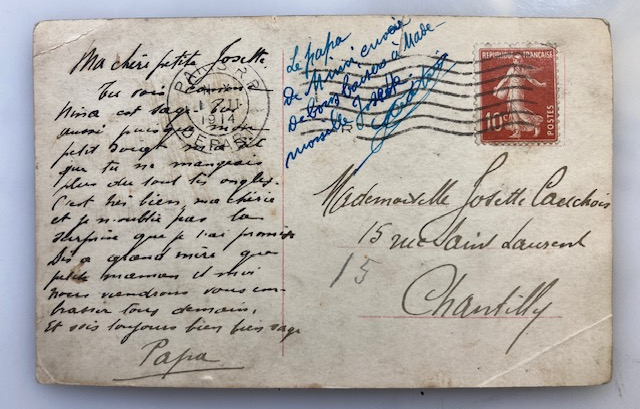
French readers please feel free to send a rough translation!

I am supplying a photo of the back of the card and perhaps someone fluent in French can translate it for us. The hand is fine and even, but small and too hard for me to see clearly enough to try to get a translation. It is clearly from Papa to his daughter Josette. Someone else has included a small message in bright blue ink – Jeanette? A sister? The card is addressed to Mademoiselle Josette Cauchois, 15 rue Saint Laurent, Chantilly. It is postmarked Paris, 1914, but the date is obscured.

Not knowing Josette’s situation it is pure speculation, but I must say, I would be very pleased to have received this card from my own Papa.

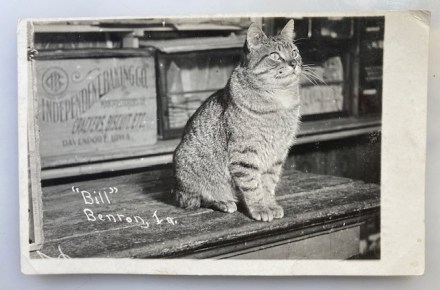
Bill, Benron, Iowa

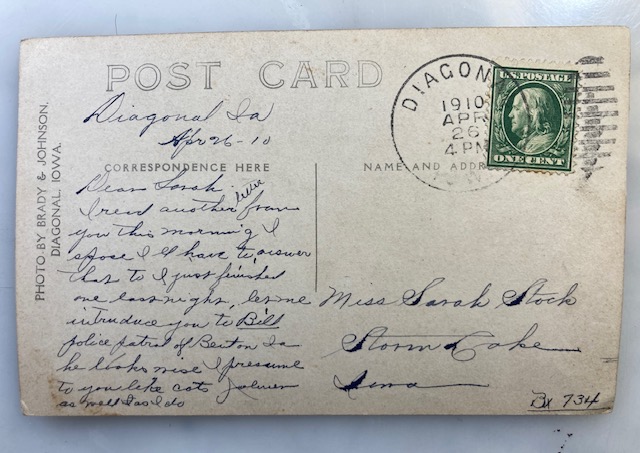
Pam’s Pictorama Post: This fine fat furry fellow hails to us from 1910 Diagonal, Iowa. He found his way to me via the wonderfully thoughtful Sandi Outland (@curiositiesantique, an antiques emporium in Texas) who sent me this. Some of you readers might remember that Sandi sent me an utter great holiday card with a period photo on it which inspired a post found here. She is also of the fascinating angry snowman collection which inspired the purchase of a card I wrote about here.

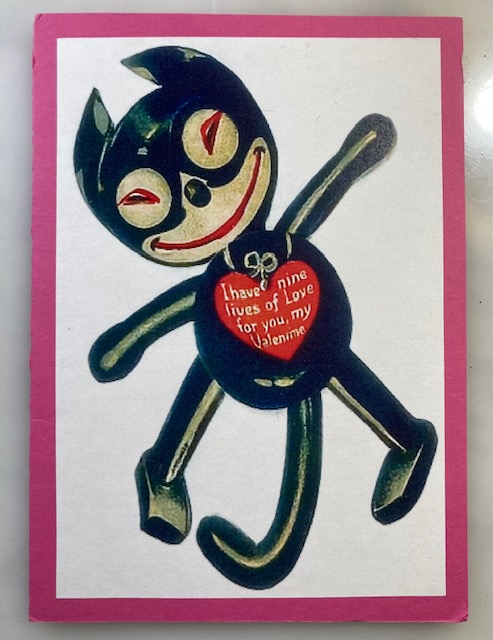
Sandi tucked this in this nice reproduction Felix valentine, shown below. I have often thought I should have a specimen example of this card and she has saved me the trouble of doing so. Thank you again Sandi!

This Valentine based on a popular period one of Felix.

Bill, the cat of our card, appears to be a solid citizen of the tabby cat category. Although I have not had a personal association with a tabby since childhood, they are dependably nice cats. The two that graced my childhood were Zipper and Tigger.

I wrote a bit about how Zipper and I as a small child would watch our fish tank together and he would “pat” the fish on the glass, guilty thoughts going through is mind! (Post found here.) He came to us as a starved and tormented stray, so small he was in danger of slipping into the crack in the backseat of the car. He grew into a swaggering dominant male of the neighborhood, holding parties with his kitty cronies in the garage, late night raids on a neighbors eel box! (Zipper’s story can be found here.)

Zipper was gone by the time Tigger came into our lives. He was one of a litter of kittens of our cat Winkie, a great tortoiseshell. My mom was generally a responsible and determined neuter and spay-er of our cats, but somehow Winkie got away from her in advance of being spayed. We kept the four kittens: the tiger Tigger, a marmalade named Squash, and two grays – Ping and Pong.

Tigger who had rather perfect markings was a good natured cat. She ran away once and was found in a neighbor’s barn, but sadly eventually wandered away again not to be found. I have always hoped she found another home, perhaps less bustling and with fewer cats than we had claim to at the time. I think she wanted to be an only cat.

Bill, the fellow in this card, appears to be in charge of a store. My guess is that he spent many a contented hour chasing mice (perhaps even the occasional rat) there and was soundly rewarded for his work in this area. Still, he does not appear to have lived on mice alone. I don’t know if he is just sitting on his tail oddly or if it was docked for some reason, but he is a splendid looking fellow, evidently in his prime here. Behind him is a wonderful wooden box emblazoned with Independent Baking Co. Crackers(?), Biscuits, Etc. Davenport, Iowa. I would claim it for my collection any day offered.

The card is addressed to Miss Sarah Stock, Storm Lake Iowa, Box 734, written in the most beautiful script. It was postmarked and dated April 26, 1910 from Diagonal, Iowa.

Back of card. Beautiful hand – look at how the “t” in storm forms the “L” in Lake! Still, is hard to read!

Despite the beauty of the script I am having some trouble reading it, however it appears to say, Dear Sarah, I read another letter from you this morning. I spose I’ll have to answer that to I just finished one last night, let me introduce you to Bill police patrol of Benton Ia. He looks wise. I presume to you like cats as well as I do. I can’t read his name (and no, he didn’t seem fond of periods) and I am open to suggestions. (For some reason I have assigned the sender to be a man, but it could be a woman.)

Although I have come close on several occasions as it happens I have never traveled to Iowa. The university there was under brief consideration for grad school, but life intervened before it got to the visiting stage and my grad school education never materialized. The Jazz at Lincoln Center orchestra played there on tour and that was the most likely way I would have found myself there as an adult, but alas it never happened. The animal hospital I work for now is highly unlikely to send me there, although I guess you never know in life – I could make it there yet.

La Jeune France

Pam’s Pictorama Photo Post: Rainy morning here at Deitch Studio in Manhattan. I was warned about the weather, but still managed to be disappointed when I awoke to it this morning. Sometimes rain can make me feel very cosy, but other times it is just a bit discouraging and I’m afraid I am leaning in that direction. It is early March however and here in the Northeast I guess we just have to take what we can get. It is a many cup of coffee morning as I sit here writing you all. As always though, it is a pleasant rabbit hole into the past to spend some time with one of my photos.

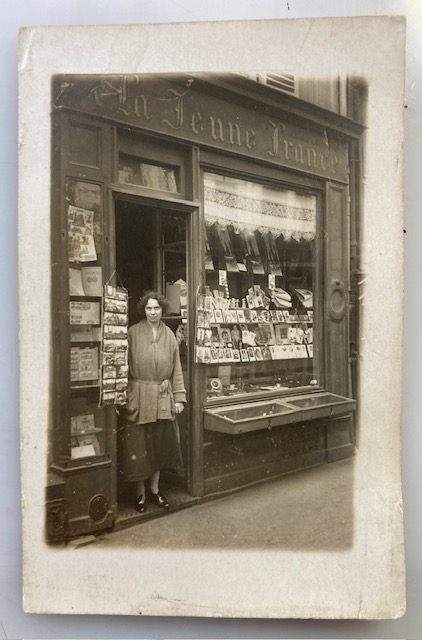
I don’t own many, but I do have a real affection for photos that show a store or establishment and its owner/workers and wares, especially magazines, photos (especially photo studios) or in this case postcards. They are little time capsules in a particular way.

This photo came to me via @missmollystlantiques on Instagram. In reality, a while back, she had sold me another photo in front of a photo shop and to my horror somehow sent it to the wrong person – who sadly did not send it back. She refunded me, but I was quite bereft. Then recently she sent me an offer of this photo since it was the same idea and asked if I wanted it, and here we are.

This woman (the proprietress?), stands in the door of a store called Young France. She has a sort of tunic jacket that perhaps is of the kind you might don each day in the store to keep your own dress or blouse clean. I like the bright buckles on her shoes which make me think she was probably a snappy dresser.

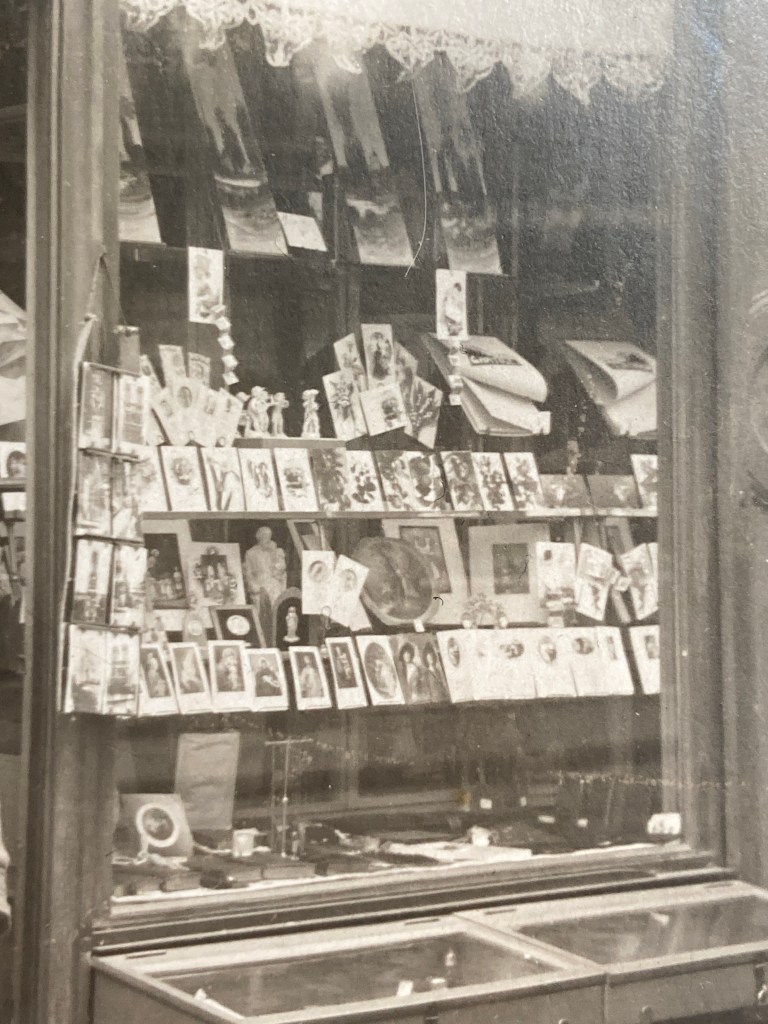
A look under a magnifying device reveals some small religious statues (a small Virgin Mary), medals and postcards in the large window. I think many of the postcards are vaguely religious in content too, although the top row are botanical ones. Some also look like the type of photo postcards that leave room for a bit to be written on the front, a small circle of photo at the top. I believe maybe some are photo cards that are fun – I believe I see one of a cat in a hat! There is a display of landscape photos of a souvenir type, on the doorframe next to her, hanging from a string.

My attempt at a detail of the photo.

There is a sort of display drawer under the window. They have locks and I cannot make out what is in them. The bottom of the window display also house some objects and other than a vague outline of a book, I cannot see what those are either however. Perhaps someone else would know immediately from the name and type of items what precisely this store was – souvenir items? In that case the religious items seem odd, but the reverse is also true.

Like many photo postcards, this one was never sent and it has no writing on the back. While the image on this card don’t really quite make the usual Pictorama qualifying parameters, it slips into the collection, filed in my mind under slice of life pictures.