Open – Sez Me: Part One

Pam’s Pictorama Post: Not often, but occasionally my purchases are essentially practical and today’s purchase was one, although certainly some style here. Somehow in the most recent office move from my last job I failed to pack my letter opener which was of the most utilitarian variety although I had some fondness for it because of the sheer number of years (decades) it had been in my possession, however there was nothing notable about it.

I have been in the work force long enough to have gone through a period with a lot more physical mail than I currently receive. Early in my career I have distinct memories of opening piles of mail every day at the Met. In fact sometimes I worry that the mail at work has failed because we go so long with absolutely none. Physical mail is so seldom now that I had a staffer who didn’t seem to know where to place the stamp on a letter he was sending for me.

Meanwhile, as a fundraiser I was surprised that my current office had never used a business reply envelope. For those not in the know, that’s what those envelopes which allow you to respond for free are called. (There is a permit number on the return address and sometimes it says, A stamp here will save XYZ money.) The postage for each envelope received back is paid by the organization, but hey, if you are sending me money I’ll pay a dollar for your envelope back to me. It’s a good return on investment and removes at least one impediment from making a gift – having to find a stamp.

When I discovered this a few months ago I went down the specifically postal rabbit hole of applying for a permit. I never worked any place without a permit so this was all new to me, nor could I find anyone else who had to apply for one within my circle. After getting an old account out of the way (a ghost account which seemed rather romantic but, not surprisingly, didn’t seem to actually do anything) I spent a lot of time on the USPS website and on the phone with their service people. I, in fact on some bad advice, went to the Main (Farley) Post Office here in NYC. As some might know, the building was purchased by the city and space recently carved out under this grand building to create a new home for Penn Station.

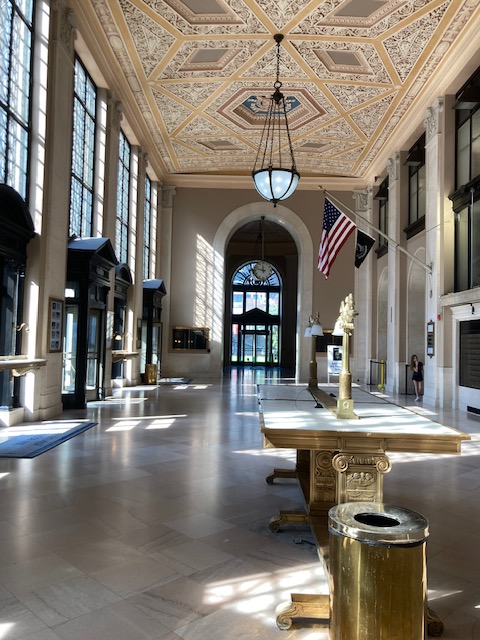
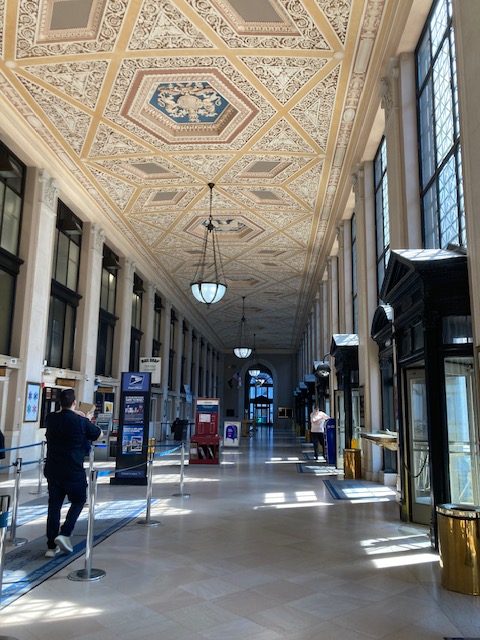
The interior of the post office, the James A. Farley building, is beautiful and I couldn’t resist a few shots despite my disappointment.

It was my first (and likely my last) visit to this post office as they do absolutely nothing there. (Does this mean there is no main post office in NYC?) Yes, you can mail things and yes, you can evidently apply for a passport there, but even an attempt to buy stamps will send you online. As you can imagine, I was told that the administrative office I was seeking was now long gone. They did, to their credit, supply me with the number to phone for help.

I am here to report that, once you get through the red tape of an annoying phone system and get to the folks (all women in this case and I spoke to several) to help you they are a great, smart and helpful group. My hat goes off to Ana, Sabriya, and Arkeda. They know their stuff and they were dogged in their efforts to help me. They coached me through filling out arduous forms, filing them and then shepherding them through the various routing. They even told me when they would be on vacation and who I could work with during that time. I praised them unstintingly in a series of final surveys and thanked them profusely. Frankly, I would hire any of them in a heartbeat if I could.

But come on, they don’t even sell stamps?

It has left me with mixed feelings about the post office. At their instruction I went to the local post office to my job to file the forms with a check to cover the annual fee and open the account. The staff was rude and at one point stood around in a group talking about me in the third person and told me to shut up when I tried to speak. What’s more, I probably shouldn’t need someone to coach me through a labyrinth site and series of mystical forms. So although I give the women above the highest grades, I give the USPS a failing grade in general. My experience as it relates to this interaction is that these women are an island of competent help in a morass of sub par service. (With apologies to others at the USPS who are hard working and doing their job!)

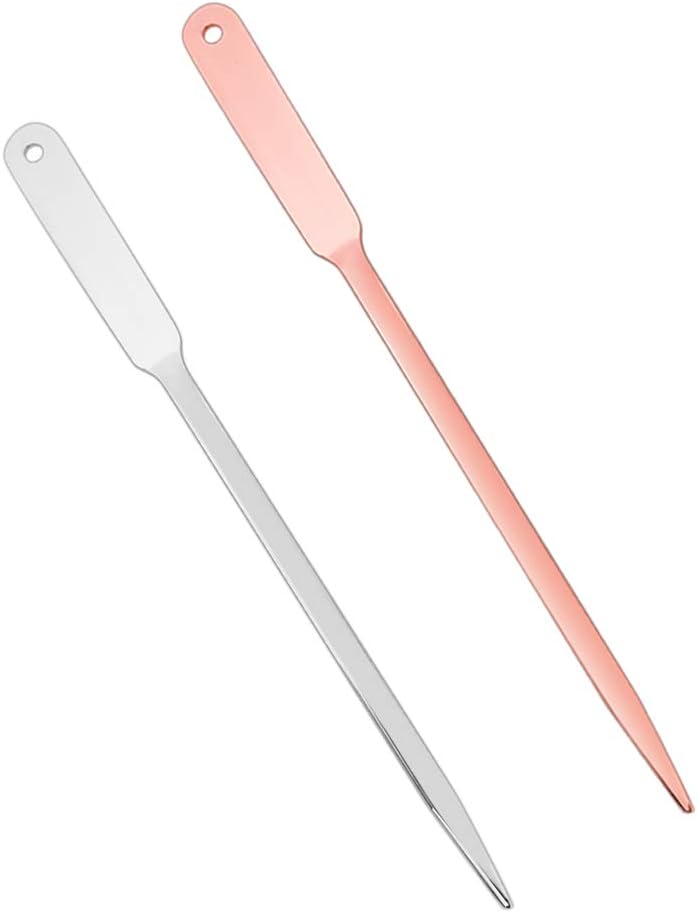
This was the Plain Jane variety opener I had been using for decades.

Anyway, all this to say, if I have my way more mail will come to my office shortly, hopefully in the form of contribution checks. And, to bring us back to my recent purchase, I actually like to open envelopes neatly with a letter opener. When you are handling money coming into an office for various reasons the envelope can be important (proof of mailing date, return address) so better if you don’t end up tearing it to shreds to get it open. I have keenly felt the lost of my letter opener, but did decide that rather than purchase another ubiquitous one from Staples that I would look for something a bit more interesting.

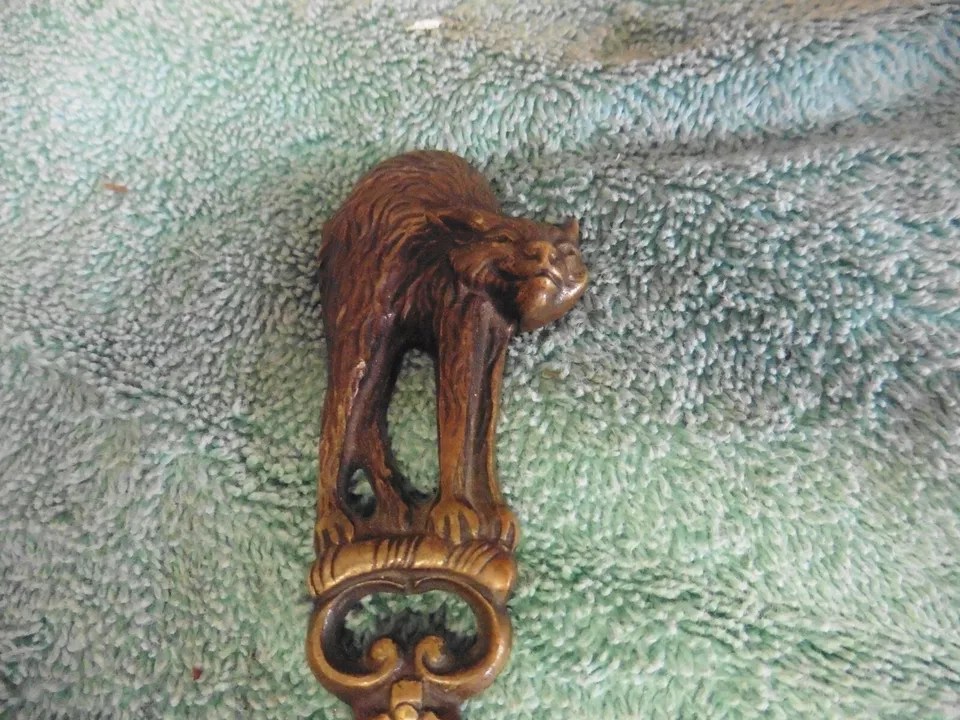
Of course my mind turned first to cats and if I had been willing to invest some real money in a vintage letter opener I found on eBay I could have had a honey. For a variety of reasons this wasn’t a moment I was inclined to do that.

Top of a very nice cat letter opener I deemed to expensive to buy. Tempting though…

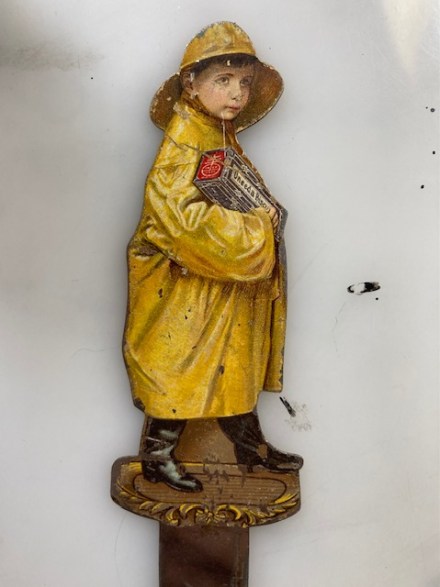
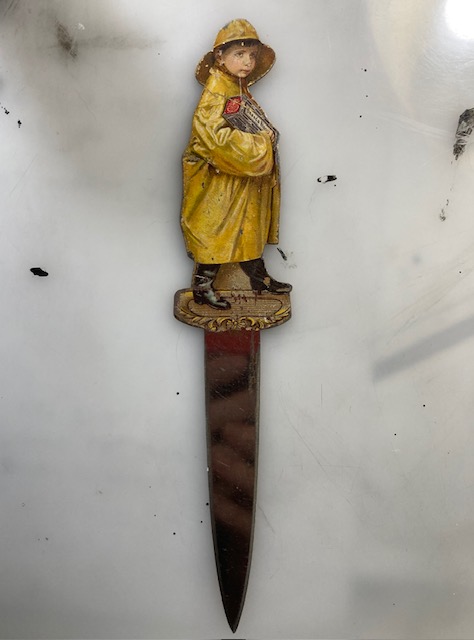
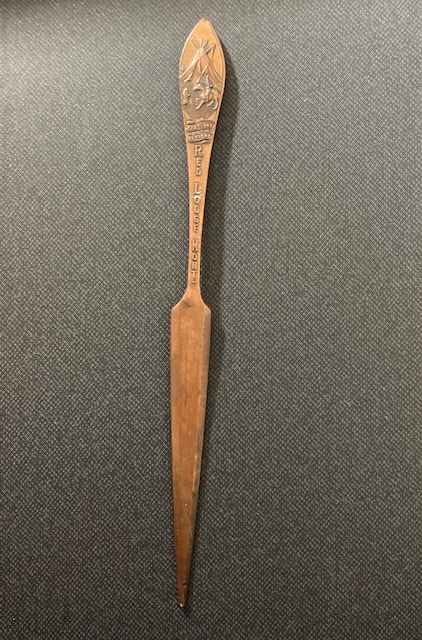
A week or so ago one of the dealers I purchase from on Instagram (@Reds_Antiques or via eBay at www.ebay.com/usr/reds_antiques) had a bunch of smalls he was selling and I picked out two advertising letter openers he had listed. I’ve bought some lamps, photos and other bits from Reds, he’s a dealer on the west coast and he lists some cabinets and tables I drool over but can’t see getting across the country to us. The vibe of his stock is a little masculine for me overall (think gas and oil signs, vintage tools and car related ephemera), but we align on certain things and he has a good eye.

Anyway, I figured one opener goes to the office and one stays here or goes to Jersey. That still leaves room in my life for a good cat one should I come across it.

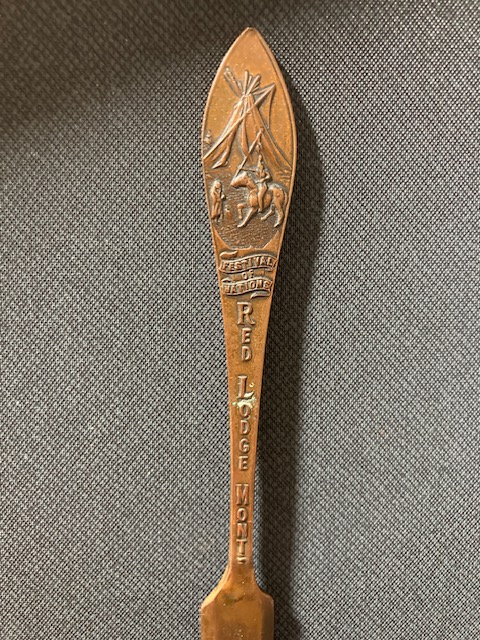
Detail of the top of the letter opener.

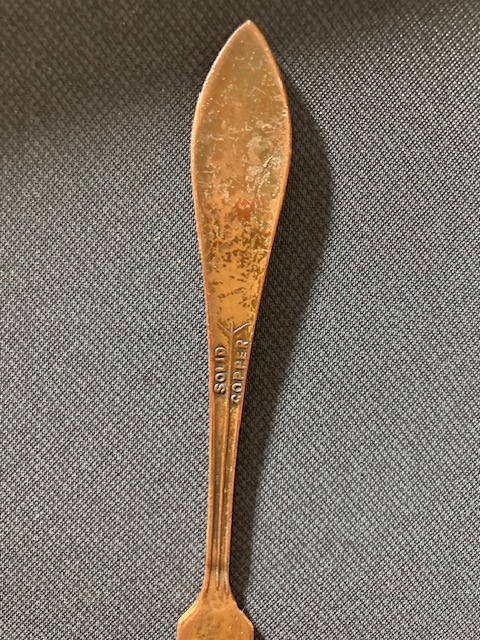
As is clearly stated on the back it is solid copper and it is from Red Lodge Montana. The top boasts a somewhat cheesy scene of a teepee and two figures, one on a horse. A tiny banner declares Festival of Nations.

Back markings.

First of all, Red Lodge (for the ignorant like myself) is a town, not a lodge as such, found at the entrance to Yellowstone national park. The area, full of skiing and hiking, looks stunningly beautiful with a downtown full of period buildings that have been preserved. (For a post on the adventure Kim and I had at a whorehouse museum in Butte, Montana, go here.)

Starting in the 1950’s the Festival of Nations was launched as an annual festival to celebrate the various (European) cultures of the area which had never much mixed beyond some tentative cultural experiments such as a unified local band, all this according to a local historical society website. It seems to still run in August of each year.

I think this one is likely to stay in the apartment. Stay tuned for tomorrow’s post and the other one I purchased which will head to the office, reporting for envelope duty, next week. Could be a cat one in my future as well.

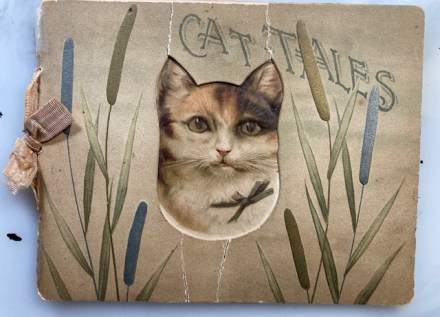
Cat Tales

Pam’s Pictorama Post: I have used the term little gem before, but I can’t think of an item it fits better than this one. Within days of purchasing the Neatness award (featured in a post from last week here) the folks at Curiosities Antiques in Texas (@Curiositiesantiques or via their website here) inquired if I would be interested in this little book – and would I!

I have one or two similar period volumes in my collection, at least from the same period and sort of litho images. The one that immediately comes to mind is one I hunted for an ultimately purchased on eBay I think. It is The Cat’s Concert and a 2018 post about it can be found here.

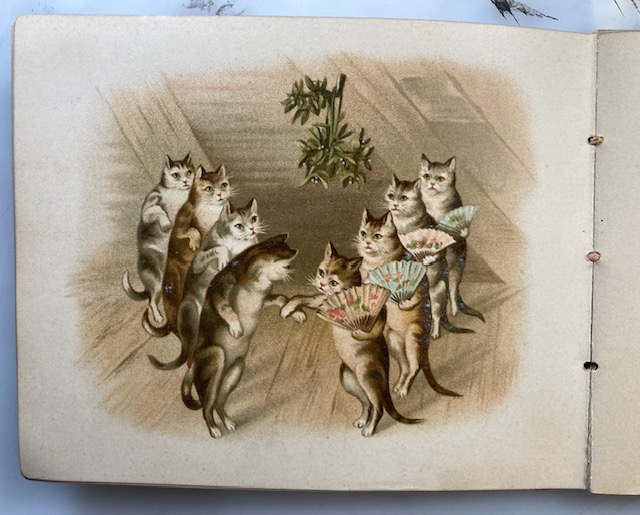
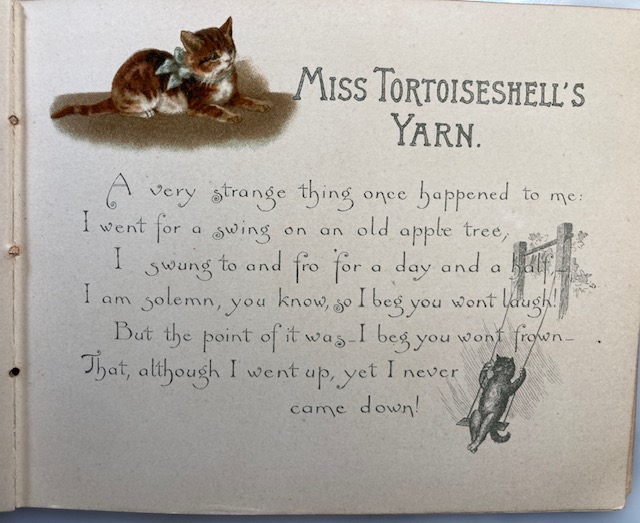
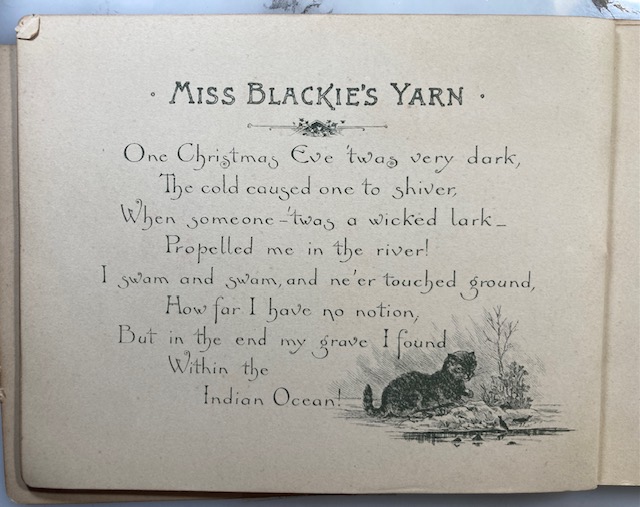
Today’s post is going to attempt to give you the chance to really see this book so many images coming up. I hope I do it justice. Obviously I had to be careful about how I propped the book open in order to take the photos so they are less than perfect, but I would not have been able to scan them which would have required flattening the book.

Inside front cover which peeks through. Pams-Pictorama.com Collection.

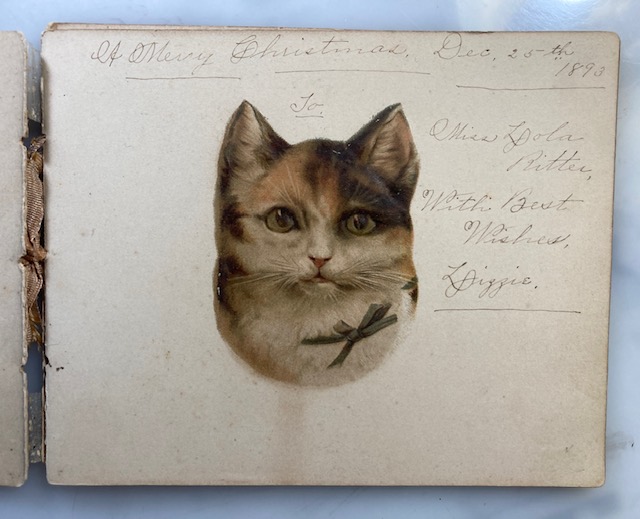
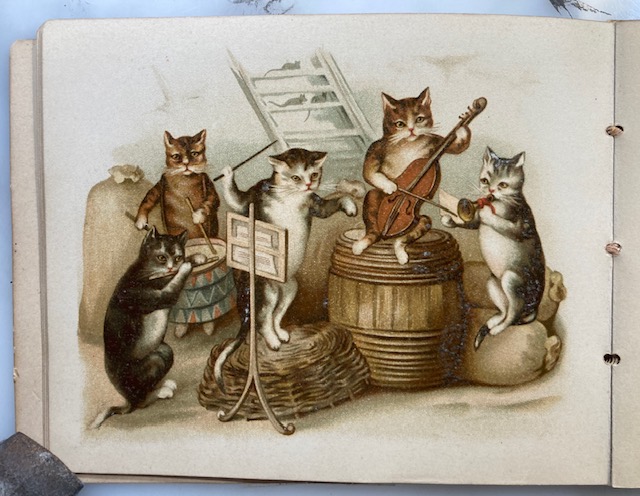
To start, the peek-a-boo cut-out cover which has kitty peering between the cat tails is the most fragile part of this book, folded almost to pieces from opening; the entire book held together with a ribbon. Kitty is a nice tortie and sports a bow in the same shades and shapes as the reeds decorating the front, very elegant and I assume that the gold and silver of the reeds were shiny in their day. These elements on the cover are embossed, the decorative plants and the cat on the inside page too, the whiskers especially stand out. This little volume was lovingly printed and produced.

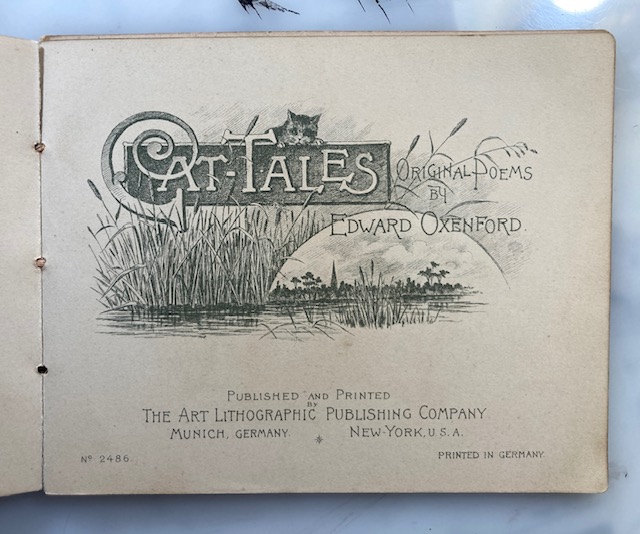
Title page. No copyright information but a printing number in the lower left?

Inside it is inscribed on the inside cover, A Merry Christmas , Dec. 25th 1893. To: Miss Lola Ritter, With Best Wishes, Lizzie. This decorating the cat part of the inner cover.

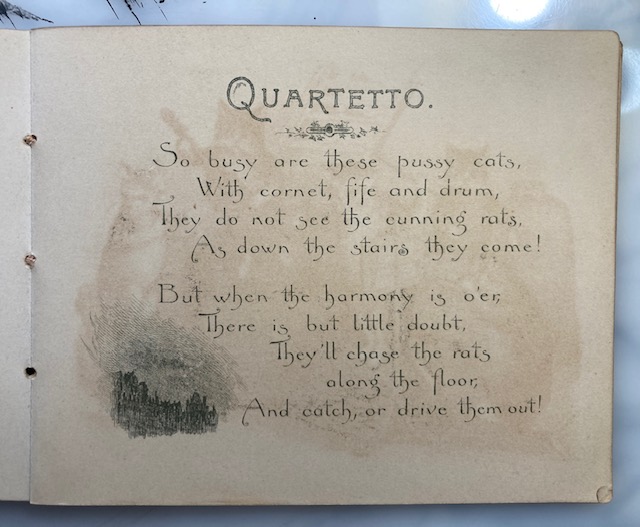
The contents are poems, cat verse. They are original works by Edward Oxenford. This little book was printed in Germany and published and printed by the Art Lithographic Publishing Company, Munich, German and New York, USA. Edward Oxenford has a few other available titles to his credit I could find, one book called Sports and Play which is a similarly litho edition to Cat Tales, but cut out in the shape of a saddle. (Apologies for not providing an image but there’s only one online and it wasn’t willing to be grabbed. An odd looking volume though.) As for the publisher, this sort of novelty book seems to have been their meat and potatoes, although I did not find any real history about it. Seems like they may have produced postcards as well.

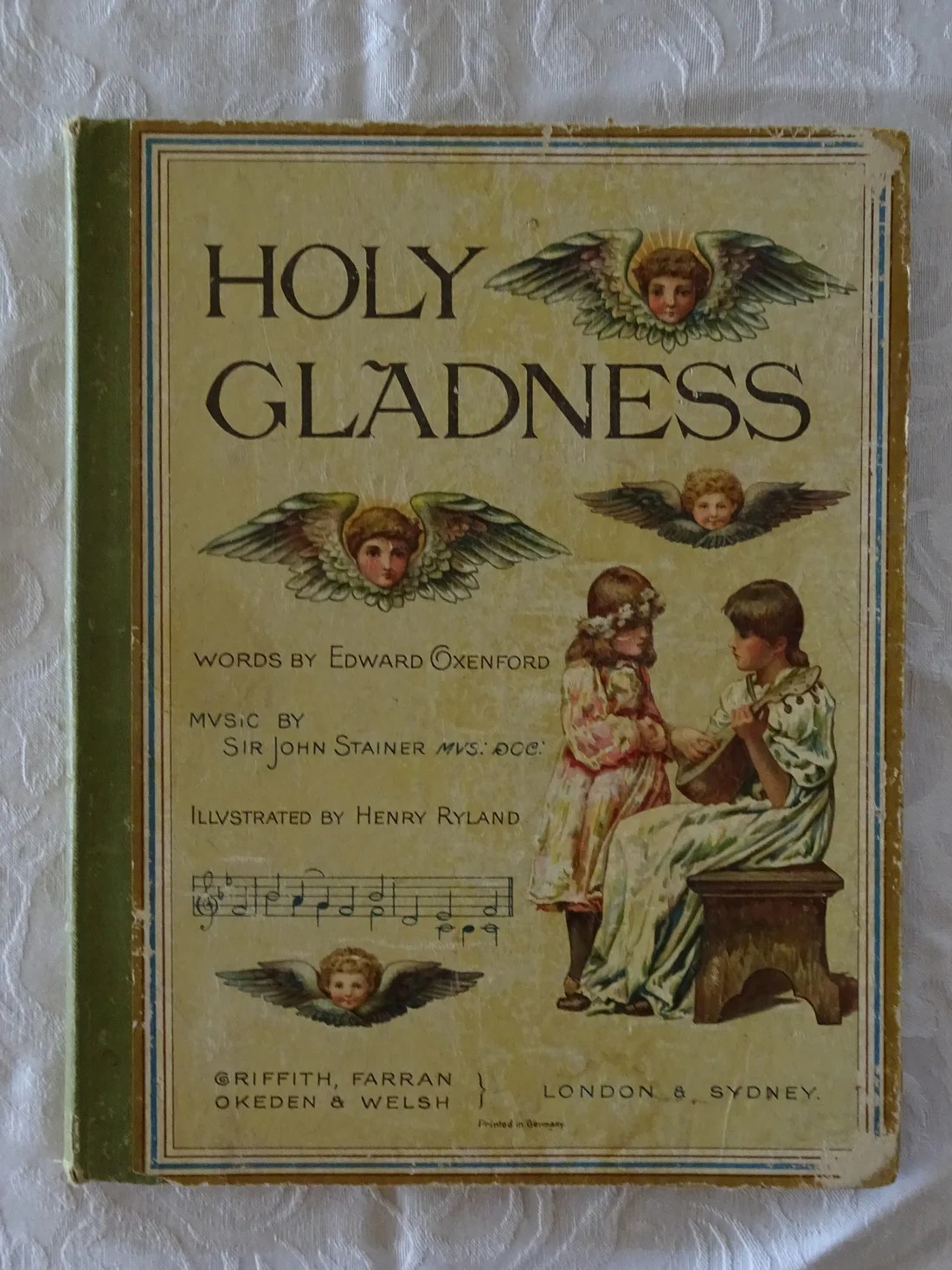
The other book of his is called Holy Gladness and it also sports beautiful lithographs but unlike the other two books, it is a larger bound edition. Neither of the other books are widely available and Cat Tales seems somewhat rare as well. Edward shares a name with a much earlier writer who also went under the name of Edward de Vere and has much more writing and controversy to his credit.

This illustrator gets a credit at least! Not in the Pams-Pictorama.com Collection.

I’m a bit surprised (and sad) that the artist of these illustrations isn’t identified and get credit. These are wonderful illustrations beyond having been beautifully printed. There is no copyright date, only the inscription on the front identifies the year.

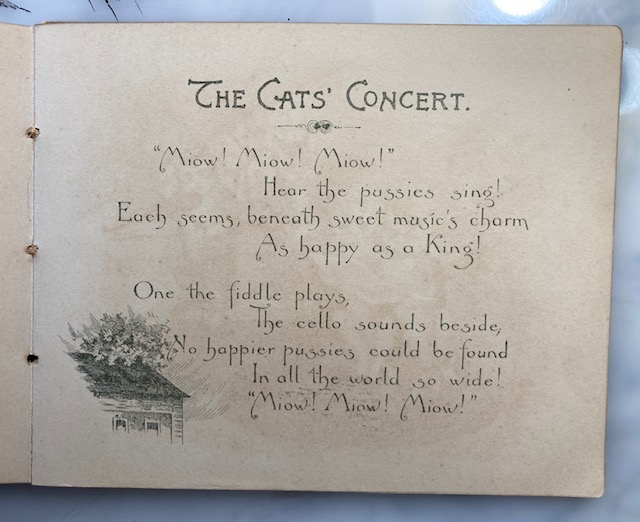
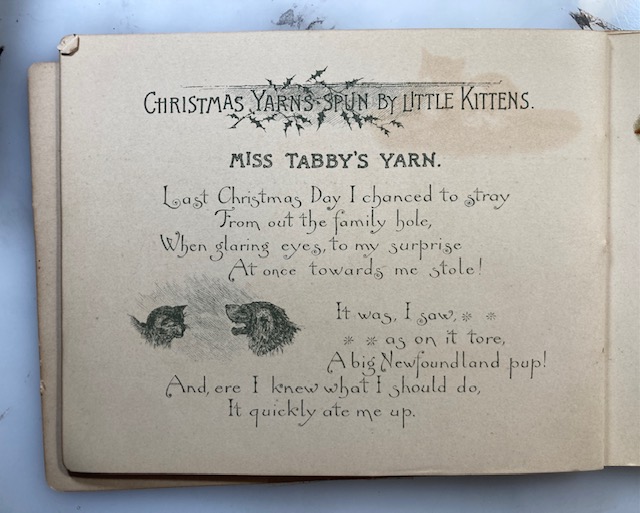
I’d like to point out that there is a Miss Blackie’s Yarn below. My Mr. Blackie is decidedly unimpressed by these so called Christmas verses at the close of this book. Oddly all three of these poems seem to end badly for the cats in question. Not at all sure I approve either. A jolly volume, these last few verses notwithstanding.

Neatness

Pam’s Pictorama Post: Some Pictorama readers will remember previous posts on a small (but now clearly growing) collection of medals I have acquired. These award pins I assume were given out (at school?) to encourage various virtues.

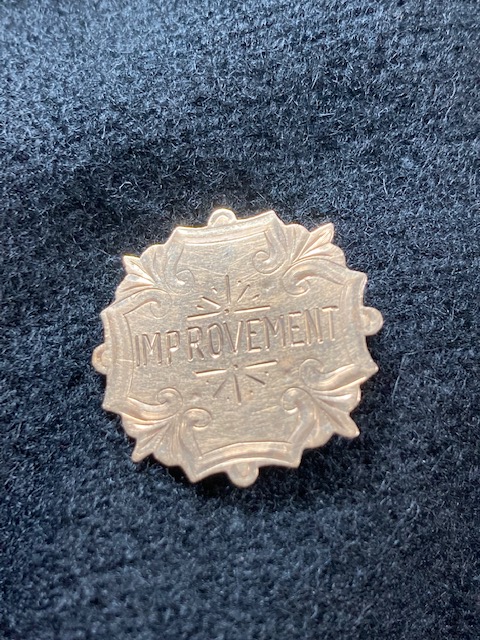
I found one for Improvement and purchased it for my birthday in the winter of 2020. It was meant to commemorate how well I felt I had grown into my job over the first few rough years there. I had spotted it while getting some jewelry repaired – probably one of the watches, they seem to need to go frequently. Anyway, I fell in love with the idea. I do like encouragement.

That one and the one that came after for Excellence, purchased on eBay, were both made of 10k gold. This too amazed me. There was a time when real gold medals were given as awards to children at school. Man, I was happy when someone put a sticker with a star on my paper! (A post on the prior prizes can be found here.) I would have been over the moon for one of these pins – as I am sure the youthful recipients were.

Pams-Pictorama.com Collection.

I believe I only got to boast Improvement on the lapel of a jacket a few times before the world shut down for the pandemic. A few years later Excellence joined on the same jacket and people would frequently remark on them. (One of my staffers surprised me as he had read the post here.)

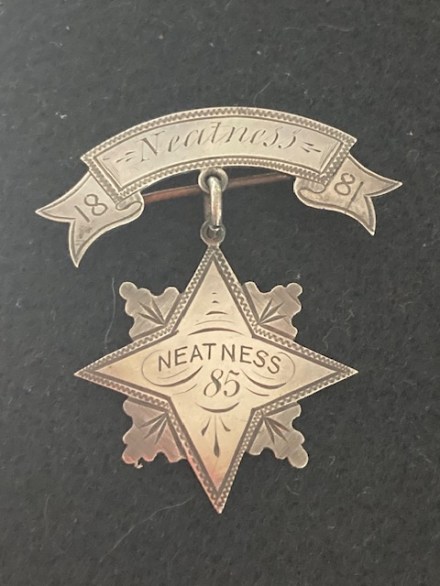
In many ways Neatness is another whole kettle of fish. Unlike my others, this one is made of silver. The other two date from 1910 and 1945 respectively. This one dates back to 1881! (This was clearly a longstanding tradition. It should be noted that my Excellence came from Canada, so we know that it was popular there too.)

I wonder how far back does the tradition go? Of course many of these were considered special and therefore saved over the years. Once I got the hang of the right search numerous ones seem to pass through the portals of eBay and Etsy. I am highly selective however about the message and have to have some sort of kinship to it.

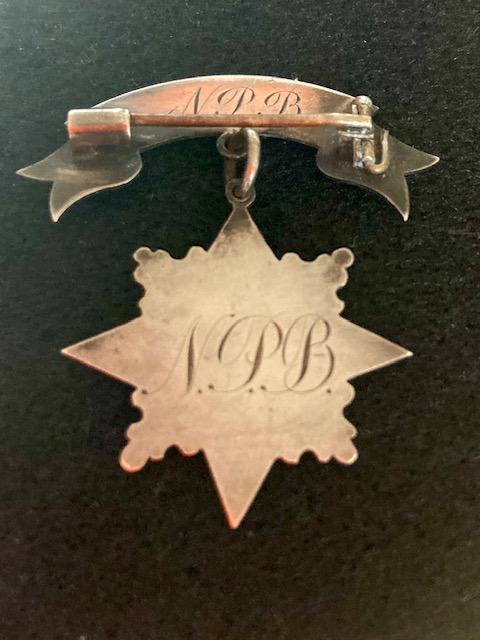
This one is so special though. I love how it has a star shape and hangs off a banner – both declaring Neatness and the date above. It is a little like being the sheriff of neatness. In the center of the star shaped charm it also says 85 and I have no idea what that refers to since the date is so clearly marked as ’81. Twice on the back, top and bottom, it has the recipients initials and this gave me a giggle too. They are N.P.B. so it was in a sense clearly meant for me.

Back of pin. Pams-Pictorama.com Collection.

Alas, I’m afraid however that an award for neatness is indeed only aspirational in my case. I may strive for it, but neatness is more of a goal than a given. It is unlikely I would have earned it. As I look around our treasure filled single room abode, let’s just say neatness is not a concept it was built around. Our books and my toys and photos grow like topsy and cat hair and New York sooty dust is to be kept at bay. Luckily we now have the house in New Jersey for some of our booty.

Still, when it came up for sale via my Texas team on Instagram @Curiositiesantiques (or via their website here) I knew it should be mine. While Jason and Sandi thoughtfully keep a weather eye out for things that might interest me, resulting in a mounting number of cat related items of various kinds, they may not know that these are a developing passion.

I am told this pin belonged to Terry, Jason’s mom – thank you Terry! (A few prior purchase posts from this Dallas duo can be found here and here, for starters.) Sandi as a regular reader knew I might find it of interest. Here’s to hoping I find myself in Dallas and can meet them one of these days – or perhaps a meet up at Brimfield. Hmmmm. A girl can dream.

I need to find the right jacket to pin this to, although maybe a black sundress will do for summer. I always think that it’s good to have ideals and I will indeed strive to exhibit and embody all these desirable qualities.

Rascals

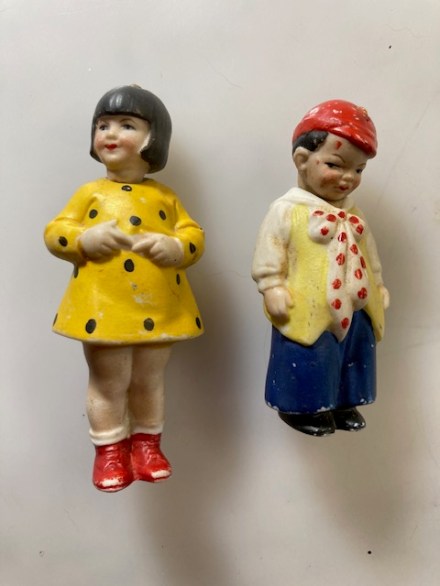
Pam’s Pictorama Post: Just when you least expect it, a collecting opportunity appears which you have not considered previously appears. Pictorama readers probably know that just last week I was opining on my buying jags for everything from antique jewelry boxes to bowls. Somehow during that same time, these two bisque nodders crossed my path and here I am, let loose on another trail of things to look for.

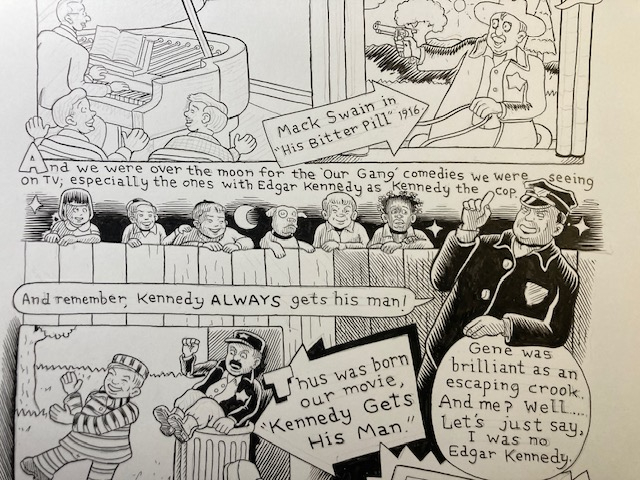
These Our Gang figures came to me via my Midwest supplier of goodies, Miss Molly (@missmollystlantiques) on Instagram. She wasn’t even having a sale when she shared these and I asked about them on a whim. These weren’t keepers for Molly and so a deal was struck and here we are. As it happens, coincidence or synchronicity, Kim has been working on reproducing the Little Rascals on a page he is working on and as a result the opening tune has been playing in the apartment (always taking me back to weekend television of my childhood), and I have been treated to the glimpses of what he is working from and on – and now you are as below. (For a prior Our Gang post, a publicity still I got for a steal years ago, go here.)

Detail from Kim’s unfinished page which includes the Our Gang kids.

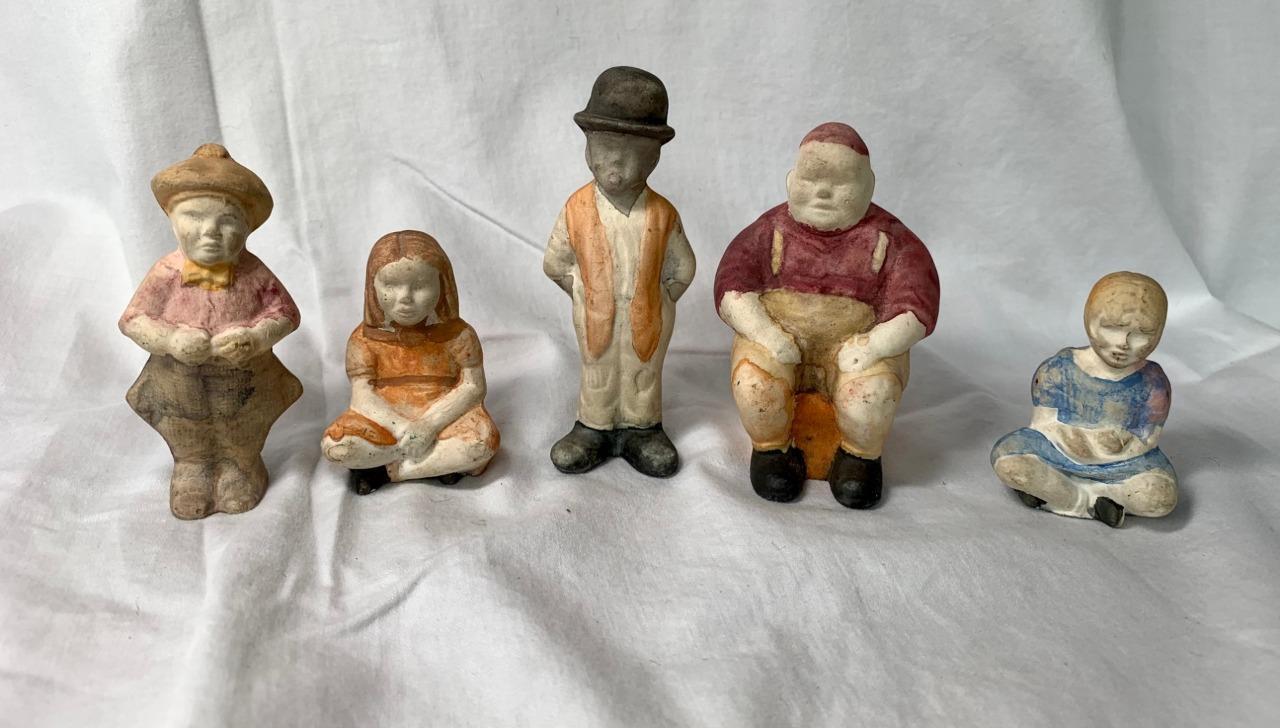
I acknowledge that the very law of averages to fill in around this entirely without a lot of repeats are slim, but we’ll see how I do over time. Not surprisingly there are a lot of variations on these out there and one of the things I need to be careful about is that I match the same set as these. There is at least one other period one that is fairly similar, but not nodders, and not the same. (The whole concept of nodders and their ongoing appeal is one for further Pictorama consideration I think. Weird, right?)

A different, partial period set. Less finely done – not sure I would have been as tempted by these.

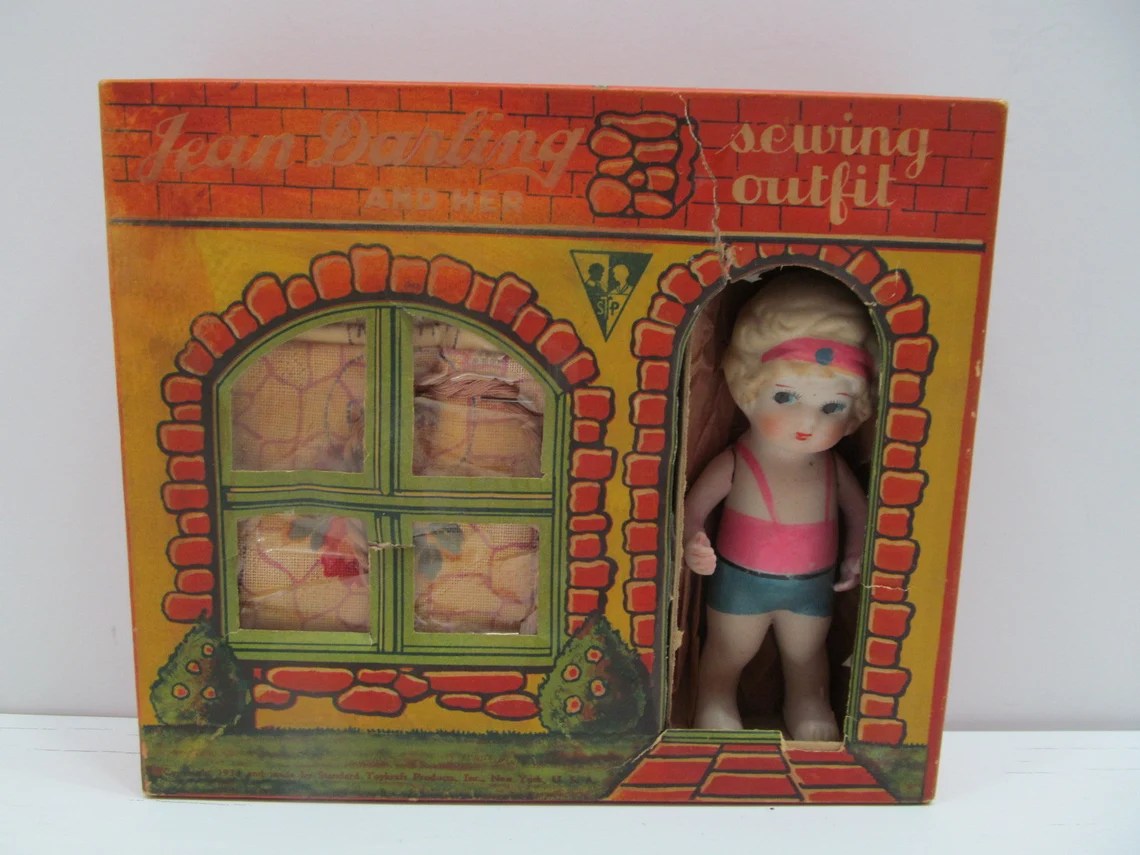
Also not a shock to see how much merchandising there has been, evolving over the decades, but quite a rabbit hole to go down. An entire, decidedly less finely executed, set of china figures was done as late as the 1980’s. To look for information is to be immediately swept into a windfall of collectibles over many decades. Among the participatory options, is this Jean Darling sewing kit with bisque doll you sew an outfit for, shown below – back in a time when the expectation was that a child would be able to execute that simple level of sewing.

Being sold on Etsy at the time of writing. Not in Pams-Pictorama.com collection, but oddly tempting.

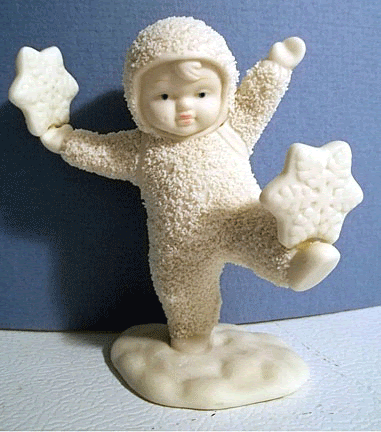
Mine are made by a German company called Hertwig. They produced well known bisque figure from 1864 to 1958. They were best known for their snow babies which were based on holiday confections of the same, but meant for decoration rather than consumption.

I’m not sure how this would work as a comestible. Hertwig Snow Baby bisque.

Hertwig was immersed in reproducing the popular culture world of the US in the 1920’s as well however. In addition to the Our Gang figures, Gaseoline Alley ones turn up as routinely as well as Little Orphan Annie.

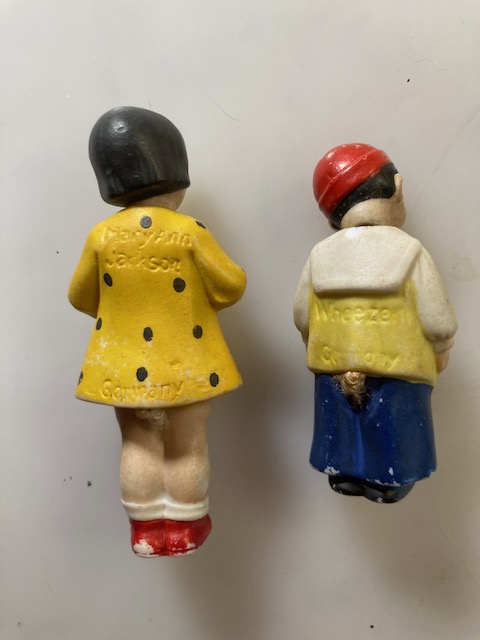
In reading descriptions these are described as cold painted and I think the other set, shown above, may have been ones you painted yourself as a kit. Mine are too precisely executed, especially the faces, to have been done by amateurs.

I’m amazed actually at how nice these are. They are a tad smaller than I imagined they would be. There is some chipping to the cold paint process on these – the downside to this method I would think. Still, with the many decades of wear they have held up well.

Pams-Pictorama.com Collection.

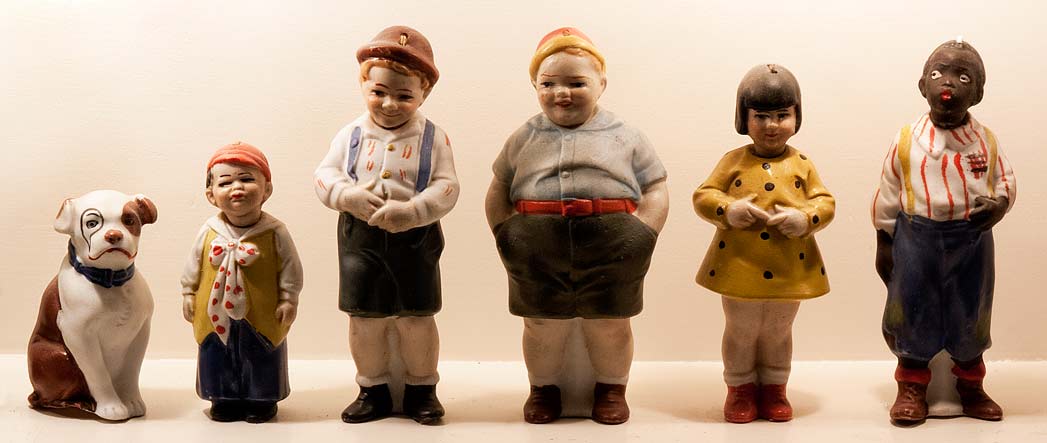
As above, the name of each character is embossed on the back, Wheezer and Mary Ann Jackson in this case. It also says, Germany. The company name is not on them; I found that when I started to research them. They are hollow with holes in the bottom and their nodding heads are held on by bits of tied string. The figures appear for sale individually certainly, but seem to largely be sold in groupings. Pete is the most likely to be missing it seems and you have to wonder if those prized ones were just scooped up individually over time.

Mel Brirnkrant’s (perfect!) full collection from his website. Roughly what I am shooting for.

I’m eyeing a little cabinet I have in New Jersey for these as a finished group. (A post about that gift from Kim can be found here.) Meanwhile though, these will stay here in New York as we hopefully fill in the remaining four.

Lights

Pam’s Pictorama Post: Today’s is perhaps a odd post. Although Pictorama readers know of my passion for all things vintage cat, there are numerous other well worn paths of buying and collecting here at Deitch Studio. Sometimes these wax and wain, but many have long legs. There are the clothing equivalents, black cotton t-shirts and undershirts to wear under jackets, sweaters and sometimes even dresses. Then there are running socks which despite my best efforts lose their mates over time so it always seems like a good idea to buy more or resign myself to being mismatched.

Tin box that holds my collection of cards (get well, sympathy and birthday) here at home.

Among my more interesting ongoing buying interests are boxes. It is as if by supplying myself with enough boxes some day I will actually be organized. (An extremely popular post about the antique tin box that helped organized my home office during the pandemic can be found here.) The boxes, in all sizes, continue to come, but the organization a bit less so.

Just yesterday I wrote about a sardine box I will use for odds and ends (I think I have decided it is heading for the bathroom in New Jersey for hair ties and whatnot which the cats steal otherwise) and today I sit surrounded by a group buy of early jewelry boxes that just came from Britain.

A ring that was a gift and is in its original box.

I think the largest of these will also go to New Jersey to store a few things there, away from prying cat paws which twitch to grab and play with them while I sleep. I may share one with a friend as well. Ring boxes are a great luxury but do require that I remember which one lives where so there isn’t a scramble in the morning – nor do I want to forget about anyone and have them go unworn. Most if not all are lined with old, worn velvet and many bear an inscription from a jeweler of another time and place. (Of course it is always very special to find an antique bit of jewelry in its original box, that which it has lived in from its very beginning.)

Popeye lamp acquisition which now resides in New Jersey.

Another purchase itch which is a bit more unusual is lamps. I seem to exist in a world with little or poor overhead lighting and as a result for both homes and office it seems an ongoing need. I have written about some of those acquisitions here and here. I will confess though that I have my eye on two more – a rather comical dog lamp which I have bid on in an auction and another attractive desk lamp.

Dog lamp under consideration.

At the office right now I have a lamp made of antique dice which has followed me since I purchased it for my return to the Met back in 2001. However, the light in my current office is dreadful even and I am considering another desk lamp. What I really need is a standing lamp, but those are especially hard to source and given the ceiling leaks I would have to be very judicious about where I located it.

This lamp below crossed my path on eBay and I am tempted although I would say this is more a NJ lamp than an office one. I think it would be a lovely light either on a desk or even on a bedside table. Thoughts?

A maybe purchase on eBay.

Part of me understands that there will be a point at which I have enough lamps, but I don’t quite seem to be there yet.

On an even more practical side of things there are bowls. If I was in New Jersey I could share a large number of bowls purchased for that house which seems oddly bereft of them. Soup bowls and serving bowls. For that kitchen they are all new. Here in New York I try to fill in with vintage ones that match my blue and white ware china (the Blue Plate Special dishes inherited from my grandmother and a post on those can be found here) such as these which were purchased on a day in Cold Spring, New York last fall.

One of two blue and white bowls from a buy in Cold Spring.

So for now, these “practical” collections seem to amass until one day I am tripping over too many of whichever. Stay tuned for updates on those pending above however as that time has not come yet.

Packed Like Sardines

Pam’s Pictorama Post: This unusual item crossed my path while strolling through the online shop for Ghost Era Antiques (@ghost_era or ghostera.com) recently. There was something compelling about it, but it wasn’t until it nagged at my brain for several days that I went back and purchased it. Before doing so, I did a quick bit of research and was surprised to find that sardine boxes were indeed a Victorian thing and that once you start to look there are many in a variety of sizes and with many levels of decoration, ranging from plainer than this one to ones of majolica greatness.

Majolica beauty, not in my collection.

As one site states, the Victorians couldn’t resist a specific dish for a special food and back in that day sardines fell into that category. There is something wholly satisfying and pleasing about this plump fellow acting as the handle on this be-flowered container. I would have thought it a tad small for sardines, but I guess not because all the sardine boxes I have viewed online seem to fall into this range. (Perhaps I am thinking of those rather extra large Italian ones?) I can’t help but wonder if there was a sardine fork or device for removing them for consumption.

I imagine that in its day the gold was a bit brighter and less worn which would have given it more sparkle. It has a few well hidden, fine cracks in it and I don’t know that it would be entirely leak proof if challenged.

Peering inside! Pams-Pictorama.com Collection.

While I am generally a contented consumer of fish and sea beasts, sardines and anchovies have long left me cold – too salty and oily. (Having said that I do religiously keep anchovy paste in the pantry which does a nice job of enriching soups and stews without having to contend with consuming the entire fish. I highly recommend this particular cooking hack.)

Sardines consumed as a delicacy seem to come on the scene in the late 15th century, kept in brine. Canning came along in the 19th century and one site says that canned sardines were served as an elegant and exotic course for fine dining as late as the 1860’s. (This same site assures me that yes, special tongs and forks were a part of the show.) And those tins were still laboriously made by hand. However, by the early 1900’s their veneer of exoticism fades and they become fare for the working class blue plate special. How far in prestige they did fall!

The traditional can.

Turns out that there are a myriad of fish covered under the canned rubric of sardine including, but clearly not limited to pilchards, silds or sprats, and at one time even herring, although I guess someone put an end to that with some truth in advertising. At first we in the US seemed to get them largely from France (they had the good sense to fry them before canning), although those herring were being canned in Maine where these canned treats became a major boom, and of course ultimately bust business. The East coast sardine biz was referred to as Sardineland and the West coast had the more familiar sounding, Cannery Row. The fish themselves ultimately largely disappeared from these locales as I gather is also their pattern.

Another majolica one to lust after!

Evidently sardines tucked away in olive oil are also aged by some, like fine wine, in cool cellars, largely in Europe. 10, 15 and even 30 years marinating is mentioned. I am not sure this increases their potential appeal in my estimation.

My box will likely reside either in my office or in New Jersey to serve as a pin box of sorts for odds and ends. I must say, I wouldn’t hesitate to invest in one of these other beauties, should ones like them ever cross my path – perhaps a whole new avenue of collecting here at Pictorama.

Mack

Pam’s Pictorama Post: Truck and car parts are not generally within the usual Pictorama sphere of collectible, but I picked this up in Jersey last summer on one of our antique store junkets in Red Bank.

It has all the heft you would expect from a Mack truck hood ornament – as if it had a function and had to prove its worth. I guess it wouldn’t do for it to have been made skimpy and light of let’s say of aluminum.

Pams-Pictorama.com Collection.

Hood ornaments started out life with a function – not that I entirely understand it, but something to do with the radiator. Turns out that they stopped putting them on cars for two reasons. First, because they were frequently literally ripped off of cars and stolen. Second, they were found to be particularly injurious to passengers in accidents. It would seem they are even quasi-illegal in cars now – although I happen to know someone who has a custom one of a beaver on her car.

Hood ornaments are a significant category of collectible. The Rolls Royce Flying Lady or Spirit of Ecstasy is the zenith of that particular area of collecting. It has a hotsy totsy history which includes intrigue, affairs and sky high prices for the item now. (The story is told best and briefly here.)

One of the variations on the Spirit of Ecstasy hood ornament on a Rolls Royce.

Rolls Royce is the only car that still maintains a hood ornament and theirs has resolved the issue by automating it to tuck into the hood for safety. Trucks seem to enjoy a different status and a variation of this Mack bulldog is still on their trucks.

Painted version of the Le Jeune Felix hood ornament, not in the Pictorama collection, alas! From a Hake’s sale catalogue.
More in line with my interests and budget, there are some wonderful Felix ones that enjoyed great popularity in the hereafter of collectibles. Oddly, I do not own one and I may get around to rectifying that at some point. They need to be mounted however and I am not handy that way. I have written about them a bit in an earlier post found here and this photo is as close as I come to owning one at the time of writing this. My bulldog could also use mounting, but an easier design than Felix, just need to find something to tuck under his front paws.

Mack trucks were founded in Brooklyn in 1900 and was making vehicles for the British army in 1916 where they got their (English) bulldog nickname. The bulldog was first affixed to the side of the vehicle in 1922. The bulldog as hood ornament takes its place about ten years later.

At a glance this appears to be as rare as claimed, a heavy British doorstop of the Mack dog.

About the early design one blog sites: The design was a front view of an English bulldog tearing up a book, and on the book was printed the words “hauling costs.” By 1932, a bored Alfred F. Masury, Mack’s chief engineer, created the ornament. A medical issue had sidelined Masury, leaving him looking for something to do with his hands. The answer: a carved bulldog. That same year, the carved bulldog figure appeared on the front of the Mack AB, a lighter-duty version of the AC. (The entire post can be found here.)

The number tells us what period he is from.

Meanwhile, unlike whatever prohibition there now is for automobiles, Mack trucks continue to boast these dogs and variations on them today. One site claims that the symbol is meant to convey solidness, dependability, but also openness to the future and of course speed.

Perched on a small jewelry box here. Pams-Pictorama.com Collection.

The variation is largely the metal color of each, indicating different things about the vehicle which it is perched on. As I understand it the gold color is for vehicles which are 100% Mack parts and the chrome for lesser ones if you will. A recent addition appears to be a copper for electric vehicles. A bit of research shows that mine is a later dog, the numbers on his chest mean he was produced after 1986. I think his separate legs mean he was indeed a real hood ornament and not a decorative reproduction. He bears a studded collar with his name Mack and he stands ever ready for action.

There is something endearing about his chunky self, leaning forward on the prow of a truck, streamlined and somehow windblown he well exemplifies a bulldog, straining and pulling forward, a collar but no leash on this fellow.

Tulip Time: Part Two

Pam’s Pictorama Post: I continue my second part, tulip treatise today with an odd alignment that came out of tulip talk recently here at Deitch Studio. As occasionally occurs here over leisurely morning work, reading and discussion sessions, Kim and I meandered through both my tulip triumphs in New Jersey and his interest in this book and comic as outlined below and these posts were born. Welcome to The Black Tulip and part two of the Pictorama post.

****

I commence with a full admission that before I met Kim Classics Illustrated comics were at best known to me in a theoretical way – a sort of punchline to a joke about not having read a school book assignment – as in clearly they read the comic book version. I confess I have never actually read one to date.

A pile of the comics within eyeshot, next to Kim’s desk, while I write this morning.

A number of years back Kim discovered a guy on 86th Street who was selling them. Not every day of the week, but most weekend days and maybe a few others piles of them on a table with their bright yellow logos being hawked. Over time they began their siren song and Kim was lured into slowly acquiring both those remembered from his youth and then ones he had missed along the way. Slowly his collection grew if haphazardly. I can’t remember now if the fellow gave up before Covid or it was the pandemic that did his periodic business in. And it wasn’t a constant flow, but an occasional addition would be made via eBay. Although he might give a quick look when I was with him it was generally a mission he completed on his own – an excuse for a walk on a nice day and presumably some comics chat.

A better look at that pile. This is just the tip of the iceberg of Kim’s collection.

Kim, a voracious reader and particularly of classic literature, seems like an unlikely candidate however most recently he uses these as sort of massive supplemental illustrations to something he is reading. (The man is devoted to illustrated fiction in all its guises.) A large trade paperback on the history of Classics Illustrated found its way into the house recently and, although he is a committed Dumas fan, his purchase of The Black Tulip I believe was a result of his reading of that. The novel is on its way so he has not commenced reading it yet.

Classics Illustrated (which has lodged in my brain as Classic Comics) had a 30 year run, from 1941-1971, launching with The Three Musketeers. With printing and reprinting and the collecting of them, it can be a deep and largely affordable vein of comics collecting. If Kim were writing this there would be color and lore I cannot provide – thoughtful observations about the various artists who illustrated them, some who were wrapping up a career during the heyday of comics.

The opening pages of our rather tatty copy.

The Black Tulip (based as noted on the novel by Alexandre Dumas) was illustrated by Alex A. Blum (1889-1969) and I would say his illustrations are definitely part of the appeal of the comic. The story takes place during the tulip craze in the Netherlands of the 1600’s after the introduction of the plant from the near east in the preceding century. As you probably know, tulips were wildly sought after and the bulbs traded like gold or cocoa on a world exchange. Fortunes were made and lost in tulips and even poor and middle class families might stake their fortunes on the waxing and waning of them.

Queen of the Night variety of tulip – appears to be pretty much as close as we come to black.

The plot of the novel is the race to develop a truly black tulip and the nefarious individuals who would do anything to capture a $100k guilder prize for the development of it. (For the record, a true black tulip does not exist even today and a very dark purple one called black is as close as one comes.) Since Kim is planning to read the original novel as well so I will have to ask him if they explain why black seemed so desirable – I prefer red and orange among others myself. (It should be noted that blue does not exist either – only a sort of lavender to blue.)

The jolly cover caught my imagination and a stroll through the comic is not disappointing. For the record, there is a column in the front cover called Student Boners which claims to be funny mistakes made on regional state exams – along the lines of Name two explorers of the Mississippi – answer: Romeo and Juliet. There is a bio of Dumas and encouragement to read the full novel at the back. Throughout there seems to be a layer of an in the service of sort of self-conscious educational mission.

The back of the book – free comics tattoos with your purchase of 10 issues.

Along those lines also included at the back is a plot summary of the opera Boris Gudenof (what did kids make of that?); a bio of Alfred Nobel (Inventor of Dynamite!); and an unrelated short story about a dog. Kim informs me that the books had to be weighted with a certain amount of text in order to get a book rate for mailing. (This is part of the eventual undoing of the company as they ultimately lost this status.) There is an emphasis on the great literature these are based on (There have been no greater story-tellers than these immortal authors) and on reading in general.

A page from a story to be published next year called Apocalypso.

As I alluded to above, these comics were a fixture of Kim’s childhood and a recently completed page from an upcoming story for his next book shows a young Kim and a friend in a room littered with them. (We had some discussion over which covers would be featured.) As for me, well my generation had Cliff Notes (which also took a final bite out of these comics) instead. I never read them, but I am sure they were far less romantic and potentially interesting as Classics Illustrated and in addition I doubt that anyone collects them today.

Puzzling Felix

Pam’s Pictorama Toy Post: Today’s toy has languished on a shelf for quite a while. It came in the big box of Felix purchased from an obscure auction last year which spewed out everything Felix related from a rare kerchief to a pile of annuals. (Tidbits and treasures from this box in previous posts can be found here and here. Some annuals remain as future posts!)

These hand puzzles are not exactly rare and I have seen some come and go on eBay over time and somehow it was a long time before I got into the game. I finally purchased the one shown here in 2019 and wrote about it here. I couldn’t resist it with its graphic image of an angry Felix with mice.

Pams-Pictorama Collection from a prior post.

Today’s is a joyful dancing Felix of dreadfully sloppy execution. Like the other, it was made in Germany and is marked as such. How these cardboard and cheap metal bits have lasted through a century of pockets and playing I cannot imagine. The cheap metal inside and out is pitted and rusty.

For some reason for me these toys always conjure up an image of a young newsboy taking a break and pulling it out of his pocket to play with circa sort of 1927 or so. Sometimes it is an errant night watchman killing time. I don’t know why – it is always men and boys I imagine in this role.

I find the two small metal mice quite cunning as are the metal traps I guess they are? I hadn’t actually thought of them quite that way, but am now as I really consider it. In addition there are two small balls and I would think the challenge is a ball and a mouse in each trap. I have attempted it and it is both engrossing and difficult. I discovered that the mice only go into the traps nose first, can’t back them in, or at least that is true of one which, incidentally, has a slight upward curl to his tail. Ha! Someone was thinking when they designed this.
The cardboard back, worn from use and handling. Hard to believe it is around 100 years old!

I know I had dexterity puzzles like this as a child although for the life of me I cannot remember the images on them or the tasks required; I suspect they were simpler. I have a dim memory of them mostly being rolling small balls into a face or something along that line. This would have seemed quite sophisticated to my then pint-sized mind.

I suspect that now that two of these have entered the Pictorama collection of course more may follow. We’ll just see about that.