Rock ‘n Roll Blues

Pam’s Pictorama Post: The ear splitting sound of electric guitar and flashing, colored lights – fans standing and yelling. Radio City Music Hall on a Wednesday night on a chilly, wet summer night. How on earth did this big band girl end up there?

Pictorama readers know I have occasionally taken to reporting on various aspects of my life, and lately that has mostly taken the form of writing about my new job at Jazz at Lincoln Center. As someone whose interest in music has rarely budged beyond a stubborn point after 1940 or so since discovering early jazz and dance band music in college, it gave me some pause to take a job where, by its very nature, I would be immersed in not only contemporary jazz, but all of the decades between.

I was very upfront about this concern throughout my interview process, often declaiming unwarranted into much of the first months of my job, until I realized that in reality most of the people I work with also have strong preferences and being open to things in a general way is the only musical mandate of the job. Over the intervening months on the march through my first year, I have discovered that I really don’t have to love everything. While my ambivalence about be-bop may be shocking to some (it really is) it is true that I don’t have to love everything. For all of that, there has been very little I didn’t at least find interesting – there was one painful night at Dizzy’s with what I will describe as abstract sax, but for the most part it has been an interesting ride.

Therefore, in the spirit of exploration I will try most things and as a result I have learned a lot. So the recent offer of a ticket to hear Steve Miller, who plays a blues program at our venue annually, resulted in a trip to Radio City Music Hall where I have not been in more than a decade. I met him recently and he seems to be a lovely person. His music is sometimes described as an entry point between rock ‘n roll and blues and with this in mind I accepted the offer of a ticket.

My most recent visit to Radio City was to hear the Dalai Lama. The long line and wait to get in for that was sort of epic, although he was fascinating as always and worth the wait. I had not thought about that particular talk in a long time, but it came back to me when I arrived at Radio City on the Wednesday night of my late June vacation. (The only other time I remember being at Radio City was to hear Frank Sinatra shortly before he died. My then boyfriend Kevin, who had the tickets, had gotten the date wrong and we had to rush to the theater, arriving late with the concert underway.)

The flashing lights and shock of the opening act, Peter Frampton, knocked me back even further, to my childhood. After the initial shock, and admittedly thoughts about running immediately from the room, I was surprised to realize oh-my-gosh, buried deep in my brain were many of these songs, as if planted there by aliens. Not all of it, but about a third of what he played kicked off a sound track in my brain, of long forgotten AM radio. (This coming to mind recently with the death of Dan Ingram. DAN’ Ing-ram, his intro playing from another soundtrack in my brain.)

Popular music blared daily from the radio in our sea green Pontiac station wagon, and from the large brown and gold affair of a radio (a bit out-dated even then) atop of our refrigerator – as soon as my sister was tall enough to change the dial from the constant news radio of the day. (WCBS I believe. My mom favored them as her brother worked for the station at the time. News was a family business.) Music of the ’70’s also blared from my bedside clock radio, (the clock radio which I later, if only briefly, discovered jazz on but about that another time), and of course from a series of small Sony transistor radios I kept with me to the extent the batteries held out. Later, in high school, top 40 music would follow me to parties at the beach at night, and ring in each New Year with a countdown of songs. WABC, top 40 radio. Little did I realize that a small tape recorder was going off in my brain and decades later someone would hit the playback switch.

My co-workers filtered in around me shortly before Steve Miller came on. When Steve Miller started the tape recorder revealed a greater knowledge and memory of his music – albums on my sister’s turntable. Then he and Peter Frampton played some blues together, blues of course being what I really came for after all, and I started to get it – not so bad for a big band girl.


Pop Goes Felix

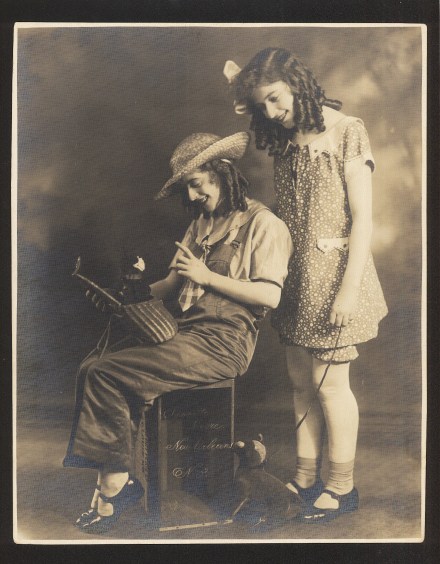
Pam Photo Post: This photo interested me and I went to some trouble to acquire it. It is a bit mysterious. The photo is large, about 10″x12″ and the surface is a photo paper with a slight toothy gloss. On the side of the box the girl is seated on it reads C. Bennett Moore, No. 3. If you look carefully, you can see that the actual box is open and empty and the words have just been dropped in over the shadow from it.

Meanwhile, C. (Charles) Bennett Moore is evidently the name of the photographer. Mr. Bennett (1879-1939, although one online source has him die in 1936) was ultimately known best for hand painted versions of his own photographs of New Orleans. Born in Minnesota, he served in the Spanish American War before showing up in New Orleans and going to work for a photographer named Emil Rivoire, ultimately taking over his studio and renaming it for himself after Rivoire’s death. A contemporary of E.J. Bellocq, but with a sensibility which ran to architecture and portraiture, he did not achieved the same level of fame. (He should also not be confused with the younger civil rights photographer Charles Moore.)

I can’t say I am a fan of the painted photographs. Whatever interest or charm the photos might have had is sufficiently destroyed with what it would only be slightly unfair to refer to as ham-handed painting. There is evidently however some market for them, but we will just agree to disagree on that point. Meanwhile, and more to the point, Kim senses that my photo is a generation lost as well and I see what he means. That could just be a negative increased in size, or maybe it is wholly reproduced. It appears to be on photo paper, but a thick one, so I remain unsure. The size is also so strange. There is also a weird sense of manipulation to it – not just the added words but a soften quality to the image.

The seller of the photo speculated that the girls were actually young women dressed as girls and a close look confirms this. The seller goes on to further consider that they were likely vaudeville performers or even silent film actresses – I am more inclined to agree with the first than the second thought. One sports boyish garb with hat and dandy gingham tie, while the second is very girlish.

Mr. Moore might be advertising himself, albeit subtly, using this prop with his name neatly in script on the side. For me, it was of course this really splendid Felix jack-in-the-box that caught my attention. I love that toy! I was the kind of kid who never tired of my jack-in-the-box, musical as I remember. Hers has a sort of strap for handy transport. It appears the Felix just pops up – my childhood version was wound up by a handle. The stuffed dog on the leash is pretty nice too. That Felix though – a great toy which I have never (not yet anyway) had the opportunity to make my own. This brings me a bit closer.

So, I wonder – was this photo some sort of advertising for C. Bennett Moore? There is nothing written on the back, but a slip of paper included with the photo dates it to 1923 which seems like a reasonable guess-timate for the year, although I see nothing to support it. Was it used somehow in conjunction with these young women and their show? Once again, those details are most likely lost to the sands of time, but I am content since I am in it for the toys.

The Cat’s Concert


This slideshow requires JavaScript.

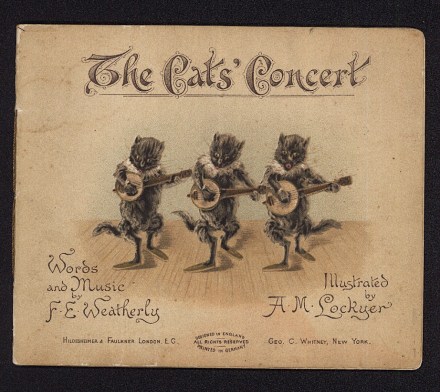
Pam’s Pictorama Post: This little volume makes me imagine screechy cat voices lifted in song! This item is the direct product of collecting mania. Back in January I stumbled into purchasing the rather wonderful Lady Pussy-Cat’s Ball (which you can find here) which lead directly to finding and buying another A.M. Lockyer and F.E. Weatherly collaboration, The Robber’s Squeak (featured here) a month later. After doing some research I discovered the existence of The Cat’s Concert which turned out to be quite pricey and not terribly available. I went into a stealth hunting mode and five months later I acquired this copy for a reasonable sum. Sadly, it has fewer illustrations than the others, but it is a little gem in its own way.

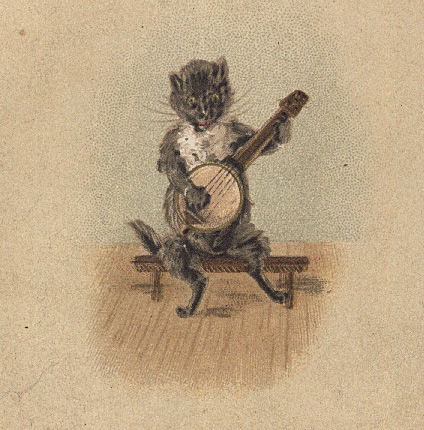
It is a fragile little book, so apologies that the inside pages cannot be scanned as I would not attempt to lay it open and flat and instead have just taken photos of them. We are treated to five tunes here: The Cat’s Concert, Sambo’s Song, Serenade, Pompey’s Trouble and Finale. As in the other books I have noted above, this one is illustrated by A.M. Lockyer and has words and music by F.E. Weatherly. These were all published in both New York and London according to the copyright information. This copy came from England. One of the seller’s has dated it at 1885 (?) as the book bears no date of publication. A publisher’s circular dated 1889 cites it as being an excellent little booklet for the nursery.

The cats on the front cover, above, appear to have very long feet. Strangely, as I look through the book, they appear to be wearing long, odd shoes – they wear them for Sambo’s Song, and even don clogs for Serenade. This tiny pamphlet is well worn with age, is about 5″x7″ in size. I do wonder at the practical application of it – hard to imagine anyone whipping it out in the nursery and playing a tune, even in the late 1880’s. Instead we will imagine that these cheerful cats entertained enough to keep this booklet in circulation over a period of time sufficient that copies remain today.

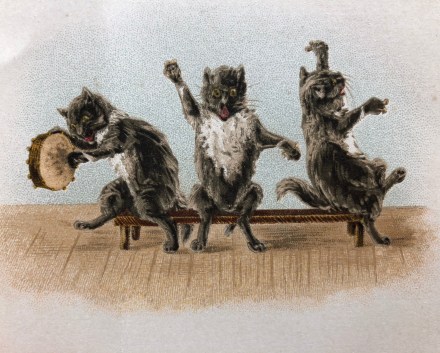
My favorite drawing is for Pompey’s Trouble, shown below. I like the sharp claws displayed by these fellows and the one on the far right could almost be a Louis Wain kit; he’s having a high old time! Pleasantly maniacal expressions on the faces of all three.

The lyrics on all of these tunes are less than memorable and racist – a mini-minstrel show for the nursery. (Collecting black cat material can lead you unknowing down this road.) The one called Sambo’s Song is the most cat related however and praises the cats for catching the mice in the farmer’s grain and seems to end in a clog dance:

Three fat Mice, Dey lay by de farmer’s grain; Dey stuff away all ob de day, An’ couldn’t get home a gain.
Den dese three cats, Came over de old barn floor….An’ I think you  see, Tween dem and’ me, De Mice go back no more.
O come along, Di_nah, come along Di_nah, do! ‘Tis de middle ob de night, and de moon is bright, we all ob us wait for you? With a wow, wow, wow! An a m’you, you, you! Did you ebber see a clog dance done?…

pompeys-trouble.jpg

Clearly the British were as capable of writing racists ditties as the Americans (Weatherly the author of music and words is British), but perhaps like me, Lockyer and the cats sold it for them.

20180630-00006.jpg

Scrum

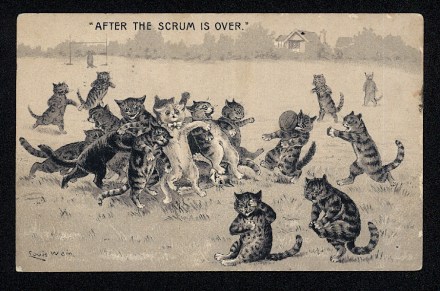
Pam’s Pictorama Post: Pictorama regulars know that I promised more Louis Wain and today is our next, although definitely not final, installment. Ah yes, as I curate the cat museum in my mind’s eye I now acknowledge that Louis Wain should take his rightful place, a collecting tributary of its own! This card is an image that I have favored from the time I started looking at Wain seriously. In some ways he is at the height of his powers here for me, making black and white work for him as well as color does.

Each and every one of these rugby playing pusses has this own expression of glee, pain, and even, my favorite, maniacal anger. Notice the one very happy cat who has his foot right in the eye of another on the ground – who in turn looks surprisingly pleased about this arrangement. The movement of these cats is great, but so is the sense of deep space with the lightly drawn house (rather British-suburban) and trees in the background. In the middle ground we have one cat covering the distance and the goalie, way back there.

This card was used and sent on January 11, 1905 from Freston. It is hard to read the address, but it appears to be something along the lines of: Miss Breaf Elle, East View, Bouds, Lancashire. The note reads, Moody Maureens next week are you & Kali coming? Let me know in good time as there is some one who will go with you. Evidently the sender assumed all would know who she was as she did not sign her name. (Handwriting and message makes me lean toward this being a woman.)

While this card is entitled After the Scrum is Over to me the scrum still seems very much in action. I guess the ball is technically back in motion so I won’t claim to understand the finer points of the game here. (Readers may remember I have a soft spot for rugby too since my sister played in college. Her trophies are considered in my post Trophies and also in The Crimson.) It is a ribald cat universe here and somehow Wain manages to capture the insane and slightly vicious, wild world that our cats would establish if someday they were indeed to take the evolutionary step toward being slightly more human. Quite a thought to contemplate fellow cat lovers!

Hep Cat

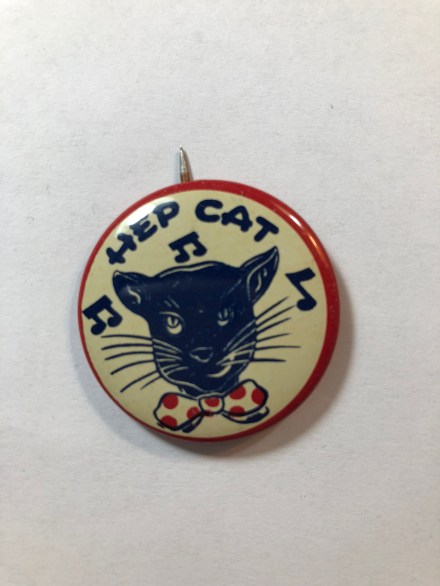
Pam’s Pictorama Post: I tend to think that this pin represents the crossroads of Pictorama and my work life. I could hardly be expected to resist it when it crossed my path on eBay recently. This knowing little fellow, sporting his bowtie, a wiseacre grin and numerous whiskers proclaiming his cool, something of a wink to us. (Would wearing such a pin have precluded actual cool on some level I wonder?) Early jazz slang seems to get intricate and dense pretty quickly, but I think Hep Cat is one we all pretty much recognize. Of course, it did lead me to reflect on how interesting it is that jazz musicians chose to call themselves cats which of course endears them to me further. For us here at Pictorama, cats are the very essence of hip and elegance. (Just ask Blackie.)

It has been noted by those who see me daily that my work attire has swiftly morphed from Met to Jazz. I readily acknowledge this – I do not dress up more or less so much as it is different. There are things I would not have worn to the Met, whereas I would say quite simply anything goes at Jazz. I spend a lot of nights at our club Dizzy’s and concerts these days and that too is quite different from galleries. I do subscribe to the theory that if your job is to ask people for money, you should always be dressed and ready to do it should the opportunity arise on any given day. Dressing appropriately is a sign of respect. (I recently saw a consultant I have worked with for years when I was dressed in my weekend wear, and he said it was shocking, like seeing the Queen dressed to work in the garden. I took this as a compliment.) I taught a class at Juilliard this spring on fundraising and one of their assignments was to arrived dressed to ask for money. They arrived in everything from pajama bottoms (he said he forgot) to suits, as well as everything imaginable between.

Meanwhile, to be blunt however, there is and never has been anything about my appearance that would lead one to think cool as such. Growing up in a preppy, conservative milieu, college largely same, and then landing at the Metropolitan Museum in fundraising, a penchant for vintage and vintage influenced clothing was my primary stake in sartorial individuality. Although really, we have all known people who have that extra something about them, what they wear and how they wear it and somehow so much more, that makes them hep cats indeed. In the end they could come from or exist anywhere. I believe you are born with it – those folks who wore even their gym uniform with a certain insouciance all the way back in grade school.

Without calling anyone out and embarrassing them, not surprisingly there are a few hep cats amongst us at Jazz, and not just among the musicians. Cool is a term which has virtually lost all meaning from overuse, yet we do still know it when we see it. As for me, maybe I will put this pin on my winter wool beret, next to the Krazy Kat pin I am sporting there because here at Pictorama, we generally celebrate a different kind of cat indeed.

Mr. Frank, In the Dog House

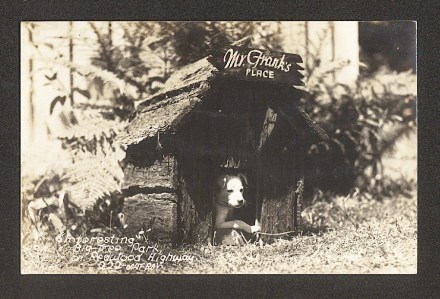
Pam’s Pictorama Photo Post: The writing at the bottom appears to say “Interesting” Big Tree Park on Redwood Highway 222-Art Ray. May we assume that the dog in residence is indeed Mr. Frank? His tidy little house is evidently constructed of some of the castoffs from the redwoods in question and he looks like quite the official resident. My guess, after an internet stroll, is that this is probably from the Big Tree Drive-Thru, Avenue of the Giants in California, where according to Roadside America today you can still drive through a tree today. It features such entertainment as the step through stump, drive-on tree, immortal tree and world famous tree house. Let’s put those aside however and instead contemplate for a moment what was probably a similarly touristy, but somehow more charming and decades older version of the Redwood Highway stop, one where you would meet Mr. Frank and stop for a cool drink or picnic, perhaps as a break from a longer journey.

However, for me this photo brings to mind a doghouse from my childhood. I arrived at about age six in a suburban neighborhood with a fully formed, roaming hoard of kids and pets. In addition to sort of a dozen kids ranging widely in age, it also included numerous cats, and canines, including our German Shepard, Duchess. (I also remember a Dalmatian, aptly named Chief, who actually belonged to a child-free neighbor, but whose boundless excess energy urged him to routinely run up and down the length of many yards.) All of this chaos and claptrap ground on the nerves of our next door neighbor, a loudly proclaimed child and animal hating Mr. George Smith. To his oft lamented chagrin, he had the honor of being wedged between our house and another house chock full of kids, the Jakes family – who had as many kids and pets as we did, the three roughly the same ages as us. One day I may write more about that neighborhood, and George in particular, who was a well-known science fiction writer. He drank heavily and made no secret of his dislike of the kids and animals which encircled him and his wife on a daily basis. To the extent possible, we avoided him and his adjoining yard. The cats and the dogs could not be urged otherwise and he threatened them with buckshot.

The yards were unfenced and generally Duchess lived inside with us, although the cats were free range at the time. However, at some moment my parents were seized with I don’t know what inspiration (perhaps 3 children in a rather tiny house also sporting several cats and said large dog meant that moving anyone or anything out of the house was desirable?) and they built a pen for Duchess outside. Then, somewhere (I suspect a garage sale) my father acquired a gently used, quite sizable, wooden doghouse which was an unbelievably good match for our own green shingled house. He installed it in the backyard with the intention that Duchess should spend time out there. To our great surprise, shortly after George Smith brought over a tiny wooden tv antennae that he had constructed and painted silver. One couldn’t say he didn’t have a sense of humor. It was installed atop of  the doghouse, where it sat proudly for a number of years. Alas, Duchess hated the doghouse and I have no memory of her ever in it. (Instead she preferred wedging her 60 or so pound self between my parents on their bed, where she had nestled as a puppy.) I was somewhat fascinated by the doghouse, even if she was not, however we left it behind when we moved several years later.

Black Cat Balloon

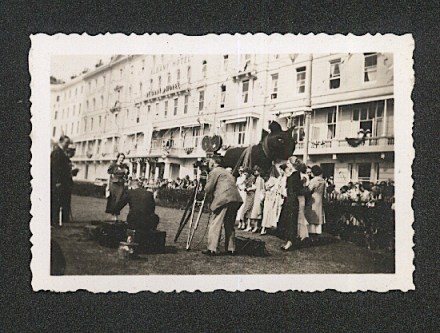
Pam’s Pictorama Photo Post: Taking a short break from the world of photo postcards, I am shifting over to a diminuative snapshot today. This little gem was spewed out of Great Britain and found in a sort of needle-in-a-haystack way while searching on eBay. The back is only marked with Velox and 5 38, and I wouldn’t be surprised if that May of 1935 isn’t the date of this photo. It is tiny, really just sort of 2.5″x3″ – the size of a business card – and has those crinkly white edges and boarder that were briefly in vogue for early commercial photo printing.

I do wish I knew what was going on in this photo as I suspect I would find it quite exciting. There is the really splendid, enormous cat balloon (held in place by an impressive number of ropes if you look carefully) and a group of women posing in front of it, while another woman is being filmed by what appears to be a newsreel or other film movie camera. (Oh to get closer!)  There are people lined up on the sidewalk behind some kind of fence or barrier. I would love to have a better look, not to mention know what it was all about. Interesting to take a picture of something being filmed. It was important enough to save it all this time – but with nary a note of explanation.

When I started collecting cat photos and photo postcards I was pleased to discover this sub-genre of cat photos – the cat parade float. I have come across and added several to my collection, most of them photo postcards. You can see some of my other lovelies at the following links:  Cat’s Eye on ParadeSpirit of the Golden West, Cats on Parade and lastly Felix on Parade. Clearly folks could easily work up some enthusiasm for a black cat float – thereby making it my kind of parade. I just wish I could have been there.

Change?

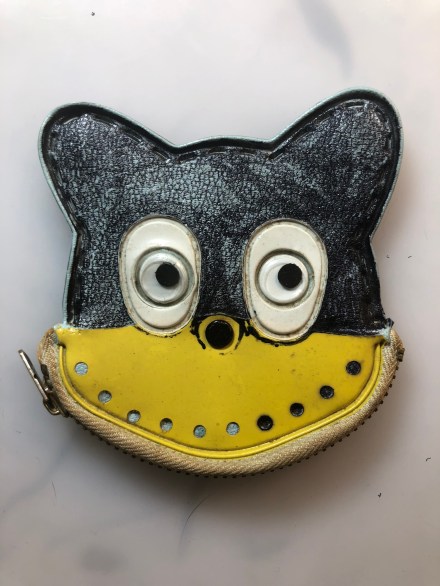
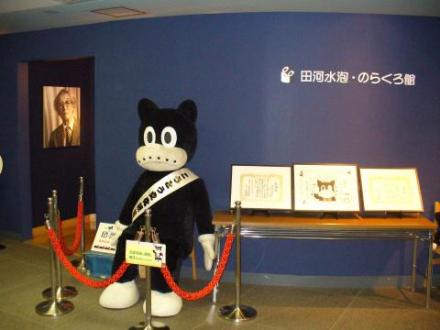
Pam’s Pictorama Post: Luckily for me someone thought this was Felix and posted it on eBay where I snatched it up immediately. I believe this little change purse (obviously much beloved by one or several children over its lifetime) is Norokuro, the Japanese cat/dog character of early comic fame there. I have written about Norokuro a few times before when speculating on a celluloid toy (in the post found here, Norakuro, the Japanese Felix? and Pam Toy Post) and someday would love to find a stuffed toy one if such a thing exists – I have seen no evidence of that however. While searching for such a thing I did come across this photo of a larger than life one from an exhibition of his creator’s work, Suiho Tagawa, at a museum in Koto City, shown below. That guy reminds me of the giant Dean’s Mickey Mouse we have in our bedroom, but is a bit disappointing somehow. I am hoping for a more cuddly version to turn up.

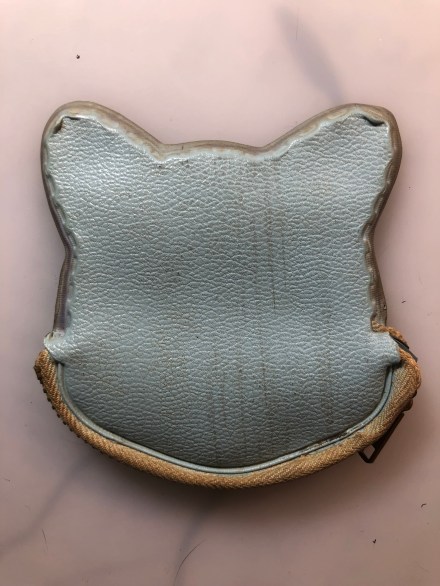
Meanwhile, this worn little nubbin of a toy change purse is splendid. I am not certain, but I think his eyes moved originally and the zipper is designed so it looks like a large, toothy, grinning mouth. It is quite small – wasn’t holding much change and a bill would have to be folded some, although I confess I know nothing of Japanese currency at the time and maybe it was more adequate than I think. The inside is surprisingly untouched and new looking, the same blue as the back shown below, with a small tag that reads Chase Japan in English. He is well designed in my opinion. And, quite simply put, I would have been nuts about this as a kid, utterly delighted to own him.

change purse back

I have dim memories of owning less remarkable change purses as a child. This one tugs at my memory and vague, tactile but indistinct memories of mid-sixties versions of my own rise up. I know I had a bright blue cloth change purse in the shape of an animal of some sort, but there were plastic ones too, long lost to time and evidently memory as well. Strange, when I think about it, that change purses are so interesting to children considering that money doesn’t yet have real meaning, and not to mention that during my childhood the ownership of them would have largely excluded boys. Somehow though, if you had one of these with a few coins in your pocket you felt like you had the world on a string!

01_932

Tabby cats

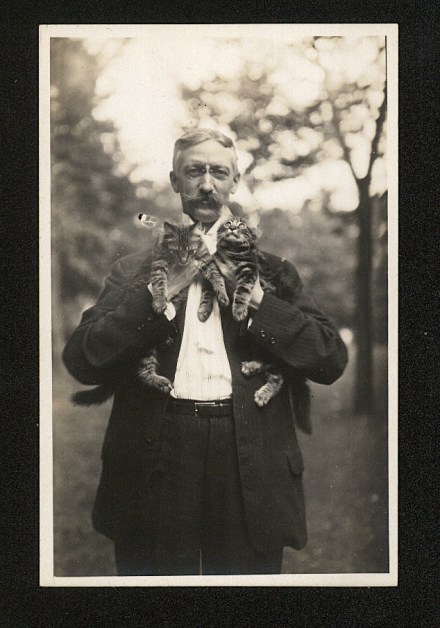
Pam’s Pictorama Photo Post: Those of you who have followed Pictorama for a bit know that men and cats are a sort of a sub-genre for me. For some reason I find it very appealing to see that some man of years gone by has grabbed a cat or two for a photo. This man seems to be quite pleased with these two great tabby kits – one perfectly calm and the other clearly itching to get on with the duties and pleasures of his own cat day.

While tuxedoes are generally considered to be the cats of choice here at Pictorama, I harbor a deep affection for our stripe-y feline friends. They are, in their own way, the very archetype of house cat, aren’t they? (I pause for a moment to reflect on that term – house cat. Interesting.) I think of them as generally genial, although my parent’s had one, Wally, who was insane and would randomly attack people with ferocity. (He was the kind of cat who created cat haters by embodying and realizing their cat fears.) Further back in my childhood however, there was first Zipper and then Tigger, both of whom exemplified the tabby persona with aplomb and good nature.

I have written about Zipper before – my mom rescued him as a tiny kitten from an ally behind a laundromat where two boys were tormenting him. He was so malnourished that he slipped between the space between the cushions in the back of the car. Somehow this made mom arrive at naming him Zipper. After a diet of cream cheese to build up his strength he grew into an easy going if occasionally skittish cat. Despite his early bad experience with humans he would submit to some petting. My mom alone could hold him though. For the rest of us he would quietly slip out from under your grasp without fuss.

Tigger meanwhile was a plump black gray and white striped tiger. She was the kitten of my insane, if remarkable, calico cat Winkie. Tigger had a good personality, undemanding yet smart and friendly. She would sleep on my bed, a bit erratically but always welcome. One day she wandered off and was missing for a very long time. She was discovered in a barn several blocks away and somehow brought back to us, the denizens of the broader neighborhood having heard that we were looking for a cat of ours. We were delighted to have her back and she settled in immediately. However, oddly, within the next year she disappeared once again, this time for good. We searched, but ultimately suspected that she had adopted another home, and when weighed we were ultimately the ones found wanting. Ours was a large but cat filled house at that time so perhaps she had a fair gripe. I have always hoped she found a home where she was the sole feline resident in charge, much adored, feted and spoiled as she deserved to be.


Who Is Pam Butler

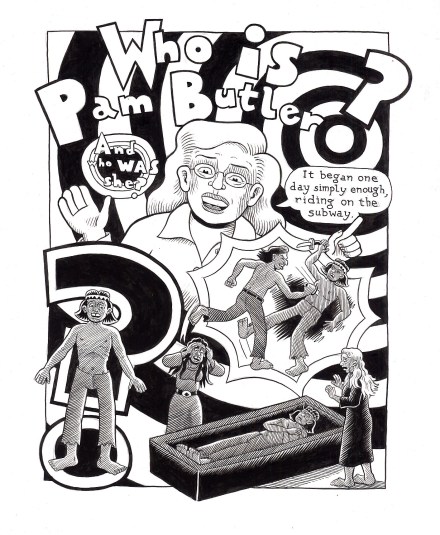
Pam’s Pictorama Post: Today’s post is from the appendix of Kim’s upcoming book, Reincarnation Stories, and is a rare Pictorama husband and wife co-production. I wrote it, several months back, although some of you have heard the story before. Enjoy!

Reincarnation

It begins one day, simply enough, riding on the subway. Kim forgot to bring something to read and he picked up a free newsletter for the Learning Annex – cheesy adult “courses” taught by reality tv show stars and people promising you that you too can make a killing in NY real estate. (Yep, I think Donald Trump was advertised in one of those – who could have guessed?) I read over his shoulder. Semi-seriously he announced that there was a course in past life regression that he thought he would take – he’d always had a story in mind around reincarnation and maybe it would be a good jumping off point. So I flippantly said I’d do it too. And just like that, we decided to phone and make a reservation.

What I didn’t tell Kim was that I had been approached about past life regression before and the thought had sort of terrified me. I suffer from a potentially debilitating form of arthritis and more than once it had been suggested to me that I might try to go into my past lives to see what might have caused it. Well, I figured if I had either done something so awful in my past life, or even worse, had some dreadful injury that shook my joints to this day, that I sure as heck didn’t want to know about it and relive it. Still, this was the Learning Annex – no need to take it seriously. It would be fun to do with Kim and if he was going to a past-life regression course I sure wasn’t going to miss it.

As it happened, the day we were scheduled to attend in the early evening turned out to be a complicated one for me. It was a sunny and beautiful day as I remember, I want to say spring rather than full on summer. I was working for the Central Park Conservancy at the time, but had taken part of the day off to attend the funeral of Lydia Mananara, a woman I had worked with at the Metropolitan Museum for many years. She wasn’t much older than me and had died of breast cancer. I had cared for her cat, a lovely plushy long haired tabby-stripe, while she was in Italy seeking alternative treatment or perhaps just spending time with family there, over the course of many weeks. After the funeral there was a reception at the Met where I saw former colleagues and met family and friends of hers I had not known. It was a strange moment of displacement having worked there for so long and being back for what may have been the first time since leaving.

That evening after work, Kim and I went down to Union Square and to the address of what appeared to be some sort of elementary school. I remember thinking that this was turning into one very long day, and we trudged into a classroom with table desks pushed together to form a large U. There were about ten people in the room and they were as varied as the human content of any subway car on a given morning commute, a few young, some older, generally nondescript. The course instructor entered and he too was pretty generic, middle aged and pale. He started out by telling his story.

Seems that when he was a kid somewhere in the Midwest, a visiting hypnotist had come to town and he had gone to see him perform. In what he’d later realize was an unusual vulnerability to hypnosis, he slipped easily into that state and, jarringly into a past life. Frankly I can’t remember if he was actually the subject of the hypnotist or if he fell into the influence from the audience – the latter seems unlikely. Anyway, he went on to describe, in fairly horrific detail, being a small child running for safety to a root cellar from where he spied his family of prairie settlers terribly murdered by Indians. Of course he had no idea why he experienced it, but a number of years later he took the opportunity to be hypnotized again and this time in his past life he was an adult, hidden away on a mountainside witnessing the slaughter of other settlers by Indians once again. This time he understood it to be a past life and devoted future time and energy to developing the skill to hypnotize himself and travel back to past incarnations.

He ended his presentation and offered that he would now help us all slip back into our own past. He turned the lights down, but traffic thrummed out the window and florescent lights hummed in the hall. At first quieting my mind and focusing seemed unlikely. Still, I had developed some meditation chops and it didn’t take very much for me to still my mind into the desired quiet before going to a “safe place” and then rolling back into something else.

He “woke” us up to wherever we had landed in our minds and asked us to look around. I was in the desert, a barefoot and nearly naked young man in my teens. The soil beneath my feet was sandy but hard and a reddish color. The teacher’s voice instructed us to take note of the year (I want to say it was the 1880’s, but I have trouble remembering that more precisely now) and things like who was President, to take note of our surroundings. I don’t know who was President and at first I thought I was in Tibet – a place I had been twice and had a great affinity for – but I gradually became aware that I was in the American West instead – and that I was a young Native American male. I was aware of being absolutely dirt poor, hungry, and not educated. I was essentially a dumb young kid.

His voice now guided me to go to the day I died and to take note of how I died. Seems like I was killed in a stupid fight with another kid – I don’t know over what. He told us to take care now to apologize to anyone we had hurt. I found myself apologizing to the guy who killed me (maybe I killed him as well?), and then I apologized to my mother and my grandmother. I had left them alone when I died and it had been my responsibility to take care of them. I felt bad about it all, but in a dispassionate sort of way. The instructor now guided us out of the past and into the current moment. He turned the lights on and suggested a break before we spoke about our experiences. Kim and I found a water fountain.

Kim, “Man, that was a waste. Nothing!” I looked at him surprised, “Really?” and quickly told him about my experience. We both wondered if somehow the teacher’s own experiences related with Indians had influenced my subconscious. I didn’t know about that, but I did know I wasn’t looking forward to telling him that I had been an Indian!

After the break we sat back down in our seats. Kim and I were seated about halfway around. Like Kim, not everyone had experienced anything and only two other stories stood out for me that day which I remember. One was a not especially cogent tale of another planet and this stayed with me because the instructor didn’t seem to find that unusual and said it happens – other planets. The other was quite moving. There was a young, attractive woman in her twenties who had found herself a bench at a bus stop near Union Square, but in the 1940’s. It was July and very hot and she was 9 months pregnant. She died in childbirth later, I think the same day. I wonder to this day what brought her to the Learning Annex that evening to have that experience.

As for me, I reported in the most straightforward way possible what I had seen and experienced. It certainly isn’t the past I would have imagined for myself and yet that is what makes it compelling. As someone who has long been interested in Buddhism I can easily accept the concept of a past life, one in an ongoing parade – hopefully ultimately toward enlightenment. The idea of even a brief window onto a self that was so different – impoverished Native American teenager who gets himself killed in a fight over something so stupid that it, unlike these other simple facts, was not indelible through time. Only that I had been young and stupid and gotten myself killed when I should have been taking care of my mother and grandmother remained. I guess the good news is that I got a bit smarter over subsequent lives. The instructor did give me a bit of a fish eye – or maybe I imagined it. But I don’t think my former self was doing any of the killing he had witnessed.

I am not sure Kim believes that my experience wasn’t entirely one of suggestion placed in my mind by the instructor’s own stories. It was a day when I had already had my share of contemplating mortality and it is more than possible that the experience was a combination of what I brought to the table so to speak. All I can say is that bit of time in another body seemed real and different, and the poignant moment of apology one that had been a long time coming.

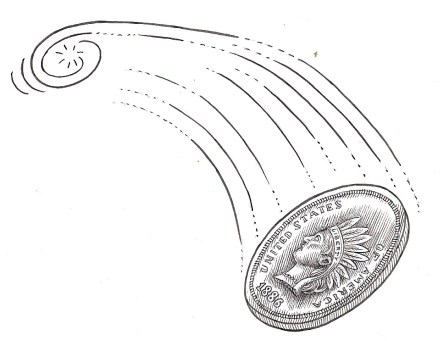
On that day I certainly didn’t get any insights into the arthritis that troubles me, and it didn’t lead to a desire to do it again and learn about other lives, if that is indeed possible. Instead it left me with a strange sort of shiny spot in my memory. As if out of the dim past one small bit has been brought into high relief. Real or not, I keep it there like a talisman, a lucky penny, dropped from the past into my lap here in the future.

20180526-00014