Four Footed Friends

Pam’s Pictorama Post: Last night a friend from Europe took shelter couch surfer here at Deitch Studio after an airline mixed up. Pete and Kim were up late catching up so I am typing quietly with my coffee. As visitors and long time readers know, Deitch Studio is a very compact establishment and should you come to spend the night you are more or less sleeping at our feet with a wall of bookcase between us. Anyway, coffee is on and the sun is coming up.

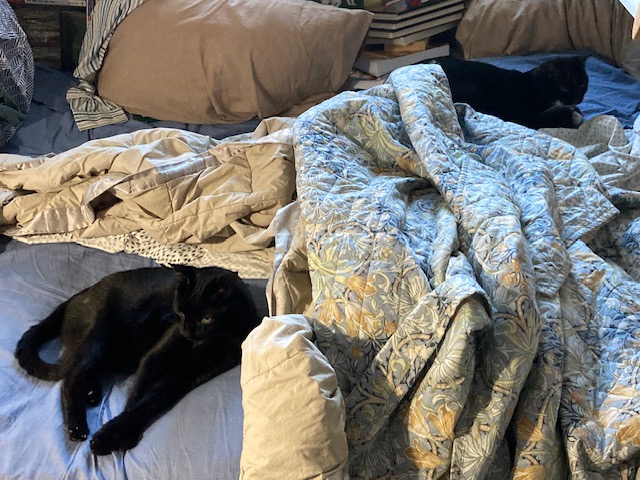
Cookie wanted her breakfast and Blackie is hiding – evidently he somehow thinks an overnight guest might result in him being placed in a carrier and going somewhere! I hate to say it but Cookie visibly expands when Blackie isn’t around. She is rolling on the floor and talking to Kim while he does his morning exercises.

I am off to New Jersey today to handle some appointments there. Sadly Kim and I will be paying a condolence call in the afternoon so it isn’t an early start for NJ.

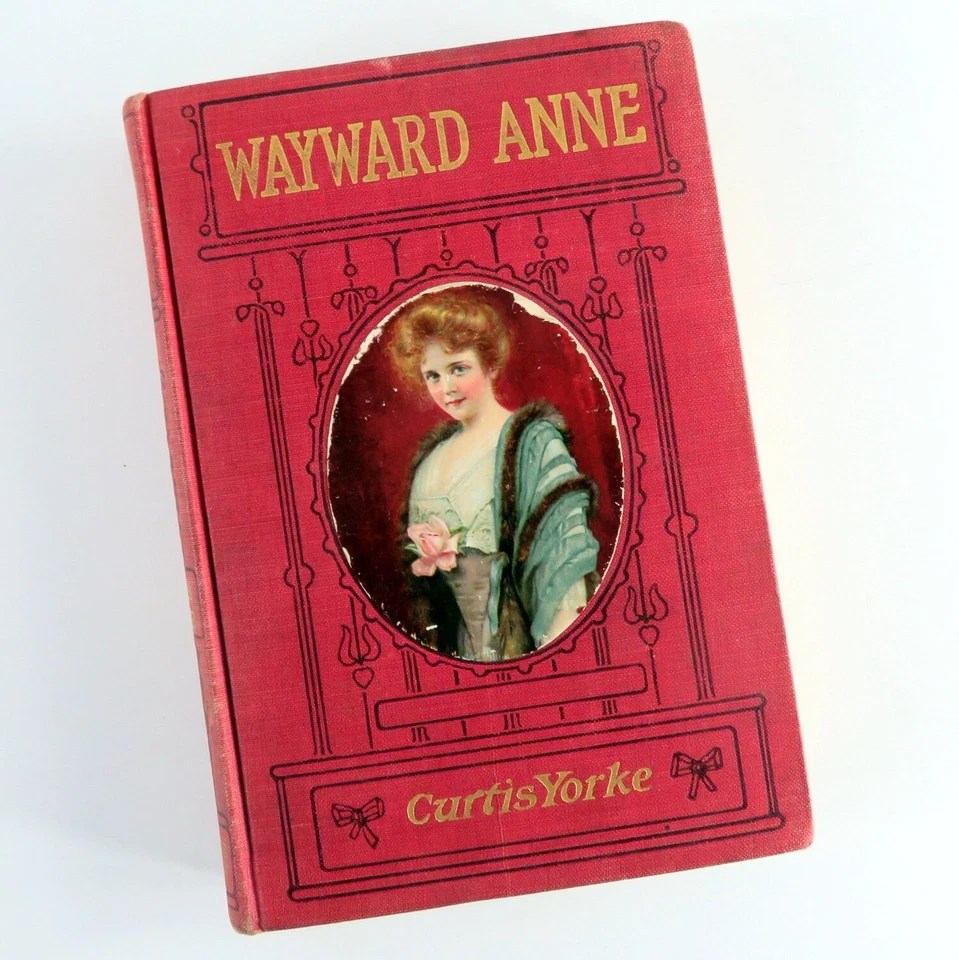
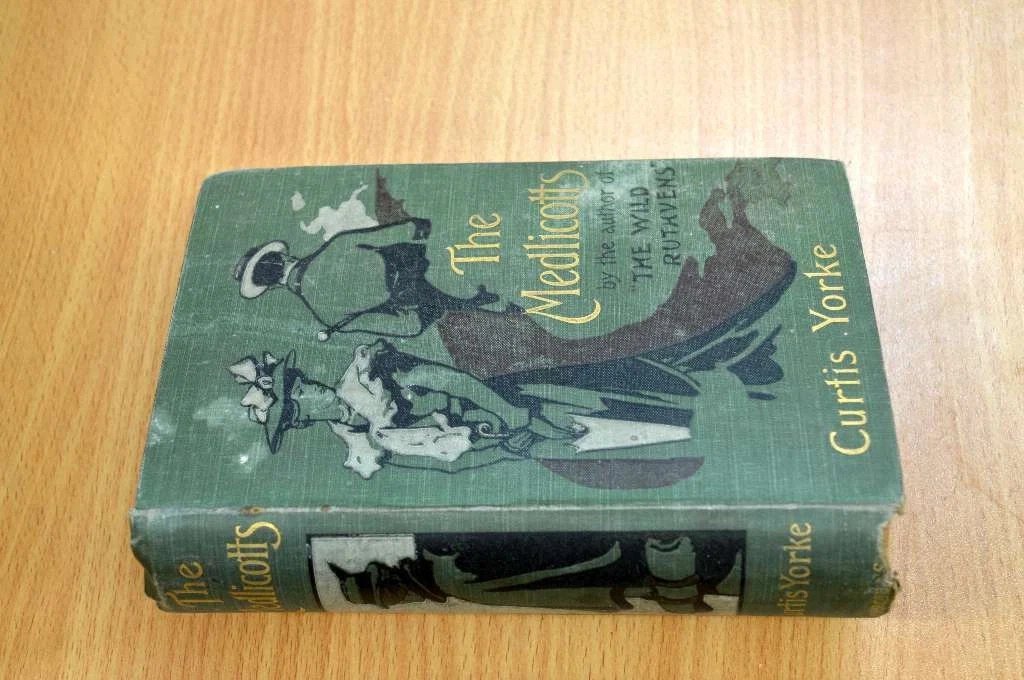
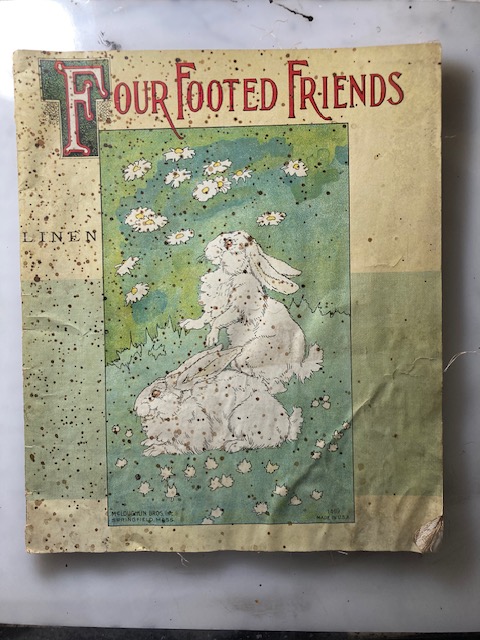
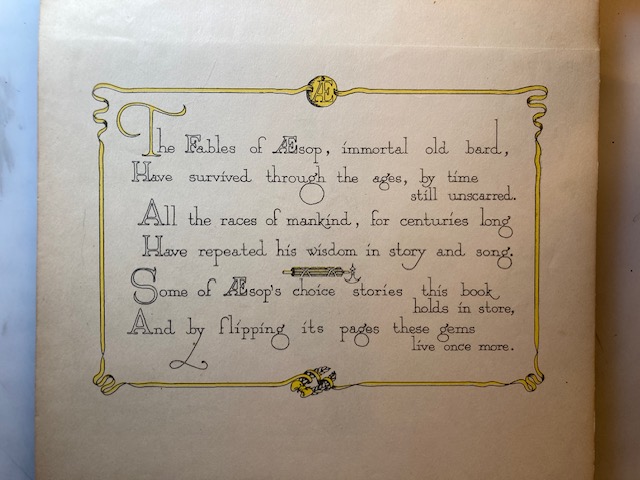
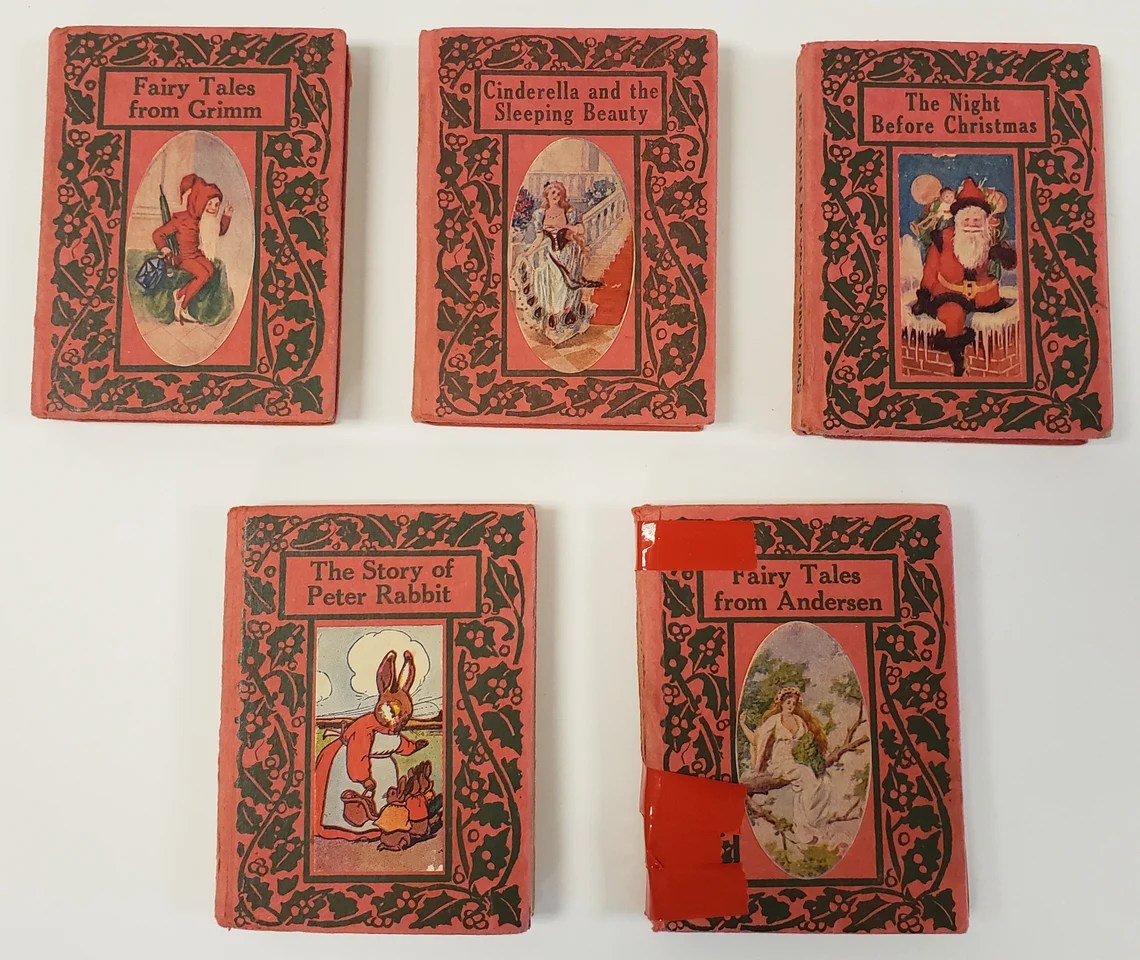
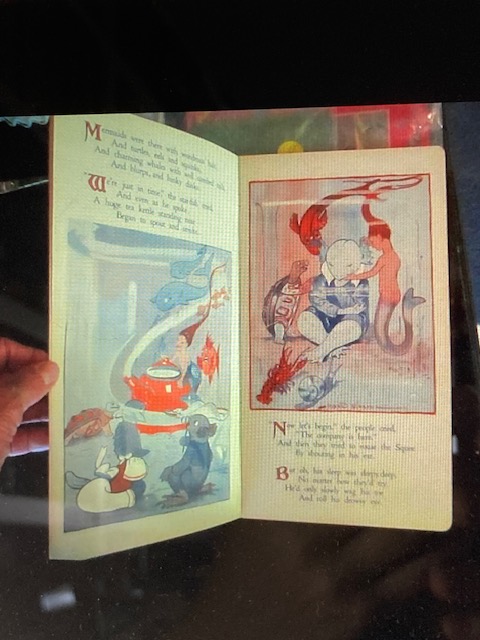
All this to say, I don’t want to give Four Footed Friends short shrift and will attempt to do it justice this morning. We picked it up at the 26th Street Flea market two weeks ago. The cover is in unfortunate shape and it is a bit off my usual beat, but Kim and I are both suckers for good illustrations and this has a few inside. I decided that for a few dollars I wouldn’t leave it there and I bought it along with a couple of photos which may be shared in a future post.

I used to buy more children’s books. I think just space constraints in general keeps me from being a real player. I started back when I was still doing more drawing. (I thought about that is bouncing around in my head so maybe more to come on that too.) I would pick them up at library sales and flea markets and use them for reference.

Somewhat tatty cover but for its age and wear not really in bad shape.

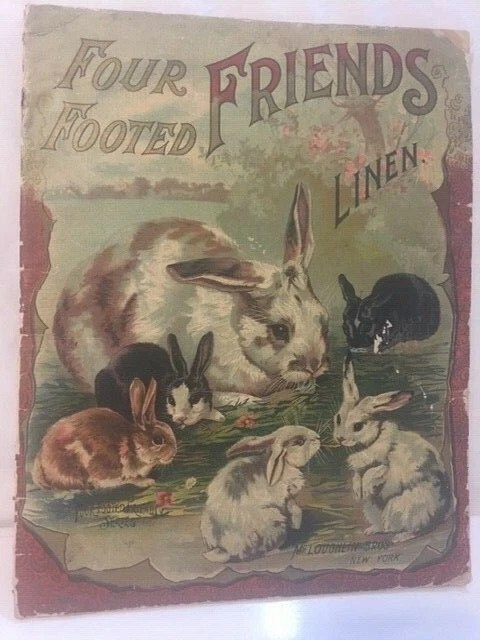
As far as I can tell this is a somewhat later version of a book by the same company (McLouglin Bros. of Springfield, Mass.) – from the 1890’s, also in linen but with a full color cover. Ours must be a bit later but there is no date. It seems like it could be a reprint from the teens. It has water damage what I thought was foxing but now I am thinking something may have actually splashed on it.

A copy of the earlier version.

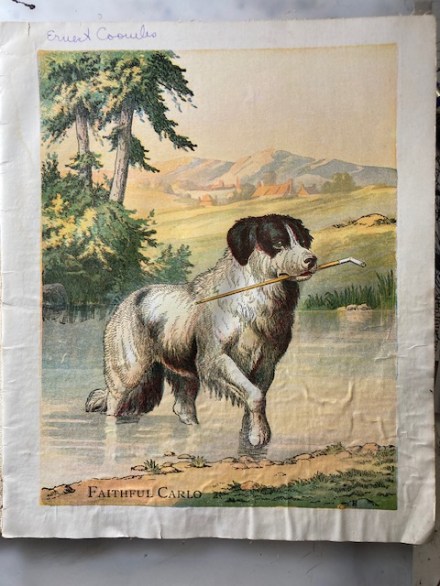
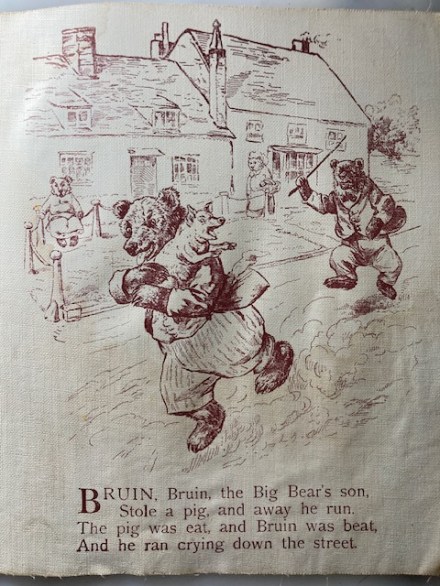
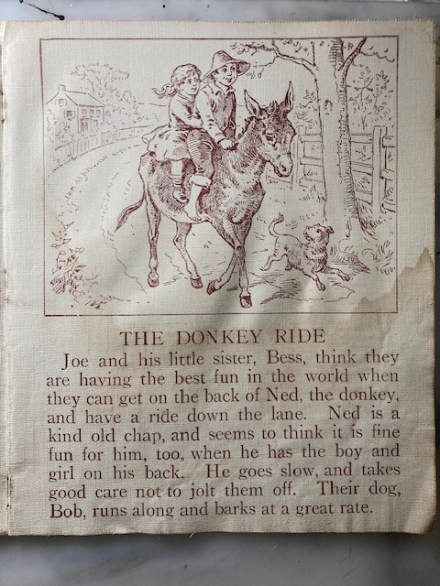
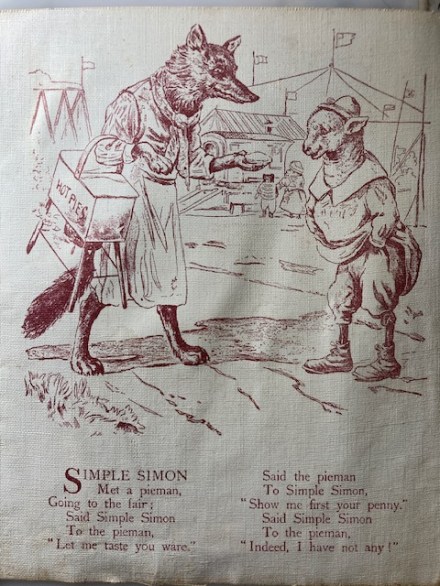
My copy starts right in with illustrations and on page 2 where Faithful Carlo, is featured. A prior owner, Ernest Cooueles (?), has written his name in a neat if childish script. This handsome pooch is holding what might be a riding crop – not sure why. Maybe this is originally from another book.

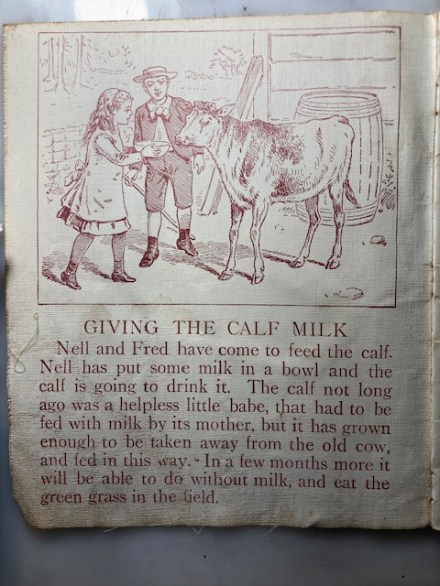
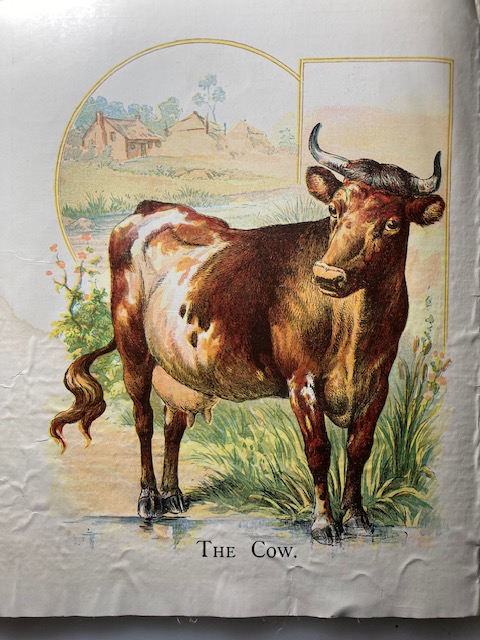
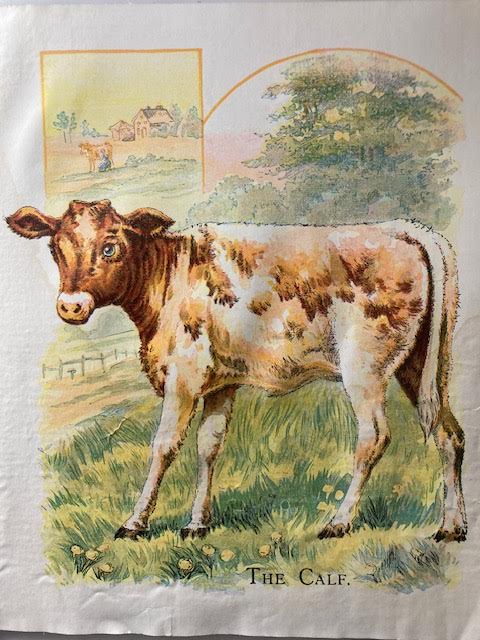
Some of the illustrations are line drawings, although several are also in color. Admittedly the color plates don’t seem to correspond to a storyline and have just been dropped in. The Cow was definitely in the earlier book. There is a mix of a few compact nursery stories too.

Loose page left in the book.

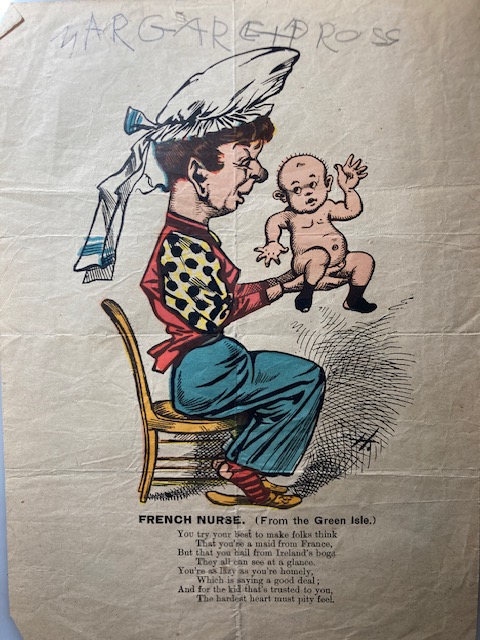
A single additional page was included, French Nurse. (From the Green Isle.) This is a much more ironic illustrated rhyme which seems a bit odd to have felt compelled to include. Someone has printed, in a less legible hand, Margaret Ross.

You try your best to make folks think
That you're a maid from France,
But that you hair from Ireland's bogs
They can all see at a glance.
You're as lazy as you're homely,
Which is saying a good deal;
And for the kid that's trust to you,
The hardest heart must pity feel.

And there you have it – Pictorama for today!

More Autumn in New York: Catching Up

Pam’s Pictorama Post: Yesterday I devoted my post to writing about work and specifically about the dog event fiesta that September has become. My job, which is on a fiscal year ending on December 31 (I do not recommend this), will increase in volume, stress and energy required, continuously increasing through our gala in early December and on through the last week of the calendar year until I fall over on New Year’s Day. However, returning from our summer weeks in New Jersey is more than adjusting to increasing work, it is the adjustment back into our lives here at the official location of Deitch Studio – a physically much smaller epicenter of our operation.

Cookie and Blackie are generally very relieved that we have once again returned them to their private abode here. While there is novelty with the twice yearly trips to the shore house, their discovery that other cats exist in the universe aside from them (not a welcome thought), they prefer the one room here where they rule unimpeded.

Blackie and Cookie in an uneasy bed truce yesterday.

For those readers who remember that Blackie was limping before we left (resulting in an emergency trip to work on Saturday) his limp has improved but not gone away. The trickiest jumps are a bit beyond him (the pedestal sink in the bathroom to his chagrin – he needs us to lift him in for a drink), but his jumping gradually improved in New Jersey. He and Cookie are 14 this year and perhaps this is a bit of age showing. If he didn’t hate the vet so I would take him to my friends in rehab and let them have a look or perhaps do some acupuncture on it.

Meanwhile, when we return they spend the first weeks hating each other like they never saw the other before. Blackie wasn’t allowing Cookie on the bed which annoyed her but she was so happy to return to her perch on the top of the couch by the windows she ignored it until it blew over in the last day or so.

I probably bought it because it is pretty but looking forward to reading it soon too.

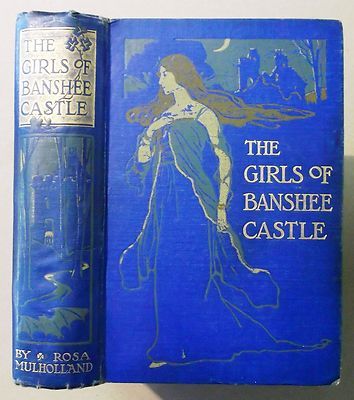
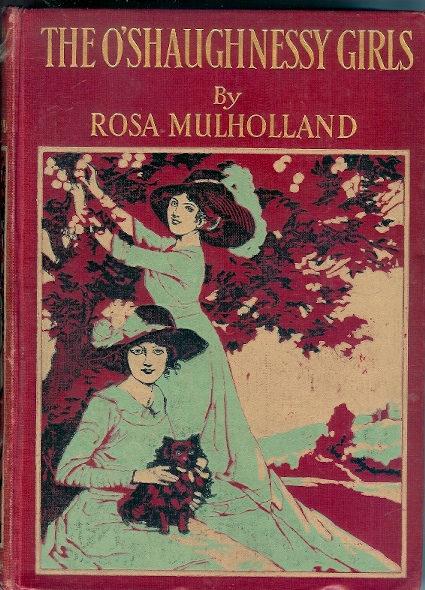
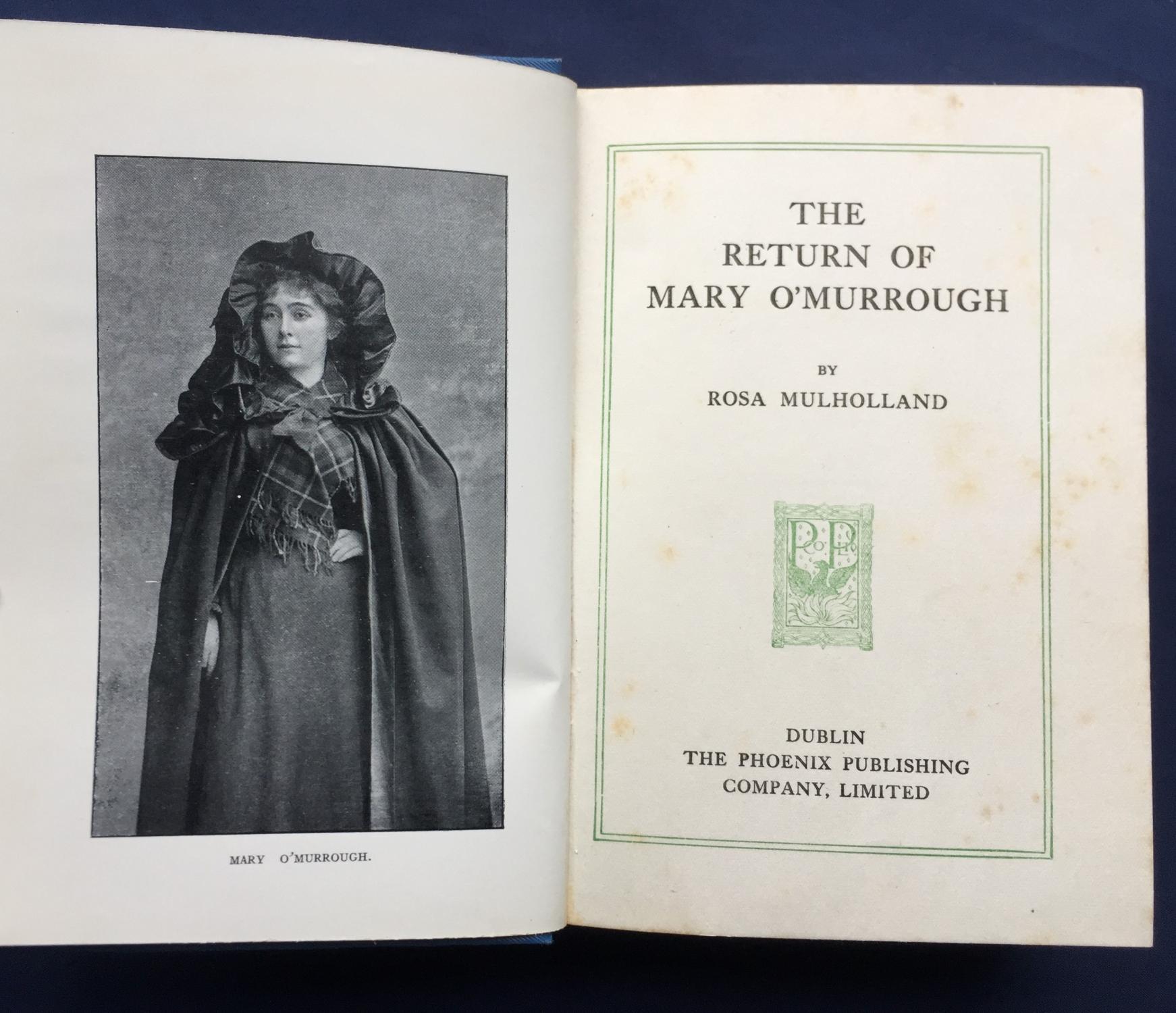
Books! Despite leaving a pile in New Jersey, many seem to have found their way back here too. As much as I have embraced reading electronically where I can (all new novels and what I can find on my list for 19th and early 20th century writers) I must say somehow a stack of books has built up next to the bed. They are mostly one off old novels and volumes of short stories from the 1910’s. If I find any new leads into interesting writers I will let you know. The most recent Rosa Mulholland book acquisitions reside there, while several earlier volumes remained in New Jersey. (Earlier posts on her novels can be found here, here and here.)

I am enjoying a book of short stories, Nancy’s Country Christmas, 1904, by someone named Eleanor Holt which I purchased on one of our trips to the Antiques Annex. Unfortunately this volume seems to be her only published effort aside from a magazine serialization or two and the internet has yielded little. I would read more of her if there was more to read.

Very few of the books I buy still have their covers!

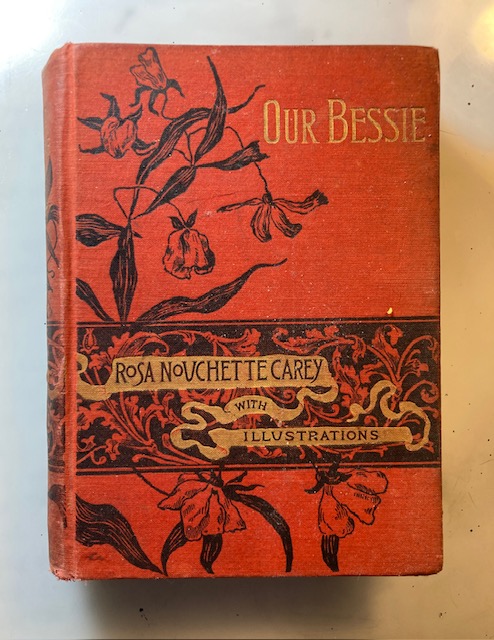
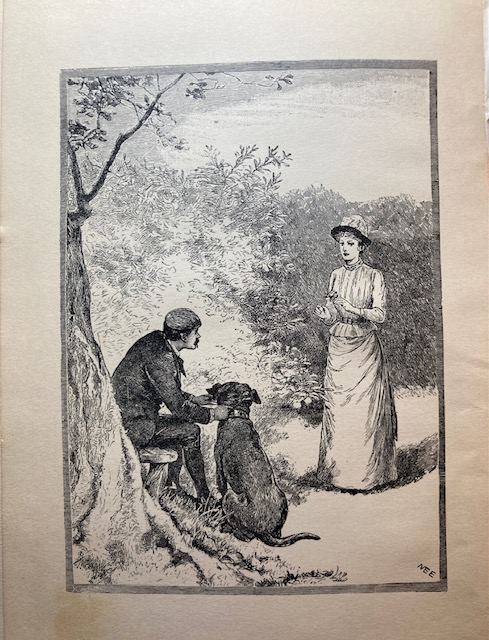
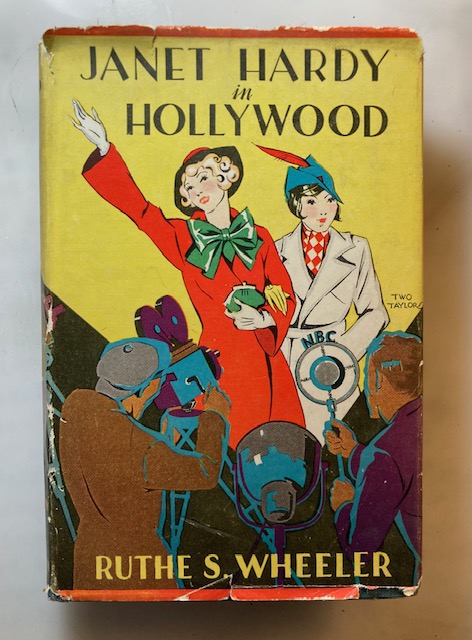
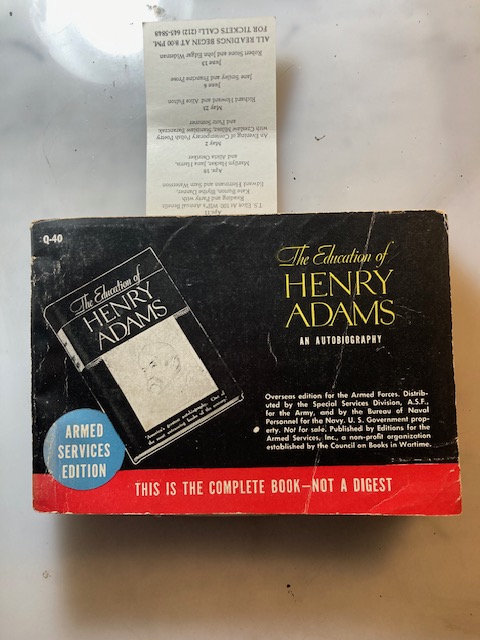
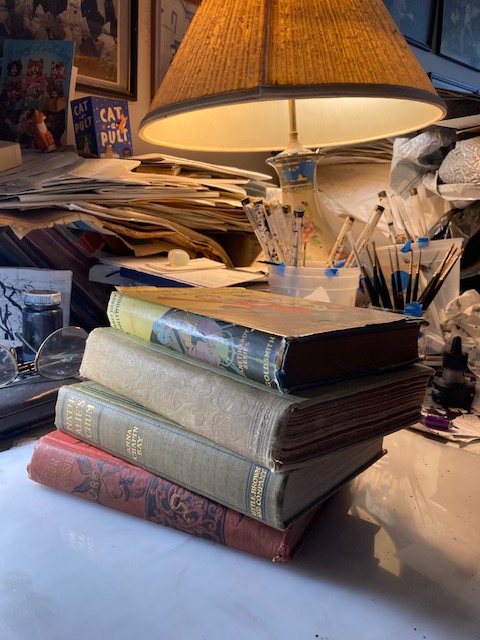
In the pile are: Natalie’s Chum by Anna Chapin Ray, 1905; Our Bessie by Rosa Nouchette Cary (nicely illustrated) with no publication date but a note on the flyleaf of 1896; and a later addition of Janet Hardy in Hollywood by Ruth Wheeler, a series book from 1935. To his credit I think Kim is reading his way through things largely purchased and left to pick back up in New York. His nose has been buried in The Education of Henry Adams for a while now since we got back – in an interesting horizontal paperback form designed to distribute to GI’s. He read reprints of the Superman saga during some of his vacation in New Jersey but luckily for our limited space, was able to leave them at the house there.

Kim’s reading.

I am a rather voracious reader when I get going and I have read a number of contemporary novels recently as well. I generally review them very briefly on Goodreads if you ever wonder what I am reading when I get into the 21st century. I am partial to books about time travel and for example highly recommend The Ministry of Time (here) and, slightly different, The Life Impossible (and here). I am a fast reader and the books pile up so I am glad they are largely electronic. Some are so splendid though I do miss having physical copies. I also miss the ability to hand my copy of an excellent book over to a friend.

Stack of books among those next to the bed right now.

Aside from digesting stuff and somehow sorting it into the apartment, there is so much to do as there is for all of us in this back-to-school time of year. I am struggling through the last of the paperwork for my mother’s estate (having saved the worst for last I am afraid; the transfer of retirement accounts is ferocious), the apartment here needs attention (plumber anyone? I can’t seem to get a call back and our toilet needs to be replaced), and soon the weather will inform me it is time to turn the closets over and a long delayed need to weed through them. I have made two fall clothing purchases and both are brown which is different for me – we’ll see how that works out. I will say we have very limited closet space and it is that moment when summer and fall clothes are cheek to jowl. My list for what needs doing is long!

Adjusting to our somewhat miniscule kitchen and away from my garden means a different kind of cooking – more just assembling than cooking really. It took a week or two but I seem to have reacquired the skill set. Kim and I have remembered the sort of dance required for both of us to be in there – let alone when the cats want to be with us! However, soup time is upon us and I am mentally gearing up to schedule in my weekly soup making. (Recipes for soups can be found in prior posts here and here.)

THE PORDENONE SILENT FILM FESTIVAL 2025 – 44TH EDITION: SPECIAL EVENTS AND RETROSPECTIVES

The super charged energy of fall will help – street festivals, dates to see friends, new exhibitions. Even for us early film fans there are options – a favorite, the Perdenone Silent Film Festival, is the first week in October and broadcast online with a subscription. (Information about the festival can be found here.) Next weekend I travel back to New Jersey for some appointments there. Mum season will have begun (I like a good couple of mums on the front steps – can’t compete with Park Avenue shown above though) and I will start to turn my thoughts to getting the garden ready for winter and the eventual holiday season there.

This ended up being longer than planned so thank you if you stayed with me to the end! Also a shout out to all of you as Pictorama crossed the 500 member line last week. Thank you!

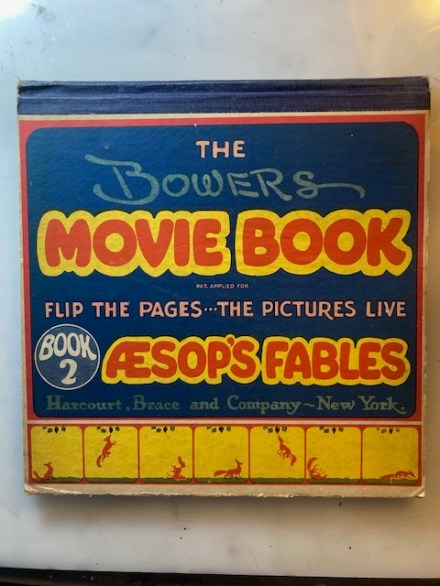
The Bowers Movie Book: Aesop’s Fables

Pam’s Pictorama Post: I have an unusual nugget of animation history today. It came to my attention on a search for Aesop’s Fable dolls which I have put out in the world. I asked for more photos because only a few pages of the inside were shown and I was afraid it was just the covers and a couple of pages. The seller quickly replied. In the end I offered a bit less than he was asking and he agreed. It was still a bit dear but something about it appealed and I went the extra mile to purchase it.

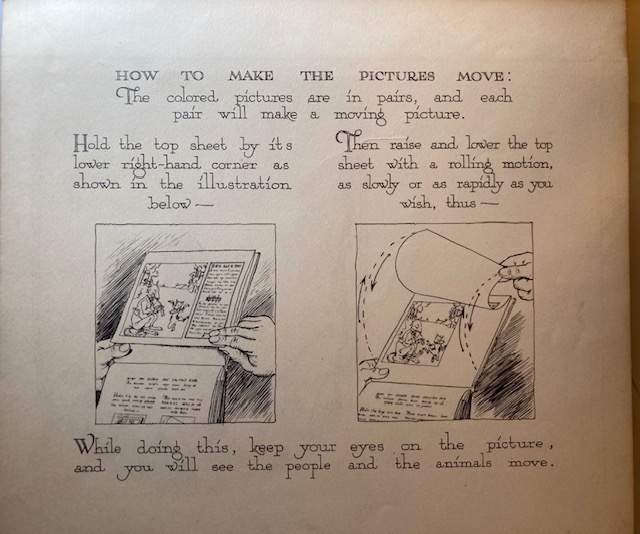
The instructions.

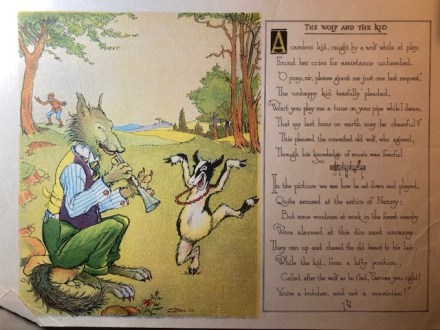
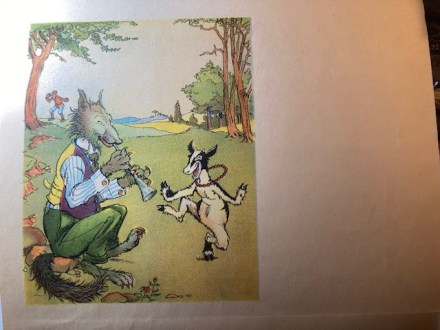
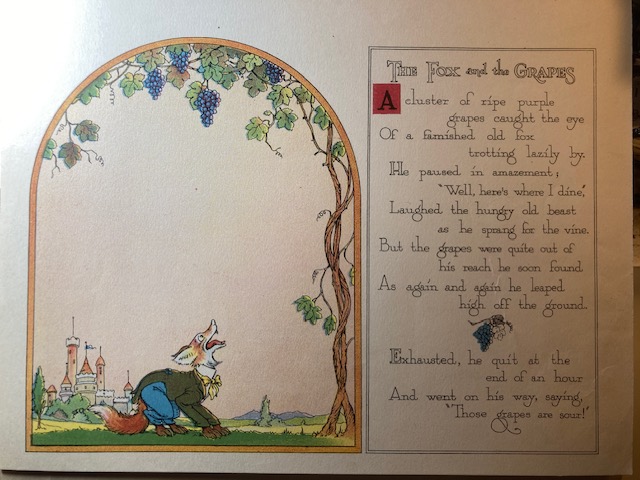
In reality the book is more interesting even than it appeared at first. Every illustration has a second illustration under it and you are instructed to (gently, especially now) flip to the second page and you see “movement” between the two. It is rather ingenious and simple – a different type of flip book. (Flip the Pages…the Pictures Live.) The book is super worn and shows evidence of much use, flipping the pages. Every other page is several more short tales which are illustrated but do not flip.

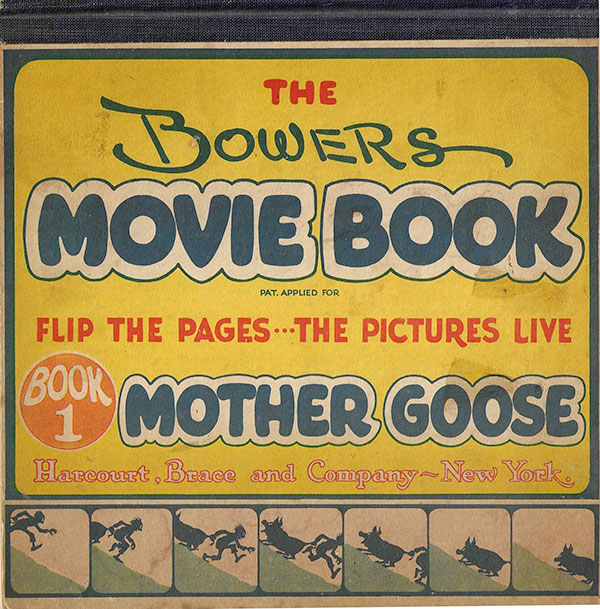
It was published by Harcourt, Brace and Company of New York and we can see it was Book 2. A search on the internet shows that Book 1 was dedicated to Mother Goose which looks at least equally interesting. In the back we see that there was a Book 3 (which I now really want!) about the circus which seems to feature a very Koko the Clown looking character! Book 4 was called Once Upon a Time. These volumes are somewhat rarified and I can only find evidence of this one and Book 1 having been recently available for sale. There are eight pages in its entirety, counting the fold-out double pages as one.

One of my attempts to show you how flipping the page looks.

The artist/s do not appear to get credit for these so I am assuming that Charley Bowers is the artist and perhaps the writer as there are no other credits for the book. On the inside cover there is a 1923 copyright and W.F. Powers Co. On the cover we see that there is a Pat. Applied For.

Charles (Charley) Bowers started his animation career working on the silent Mutt and Jeff cartoons. By the early twenties he moved to Educational Films where he made slapstick comedies, some shorts featuring Rube Goldberg creations and a mix of animation, stop motion and live action short subjects. He is prodigious in his output through the twenties and does a stint with Walter Lanz in the thirties. At the end of his career he moves to Wayne, New Jersey and drew cartoons for the Jersey Journal. Sadly at the end of his life arthritis cripples him and he instructs his wife to execute drawing the cartoons under his instruction.

It is also noted in his bio that he was known for illustrating children’s books although the Wikipedia article mentions this for his post-film career and these were clearly made in the thick of it. He was largely forgotten until a Lobster Film dvd came out in 2004 and revived interest in him. It is still available however you will pay up. (It can be found on Amazon here or Flick Alley here. I would poke around eBay for a slightly better price.) As a result, not many videos are posted online, but one I offer is available here.

Not in the Pictorama collection.

Clearly a bit of a mechanical genius this is a tiny salute to Charles Bowers of early animation fame. This book is a remaining concrete tribute to his ingenuity.

The Cat’s Party

Pam’s Pictorama Post: So today I take us back to the world of cat ephemera with a bang today. This little treasure came to me via a new dealer who I imagine I may see a lot of, Eldritch Oculum Antiques. (The website can be found here although I found them on IG as @eldritch_oculum_antiquarian.)

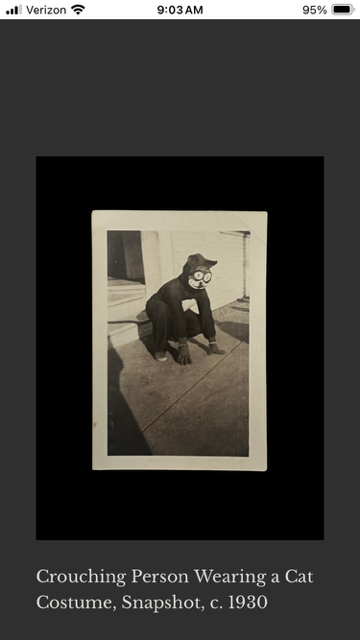
Our story unfolds, as it sometimes does, with an item someone (I believe it is my IG friend and gad about @fatfink) gave me a heads up about but had quickly sold. This was a photo of someone in a Felix costume that I would have loved to have scored for my collection – not least because I appear to own other photos from the same session!

Longstanding readers may remember a very early and popular post of these tiny photos I featured in the early days of this blog. I seem to have bought a few and then found more from a different dealer. When I told the story to the folks at Oculum I misstated that they came from Seattle but I just read my own post and it says that the came from Portland, OR – right where these folks are located. Portland seems to be an odd El Dorado of early Felix photos and I have that post and a few others devoted to this which can be found here, here and here!

Not in Pams-Pictorama.com Collection – sadly!
Pams-Pictorama.com Collection

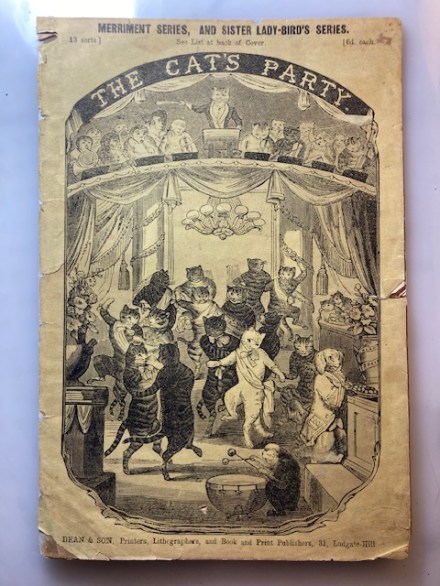
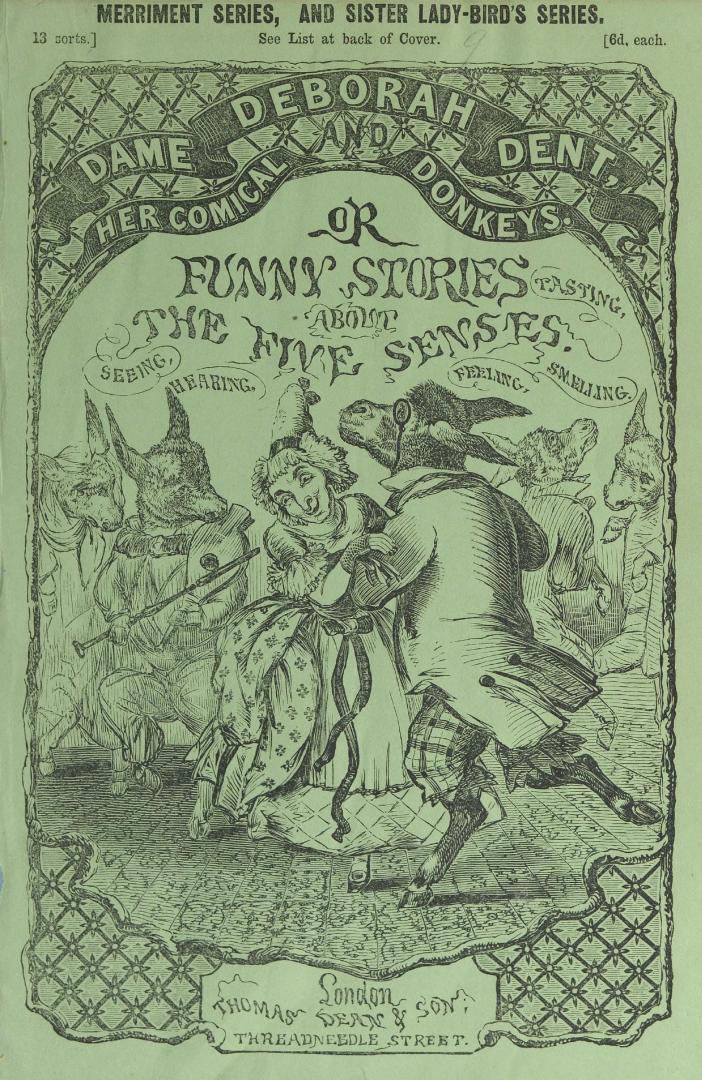
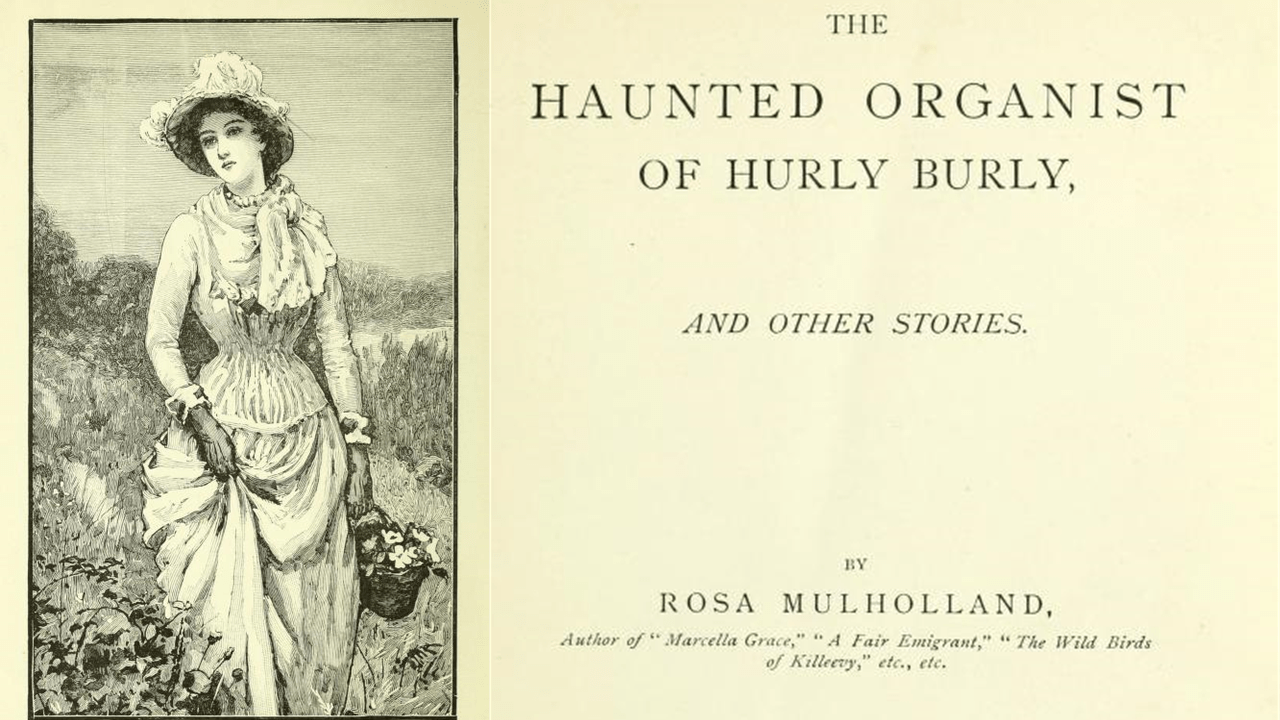
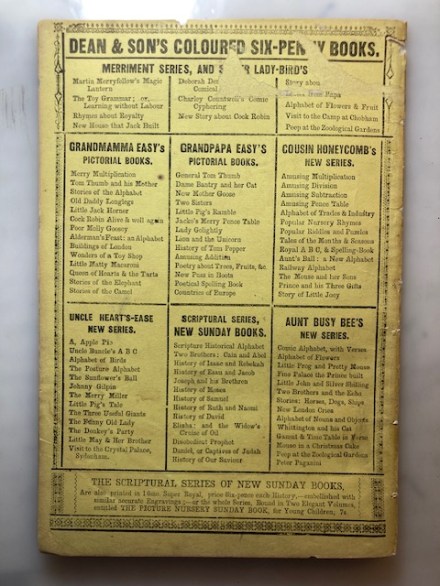
However, this was clearly an account I wanted to follow! It wasn’t a month later when I spied this gem and snatched it right up. This is an unusual piece and further nascent searching on the internet only turned up two other editions of the Merriment Series, and sister Lady-Bird’s Series. One edition I did find, shown below, devoted to Funny Stories, and the other on the Internet Archives (see my Rosa Mulholland post of last week!) which is a scan of The Alphabet of Flowers and Fruit.

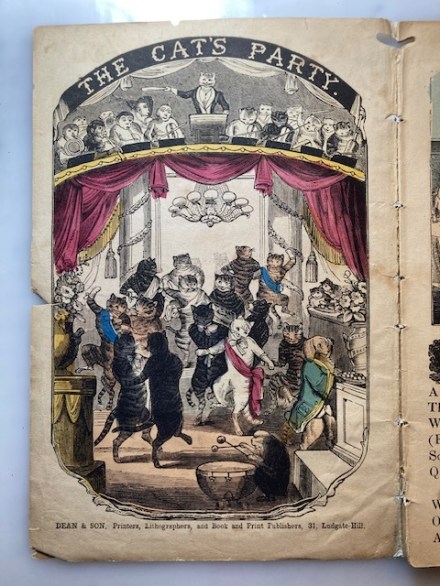
It was published by Dean & Son, Printers, Lithographers, and Book and Print Publishers, 31, Ludgate-Hill. This company, founded in 1800, became known for children’s pop-up books in the latter part of that century. They are noted for publishing into the mid-20th century but it is unclear to me if they exist today.

From the Ontario Digital Archive.

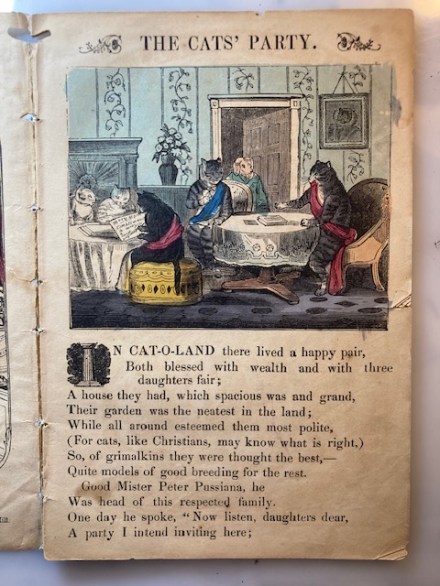
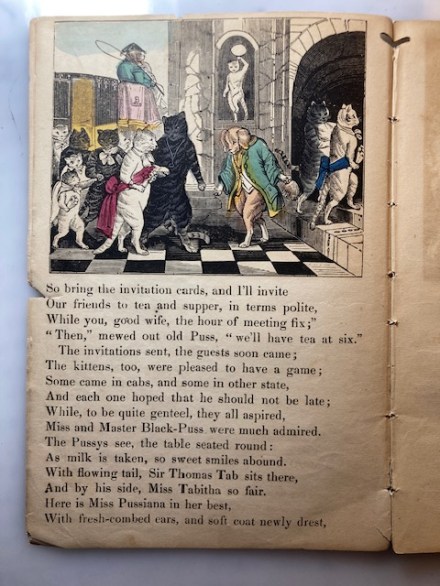
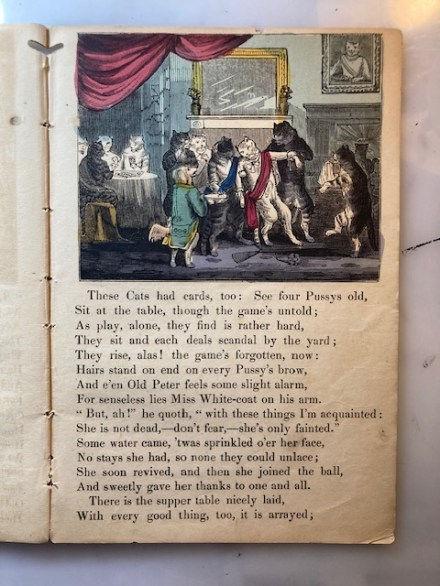
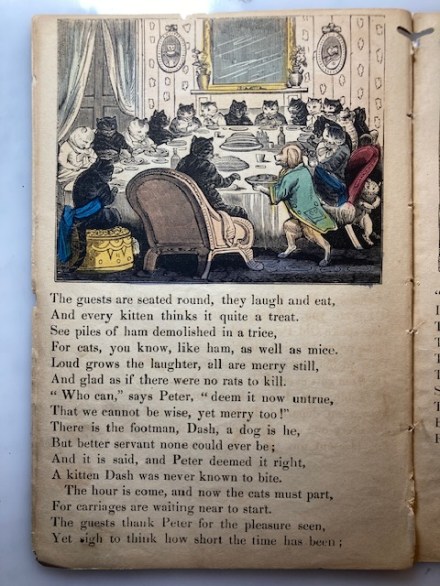
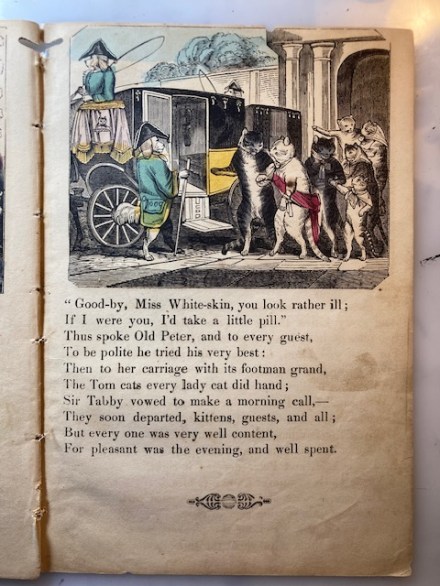
So, to get to the heart of the matter, this little missive is the tale of a party in Cat-o-Land, where cats rule and dog servants in livery are footmen and butlers. (Although the monkey playing the drum on the cover is notable as well. A careful look at the top shows one half of the orchestra as monkeys and tthe others as cats – one with his bow in the air and dropping his fiddle.) This is a jolly affair hosted by Mister Peter Pussiana.

It is written entirely in rhyme – …While all around esteemed them most polite, (for cats, like Christians, may know what is right/So, of grimalkins they were thought the best, – Quite models of good breeding for the rest… No author claims credit. Printed oddly, a pamphlet (9.4″x 7.4″), it has blank pages inserted throughout – something having to do with the printing? It is in fair condition, with the binding still tight but worn with dirt and folding and cuts or tears on some pages.

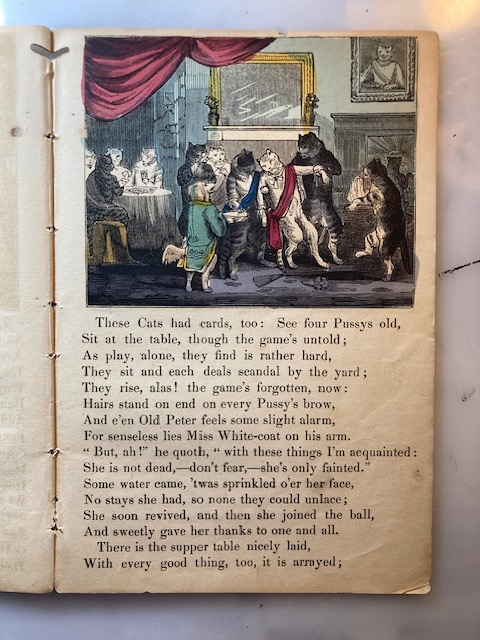
Fainting after hearing a bit of gossip scandal. I like the art!

While the cover is without color (although the first page is the cover with color), the rest of the illustrations are in a sort of limited color, looking applied on in subsequent layers. The backcover has a rather tantalizing list of other titles in the series that were available. Every thing from The Toy Grammar; or Learning without Labour to Mouse in a Christmas Cake. There is no publication date.

The tale takes us thoroughly through the evening and its entertainments – from dancing and eating to playing cards and gossiping. (Some scandal so salacious that Miss White-coat actually faints!) One of my favorite pages is the company around a large table eating, kittens lurking behind chairs, family portraits on the walls and a dog serving.

I share it with you in its entirety below to flip through – blank pages deleted. Pay special attention to the art on the walls and sculptures!

Narcissa’s Ring: More Mulholland

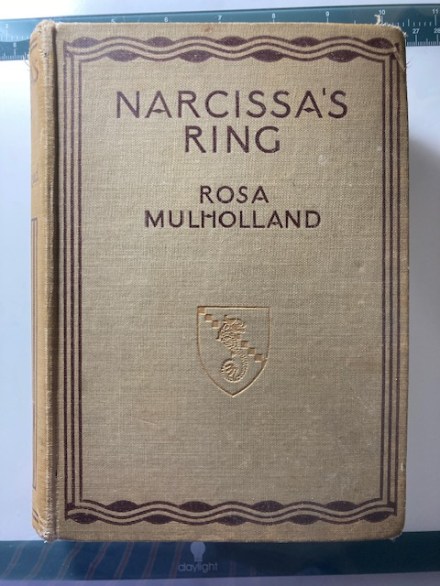
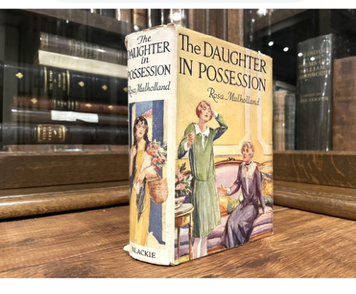
Pam’s Pictorama Post: I did not plan to post about Rosa Mulholland so soon on the heels of my most recent post (found here if you missed it just last week and the first one about her books here), where I zipped through a number of her works, mostly early, that I had read. However, Narcissa’s Ring, was a recent acquisition and a later work which kind of knocked me off my chair. As it happens, I was also lucky to find an internet site with a number of her books – including The Daughter in Possession: The Story of a Great Temptation. Both of these interesting works were published originally in 1915 and’16 respectively and they are worth note and comment while they remain fresh in my mind.

Before I get to them, a heads up about where I found The Daughter in Possession which I had not even seen copies or mention of for sale or otherwise. A site I have used occasionally in the past called Internet Archive (find it here) turns out to have a number of these hard to find volumes available for reading online. The did not come up in a general search for her books initially and it wasn’t until I thought to look there that I found them. This is very good news!

The somewhat bad news is that it is not the easiest site to read a long book on – I have had trouble saving them to my “account” although perhaps it is just most easily done on a computer rather than a phone or iPad. I am still working that out. Actual volumes are scanned for every page which is a charming way to read them – inscriptions and all in some cases. It also means if the volume was illustrated (which these virtually all were) you get those too. I am thrilled to be able to offer a place where some of these are available online, not to mention for free.

As far as I can tell, the Internet Archive exists out of California and I have not attempted to tap it for the many, many other categories it lists (everything from television shows to Russian literature). Of course I am curious about film and assume that, like the books, the films archived there may not show up in more general internet searches although may for specific books. I will need to send them a contribution as they have done great work in making some really obscure volumes available.

I had not in fact had I heard of Narcissa’s Ring either until I stumbled across a copy on eBay for sale here in the US. (I search for new ones online on a regular basis and eBay seems to pop for one periodically. The shipping from the UK where many of these reside makes the cost untenable.) It is the real find. In 1916 Mulholland was 71 years old and from reading this she may have in a sense been at the height of her prowess as a writer. While the style remains the same and some of her favorite tropes (romance, class divisions, astronomy) remain intact she goes for a full on sort of mystery in this now favorite novel.

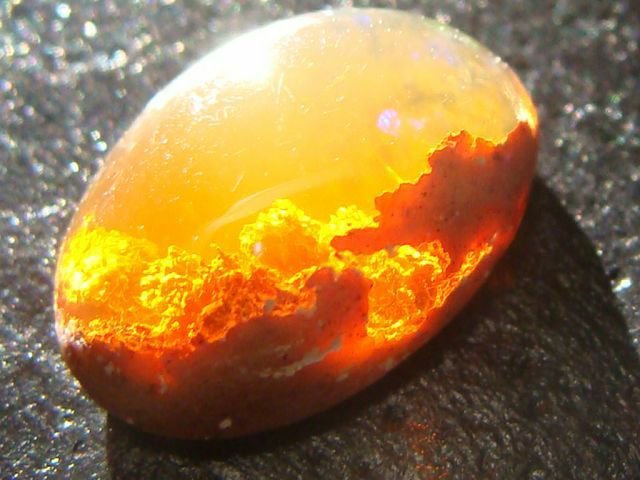
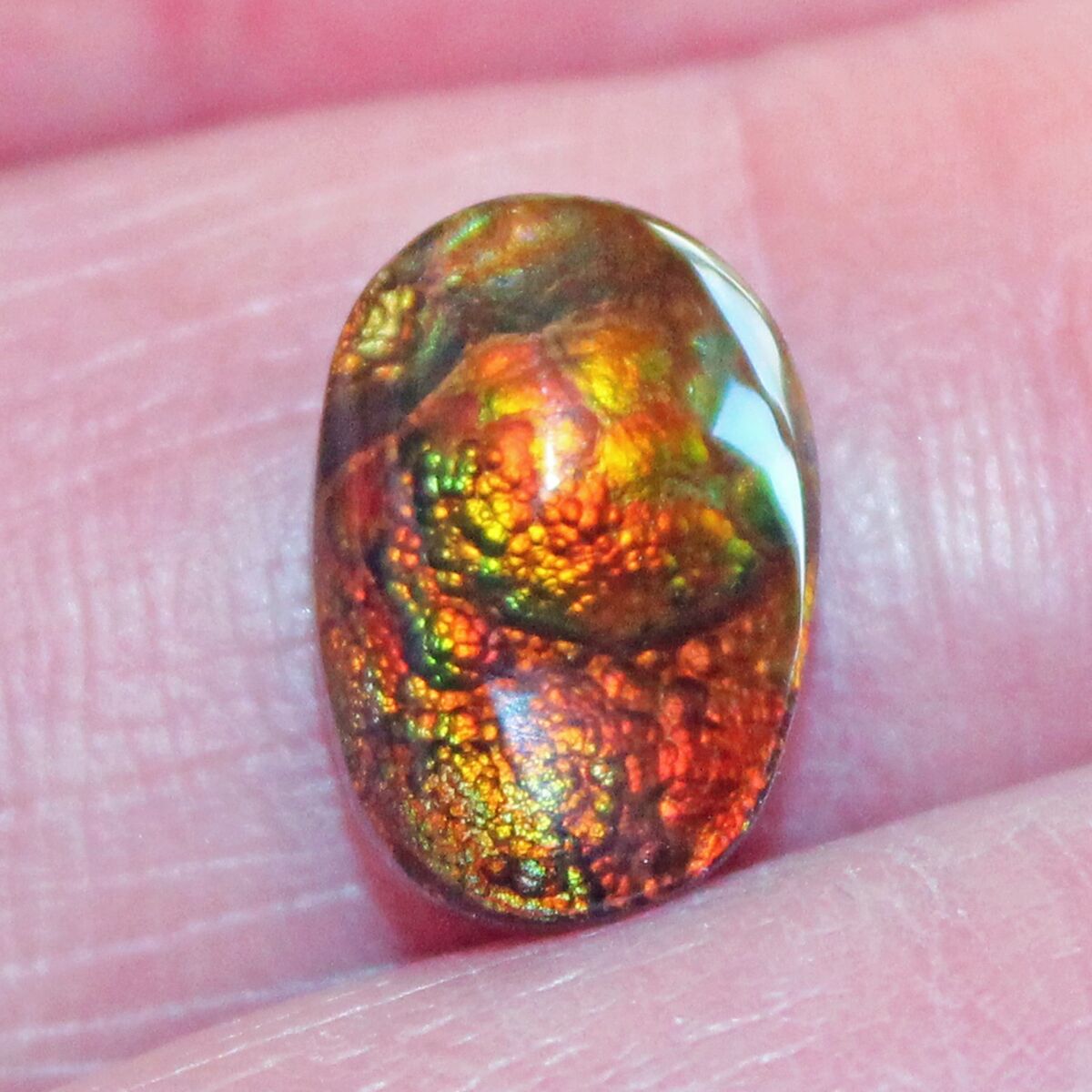
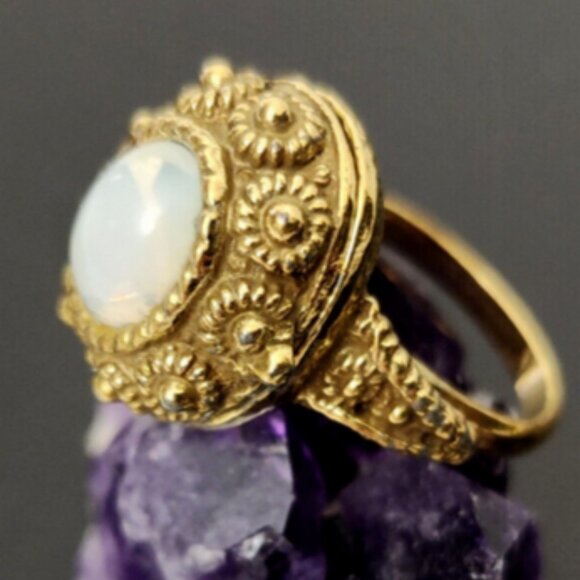
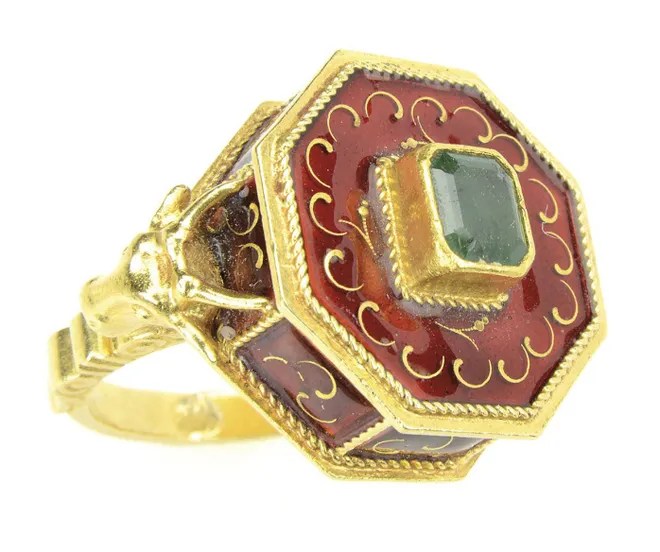
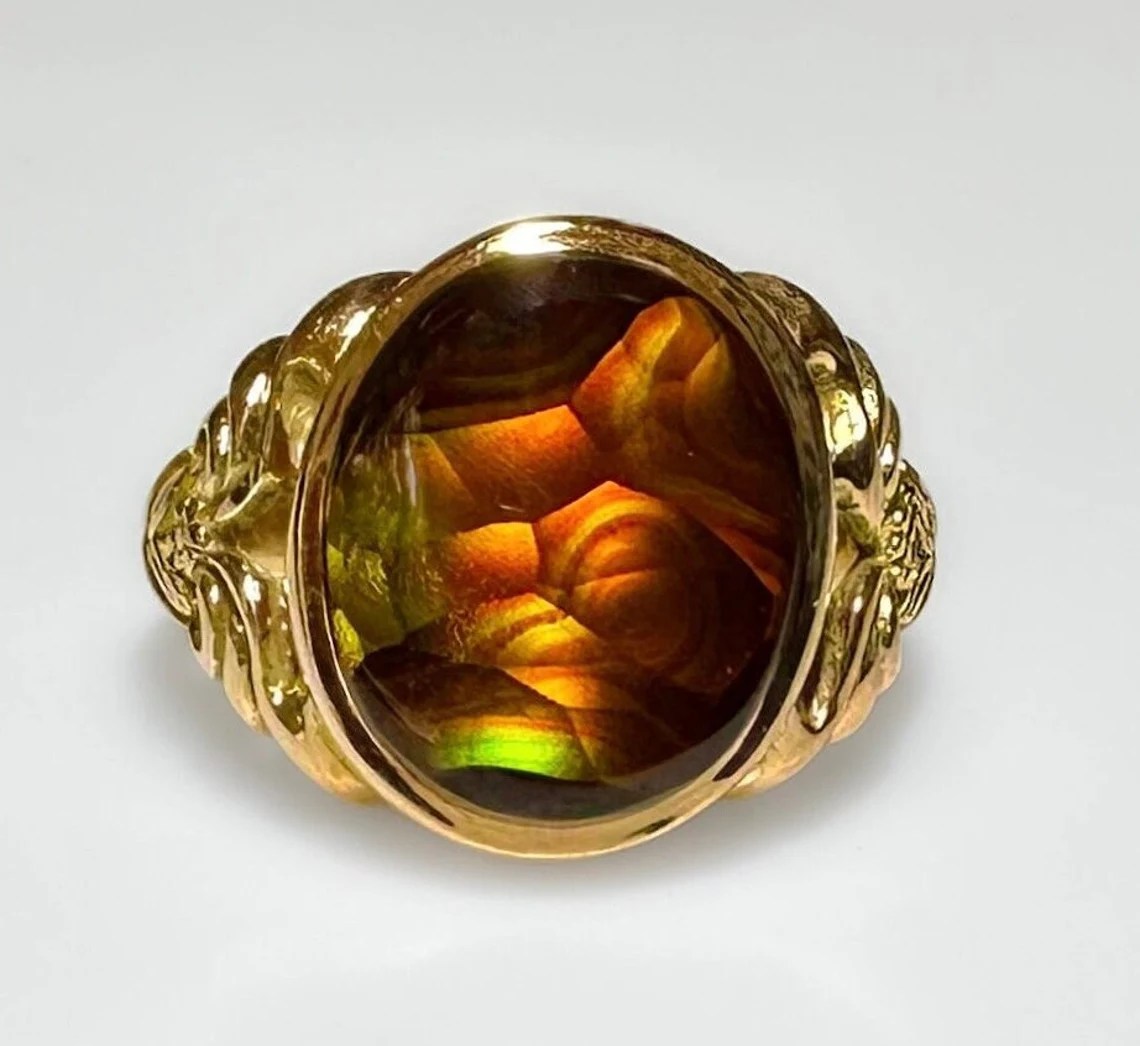
As the story opens we find a young Russian teen with a penchant for chemistry in London, before long he is shifted to her favored locale of Ireland, but not for long as he is chasing clues to rescue his father from a life sentence for murder in Moscow. The search leads him to a certain perfume found in an antique ring – the sort which might have also stored poison but instead house a bit of sponge or other substance scent would be added to and worn. The scent in the ring never dissipates. It has a cabochon of glowing red stone on it – one that takes on an almost supernatural glow in certain lights. (Two stones to engage your imagination above.)

Mulholland leads us on a most wonderful chase through Britain, a sojourn in Egypt and ultimately the Moscow of the day. Because Mulholland is writing about these places as they are being experienced at the dawn of the 20th century there is a more than usual time capsule quality to her record of what these places were like at the time – not so much with her usual eye to recording what she knows may soon drift away in her native Ireland, but with more of a sense of the here and now in these places.

This slightly cheesy version kept coming up in my searches. The stone is really beyond the beyond!

I wouldn’t dream of spoiling the intricate plot but am here to say that it is a corker and I would have to put it at the top of my list of her books!

It also left me wandering the internet looking at these rings – presumably there was one in particular which must have inspired her. The concept goes way back to the Middle Ages and all sorts of examples still abound. As for glowing fire stones there are many – from fire opals exotic agates.

Immediately on the heels of Narcissa’s Ring I was able to hop back a year for The Daughter in Possession: The Story of a Great Temptation. (It’s a bit of a title, right?) This is an interesting lead into Narcissa’s Ring if you are considering her oeuvre as a whole because there is a developing sense of mystery and plot in this novel which is a prelude to the other.

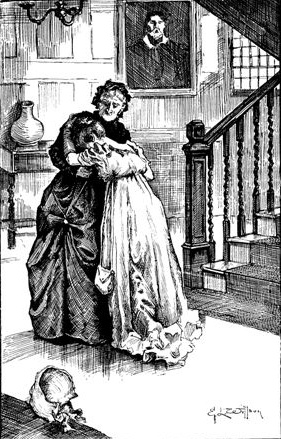
Illustration from the online version of The Daughter in Possession.

The Daughter starts off with a favorite baby rescued after shipwreck set up (see Marcella Grace for another example) but turns into a multi-faceted plot following several lives as they set off together in one place and diverge wildly before all coming back. Like Narcissa’s Ring, locations in Ireland are briefly paid tribute to but the majority of the book takes place in London and then Europe, largely France which is a bit of a surprise. (There is an interlude in Toledo and sometimes I feel like we are treated to a travel log of her globetrotting.)

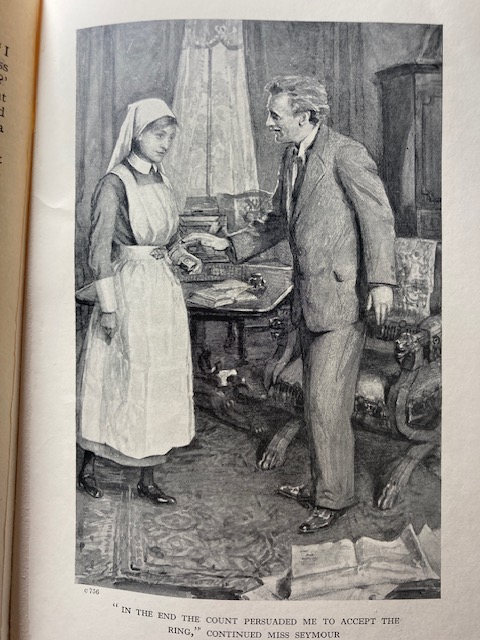
Illustration from Narcissa’s Ring.

We have a narrator for part of the story who is a bit unreliable, and we don’t quite know how the ending will or won’t surprise us. Like Narcissa’s Ring the trip is definitely worth the journey here. I would not rate it quite as highly but must say that she was going full throttle with her writing powers at the end of her life and seems to have only continued to improve.

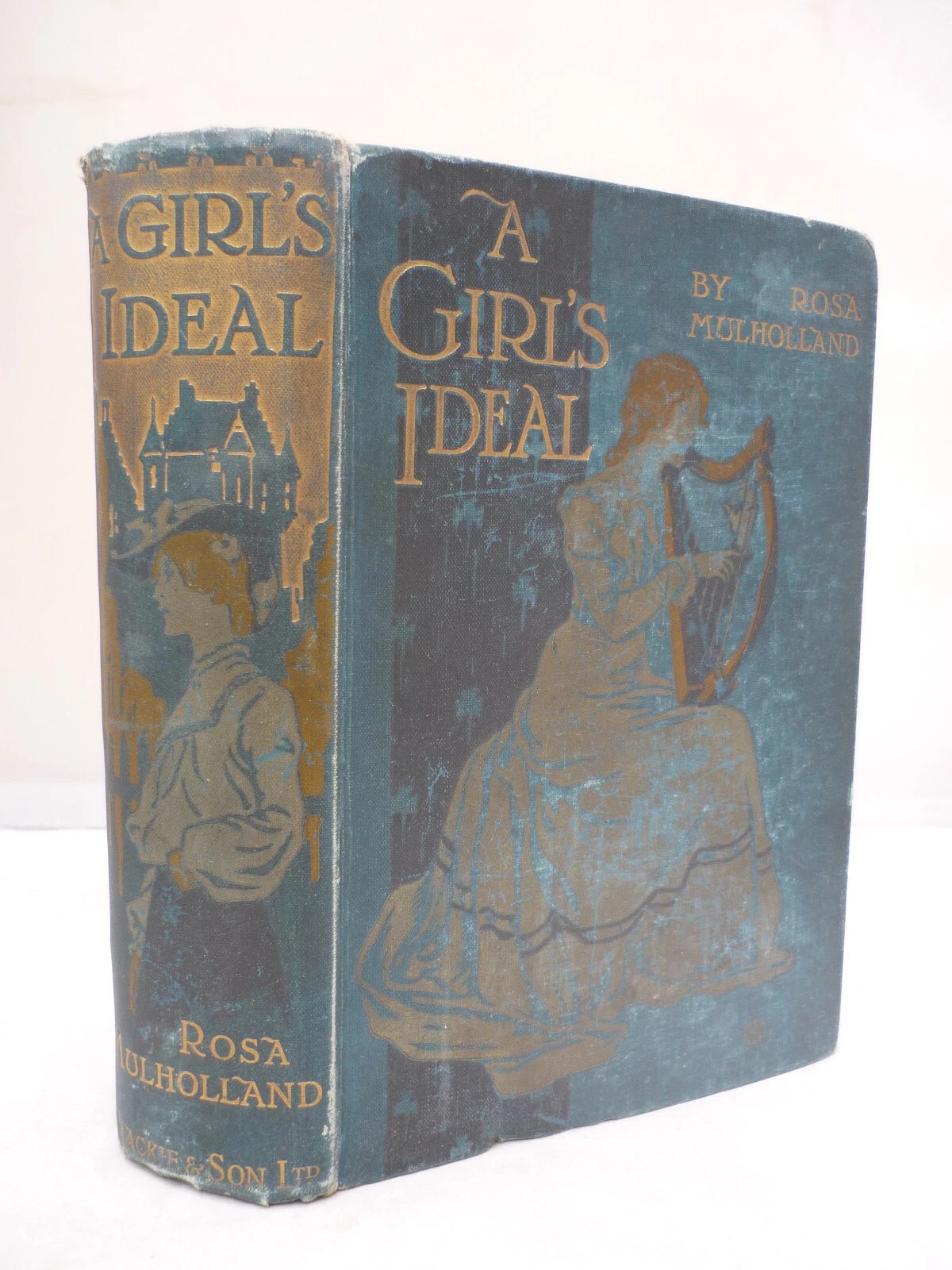
The next one slated for reading, A Girl’s Ideal (1905), appears to start in the United States but will likely shift to Ireland shortly. (It is also available via the Internet Archive.) It is not clear to me that she ever made it to this country and her nascent description is a bit barren. This one is a you inherit a large fortune if you agree to marry this fellow you don’t yet know story!

Rosa Mulholland Part Two: Searching for the Sweet Spot

Pam’s Pictorama Post: Several weeks ago I embarked on reading a new late 19th-early 20th century author, Rosa Mulholland, and wrote a post about her that can be read here. I’ve subsequently read several more books and thought I would update you a bit on my findings. (Recovering from mouth surgeries has given me much reading time – in addition to these books I polished off at least as many contemporary novels!)

For those just tuning in, Mulholland (who also wrote under the name Gilbert) was a prolific Irish writer of the late 19th to early 20th century. Many of these volumes, virtually all illustrated fairly profusely, are beautiful old editions which is what attracted me when I bought the first volume.

I have read several more since I last reported and found one I cannot seem to get into, but more about that in a bit. Terry, Or, She Ought to Have Been a Boy, was one of the few books I was able to find and read online. It was published in 1902 and is a novella that seems to have been a sort of chapter book for older children, or one that could be read to them.

I didn’t love it – for me it felt like it never quite got all the way off the ground. It is about a very obstreperous and wildly undisciplined little girl and her brother who tags along with her exploits. Said children are left with an infirm grandmother who leaves their care largely to a housekeeper. A lot of chaos ensues. Terry is a Rosa Mulholland-type character as a child who we never get to follow into adulthood.

Not my copy as I read it online. Pretty though!

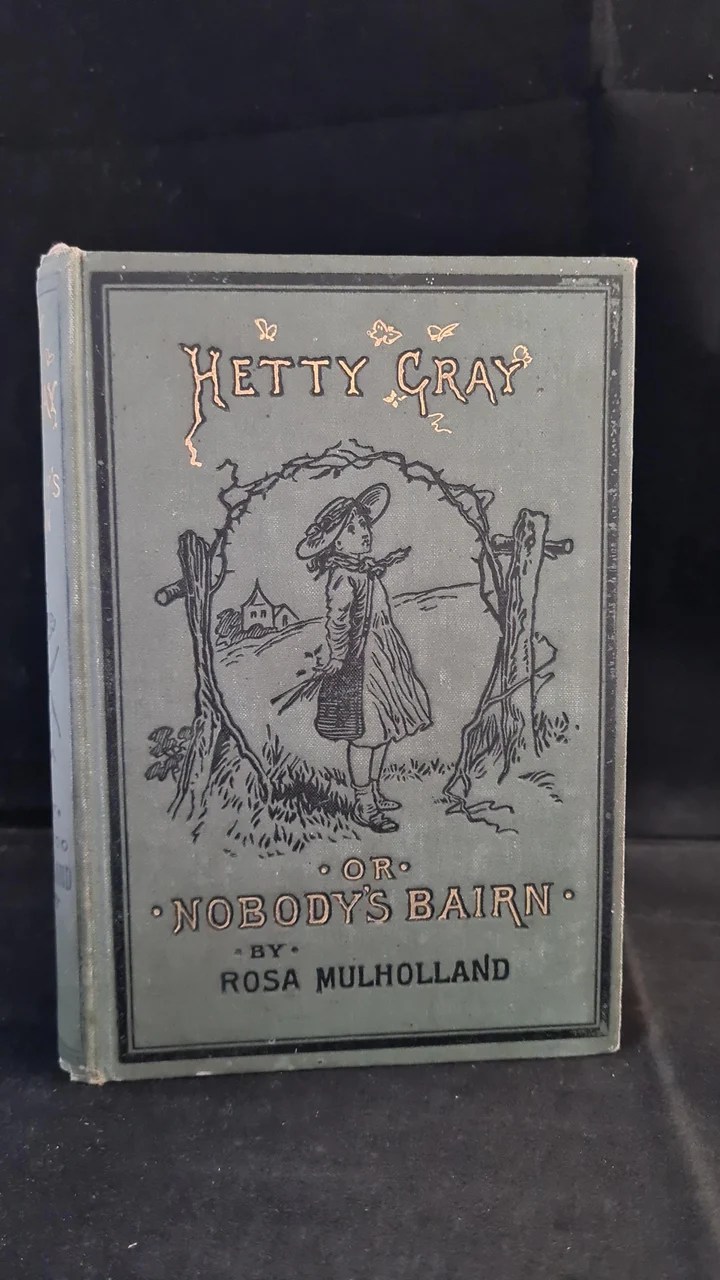
Hettie Gray: Or Nobody’s Bairn (1883) is short novel, also available online and I gather there is a reprint that is widely available. This is a more interesting story where Hettie is a foundling (of high birth of course) who literally washes up ashore and is taken in by a poor village couple. As a small child (with a bit of a wild streak) she is found one day by a wealthy woman who literally scoops her up and takes her off. She spoils her terribly and makes her into a bit of a wretch and then the wealthy woman promptly dies leaving Hettie largely friendless. We watch her original good nature re-emerge under adversity.

Mulholland has a few ongoing fascinations she returns to again and again in her writing – one is strong willed women and the difficulties they have fitting into the narrow society of the time (they are generally somewhat tamed but that will also pays off in other ways), and another is class structure. These two things play together as evidently to be poor and strong willed is seen as one thing but to be rich and strong willed another.

I don’t own this one yet, but there seems to be a fair amount of noise about it so am looking for it (1895).

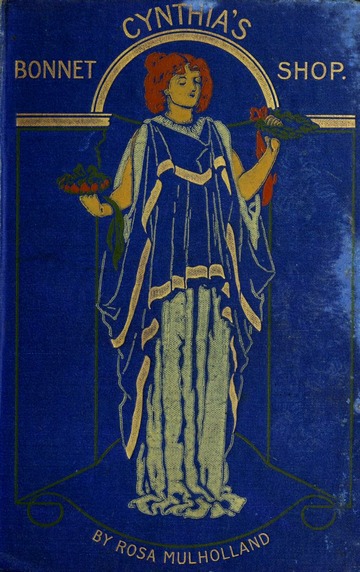
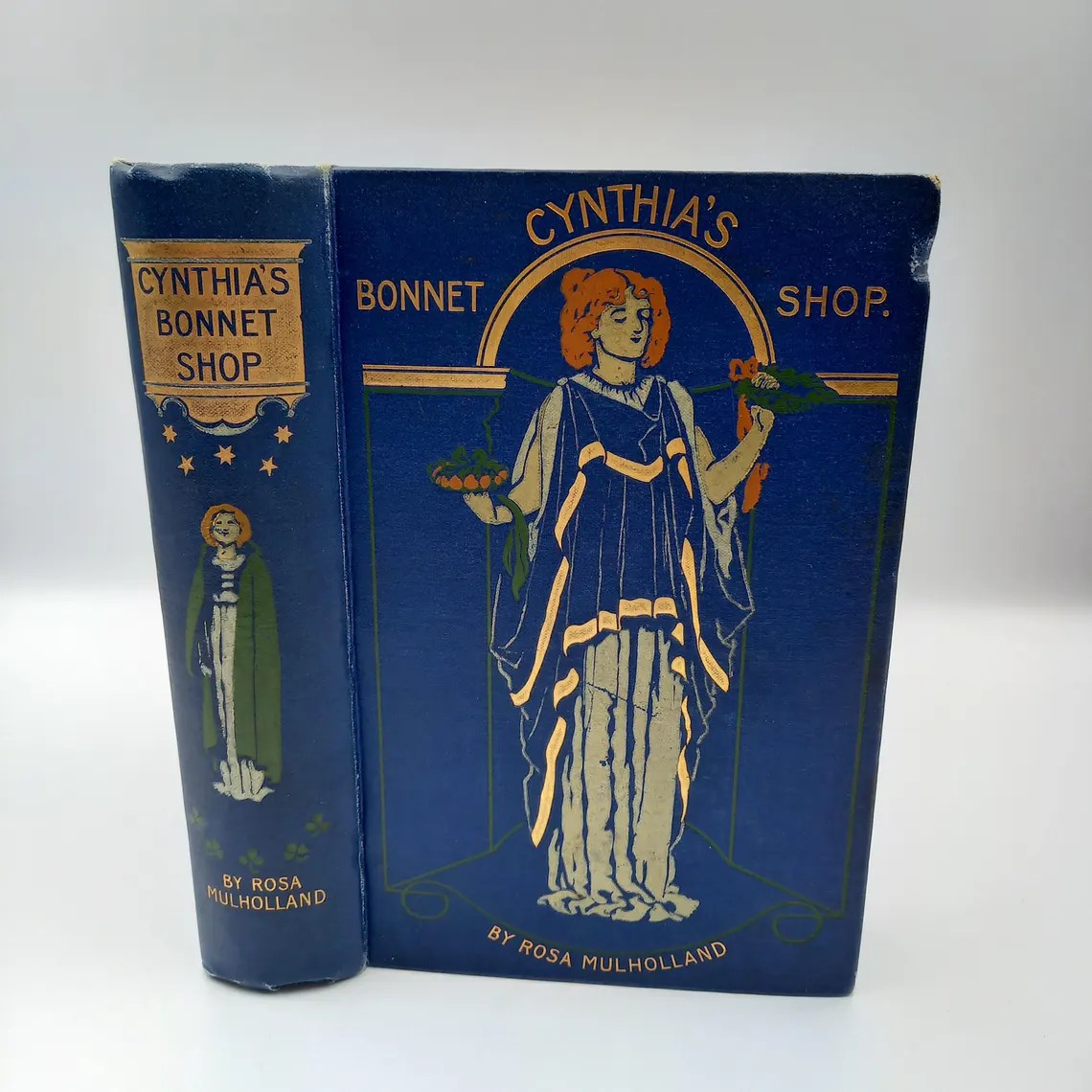
The best of this lot was Cynthia’s Bonnet Shop (1900) and it is for me Mulland at her best. (I did purchase one of the first editions as shown here, but had to settle for one that is quite tatty in order ot make it more affordable!)

Although some of the usual tropes are present, Cynthia is part of a fatherless but otherwise large and intact family which is a nice switch. There is the requisite wealthy (but unpleasant and selfish) relative who inadvertently sets Cynthia on the path to establishing her own bonnet shop. There is a mysterious benefactor. Her London shop becomes wildly popular. Romances for the sisters ensue but skew some with a patent Mulholland, I love him but I think he loves you not me so I’ll step aside, bit of plot. It is a pleasantly long read and the characterization of the two older sisters is great and good fun.

Mulholland notably also has a thing for astronomy. This is the second book (My Sister Maisie being the other) that has a story line about a woman who aspires to being an astronomer. I have to imagine that it either was a personal interest of hers or she was close to a woman who was or wanted to be one. That is another quality of these novels – the women are striving for something but consistently fall short of achieving in the man’s world. I assume this was a factor of the time and place. Mulholland is several decades earlier than let’s say Francis Hodgson Burnett (I wrote about her adult fiction which I enjoyed immensely in a post here). Europe was behind the US in progress for women and I would guess Ireland a bit further behind still. People looking at Suffragettes more than a bit askance as they emerge there.

Another I don’t have but am interested in (1905).

The final book for today, Marcella Grace, An Irish Novel (1886), is a plot that is devoted entirely to class distinction and the inflammatory politics of Ireland at the time. As someone without a lot of background in the political history of Ireland I am not equipped to comment on the position she takes. It is clear that she is leaving some room for a dissenting view (some sympathy for the downtrodden who took the paths of taking up arms) although for all of that they are the evil forces who drive this particular plot forward. This does make for a different book and I appreciate that as she could start to feel a bit repetitive. However, while I enjoyed it I cannot say it was an absolute favorite.

There is one on my bedside pile that I have been unable to penetrate, Father Tim (1910). Unsurprisingly it is about a priest in Ireland. I’m not saying I won’t end up reading it but I have not yet been able to really engage with it. Perhaps the fact that it seems to be written from a man’s point of view isn’t working for me. If I manage to read it I will report.

Another one I am hankering for, 1889,

I’m not sure looking this over that I have precisely found the sweet spot in her writing. I want to say that 1900 seems to be a high water mark, but Terry, Or, She Ought to Have Been a Boy is shortly into the 20th century and was less promising. (I think I have to be careful to avoid these books meant for children – not true of all authors but for me it may be for her.)

I have one more hardcover book in the house to read, Narcissa’s Ring, 1916. I have been acquiring them as they become available. They are more widely available in Britain but the postage to ship a book is so outrageous it puts most of them out of reach. Given what I wrote about in the earlier post and this one, a true sweet spot has not yet emerged.

Rosa Mulholland: Part One

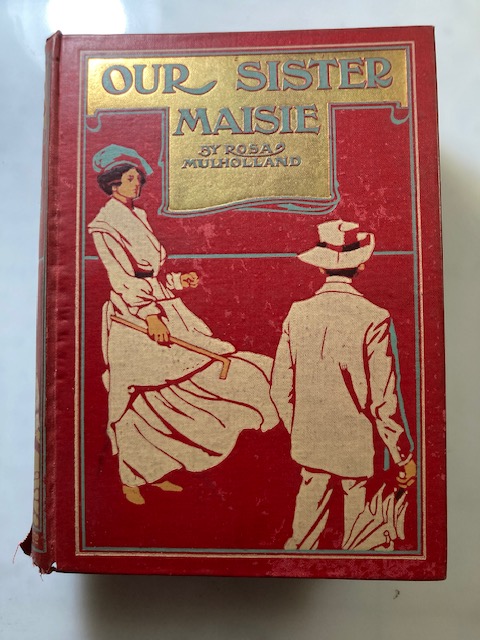
Pam’s Pictorama Post: If yesterday was devoted to a bit of what we’ve been watching here at Deitch Studio, today I will spend some time on what I have been reading. You may remember that as part of a much belated birthday celebration spent wandering around downtown with Kim, I purchased a rather beautifully bound volume by Rosa Mulholland with the intention of reading it. That volume, Our Sister Maisie, turned out to be an interesting sort of a point in her career to stumble onto and, written when she was 66 years old, it seems to have been one of her most popular books.

Volume I purchased as a belated birthday gift to myself in March at The Strand.

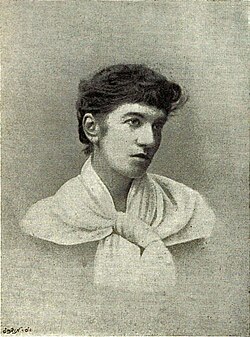
Her biography is interesting when considering her stories which deal a lot with the position of women in terms of money and livelihood at the time which she documents and considers. The daughter of a prominent doctor she came from a fairly well to do Irish family in Dublin. Other she first dabbled in painting (I have seen no evidence of it) she turned her hand to writing early and began trying to get published in her teens, including a novel at 15. One of the most interesting pieces of the tale is that early publication of her work caught the eye of an elderly Charles Dickens who not only encourage her but published her in one of his magazines and in a compilation with one of his own stories.

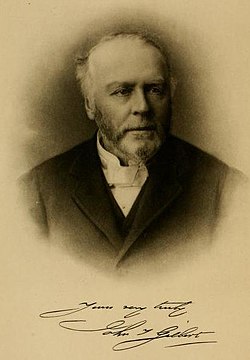
He bet on a good horse. She was very prolific with a list of upward of forty publications, mostly novels, to her credit. She wrote under at least three names I can find, Rosa Mulholland, Rosa Gilbert and very early on, Ruth Murray and seem to have published until a few years before her death and there was a healthy reprinting of her work which continues into the 1940’s. Gilbert is her married name – she married at the age of 50 to a well-known historian, Sir Thomas Gilbert, 12 years her senior. By marriage she therefore became Lady Gilbert.

If any of her writing was used for films I cannot find any evidence of it. I want to say that her books while very popular in Ireland and Great Britain they appear to have been less known here in the US. Really though the only evidence I have of that is that used contemporary copies of her books are mostly available in Britain.

Much like some of the other women authors I have written about previously (for starters, the adult novels of Francis Hodgson Burnett which can be found here, one about Mrs. George de Horne Vaizey here and an earlier one on Edna Ferber here) she is writing about the changing values and culture evolving around women’s emerging role in the late 19th and into the 20th century. Of the above mentioned authors, Francis Hodgson Burnett writes a bit about the other side of the Atlantic and especially the influence of the more forward Americans who visit there – generally very wealthy ones at that. Mrs. George de Horne Vaizey also writes about Britain but is poised a bit later.

A pretty if damaged volume for sale. I am waiting for a less expensive but equally beautiful volume.

Mulholland therefore is a bit unique in her entirely Irish perspective and generally a bit earlier than the women above. She recognizes that there is a problem where women’s only option for survival is the money their family could supply in the form of a life-long bit of capital to earn and be spent down and the marriage they make. Therefore nascent attempts to work among them are plot points – smart and ambitious women (much like herself we have to assume) are trying to break the mold either because they have been left with no money or are a simmering genius whose talent must find an outlet.

For all of that and knowing of her own life she can be a bit hard on these women – perhaps as society at the time was and it was the feeling of the day. I have read three of her books to date and in Our Sister Maisie there is a younger sister who yearns to be an architect – much like the young Mulholland she even has some of her designs used when she is teenager. Against all odds she makes it to architecture school and, although it is a bit unclear, drops out just before completion to marry her wealthy and wonderful heart’s desire.

I don’t have this one yet either but great title and nice opening page.

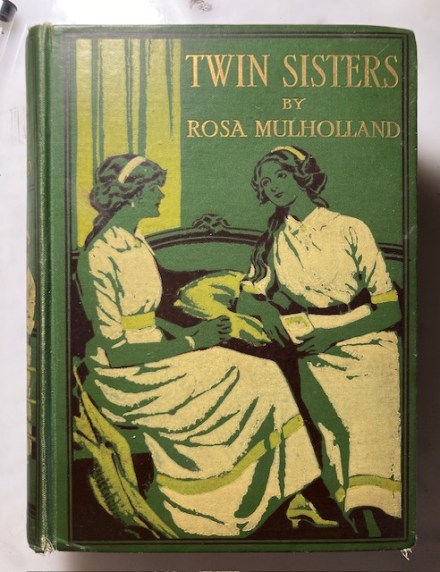
In a later volume, Twin Sisters, An Irish Tale published in 1913 she has a female character who, in charge of her late husband’s estate (it is thought of as her managing it for her son – as if she wasn’t also living off it in the meanwhile) invests aggressively in the stock market and makes but ultimately loses much of the fortune. She is criticized as having had no business trying to do the work of a man. But women like her are frequently left to their own devices and the heroine of the story arrives, along with her twin sister, in Britain from Spain as the wards of a family friend they never met. Penniless, the woman charitably agrees to help launch them into society and make agreeable marriages for them. Our girl Pipa isn’t having it though and takes work in an apple orchard in the country instead. Although she is roundly criticized for this, she is our heroine so needless to say she does the right thing – but of course she will end up with her best mate as well.

I’m also holding out for this illustrated version of this volume.

Mulholland’s books are a bit harder to track down than what I have enjoyed in recent years where there has been aplenty available online and in inexpensive used volumes. Rosa Muholland’s books tend to be beautifully bound, illustrated, volumes that are being sold at a premium because of that and despite the fact that there is not much demand to read them. Why more are not available electronically I cannot quite figure out. Perhaps she is just a bit early for for most people – or if the basis of those collections is based on American libraries and universities she may just not be in the right purview.

Clearly it would be a pity not to read this one in a beautiful illustrated volume like this one as well! Not in my collection – yet!

All this to say that while between the acquisition of physical volumes of her books, I grabbed one of her earlier works online and that was interesting and The Late Miss Hollingford was the story of hers, serialized in a magazine, that caught Dickens’s eye. Her descriptive powers were in greater force in her early writing, although her descriptions of the Irish country and seaside are also wonderful in Our Sister Maisie. The descriptions of the farm this young woman goes to live on are just cozy and great. (Yes, another orphaned girl-woman sent off to live with folks she hardly knows – this time her parents, who she barely knew, died of a fever in India leaving her a sufficient income although in reverse this time she is sent to live with people who don’t have money. The father was the perpetrator of a pyramid scheme and those seemed to be rampant at this time – I know the from the de Vaizey books among others!)

Illustration from the Late Miss Hollingford which I read electronically but with illustrations via Project Gutenberg.

I suspect there will be more to come on Ms. Mulholland and her writing as I am wading into the depths. I also suspect that Abe Books and others can expect to be seeing a whole lot of my pocket change in the near future. Stay tuned.

Holiday: Gifts!

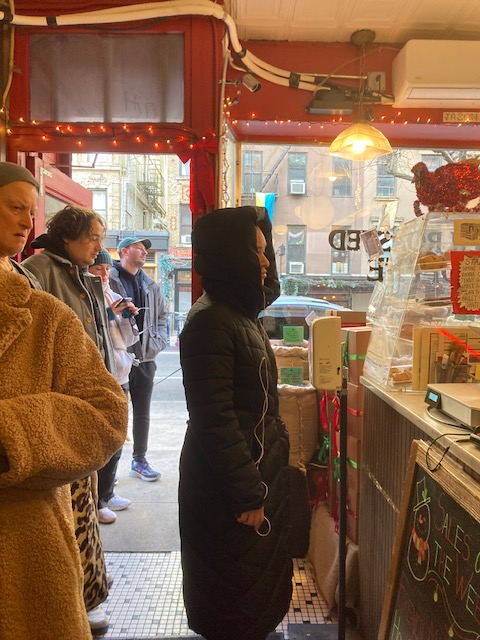
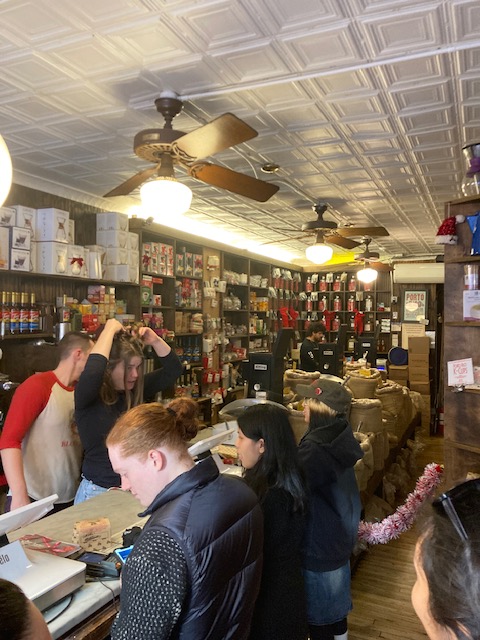
Pam’s Pictorama Post: Last weekend’s trip, which started with our holiday nostalgia train ride as memorialized in yesterday’s post, was largely a shopping venture. I had a few places I wanted to investigate and it was time to pick up coffee from my favorite establishment. Porto Rico Importers has been in business since 1907 with three New York City locations (Bleecker, St. Marks and Essex Street) and I became a true devotee a couple of years ago. I frequent the St. Mark’s one although I guess the Bleecker is the original site.

Located next to my eyeglass store (Anthony Aiden Opticians – I have worn transitional lenses for years and I swear by them for the care they take in executing my prescriptions), on St. Mark’s I make periodic trips and buy several pounds of coffee at a time and freeze it. After much experiment I have settled on the Danish blend. I bought four pounds and one will come to Jersey next week. There was a long line out the door of their tiny outpost last Sunday, but it moved quickly and I was undeterred. There is a bench out front and the weather was good so Kim read his book there.

Pams-Pictorama.com purchase in October, John Derian for Target.

One can purchase their coffee online and have it shipped. If you have enough space in your freezer, free shipping starts at orders of $75 or more. I do not and I have the option of occasional trips downtown to purchase it. If you are curious their website can be found here.

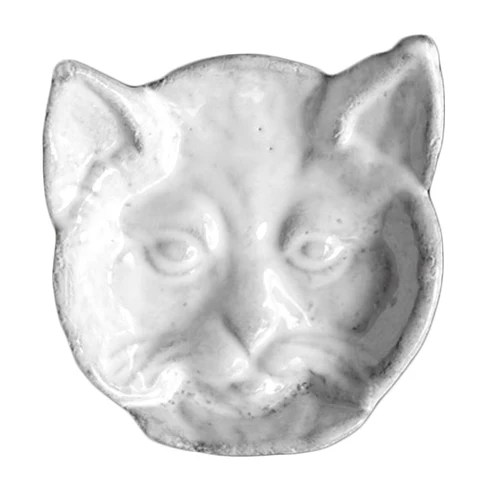
A nice ceramic version available at John Derian or online, but it’ll cost you!
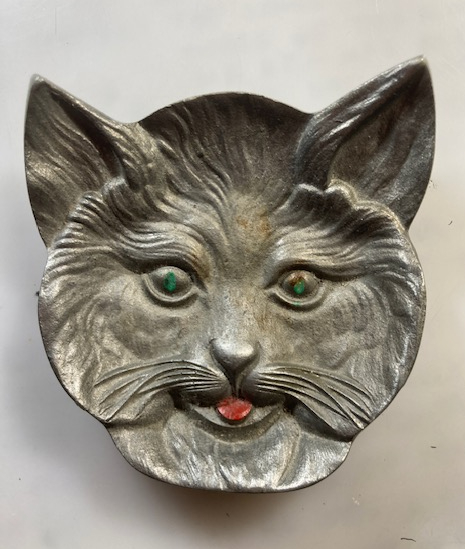
I purchased a pair of these for a nominal amount via an online auction. August 2014 post about these Corbin Cats.

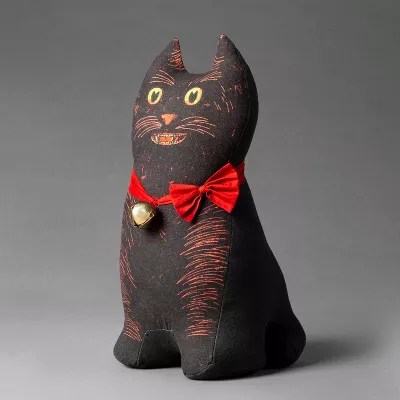
Another of my goals was to visit the John Derian store on 2nd Street. Pictorama readers might remember several months ago when I posted about a great stuffed cat I purchased from Target which was part of a Derian/Target collaboration. I thought it was worth a trip to the source. It was a bit crowded and I purchased a few small gifts including notecards of said same black cat. However I largely found it out of my price range. In some ways I think Mr. Derian is a brother from another mother, as our collecting sensibility is remarkably similar. He however then takes these items and repurposes them by reproducing them for sale. I can attest to paying less for some of the original items that his copies are made from.

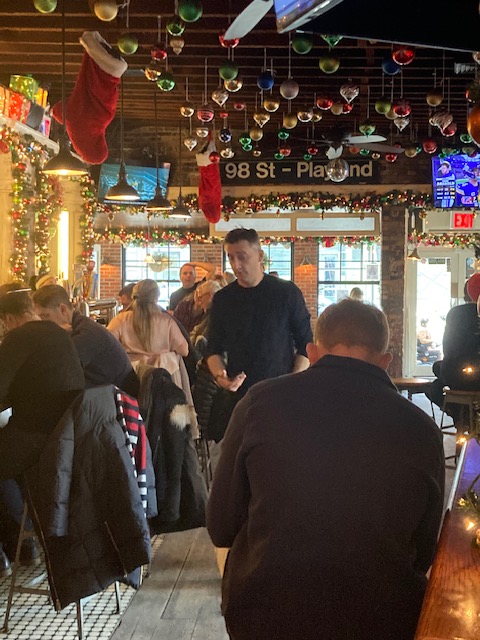
Phebe’s all decked out for the holidays. We wondered about this 98 Street – Playland sign. Rye Playland??

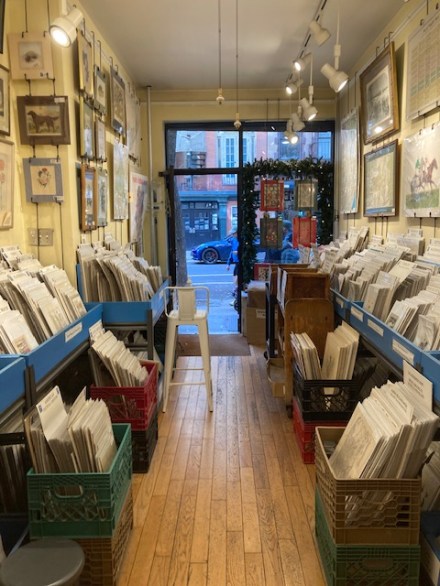
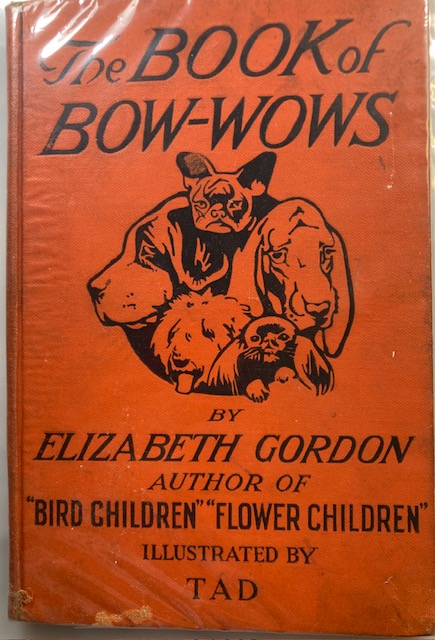
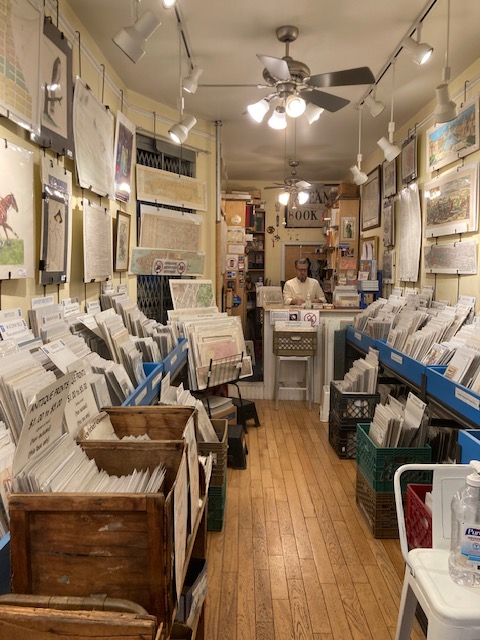
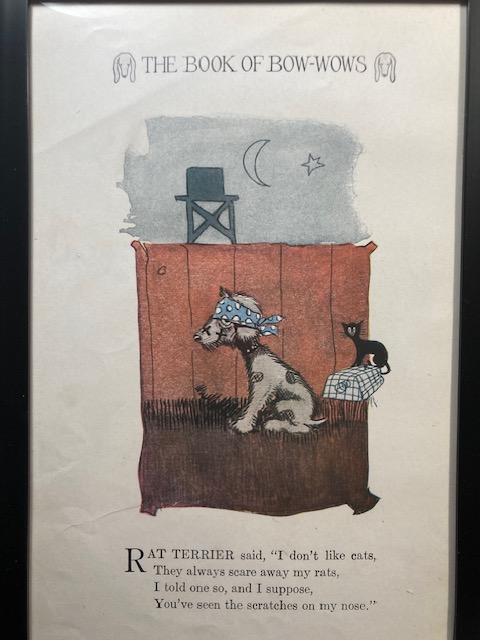
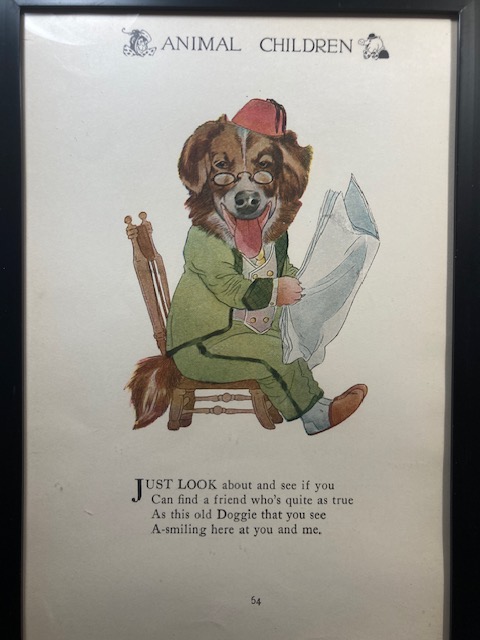
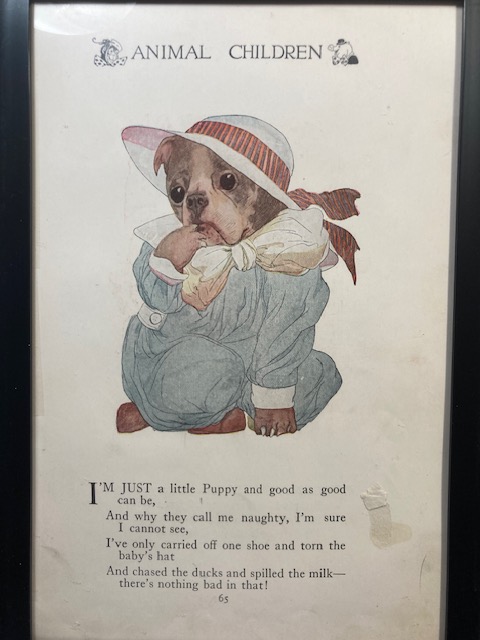
I had a plan to stop in a hat store, a small independent designer by the name of Esenshel. It didn’t open until afternoon so Kim and I popped into Pageant prints and maps which I had no idea resided on East 4th Street. It turned into a goldmine of gift acquisition and I grabbed up three pages, neatly excised from The Book of Bow-Wows, and the original cover to boot. While I don’t really approve of the slicing and dicing of this old book, the pages nonetheless make great gifts for a few of my colleagues at work.

Just the cover to the book, sold for a few dollars separately.
Peering into Pageant.

A quick look tells me that you’ll pay up if you want the full copy of this book – as Kim pointed out, I could however, purchase a coverless copy! Illustrated by someone only known as Tad I cannot seem to find further tracks on him. The author, Elizabeth Gordon, seems to be better known for her Bird Children and Flower Children which were illustrated by other people. Those have seen more recent reprinting, however they are a little saccharine for my taste. The Book of Bow-Wows was written in verse and I have shared the now framed (thank you Amazon!) pages I chose for my gifts. (I am laboring under the impression that none of the people I purchased for are readers – apologies on the surprise thing if you are!)

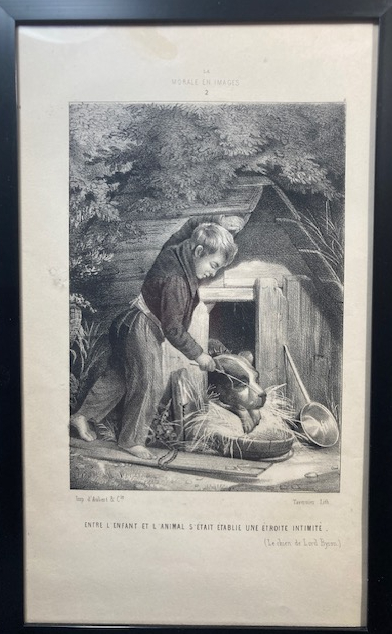
Last, but in no way least, is this book litho illustration. Titled, La Morale en Images the line at the bottom roughly Google translates to: between the child and the animal a close intimate relationship had been established. At the bottom it also read, (La chien de Lord Byron).

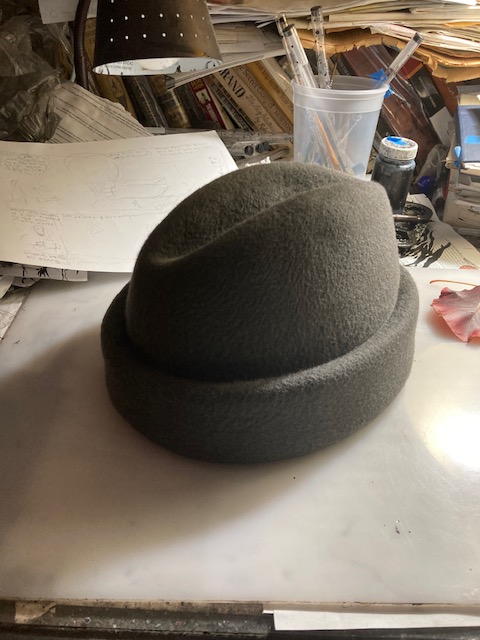
Also, in the end yes, I did purchase a hat. It is a wool variation on the Russian wool hat my dad’s father wore. Lunch was had at Phebe’s Tavern, an establishment I have not entered in several decades. My main memory of it was that when I was in my 20’s they sold an extremely inexpensive pitcher of beer and there is a lingering memory of a hair of the dog Sunday afternoon there once. That notwithstanding, Kim bought us a lunch of excellent burgers before making our way back – this time on a regular modern subway uptown.

The Christmas Letter and The Fairy Godmother

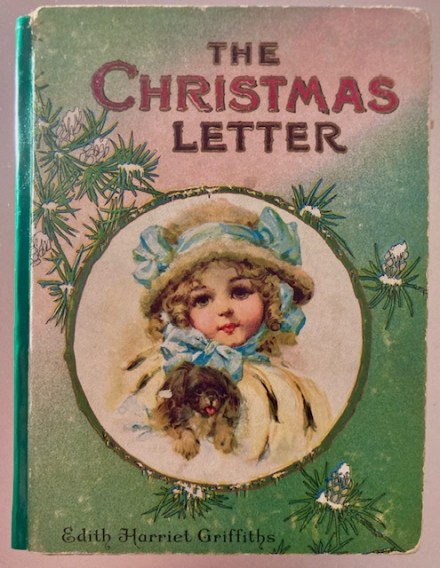
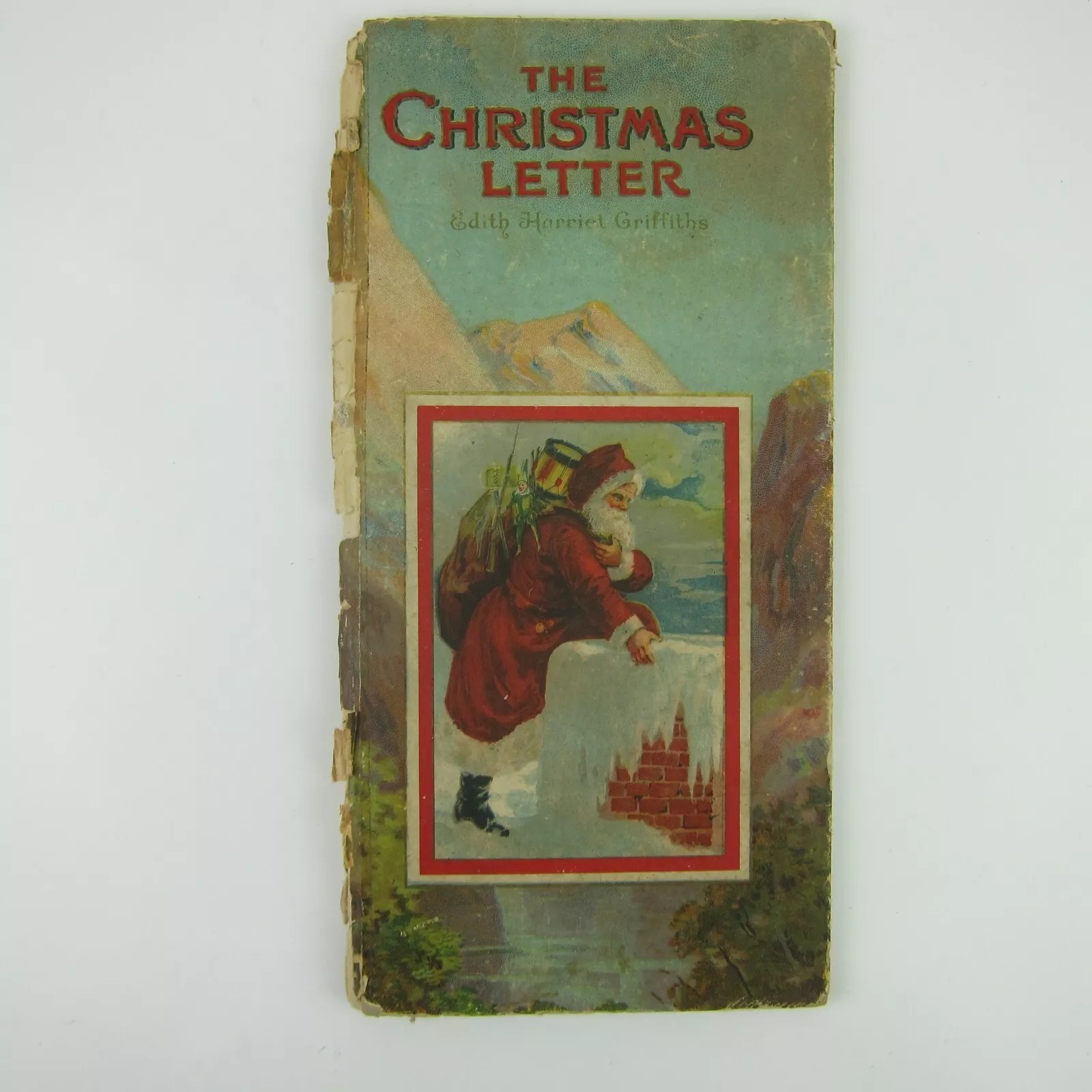
Pam’s Pictorama Post: This was a lucky buy. I spotted it in a sale online (once again it was @missmollystlantiques on IG) and took a chance on it for a few dollars. It arrived several weeks ago and has been on my desk waiting for its turn. Apologies if I am jumping the gun on the commencement of the holiday season by a bit. Deitch Studio is at the mercy of the supply chain as well and I am waiting on the arrival of several items.

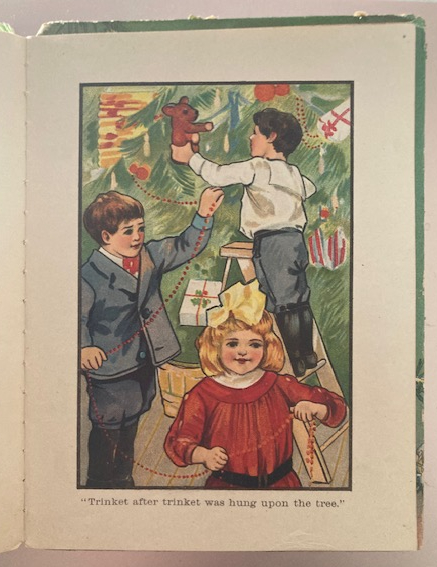
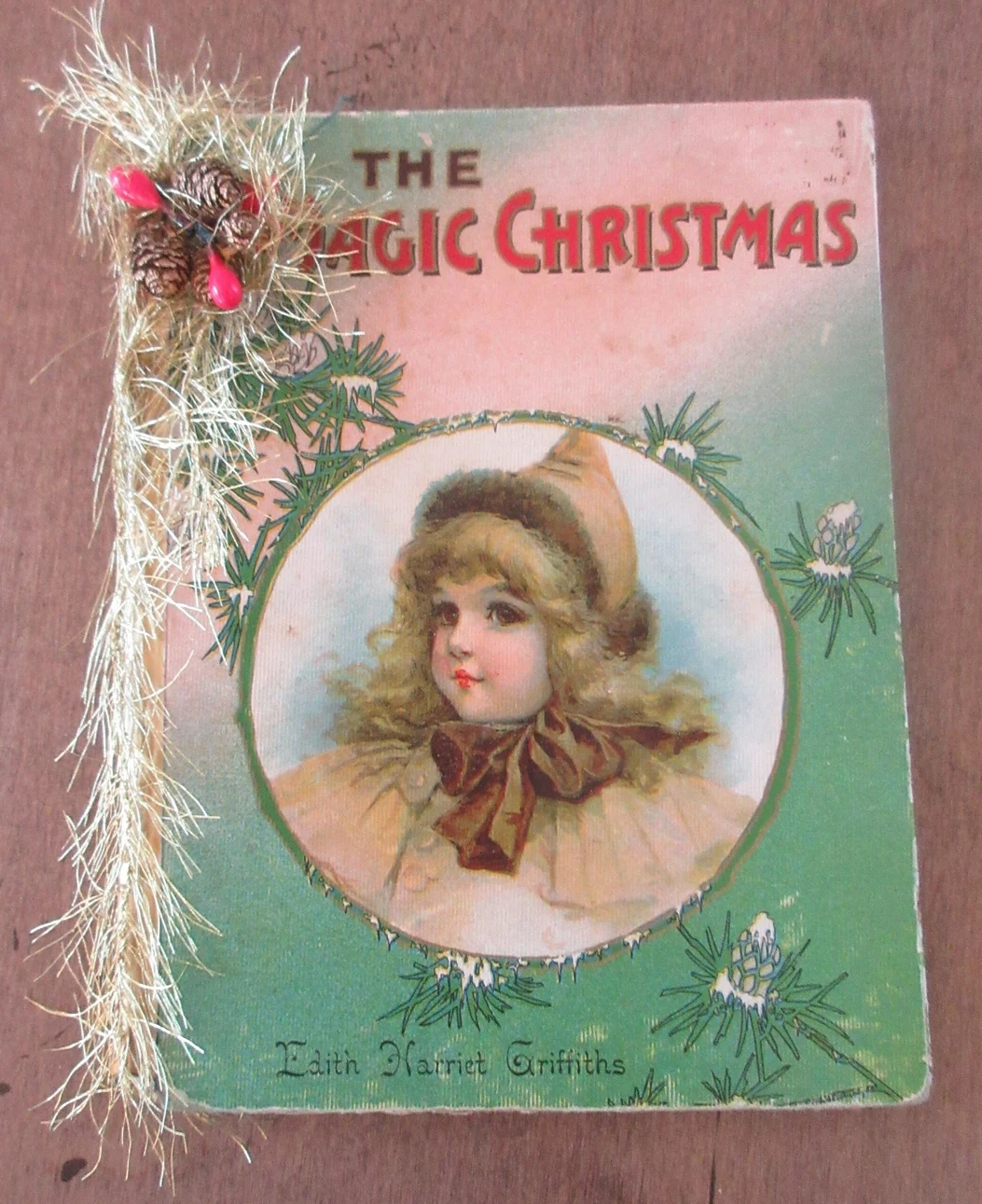
When I grabbed it up online I couldn’t have known how really charming it would be and I like it so much I sort of want to pass it onto someone else who will also appreciate it. It’s thin – about a dozen pages altogether with four or five illustrations. The two stories were written by Edith Harriet Griffiths and they are splendid. This volume was published in 1911 by something called The Hayes Lithographing Company and it belongs to something called the Christmas Stocking Series, as printed in tiny gold letters on the back.

One of the internal illustrations.

The first title story is straightforward fare about a family where the father is ill and their financial straits spell a sad holiday for them. They cheer themselves up by writing to Santa with their modest list. My favorite part of the story is they send it to him by putting it up the chimney to be swept up and delivered by the draft. (Never heard of kids using that delivery system, but I like it.) The letter finds its way into the hands of a wealthy gentleman (who bears a resemblance to St. Nick – its not clear how these actually get delivered; down the chimney?) and in the form of a doctor who helps to deliver a happy Christmas Day complete with potential job for Dad when he is well again.

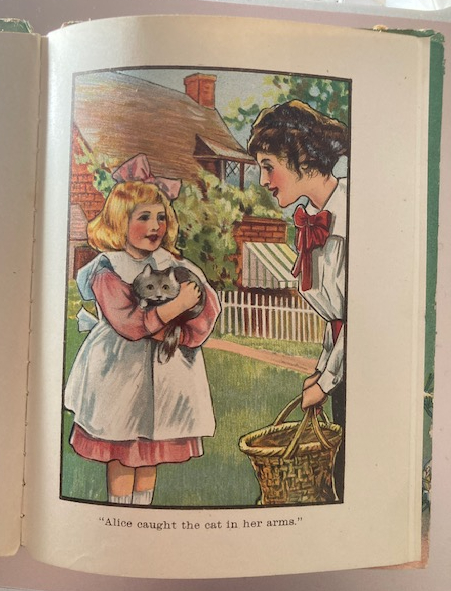
From The Fairy Godmother.

The second story is a nice surprise and it is about a little girl who is meeting her godmother for the first time and she dubs her Fairy Godmother. However the story ends up being about her imaginary pet cat who is banished – and later the godmother replaces him with a real kitten. Perfect story for me.

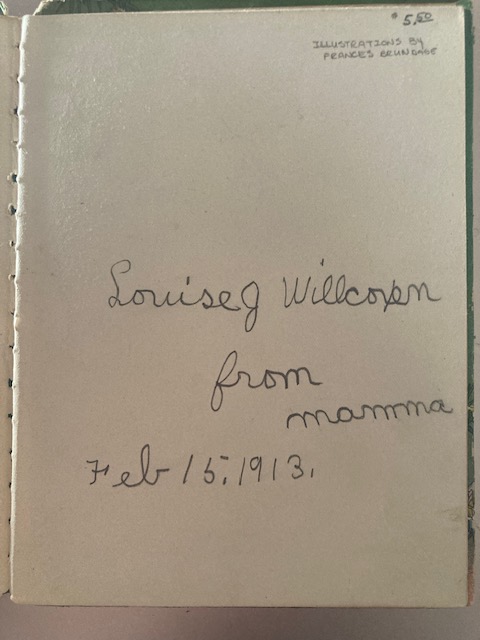
Inside inscription.

This particular volume is inscribed Louise J. Willcoxen from Mamma Feb 15, 1913 penciled in a child’s hand.

From The Fairy Godmother.

There is a later, and seemingly more lavish, edition a few years later and they appear to have added a few illustrations. While either volume is not impossible to find, there are not a lot available.

This volume was recently sold online. It is the later, more lavish volume with many additional illustrations.

I found one copy sold on eBay ($49.99 in bad condition) and it was a re-issue from a few years later. As you can see it is a more festive edition and a number of (nicer) illustrations have been added. It is only The Christmas Letter, without The Fairy Godmother and it ends with a poem The Night After Christmas which appears to be a comic take on the over-indulging at Christmas.

This series, also published as Christmas Stocking Series the same year – was five volumes which I think you could buy individually or as a nice box set.

Another small holiday book by Edith Harriet Griffiths turns up a bit more frequently and it is The Magic Christmas and Missy and McKinley. It has the same 1911 publication date by the same Hayes Lithography publisher. (Available for $45.95 on Etsy at the time of writing this.)

Currently for sale on Etsy.

For all of that, in my light online research the trail is pretty cold on her as an author beyond these volumes which is too bad because she’s a good writer. I wonder if she published under another name or names and if that is just erased in the sands of time, at least for now.

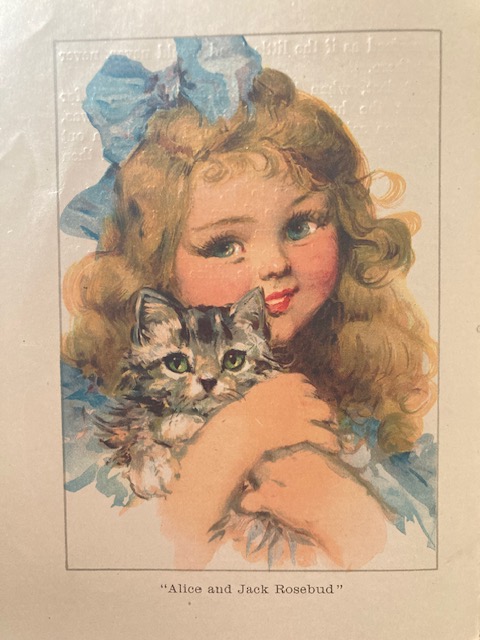
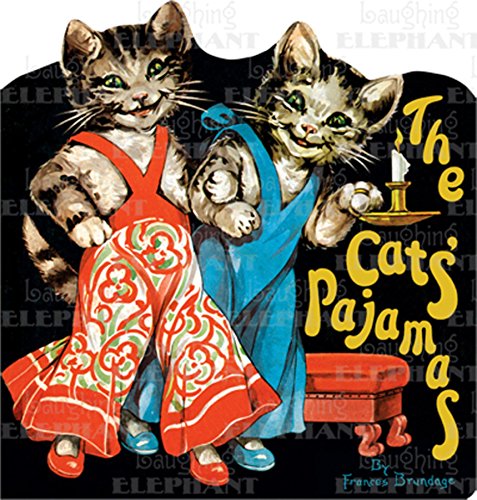
My volume is illustrated by Nina B. Mason and Frances Brundage and frankly the outside illustration and the overall package is somewhat more impressive than the inside illustrations. I don’t see them team up again although I did find a few further illustration jobs by each of them separately. I like them separately better.

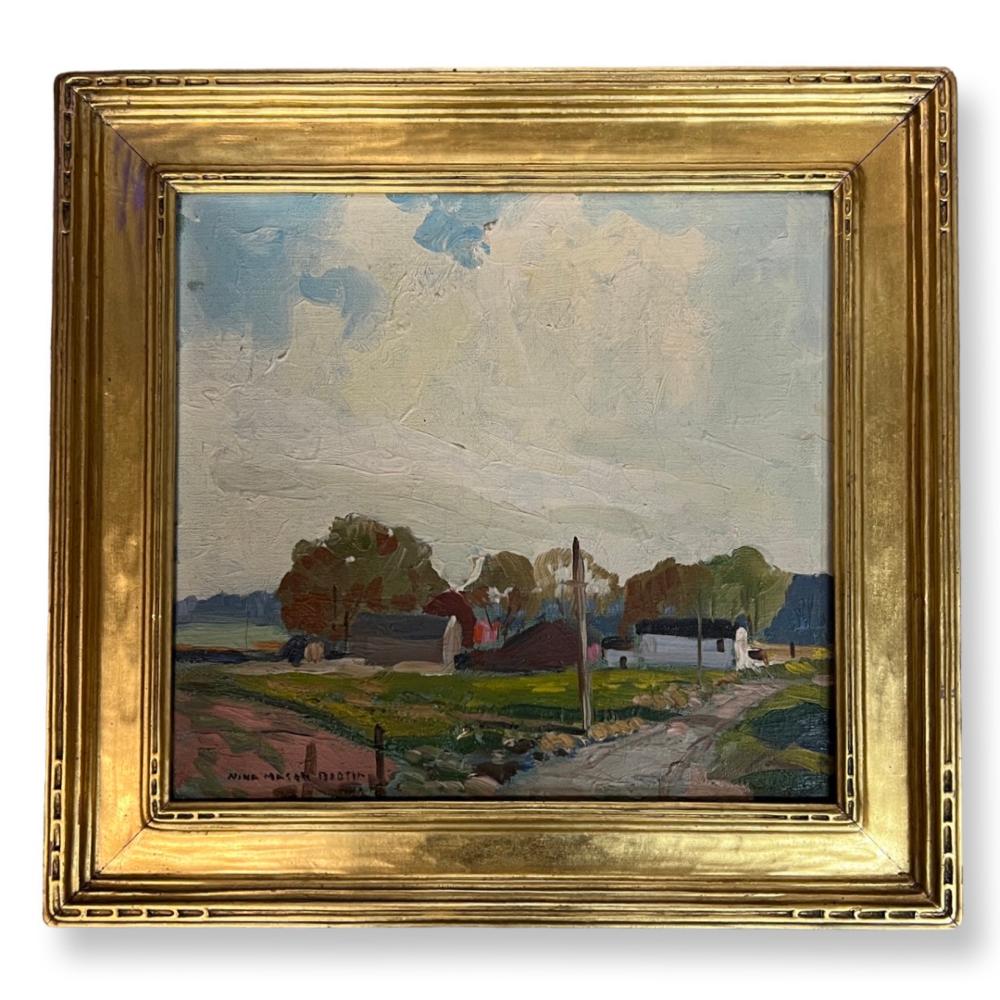
Nina B. Mason painting recently auctioned and sold for an undisclosed sum.

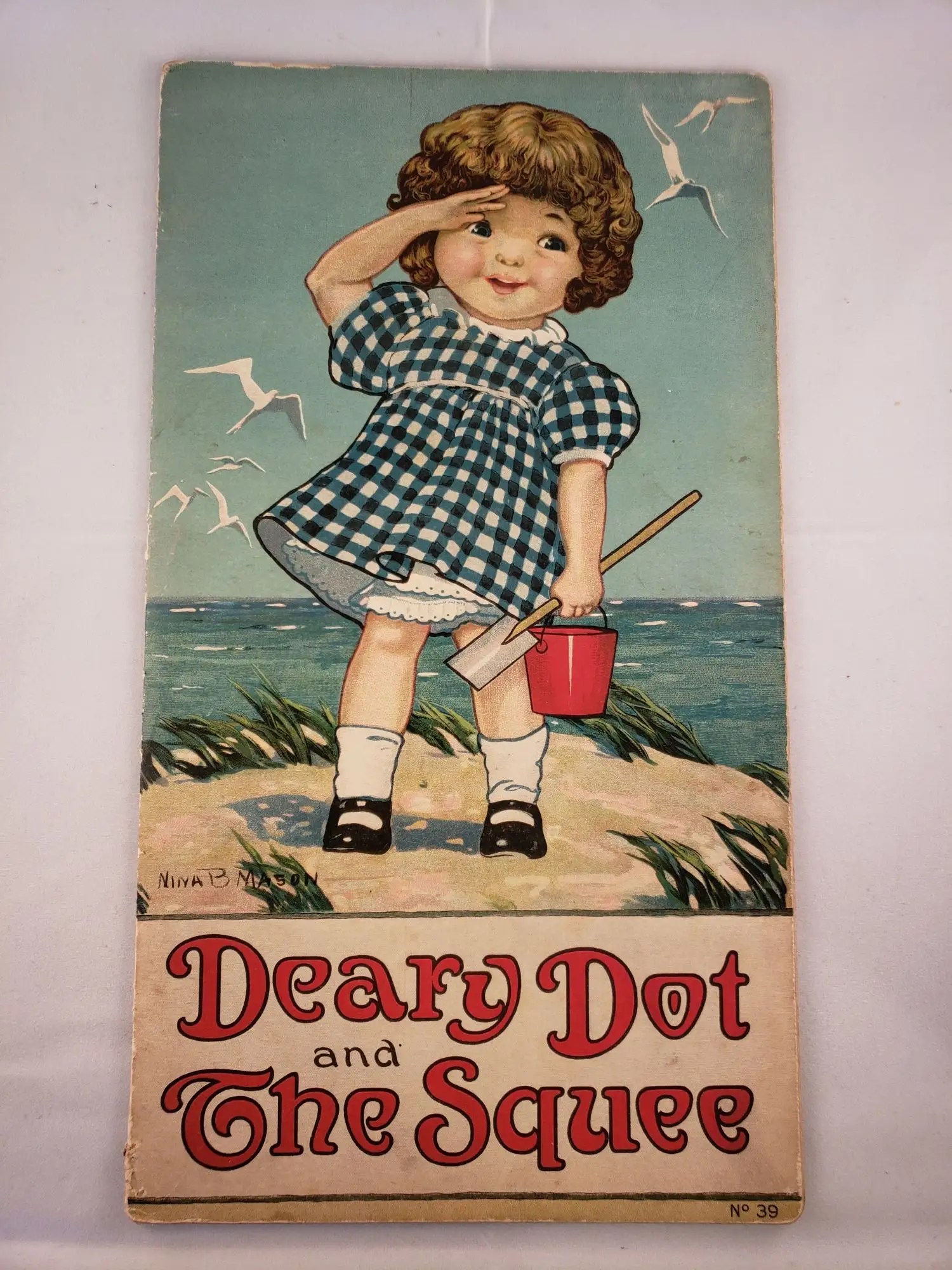
I believe that Nina B. Mason is Nina Mason Booth after marrying a few years later than this book. Her family was intertwined with engraving and lithography with a start in norther New York. A nice bio of her career can be found online here. She was notable for her portraits and illustrations. A quick look online shows some nice oil landscapes by her. There is one kid’s book which appears to be written and illustrated by her. I don’t love the look of it but the inside story and pictures are really loopy! Deary Dot and the Squee!

Apologies – best screen shot I could get. This volume on Abe’s Books will cost you! $167!

Meanwhile, last but certainly not least, Frances Brundage (1854-1937) who was older than Nina Mason and presumably more established. She is the only one of the three who rates a Wikipedia entry (it can be found here) and she had a long career illustrating cute children, cats and the like. Her specialty was Valentines, postcards and other ephemera, much published by our friends over at Raphael Tuck & Sons. (See my Felix cards produced by them here in a prior post!) My favorite antidote is that she sold her first sketch to Louisa May Alcott. It was an illustration of one of her poems.

Of course this caught my eye. It appears to be written by Brundage as well.
I suspect this is more typical of Brundage’s work.

So we kick off the holiday season here at Pam’s Pictorama. Holiday books from the 1910’s could be a deep vein to mine, although a pricey one for the most part. I will be keeping a further weather eye out however and we’ll see what we can find.

Catland: Louis Wain and the Great Cat Mania

Pam’s Pictorama Post: I haven’t posted a book review in a very long time and I am not entirely sure I have ever written one for a contemporary volume (Kim Deitch books notwithstanding of course), let alone a non-fictions one. (My reading and therefore posting runs heavily to very early 20th century fiction, largely by women. For a few examples you can look here and here.)

However, it seems quite logical that I would break that ground today with this recently published book as it combines Louis Wain (of whom I have posted often – try here and here for items from my collection) and the Victorian cat craze which helped launch the cat as house pet relationship as we know it today. Catland Louis Wain and the Great Cat Mania by Kathryn Hughes is more or less hot off the presses. Hughes has worked the Victorian history side of the street before and draws heavily on her accumulated knowledge for this sizeable volume.

The Naughty Puss by Louis Wain.

Hughes uses Wain’s biography as a rough parallel to the rise of cat breeding and ownership – perhaps a fair measure as one could say that Wain’s art, intertwined with the newly found fondness for felines, helped drive the mania but was also driven by it. She loads it up with an equal amount of stories and tidbits from broader Victorian life, but centered mostly on a newly formed cat craze as it were.

While Hughes does take the opportunity to set both Wain’s autobio and previous chroniclers straight on some points, his biographical bits are interspersed throughout by chapters devoted to other aspects of cat related Victorian life. (Somehow I had missed the fact that Wain had a cleft palate which was largely hidden by facial hair as an adult and I had no knowledge of the family history designing and making liturgical fabrics – the latter being of much interest when you consider his sense of pattern and design.) Evidently Wain gilded the facts of his life liberally (lied) during his lifetime making some of it up out of whole cloth more or less.

circa 1900: Cat artist Louis William Wain (1860 – 1939) draws inspiration from a pet. (Photo by Ernest H. Mills/Getty Images)

Hughes’s Wain is a socially awkward fellow, albeit it with flashes of attempted showmanship, who was most comfortable wandering off into his own world, In his public persona he judged (the newly created) cat shows, gave demonstrations of two fisted simultaneous cat drawing, and wrote some vaguely (and then increasingly) unhinged editorial pieces for the papers of the time. On the other side of the coin, he and his family declared bankruptcy more than once; he had a tendency to wander off for periods of time, and of course eventually he sadly drifts (almost retreats) into his decorative cat laden world of insanity.

Much the same could be said about Victorian England and its relationship to felines. First, it is clear that there was a pretty hard line between the nascent “purebred” (often pampered) pets of the day, and the run of the mill kitty of the street. The practice of bringing a street kitten or cat into your home was not the norm and, aside from those which were kept for work such as mousing, those cats were at best left to languish in the streets.

Tabbies in the Park and black and white print by Wain.

Some of the Victorian practices concerning cats are not for the weak of cat-loving heart to read so fair warning here. There were descriptions and stories I glossed over at best and I suggest same for Pictorama readers. A chapter on Victorian taxidermy (including a woman with a literal cat hat and cat tail cape – Eeeck!) isn’t even the worst of it as the period does seem to have a glib cruelty to it. However, not all the cat tales are bad ones and there were numerous fun bits and pieces that I’ve been reporting to Kim in bed for weeks now.

The book is gloriously well illustrated including, but happily not limited to a color section. Wain’s work lends itself even to black and white reproduction and Hughes uses it to good effect in support of her points as well as being fun to look at.

My favorite chapter in the book was on the Wain futuristic ceramics which I have always had an interest in and it answered at least some of my questions about these. A somewhat luxe line of teapots and the like in true Futurist forms, Wain had the bad luck of launching his line in June of ’14, just as war was overtaking Europe and Great Britain. Not the best time for offbeat ceramic cat-ware.
A bevy of the ceramics!

Produced by a company called Max Emanuel there were 19 patented designs in the first batch with names as diverse as The Mascot Cat and Road Hog Cat. The choice of colors where the larger designs were produced was referred to by a critic as an angry cake decorator on acid. Evidently there was even at inception a riot of designs, colors and finishes for the items, manufactured at two different plants which would make positive identification hard even then and almost impossible now that forgeries have flowed into the market. Still, I would snatch one up if I could and liked it and remain unconcerned about proof of origin.
The most disappointing chapter was on Wain and Felix! Other than the story of Sylvia Pankhurst’s Felix factory on the East End of London being told (Pictorama readers may remember that from a very popular early post that can be found here), Hughes does a rough retelling of a the plot of a silent cartoon that is easily viewed on Youtube. I’m mystified by why she included Felix if she was so disinterested.

Christmas was a favorite and very lucrative time of the year for Wain from the beginning of his career.

Wain and his sisters eventually leave London to reside in a suburban seaside town near Margate (one of his boosters in the magazine world was an early investor and set them up there), and this holiday retreat lifestyle inspires some of Wain’s most entertaining cards and images – cats golfing, boating and swimming as well as sly social commentary found even in Catland.

From the Pams-Pictorama.com collection. Sadly not Wain and Eliot, not yet…
Meanwhile, of course I have wonderful day dreams about Louis actually wandering over to the Felix photographers in Margate where so many of my Felix photos were made and having a postcard made with an arm tossed around the shoulders of a tall stuffed Felix – this is now united with my day dream of finding one of the giant Felix dolls from those establishments.
Furthermore, as it happens eventually TS Eliot was also nursing a nervous breakdown in the neighborhood – in a town just on the other side of Margate. It is irresistible to imagine that they met at that time, perhaps had a coffee and were strolling the boardwalk together. And perhaps they wandered in and had a picture postcard snapped for posterity – to show up in my collection one day.