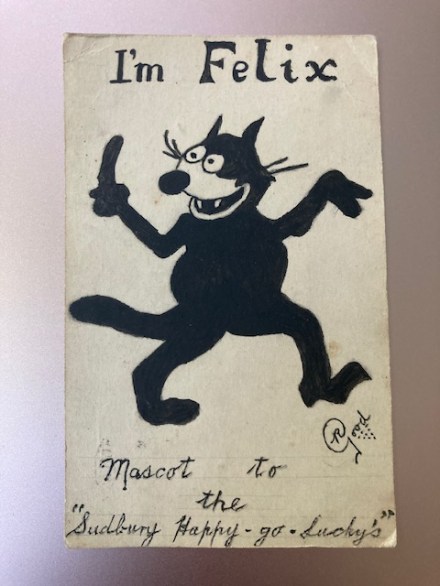
It’s a Felix!

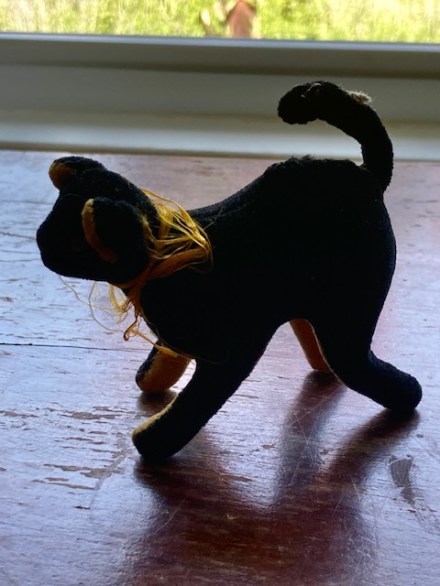
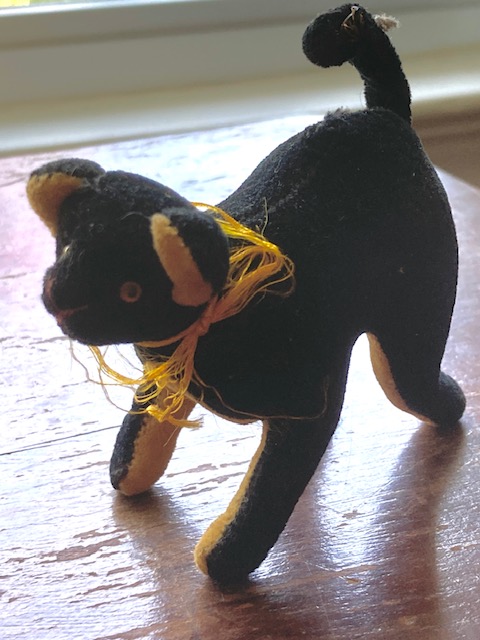
Pam’s Pictorama Post: Sometimes here at Pams’s Pictorama it’s just a Felix acquisition day and today is that day. The other day combing through listings I came across a duo of Felix in Australia. The condition was sort of medium and the price right and the next thing I knew this fellow was on his way to me.

I have a few other examples of this Felix and this fellow in particular may next find his way to New Jersey where there is a shortage of Felix-es at my house. (Although there is an abundance of kitties who have a lot of unsupervised hours so I am mindful of that as well. The younger inhabitants there like some high jumping too and I have an Oswald Rabbit I worry for occasionally. A post about him can be found here.)

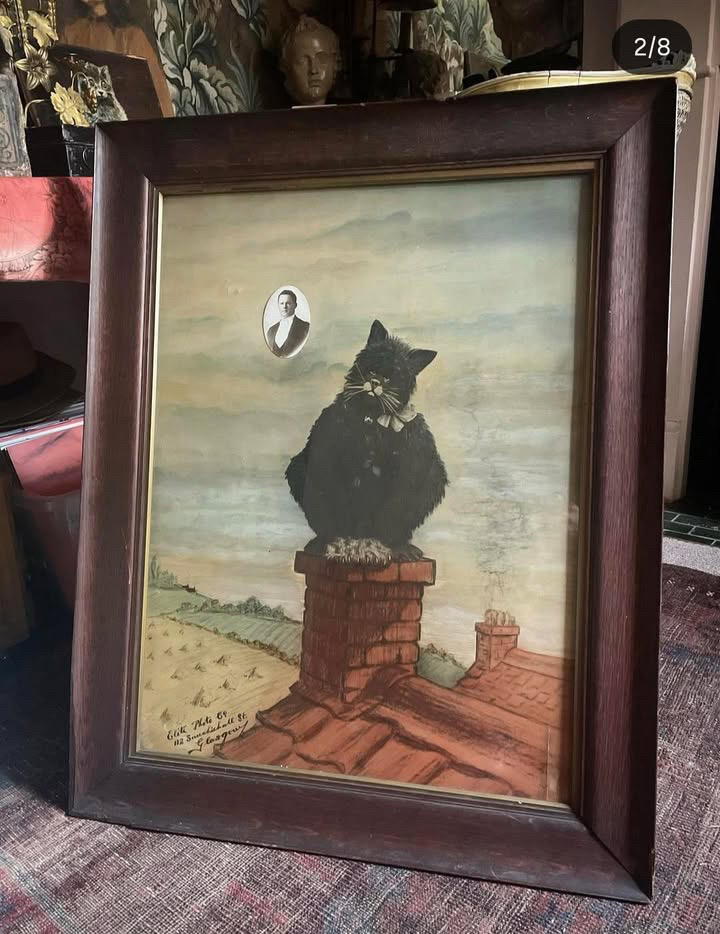
Years ago I was at a huge vintage toy show in Atlantic City where a dealer had a whole basket of these (such bounty!) and he said that they were used as carnival prizes in England. They must have been very popular because many exist today but somehow they seem a bit too well made, and therefore expensive, for that. Still, it makes my brain whirl a little to think of being able to bring home such a toy from a fair – perhaps after having had my photo taken with Felix elsewhere earlier in the day. (Throwing in a photo below from my collection of folks posing with Felix for anyone who is a new comer here!)

Pam’s Pictorama.com collection.

Also a long time ago I took one of these for repairs at a toy hospital that used to exist on Lexington Avenue near Bloomingdales. I wrote about it here. It turned out to be very expensive but, at least for me, worth the brief entrée to that somewhat ancient and particular place before it quietly disappeared a few years later.

This fashion of Felix has mobile arms and legs. (Legs had come off on the one that had to be repaired. I do not recommend moving them much – I learned from the broken one that there is just a rusty metal rod holding him together.) This fellow has a good look until you realize that oddly almost all of his mohair has worn away. His tummy in particular is quite bare as is the spot under his snout. He has such wideset eyes – they always contribute to a goofy look. His tail, as is often a design feature, sets him up like a tripod for steady standing.

While his felt ears are intact, Felix has a few places where his fur is completely worn through, revealing small spots of the straw stuffing underneath. It is my understanding that these were assembled by hand in England in small factories. (Read a very interesting and popular post about this here. Such a factory was set up on the East End of London to employ indigent women.) All this to say that these end up have a very individual character and look to each one.

Tummy is oddly barren. Pams-Pictorama.com collection.

I did express some concern about Felix making such a long journey from Australia to New York City with the small holes and stuffing in particular leaking through. I am afraid I offended the poor seller when I asked – it wasn’t meant to be a reflection on her packing ability – more just the reality of a certain amount of jostling he was bound to undergo. However, she pledged extra good packing and she came through so there was barely a smidge of stuffing loss in transit.

We will pack him carefully again as part of our exodus to New Jersey in a few weeks. Until then he is hanging out with his Felix brethren here in Deitch Studio.

Moonlight Serenade

Pam’s Pictorama Post: This fetching and fluffy feline caught my eye recently. This card is a bit later than the majority of cards in my collection and was sent on September 9, 1933. A woman named Agnes sent it from Whinchmore Hill to Miss Connie Connors at 63, Park Av. Park Estate, (can’t read the town) Northumberland for a penny.

Agnes writes simply, Dear Connie, It seems ages since I have heard anything about you all. Hope you are well. Lots f love, Agnes xxxxxxxx. Presumably it is Connie who had and kept this card to make it down the decades.

And I ask, who wouldn’t have kept this card? This little fellow is caught mid-meow posed on a faux brick wall for this purpose. In some ways it is the evocative bright moon scenery behind him that really does it for me. At the bottom in a script font it reads, A moolight serenade and W. & K. 1592. W&K postcards is the logo for Wildt & Kray, London. The company was founded in 1905 and was active into the 20’s publishing postcards of several genres but most notably cats – including Louis Wain.

Therefore if this card is postmarked 1933 (which it clearly is) it was either a bit old at that time or had been reprinted and distributed somehow subsequently. (Therefore the esthetic appeal to me makes sense since it was likely made before 1925 or so.) You can see it a bit above, weirdly the postmark machine has come through and embossed half this card.

Back of card.

I am glad I have not lived in a time and place where caterwauling is a nightly event. As a cat lover on the rare occasion I have heard it, and the likely fight that might follow I have found it hard to ignore. Just a cat meowing outside will of course garner my attention. Not that I would ever have thrown shoes at them – and not that I can imagine that would do any good.

In this mature period of her life Cookie (age 13) has become very chatty. She demands our attention, especially in the morning, with long, complex cat sentences. This is generally combined with a certain amount of staring (you human fool! why don’t you do as I ask?) and some rolling and stretching and expectation of tummy rubbing. (Cookie is the tummy rubbing-est cat I ever met! Growing up a cat would just bite you if you tried to rub its tummy, but oddly Cookie demands it.)

This leads me to a topic which may require more examination in a later post but there is a movement afoot on the internet where people are teaching their cats to “talk” using buttons spread across the floor. Of course, living in a tiny apartment in New York my first thought was, man, these people have space to spare and waste! Once I got over that, I started following a few people on Instagram who document their interactions ongoing.

To aide your cat or small dog in being a Chatty Cathy!

As far as I can tell one chooses word buttons and spreads them out on the floor and trains kitty to step on the appropriate one to converse. Obviously word choice is limited and a sort of pigeon English (if you pardon the term) emerges. Of course my friends at Chewy sell them but I have no real sense of how popular this trend is.

The account I watch most is a science fiction writer named Alice with a calico cat named Elsie (@elsiewants). Alice says she introduced button talking as something for a novel she was working on and thought her cat would better be able to tell her what toy she wanted to play with. Instead she seems to have gotten a Demanda Kitty (something we call Cookie occasionally) who appears to embody exactly what I always imagined cats would say if they could talk. It is sort of feline trash talking, a series of what she does and does not like and mostly what she wants.

There are companies like Fluent Pet that sell the buttons, lodged in brightly colored mats like those you see in a kid’s playroom. The companies have training instructions (do you want to talk to a cat or a dog?) and of course there are videos online to help. The real question we have to ask is, do we actually want to hear more about what they have to say?

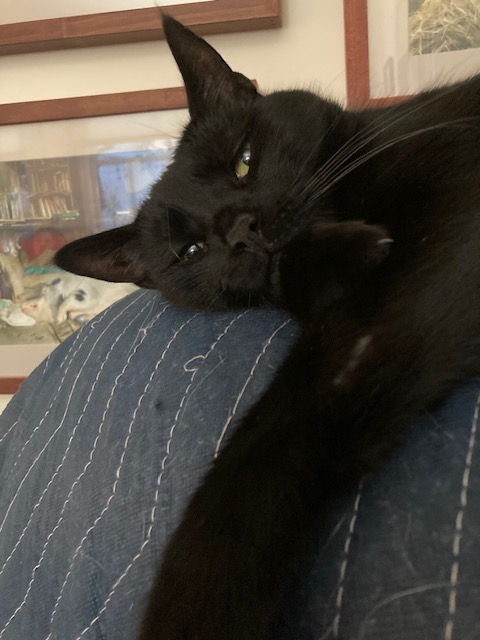
Cookie not really asleep this morning. Do you really want to know what this cat has to say?

As much as I adore Cookie and Blackie, I’m not sure there is much to improve our relationship by giving them more control over the daily demands they already make. Although maybe a diabetic Blackie could communicate better about his sugar levels, too easily I can imagine Cookie pressing the same button again and again – and Blackie always insisting he hates Cookie. I have to say, this might be one area where ignorance is bliss and we shall not go.

The Cat’s Party

Pam’s Pictorama Post: So today I take us back to the world of cat ephemera with a bang today. This little treasure came to me via a new dealer who I imagine I may see a lot of, Eldritch Oculum Antiques. (The website can be found here although I found them on IG as @eldritch_oculum_antiquarian.)

Our story unfolds, as it sometimes does, with an item someone (I believe it is my IG friend and gad about @fatfink) gave me a heads up about but had quickly sold. This was a photo of someone in a Felix costume that I would have loved to have scored for my collection – not least because I appear to own other photos from the same session!

Longstanding readers may remember a very early and popular post of these tiny photos I featured in the early days of this blog. I seem to have bought a few and then found more from a different dealer. When I told the story to the folks at Oculum I misstated that they came from Seattle but I just read my own post and it says that the came from Portland, OR – right where these folks are located. Portland seems to be an odd El Dorado of early Felix photos and I have that post and a few others devoted to this which can be found here, here and here!

Not in Pams-Pictorama.com Collection – sadly!
Pams-Pictorama.com Collection

However, this was clearly an account I wanted to follow! It wasn’t a month later when I spied this gem and snatched it right up. This is an unusual piece and further nascent searching on the internet only turned up two other editions of the Merriment Series, and sister Lady-Bird’s Series. One edition I did find, shown below, devoted to Funny Stories, and the other on the Internet Archives (see my Rosa Mulholland post of last week!) which is a scan of The Alphabet of Flowers and Fruit.

It was published by Dean & Son, Printers, Lithographers, and Book and Print Publishers, 31, Ludgate-Hill. This company, founded in 1800, became known for children’s pop-up books in the latter part of that century. They are noted for publishing into the mid-20th century but it is unclear to me if they exist today.

From the Ontario Digital Archive.

So, to get to the heart of the matter, this little missive is the tale of a party in Cat-o-Land, where cats rule and dog servants in livery are footmen and butlers. (Although the monkey playing the drum on the cover is notable as well. A careful look at the top shows one half of the orchestra as monkeys and tthe others as cats – one with his bow in the air and dropping his fiddle.) This is a jolly affair hosted by Mister Peter Pussiana.

It is written entirely in rhyme – …While all around esteemed them most polite, (for cats, like Christians, may know what is right/So, of grimalkins they were thought the best, – Quite models of good breeding for the rest… No author claims credit. Printed oddly, a pamphlet (9.4″x 7.4″), it has blank pages inserted throughout – something having to do with the printing? It is in fair condition, with the binding still tight but worn with dirt and folding and cuts or tears on some pages.

Fainting after hearing a bit of gossip scandal. I like the art!

While the cover is without color (although the first page is the cover with color), the rest of the illustrations are in a sort of limited color, looking applied on in subsequent layers. The backcover has a rather tantalizing list of other titles in the series that were available. Every thing from The Toy Grammar; or Learning without Labour to Mouse in a Christmas Cake. There is no publication date.

The tale takes us thoroughly through the evening and its entertainments – from dancing and eating to playing cards and gossiping. (Some scandal so salacious that Miss White-coat actually faints!) One of my favorite pages is the company around a large table eating, kittens lurking behind chairs, family portraits on the walls and a dog serving.

I share it with you in its entirety below to flip through – blank pages deleted. Pay special attention to the art on the walls and sculptures!

Long Island

Pam’s Pictorama Post: In a better world I would be writing this from home on Saturday morning as usual. I do have some new acquisitions that I am looking forward to treating you to but it will have to wait until Sunday as I am on what is these days, a very rare business trip.

My days at Jazz and even the Met treated readers to a fair amount of travel. Some of it quite exotic and international. (Some of those posts can be found here and here.) However, my current gig fundraising for an animal hospital does not require must travel. However, today here I sit in the rain, in very slow moving midtown traffic, a passenger on a Jitney heading for East Hampton.

I frequently say that into every New York fundraiser some time in East Hampton must fall. In today’s case it is an event tomorrow night. I am going out early and staying with a friend until Saturday.

Growing up at the Jersey shore my relationship with Long Island beaches is a bit skeptical. While “beach traffic” was a thing of my childhood (we could walk to the beach but you still had to negotiate traffic for any of life’s needs in a car) it could not prepare me for the gridlock of Long Island. Cars line up in long rows for blocks and blocks at intersections. You find that traffic is always a major topic of conversation here – what route did you take and how was it. This year’s event is in downtown Sag Harbor so some lucky folks who live in that historic district will be able to walk.

1937 view of Peninsula House (aka P House) Sea Bright in 1937. It burned to the ground in 1986.

The east end of Long Island has always seemed like the glitzy cousin to my beloved Jersey shore. The old houses here are older and many have more gravitas than our beachside mansions along the ocean. Houses here were built right on the ocean while most of those in Monmouth County are on the other side of a seawall and thoroughfare. Some of those few that were waterside perhaps washed away – or otherwise lost to time like the Peninsula Hotel which used to perch seaside in Sea Bright.

Luxury brands abound here – the streets dotted with the designer clothes of the moment, Starbucks (of course) and the likes of Tiffany. In Jersey the wealth moved more to the riverside and the mansions line those more interior shores.

View from the lovely house I stayed at.

Still, I have never entirely understood the appeal of this location, now with traffic a good more than three hours from Manhattan when I can hop on a ferry at 34th street and arrive on the beach shores of Sandy Hook in 50 minutes.

Another view – with swans.

Work is what is more likely to draw me out here in the summer than leisure activity of my own – my garden in NJ beckons! It has been a few years since my last jaunt during my final summer at Jazz at Lincoln Center when I came out for one of the orchestra’s engagements and to visit supporters out here.

Geese outside my window Friday morning, gently honking.

Then like now I stay in the gorgeous home of a thoughtful friend who I met during my years at the Met. This year I perched in a lovely guest cottage on her property which overhangs the shores of Georgica Pond. It is a heart stoppingly beautiful view of this protect inlet, just a canoe ride around the bend from the open ocean. I woke to geese gently honking out the glass doors to the water. (I wrote about one other sojourn at her house here.)

The weather here, like the weather everywhere in the area, has been lousy. Overcast and drizzly days, far cooler here than the humidity of the city which we have been subjected to. (I always vacation in August as over time I have decided that July tends to just have bad weather.) So,although I did get a short walk on the beach I never made it into the pool nor was I able to sit outsie with a book or thihs laptop and enjoy the world going by.

However, in a yard filled with water fowl, birdfeeders, a glory of bunnies and chipmunks there was always something going on. It reminded me so nicely of the river view from the house I grew up in where there was always something to watch or look at in the yard.

Also, the last time I visited here my mom was still alive. I remember sending her many photos of the views here and my fingers still itched to be able to do it.

This weekend’s destination was an exhibition of animal sculptures and a reception celebrating the animal hospital I work for. The building housing it, an exhibition space called The Church, which was once originally – a church that is. Philosophically I believe that Hamptons events consist almost entirely of people who live in greater Manhattan and who you could see there for less cost in time and money. (In other words, this feels unnecessary from a fundraising perspective.)

Aside from the event, my host took me to Long House gardens – the estate of Jack Larsen – where we took a wonderful long walk through the landscape, stumbling on sculpture nestled among the plantings. Having once worked for the Central Park I have some sense of the scope that the care of such seemingly casual plantings need. It was a day closed technically closed to the public and the staff was out enforce to take advantage of the weather between fits of spitting rain, broken by short periods of intense sunny heat.

Main drag in East Hampton taken while waiting for the bookstore to open. The one in Sag Harbor is the good one though!

I will report quite a bookstore discovery in Sag Harbor. I had gone to a satisfactory bookstore in East Hampton earlier in the visit where I was intrigued by a volume or two. However, Sag Harbor Books (info here) appears to have consumed a used bookstore we went in search of and the end result is a combination of books old and new for sale, just a block up from the water. I had limited time there but grabbed these two volumes and will give them a try. If you find yourself in this area make the trip to see it. Ignore the first editions and cases with huge prices and head to the carefully tended and curated shelves of more generic offerings. (There was a strong evidence of westerns and cowboy options. Kim is a fan but his reading so voracious and longstanding that I hesitate to buy for him. He is getting a t-shirt on this trip which is an odd choice, but I saw a color I liked and I grabbed it at a general store.)

General store in East Hampton where I purchased a t-shirt for Kim and some very over priced hair ties.

As I finish this I am on the Jitney this Saturday morning. It will be afternoon by the time it reaches you all and those regular readers may be wondering where I have wandered off to. I won’t get back to Manhattan until 12:30 and will need to get settled with photos and all before sharing this. However, I promise a rare treat in terms of a cat item tomorrow so stay tuned.

Narcissa’s Ring: More Mulholland

Pam’s Pictorama Post: I did not plan to post about Rosa Mulholland so soon on the heels of my most recent post (found here if you missed it just last week and the first one about her books here), where I zipped through a number of her works, mostly early, that I had read. However, Narcissa’s Ring, was a recent acquisition and a later work which kind of knocked me off my chair. As it happens, I was also lucky to find an internet site with a number of her books – including The Daughter in Possession: The Story of a Great Temptation. Both of these interesting works were published originally in 1915 and’16 respectively and they are worth note and comment while they remain fresh in my mind.

Before I get to them, a heads up about where I found The Daughter in Possession which I had not even seen copies or mention of for sale or otherwise. A site I have used occasionally in the past called Internet Archive (find it here) turns out to have a number of these hard to find volumes available for reading online. The did not come up in a general search for her books initially and it wasn’t until I thought to look there that I found them. This is very good news!

The somewhat bad news is that it is not the easiest site to read a long book on – I have had trouble saving them to my “account” although perhaps it is just most easily done on a computer rather than a phone or iPad. I am still working that out. Actual volumes are scanned for every page which is a charming way to read them – inscriptions and all in some cases. It also means if the volume was illustrated (which these virtually all were) you get those too. I am thrilled to be able to offer a place where some of these are available online, not to mention for free.

As far as I can tell, the Internet Archive exists out of California and I have not attempted to tap it for the many, many other categories it lists (everything from television shows to Russian literature). Of course I am curious about film and assume that, like the books, the films archived there may not show up in more general internet searches although may for specific books. I will need to send them a contribution as they have done great work in making some really obscure volumes available.

I had not in fact had I heard of Narcissa’s Ring either until I stumbled across a copy on eBay for sale here in the US. (I search for new ones online on a regular basis and eBay seems to pop for one periodically. The shipping from the UK where many of these reside makes the cost untenable.) It is the real find. In 1916 Mulholland was 71 years old and from reading this she may have in a sense been at the height of her prowess as a writer. While the style remains the same and some of her favorite tropes (romance, class divisions, astronomy) remain intact she goes for a full on sort of mystery in this now favorite novel.

As the story opens we find a young Russian teen with a penchant for chemistry in London, before long he is shifted to her favored locale of Ireland, but not for long as he is chasing clues to rescue his father from a life sentence for murder in Moscow. The search leads him to a certain perfume found in an antique ring – the sort which might have also stored poison but instead house a bit of sponge or other substance scent would be added to and worn. The scent in the ring never dissipates. It has a cabochon of glowing red stone on it – one that takes on an almost supernatural glow in certain lights. (Two stones to engage your imagination above.)

Mulholland leads us on a most wonderful chase through Britain, a sojourn in Egypt and ultimately the Moscow of the day. Because Mulholland is writing about these places as they are being experienced at the dawn of the 20th century there is a more than usual time capsule quality to her record of what these places were like at the time – not so much with her usual eye to recording what she knows may soon drift away in her native Ireland, but with more of a sense of the here and now in these places.

This slightly cheesy version kept coming up in my searches. The stone is really beyond the beyond!

I wouldn’t dream of spoiling the intricate plot but am here to say that it is a corker and I would have to put it at the top of my list of her books!

It also left me wandering the internet looking at these rings – presumably there was one in particular which must have inspired her. The concept goes way back to the Middle Ages and all sorts of examples still abound. As for glowing fire stones there are many – from fire opals exotic agates.

Immediately on the heels of Narcissa’s Ring I was able to hop back a year for The Daughter in Possession: The Story of a Great Temptation. (It’s a bit of a title, right?) This is an interesting lead into Narcissa’s Ring if you are considering her oeuvre as a whole because there is a developing sense of mystery and plot in this novel which is a prelude to the other.

Illustration from the online version of The Daughter in Possession.

The Daughter starts off with a favorite baby rescued after shipwreck set up (see Marcella Grace for another example) but turns into a multi-faceted plot following several lives as they set off together in one place and diverge wildly before all coming back. Like Narcissa’s Ring, locations in Ireland are briefly paid tribute to but the majority of the book takes place in London and then Europe, largely France which is a bit of a surprise. (There is an interlude in Toledo and sometimes I feel like we are treated to a travel log of her globetrotting.)

Illustration from Narcissa’s Ring.

We have a narrator for part of the story who is a bit unreliable, and we don’t quite know how the ending will or won’t surprise us. Like Narcissa’s Ring the trip is definitely worth the journey here. I would not rate it quite as highly but must say that she was going full throttle with her writing powers at the end of her life and seems to have only continued to improve.

The next one slated for reading, A Girl’s Ideal (1905), appears to start in the United States but will likely shift to Ireland shortly. (It is also available via the Internet Archive.) It is not clear to me that she ever made it to this country and her nascent description is a bit barren. This one is a you inherit a large fortune if you agree to marry this fellow you don’t yet know story!

Tavern Trip

Pam’s Pictorama Post: Yesterday on a whim Kim and I spent the Independence Day holiday in a remarkably patriotic way with a trip to the Fraunces Tavern museum in lower Manhattan. This important Revolutionary War landmark, where George Washington said farewell to his troops, is tucked among towering modern edifices, near the water and Wall Street. Kim just finished Washington Irving’s biography of Washington and it occurred to me that neither of us had ever been before.

Waiting in line out front for it to open.

The Tavern remains a restaurant and pub (I don’t believe it has operated continuously as there was information about a renovation and restoration at one time in one of the exhibits) and, unsure if it would be the holiday destination for many, I made a lunch reservation in one of the several dining rooms just to be safe. We had a 12:45 reservation which turned out to be about right to see the museum first.

Funny little display in the front wall of the building near where we waited on line.

Luckily it was a glorious day and we hopped on a ferry running along the East River and took it all the way to Wall Street from 90th Street, convenient to our Yorkville neighborhood here. July 4 is one of those holidays when Manhattan generally empties out and aside from some tourists, there is a group of us left to our devices here and that was represented by folks who were lined up to take this local ferry to the beach, biking or like activities. The result was a fairly full but not crowded ferry ride. (I became enamored of the ferry system, running up and down the east side, to Queens, Brooklyn and even New Jersey during Covid and have written about my introduction to the longer on to Jersey here .)
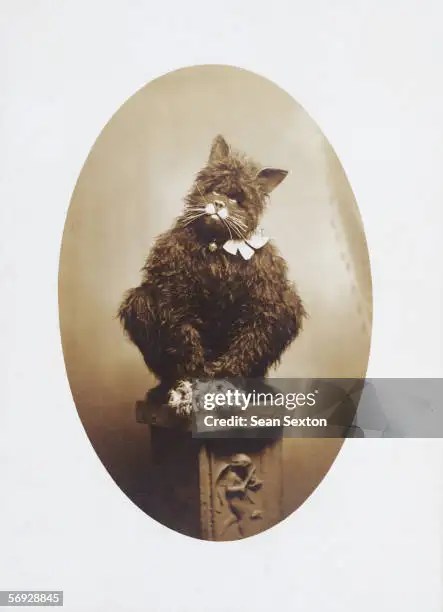
A snippet of the ferry in the East River about to go under, I think, the Manhattan bridge.

It was fun to travel to the museum by water rather than subway, a period appropriate way as the water would have frequently been used for transport in the 18th century. It was also a fraction of travel time – although the wait was longer than for a train and this was exacerbated by the mercurial holiday schedule it seemed to be on.

The museum is just a few blocks from the ferry terminal although Google lead us on a bit of a roundabout merry chase in an attempt to use maps. I think in part the problem is with so many tall buildings that reception is iffy there and the map would not reload properly. Anyway, we arrived as a small parade of folks in period clothes seemed to be wrapping up. (I overhead that they were here from Virginia but I am not sure if I caught the broader reason for their costumed attendance there.)

The Dingle Wiskey Bar, closed, but where we waited for the museum to open. Woman in 18th century dress using her cellphone a bit of a bonus here.

For those of you who don’t know the city, downtown Manhattan is entirely different than the rest of the island. As the area that was first built up, the streets are tiny and narrow. Because it is now the seat of commerce and business, enormous towers have risen and largely block the light from the clutches of tiny, historic buildings. I cannot imagine living or working in the area – it would be like living in an entirely different city. Unlike the rest of the city, lower Manhattan is not on a grid and hence the need for a map to find your way among unfamiliar and twisting streets.

A block or so of historic buildings approaching the museum’s block.

Even for all of that, we arrived early for the noon opening of the museum. There was a line outside but that was really just waiting for it to open – it did not have a persistent line throughout the day although they seemed largely booked for dining.

We were herded into one of the bar spaces to wait which gave us a chance to study that room a bit. There are, I believe, six different dining and drinking spaces (although there was a private dining area which may be a seventh – I lost count.) I was unable to figure out if the configuration was based on the original layout – many small rooms being typical of such an early building. There is evidently a piano bar occupying the fourth, top floor, but it was not open and we didn’t get to see it.

Another view of the Dingle Wiskey Bar.

The museum commences on the second floor which, in its day, would have also been serving spaces. It is not clear to me that this edifice was anything other than an eatery so perhaps all the floors were dining areas. (It isn’t clear that Mr. Fraunces or subsequent others lived there. It seems that in Washington’s day it was open day and night so my guess is he did live on the premises.) A large room on the second floor is said to be where Washington addressed his troops – it seems too small for that leaving us wondering how that worked. A firsthand account of the event is on display but also written on wall text for easy reading.

Arguably the reason we were there – said to be the space where Washington address his troops.
A later rendering of the event on display.

The tavern was also used to house some of the governmental staff during that first Presidential term which was served in New York and not Washington DC. I think it housed foreign relations and another arm of government I have forgotten. There is a small special exhibit about the discussion of the British evacuating New York and the trails that were held for traitors to the American cause.

In culinary history, the restaurant is known as being among the first to have a la carte table services while others still only offered family style meals at large tables. As mentioned above, it was also open 24 hours a day – all making it a bit ground breaking in that sense.

Not surprisingly, images of Washington and ephemera abound on virtually every surface.

While the second floor has the one period room (also where you pay admission, usually $10 but only $1 yesterday for the holiday, a small shop there as well) and an exhibition space. The third floor are the larger galleries and a room set up auditorium style. (They were actually preparing for a lecture later that afternoon.) The exhibitions are largely reproductions of documents and a smattering of items. The old maps were of interest and some of the letters (the original of Hale’s last letter before he was captured and executed as a spy) are available to be read more easily online with a QR code.
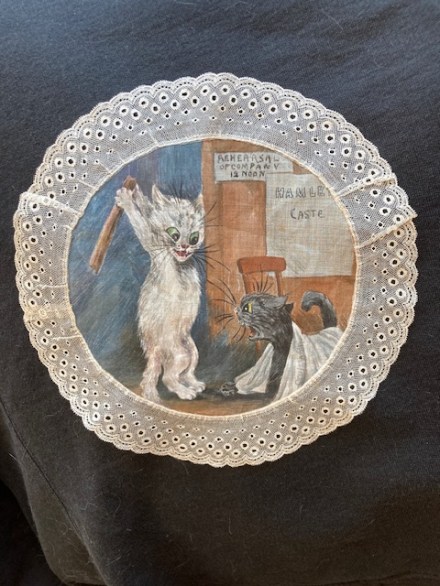
Fewer actual ancient bits are on display than anticipated, but this very old desk/chair was one.
The physical space is a mishmash of period styles and bits. For example, the enormous original plank floors are only in the smallest area with a mix of wooden floors from different periods throughout. Early wallpaper is noted to be from an indeterminant early but later period. Ceilings are low and rooms are intimate – fireplaces in all the original rooms. However obviously the space has been renovated, constructed and reconstructed to make it (somewhat) accessible and work for modern displays.

It was easy to locate where we reside, about halfway down this map, given the islands and waterfront outline.

The displays, as mentioned, are a bit ricky ticky, if you need sophistication you will be disappointed. However, the museum appears to have a robust program of lectures, symposium and especially family activities and while it certainly attracts tourists it is clearly also a part of its community for those who live in the area. (Events around period games, quilts and story time are scheduled for the remainder of July.) I got the feeling that for some folks it is a regular neighborhood hang for food and drink.

With that I would say the same about the food establishments. There are programs of live music most evenings and at least one of the bars is for walk ins only. I was pleasantly surprised to find that the prices are not touristy gouge-y, but actually quite average for New York City. I made a reservation through Open Table online and we were put in a long bar space in the front of the building. The other large dining room, running along the side of the building, is somewhat more formal.

Incongruously perhaps, soft rock music circa the 1990’s played (loud but not hideously so) in the bar space we occupied for lunch. Kim had a burger and fries and I had a blackened salmon sandwich with sweet potato fries. Kim had one of a number of non-alcohlic beers and I had a large (very good) extremely local Frances Tavern pale ale. While I was very tempted by the idea of a sticky toffee pudding (I generally cannot resist that description) I decided to be good and allow for the possibility of an ice cream later.

Holiday themed celebrants at the bar restaurant where we ate lunch.

The ice cream never materialized. After leaving Fraunces Tavern we attempted a visit to the nearby Seaport Museum but they had (mysteriously) opted to be closed for the Fourth. Our day ended with ferry mishaps as they decided to run the last ferry earlier than published and police barricades (anticipating crowds along the waterfront for the fireworks which wouldn’t start for many hours) kept us from hopping on the final one. So the day ended on the 4 train speeding uptown and ultimately a happy collapse in air conditioning and with cats as the conclusion to our holiday adventure.

Rosa Mulholland Part Two: Searching for the Sweet Spot

Pam’s Pictorama Post: Several weeks ago I embarked on reading a new late 19th-early 20th century author, Rosa Mulholland, and wrote a post about her that can be read here. I’ve subsequently read several more books and thought I would update you a bit on my findings. (Recovering from mouth surgeries has given me much reading time – in addition to these books I polished off at least as many contemporary novels!)

For those just tuning in, Mulholland (who also wrote under the name Gilbert) was a prolific Irish writer of the late 19th to early 20th century. Many of these volumes, virtually all illustrated fairly profusely, are beautiful old editions which is what attracted me when I bought the first volume.

I have read several more since I last reported and found one I cannot seem to get into, but more about that in a bit. Terry, Or, She Ought to Have Been a Boy, was one of the few books I was able to find and read online. It was published in 1902 and is a novella that seems to have been a sort of chapter book for older children, or one that could be read to them.

I didn’t love it – for me it felt like it never quite got all the way off the ground. It is about a very obstreperous and wildly undisciplined little girl and her brother who tags along with her exploits. Said children are left with an infirm grandmother who leaves their care largely to a housekeeper. A lot of chaos ensues. Terry is a Rosa Mulholland-type character as a child who we never get to follow into adulthood.

Not my copy as I read it online. Pretty though!

Hettie Gray: Or Nobody’s Bairn (1883) is short novel, also available online and I gather there is a reprint that is widely available. This is a more interesting story where Hettie is a foundling (of high birth of course) who literally washes up ashore and is taken in by a poor village couple. As a small child (with a bit of a wild streak) she is found one day by a wealthy woman who literally scoops her up and takes her off. She spoils her terribly and makes her into a bit of a wretch and then the wealthy woman promptly dies leaving Hettie largely friendless. We watch her original good nature re-emerge under adversity.

Mulholland has a few ongoing fascinations she returns to again and again in her writing – one is strong willed women and the difficulties they have fitting into the narrow society of the time (they are generally somewhat tamed but that will also pays off in other ways), and another is class structure. These two things play together as evidently to be poor and strong willed is seen as one thing but to be rich and strong willed another.

I don’t own this one yet, but there seems to be a fair amount of noise about it so am looking for it (1895).

The best of this lot was Cynthia’s Bonnet Shop (1900) and it is for me Mulland at her best. (I did purchase one of the first editions as shown here, but had to settle for one that is quite tatty in order ot make it more affordable!)

Although some of the usual tropes are present, Cynthia is part of a fatherless but otherwise large and intact family which is a nice switch. There is the requisite wealthy (but unpleasant and selfish) relative who inadvertently sets Cynthia on the path to establishing her own bonnet shop. There is a mysterious benefactor. Her London shop becomes wildly popular. Romances for the sisters ensue but skew some with a patent Mulholland, I love him but I think he loves you not me so I’ll step aside, bit of plot. It is a pleasantly long read and the characterization of the two older sisters is great and good fun.

Mulholland notably also has a thing for astronomy. This is the second book (My Sister Maisie being the other) that has a story line about a woman who aspires to being an astronomer. I have to imagine that it either was a personal interest of hers or she was close to a woman who was or wanted to be one. That is another quality of these novels – the women are striving for something but consistently fall short of achieving in the man’s world. I assume this was a factor of the time and place. Mulholland is several decades earlier than let’s say Francis Hodgson Burnett (I wrote about her adult fiction which I enjoyed immensely in a post here). Europe was behind the US in progress for women and I would guess Ireland a bit further behind still. People looking at Suffragettes more than a bit askance as they emerge there.

Another I don’t have but am interested in (1905).

The final book for today, Marcella Grace, An Irish Novel (1886), is a plot that is devoted entirely to class distinction and the inflammatory politics of Ireland at the time. As someone without a lot of background in the political history of Ireland I am not equipped to comment on the position she takes. It is clear that she is leaving some room for a dissenting view (some sympathy for the downtrodden who took the paths of taking up arms) although for all of that they are the evil forces who drive this particular plot forward. This does make for a different book and I appreciate that as she could start to feel a bit repetitive. However, while I enjoyed it I cannot say it was an absolute favorite.

There is one on my bedside pile that I have been unable to penetrate, Father Tim (1910). Unsurprisingly it is about a priest in Ireland. I’m not saying I won’t end up reading it but I have not yet been able to really engage with it. Perhaps the fact that it seems to be written from a man’s point of view isn’t working for me. If I manage to read it I will report.

Another one I am hankering for, 1889,

I’m not sure looking this over that I have precisely found the sweet spot in her writing. I want to say that 1900 seems to be a high water mark, but Terry, Or, She Ought to Have Been a Boy is shortly into the 20th century and was less promising. (I think I have to be careful to avoid these books meant for children – not true of all authors but for me it may be for her.)

I have one more hardcover book in the house to read, Narcissa’s Ring, 1916. I have been acquiring them as they become available. They are more widely available in Britain but the postage to ship a book is so outrageous it puts most of them out of reach. Given what I wrote about in the earlier post and this one, a true sweet spot has not yet emerged.

Attached?

Pam’s Pictorama Post: Today I find myself at a perch that used to be most familiar, Kim’s computer at the foot of his long drawing table. It is a somewhat superior spot to my usual view of a bookcase at my desk/work table behind where he is seated (even as I write, working away on this Saturday morning). This is one of those “slice of life here at Pictorama” posts.

Back at the commencement of Covid in March of ’20, a very basic beast of a laptop that I had purchased for work went into daily use at home for the next almost three years. (I have written several posts about that work from home period. A few can be read here and here.) That rather anonymous laptop died a slow death after taking a beating during those Covid years. I was very fond of it by then but it had developed the unfortunate habit of locking itself periodically a habit which it could not be broken of. Intervention made it meltdown completely. Rather than take another clunky Jazz at Lincoln Center owned laptop I purchased my own.

Early Covid desk set up with work laptop here.

I turned to a friend who has helped us with computer issues in the past and asked him to find me the lightest laptop possible. At time, January of ’23, my job at the animal hospital wasn’t even a glimmer in my eye yet and I assumed I would return to my domestic and international travel for Jazz at Lincoln Center and lugging a heavy laptop was exhausting. Bernie found me the lightest little laptop in the world – barely weighing more than my elderly iPad and keyboard at four pounds it is a basic but very usable little fellow. Although the travel has largely been to and from New Jersey, I never regret how very light it is, tucked into a bad or suitcase.

It was rebuilt and happened to also come in this sort of pretty rose gold color. It cost me $378. Since it was now my own computer once set up at my work space I migrated to it for everything and left my weekend morning perch at this one, where I had spent many a Saturday and Sunday writing to you all. There were adjustments to be made – most significantly a very small screen, the price of such a small, light laptop. Nonetheless, it has gotten me through many trips to New Jersey and has been my cheerful morning companion daily since its purchase.

Blackie as a hard working home office cat during Covid.

At first I missed sitting in this spot a bit. Looking at Kim rather than at the back of his head as we chat. I get to look out the window from here too. I am though, as I have opined before, very much a creature of habit so my routine has been upset and it leaves me out of sorts.

It is odd to me how attached we sometimes become to these anonymous bits of equipment we spend our days with. Not all of them mind you – some I have happily sent into oblivion. I have not been one much to name them or humanize them, but we spend time with them and unthinkingly store things on them we want to keep. We understand that they are always temporary but periodically we get caught. I don’t have a lot on the hard drive of that computer I don’t have elsewhere but it would be inconvenient to lose it.

Meanwhile, in other news, I have been fighting the good fight with a problem in my mouth for well over a year. Several surgeries and the most recent ending in (very) painful failure. This happened earlier this week. After the unexpected surgery I came home and fell into bed for several hours. When I finally woke up sufficiently at the end of the day to spend a half hour answering the most urgent work emails, I sat down at the computer and signed on and…a black screen. I shut it down and tried again. And again.

I do question, if I need to buy another laptop – would I buy a rebuilt inexpensive one again? I mean, I got my money’s worth in a sense. It is rebuilt so it makes it seem less disposable although as I probe I am not sure if that is true. I am open to suggestions and thoughts on this one.

Therefore, immediately following the writing of this off to the Geek Squad or u break it we fix it for a long morning of waiting and paying. The good news is that the pain in my mouth has started to abate which improves my mood for this venture considerably.

Two Is Company

Pam’s Pictorama Post: Oh the poor rejected lover kitty! His beloved caroling away with her paramour. So sad! Is she truly fickle? Did they etch their initials together previously in this tree trunk? Or are those the initials of the lovers he he walking by? Or was the affection all on his side? It was not meant to be.

Our third wheel is in a strange stance – partial fight and somewhat flight as the bottom half of him already seems to be walking away while the top half looks back. He wears a nice bow, unlike the singing lover, although Miss Kitty has a red collar on. The cat couple only have eyes for each other so they don’t even see him behind the tree – alas. I’m fairly sure that the toad stools growing at the base of the tree are symbolic. (Danger, poison and no less than Existential Dread according to the internet.)

This card has an embossed quality and was never mailed, nothing is written on the back. It was produced by Souvenir Postcards of New York and Berlin. I assume it was riding the crest of the Wain-esque cat craze of the post-Victorian era. Although anthropomorphic like his these cats are less pointedly satirical. Not sure who you’d send this card to where they wouldn’t feel like you were making some sort of point or message.

This card points to the whisp-o-will nature of cat affection and, shall we say, coupling of felines. I have limited personal experience of this beyond one cat, Winkie, that managed to evade our window of spaying post-adoption slip out and find a tabby with whom she had a brief liaison resulting in four kittens.

My sister Loren holding the mysterious Miss Winkie.

In retrospect, it is hard to associate those kittens with her as she made short shrift of her affiliation with them. We kept them, two gray, a tabby and a orange tiger. They became: Ping and Pong, Tigger, and Squash. Ping was a smart female and Pong a (very) dopey male. Tigger was a nice and very pretty tabby who sadly wandered off, was found once and did it again. (Our cats were free range in those days.)

Meanwhile Squash turned out to be a pale long drink of an orange cat – so long it was like he had an extra vertebrae or two. As a result would often sit on his haunches, like a human on the couch or in an armchair, comfortably bent completely in two. (My brother Edward once declared of Squash, Survives but never thrives, which seemed pointedly accurate. I have to admit that I have no memory of when Squash passed out of our lives as I wasn’t living home at the time but neither do I remember the report.)

Squash was in most other ways a rather undistinguished fellow living quietly in a multitude of cat personalities. (The kitten event had swelled the family total to unforeseen highs!) However, his distinguishing characteristic was his affection for one of the other cats. He was the rare cat in that house who would seek out another and sleep with his arms around him.

Peaches, one of the Jersey Five of cats, hates everyone (man and beast) it would seem, except the elderly cat Milty. She stealthily climbs up on a chair and curls up asleep with him. Milty, whose precise age is not known to me but a rough calculation has around 20, is largely the benevolent figurehead of senior male in that house. He likes to have a brief go at every dish of food as it is put down but otherwise he’s pretty chill.

Peaches, left, with the ever patient Milty.

Meanwhile, the role of senior cat largely belongs to the four year old enormous all black male, Beauregard or Beau. That said Blackie, of the visiting New York cats, believes himself to be senior cat when we are in NJ. Beau will take a certain amount of that since B doesn’t eat with them which would probably cause the imminent collapse of that small kingdom.

There are occasional blow ups and one took place last summer while I was on a call with the two Board Chairs from work. That said, if you are going to have a cat fight explosion while on an important work call its good that you work for an animal hospital. They are very forgiving about animal interruptions on zoom.

Blackie, looking entirely black since we can’t see the white star on his chest.

Going back to Winkie, who was a very smart little polydactyl calico cat. Having produced said kittens (in my parent’s closet, the carpet was never quite the same) and caring for them a scant amount of time she pretended that she had no memory of them nor where they came from and generally treated them with a superior attitude and disgust as interlopers we’d wished on her one day. Such is the attitude of cats.

A Striking Cat

Pam’s Pictorama Post: This is a pretty odd piece I purchased recently from a dealer in Britain via Instagram. (See last week’s post which can be found here for the other piece I purchased at the same sale, @oldstockantiques or www.oldstockantiques.co.uk.) It was listed as a match striker.

This auction went sort of fast and furious (and also very slow in another way which I expounded on last week) without much chance to really study each object. I mean you could look at it or buy it but not really both because it would be gone by the time you looked at it – or so it seemed.

Not to say I wouldn’t have purchased this little fellow either way. I like him and he gave the cats a bit of a fright this morning with his miniature arched back silhouette while I was carrying it around. First Blackie raised an eyebrow but Cookie had a full on stare down and sniff fest with it. We never got to an all out hiss though. With all the black cat objects in the house few are close enough to cat size and in the war making position to attract their ire.

And the back. Look at this little slab of marble!

Anyway, there are some disparate aspects to this little fellow. His overall weight and marble stand make me think of something I would have found in my grandmother’s house. She had many little jade ashtrays and pin dishes (no one smoked) on marble stands like this. Sadly I have none to share as my mom wasn’t a huge fan of ashtrays.

In the lower right corner (ours, not his) is a little groove I assume is for actually striking a match – I could use this as I am the person who always burns themselves when I strike a match!

The match striking spot.

He (she?) is a solid cast iron and as mentioned above, even marble aside, is weighty. The fur is nicely delineated and a careful look reveal tiny teeth in the open (hissing) mouth. There is that nice big red bow. He stands on toe defined feet. The paint is a bit chipped but overall in good condition.

They are only glowing red because they are reflecting the cover on my phone! Still, I like the effect.

There are two unexpectedly odd aspects to this piece. The first are the rhinestone eyes! I assume they are original and I can imagine that they would flash a bit in the light but there is something utterly unexpected about them. They do glint and glitter.

Odd hole – to hold matches?

The other thing is the strange hole showed in the top. Did people drop the matches in there? Or maybe it just held a few? Not like it could have held a lot of them. There is not evidence that there was ever anything additional that went in that opening. I am somewhat stymied.

C & B in the sun this morning. The fake cat forgotton.

However, this item seems like an ideal denizen of the Pam’s Pictorama Collection here at Deitch Studio and I’m pleased it transversed the Atlantic to rest here.