Score

Pam’s Pictorama Toy Post: This is one of those lovely occasions when I get to write about acquiring something I have wanted for ages! Today it is this wonderful Felix toffee tin turned toy pail.

Allow me to start by saying that I love toffee. Seriously, caloric concerns are thrown out the window as soon as I see sticky toffee…followed by virtually anything written on a menu. It is a little known fact about me, but a fact nonetheless. I came to it late in life, but I think that has more to do with having had limited exposure to it when younger. I believe if I had been introduced to it earlier I would have been a life-long toffee fanatic. Somewhere in a parallel universe I am simply ruining both my teeth and my waistline contentedly stuffing myself silly with toffee.

e828ba91-0804-48b0-97a5-833a81a96188.jpg

So if nothing else for me the vision of this delightful pail stuffed with British toffees is a wonderful one indeed. Oh the gluttony! Oddly and somewhat mysteriously, the tin bears no label for said toffees sold, only the maker of the tin, E.T. Gee & Sons and this pail is always advertised by that name. One might imagine that a toffee maker of the time like Mackintosh’s might have filled it. The candy descendants of Macintosh’s Toffee exist today and are the makers of Rolos and other delights. Macintosh was definitely selling similar pails of toffee, but those are all emblazoned with their name leaving me wondering and somewhat stumped. It is possible that the lid had a name embossed inside perhaps, or that there was a paper label/sticker. One version online seems to have the remnants of an odd sticker that says …sweet little babies.

E.T. Gee & Sons is not especially well documented as a company – I could not find much history on them. However, I find tracks showing they made a whole line of similar candy containers that were also tin toys once emptied of their confectionary treats so this must have been the side of the street they were working. Although the Felix pail is the most prevalent one, I found evidence of two others online and sadly could only fine this single small image of the house which held creams. (Google images revealed no larger photos nor additional examples.) The house, doubling as a bank, is a photo from the Worthpoint auction site and the biscuit tin wagon from an auction site called Bukowski’s.

download-2

At auction on Worthpoint, a toffee tin that doubles as a bank.

10573906_fullsize

A biscuit tin that doubles as a toy truck, image from the Bukowski auction website.


Meanwhile, I have been admiring this Felix pail for a number of years now, stealthy hunting of it on eBay, tracking prices and failing each time to be the high bidder. A version in condition only somewhat superior to my own, but with the top (shown below with this mischievous Felix whose tiny rendition of the toffee pail is stuffed with toffee – mine does not have the top sadly) went for more than $3,500 just several years back at Hake’s. I have lost several on eBay that went for much less than that, although probably all without the top. My example does come from Hake’s – just a bad day at auction?Maybe, but clearly for whatever reason the price of them has dropped considerably. I paid a tiny fraction of that for mine.

image-1

From a Hake’s auction catalogue, lid to the Felix pail which mine is sadly missing.


The decoration is decidedly and delightfully cryptic – the scenes are certainly comical, but you really have to wonder where they came from. On one side Felix rides a white horse or pony (sort of Felix as Lady Godiva in my mind) along the water’s edge. He is being chased by a young boy (with an outsized head) brandishing a spatula? Or perhaps it is the shovel to a sand pail? The boy seems to be running full speed while the awkward drawing of the horse seems to have Felix at a slower pace. (His toes curling upward in an interesting manner.) Most bizarre of all however, is the female Felix in an old fashioned bonnet and dress, taking the scene in at the water’s edge. A broken fence in the foreground leads the mind further down the path of an unknown narrative. The horsey hardly looks like he’d break down a fence. Curious indeed!

felix pail side 1

My very own Felix toffee pail! Pams-Pictorama.com collection.


The more benign scene on the other side is my favorite – a large family of Felix-es, Mom, Dad and three babies – having their photo portrait taken! Of course as someone who collects photos of people posing with Felix on the beach this is a very funny inside joke. They are dress for the occasion – the Dad in a vest, mom in a long dress – in this alternate universe Mrs. Felix evidently dresses like a Mennonite. One child splashes in the water with a small sand shovel, the other getting his feet wet while a small girl perched on a rock beckons to him. The photographer, complete with tri-pod, camera with bellows and (I think in my mind) long exposure film, appears to be a young boy. Daddy Felix is gesturing approvingly to the camera. A toy looking sailboat appears in the distance. A splendid Felix walking decoration rings both top and bottom of the pail.

felix pail side 2

Pams-Pictorama.com collection


My version of the pail is about 8″ high and I understand that there is a slightly smaller version with a single row of Felix around it. (I’m glad mine has those!) It has a satisfying sturdy handle for holding and swinging merrily as you walk, and I think it would make a jolly pail at the beach, although I am pleased this one doesn’t appear to have spent much time in that capacity.

As a child who grew up on the shores of the Atlantic ocean I know a little something about playing in the sand at the beach and I can assure you much could be accomplished with a nice little pail like this, accompanied perhaps by a small sand shovel. One could dig deep caverns, carry water to fill moats or to dampen sand into the proper consistency for the construction of castles and related buildings. One’s pail was essentially a ticket to hours of beach fun and this would make a splendid addition to any discerning child’s collection.


Of Tropes and War: Part 2

Pam’s Pictorama Post: Picking up where I left off yesterday, today I tackle what really made this recent Frances Hodgson Burnett read a bit different, the description of a WWI Britain. I am a bit fascinated with a lot of contemporary fiction which covers the period between the two world wars in Britain. It is an interesting slice of time as people recover from the horrors of WWI and then, in too short a time, the foreshadow of the second world war rapidly creeps over them. Conceivably many of those men who survived the first war had sons in the second and that alone is too horrible to really contemplate. This novel is an eloquent reminder of the reality of that war.

The sequel to her book, The Head of the House of Coombe, Robin occupies itself entirely with the war, the main male character of the story having been marched off at the end of part one, this second half takes place during the war which is central to it. There are things that surprise me about this description. Perhaps because it is so close to the actual events there is a vividness to the descriptions that I have not read before.

The horrors of the pillaging of Belgium is graphically described and a central motivation for young Brits, even from the wealthiest families, to join up. I was well aware that part of the horror of WWI was because of the brutal mix of modern warfare with what had sufficed for ages before – men killing each other on horseback and in hand to hand combat. Now men on horseback and fighting with swords were being killed by mechanized weapons and bombs from the sky. For all of that somehow the kind of on the ground rape and pillage that went on in a more Genghis Khan fashion had escaped me.

CpAXCkJXEAAQCRp.jpg

The cynicism of the British nobles about the Americans and if and when we would enter the war was also enlightening. Would the United States only enter if it was of economic value to us? They desperately needed the Americans in the war and as we are aware, for a number of our own reasons that commitment was not so quick to come. This was hugely frustrating and even terrifying for them.

Remember also, Hodgson Burnett had deep loyalties to both countries – that of her birth and the country she adopted as a teen and subsequently lived in most of her life and that conflict plays out here. I assume Burnett, in the final years of her life which were spent living in Westchester, did not see or experience WWI London firsthand. Perhaps these vital descriptions came from accounts from friends and newspapers of the time or maybe she did travel back shortly after.

Finally I was surprised to read that, much like those folks who brought picnics to watch the first battle of the Civil War, there was a practice of going up on rooftops to party while watch the zeppelin bombings on London. Ultimately this ends badly in the novel (as I assume it must have in life) and a brief but horrific plot point turns on this event. There is a description of random body parts being found in the street after, only a hand left to be found and identified, that had a realism which was also chilling.

hith-london-wwi-zeppelin-terror-poster-wikimedia.jpg

I did know from other reading that the bombing of London during WWI was as devastating as that of WWII and again one is stunned thinking about a certain sandwich generation which experienced bombing during both wars fully.

Worst of all were the descriptions of the German prisoner of war camps however. One assumes that a few years after the war these stories were finding their way out and Hodgson Burnett shocked me with some of them.

To me it is of interest that even at the end of her life, Hodgson Burnett was still delivering these very contemporary stories. A few decades before her stories described the emerging 20th century world – where travel between Europe and the New World became accessible to all and the role of women was rapidly emerging. (I have written about the emerging 20th century woman in her novels here.) As in WWII Britain, women took on all jobs at home during WWI which is also described in this novel. She also recognizes that sweeps many of the remaining social constraints and conventions for women aside.

6SdBbMDgiZ_HmzUeuzaNYTZpQhqlk4adGZTZxNPTpBE,9mNWrSn4wCr8GyT2ITRFhlJgQJeG1uz0pX6bEEHuMx4,tpp20Ucl9g7GMQmJyfiJFfME6r2IfQ42whT1iPAQ-8c

Knowing that the first half of this novel, filled with the aforementioned tropes of pining romance, rags to riches plot and unearthly communion (as outlined in yesterday’s post found here) was hugely popular in the United States I do wonder about the reception of this second half, originally published on its own the same year. While the first half is all flag waving for the war, this second half contains all the cynicism and pain. Somehow she wrapped all these things together and tucked them into one final novel.

Of Tropes and War: Part One

Pam’s Pictorama Post: I do apologize up front if you do not share my continued interest in these Frances Hodgson Burnett novels, because even I thought I would be done by now. Yet I find another aspect that had me in its thrall this week and has occupied my mind in a way that prevents me from finishing my next Felix post of a great new wind-up toy recently acquired. (For anyone who is joining me for the first time, a few earlier posts on Hodgson Burnett’s adult fiction can be found by searching this blog or herehere and here.)

For those of you who are following my passion for Hodgson Burnett’s novels, you may remember that early on I said that the worse the title of one of her stories, generally the better it is and The Head of the House of Coombe falls neatly into that category. As a result I had not grabbed it before this. However, I recently used Goodreads.com to help me figure out what remained of her works that I had not read and create a list of which are novels, as opposed to novellas and short stories, that remained for me to read. For all its greatness Project Gutenberg supplies no information before you download – could be a hundred pages, could be twelve and I like to know what I am getting into when I start a book or story.

product_thumbnail.jpg

Written originally for serialization it was published as a novel in 1922; it was the fourth most popular book in the United States that year. The sequel, or second part of the book as it was served up to me, is called Robin. It also has a publication date of 1922 so the exact publication history and serialization of the two parts remains somewhat unclear to me. The publication date is mostly of interest to me because of the proximity to the end of WWI, which drives the plot of this novel, and that this book appears to be the last major publication of her life as she dies in 1924. Assuming these were actually written for magazine serialization in 1921 or so, it is a few years after the conclusion of the war and as many before she dies.

However, before we get to the war, we are treated to Burnett in all her glory reveling in several of her favorite Victorian tropes. Robin, the main character, is a commoner ultimately taken up by nobles. She is so purely good and innocent the more cynical nobles quickly become devoted to her. Meanwhile, her mother is a stunningly beautiful chippy, wonderfully named Feather, who it is well-known, a woman kept by the Lord of the House of Coombe.

FC Yohn Good Housekeeping

FC Yohn illustration of The Head of the House of Coombe as published in Good Housekeeping


Meanwhile, in addition to her rags to riches story line for Robin, she also puts her through her paces with two other beloved tropes, illness and spiritual communion or communication. Burnett just loved to plunge her characters, usually a woman but occasionally a man, into a mysterious consumptive wasting state due to separation from or rejection from a beloved, usually a lover. In some way s/he is miraculously revived when reunited with the person in question.

Again, for those of you who have been following me on this path thus far, know that Burnett’s own oldest son Lionel was lost to consumption (TB) just two months before his sixteenth birthday. While blogging about Frances Hodgson Burnett I was contacted by her great-great granddaughter, Keri Wilt, who has a website (fhbandme.com) and an active Instagram account also under the name fhbandme. I began to follow her and she recently posted a photo of a locket Burnett wore with Lionel’s photo. I was a bit fascinated by this post. She shows us the locket and the inscription Farewell to others, but never we part. Heir to my royalty, son of my heart.

39977263_1400629172

Burnett with son Lionel. The inscription on his grave, “Lionel, whom the Gods loved”.


She also quotes a letter of Burnett’s about her son’s death, It will seem almost incredible to you, as it does to others, when I tell you he never did find out. He was ill nine months but I never allowed him to know that he had consumption (tb) or that he was in danger – and when he died he passed away so softly that I know he wakened in the other world without knowing how he had left this one. I can thank God for that. Wowza – not sure what I make of that. Can a 16 year old boy, dying of consumption at that time not at least deeply suspect that he is dying? For me it is overwhelmingly moving though in its need to be true to her. She returns to it again and again in her fiction.

d41ba0a862492351dc512fc8572fe859

The wasting unnamed and consumptive disease illustrating an article on this topic.


Another deep vein of interest is Hodgson Burnett is her interest in spiritualism which I gather she takes up somewhat later in life. (I am assuming that it ties out to the death of her son but I am not sure I have seen this confirmed.) If I can find more information on where it parallels with her life it will definitely rate a post of its own – this may happen when I get to reading her autobiography which is already in the house. Spirit communication is a frequent plot device with some variations – mystical communication with both the living (but not present) and the dead. The novella The White People is one of several shorter works devoted entirely to the subject. Without being a plot spoiler I will just say that it makes up the major plot weenie (as Kim would say) to the second part of this novel.

1_M-8aEx_9g35r5FzeBNnueQ

Library of Congress example of spirit photography.


Having covered wasting illness, rags to riches plots and touched on spiritualism I leave you for today. Tomorrow I will share the fascinating turn things take with Burnett’s surprisingly graphic descriptions of WWI England which was what really made this book stand out for me.

3 Little Kittens

Fontispiece.JPG

Pam’s Pictorama Post: This wonderful little tidbit was a gift from my friend Eileen Travell – and it is a perfect addition to the Pictorama library of cat literature, toys, phots and collectibles. I read that the original poem is an English nursery rhyme with roots in British folk lore. The poem as it is generally known today is attributed to Eliza Lee Cabot Follen, an American writer (1787–1860), first published in 1843, but finding its way to the Mother Goose canon over time. This edition is of the poem updated further and modernized for the 1923 publication by Ruth Kauffman. On the inside flap of this copy there is an undated inscription by an earlier owner, Alma Richarde, in uneven but very legible print.

Not much can be found about Ruth Kauffman beyond this volume – although it should be said that must have been a wildly popular book as many copies are available on the internet today. It would appear that Ms. Kauffman was married to Reginald Wright Kauffman, author and journalist; his work generally pertaining to social causes of the day. As for Ruth, her slim volume of The Three Little Kittens Who Lost Their Mittens seems to be what she is remembered for today. I could find nothing else attributed to her – or an author with her name spelled this way.

warning

dog final.JPG

Her 1923 version of the Kitten Mitten story has the mama cat warning her kits of the great, big world. Of streets and motor-cars, of wayward baseballs and of stones that make a cat see stars. Mama cat further tells them to keep themselves and the “clothes” tidy – their wardrobe consisting of little jackets, shoes and of course mittens, in this case mits that matched each Kitten’s hair. I’ve never been sure why kittens needed mittens, nor for that matter why small children needed them beyond winter weather protection – and these seem to be indoor/outdoor mittens. (Meanwhile, cat mittens turns up some alarming images of contemporary be-mittened cats. No idea why anyone would do that to a cat.) Cookie as a tuxedo has permanent, nice, bright white mittens – those are the kind I like best on kittens.

gave them mits.JPG

Fan.JPG

Although she doesn’t appear to even rate a Wikipedia entry, the illustrator Margaret Campbell Hoopes’s has illustrated books which appear to do brisk business on antiquarian book sites. Born in 1893 (d. 1956) she studied at the Philadelphia School of Industrial Arts and she and her Florence sister achieved success as illustrators of their day. Their combined work seems to be best known for something called the Alice & Jerry readers of the 1930’s – these have escaped my notice until now. However, in addition to my slim volume, I find illustrated editions of Peter Rabbit, A Child’s Garden of Verses, and many copies of something called I Don’t Want to Go to Bed. (There’s a handsome Puss ‘n Boots that maybe I need to own.) I found a fellow blogger searching for information about Margaret and her sister back in 2008. There needs to be more information on these gifted illustrators.

I do love her illustrations in this book. The cats are just the right combination of anthropomorphic and true feline. The three kittens, Tortoise-shell, Silver-fur and White, are sent out to play while Mama has to bake a pie, and cook some mice that I have caught, So you must just amuse yourselves, but – wear the mits I bought. Out they go and there they skipped about and sang, and bit their tails in play, and turned the cutest somersaults; you know a kitten’s way.


playing again.JPG

playing close.JPG

Lastly of note is the owner of the interesting shop where Eileen found and purchase this nifty little book. Sally Brillon, along with her husband Joe, is the owner of 1786 Wilson Homestead (1117 Chamberlin Mill Road, Salem, NY; their website which can be found here) and the photos of the Hutchinson’s shop in a barn intrigued me before I knew Eileen had procured this book for me. In addition to books and antiques, until recently she also taught cooking on a hearth, something for those with a fireplace and the inclination.

IMG_6592

Sally in her shop.

IMG_6584

Andrew, did you buy the top hat?

Should the winds of chance take me to Salem, New York, I will be anxious to stop in and spend a few hours digging around. Who knows what cat related gems must lurk in those piles.

End page

Joyful kittens at the end of the book!

ID – #O92

Pam’s Pictorama Post: Over our vacation this week a visit to the Met revealed something I had never seen before – a collection of early photo ID pins. Reminiscent of mug shots these identification tags seemed largely to have been from the industrial world of the 1930’s and 40’s, maybe into the 50’s. (I learned that earlier there had been just metal pins with numbers.)

From companies we still know today, such as Proctor and Gamble and Frigidare, to the rather snappy but little known Textile Machine Works, each of these is interesting individually, but they create a wonderful overall effect when you see a couple of dozen displayed as the Met has currently put together.

Unlike the rather uninteresting identification folks like me carry daily today, these photos in their tin frames are impressive in their weightiness. Sadly, I am not sure anyone will ever find my Jazz at Lincoln Center identification worth recovering and saving, nor will they have the chance as today’s ID cards are of course chock full of electronic information and are generally required to be returned upon leaving employment.

Frigidaire

From the exhibit at the Met, one of many badges in a display case.


Although not especially attractive aesthetically, my Met ID was a wonderful thing which not only open employee passageways and activated elevators, but it also gained me free admission to all of the museums in New York and many elsewhere. The photo was decidedly mug shot-esque, but the person taking the photos was usually kind about it and would take a few and let you pick. Over the 30 years I was there I learned a few things about getting the best photo, but lousy at best really. (They were also nice enough to produce photos needed for passports and travel visas.) I do miss that ID and the empowerment it accorded.

My current ID gains me access to our offices and the bathroom in the hall, as well as opening the doors to our backstage area in the hall. In addition it occasionally gains me access to backstage at other venues when the orchestra is playing. The photo, such as it is, is sort of illegible really.

Jazz ID.JPG

These tin badges, worthy of any child playing sheriff I would think, have heft. It is easy to see why they all still exist as one can easily imagine people keeping them after years of service to a company. You can just imagine a retirement after many years, the badge put away and then saved again and again by subsequent generations.

After our morning at the Met Kim and I wandered downtown, stopping first at Blick for art supplies, then lunch and my favorite clothing store, DL Cerney – maker of vintage inspired cloths for both men and women utilizing vintage or vintage inspired fabrics, buttons and designs. (Our day was a well worn path known to Pictorama readers!)

slide0

DL Cerney on 9th Street in the East Village


Our afternoon ended with a stop in at Obscura Antiques and Oddities in the East Village. which I wrote about before in my birthday post. There we had the surprise please to meet up with Mike Zohn, one of the owners. In all my visits, I do not think I have every been there when Mike was there, although I think it was he I met at an opening of Kim’s a few years back. I believe that was when I first heard about the store which I like to wander into a few times a year. I asked him to keep me in mind when he runs across early Felix items.

Oddities

Being sold at Oddities and Obscura Antiques, sorry we don’t have room for this somewhat creepy nodder.


Meanwhile, to my amazement he was selling a small clutch of photo identification badges in a cabinet near the front of the store, just like the ones we had seen earlier in the day. I chose the one below as the nicest. I suspect that these may become a sub-genre in my photo collecting over time.


A quick look tells me that the LaPointe factory in Hudson, MA made broaching machines. Now, I have to say, that even as I look at the definition of a broaching machine (Wikipedia’s can be found here in case you are curious) I do not really comprehend what it does. I guess I would say I understand it to be a type of bit that makes grooves and other irregular cuts.

Unlike today’s identifications which, while they have numbers generally require a name as well, this one identifies 092 only that way. Many seem to have had a similar height chart behind the employee as well. I sort of wonder – how useful it was to know that 092 was 5’6″ and a half? While this pin is wonderful in all it’s substantialness, I have to admit my flimsy piece of plastic is easier to hang around my neck daily – and thinking about the holes this must have put in the shirts and jackets of 092. Although perhaps he wore it on a uniform and therefore did not make his wife nuts.

My maternal grandfather worked in a Bendix factory in New Jersey and I am searching for a nice example of what his ID might have looked like. (My grandmother was not a saver of such things.) Hopefully a future post on that.


Editha’s Burglar: Book vs. Film, an Unexpected Review

Pam’s Pictorama Post: Just when I thought maybe I had come to the close of authoring my thoughts on Frances Hodgson Burnett I stumbled across a rather splendid DVD of the 1924 film, The Family Secret, issued by the film accompanist Ben Model under the Undercrank name. The disk (which can be purchased here) came out in 2015. We missed it then and I came upon this release while reading a blog post by Ben, via Twitter one morning about a week ago, concerning the short in the same package, Circus Clowns. (Ben’s fascinating blog post can be found here.)

download-3.jpg

Needless to say, when I realized that The Family Secret was based on a Frances Hodgson Burnett story published in 1888 under the title Editha’s Burglar, I almost spilled my morning coffee and couldn’t wait to get my hands on both the film and the story for comparison. (For those of you who have stuck with me through these several posts on Frances Hodgson Burnett and her adult fiction, you will remember that while discussing the women in her stories I also delved into the early films made of her work, many now lost. For new readers, that post can be found here. The other Hodgson Burnett posts can be found here, here and, yep, here.) The whole disk features Baby Peggy which is a super bonus as well.

The DVD arrived just in time for the commencement of our vacation. A short list had quickly formed for film watching vacation activity – Kim is working his way through the available films of Jessie Matthews with mixed results, and something called Faithless with Robert Montgomery and Tallulah Bankhead, 1933, is up next for me. We reconvene together over the ones good enough to share with the other. There’s also lots of trolling through what’s available on TCM – a trick I only recently taught our tv and we’re having fun with that. (A raucous sounding Jessie Matthews film is issuing forth from the television even as I write this. Sounds like a winner.)

The print quality of the film on the disk is really great, pieced together from a few sources, an Italian print and a Library of Congress one at a minimum, to maximizing all. It is a complicated and twisting melodrama, worthy indeed of Frances Hodgson Burnett (whose short story is credited), complete with separated lovers and a little girl who doesn’t know her father. I won’t spoil the plot, although I have probably already told you enough to figure it out. Baby Peggy was great. I don’t know what I expected, but she really sort of ruins me for other kid actors because she just sparkles on the screen in a way I hadn’t anticipated. She really had something.

1024px-Family_Secret_lobby_card.jpg

This is definitely the print of the film you want and Circus Clowns is a treat too. The disk is topped off with another great short, Miles of Smiles (with Baby Peggy in a dual “twin” role), and some newsreel footage of Baby Peggy as well. All great and worth seeing – scoop up whatever copies are available immediately.

****

This time Google Books provided the short story in question rather than Project Gutenberg and it is a story that is appropriate for children as well as adults. I probably would have been better to have read the story first, but it didn’t work out that way. The version I downloaded provided very good original illustrations, by Henry (Hy) Sandham and I offer samples below. (I always select the option to include the illustrations if any when downloading, but they are rarely as good or as plentiful as these engravings.) I didn’t know his work, but Hy Sandham, 1842-1910, was a Canadian painter and illustrator.

Image-1 copy.png

Image-1

I am a tad confused about the letter that appears at the opening of the book and which I offer in its entirety below. Elsie Leslie is identified as the inspiration for Editha although what that has to do with Jordon Marsh (which I believe was affiliated with the Boston based department store) or what was written to Frances Hodgson Burnett I cannot say. The letter seems to always be included with the short story and Jordon Marsh is the publisher of the elegant, fully illustrated 1890 edition of the book. Elsie Leslie was the first child to portray Editha in a one-act stage version two years after the original publication.

March 25 1888

Dear Mr Jordan Marsh & Co

Mamma has left it for me to deside if I will let you have my picture for your book I think it wold be very nice. wont it seem funny to see my very own picture in Editha like the little girl that used to be in st Nickolas. I think mrs Burnet writs lovely storys I wrote her a letter and sent it away to paris and told her so and asked her if she wold hurry and write another story just as quick as she could I am looking for an anser everyday. I like to write letters but I like to get the ansers still better I am going to play Editha in boston for two weeks and I will ask my mamma to let me come to your store and see all of the butiful things I used to come every day when I was in boston last winter

your little frend 
Elsie Leslie

72 West 92 Street 
New York City

(Written by Elsie Leslie Lyde, the original Editha, eight years old.)

The play adaptation was written by Edwin Cleary and, from what I can tell from a (rave) review of 1887 which dates it to before the 1888 copyright of the Hodgson Burnett story – it is beyond my sleuthing to untangle what this means and if she adapted his play or the other way around, although the easiest guess is that perhaps the story was first published in a magazine under a different copyright, the thread of that tale now lost to us.

Interesting in her own right is Elsie Leslie (the Lyde somehow gets dropped in her professional moniker), who at age six was already three years into her stage career when she took the role of Editha which solidified her star billing. According to Wikipedia she is propelled into further stardom in her stage production of Hodgson Burnett’s Little Lord Fauntleroy and becomes America’s first child star, highest paid and most popular child actress of her day. William Merit Chase even paints her in the garb from Little Lord Fauntleroy. I have used a photo of her from the collection of The Museum of the City of New York to illustrate today’s post.

She doesn’t seem to make it into early film (an adult return to the stage in 1911 was not resounding), but was evidently a great correspondent and maintained contact with people from her stage career through her life. Wikipedia sites letters to and from her that can be found in the collected correspondence of such luminaries as Mark Twain, Helen Keller and Edwin Booth. Married twice, she was a great beauty, traveled the world with her second husband, lived to the age of 85 and in general seems to have lead a rollicking good life.

****

The bottom line is the short story is lovely with a very simple plot which is purely about Editha, a rather extraordinary small child, and a burglar in her home whom she convinces to burgle very quietly so as not to wake and upset her rather fragile mother. Instead Editha and the burglar have a conversation (he a snack as well, helping himself to the well-stocked larder including a very large glass of wine) where she also convinces him to take her bits of jewelry rather than the things of value which belong to her parents as it would make them very sad. He takes those, and also appears to pile up the family silver, although not much note is taken of that. The dramatic arc of the story is Editha meeting up with said burglar in prison later.

I can’t help but feel that if a film had instead been made of the original story Baby Peggy would still have been my pick to play her. I believe Baby Peggy could have pulled off the role that way as well, based just on the character of the little girl. I end by saying that I was anxious to compare one of her original stories to what was contemporaneously being made from and inspired by her work and I accomplished that here. To my amazement, very little of the plot survives and instead only the plucky spirit of the character Hodgson Burnett created.

book-cover


Pinned

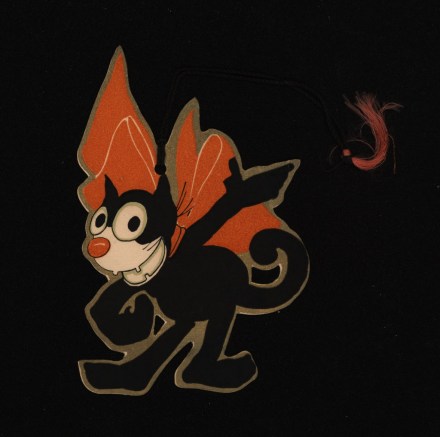
Pam’s Pictorama Post: This little tidbit has been sitting under the computer waiting for its turn at bat in a blog post and here we finally are. I have never seen this particular Felix pin before. In an attempt to research it I did find another for sale – I am pleased to say for that one for more than I paid for it. Score!

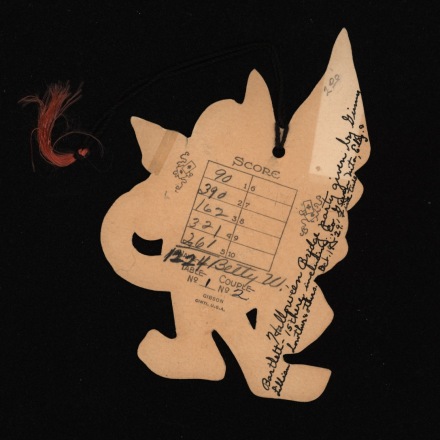
Other than this very dapper little Felix gracing it, the interesting features of this pin are that it is made of cardboard and it is quite old. I have never seen another pin made of cardboard in this fashion and a quick internet search did not immediately turn up additional ones, although I assume it was a genre.

Previously I have trumpeted my affection for the Hake’s auction catalogues (I devoted one post to it here) and one of the joys of that catalogue are the obscure, often ancient political and premium buttons that generally make up the front section of those catalogues. Unlike this little gem, those tend to impress me with the gravitas of materials – daguerreotypes, non ferrous metals metals and a range of reproduction processes – they fascinate me. This one goes in the opposite direction – simplicity and cheapest of materials. In that regard it is a bit amazing that it has survived so long in fairly pristine condition.

The Felix on my pin is somewhat primitive and off-model so this may not have been a fully sanctioned Felix affair. It would have been a very natty fellow indeed who would have sported this in his lapel or on his tie. I purchased it from a seller in the US and my guess is that it was made here although there is no marking of any kind.

As a child in the ’60’s and early 70’s I was fascinated by the metal buttons of the day – and it was a button-filled time. I remember someone giving me an early Smiley pin and I was crazy about that. I would have owned dozens of those if they crossed my path. Meanwhile, my father brought home piles of election buttons of the day for me – his job as a news cameraman putting him in a rather unique position to acquire them. Being pre-political myself I judged them on a purely aesthetic level, although I was known to hold a grudge against Presidential candidates who I felt had taken my father away for prolonged periods, Nixon was one of these. Somewhere I have a few signed political photos from the period. These were not sufficient to acquire my forgiveness; I was a hard child. The buttons below are of the type I remember having.

I don’t know how these things are done now, although with the general porousness of news media and the ability to broadcast easily from virtually anywhere I am sure it is different. At the time of my childhood, a camera crew like my father’s covering national and international news, would be dedicated to trailing a significant Presidential candidate from more or less the time they declared through the primaries, or if they dropped out of the race sooner. (This as in the case of Edmund Muskie who my father, a generally somewhat apolitical they-are-all-bums kinda guy, had a mysterious fondness for. Dad felt strongly that Muskie had been railroaded out of the race in what was later known as the Canuck Letter incident – this somewhat verified by the Watergate investigation. It always left me feeling that Dad, who had traveled with him for months and was generally politically cynical, must have been onto something.)

images-1.jpg

Election years meant Dad traveling virtually non-stop all the way through the cycle which could even be a bit longer than twelve months. As a result I hated those Presidential election years as a child, missing my father who was frequently gone for months at a time including birthdays and holidays.

In those days news was still captured on film and messengers were used to fly it back to New York daily. A camera crew at that point was made up of an opulent four or so people (dedicated sound, film, lighting, reporter and a producer), whereas at the end of my father’s career he had what he called a one man band and he would cover stories alone with the reporter – the monster camera managing sound, lighting, recording and of course sending to a satellite for transmission. If I remember correctly, in the early days of satellite transmission they plugged into phone lines. I would imagine they have done away with that – I see news vans here in the city with a sort of satellite dish on top, perhaps a variation of that.

These days I collect on the occasional button. However, I do keep on of these Kim Deitch Sunshine Girl pins, reproductions created for a gallery opening several years ago, on my desk at work to remind me of the denizens of Deitch Studio while I am away for the workday.

Sunchsine girl pin new

Sunshine Girl pin reproduction.


Oringal-Vintage-1960s-Sunshine-Girl-Cartoon-1-1-2-Pinback

Original Sunshine Girl pin.

Primitive Postcard Felix

Pam’s Pictorama Post: For those of you who are in it mostly for the Felix posts, there has been something of a Pictorama drought for you. You will be glad to know that there are several unusual and, if I might say so myself, quite interesting Felix posts just itching to be written over my vacation. I kick off the bonanza today with this postcard entry. This card hails from Great Britain, mailed from Brighton – Pictorama followers already know Brighton as a hot bed of early 20th century Felix-y activity and the origin point of many of my most delightful photos of people posing with giant Felix dolls on the beach. (One of those prior posts, Picture Perfect, can be found here.) I sometimes consider a trip to Brighton just to see if I can pick up the ghost of Felix fun past.

The hand-inked Felix postcard turns out to be something of a sub-genre and I have yet to fully unravel the mystery behind it. Years ago I discovered that here was factory in East London which employed otherwise out of work women to hand produce many of the delightfully off-model stuffed Felix toys I am so mad about today. (This post, in my own opinion one of my most fascinating discoveries, can be found here. It ranges from Felix toy production to suffragette activity – an amazing story really.) I wonder if these handmade cards were also produced by them or by another similar group. This group from my collection shown below appear to have light pencil lines for someone to follow.


This slideshow requires JavaScript.

Another version from a fairly recent post (which can be found here) is shown below, but that one had a slightly embossed quality suggesting a different method. And clearly from the drawing style these all originated from different hands.

Fat Felix

When I look at today’s card I cannot help but feel that someone with a real feel for Felix expert would have probably done something clever where Felix’s tail becomes the question mark, but it’s an interesting sort of action pose otherwise. A bit awkwardly placed at the top of the card, it also shows signs of where it was unevenly inked by hand. I can’t help but wonder how hand inking these could possibly have been less expensive than printing them?

This card was mailed on September 11, from Brighton, but the year is obscured – there is a 4. ’24? ’34? It was mailed to Mrs. Irene Eden at 38 Rushman Road, Clapton, London. It roughly says the following: My Dear Rene, Hope you haven’t eaten up all my wedding cake. This is a photo of your Felix. Take care of it & I will tell you all about it when I come home. Give Olly and John a great-big kiss for me. Love Kim XXXXX Auntie Frances Uncle Charlie. Your Felix – I love that! Alas, that Felix tale, whatever it may have been, is lost to us now.


The One Year Mark and the Uber Adventures

Pam’s Pictorama Post: This rambling and personal post was written last week while in Los Gatos and San Jose for a business trip. I was there over the anniversary of my father’s death, but since I would be sad about that wherever I was I decided there was no reason not to go. (I wrote about Dad at some length last summer in a post here.) The reason for the trip was an unexpected opportunity for a dinner on the west coast. I work for Jazz at Lincoln Center and Wynton Marsalis, and his schedule is generally so tight that opportunities for him to host something on the west coast are rare. Anyway, what follows is the tale of the unexpected things that happened on that trip.

*****

I didn’t think I wanted to post today, the one year anniversary of my father’s death. Like Father’s Day I sort of felt like what of interest could come of it. However, the universe conspired today and as it has been a rather extraordinary day which has triggered much reflection which I will share.

I find myself on the west coast as I write. I flew out for a dinner held in Los Gatos last night – it used to make my sister Loren laugh, that her little sister would be flown across the country for a single dinner. (It isn’t that it happens so often, but it happens often enough.) Having come out here I also inquired about a meeting with a foundation in Los Angeles which agreed to see me, and so as I write this I am on a smallish plane speeding to that destination. However, in every sense that puts me ahead of my story.

When I left the house Thursday afternoon in a yellow cab, I immediately hit a wall of traffic and had time to contemplate the trip ahead, sitting in the parking lot that the road to JFK airport had become. No matter how often I do it, every time I leave home to travel I am somehow surprised to be reminded over again that I exists fully outside of the daily bubble that is my life – joyfully, Kim and the cats; my minor daily commute to and from work; my own punch list of things that need doing, errands that need running and work that needs to be done. Somehow it is always a shock to realize that I am a being apart from that comfortable day-to-day, and here I am, on my way to the other side of the country and I will still be me. Sounds simple but this is what I remember thinking while stuck in traffic, listening to my gym music on my phone for a distraction which, for someone who otherwise generally doesn’t listen to music made after 1939, is a surprising mix of rock ‘n roll from the ’70’s, Bruce Springsteen and even a bit of Motown.

Everything about the kind of dinner one travels across the country for requires someone like me and my team of people to create it, people whose job in part is to assemble an evening that seems perfect yet effortless. We all know that effortless requires forethought and elbow grease. While this dinner was no exception, it did not present any truly unique challenges. By the end of Friday night a lovely meal had been executed with some Bay Area elite and all of whom seemed lovely. A colleague and I jumped in an Uber to head back to the hotel.

While checking my email I saw one from a college friend. I don’t hear from her that often so her emails in my box always cause a thrill of anticipatory pleasure when I see them. Sadly I rapidly realized that it was not the case tonight. On this evening she was writing because her husband, a man of our own newly minted middle age, had mysteriously died in his sleep on Tuesday.

41191494_1565289970936388_r

Jack Kennedy who sadly and unexpectedly died last week.


I rarely make a visit to this part of the country without routing myself through their town, but this fast and furious trip was an exception. I had reached out to her in the weeks leading up to it and said it wasn’t likely but giving her a heads up in case my plans changed and I found myself able to swing through. On this evening my post-dinner, champagne infused brain raced. It was so sudden and so unbearably sad. I emailed her when I got back to my hotel, almost midnight by then, told her I could push LA off and come see her if my showing up wouldn’t increase the chaos she was already experiencing. The suddeness was overwhelming and knocked me sideways. I had last seen them on a trip with the Jazz at Lincoln Center orchestra last fall and I had stayed with them. They had come to the concert.

When I woke this morning it was as if someone had pulled loose thread of stoicism I had carefully constructed for the purpose of getting through this weekend, the anniversary of Dad dying a year ago. My calm started to disintegrate and a wall of sad began to ooze around me with memories of last summer. However, despite realizing this nothing to do but attempt to button it up, pack my bags and headed out for a meeting in Santa Cruz which was to be followed by going directly to the airport.

I live on the east coast and my geographical knowledge of this part of the world is not, to say the very least, deep. Therefore, foolishly, I had planned an in person early morning breakfast meeting with Wynton in Santa Cruz when I was staying in Los Gatos as it was the last time I would see him before September, back in New York. Somehow, although the time for travel had been dutifully been plugged in by the extraordinarily capable colleague who had put the trip together, I managed to miss the mountain that sat between where he was staying and where I was.

The view was stunning, mist hanging in the valleys like a Japanese print and the winding highway reminded me distinctly of travel in Bhutan years ago, but the sheer folly of the trip across a mountain for a meeting rather than a call struck me as especially idiotic on my part. However, as it turns out the driver, Gajend, was from Nepal and we had a long conversation about how pollution has changed Kathmandu for the worse and how this was a baby mountain compared to those that made up the foothills of the Himalayas. He had been back recently and I have not been since 2000.

As I described my trekking on a sacred path on Mt. Kalish in Tibet, I realized I hadn’t really thought about that life changing trip in years. I told him about the various sacred caves I had climbed to – sometimes crawling into tiny ones on my belly as instructed, and he was interested, but it cheered me to think about as well. I remember tying prayer flags to the top mountain pass and saying a prayer for my sister, who was dying from cancer. And I remember leaving something on a mountainside full of bits of clothing and items with the idea that it would help draw you back to that sacred spot when you at the moment of death. I also laid on the ground among the detritus left by others and meditated for a few minutes on that sacred ground – imaging that I would return to that spot at the moment of my death and therefore have a more auspicious rebirth.

The restaurant in Santa Cruz turned out to be right on the beach and it reminded me of the seaside New Jersey town near where I grew up, where I waited tables and was short order cook to beach going visitors in my high school and college years. Santa Cruz seemed a bit more affluent than Sea Bright. The sight and smell of the ocean was cheering.

I had my suitcase as I was to head directly to the San Jose airport after my meeting although I was still torn – should I just bag everything planned and head instead to my friend’s home in Santa Barbara? So frustrating to be so close and not see her. Yet, I sensed too that I was a tad too raw and this news had ripped the scab right off the wound that was the anniversary of dad’s death; I really was not at my best. The lack of coffee probably didn’t help.

I was the first to arrive at the restaurant and within minutes I realized that I did not have my eyeglasses! Now my sister was blind like couldn’t see her hand in front of face unable to see without her glasses and I am not that bad, but I’m pretty bad. My prescription sunglasses (in addition to being sunglasses) are only for distance only (I wear progressive lenses and mostly they are geared to mid-range) not to mention impractical inside. Alas those were perched on my nose and my regular glasses nowhere to be found and were presumably in the Uber I had just exited.


IMG_2440

View from the restaurant in Santa Cruz.


By the time Wynton arrived I had reached out to Uber (yes, the app has a place for left something in my driver’s car) but hadn’t heard back. We talked over breakfast for about an hour (throughout which I continued trying to contact the Uber driver with no luck), and after making sure I was okay to get back to San Jose he left for a film shoot. I sat outside near a large ukulele band setting up to play. Normally that would have cheered me immensely but not at this point. Frankly I didn’t know what to do next and I was melting down. I pulled out my phone and I called Kim in New York. I felt better hearing his voice but then he suddenly immensely far away and I was missing him. The dam broke and I found myself sobbing –  yep, just sitting on a curb in Santa Cruz and weeping.

A few weeks ago in my first post about Frances Hodgson Burnett (which can be found here) I said you want to marry someone smart enough to give you good book suggestions when you are whining about having nothing to read (and I still maintain there are worse ways to chose a mate), but really one of the very best thing about Kim is he remains very calm in emergencies and times of extreme stress. Although I am generally the more rational of the two of us and I rarely lose it, but when I do he is one of the few people who can get me off the ledge.

IMG_2442.JPG

Bad photo of the uke band tuning up from where I sat on the curb talking to Kim.


He spoke very calmly to me even though in retrospect, never having experienced me in quite that state before, let alone on the other side of the country), he probably was a bit worried.  We agreed that I would get another car and head back to the hotel where I started in San Jose and hopefully be able to meet up with the first driver there. I pulled myself together and called yet another car and a woman Uber driver named Guadalope picked me up. (I am sorry to say the uke band had not started before I left – I was very curious.) The first driver, Gajend, eventually called he had my glasses! We established that he would meet me at the hotel where he’d picked me up, but he was in another area and it would take him two hours to get there.

I was probably screwed for the flight to LA and I became confused all over again about maybe changing my plans and heading to Santa Barbara. I called Kim again to update him. I was still weepy and by the end of that call Guadalupe pretty much knew the whole story. Kim took charge and told me I was definitively not going to Santa Barbara and just get my eyeglasses, we’d figure out things out from there. He was right of course, you cannot drop your hot mess self with your own problems onto someone who truly is in the midst of dealing with their own, more significant crisis.

IMG_2443

The very capable Guadalupe driving us through the mountains.


About the time we hung up, Guadalupe and I were slowing down in traffic to a stop – yes, because there was an accident somewhere ahead. However, Guadalupe turned out to be a resourceful woman and she softly said something about how there are not many back road options and she turned the car (just, um, briefly off-road) and she took us up exactly that sort of back road.

Once again I was brought back to memories of traveling in Bhutan and the endlessly winding roads in order to go over the mountains – constant switchbacks with nausea induing constant turns and twists. Oddly the roads were populated with many people on bikes (it was so steep I can’t imagine how the muscles in their calves must bulge) who braved the cars emerging from each blind turn. I have a strong inner ear and rarely experience car or sea sickness, but I was turning a tad green by the time we finally emerged on the other side and went bombing off toward the hotel.

As I plunked myself down to wait on a bench outside the Holiday Inn where I had spent the past two nights I reflected that for me today was clearly going to be about learning patience and slowing myself down a bit. This Holiday Inn wasn’t bad, but it was in the midst of a very poor area. The day before a colleague and I had walked about two blocks away and eaten rather splendid Mexican food for lunch (an enormous bean burrito in my case), but encountered several people who appeared to be homeless, their possessions in the shopping carts they pushed.

IMG_2438 (1)

Snapped this photo of this souped up motorcycle by the front entrance of the Holiday Inn while parked on a nearby bench.


Across from where I sat waiting, there was a stop for the local light rail line which I had no time to figure out during my stay and I watched people come and go on that. I read part of a Frances Hodgson Burnett novella Theo: A Sprightly Love Story, on my phone. I fought with a cash machine in the hotel – and lost. After counting all my cash to figure out what I could tip Gajend – who at this point had now driven me across a mountain where he probably didn’t get a return trip and now was making his way to me, wasting his work day, gas and time I found I had $100. Somewhere in the back of my head was my mother’s voice asking me why I had traveled across the country with so little cash – and she was right of course. She taught me one should have cash in case of emergencies. Anyway, I would give him the $100 and figure out cash in LA.

md1330990735.jpg

Eventually a heavy-set man, probably a bit older than me, decorated with monotone tattoos and walking a tiny, bulging eyed dog came and sat on the bench with me. We passed the time, discussed the dog – the pup tired easily with such short legs working hard when they took a walk. My cat Cookie could have taken this dog on with one paw behind her back, but I kept that thought to myself as it seemed like it could be considered unkind. I was just about to ask if I could take their photo when Gajend pulled up! Yay! He jumped out of his car with my eyeglasses in hand. I thanked him profusely and gave him the hundred dollars. He offered to take me to the airport. I ended up making the flight, where I started this post, with enough time to be a lousy slice of pizza for lunch.

******

I write now, a day later and tucked into my airplane seat heading home after my last round of meetings in Los Angeles. I am very anxious to get home and see Kim and the cats. All will likely be asleep when I slip in around midnight, we are early to bed folks when left to our own devices.

I just watched Dumbo on my tiny airplane screen, which was about the level of emotional intensity I felt like I could manage at this point. After my usual tomato juice (don’t know why but I always have a glass of tomato juice when I fly) I had a stiff drink, which I generally never do when I fly – afraid of jet lag. It wasn’t a martini, dad’s favorite drink, but I think he would approve. So at last here’s to him!

******

IMG_2458

A blurry photo of Cookie claiming my suitcase for her own purposes upon my return.


Frances Hodgson Burnett: the Fashion, Part 4

Pams Pictorama Post: I am wrapping up this summer reading series on the adult novels of Frances Hodgson Burnett with this post on the lavish and lovingly described clothing in her stories. It is clear from her detailed descriptions that she loved fashion and had thoughts about clothing and what it meant. I share an autochrome of a well dressed woman of the day by Helen Messing, a French photographer, taken in 1912, as the featured image and to set the tone for today. For anyone who has just wandered in, the first three posts can be found clicking on the following: Frances Hodgson Burnett, an Excellent ReadFrances Hodgson Burnett, Part 2: the Grown-up Books;and Frances Hodgson Burnett, Part 3: The Women.

Frances Hodgson Burnett was one of those people who lived long enough and over a time to experience fashion from the days of whale bone corsets to the nebulous non-supportive skivvies of the 1920’s. One interesting quote which I pulled out off the internet concerned her own wedding dress. The story went that she had a long engagement to her first husband, Swan Burnett, and with the earnings from her writing had a couture wedding dress made for herself on a trip to Paris. They were to be married in Tennessee and she shipped the dress there. For whatever reason, now lost in the telling, it was delayed and despite her urging, he would not postpone the wedding for the arrival of the dress. Writing to a friend about her new husband she had this to say, “Men are so shallow … he does not know the vital importance of the difference between white satin and tulle, and cream coloured brocade …”

Wedding dresses are a significant point of discussion in T. Tembarom. In this novel of 1913, the hero finds his foothold as a cub reporter taking over the society page of a New York newspaper. Temple realizes that learning how to describe the wedding dresses accurately will win the favor of the socialites (and their dressmakers) who he needs to befriend for material. Therefore loving descriptions of him laboring to learn the nips and tucks of white peau de cyne trimmed with duchess [sic] lace and other fashionable wedding garb of the carriage trade ensues and descriptions of finery become his stock in trade. I share a photo of something like what he was talking about below, from the period and for sale online if  you are so inclined. (Clearly a bit worse for wear but only fair to consider it is over 100 years since it was sewn.)

tumblr_ltweanbtjZ1qidnqfo1_500

Worth gown circa 1913


Later in the same book, Temple’s fondness for his elderly relative is expressed through the wardrobe he has made for her in London. Below is a bit of an excerpt from the novel:

Mrs. Mellish became possessed of an “idea” To create the costume of an exquisite, early-Victorian old lady in a play done for the most fashionable and popular actor manager of the most “drawing-room” of West End theaters, where one saw royalty in the royal box, with bouquets on every side, the orchestra breaking off in the middle of a strain to play “God Save the Queen,” and the audience standing up as the royal party came in—that was her idea. She carried it out, steering Miss Alicia with finished tact through the shoals and rapids of her timidities. And the result was wonderful; color,—or, rather, shades,—textures, and forms were made subservient by real genius. Miss Alicia—as she was turned out when the wardrobe was complete—might have been an elderly little duchess of sweet and modest good taste in the dress of forty years earlier.

In the subsequent pages of the novel, the fragile and shy Miss Alicia is given confidence on several occasions by her extremely well conceived of and thoughtfully considered clothing. (This speaks to my own belief that women’s clothing – and jewelry – are like armor for battle. I urge – choose wisely!)

Like many of her characters, it is reported that Frances turned to her own sewing skills during leaner periods of her life and, among other things, sewed elaborate outfits for her sons – a la Little Lord Fauntleroy. Her writing is peppered with allusions to line and properly made clothes – dresses of old pillaged and remade resourcefully for deserving young, dewy, emerging impoverished belles. I believe I have mentioned the fact of me and sewing – which is that I can re-attached a credible button but not much beyond that. Therefore the idea of remaking dresses and whipping up new ones wholesale is utterly alien to me and vague notions of Project Runway is all I can summon.

In the novel, Vagabondia, published in 1884 we get a glimpse of even earlier fashion. (This is a slightly different type of book about a happy Bohemian family of artists and their salon of hangers on, both rich and not.) The description of a purple dress as trimmed with swan’s down (really?) gave me pause and sent me running to Google. Evidently swan’s down was used as a less expensive replacement for fur, primarily at the end of the 19th and early 20th century. I will spare you the description of how exactly this is extracted from the unfortunate fowl. It was so popular at one time that swans were in danger of extinction.

WaistcoatManchesterGalleries1

Period blue silk vest trimmed in swans down, via i10.photobucket.com or Pinterest


swans down trip 1900 Etsy

Victorian Edwardian child’s cape/coat trimmed with swan’s down, for sale on Etsy at the time of writing


The concept of a simple white muslin frock with a ribbon belt like the one below comes up in virtually every novel and short story – sometimes as a supporting character, sometimes a main event. In its own way this was the little black dress of its late 19th and early 20th century day – although of course it was the exact opposite as instead of sophistication a la Chanel, it was to show off simplicity and innocence. It was the dress that could be simply sewn and easily afforded, and theoretically allowed the native beauty of the wearer to shine. Burnett has wealthy women of the world who embrace the simple muslin gown as a way of showing their simple underlying beauty – while a clever poor good seamstress could whip one up for herself (or sometimes for a beloved sibling) and unusually beautiful this simple dress could let their beauty shine through – and perhaps even show up some catty, wealthier acquaintances.

1912_apavlova_v_12apr12_pa_b

While Frances Hodgson Burnett probably would not have been willing to say that clothing makes the man. However, she had a deep understanding of how critical clothes were to how women defined themselves in the world and used it to a descriptive advantage in her stories. At a time when women didn’t have a lot of tools for defining themselves at their disposal, Frances Hodgson Burnett’s interest in them and use of them in her narrative was not coincidental nor casual. My guess is that she had given a lot of thought and understood it in a personal way.