Oswald

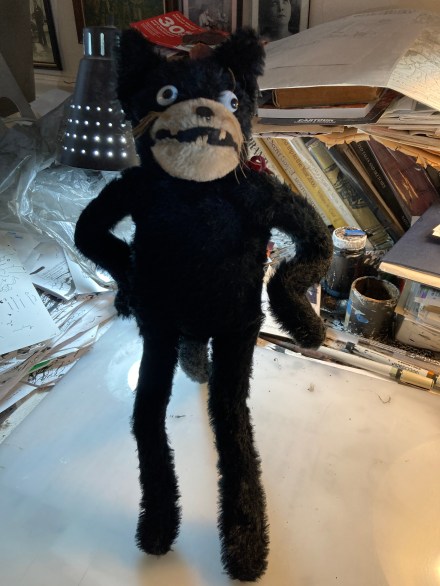
Pam’s Pictorama Toy Post: A new friendship with a reader who is a fellow collector has lead to a cheerful volley of toy conversation via email recently which I have quite enjoyed. His collection runs broad and deep and some of the items he has shared photos of fascinate and entice! He recently shared photos of a few groups of rarified early character toys which were amazing. Among them a few examples of our friend Oswald rabbit which are from a different period from mine which turned my attention to cartoon rabbits today.

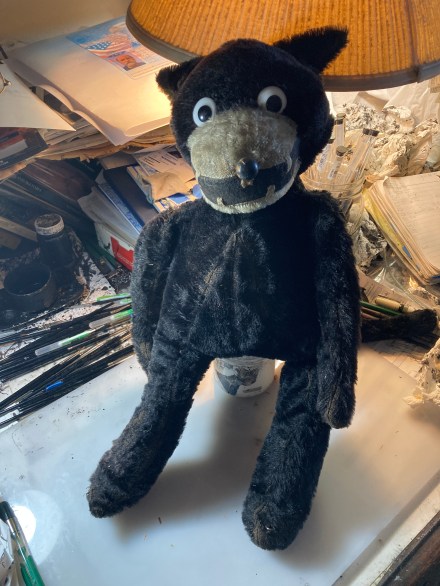
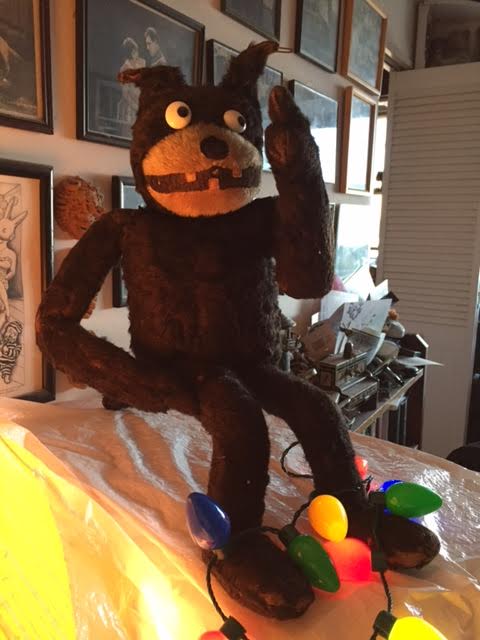
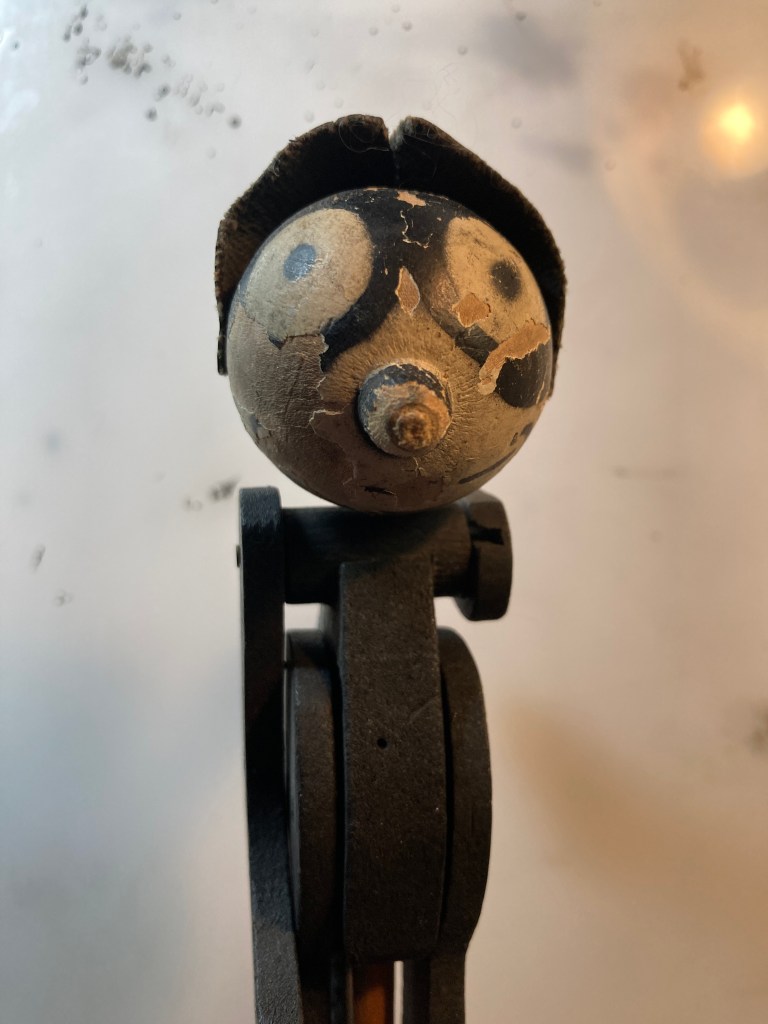
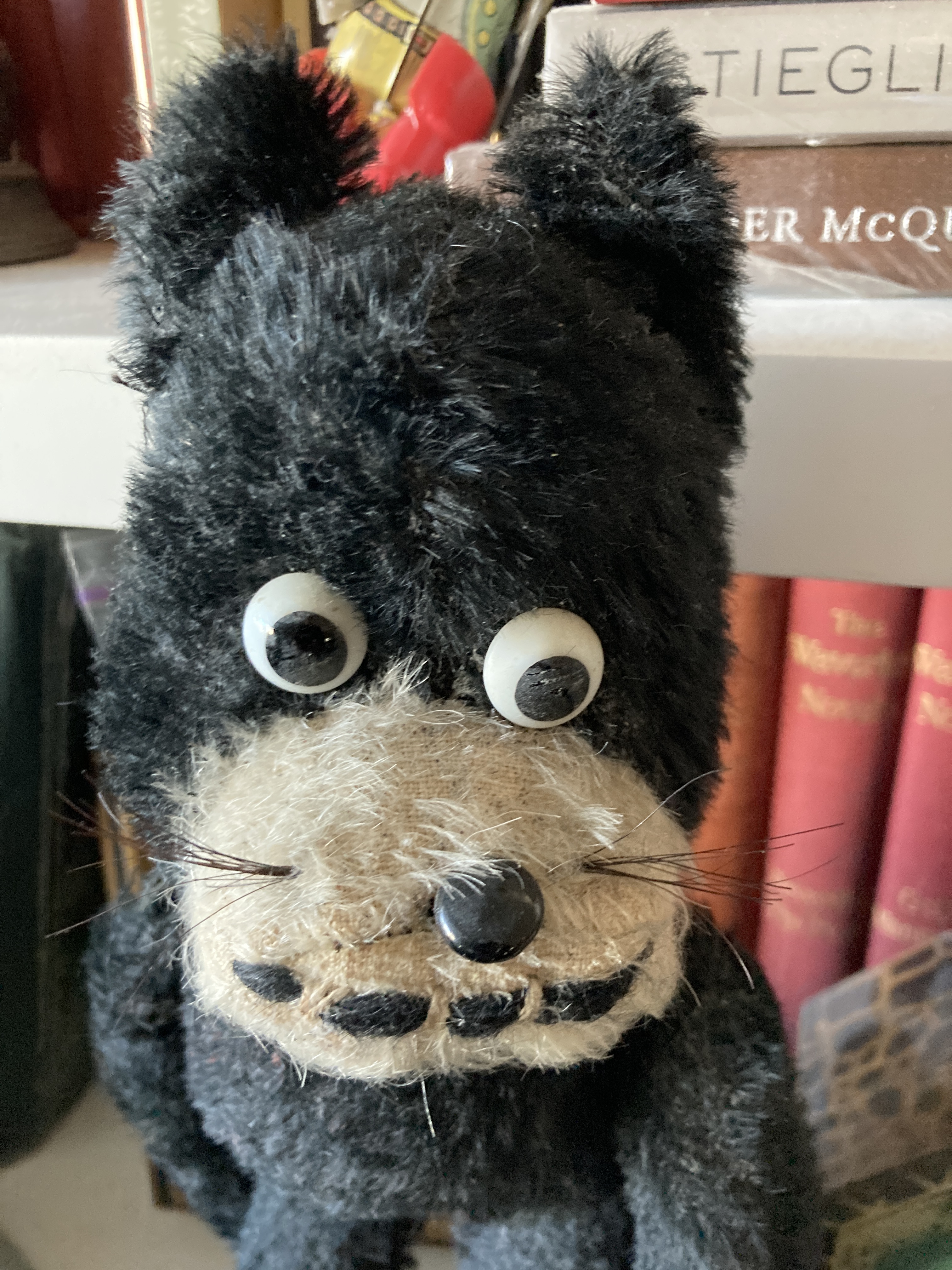
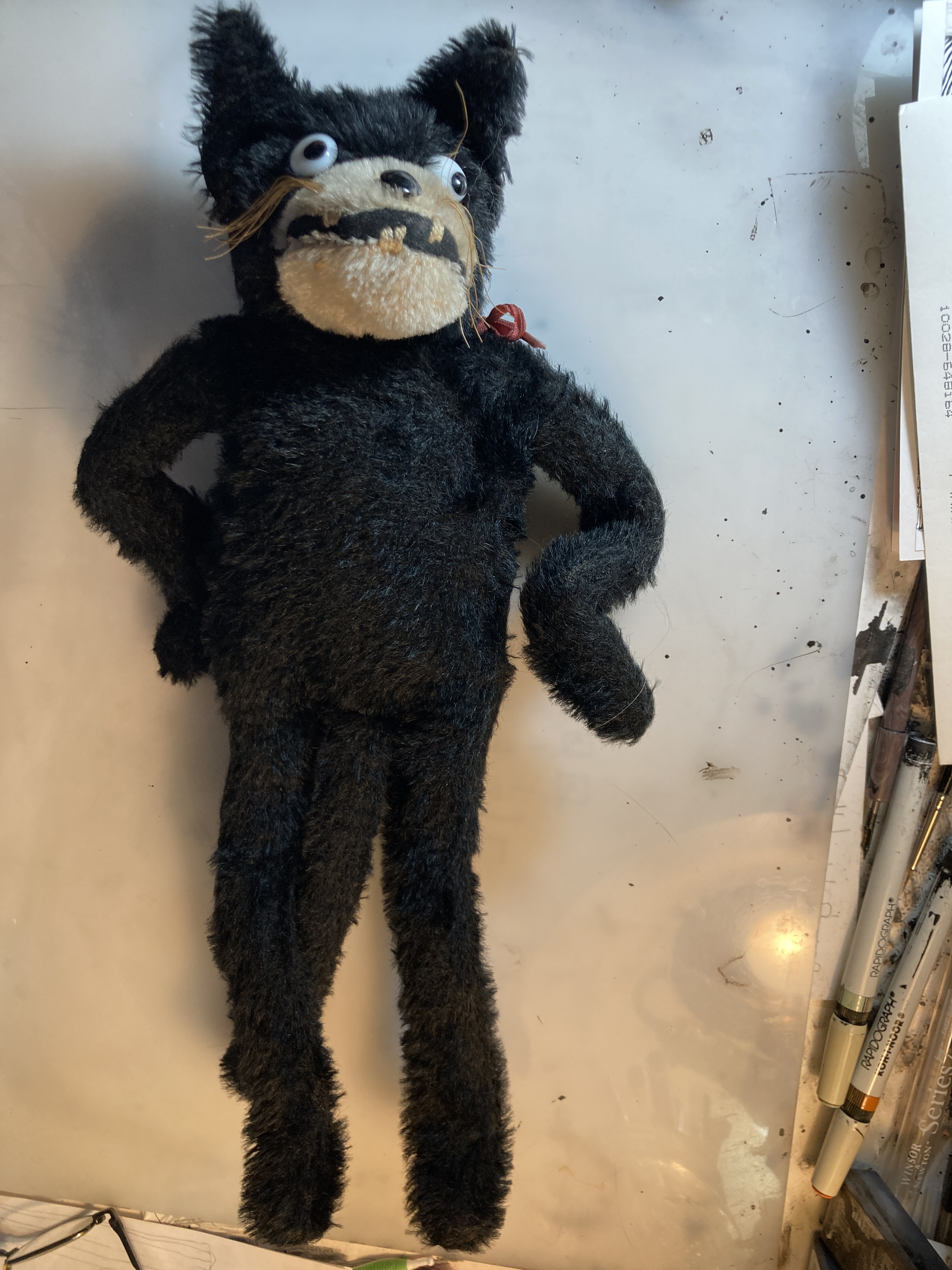
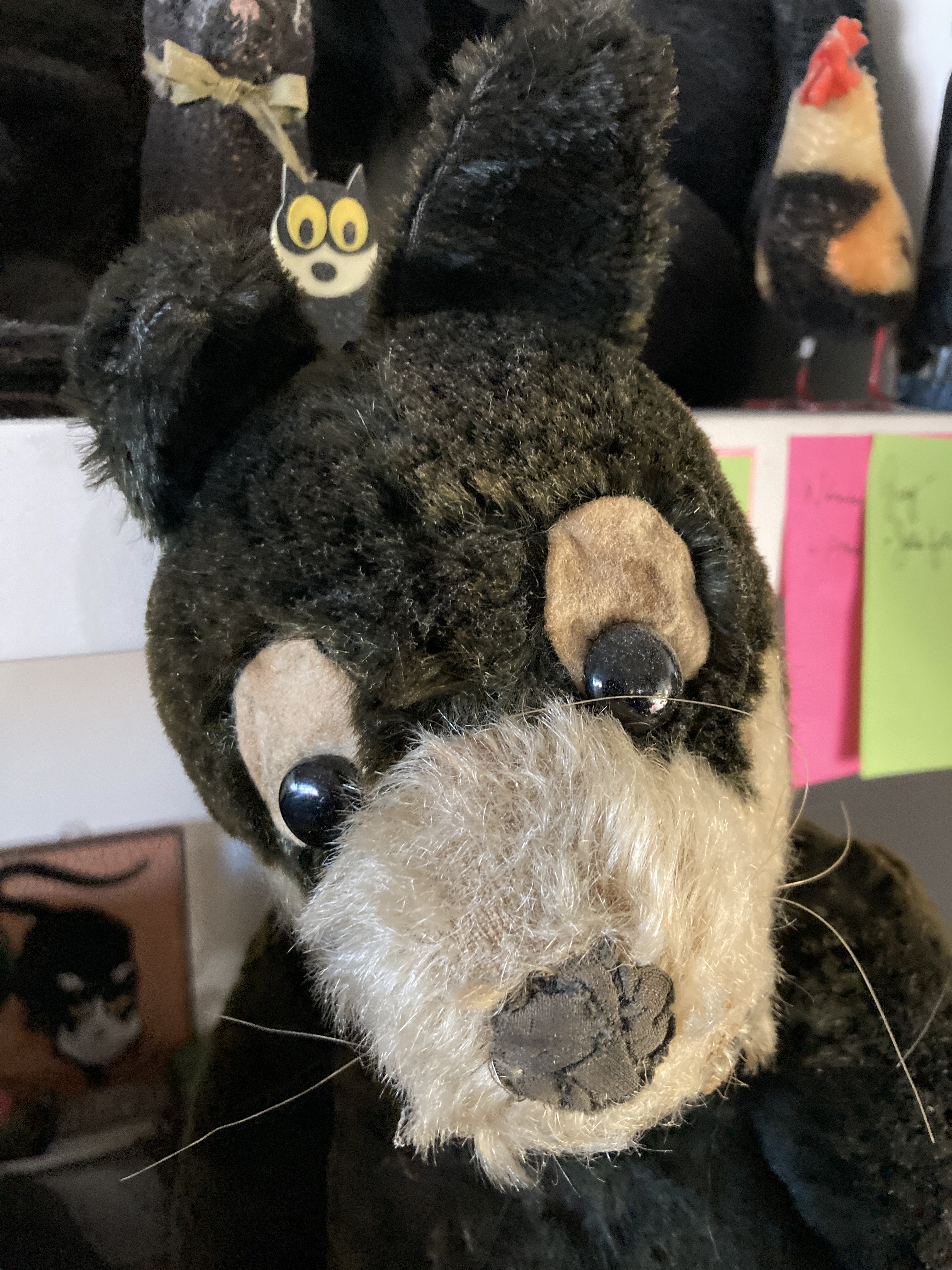
As you can see, my fellow is in very rough shape indeed. Many years ago I bought him on eBay where he was poorly posted and I acquired him for very little. I don’t generally purchase a lot of toys in a bad state as I don’t think I am the person to best figure out getting them repaired, but occasionally one comes over the transom and I cannot resist. (In the early years of Pictorama I wrote about visiting an elderly man who repaired toys on Lexington Avenue near Bloomingdales. That odd tale can be read here.)

He is my only example of this erstwhile character created by Walt Disney. As the story goes, Disney lost the rights to this his first popular character in a deal with Universal gone wrong. Disney limped off and made history creating Mickey Mouse and Oswald faded into obscurity

About 28 Oswald cartoons were made and over time disappeared from the public and most living memory. Several years ago a disk was issued with a number of the cartoons which are great. An example can be seen below.

An Oswald Rabbit cartoon via Youtube available at the time of publication.

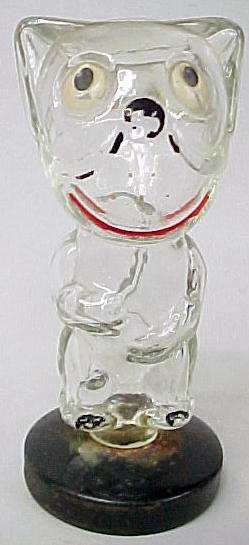
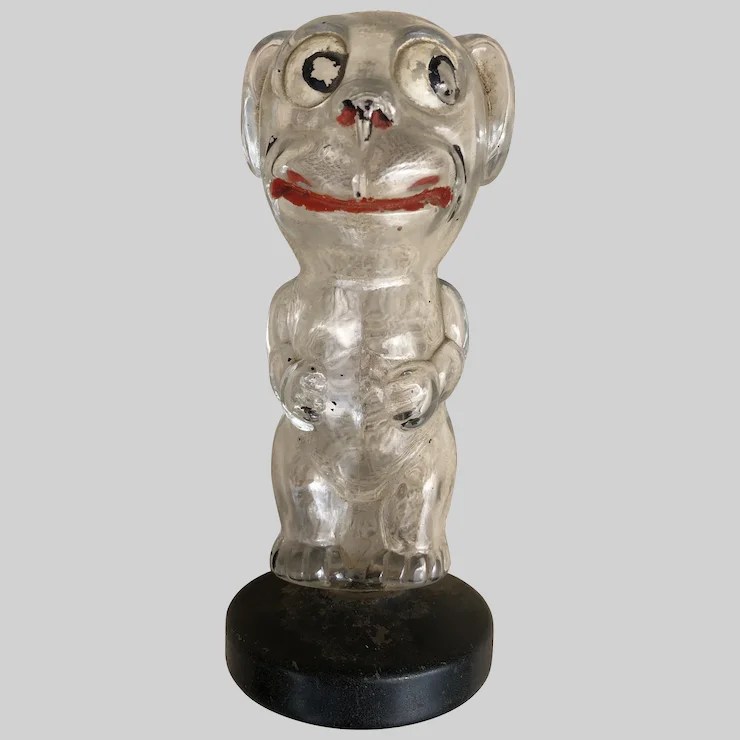
My Oswald has his name and Universal Pictures emblazoned on his chest. I found a listing online that says he was made in 1930. He has a key in his back and would have wound up to walk side to side. The key in mine is long frozen in place and the mechanism seized up, but I’m sure he was quite jolly indeed. (Below is a fellow whose photo I found online who is clearly survived the years in better shape.) I love his little shoes complete with laces! If you look carefully you can see this is a slightly different version of Oswald with a larger nose and clothes made of flannel instead of cotton. (There is some writing on either side of his grin that doesn’t exist on mine as well.)

I think the overall shredding and wear on mine is beyond repair although my collector conversations have made me consider repairs on some of my toys, most notable a Kiko the Kangaroo who came to me in poor shape and has continued to lose ground over time. Kiko, a Terrytoons character, never enjoyed the widespread popularity of Oswald. He made his debut in 1936 with good ole Farmer Alfalfa and last only a year. With the help of my new toy correspondent I am in touch with someone in Canada who may be able to make some repairs and stabilize him. I would like to get him in better shape. I promise you a future post on him, the before and after, once complete.

A Kiko cartoon via Youtube at the time of publication.

Meanwhile, I promised a photo of Oswald to my new friend and so in taking him out for a turn today I thought I would share him to my Pictorama readers too, beat up although he is. My Oswald sits on a somewhat remote shelf where he is left largely in peace, spending his days with a Dean’s Rag Pluto and Flip the Frog. This volley of emails has me thinking rabbits however and I have long wanted an example of the Dean’s Rag version so stay tuned and see what time might turn up!

Felix Sewn Up?

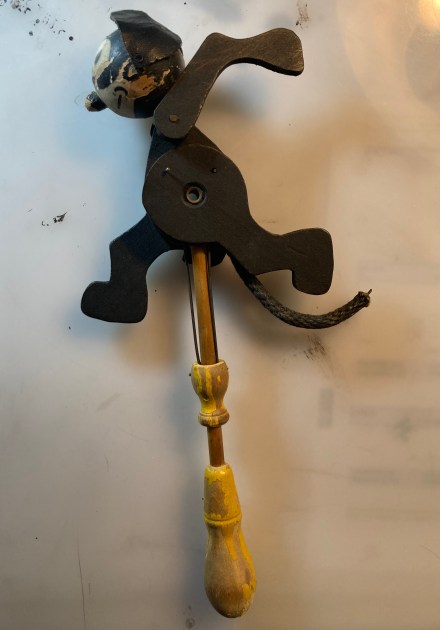
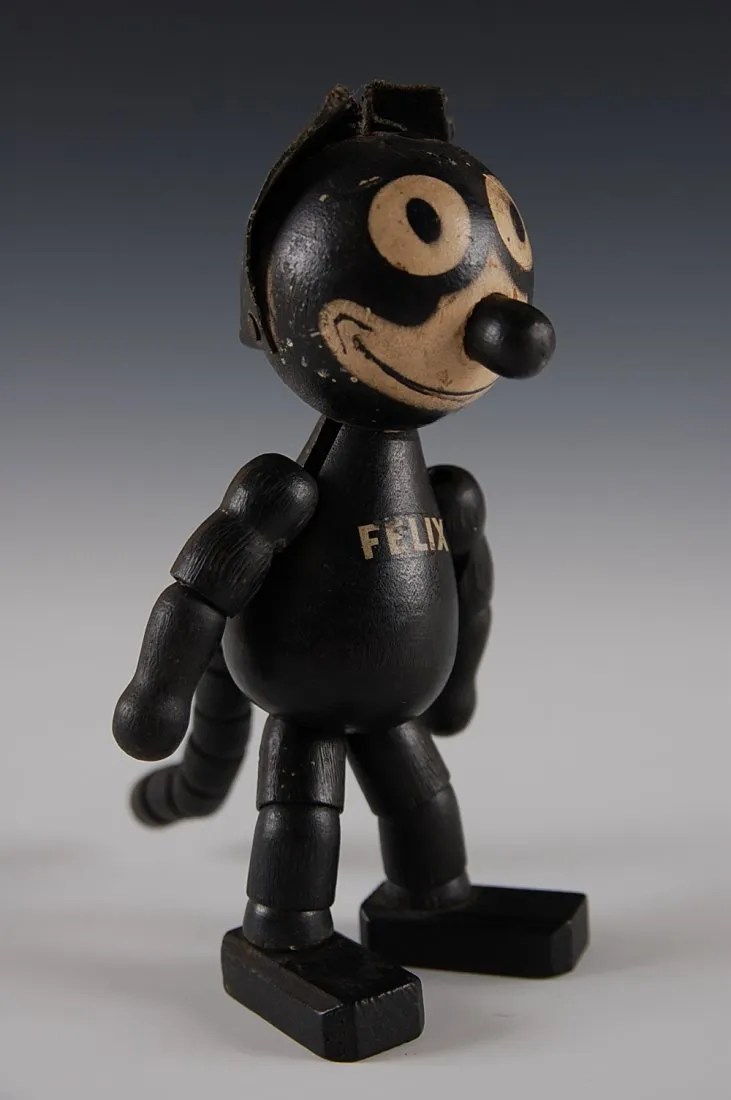
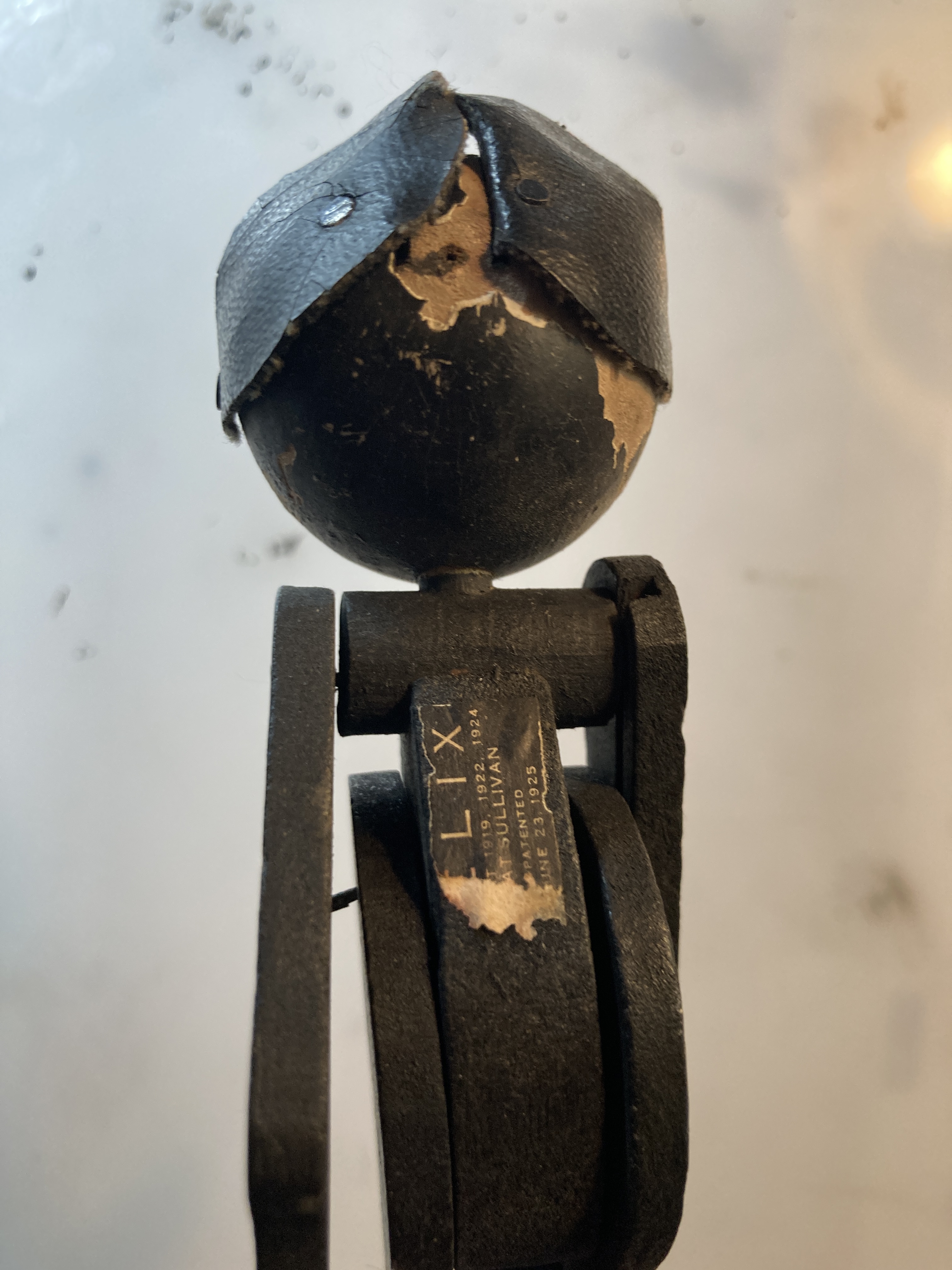
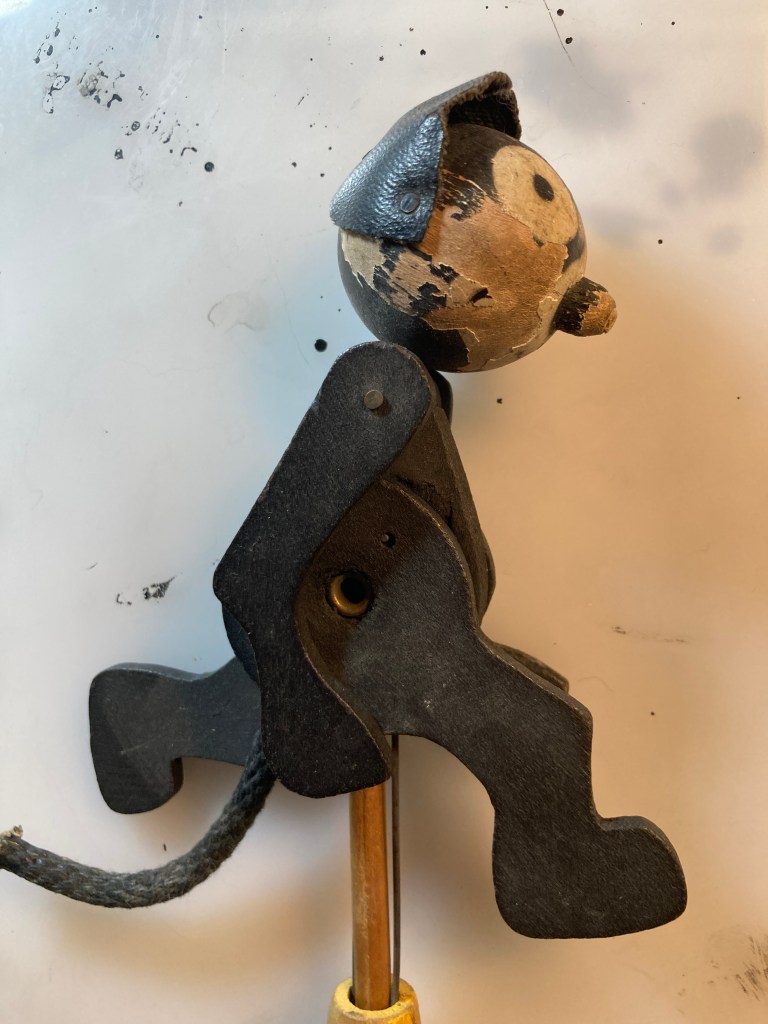
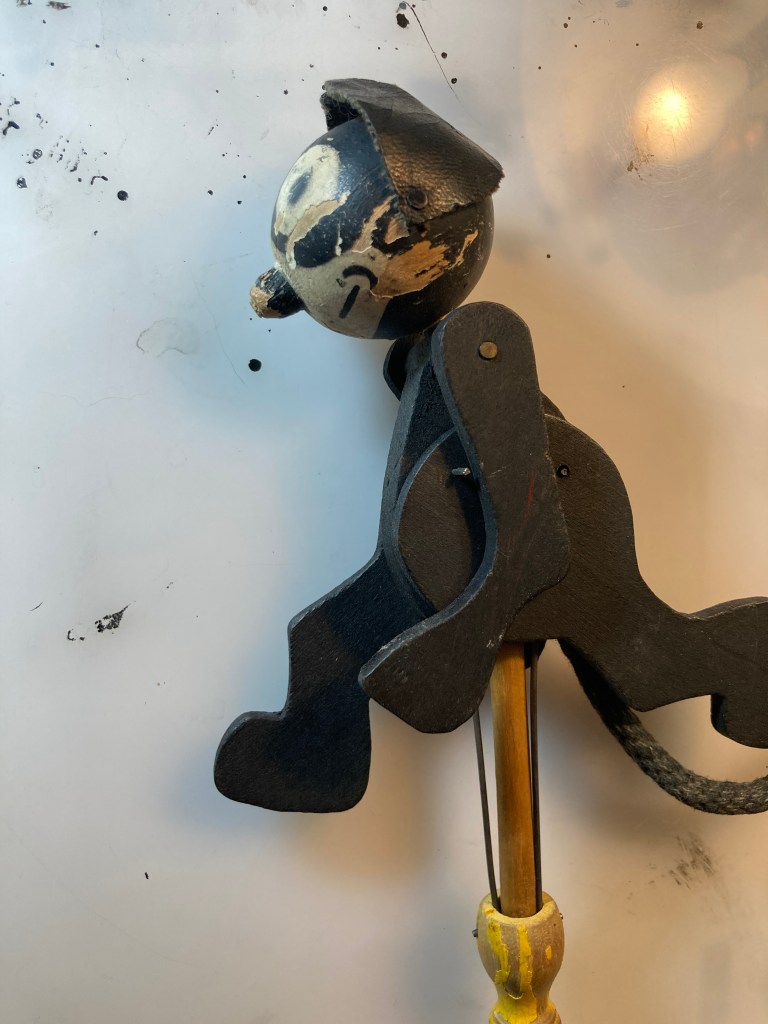
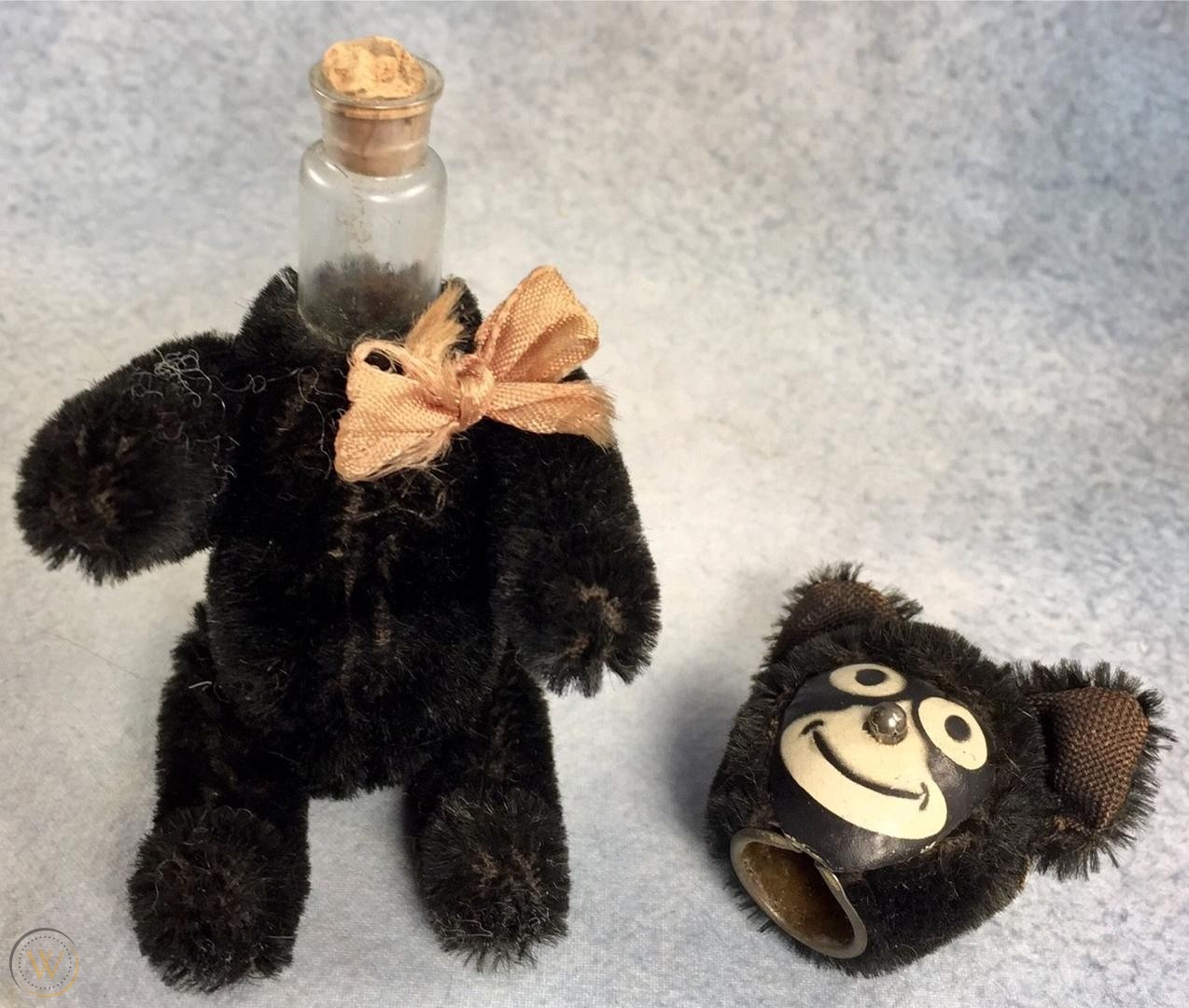
Pam’s Pictorama Post: This odd item came to me via a collector and reader who sold me a cache of items recently. Neither of us knows exactly what this is or how it worked, but the piece on the end appears to be a pin cushion. Therefore I think it was some sort of sewing implement which probably held a spool of thread on the other side.

Felix himself has leather ears. There are small holes on each side which I assume held spindly arms. In addition there are tiny metal loops below those holes which held something too. I have guessed this and that, but really don’t know what those may have been for. The other logical piece I can think of would be something to help you thread a needle (I use those gizmos on the rare occasions I sew a button, and did even before my eyes became middle aged), but no idea how that would have worked. As I contemplate it, I cannot vouch for the practicality of using it, but as a non-sewer it is hard for me to say.

This item is made of wood and has no makers mark, but to me it looks commercially made. It is without question old. I can cheerfully attest to never having seen anything like it despite looking at (literally) thousands of Felix items over time. A dedicated search did not turn up anything. Now that I own it perhaps they will start to show up – that happens sometimes.

Pams-Pictorama.com Collection.

As a companion piece I offer an items one sees often, a Felix yarn winder that wandered into the house about a year ago. I see these frequently and although the Felix head seems a bit off model it does bear an official Pathe emblem in the middle. (I believe this came to me via my friends in Texas @curiositiesantique and a shout out to them!) I assume that wool winding on such an item is somehow better than just using it as it comes in those long lumpy skeins. Felix Keeps on Knitting we are informed.

Although I have written about sewing (I have a small collection of old needle packages and I wrote about them here and here) once or twice before I don’t seem to have documented my generally ham handedness for sewing. My mother had a sewing machine, a very substantial and insanely heavy, 1960’s table model, which I swear I never saw her use. (It seems that my sewing disability was passed to me via my mother who, to my knowledge, has sewn nary a button that I can remember.) My sister Loren took it over and produced some very credible items, although in somewhat typical fashion she wandered away from it once conquered.

Pams-Pictorama.com Collection.

I personally never met a bobbin that I didn’t snarl and often destroy which was hard on me in the Home Ec of my junior high days. (I’m assuming Home Economics is one of those things that disappeared or at least has been renamed over time. It sounded dated even to my young 1970’s ears. Still, as I consider this I would encourage everyone to be taught the basics of cooking, rudimentary nutrition and maybe how to sew on a button. Useful life skills.) I mean, me and ten minutes trying to fill one of those things and it was a solid web of disaster. Whole machines were out of commission after me; amazing how fast it could all go wrong. I was also known to freakishly break a needle for landing directly on a pin.

I can only volunteer that I was only marginally better in Shop class which I migrated to once I had the opportunity, hoping to get away from the world of sewing machines. It’s amazing that I paint, draw, cook and lead a generally useful life despite all this. The attempts to teach me these allied skills having failed miserably.

I did do a bit of hand sewing while still very young. I achieved adequately well on cross stitch samplers, but tended toward large looping and uneven stitches for actual sewing. Despite multiple efforts and instructors knitting utterly confuses me and my brain refuses to accept whatever pattern is required to turn yarn into sweaters and scarves. I have never sewn a hem.

In college a roommate taught me how to sew a button on properly and I remain in her debt as it is a skill called for on a regular basis really. I don’t know what bit of hand-eye coordination so eludes me, but I have learned to accept it much as I accept my brown eyes and prematurely gray hair, and over time I have made the acquaintance of a good tailor.

Onward and Upward

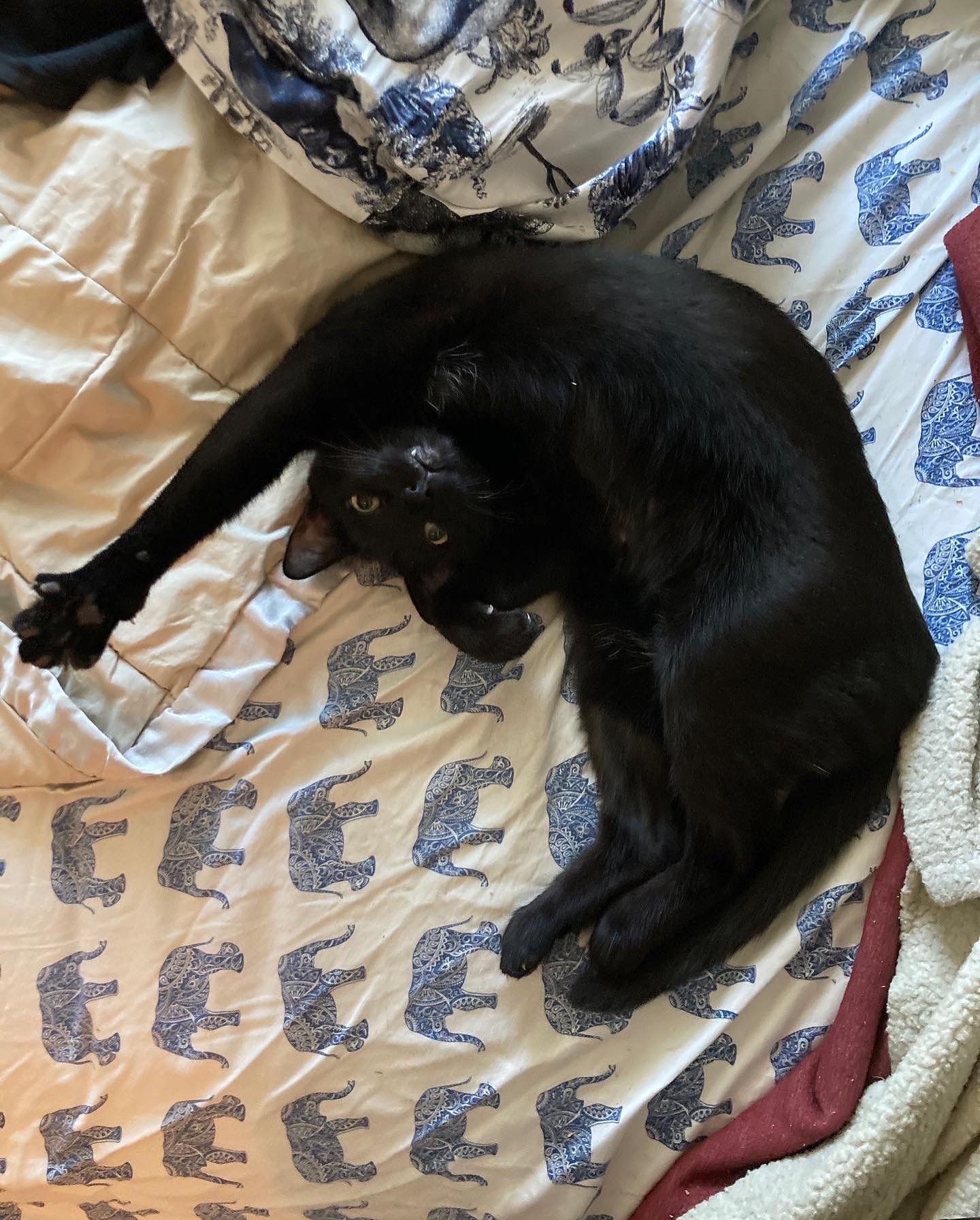
Pam’s Pictorama Post: I purchased this pin back in August and it arrived during an especially hectic period while I was traveling and Blackie was in the kitty hospital. (He is slowly returning to his handsome, suave, feline self. I have promised him I will not post any photos of him until he is back to his full glory however.) I have written about my occasional dysmorphia when buying online – slightly enormous and smaller than anticipated toys show up all the time. (A post addressing that can be found here.) There is, for example, a huge wax cloth Uncle Walt doll on our shelf that I have not found a proper spot for yet. (Future post, I assure you.) Most famously, there is a beloved Mickey Mouse by Dean’s Rag that was a store display which is the size of a six year old in our bedroom. I have taken to measuring more often, which lead to my not buying a rather splendid Felix decorated drum that came my way. Alas, life in a small apartment.

I had my heart set on this sterling silver Victorian arrow as soon as I saw it posted in a coming attraction reel with some other items posted by one of my go-to’s, @marsh.and.meadow (Heather, one of these days I will be in Ohio with the band and say hello!) and I set my cap for it. I was admittedly rushed when it came up for sale. All this to say, I had not really stopped to consider that it’s three and a half inches is about an inch longer than expected. But it is a solidly beautiful item and frankly, it has sat on my desk where I have just delighted in it over recent weeks.

We all want to be Excellent! Pams-Pictorama.com Collection.

Although it is silver there is something vaguely more industrial looking about it, like steel. It is wonderfully solid looking. It was clearly meant for a scarf, shawl, hat or bulky knit sweater. While I had originally envisioned securing it, pointing upward of course, to the lapel of a blazer it is too thick for that and I am now thinking winter coat or hat – which assumes I will leave recent years of nothing but an outer attire of an old down storm coat and watch cap behind and resume wearing a nicer wool coat and with some attitude. (This also assumes that the moth farm I have inadvertently cultivated has left me a shred of wool to wear.)

Back of the pin. Pams-Pictorama.com Collection.

There are certain symbols that appeal repeatedly to me in jewelry. Although my recent fascination with insects confounds me somewhat (posts on those can be found here and here), I have collected a few old school medals which provide unabashed encouragement – Improvement! Excellence! – and a post on those can be found here. I like the idea of a sly advertisement or hopefulness, a horseshoe perhaps, and a bit of encouragement for myself to be found in my pins.

A favorite insect pin, also coincidentally from Marsh.and.Meadow.

I am far from the first person to wander down this path and for example it has been done much more intelligently by the likes of Madeleine Albright, former Secretary of State, as she famously signaled her diplomatic intentions with her pins. I like arrows and have been looking for one for awhile. Somewhere I have a nice rhinestone one I acquired all the way back in high school, but I cannot find it and as a friend of Kim’s says, if you can’t find it you don’t own it. (It has become a mantra in this house!) I have made a few attempts to purchase pins that depict Haley’s Comet (yes, those are a thing) which is more like an arrow shooting out of a star.

While piercing is the first thing that comes to mind when thinking about arrow, the symbolism of the arrow goes beyond being a badass. They represent triumph over struggle, strength and perseverance. And of course optimism, upward, let’s go this way. I think it is always good to acknowledge triumph over struggles, both large and small, and also a good reminder to be pointed on the path upward and ahead.

Felix Keeps on Walking

Pam’s Pictorama Post: I was thinking this morning that Pictorama is seeming a tad Felix deficient so I will swell the Felix quotient with two “walkers” that are currently in residence here. One I bought earlier this year from my antiques friends down in Texas (@curiositiesantiques) and the other which just wandered into the apartment from a Pictorama reader who contacted me and sold a few items to me recently, others to appear in future posts. So if you are inclined, settle in for a bit of contemplation on Felix and his favored mode of locomotion.

Youtube video of the cartoon, available at the time of publication. Perhaps the origin of the phrase.

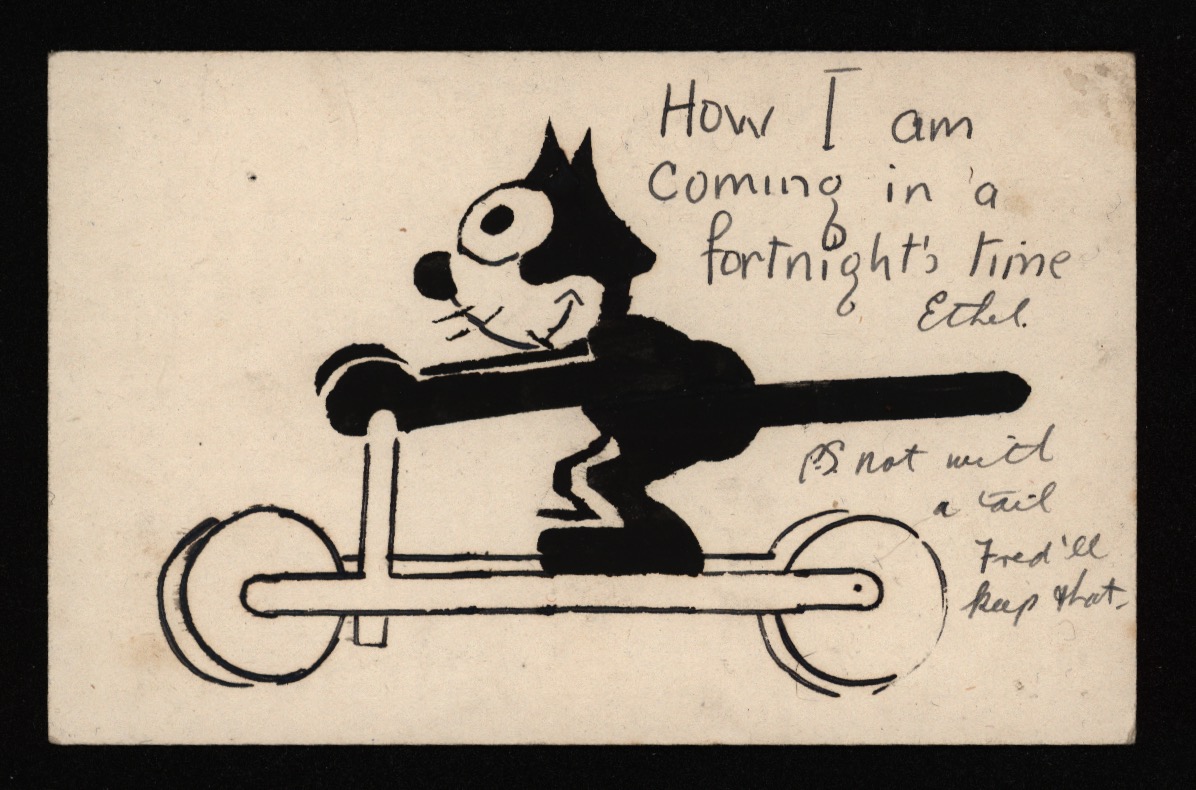
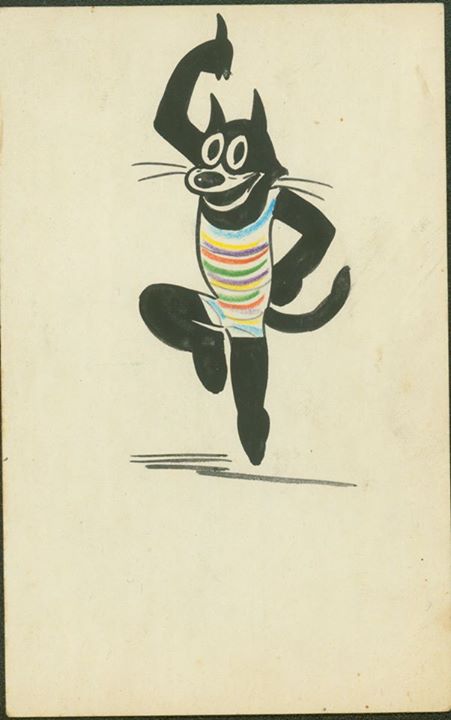
Felix and his walk have always been a matter of some interest. His trademark hands behind the back walk as he thinks and dreams up tricks is a significant aspect of his devilish charm. It has been celebrated in song and film (the very funny lyrics to Felix Kept on Walking can be found here, and an early post I wrote on some of my cat sheet music including this one can be found here), but also graces everything from dishes to postcards. It was used for advertising and sometimes took on a more adult meaning – usually involving an enticing girl cat and sometimes batches of kittens.

Felix Keep on Walking plate, Pams-Pictorama.com

I share two recordings of the tune which were available at the time of publication. The Savoy Havana Band does a jolly instrumental illustrated with great photos, below. While a rendition with the lyrics sung by Clarkson Rose can be found on Youtube here.

Meanwhile, I found an interesting essay which discusses the dialogue between Buster Keaton and Felix from the San Francisco Silent Film Festival (which can be found here) noting that Keaton’s film Go West could have been inspired by a Felix cartoon a year earlier, Felix Goes West, and Keaton pays that off with a bit of the Felix walk while contemplating his situation.

The walker from Texas is a somewhat more available model and mine is missing the stick with which to animate it. This one is a simple toy and a stick would have affixed to it for a child to push it forward. There are no indications of where the stick attached and no evidence that this fellow ever had arms. His feet are the only bits animated, head and tail do not move. I like his simple stenciled face – and there are two mysterious purposeful sort of holes in his eye which I cannot image what they were for. His silhouette is a bit bottom heavy rotund. He is made of a light balsa type wood.
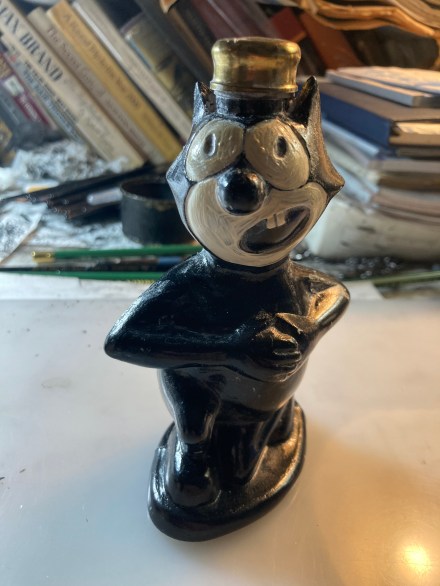
Pams-Pictorama.com Collection.
A very similar item is for sale on eBay with the stick in place and as far as I can tell there is a space between back of head and tail where it would have gone. The item on eBay has a date of September 8, 1924 scribbled on the back. I would have thought this was a bit later myself. I think these days we might be a tad concerned about toys for small children that are animated with large sticks out of the back, but as I do not have any small children I cannot say if this is a fact.

The more recent acquisition is by far the more substantial of the two toys, made from thick wood and with a hefty roller and even the stick is a more finished item with a handle making it seem like it is less likely to poke an eye out. This Felix animates with arm movement and he seems to have had a moving tail at one time, there is a slot for it. One arm on mine still moves but the other is disengaged – it would be easy enough to reattach with a tiny nail although I don’t think I am that person. Nonetheless, this fellow does indeed keep on walking.

Pams-Pictorama.com Collection.

The Antique Cat

Pam’s Pictorama Post: I always like to look at old children’s books and juvenile fiction given the opportunity. Pictorama readers know that I enjoy early chapter books that would be called young adult fiction today. (There are the posts devoted to girl detective Judy Bolton, Honey Bunch and of course several devoted to The Camp Fire Girls, Red Cross and Ranch Girls. A smattering of those can be found here, here and here or search the site for books.) And I have written about some of my childhood favorites, including one illustrated by the great Garth Williams called Push Kitty (post here) which reminds me a bit of this volume. Still, it is rare that a true children’s book that I had no prior knowledge of zooms into a place in my heart as this one has. It is great for kids but a winner for the cat lovers too.

The illustrated cover which my copy does not have.

I stumbled across this title while searching for information on another one on Goodreads. The description was appealing and on a whim I purchased a (much) used library copy, sans cover and with a heavily taped spine, (stamped throughout as from the School of the Japanese Martyrs, Leavenworth, Minnesota!) for a nominal amount. With an unexpected trip to my mom in New Jersey and other pressing life matters I didn’t have a chance to read it until last night and it is a gem! I can only say I am sorry I didn’t know it when I was a kid, it would have been a favorite in rotation and my parents would have loved it too.

Solomon in the store window at night entertaining passersby.

The story is a simple one – a skinny stray (all black) cat is taken in by the owner of an antiques shop. It is told from the cat’s point of view and he has some simple adventures – most involve his love of eating fish – and all ends well with him installed as the beloved master and mascot of the establishment. An antique store makes for an interesting setting for cat adventures – while fear of breaking fragile items is mentioned, claw paws and scratching are not. However his nemesis ultimately is an antique doll who receives too much of his mistress’s attention and affection. Fortunately his human loves him above all else and forgives some minor feline transgressions.

Undeniably great cat poses!

The all black protagonist of our story, Solomon (we are not told how he acquired his moniker), looks like my own Blackie and the early drawings of him as a street cat sadly corresponding to our boy recovering (shaved and thin) from his recent stint of illness. (No mention of black cats and bad luck are mentioned and Bradbury gets points for me with this.) Solomon progresses to shining glory although I guess some of his battle scars around the ears and whatnot remain as badges of feline honor.

I easily could have found this book as a child. The copyright in this edition, the first, is 1945. It was published by The John Winston Company of Philadelphia and Toronto and the copyright notes that it was also copyrighted in Great Britain (Dominions and Possessions as well) and in the Philippines. It was written by Bianca Bradbury with drawings credited to Diana Thorne and Connie Moran.

Front papers.

Bradbury was born in New Milford, Connecticut in 1908. A brief online bio outlines that as a young wife she published verse and short pieces in magazines and eventually, after her sons were born her worked morphed into children’s books and ultimately into young adult chapter books. She evidently wrote realistically about the issues of the day for kids in those later books, not balking at difficult subjects. This book and that bio intrigues me enough to look into some of her other books. (One Kitten Too Many may be where I start, but I will look for the longer ones as e-publications perhaps.) She was prolific and wrote 46 books in her 40 year career.

Solomon thinking back on his stray cat compatriots!

Meanwhile, Diana Thorne gets top illustrator billing here and she deserves it. Her cat illustrations are perfect. It seems she is best known for her illustrations of dogs (these seem to be well known and collected), but she certainly lived amongst cats as the poses are spot on for us cat lovers. Her illustrations are pitch perfect and absolutely put the story over. While her illustrations and drawings are widely available on the internet, there is little biographical information about her. It seems, oddly, that she was either born in Odessa, Ukraine, or as she was later to claim, on a ranch in Winnipeg, Manitoba, in 1895 (d. 1965) – her love and knowledge of animals would argue some time on a ranch I think. Her work is collected in numerous museums in the United States and Great Britain including the Smithsonian.

Something “fishy” about this doll…

The other illustrator credited, Connie Moran, seems to have teamed up with Thorne on a number of similar illustrated children’s books. I can only assume that Thorne was only interested in the animals and left the humans (and in this case some antique furniture) to Moran. She is from Chicago, born in 1898 and dies in 1964 so she and Thorne are contemporaries. Her illustrations are, for me, more commonplace and would be forgettable without the Thorne cats among them.

Solomon loves his dish of fish.

The Antique Cat is much shorter than May Sarton’s The Fur Person, (you can find that post here), but reminds me of it in tone and the way it is told from the cat’s perspective. It is a very worthy entry into cat related literature and certainly deserves a place in the Pam’s Pictorama library.

Blackie this morning. Hopefully on the road to recovery.

Has Anybody Seen My Cat

Pam’s Pictorama Post: I’ve seen this sheet music come and go and I finally grabbed it up. It occasionally turns up in my cat searches and I finally landed on this copy earlier this week. There’s another version with an equally good cover, but very different cover which I will still snatch up given the opportunity.

Pictured on the front between these two great black cats is, I assume, Emma Carus. Emma was a vaudeville performer who was the face and voice for putting this song over. According to the American Vaudeville Museum site (University of Arizona, here) although she was pleasing looking, she generally opened her act with the line, I’m not pretty but I’m good to my parents. However, her songs were incredibly popular and she sold reams of sheet music. She hit the big time as a performer in 1900 so when this sheet music (copyright 1922, but more about that in a moment) she was a well established star and money maker.

This Black Cat Hosiery Cat of the same period at seems to be a kissin’ cousin of the ones on the sheet music.

Emma gets the top credit, followed by Dan Blanco (of whom I find no real tracks) and then J. Walter Leopold. I am not sure I see real evidence of her actual song writing as I read her bio. J. Walter Leopold has numerous song credits, but was also a performer and he and Carus teamed up in 1918 and worked vaudeville until the end of that particular line. He drifts to radio and then manages some bands. She lived hard starting in her teems, has two failed marriages before she is 25, and dies in failing health at 48.

Emma Carus in all her glory in an undated photo, on Ziegfieldfolliesgirls.com

Sadly I cannot find a recording of her singing this song, nor can I find a recording of her singing at all.

While credit is given as above on the front of this sheet music, the internet reveals that the original song was song was British and was written and composed by TW Connor in 1899 for George Beauchamp – probably as a sequel to an earlier successful song Puss, Puss Puss (1897). A 1901 recording of the song can be found here with the slightly different name of Has Anybody Seen Our Cat, but virtually the same lyrics. There are recorded versions going back to 1897 under this name so I don’t know how to make that jibe with the claim of the 1899 authorship above – was it acquired and reacquired multiple times?

The copyright page tells us that Dan Blanco acquired the rights in 1916 and they were transferred to Emma Carus in 1922. So maybe Dan’s only claim to fame is acquiring these rights and selling them.

Children’s Book which claims to have roots in one of the versions of this song.

The song goes on to inspire a Tex Ritter tune, Has Anyone Seen My Kitty, (listen to it here) and eventually a recent children book, Anybody Seen Our Cat by Kenneth Griffin, illustrated by Brandon Weiner.

Below are the lyrics which bear their British roots and age, but produce a chuckle. Enjoy!

I'm upset now; let me tell you why,
Our old tom cat has been and done a guy (run away)
My old gal declares that it's a sign
Somebody's number's up and two to one it's mine
I've been wondering why I am to blame
For sneaking the bacon and the brawn
And the young man lodger's two-eyed steaks (bloater)
When they're missing on a Sunday morn.

Chorus: Has anybody seen our cat?
Has anybody seen our cat?
He's got a bit of black on the end of his tail
And the skin's all off where he's been fighting
Last Sunday morning we missed him from the mat
Puss! Puss! Puss! Meat! Meat! Meat!
Has anybody seen our cat?

How we loved that cat nobody knows
Put butter on his feet and pepper on his nose
When he caught cold gave myself a job
When the toothache troubled him so bad
And I found little Tommy couldn't eat
I tied up his face, put baccy in his ear
And got another cat to chew his meat.

Chorus:

I never thought he'd leave his happy home
Though after the gals he often used to roam
I've sent tripe hounds out upon his track
I'm doing everything to try and get him back
Got two cods heads stuck up on a pole
And nailed up a kipper on the door
And written underneath it ‘Welcome home'
And a promise not to kick him any more.

Chorus:

My Little Chickadee

Pam’s Pictorama Toy Post: This is a truly oddball purchase for me. Sometimes the unusual just calls to the collector in me and this fellow is one of those times. I was not the least bit disappointed when he showed up in the mail however – he makes me laugh!

I don’t know why, but I have it in my mind that this slightly angry looking celluloid chicken is an umpire. He does have a baseball bat tucked under one arm and I can be convinced that his hat is a baseball cap as well – because really why would he wear a tam ‘o shanter or captain’s cap? And I can imagine him yelling, Strike – you’re out! Meanwhile, let’s discuss that he sports a tie and belted trousers. I like his hands spread across his considerable girth too (as if he just had a nice big meal), and although he has human arms, his legs are chicken legs complete with scaly toes.

Celluloid chicken, Pams-Pictorama.com Collection.

I found him while scrolling through my Instagram feed one night (@MissMollystlantiques) when I really wasn’t inclined to purchase anything (having just spent a fortune with Blackie in kitty ICU – his recovery continues apace, steady if a bit slower than I would prefer), but how could I say no to an angry celluloid baseball chicken? Man, you don’t want to argue with this chicken. He has some attitude.

The angry celluloid chicken in suit series? Not in Pictorama Collection.

This fellow rattles in a nice loud fashion that I can see being pleasantly distracting for a small child back in the day – I admit to rattling it a bit myself. I will note that this is not a young chicken and if I had to guess I would say his era is the 1940’s or ’50’s, although I share above illustrations from a current Ruby Lane listing and they say the 1920’s making him an elder statesman indeed. (These also evidently bear tiny labels stating, Made in Japan, which is not surprising.) I like the top hat on their rattle, although I prefer the expression on mine. The roly poly looks like he is doing a stump speech with his cigar in hand! Movable bits on him and the rooster on the end. (They are for sale, as is the toy at the bottom of the post, at the time of publication.)

My guy does stand, albeit a bit unwillingly and he is not cracked, but has a few errant child induced marks and smudges. At his senior age he is a tad fragile, although perhaps not quite as much as you might think. (Over time I have become less terrified of the fragility of celluloid which I once wrote about here. In that vein I purchased a celluloid cat rattle awhile back as well and that post is here.)

My chicken (rooster, let’s assume he’s a rooster?) is without a maker’s mark or other identification, although there is a (more recent) $10 penciled in on his bottom, but no company or place of origin on mine. If there was a sticker it is long gone.

Somewhat kinder gentler version for sale on the internet, Pickclick.com.

I located another kissing cousin to him (shown above), a brother in a full suit and jacket, no baseball bat, and a friendlier look, who was identified as an Easter celluloid chicken. When I look back on Easter baskets of my childhood (which were in all fairness prodigious things of chocolate and other candy, as well as a bevy of soft chicks and like toys) I can safely say that nothing like this was ever included. I am glad to have mine, if a bit late in life, now.

A (Felix) Cat Book

Pam’s Pictorama Post: I’ve actually been in possession of this slim volume for a few years since purchasing it on eBay. I think it went to the shelf and somehow never made its Pictorama debut. But I was emailing about all things Felix with a fellow Felix-o-file and dug it out to show him. I have not seen it around much, but some digging shows that you can currently acquire a copy if you are willing to pay up. My copy is inscribed twice. The first is in a childish pencil scrawl which, oddly, reads, Elizabeth Butler, 1021 Craggmont. The other, in a neat pen, To Martha, from Mabel Crowe. Neither is dated.

Titlepage, Pams-Pictorama.com collection.

It is a somewhat odd book. To start with, across the front it announces that it was Published by Harper & Brothers – Established 1817. A quick check and Harper & Brothers, which started life as J. & J. Harper publishing in 1817 (brother Jay and John at the helm) until more brothers from the clan joined and the name changed in 1833 to recognize them. Then it changed again in 1962 and became Harper & Row, before later finding its 21st century moniker, Harper Collins. However, while new printing methods made them a leading publisher of books and textbooks, the influence of the famed Harper’s Magazine could evidently be felt through their publishing empire and its influence is felt in this volume.

Felix himself travels under an American passport and Harpers a US publisher, however the author is British essayist, E. V. Lucas, giving this something of the feel of a British product like one of their comics annuals. While this Felix volume was published in 1927 there is an earlier, 1902, version which has different and more traditional cat illustrations by someone named H. Officer Smith and in fact published in Britain. The illustrations have a whiff of Louis Wain to them.

The earlier version of the book with illustrations by H. Officer Smith. Not in Pictorama collection.

Lucas was a lifelong Punch author whose prodigious output of essays, commentary, verse, plays and was legendary in his day. His biography is sprinkled with references to hobnobbing with friends Barrie, A.A. Milne, Arthur Conan Doyle and the likes of his day, playing cricket and billiards. He has written the copy in simple verse with a sly eye to the beloved tricks, maneuvering and manipulation of cats.

Our volume (ostensibly illustrated by Pat Sullivan who signed each illustration, however we’ll assume it is of course Otto Messmer ready at the dip pen) is a slim one at about 30 pages, writing on each left side and illustration on the right. Felix takes on the role of a sort of every cat persona rather than doing a star turn as his famous film self here – although he seems to have some of the Felix wiliness and trouble-making charm as played out in the pictures.

The drawings show Felix in fine fetter and I can only imagine that for a pro like Messmer it didn’t take him long. However his skill shows in making every line count for maximum entertainment and raises it to the level of a Pictorama worthy Felix investment.

Ed. Note: After this was posted @judd_kid and @tomatitojose sent word that they think it was drawn by Dana Parker who drew many of the Felix theater posters and advertising art! Fact for the day!

It’s Bimbo

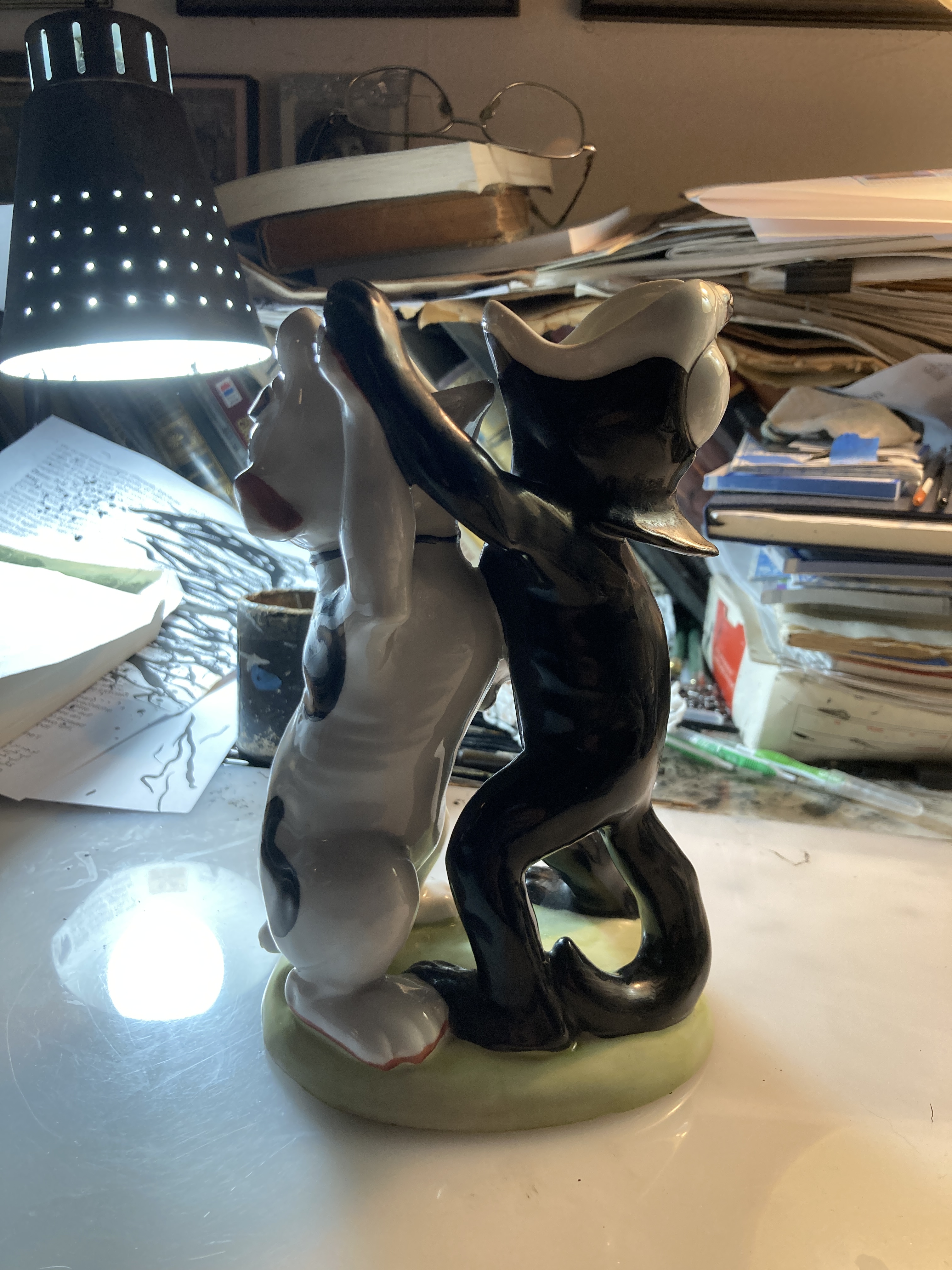
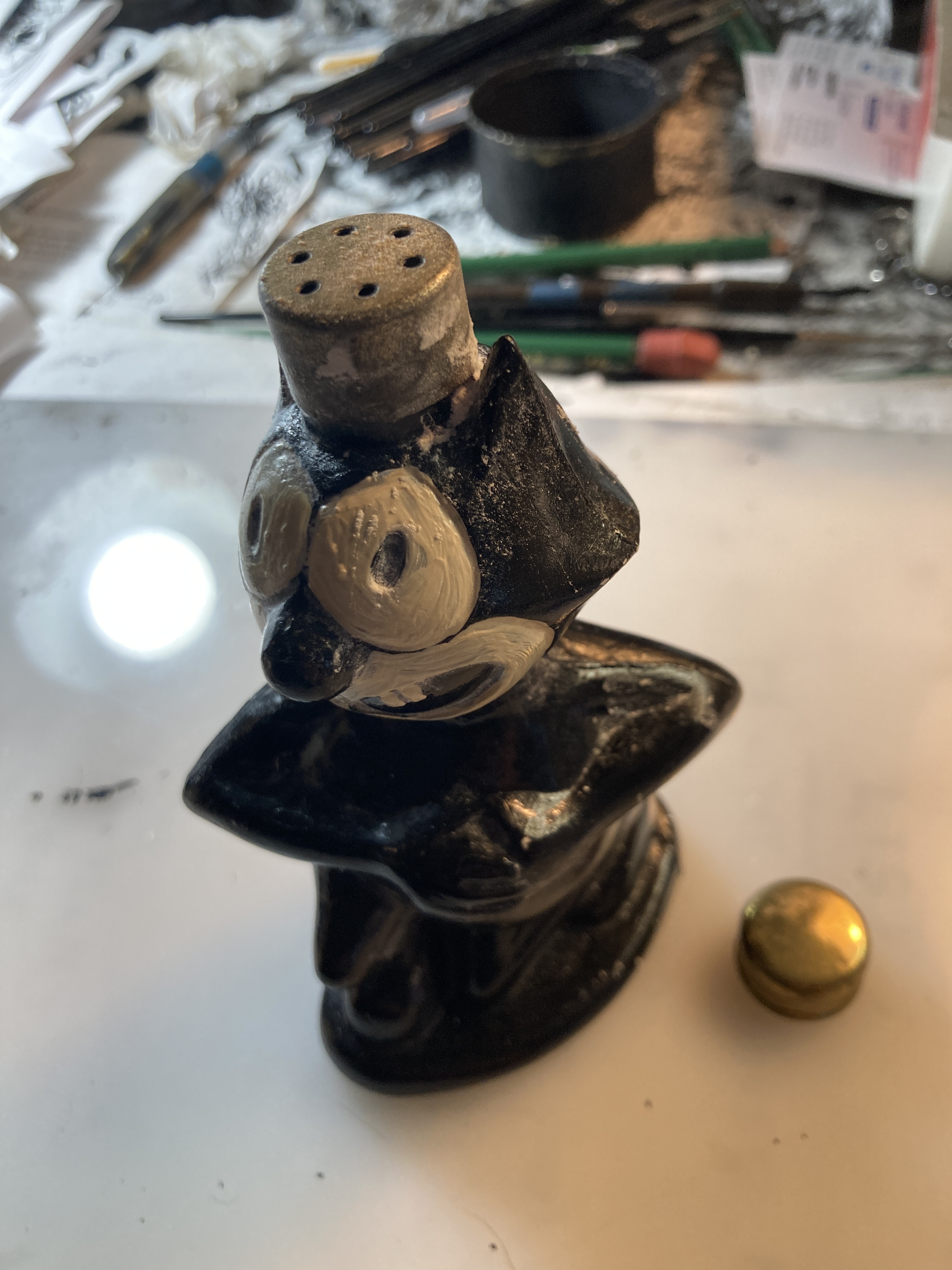
Pam’s Pictorama Post: Today I am celebrating a somewhat forgotten character of animation via this really nice little ceramic figurine which traveled here from Texas earlier this week. It came from our Instagram pals @curiositiesantique (and getcuriosities.com – I have written about them and Sandy who is my thoughtful contact in a post that can be found here) who were very nice and sent me a photo asking me if I was interested in purchasing him – and I definitely was.

I quick check on Wikipedia this morning (which cost me a donation to them, got me at a weak moment) reminds me that Bimbo, an animated perpetual pup of sorts made his debut as KoKo the Clown’s sidekick in the Fleischer Studios Out of the Inkwell series before becoming Betty Boop’s paramour as she rose to fame in the early 1930’s. Bimbo was the first animated character to invite everyone to follow the ball and sing along in the 1926 cartoon, My Old Kentucky Home. (All cartoons mentioned here are linked to viewing on Youtube available at the time of posting.) Oddly they note that his name comes out of a reference at the time to men who like to fight which is a fact for the day.

From Bimbo’s Initiation.

A loosely designed Bimbo stars in the 1930 cartoon Hot Dog where he is nabbed for annoying women with unwanted attentions. Later Betty and Bimbo made classic cartoons they are both best known for such as Minnie the Moocher and Bimbo’s Initiation.

Bimbo is eventually overshadowed by Betty as she rose to greater prominence. It seems as she became less doggy there was eventually pause about a human being in a relationship with a quasi anthropomorphic dog. In 1934 the Hays code decided that interspecies affairs in animation were a problem and nix their onscreen relationship. Betty gets a proper puppy pet, Pudgy, instead and Bimbo is largely retired.

From Van Eaton Galleries. Not in Pams-Pictorama Collection. Slightly different Bimbo.

Some research turns up a set of Bimbo, Betty and KoKo in the box of these figures and which reveals that it was imported by George Borgfeldt which is a name I have seen in and around objects and toys of this period. The example, shown with the box is from an auction site and seems to be a slightly different incarnation of Bimbo, less well executed.

Original box, also from Van Eaton Galleries, not in Pams-Pictorama.com collection.

There is another variation which shows three Bimbos in a musical trio. Not sure what the inspiration was for these.

Not in Pams-Pictorama.com Collection and for sale on eBay at the time of publishing.

Fleischer Studios is imprinted on Bimbo’s butt, an inventory number above and Made in Japan across his heels. He is made of ceramic, some sort of porcelain bisque. Although one ear looks like it may have been lopped off, the other image assures me that this is as he was made. He’s a good design, reasonably close to his animated self, and pleasantly sturdy. Bimbo will enjoy a place of pride in a display cabinet on the long shelf of curiosities here at Pam’s Pictorama and Deitch Studio.

Dragon Flying

Pam’s Pictorama Post: This pin was waiting for me when I got back from my Denver trip. It traveled here from Great Britain and an Instagram seller I have purchased from before, @lucyameliasvintage. As it happens my prior purchase was also celluloid – an elephant box for Kim and a butterfly which I wrote about in a post that can be found here. It makes me assume that the British knew something about celluloid we did not in the US – or they were just more careful with theirs.

I have written a few times before about the subtle mania for insect related jewelry that seemed to overtake me during the pandemic, a product of online shopping and perhaps being too confined. These acquisitions have ranged from a silver bracelet with spiders in webs to a few tiny insects, and as well as these sort of glorious plastic winged critters. This spring I got to live a fantasy of pinning several to a jacket lapel at once. A small tableau of bugs.

Deitch Studio Collection.

This latest acquisition is both a tad cheesy and a bit delicate, but I like it. The body is a light metal, painted a shiny green, appropriately bug-eyed, and the long delicate celluloid wings, pin underneath. I will have to wear it before coat season because he should not be smushed under a coat or bag shoulder strap. He is a fair tribute to the dragonfly, but that is an insect whose iridescent beauty is almost impossible to capture and jewelers from Tiffany to whoever made my plastic pins have been inspired to try.

Celluloid butterfly, Pams-Pictorama.com collection.

Frankly, I am not especially kindly in my feelings toward real insects. A waterbug showed up in the kitchen a few weeks ago and not unlike a cartoon if I could have found a chair to climb on, Olive Oil style, I would have. Instead, despite being on the phone with my mother, I yelled while the cats looked on, amused but doing nothing except an occasional soft “pudding paw” swat while it ran to safety under the fridge.

Spotted Lanternfly via the NYT.

Those of you in New York may know about the Spotted Lanternfly which has landed on our shores to munch all of our trees. The New York Times had a cover page story asking us to stomp on them whenever we see them. Oddly, about a day later I was on an all day staff retreat in borrowed but palatial office digs when a yell went up at the far end of the table. My colleagues were standing around pointing – at a Lanterfly of all things. Much to her credit, our CMO popped off her sandal and whacked the guy! Bam!

Meanwhile, I also had chance to step on one leaving my office the other day. Sadly, they are quite beautiful really. It should be noted that they do not go easily and I felt badly, not to mention that this is obviously an ineffectual campaign all said and done. Shortly after the original article the Times published a follow up – some folks expressing sympathy for the Spotted Lanternfly with its appealing design and hiding them from would be assassins. Will I commit to insect killer or savior? Clearly more to come on this, but I am already sure that Lanternflys would make a very nice pin design.