Buster Brown Bank

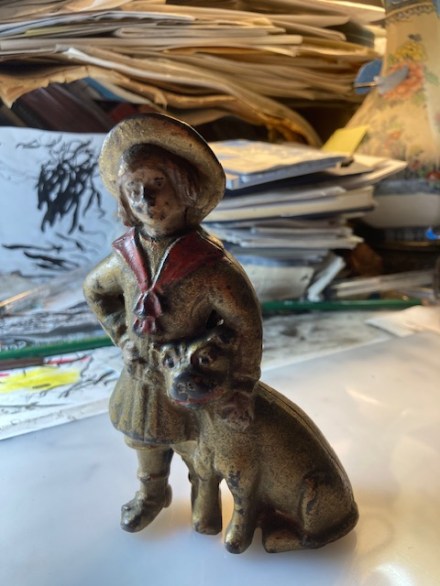
Pam’s Pictorama Post: I realize that there has been no reason to visit the history of Buster Brown in this blog. Today I will try to do him justice via this bank I purchased recently from my Texan friends, @curiositiesantique via Instagram.

For those of you too young to have owned these shoes (I barely slip into that category with a dim memory of the advertising at the shoe store when I was a tiny tot) the brief history goes pretty much as follows. Back in 1904 in an early advertising coup the nascent Buster Brown shoe company purchased the rights to an existing comic strip character created by Richard Outcault of Yellow Kid fame. Outcault was on the market selling the character and pressed them to additionally purchase the rights to the Buster’s girlfriend which they did – more about her in a minute.
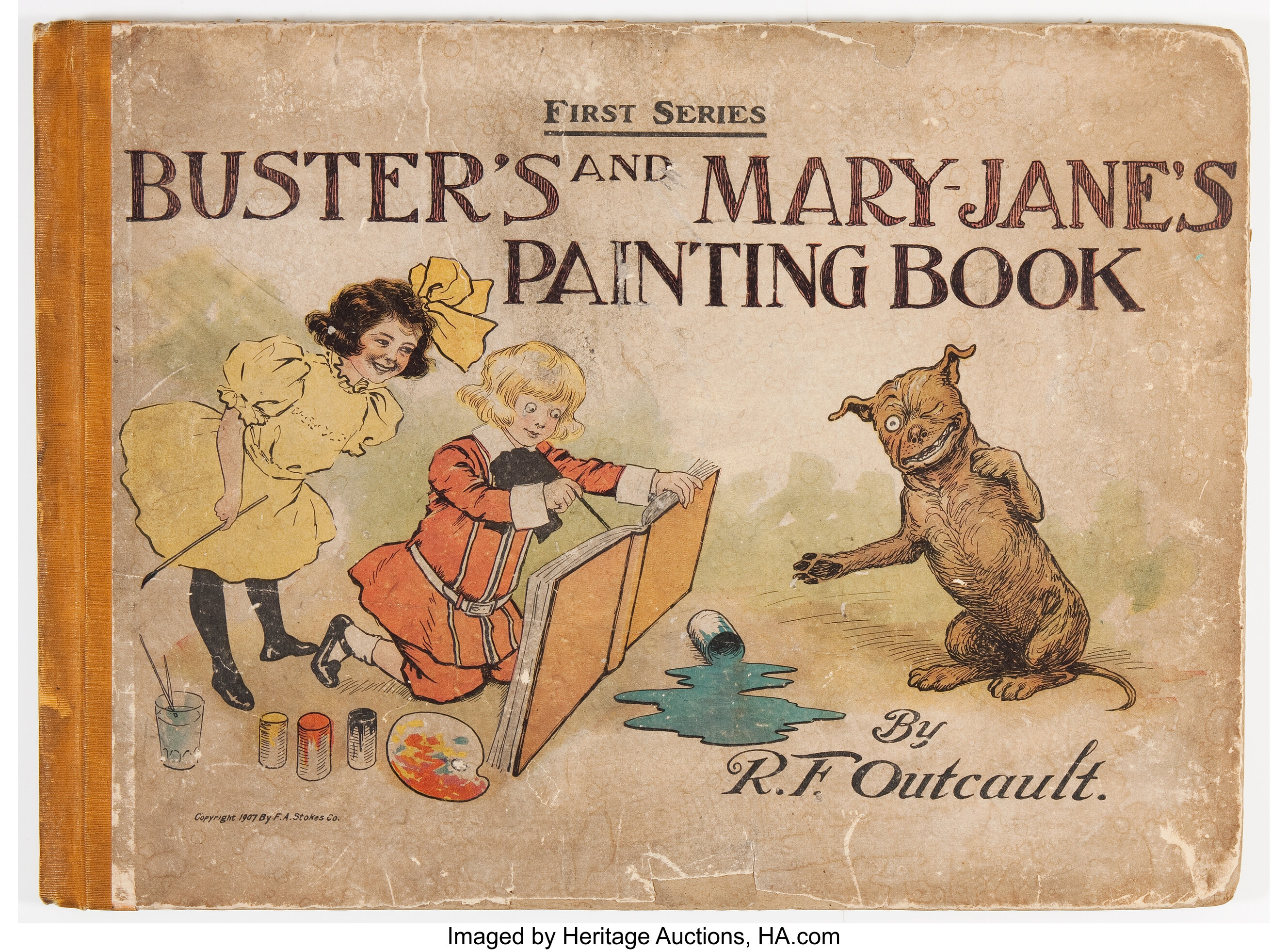
From a Heritage Auction. Not in Pictorama collection.

Interesting to me that Outcault sold the rights to 200 companies at the Louisiana Exposition which is where the shoe company picked it up. Therefore, presumably, there are Buster Brown items or more likely advertising that does not belong to the shoe company. Clearly however the shoe company made the most of their acquisition and a long history of Buster Brown shelling for shoes begins and runs well into the middle of the 20th century and Buster Brown is virtually synonymous with shoes now.

Meanwhile, it should be noted that the cartoonist Outcault was quite the business man when it came to licensing and in 1904 was making $75,000 a year on licenses and employed a small staff to manage them. (If Google is telling me the truth this means he was a millionaire in his day.)
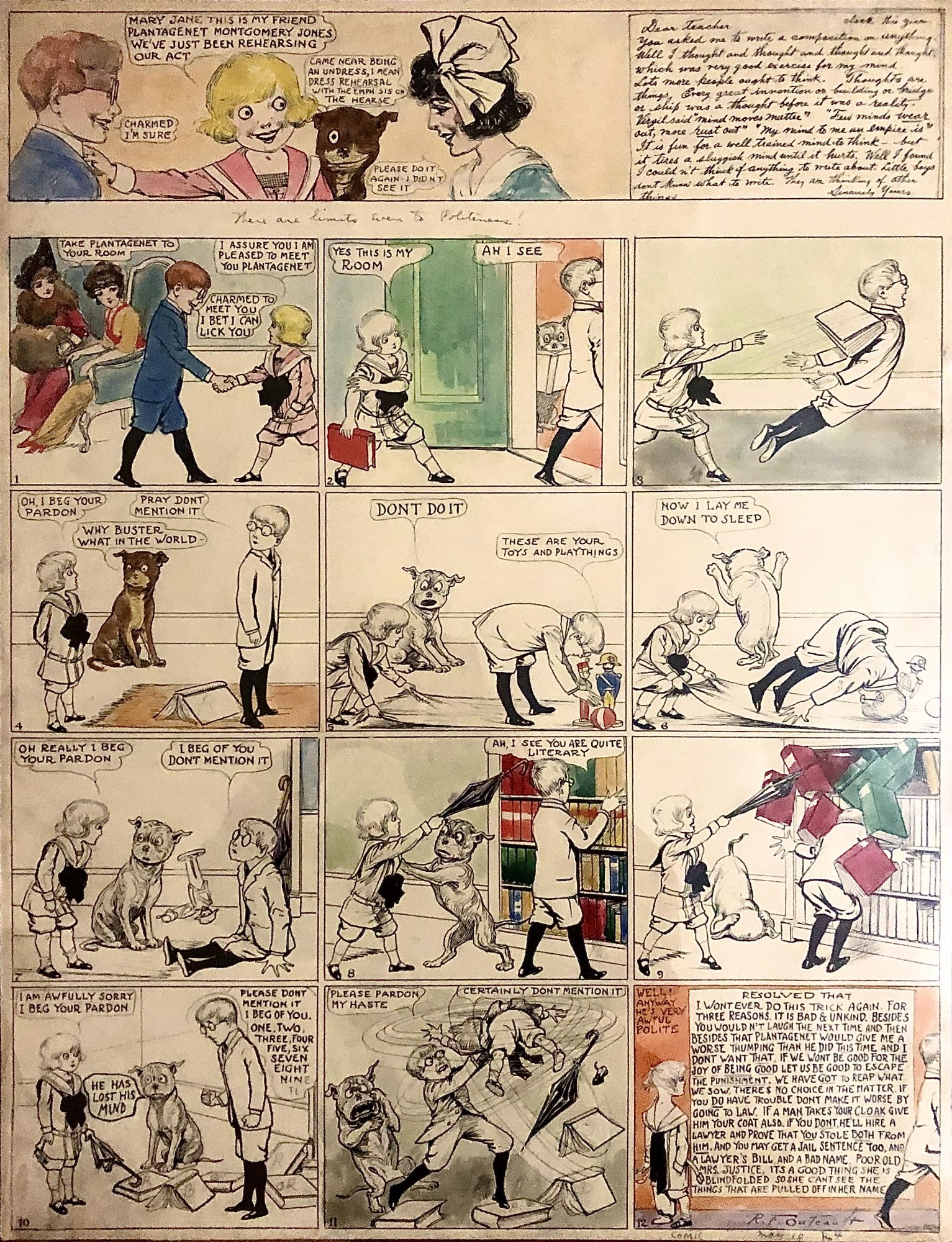
Speciman 1908 hand colored Outcault Buster Brown strip.

However, let’s get back to the shoes. The shoes were so popular that generically a kids shoes might be referred to as their Buster Browns. In addition to items like this bank there was reams of print advertising and purchase point items for stores. Midgets were employed to play Buster, in his unfortunate garb, with cheerful pit bulls enrolled to play his dog Tige. The merchandising for toys was glorious and I spied at least one stuffed Tige online that I covet already. By the time I wandered onto the shoe wearing scene in the 1960’s the merchandising boiled down to some balloons. (There is a vague memory that maybe there was something else, maybe a comic long reprinted but I don’t really remember.)
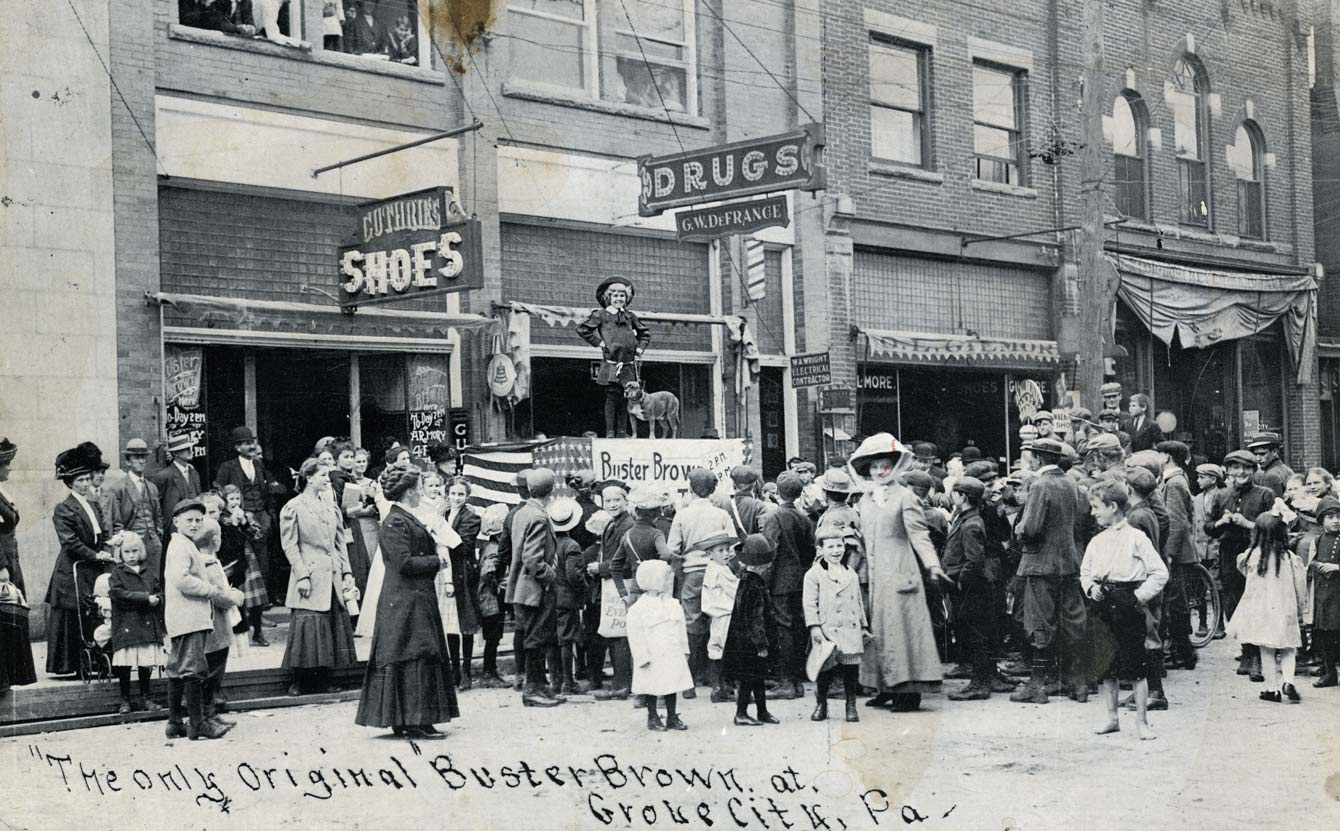
Buster Brown and Tige in front of a shoe store. The copy of this photo is credited to Mel Birnkrant’s collection although a few exist online.

The shoes had Buster and Tige inside, under your heel and I remember the jingle from early tv in a high pitched voice, I’m Buster Brown and I live in a shoe, that’s my dog Tige and he lives there too.
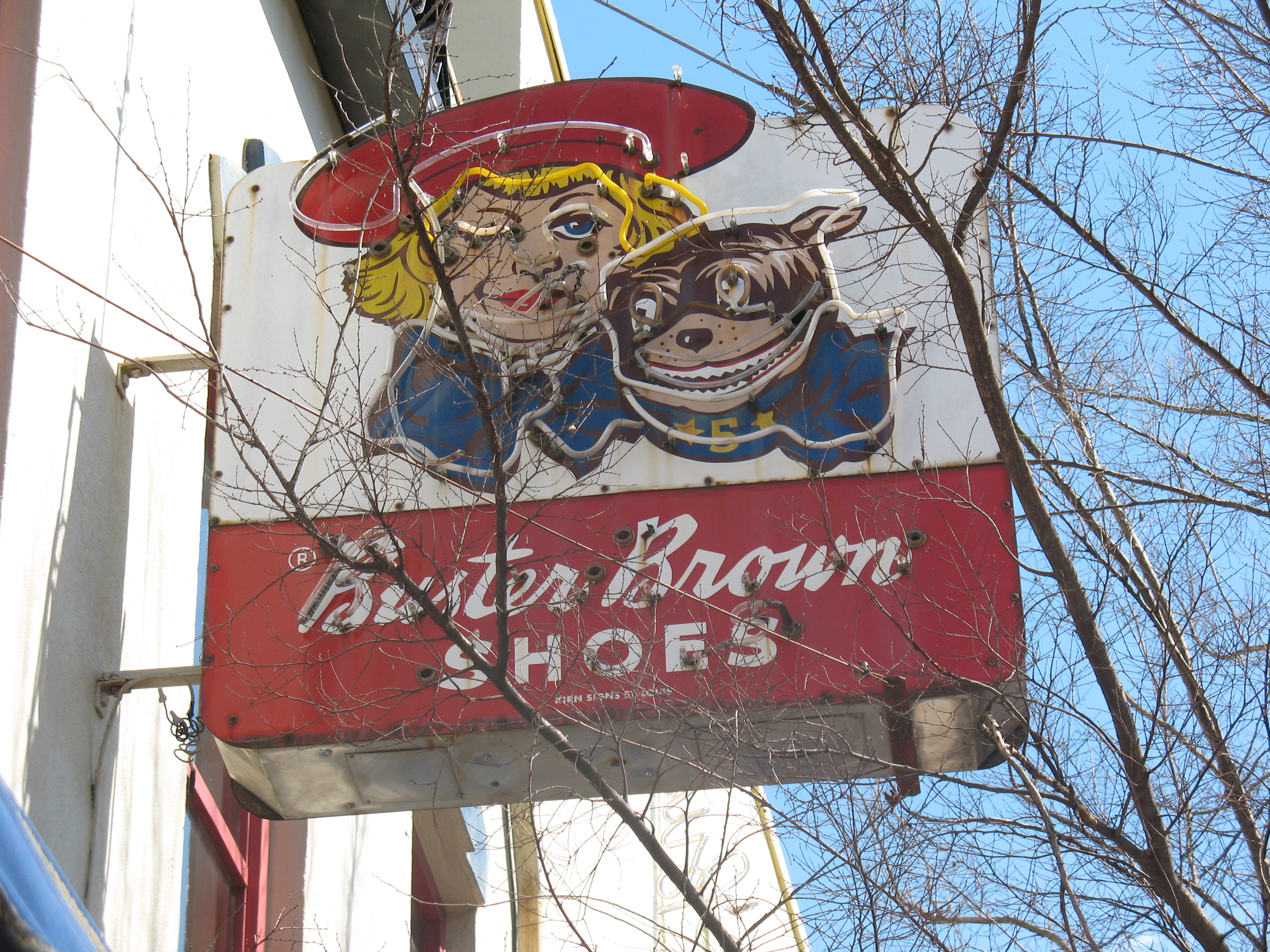
Buster Brown Shoes sign located in Thomasville, Georgia. It can be found on North Broad Street.

So to my surprise, I learned today that as above Buster Brown had a girlfriend (huh), and her name was Mary Jane – and that is how women’s shoes with the single strap were named Mary Janes and are still known by that term today.
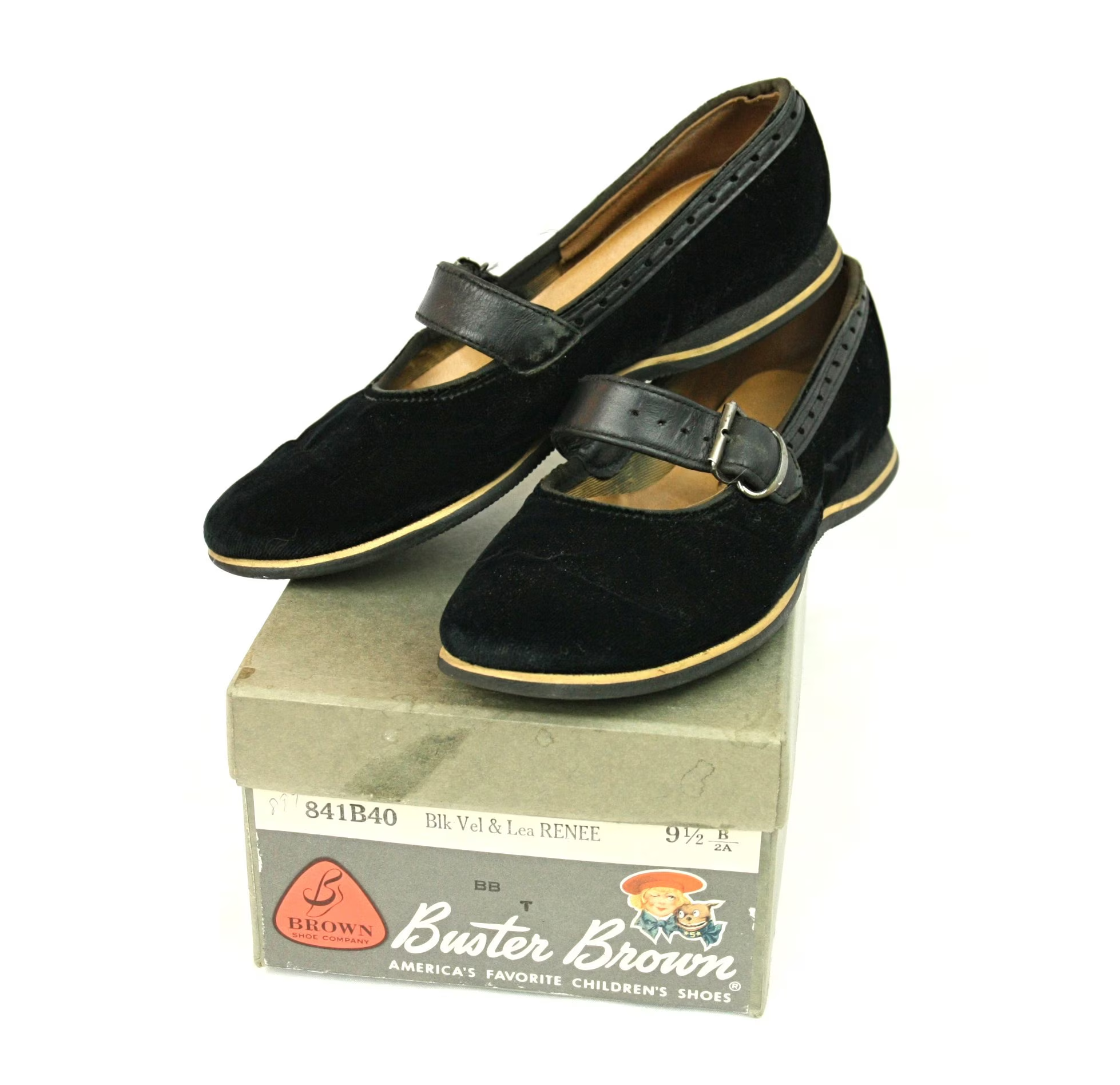
Real Buster Brown Mary Janes. Can be yours on Etsy at the time of publication.

As for this bank, it stands at five or six inches. A trace of paint remains on the face and hands while the red tie remains fairly vivid. This seems to be the most common form of this bank although online I found versions in an overall green and one in red which I can’t decide if it is original or not. The face was the first to go and I can’t say I found it pristine on any of this design. Buster’s hair was painted a light brown and Tige’s mouth was also the vivid red and there were red circles around his eyes.
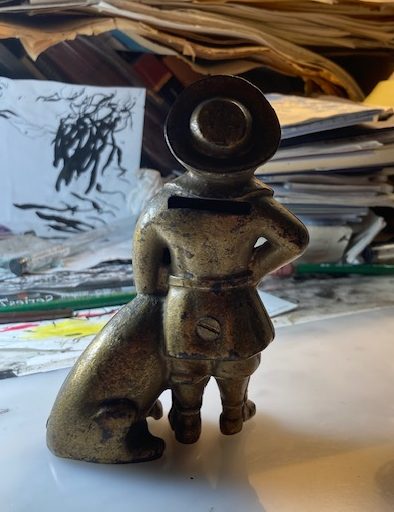
Back of the bank.

It is a simple bank with a screw in the bottom you would use to retrieve your saved coins. It is small so not like you were keeping a fortune in there. Kim starts to ruminate on restoring it as soon as he looks at it. Evidently it makes him itch to paint it although we know that he won’t – nor should he devote time to such projects when more creative work awaits him. (Although Kim’s next book is scheduled for release early next year he’s already deep into the one after it.)

So now that we have a first Buster Brown item we’ll see how long it is before the next wanders in the door. I am going to be looking sharp for that stuffed Tige.

Aspirational

Pam’s Pictorama Post: It’s a rare, I don’t own ’em but wish I did post here at Pictorama today. To the extent that I have set ground rules here, one general one is that if I feature it I own it. (Some readers will remember that I broke it recently to bring you a wonderful cat chair photo. It was a family photo which a reader shared with me and the post can be found here.)

However, to some degree rules exist to be broken and this image came to me both via Mel Birnkrant (his endlessly fascinating FB page can be found here – it is a rabbit hole to go down and possibly never emerge from) and some folks sent it to me via both the Old London FB page and also via X (that we used to call Twitter). The caption reads, Felix the Cat dolls leaving their Acton factory, 100 years ago.

Allow me to start by saying this image just floors me altogether. Admittedly, Felix lust immediately filled my soul! Oh the riches of the past! Truckloads of precious, giant Felix dolls making their way from Acton, out into the 1924 world of of extremely fortunate children and itinerant photographers.

It is also of interest to me to learn that at least one factory making these dolls was in Acton. Unlike the bit of history I uncovered previously (in a post from 2015 I very much favor and can be found here) which indicated that unemployed women were given jobs making smaller ones in a factory on the East End of London. Acton is a suburban area to the west so now I know Felix was being made all over London.

Collection of Pams-Pictorama.com

These are truly splendid huge Felix toys. Are they large enough to be the ones people posed with? Could be, but hard to say. If for kids, very luxe indeed. I certainly have photos of people posing with this size Felix although it isn’t the very largest size which I judge to be about the size of a midget. However, over time my collection has come to include period photos from British beach resorts with Felix dolls smaller than these. (A post on the one above can be found here.) None of the dolls in my collection (yet!) reach these size of the ones in the truck. Hope springs eternal however.

An admittedly soft grab off the film, but a nice close up of the Felixes.

While chatting with Mel and researching this earlier today, I realized that this is actually a British Pathé newsreel short. It can be seen in its entirety here. (I was unable to place the video here – I am experiencing mechanical stupidity today.) Note the unruly little fellow who looks like he wants to make a break for it by falling off the cart.

Of interest that most of these Felix toys were sensibly wrapped in brown paper, precious little parcels being piled up. However, someone must have realized that some should fill the back unpacked in order to get this wonderful image.

I think what I have here is actually a frame grab rather than a still, although hopefully stills do exist so I have a chance at one some day in the future.

Bookplate not in Pams-Pictorama.com Collection.

While we are having a posting moment focused on things shared but not owned, I am adding this Felix-y bookplate which came to me via J. J. Sedelmaier a few weeks ago. It would appear that Mr. Lowell and our cartoon friend shared a moniker. I assume he had these made – very pro job though. A nicely squared off, early looking Felix here. Something sort of smart about how his hand rests on the edge of the “shelf” and the lettering. Oh for the days of book ownership pride which would result in special bookplates like this!

Back to stuff I own next week!

Wound Up and Rolling Along

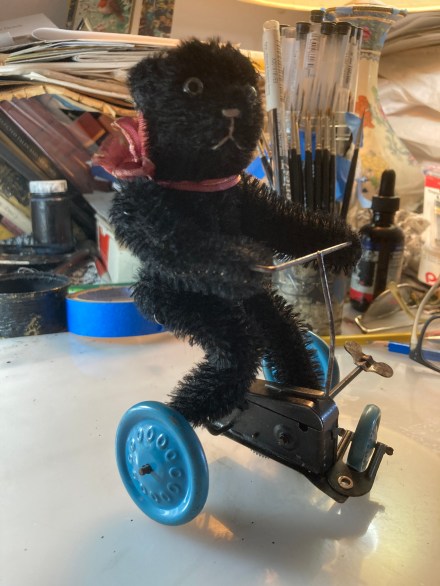
Pam’s Pictorama Post: This splendid fellow came into the house just before the en masse exodus to New Jersey in August. He was part of the haul from the British sale that brought numerous Felix treasures into the house. The items included a Felix walking statuette (that post is here) and a sort of box of Felix which included a rather extraordinary Felix hanky (post is here) and some Felix pins (which can be found here).

This is such a great item that I wanted to make sure he got his fair due. He caught my eye because although I guess he is a bear he is very black cat like. Although he comes from Britain he was listed as German, made in the 1930’s. No maker identified. I would have thought he was British and out of the Felix factories of the day. (See my post about those Felix factories of the day here.)

He perches atop of a spinning part and this helps direct him around in circles when wound.

Watch him turn his elderly circles!

I think there is a Felix version of this toy out there, but they are rare (if I haven’t imagined them) and I cannot even summon an image of one. This fellow works, albeit in a sort of desultory fashion. I think his days of ribald pedaling are behind him which is fine for his retirement here at Pictorama.

For some reason toys on wheels have always interested me although I mostly think of pull toys. I do love a good wind-up toy and this one is a wonderful combination of both.

Today is the first day back here at Deitch Studio in Manhattan when I have time to start to put things in order and Kim has pledged to help. For readers who have been following over the summer there was a harrowing period of moving Kim out of his warehouse space followed by moving the whole crew to New Jersey.

Cookie captured earlier this week looking quite chuffed at being back in NYC.

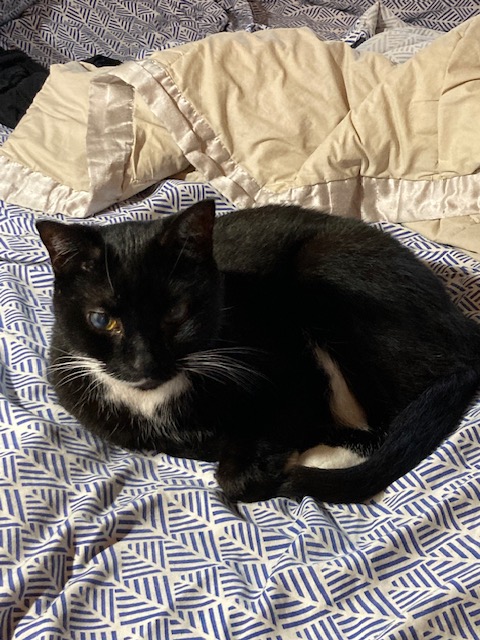
A delightful summer there followed (with some regional collecting), but now we are all back to work and Deitch Studio is working on all cylinders! At the office the orchestra’s season is set to start this week and Kim has finished the color work on his book he started in New Jersey. The cats are surprised to be back. Cookie is delighted and walked around the apartment crowing with pleasure. Blackie seems to be in a funk and is spending his days in the closet for the most part right now.

Meanwhile, the apartment is in a bit of chaos and it is hard to fit ourselves back in our single room. However it is comforting to be amongst the toys again and there are a few other items that came into the apartment either right before we left or during our time in New Jersey. So stay tuned – some more fascinating things to come!

Here Piggy Piggy!

Pam’s Pictorama Post: This little piggy showed up at our local haunt which has supplied us with a few other items over the past year or so. Most recently a rather splendid elephant bank I wrote about here. (A glorious reveal of another one pending for a near term future post!)

The other day without really meaning to, Kim and I wandered in on one of our trips to or from on that particular block. This block is on the path of our trips to a Vietnamese take-out place we favor, our pet food store and is the block we stroll up and down while waiting for our Mexican food to be prepared for pick up. I like to stop and look in the window and occasionally I breakdown and purchase something. The fact that they keep odd hours makes it easier not to resist actual purchases as our strolls seem to rarely matchup with their being open.

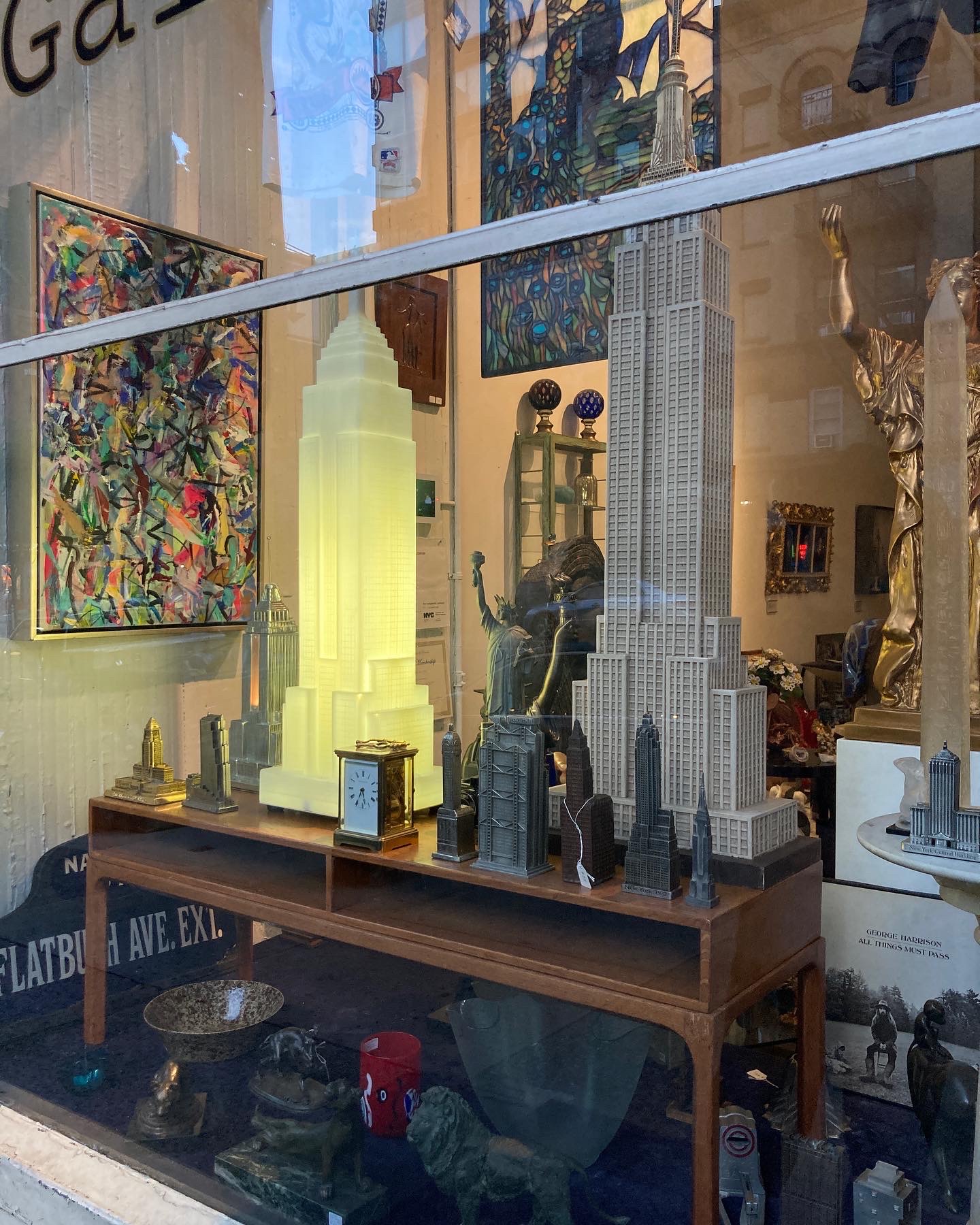
A fairly recent view of the store window.

However, a week or so ago we were out on a Saturday afternoon and they were open and we wandered from front window to being in the store. We had noticed this little fellow through the window a week or so before. He seemed rather singular and so he has joined the ranks here at Deitch Studio.

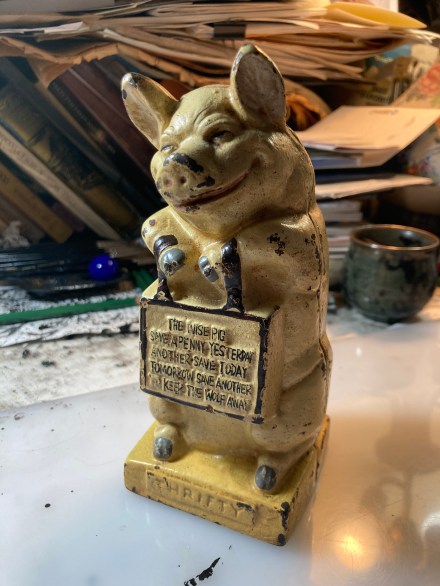
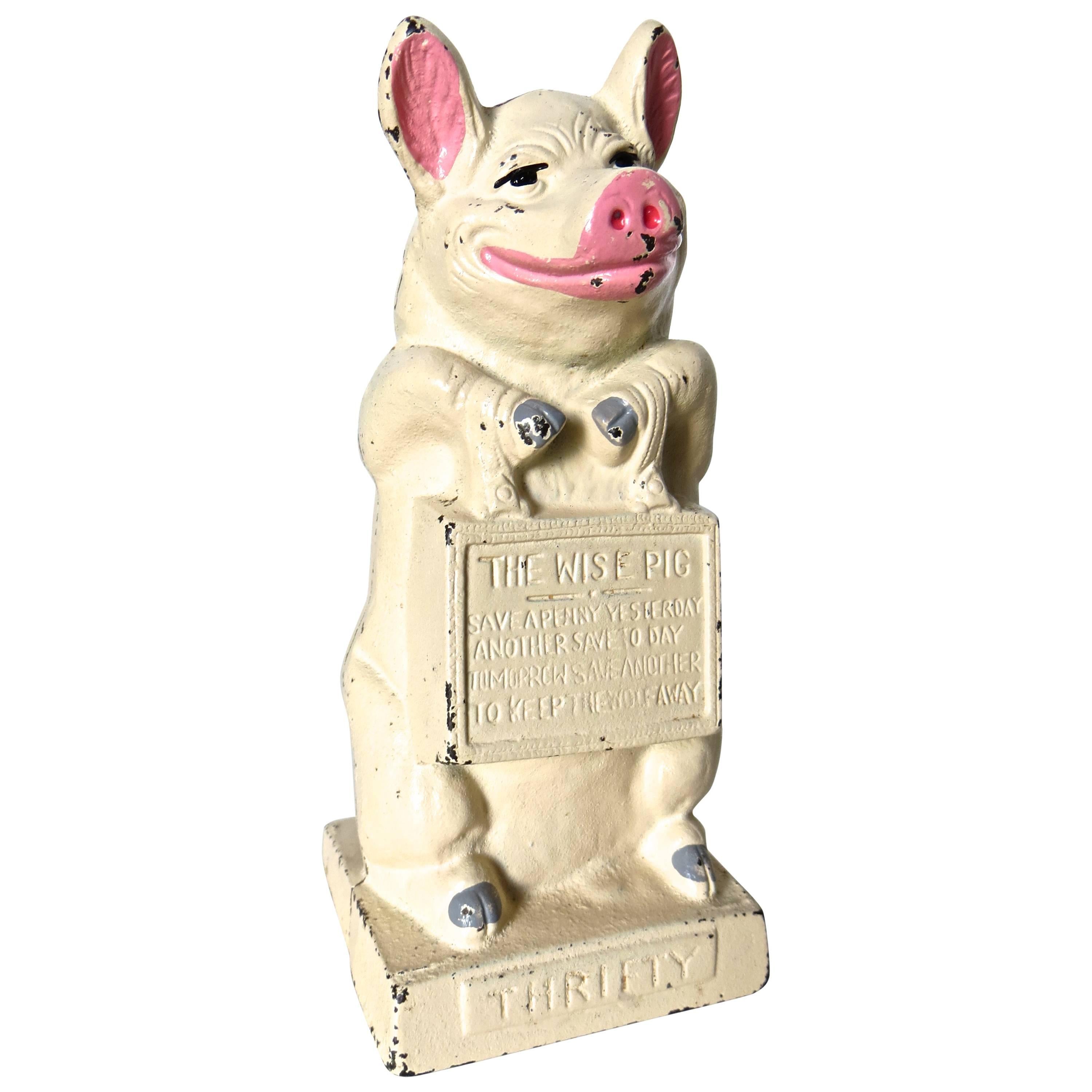
This piggy turns out to be very popular and widely available (currently examples are available on Etsy and other sites) and seems to have been produced over a long period of time starting in the teens, by the maker Hubley. (Another item from this shop is a great dog bank that was made by Hubley. You can find that post here. Seems like I am starting a de facto bank collection via these folks!)

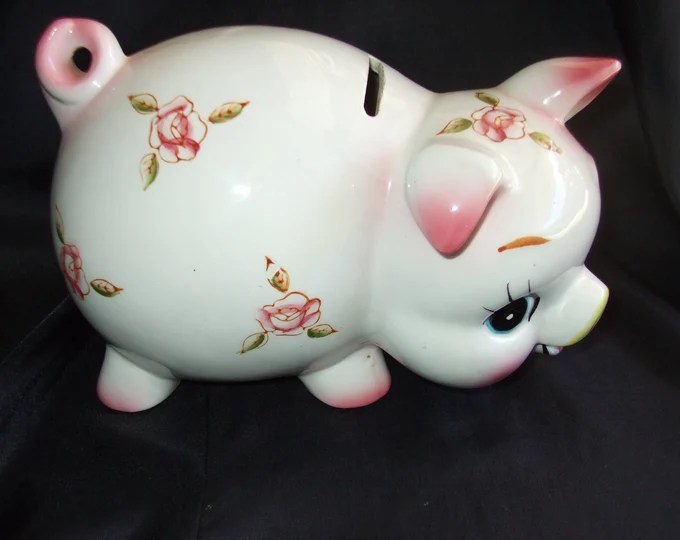
On my version the sign he sports is easily read, The wise pig/ Save a penny yesterday another save today tomorrow save another to keep the wolf away. Below that, on his little stand, it proclaims Thrifty. I feel he is both smiling and yet has a concerned expression. Encouraging you to save and concerned for your future well-being. Other versions of the bank feature the pig with a big pink mouth – making me think of the phrase, lipstick on a pig.

The lipstick on a pig version of the bank. Not in Pictorama collection.

He is pleasantly chipped and handled. I alway wonder about these banks how many pennies, nickels and dimes you could realistically have fit in. The effort to loosen and remove the bolt at the back seems beyond a child – perhaps the whole point? Or maybe kids just jiggled the money out of the slot again. I would say none of my banks, for all their decades in existence, show any evidence that they were ever unscrewed and opened. Teaching children thrift indeed.

I wrote a bit about banks I had as a child in a post here. The one below is a reasonably close clone of my memory of the very traditional one that was beloved to me as a child. Mine may have been a model that was slightly older or newer. I don’t remember the one ear down, but it was a long time ago. This piggy had a cork holder in the bottom I believe. I may have kept coins in him (her?), but I think mostly I just liked it.

Perhaps the model of piggy bank I had as a child, for sale on Etsy. Not in Pams-Pictorama.com collection.

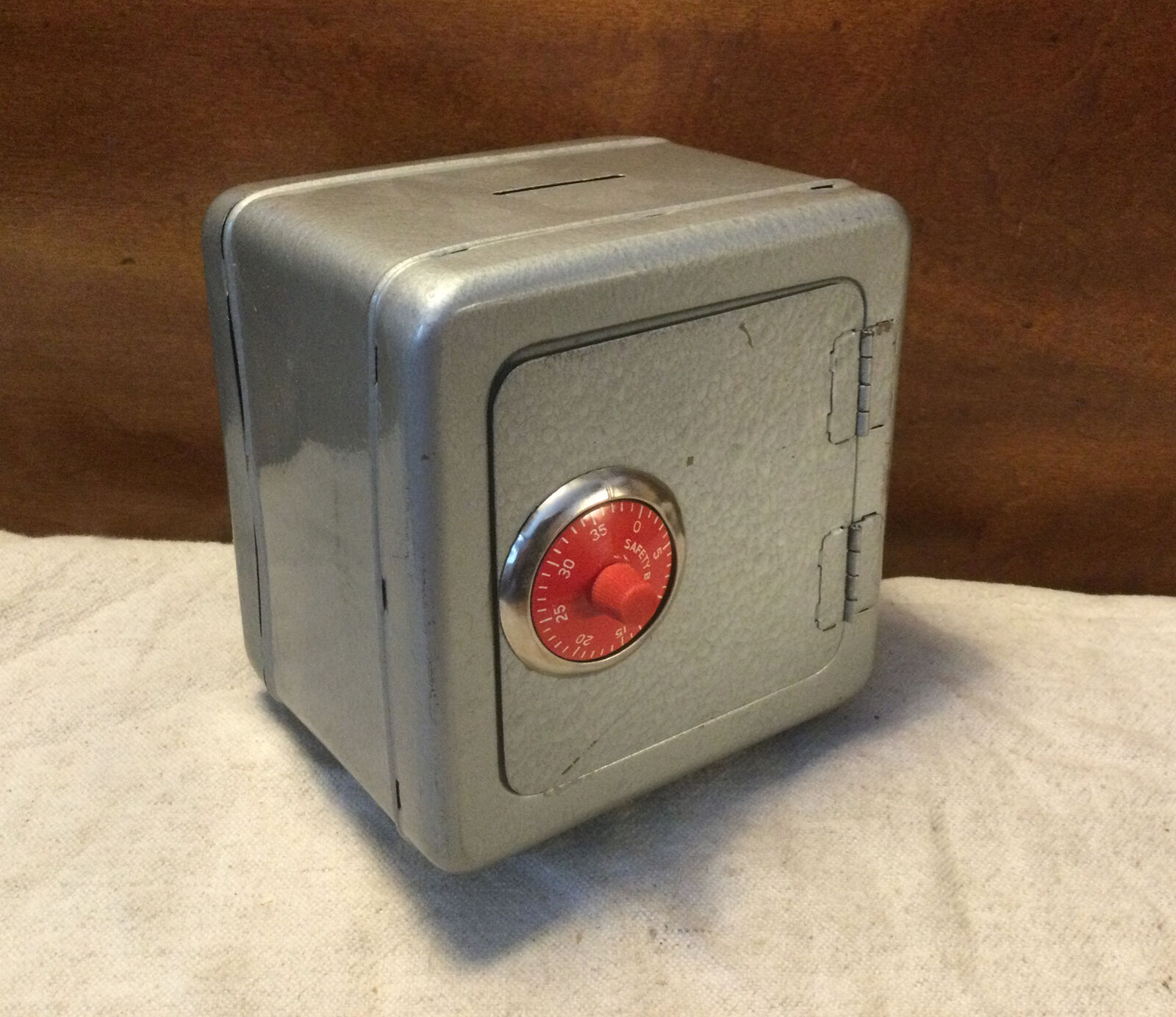
My “real” bank was a small safe someone gave me. Loren and I were each given one and I used mine for many years, tucking away both bills and coins. Later in life I adopted the habit of keeping bills in my dresser drawer – Loren was fond of the sticking it in old purses method of storage. We had proper savings accounts as kids too.

The exact toy safe I had as a kid – down to the red knob. Loren’s had a blue one.

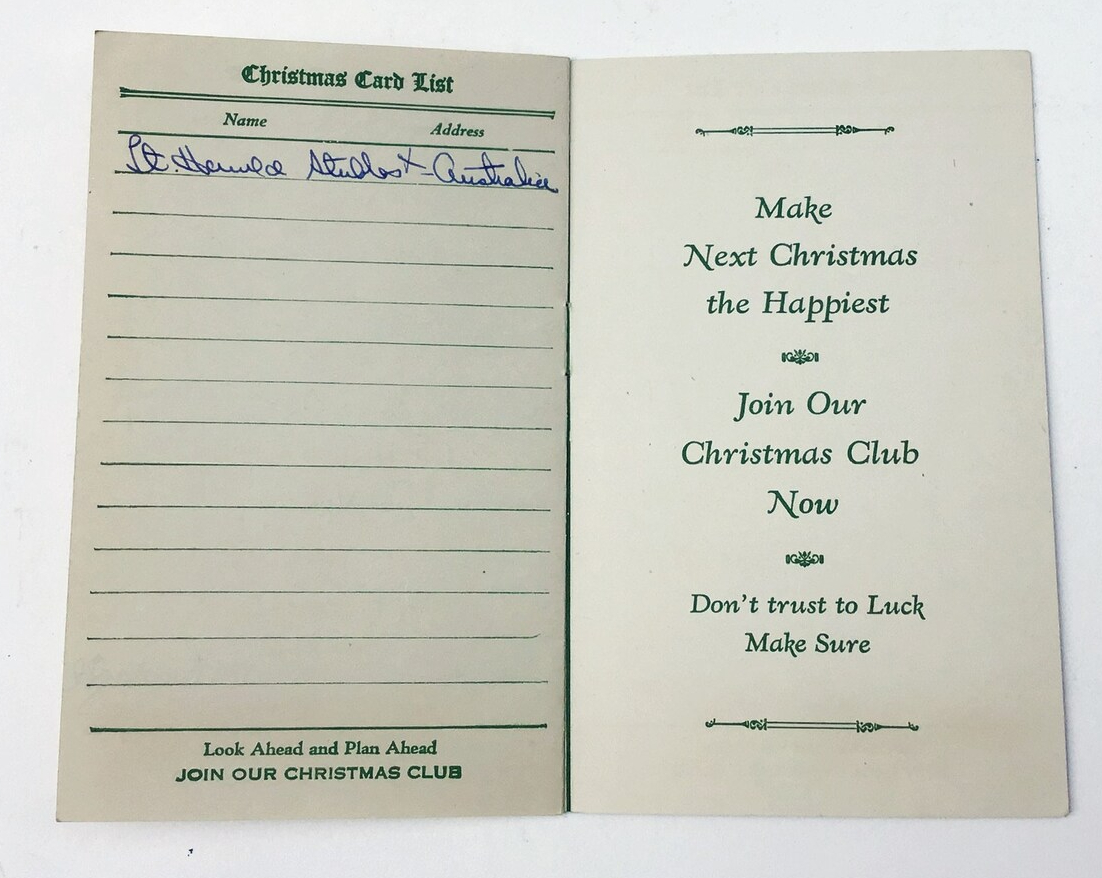
I also remember Christmas Clubs – does anyone else? A small amount would be deducted throughout the calendar year and put into an interest bearing savings account. Those must have been an administrative nightmare for banks, but it got people into the bank and to create savings accounts I guess. A quick search tells me that there are still a few that do it, although of course now it is an automatic deduct from your account, not the charming little passbooks of years ago.

Going Sideways

Pam’s Pictorama Post: It is always a great day at Pictorama when I get to share a new Felix and a few have arrived at our welcoming shores recently. Due to a bad case of life in general Christmas arrived a bit late at Deitch Studio this year, but that made these acquisitions no less beloved as additions to the Felix family. The collection has grown so over the years it can be a bit difficult to find toys that are distinctly different enough to add, but these are worthy additions indeed.

These Felix-es hail from Peter Woodcock, the dealer who recently sold me the simply amazing Dean’s Felix this past fall in an online British toy sale. (That post can be found here.) In late December I threw myself on Peter’s mercy to supply both Christmas and birthday (February!) gifts this year and he responded splendidly with three Felix toys, the first which is being featured today.

A friend recently told me in an email that I was the first person to ever take her into an antique store. I am not sure I was aware that it was among my accomplishments, nor do I remember the occasion, however we went to college together so I assume it was during that time. Given a reasonable proximity to antique stores or even junk stores (New London, Connecticut was more junk than antique by far), it is hard to keep me out of them so it seems distinctly possible – putting aside for the moment the question of who hasn’t been in an antique store before reaching young adulthood?

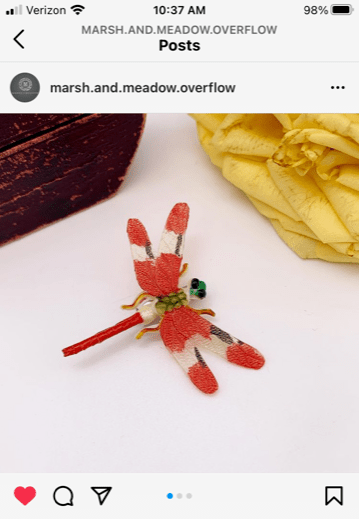
Celluloid firefly in the Pams-Pictorama.com collection.

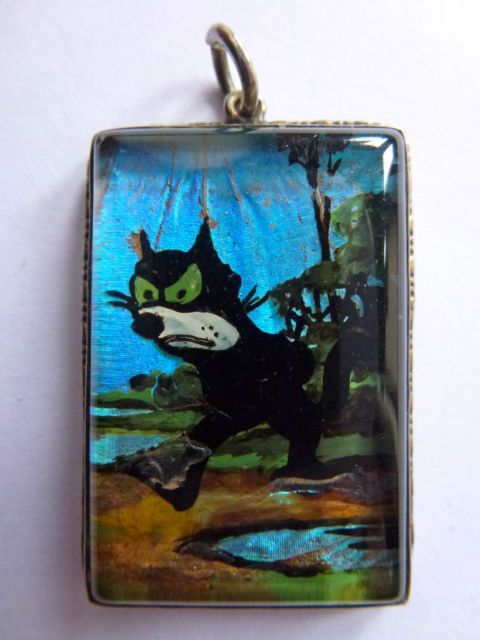
Meanwhile, I had been nattering to her about my recent affection for insect jewelry of the early years of the 20th century. (Subject matter insects, not made of insects – which yes, does seem to have been an early 20th century thing – I am more celluloid firefly than Felix depicted in butterfly wings. All about insect jewelry posts can be found here and here.) She pointed out that my aesthetic and interests had always converged on the dawning years of the 20th century.

Felix pendent made of butterfly wings. Not in Pams-Pictorama.com collection. (The concept kind of creeps me out!)

Pictorama readers know that in recent decades that interest has been directed largely to things early Felix the Cat and perhaps most especially those items which celebrate the somewhat off-model, askew evidence of the human hand. The revelation that some such a work force on the East End of London, (made up of indigent women as a social service scheme) in the 1920’s was one of the favorite fun facts I have ever turned up in my research. (That post can be read here.)

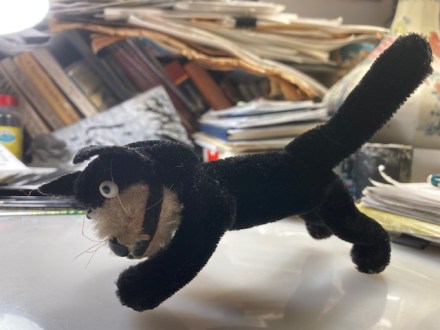
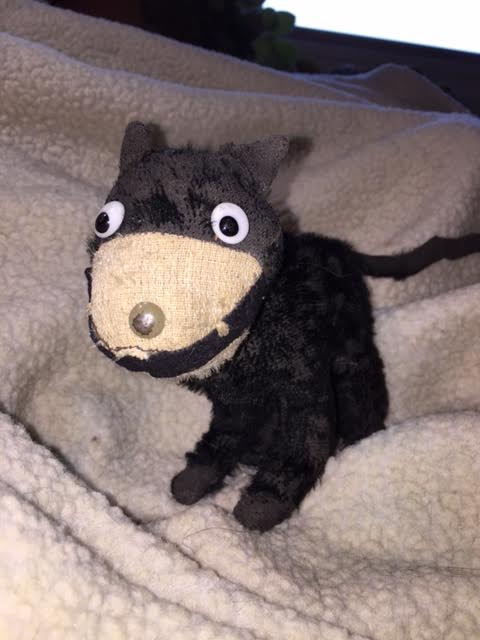
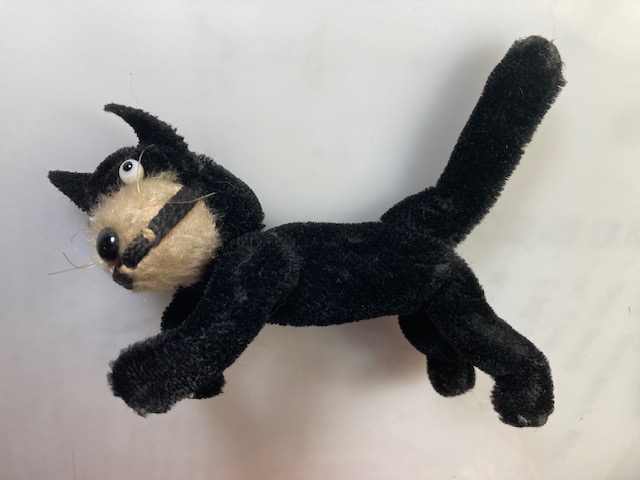
I suspect that maybe today’s little fellow hails if not from that collective perhaps from a similar British enclave of toy production. He is the second entry of a horizontal Felix in my collection and if I have seen many more I do not remember them. Christmas of 2015 brought the first to Pictorama, shown below. A post devoted to him, for those of you who are a bit completest like me, can be found here.

A Felix Christmas gift from 2020. Pams-Pictorama.com collection.

Today’s featured fellow is smaller, a scant five inches or so. He is made of a plushy velveteen-y fabric. His head is (was?) somewhat swerve-able. He maintains his sparse but prickly looking plastic whiskers on both sides; his pointy ears are an ancient felt. While he has glass eyes like the one above, his have a slightly more insane expression (right?) and his black nose maintains its gleaming black. I like his sturdy tail which sticks up, almost like a fifth leg. His muzzle has also kept its mohair fluffiness.

Pams-Pictorama.com Collection.

Although Felix as an early cartoon entry certainly spent a fair amount of time in a catty horizontal run, we tend to think of him in his anthropomorphic semi-human vertical form. While my previous acquisition was a bit more catty than Felix usually is, this one captures the spirit of the cartoon in that regard – Felix in motion.

Newly transplanted to the shores of the United States, this little guy joins the Pictorama collection with a place of pride on a Felix devoted shelf near my desk where savvy visitors via Zoom get to see him featured daily. Thank you Peter for parting with him!

Eugene the Jeep

Pam’s Pictorama Post: Today’s toy acquisition is part of the loot from lightening striking multiple times at one online toy sale in Britain this fall. Within a few hours I had redistributed some hard earned cash to three dealers. One was a small purchase, a wonderful postcard though of a girl in hunting garb aiming at a Steiff teddy. (That post can be read here.)

Today’s Jeep came from a dealer whose toys seemed to skew more toward traditional bears and dolls than somewhat obscure comic characters. She was lovely however and I will hope there is a chance to do future business with her.

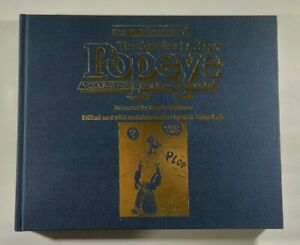
As it happens, I have always had a soft spot for the Jeep and frankly had no idea that Deans Rag Company produced one, but as soon as I saw this one I snatched it happily up. For those who have not read the original Segar Popeye strip, I say do yourself a favor and settle in with the full run and have a good old read. I originally read the dailies serially via a wonderful edition of hard cover books that our friends at Fantagraphics published years ago. (They have subsequently published the Sundays as well.) The full glory of Popeye in his native medium bears little resemblance to the somewhat limited range of the animated cartoon character of my childhood and it was one of the nicest rabbit holes I ever headed down in comics.

A volume from my beloved edition of Popeye dailies published by Fantagraphics.

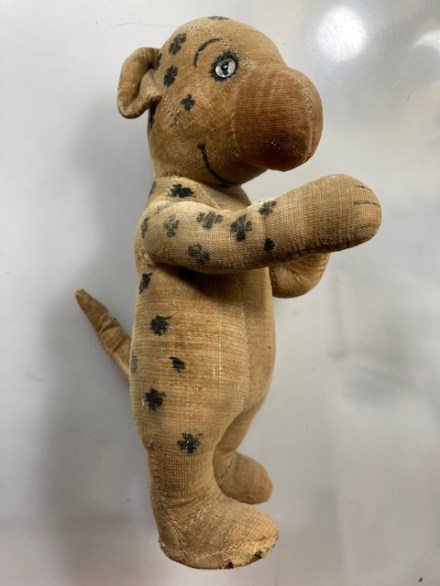
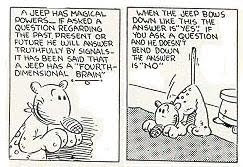
Among the discoveries, such as characters Ham Gravy and Castor Oil, was Eugene the Jeep. The Jeep, for those of you who have not encountered his mystical self, is a dog-like animal from Africa who can, (among other things) appear and disappear at will, walk on his hind legs, always tells the truth, and can utter the single word, Jeep! (Wikipedia has a rather cogent explanation of him and his back story which can be found here.) The Jeep represents a sort of the high point of that strip for me – a charming and mystical character which possesses somewhat limited if extraordinary powers.

The first mention of the Jeep appears in March of 1936, although he takes his place in the strip later in 1938. While researching this and the dates associated with it I had a moment of wondering how the first mention might have intersected with the introduction of Punjab into the Little Orphan Annie strip. The equally mystical Punjab was introduced into that strip almost exactly a year before in February of ’35. Makes me wonder if it inspired Segar or if there was something else afoot in the world that inspired both. I am not well versed enough in these things to say, but will perhaps pose the question to one of our better informed friends such as Bill Kartalopoulus, comics historian. Maybe it was just in the air. (The question of whether or not the army vehicle with this moniker has the strip as the origin remains somewhat unclear to me, but is definitely possible.)

Much like Krazy Kat, and even Felix to some extent, the relatively simple shape of this character seems to have inspired somewhat strangely inaccurate three dimensional recreations and I have looked for a splendid soft Jeep toy for a very long time. Kim has spoken of one that passed through his hands in the late 80’s which I have had trouble finding. I think it might be this model below, just spotted on eBay.

Not (yet) in Pams-Pictorama.com Collection. Interesting that the lucky clovers deteriorated into spots here.

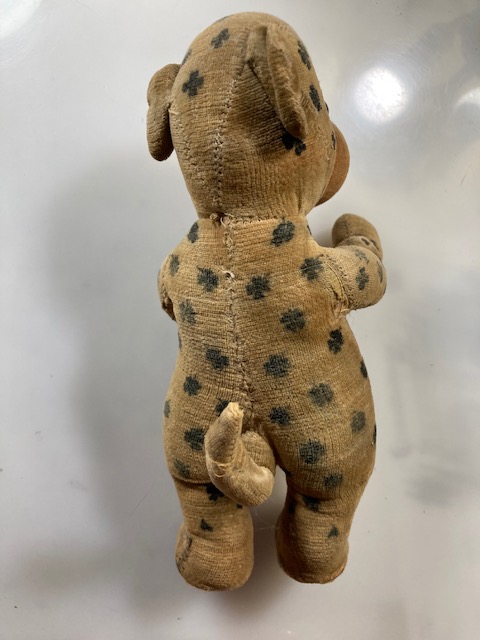
While the earnestness of this Dean’s Rag incarnation cannot be denied, down to the lucky four leaf clovers which decorate him, somehow he is a bit off kilter. He is about 7 inches in height. (I have not had a chance to dig really deep to see if he came in a number of sizes, although as a rule Deans character toys did. Having said that he does seem a tad rarified so there isn’t much online. Somewhere I have a CD which has the history of the Dean’s catalogue on it which will enlighten me if I can find it.) My example has a small tear on the neck and toward the tip of the tail. The only other example I can find has a worse tear at the tail with stuffing emerging – at first I thought it was a characteristic of the toy.

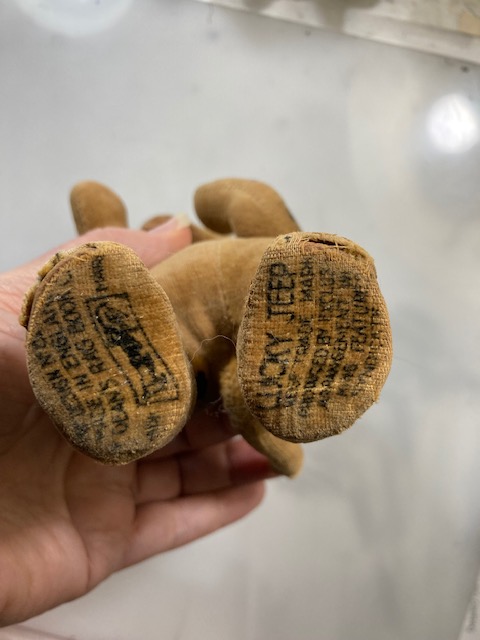
He has, as is necessary, the wonderful Dean’s Rag Book Company imprint on the soles of his feet. (For some reason those imprints fill me with great joy – if I were to come back in a future life as a vintage toy I would very much want to be a Deans Rag toy proudly sporting this indicia.)

Lucky Jeep! Deans Rag Toy tag.

As toy collector and seller Peter Woodcock pointed out in an email these small toys soiled and tore easily with handling and did not survive in large numbers. (Peter will emerge further as a subsequent character in the tale of this sale as he parted with something truly delightful which I purchased as well.) A quick look over at Mel Brinkrant’s collection shows a few pristine examples, as well as one or two other examples I must keep my eye out for – I can see the corner of another of the Deans Rag ones and I would say yes, it is larger. (For all things Mel and his beyond extraordinary collection you can go here. Talk about a happy rabbit hole!)

Jeep not in Pams-Pictorama.com collection – but you never know…For me this one is the best design relative to the drawing in the strip.

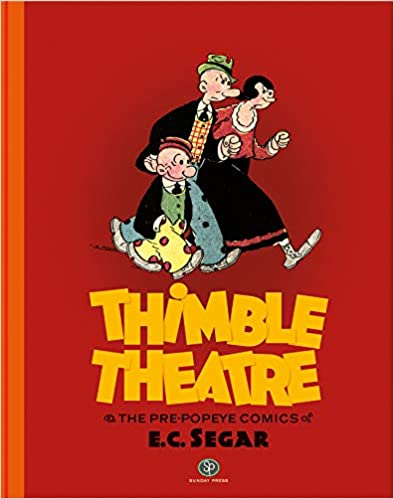
Researching this wonderful toy has reminded me that within these cramped four walls is a new volume of the pre-Popeye Thimble Theater strips. (It can be found here on Amazon.) I think I need to curl up with that oversized volume in bed for the remainder of the weekend. It is snowing gently outside and I cannot think of a better way to wile away this afternoon and evening.

Turkey Talk

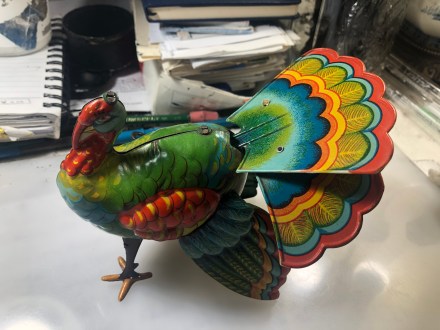
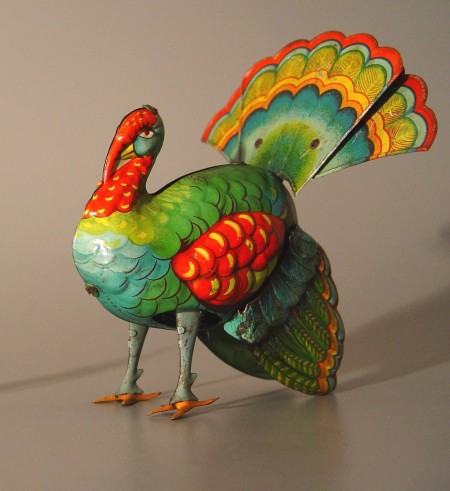
Pam’s Pictorama Toy Post: Toys today again with this terrific turkey. This item made a rare route to Pictorama a few weeks ago by way of Kim posting an image of it on Facebook which was so glorious I went in search of the toy. A quick search turned one up in good condition on Etsy and he landed here a few weeks ago. Unfortunately, a tiny bolt on one side of his tail went missing, either in transit or the seller neglected to mention it. Kim has done a short term repair with a tiny bit of wire from a twist tie off a loaf of whole wheat bread. Click below for our best effort on filming him – we got his tail to stay together sufficiently to get him moving on film, but I don’t think he has a ton of runs in him. Watch the video through, the full rise and spread action of his tail is what makes it great!

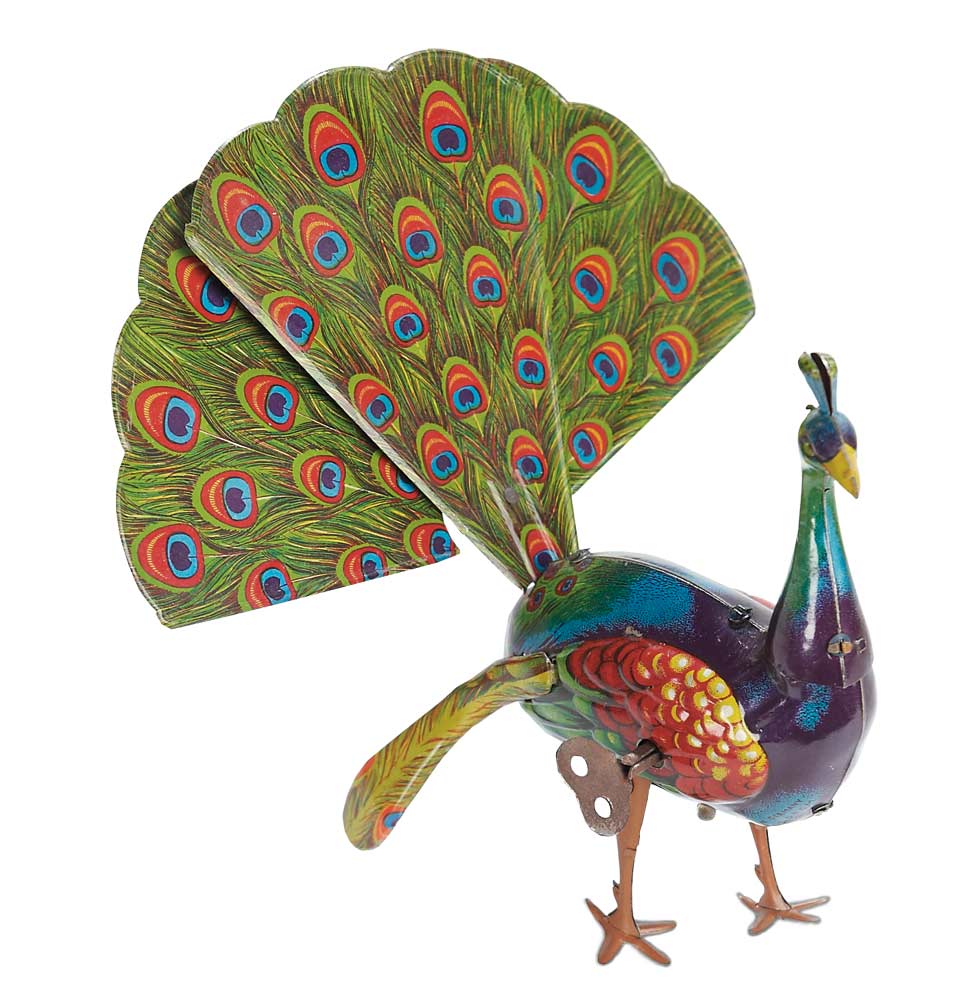
He is the earlier model of at least two that I found online (see further below),with greater definition and better action than the later one. There is something wonderfully Art Deco about the colors and design of his tail feathers that I especially like as well and what attracted me in the first place; his color is pretty glorious. Mr. Turkey is marked Made in the US Zone Germany on his tummy, which puts his manufacture in the mid-40’s to early 50’s. A Google search turns up an auction listing which mentions it was produced by Blomer and Schüler (or Bloomer and Schüler), a company founded for making parts in 1919, but which started making its own toys in 1930. It had an early hit with a Jumbo Elephant wind-up toy which is described as running. I have a weakness for elephant toys so I may need to investigate this more closely. Toys do lead to toys and a good wind-up toy is just the jolliest thing I can think of. (There is also a very hotsy totsy peacock too, but I must say, his mechanism looks even more fragile than Mr. Turkey’s.)

I didn’t see many of these on the internet, but would love to see him move!

The turkey’s action really does recall a come hither Tom Turkey trotting, showing off his glorious tail feathers to attract a girlfriend which makes me think he was designed by someone who knew turkeys. When living in England many years ago, I was surprised to discover that not only is turkey not indigenous to Britain, nor indeed Europe, but that they don’t have much of a taste for it and do not import it widely. (My Thanksgiving dinner that year was a Chinese recipe for orange chicken as a result. In retrospect, and knowing more about cooking now than I did then, just as well. I had the tiniest oven imaginable which would have taken three days to cook the smallest turkey.)

I will add that my surprise grew when I discovered that pumpkin isn’t eaten there, and they aren’t big on corn on the cob either. (Corn is grown there but is fed to farm animals. As a result, I don’t think they produce corn flour either.) Although admittedly my first hand information on the subject is now decades out of date. All this to say, I believe it was the American influence which designed this turkey as I do not believe at the time Germans were widely familiar with the mating habits of turkeys or eating them either, although the internet says they have caught up with a taste for turkey in recent decades.

From the collection of Deb Mostert via Pinterest – the image that started it all!

Although I do not eat fowl these days, nor have I for many decades, I was in charge of the family turkey on Thanksgiving for many years after my brief stint of professional cooking – my mother happily ceding this responsibility to me, my father never much of a turkey carving dad either. However, I cannot think about cooking a turkey without remembering a French chef I knew going on in honest bewilderment on the subject – not only at the American fondness for them, but the cultural necessity for serving it whole and carving it at the table. He pointed out, the thickness of a turkey’s legs demand significantly more cooking time than the thinner breast and wing meat and to think that there is a way of getting the legs done without drying out the breast was, in his opinion, a fool’s errand. He would have had you cook the bird whole, let it rest, carve the legs and put them back in the oven to finish cooking. I venture that cooking the bird stuffed, while slowing the whole venture considerably, helps ameliorate this issue, but his point was well taken and an easy solve if you aren’t married to carving a full bird at the Thanksgiving table. (The attenuated cooking time needed for the bird cooked stuffed also set him going – in all fairness, he was not only French but a restaurant chef which is another bird altogether. Clearly he wasn’t familiar with Norman Rockwell paintings on the subject!)

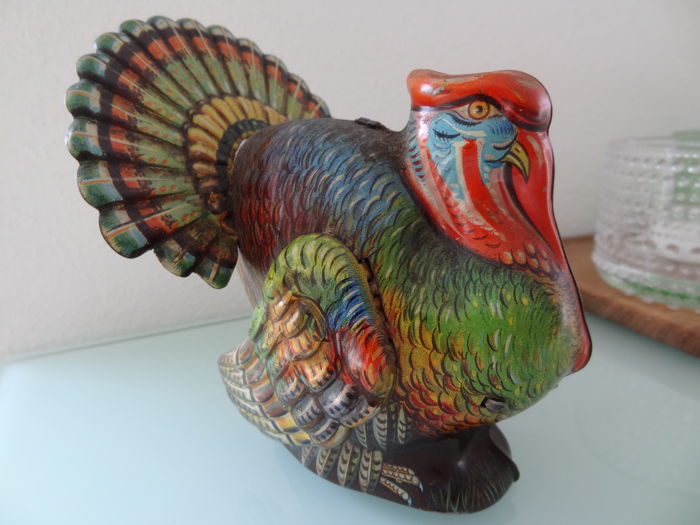
Later version by same company.

Given my early defection away from eating (and therefore cooking) red meat and fowl, I have never attempted to cook a turkey in a Manhattan apartment. Our ovens run small though, as do our kitchens, and I can tell you that New York is evidently littered with beautiful turkey roasting pans purchased each year without measuring the apartment oven in question. From the stories I hear from first time turkey chefs, they often find themselves with pans and even birds that do not fit our abbreviated oven sizes. I encourage first time city cooks to use a doubled up disposable pan on that first go, but to go easy on the turkey size too. We are so used to our ovens that we’ve forgotten how comparatively enormous a regular one is. I glory in how many things I can fit in my mom’s oven by comparison.

As we finally slam the door on 2020 with my turkey post, we at Pictorama and Deitch Studio are wishing all the best in the coming New Year. I look forward to seeing you all on the other side, at the dawn of ’21!

Three Piggy Pail

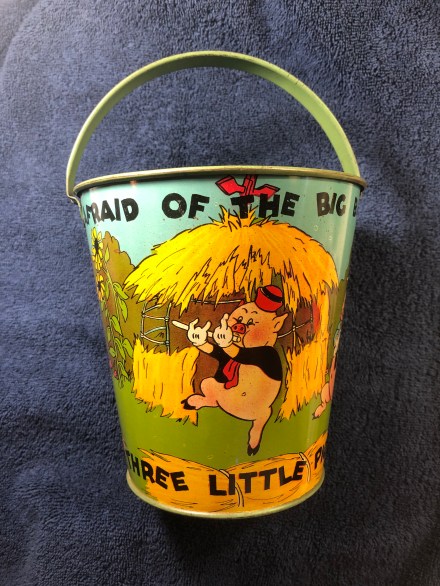
Pam’s Pictorama Post: This sharp little number is the other pig purchase made on in honor of my birthday, also from The Antique Toy Shop, New York. It is little, only about six inches high and is just the right size for a pint-size person.

This is a very sturdy little pail and, although it looks fairly pristine, it was well built for days of sand castles at the beach and the like and may have seen days of service. As a former sand castle building aficionado I note only that although the handle moves it does not go all the way down. This would be very inconvenient for the making of towers from piles of wet sand and the like. It looks as if it is nicely water tight however, which is another important feature, hauling water from the ocean to your construction site and all.

This slideshow requires JavaScript.

Unlike the mug featured yesterday (see that post here) which shows the pigs having firmly trounced the wolf, this one shows two irresponsible pigs at play and the stolid one with his bricks, building, with the Wolf in his full glory. Whose Afraid of the Big Bad Wolf ?is around the top. The responsible brick laying pig has wolf proof paint (something I think we could all use, right?) and the other two dance a jig in front of the half finished straw house. (This shoddy straw house looks a bit like one of the shacks from the Gilligan’s Island reruns of my childhood. I watched them every afternoon, The Flintstones on one side or the other of it. If I ever saw those again I could probably recite parts of dialogue.)

The stick or wooden house is absent. I have remarked before that the swift collapse of the wooden house confused me as a child who lived in a wooden house. My parents failed to supply a sufficiently comforting explanation to me and I can only hasten to point out that you will find Deitch Studio located in a large brick high rise building.

This pail has a mark from the Ohio Art Company, a tin lithography company still in existence today. It’s a good story and I share an excerpt from their history, from their website:

Dr. Henry S. Winzeler, a dentist in Archbold, Ohio, who sold his practice because he was convinced novelty manufacturing held great promise for him. Renting part of a band hall and employing 15 women, the company was soon shipping picture frames to all parts of the country, as well as Canada and Mexico. Business grew rapidly and Dr. Winzeler needed a larger plant.

Through the efforts of local citizens and the Chamber of Commerce, enough money was raised to build a new factory and lure The Ohio Art Company to a new location – Bryan, Ohio. With larger quarters and better shipping facilities, the firm continued to grow…Soon after the move to Bryan in 1912, the company installed metal lithography equipment, an addition that would shape the company’s future. New items began to appear; advertising signs, scale dials and a few small wagons, representing the beginning of a long and successful run in the toy business.

When WW1 halted the flow of German toys to this country, American manufacturers had a tremendous opportunity to surge forward. Quick to realize this, Dr. Winzeler increased his line of toys and toy parts and business boomed. A quality (and very popular) tea set line was introduced, and in 1923, sand pails appeared. In the early 1930’s, Ohio Art was one of the very first companies to license a character from Walt Disney for a toy; Steam Boat Willie, the precursor to Mickey Mouse. Other successful early metal lithographed toys included tops, shovels, farm houses, drums, globes, checker sets and more.

Once plastic takes over in toys the company diversifies again and makes the film canisters for Kodak and premiums for companies like Coca Cola and Budweiser even today. The mark on this pail, Ohio Art Co Bryan O USA, refers to the company’s post-move location in Bryan, Ohio.

So, my advice is always be mindful of construction materials, build thoughtfully and work hard – and then you too can dance a jig and sing, Whose Afraid of the Big Bad Wolf?


Whose Afraid of the Big Bad Wolf?

Pam’s Pictorama Toy Post: Today is a toy post in its full glory – dedicated to the recent acquisition of this absolutely extraordinary Big Bad Wolf toy! This wolf comes to me as a Christmas gift from Kim-as-Santa via a Bertoia auction. Mr. Wolf made a rather slow trip to Manhattan and just arrived the other day, but he was certainly worth waiting for and slow Santa by post is more than forgiven.

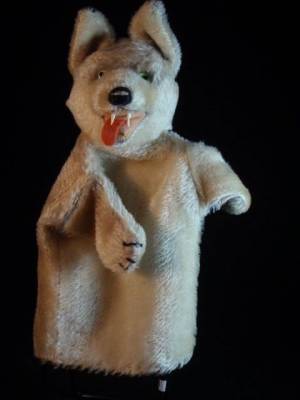
I’ll start by saying my yen for a wolf toy dates back to a street fair decades ago. This was a very mom and pop affair, just a single city block with German delicacies and an um-pa band mid-block. I was just passing through and stopped at a table and saw a very nice Big Bad Wolf puppet. Now, I was younger then and I made a mistake that I have tried not to make subsequently, and that is I walked away, to think about it. And yep, by the time I walked back, positive I had to have it, the puppet was long gone. She who hesitates is indeed lost and it lived on in memory. The one below is close enough, although I am unsure the one I saw that day was indeed Steiff. So, in a sense, I have waited all these years to fulfill my errant desire for a Big Bad Wolf.

steiff-loopy-wolf-hand-glove-puppet-mohair-plush-1950s-teeth-vintage.jpg

Steiff Wolf Puppet, sadly not in my collection


Somehow, despite the world wide web and all, it was a mistake I have never rectified. I am, after all, a collector of toy cats first and foremost and generally that is what I end up looking for and at – living in a single room, I try not to follow my nose in too many other directions. However, while taking a very last minute twirl through this December auction, late one night, I saw this little guy and decided that he was sort of grand, toy lust kicking in. After a brief discussion with Kim the following day, we decided that if acquired he would make a fine Christmas gift. Lucky for us, everyone else seemed to have other things on their mind and he was acquired for a relatively modest sum. (You don’t want to know what toy collectors consider modest.)

Bertoia offered no real information on him however and, glorious as he is, he is without makers markings. If I had to go out on a ledge with a guess I would say maybe he was made by the Lenci company in the 30’s or 40’s? Lenci was an Italian toy company from 1919 to 1944 founded by Elena Scavini (her nickname was evidently Lenci) which is better known for regulation dolls. At least one individual has identified him as such on the internet, although I remain somewhat unconvinced. I will continue to research and am open to any suggestions or further discussion.

Dating on either side of my Wolf I found this very nifty Knickerbocker example which is earlier and although more primitive I would have snatched up in a minute as well. This one, shown below from a Hake’s auction back in 2013. I find his bear-like simple look very appealing in a different way.


Hake’s also had this listing shown below for a later Lars Wolf, probably made after mine, and Three Little Pigs.


8466670_1

Better view of the Lars version.


This lead me down a charming rabbit hole of Mel Birnkrant’s website (always a great read) and his great story about acquiring his Lars Mickey, Big Bad Wolf and other toys. It can be found here and I highly recommend it. Mel did a drawing for a really smash up alternative version shown there as well.

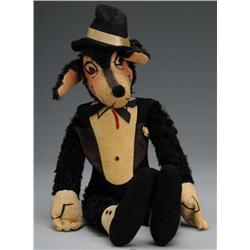
Meanwhile, I also include an alternative universe Wolf that appears to be an unlicensed version, but clearly got around as I found several examples. It is shown as listed on Morphy’s auctions below. It might be a slight exaggeration to say these abound, but they seem to get around more than some of the others. I especially like his tuxedo!

8466671_1m.jpg

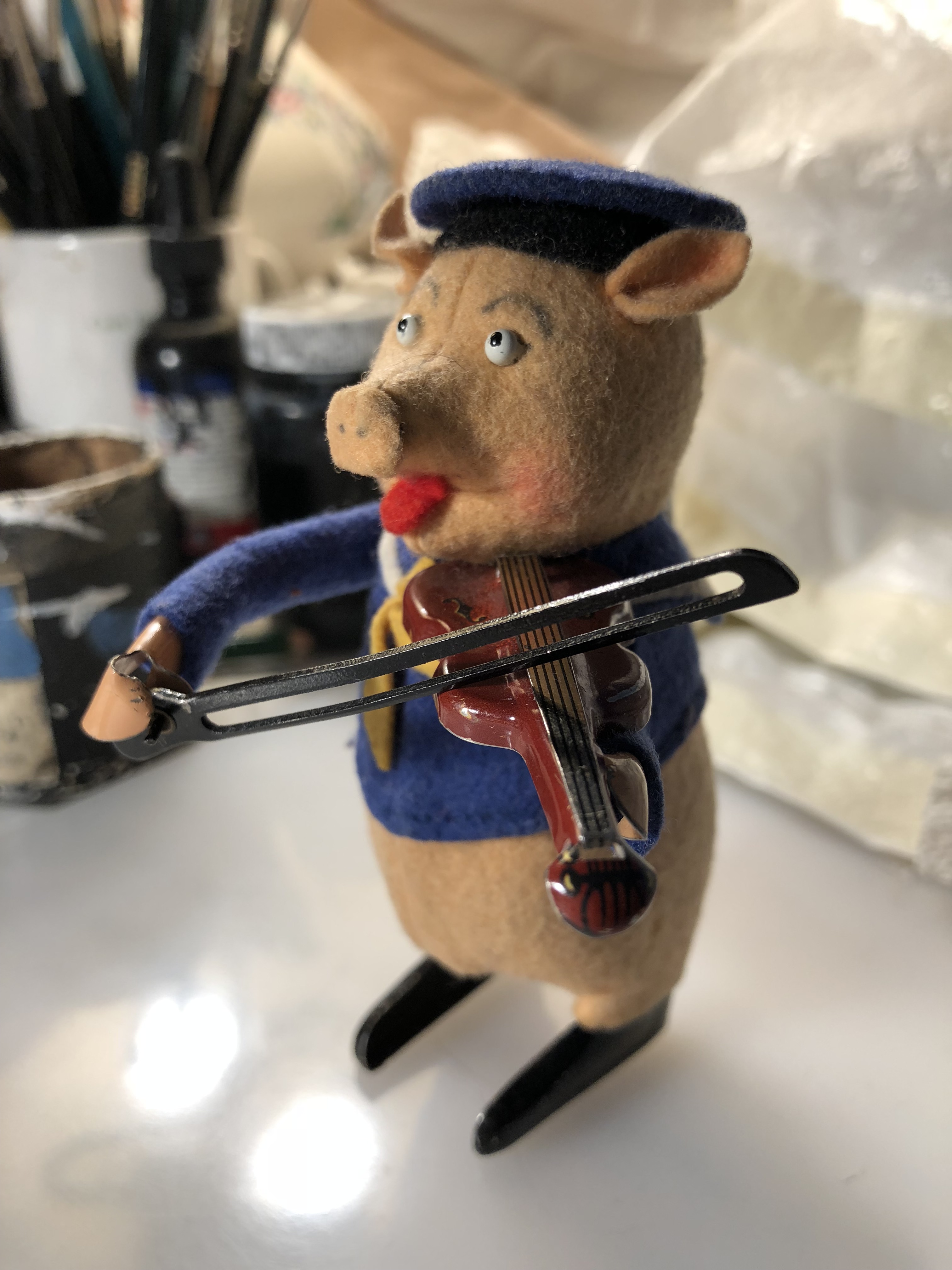
Back on my birthday in 2018 I purchased the Little Pig below and wrote about him here.

Still pic of pig

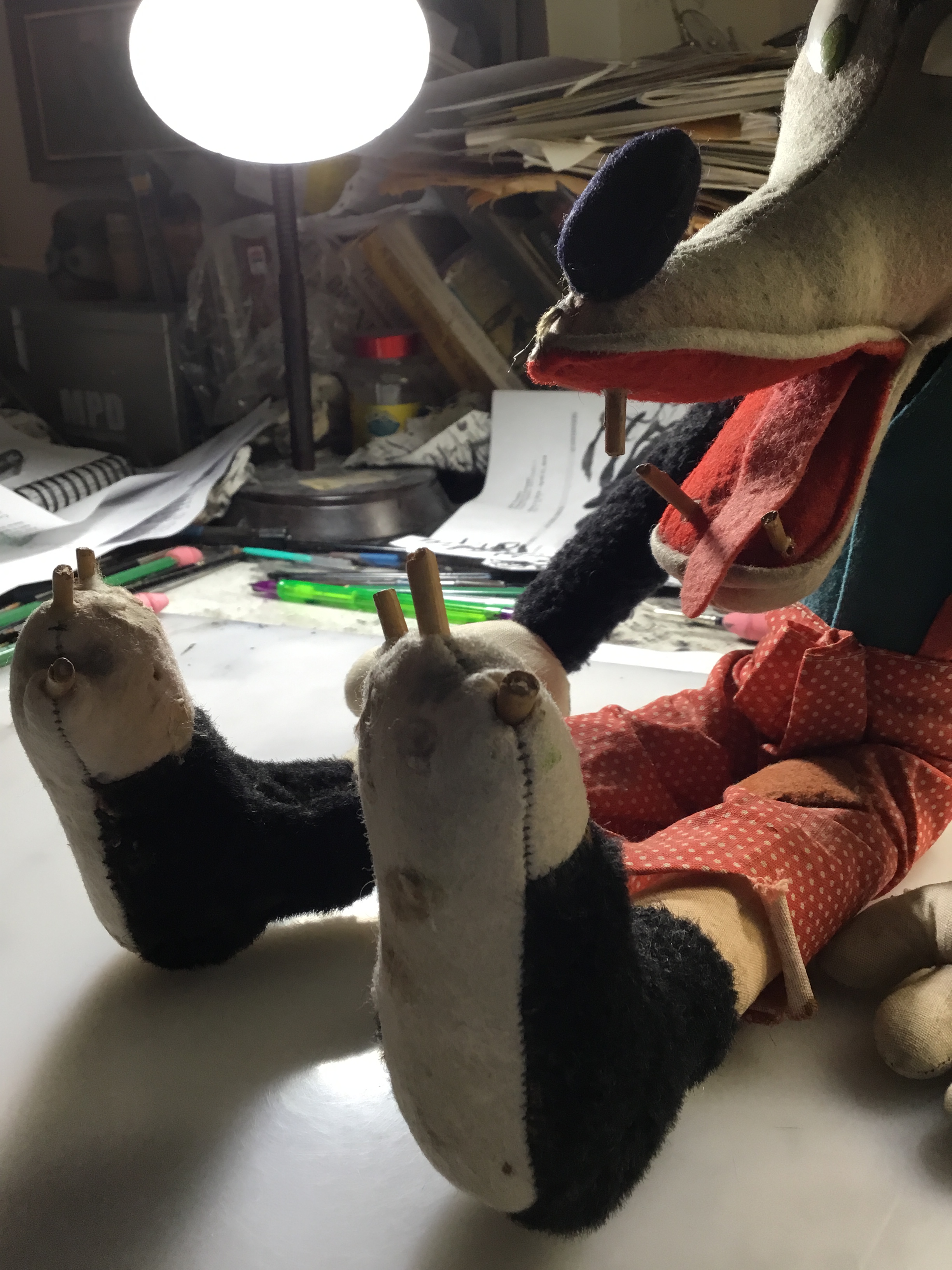
Getting to the main event, my doll has some really splendid detail such as his felt tongue sticking out. I love his strangely spiky toothies and toy nails. He appears to be made of wool felt with cotton clothing and hands. His pre-tattered clothing has a few repairs and there are some moth holes on the soles of his feet, but otherwise he is in remarkably good shape. Details include some delicate coloring in this cheeks and on his toes and those strange painted eyes and I have to say he made me laugh out loud when I first unpacked him.

IMG_0050.JPG

Detail of Big Bad Wolf from Pams-Pictorama.com collection


He is unexpectedly articulated with a head that turns a bit and arms with full range; he does not stand as his legs are not movable and is permanently in a seated position. He is very jolly though and cheered me up immensely while confined to bed with my bad back this weekend.

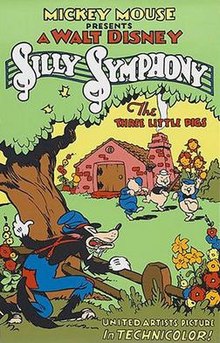
Of course this post would be utterly incomplete without a link to the Silly Symphony Three Little Pigs and Big Bad Wolf which can be found here and here. These cartoons elevated our Wolf to ever greater fame, one way or another, inspiring all of the toys mentioned here. And I, at last, have a great Big Bad Wolf of my very own.

220px-Three_Little_Pigs_poster.jpg

Steiff


Pam’s Pictorama Toy Post: I think it is fair to say that given any opportunity where I might ferret out a Pictorama worthy toy I am likely to achieve. After the first five minutes at yesterday’s East Coast Comic Con (Deitch Studio was fully represented and I did a somewhat real time post of our day which can be found here – for those of you who are wondering the cold I was fighting bloomed overnight, now complete with chesty baritone cough) I rapidly assessed it as not the kind of gathering that would produce much antique toy fodder. While I was generally right about that, I did find this little guy stuffed away on a shelf while Kim and I took a break wandering the con.

This little bear breaks several of the Pictorama essential guiding principles of toy purchase: he’s a teddy bear (I own very few and I have written about those here), made by the Steiff company, and a reproduction. Don’t get me wrong, teddy bears are wonderful and it is only because they are such a deep rabbit hole to go down that I generally have excluded them as potentially overwhelming my limited resources of space and funds. (Some early examples of Steiff bears have gone for hundreds of thousands of dollars at auction, but I could easily do a lot of damage at the hundreds of dollars level myself.) I have seen several that would indeed tempt me, but fortunately I generally don’t run across those rarified items and do not go looking for them.

If I did buy teddy bears many would actually probably be Steiff, as I have always felt that somehow the antique Steiff produced bears have an extraordinarily life-like and human look in their eye. They are unquestionably, beautifully made. For those of you who aren’t in the toy know, Steiff is sort of the gold standard of early stuffed toys, marked by a metal button and tag in the left ear of the toy. Started in Germany in 1880 by a Margarete Steiff, a seamstress who created a line of elephant pincushions which evolved into toys, Steiff evolved into a world renown toy maker. Margarete’s own story is an interesting one of perseverance as she was left paralyzed and never walked after an infantile illness.

With the help of her siblings and others Margarete attended school and ultimately bought a sewing machine, starting her own tailoring business which morphed into plush toys. A favorite nephew drew animals at the zoo for designs (hence the elephant and then the introduction of other animals) and his bear was turned into a plush toy, purchased in volume by an American company. It was this mohair fellow that was, in 1906, then christened the Teddy Bear in honor of Teddy Roosevelt. The toy company, whose motto was, Für Kinder ist nur das Beste gut genug! – for children, only the best is good enough! Well over a hundred years later the company still thrives today. (There is a strange and wonderful silent short from the teens where Steiff bears are animated into a Goldilocks and the Three Bears story – the toy bears are shot at the end by a Roosevelt-like character.)

So, now my Pictorama friends are wondering, why isn’t my collection chock a block full of Steiff cats? They did indeed make cats, including one model of my friend Felix, which has long eluded me as a very expensive item. Strangely, while I find the teddy bears very alluring and compelling, I have never been that charmed by their cats. A few small examples have wandered into my collection and I posted about them once before. (That post can be found here.) However, there is not much variation and somehow they lack an essential humanity (so to speak) of some of the bears.

Lastly, I rarely buy contemporary toys. The quality and sometimes patina of old toys is generally what interests me and I am rarely charmed by new toys. I have occasionally made exceptions however, for something especially well made or otherwise compelling. (I made an exception for a few toys by a company called Hansa which makes beautiful toys representing a vast variety of animals. I own a rooster and a beaver and my post about them can be found here – definitely an avenue of collecting that could easily swamp my resources!)

I have been aware of this line of reproduction Steiff bears. These were expensive toys when they were sold new and used fetch a generous amounts in resale too, as much as a few hundred dollars. I had never seen one in person and frankly I was amazed at how well the reproduction matches the quality and feeling of the original toys. Steiff was clearly aware that their reproduction was good enough to fool a casual observer and therefore it is well marked with its ear tag as a coll ed 1987 replica 1913.

According to the tag which Steiff used mohair and traditional (kapok) stuffing, pads of felt, as well as hand embroidery. As someone who handles antique toys daily, for me he truly has the look, feel and heft of an original toy – slightly prickly mohair and all. I am very impressed with all aspects of him. His arms and legs move independently, although his head does not turn. The label mentions a voice box which I find no evidence of – neither functionally, nor can I locate by feeling his body.

As I mentioned, he has his original tag with some history as well as his ear tag. Our fellow is identified as a Circus Bear. He was available in a selection of colors; green and yellow variations are available online, but a photo shows blue and red too. For the princely sum of $30 Kim purchased him for me yesterday and now he resides in the Pictorama collection, welcomed among his antique and largely feline brethren.